Announcement

Collapse
No announcement yet.

Bullish Information

Collapse
X
 
  • Filter
  • Time
  • Show
Clear All
new posts

  • Jim Nickerson
    replied
    Re: Bullish Information Re. Tom McClellan from Barron's

    http://online.barrons.com/article/market_watch.html

    [subscription required]

    Get Ready for Bounces
    McClellan Market Report by McClellan Financial Publications
    P.O. Box 39779, Lakewood, Wash. 98496
    Aug. 7: The 20-week cycle bottom which was supposed to arrive in early August has done so right on schedule....Back at the March '07 bottom, we recall everyone was worried about a liquidity crisis. The world survived that one, and will survive this one, too. The cycle promises us a robust bounce up out of this low over the next few weeks, with minor bottoms due Aug. 20 to 21 and Aug. 30 serving as [speed] bumps.
    -- Tom McClellan
    Above is all that was in the Barron's blurb. McClellan is the son of the Tom McClellan responsible for the McClelllan Oscillator and Summation Index.

    I put in this and the post above regarding Mark Hulbert's assessment, to at least broach the issue of bullishness now in the face of what I perceive as major bearishness on iTulip for the past 7-10 days--more bearish than usual on a usually bearish site.

    Looking at a lot of technical indicators, they are at levels seen at past bottoms in the last 4 years, though as I read them Investors Intelligence, AAII sentiment indicators have not become all that bearish, but in saying that, II is more bearish now, slightly, than it was at the last bottom in March 2007, but not nearly as bearish as it became last summer.
    Last edited by Jim Nickerson; August 11, 2007, 01:11 PM.

    Leave a comment:


  • Tet
    replied
    Re: Bullish Information Re. Mark Hulbert in Barron's online 8/7/07

    Originally posted by Jim Nickerson View Post
    A Contrarian Should Be Bullish on Stocks http://online.barrons.com/article/SB...ne_mutual_fund [subscription required]


    Hulbert's arguments strike me as rather powerful, especially when contrasting his noted drop in bullishness now, to the persistence of it in 2000.
    Hulbert's not one you can easily fade, thanks for posting.


    Still more bull than bear in this chart and it is saying buy not sell.

    Leave a comment:


  • Jim Nickerson
    replied
    Re: Bullish Information Re. Mark Hulbert in Barron's online 8/7/07

    A Contrarian Should Be Bullish on Stocks http://online.barrons.com/article/SB...ne_mutual_fund [subscription required]


    Originally posted by Hulbert published on 8/7/07
    THE STOCK-MARKET DECLINE OVER the last couple of weeks, painful as it undeniably has been, is not likely to be the beginning of a major bear market.
    That's not just wishful thinking based on Monday's [8/6/07] impressive rally, in which the Dow Jones Industrial Average soared some 286 points. It is also the conclusion of a contrarian analysis of sentiment among investment newsletter editors.
    .
    .
    As such, contrarian analysis is especially helpful at times like now, when the question everyone is asking themselves is whether a bear market began on July 19, when the Dow Jones Industrial Average closed above 14,000 (for the first, and so far the only, time).
    Had the average adviser remained stubbornly bullish in the face of the decline since then, for example, contrarians would have had to conclude that July 19 was in fact the top of the bull market.
    But that is not how the typical adviser reacted. Far from sticking to his bullish guns, he almost ran to the exits. That's a bullish sign.
    Consider the latest readings of the Hulbert Stock Newsletter Sentiment Index (HSNSI), which reflects the average recommended stock-market exposure among a subset of short-term market-timing newsletters tracked by the Hulbert Financial Digest. As of Monday night, the HSNSI stood at just 5.4%, which means that, on average, the short-term market-timing newsletters are recommending that their clients risk very little in the stock market, instead allocating some 95% of their equity portfolios to cash.
    Not only is this 5.4% recommended equity exposure level quite low in absolute terms, it also has fallen markedly over the last couple of weeks. On the day the DJIA closed above 14,000, for example, the HSNSI stood at 50.9%. So in a little more than two weeks' time, the editor of the average short-term market-timing newsletter has reduced his recommended equity exposure by more than 45 percentage points.

    On both counts, a contrarian would conclude that the current sentiment picture does not conform to the typical psychological profile of a major market top.
    Contrast how newsletter editors have behaved recently with how they reacted in the few weeks following the March 2000 market top. At the time, of course, no one new that it was the top of the market. But as we now know, the Nasdaq Composite's all-time high occurred on March 10 of that year, while the broad market hit its high two weeks later, on March 24.
    Believe it or not, the average HSNSI level for the month of April 2000 was higher than in March. And, even more incredibly, the average HSNSI level in May was even higher still.
    Now that's stubborn bullishness: The average adviser became even more bullish in the face of the first two months of the worst bear market in decades. That is classic market-top behavior, which is why contrarians were not surprised by what ensued.

    Today, in contrast, we're not seeing anything like the stubborn bullishness that was prevalent then. This does not mean that no individual advisers have remained bullish in the face of the market's pullback; some have. But for every stubbornly bullish adviser there have been more who have built up cash; some, by going short, have aggressively bet their portfolios on a continuation of the market decline.
    Does all of this guarantee that a bear market won't begin? Of course not. Sentiment is not the only thing that makes the market tick. And, in any case, there are no guarantees in this business.
    But sentiment is a powerful determinant of the market's short- and intermediate-term direction. And in this game of probabilities we call investing, it can make a big difference whether the sentiment winds are blowing in or against our sails.
    Think of it this way: The editor of the average market-timing newsletter is more often wrong than right at market turning points. To be bearish right now requires you to bet that this time he will uncharacteristically get it right.
    Hulbert's arguments strike me as rather powerful, especially when contrasting his noted drop in bullishness now, to the persistence of it in 2000.

    Leave a comment:


  • Tet
    replied
    Re: Jeremy Siegel says stocks "reasonably priced"

    Originally posted by DemonD View Post
    I would definitely appreciate an itulip counter-argument to Siegel's article. To me it illustrates a very well articulated bull case, and corporate earnings from 2Q have been doing fairly well despite housing troubles. Also, I read somewhere else that there aren't a lot of retail investors piling on the stock market bull as in 1999 (and as with the RE market), so valuations are not as out-of-whack to where there is a lot of over speculating on the long side.

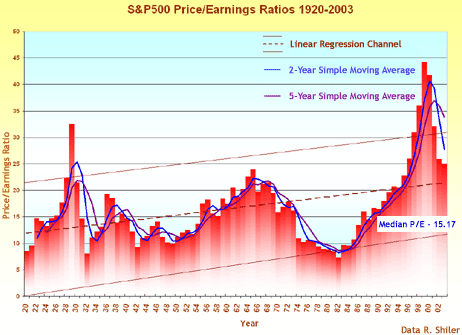
    Also, the US markets still appear to me to be fairly valued on a historic basis by p/e ratio. P/E ratio is bunk of course when looking at some fraudulent mortgage company, but for most companies it is at least a decent measure of basic value. By historic standards, the P/E ratio is not overly out of whack as it was in the tech bubble where P/E of the entire S&P 500 was over 40. It still may be a bit "pricey" or slightly overvalued, but in a fairly valued market you can always find some companies that are too high (apple?) and some that are too low (johnson and johnson?)


    Old chart but useful.

    In any case, Siegel's arguments are not overly super bullish but he brings up enough fair points to where it's hard for me to see a really huge contraction, especially with all the short interest that is in the markets nowadays.
    Market looks very oversold, though being oversold can continue for some time the market looks like a buy.

    From Hickey and Walters
    S&P 500 Sector Snapshot: Most Sectors At or Near Oversold Territory

    Below we highlight the trading areas of the ten S&P 500 sectors. The blue shading represents one standard deviation above and below the sector's 50-day moving average. Prices are considered neutral when trading within these boundaries.

    The red area represents one and two standard deviations above the sector's 50-day, and outside the red area is 2+ standard deviations above. When the price moves into red territory, it is considered overbought, and anywhere above the red area marks an extreme reading. A move above the red area is usually followed by a short-term pullback or sideways trading pattern.

    The green area is between one and two standard deviations below the sector's 50-day, and outside the green area is 2+ standard deviations below. A move into green territory is considered oversold and extremes are seen once the price moves below the green area.

    As shown by the charts below, many sectors remain at or below extreme oversold levels.


    Fish in a barrel.

    Leave a comment:


  • DemonD
    replied
    Jeremy Siegel says stocks "reasonably priced"

    Based on the S&P 500 Index, which constitutes 80% of the total market value of U.S. stocks, these stocks are now selling at 16.5 times a conservative estimate of 2007 earnings. In a world where government rates are below 5% and inflation is below 3%, stocks are not only reasonably priced, but cheap on a historical basis.
    http://finance.yahoo.com/expert/arti...reinvest/40790

    edit: okay fair enough he's buying government lies on inflation, but the rest of the argument still stands, and companies with large international presences still make great hedges against currency inflation.

    and a little fed action thrown in there too:

    (3) In a worst-case scenario where the tightening of credit standards does lead to a substantial economic slowdown, the Fed has ample room to ease interest rates from the current 5.25% level. With the sharp drop in treasury yields across the board, the term structure of interest rates has once again become inverted, with the ten-year bond falling to 4.75%. This puts the central bank on alert that the market thinks that short term rates may be too high. In fact, the Federal funds futures market now expects two 25 basis point reductions in the Federal funds rate by next summer. Although I think the economy will stay strong enough so that the Fed will not have to lower rates, if the Fed does act, this will be very positive for stocks.
    I would definitely appreciate an itulip counter-argument to Siegel's article. To me it illustrates a very well articulated bull case, and corporate earnings from 2Q have been doing fairly well despite housing troubles. Also, I read somewhere else that there aren't a lot of retail investors piling on the stock market bull as in 1999 (and as with the RE market), so valuations are not as out-of-whack to where there is a lot of over speculating on the long side.

    Also, the US markets still appear to me to be fairly valued on a historic basis by p/e ratio. P/E ratio is bunk of course when looking at some fraudulent mortgage company, but for most companies it is at least a decent measure of basic value. By historic standards, the P/E ratio is not overly out of whack as it was in the tech bubble where P/E of the entire S&P 500 was over 40. It still may be a bit "pricey" or slightly overvalued, but in a fairly valued market you can always find some companies that are too high (apple?) and some that are too low (johnson and johnson?)


    Old chart but useful.

    In any case, Siegel's arguments are not overly super bullish but he brings up enough fair points to where it's hard for me to see a really huge contraction, especially with all the short interest that is in the markets nowadays.

    Leave a comment:


  • Jim Nickerson
    replied
    Re: Bullish Information Re. HUI ? breakout Elliot Wave 3 of Wave III

    http://www.financialsense.com/Market...2007/0719.html

    Martin Goldberg. 7/19/07

    Originally posted by Martin Goldberg
    Strategically, once again gold stock traders find themselves in the same predicament they faced on 4 separate occasions since the spring of 2006. That is, of waiting for the overbought $HUI to break out into new high ground or to pull back from its overbought condition. A pull back appears to be likely, but the paradox is that if a strong breakout into new high ground were to occur, it should probably be bought. Such a breakout would likely signal the beginning of Wave 3 of Wave III the full force resumption of the gold stock bull market.
    The resistance for the $HUI has been 370. Today gold closed at 371.11 breaking out, but as Goldberg said, "albeit, not yet decisively."

    One might also read Ostap's post today that must be interpreted as bullish for the $HUI
    http://www.itulip.com/forums/showthread.php?t=1657

    Leave a comment:


  • Jim Nickerson
    replied
    Re: Bullish Information Re. Chartist issues trader's buys for 10 stocks.

    Dan Sullivan, The Chartist, http://www.thechartist.com [subscription]
    issued recommendations to buy 10 momentum stocks today for those who participate in his recommendations as "traders" who are cognizant of the risks.

    I am torn between putting up the recommendations or not. I hate to appear to be playing some sort of game here, which I definitely am not. It is probably wiser not to put up the recommendations.

    The point I take from Sullivan's action is that he still in relying upon whatever are his proprietary indicators suggests there is more upside action in the markets.

    Of course at some point, if he keeps on making buy recommendations at market peaks, he will be wrong.

    Leave a comment:


  • Jim Nickerson
    replied
    Re: Bullish Information Re. Gold and Silver

    http://www.safehaven.com/article-7939.htm

    http://www.safehaven.com/article-7938.htm

    Clive Maund, 7/11/07, analyzes gold and silver, both probably safe to buy here in what he sees as a potent situation that usually results in a big move; the odds favor an upside breakout.
    Last edited by Jim Nickerson; July 12, 2007, 11:20 PM.

    Leave a comment:


  • jk
    replied
    Re: Bullish Information Re: Russell--3rd phase Bull Market

    Originally posted by Jim Nickerson View Post
    Richard Russell, http://ww1.dowtheoryletters.com/ [subscription] 7/09/07

    [emphasis JN]


    Russell put up charts of EWA, EWT, EWY, FXI, EWY, EWG.

    Russell said a few days back he has 10,000 subscribers. $250 X 10,000 = 2,500,000 bonars/yr. Not bad work if one can get it. I don't know that Russell is under any burden to be correct in his perceptions.

    The question I ask, is at 83, as wise and wizened as he may be, what allows Russell or anyone to predict a financial event, that has never occurred, or perhaps significant inflations and even hyperinflations are not all that uncommon. Russell writes about all this as though it will be a something good--like it might be to really make a lot of money--if lot of money is what turns one on. A generation is about 20 years as I figure it. I take it that Russell is talking about surely a once in a life-time event.
    i think russell means it when he says "once in a lifetime" sized. it's like the 100-year flood, or the 100-year storm. this, he says, will be the 100-year bull market [meaning you only get something this big every 100 years, not that it will last 100 years]. of course, i would expect the 100 year blow-off to be followed by the 100-year bear market.....

    Leave a comment:


  • Jim Nickerson
    replied
    Re: Bullish Information Re: Russell--3rd phase Bull Market

    Richard Russell, http://ww1.dowtheoryletters.com/ [subscription] 7/09/07

    Originally posted by Russell
    I believe we are going into an international third phase of the bull market. The third phase is the highly speculative phase. In the third phase of a bull market, stocks may rise faster and farther than what they did during the first and second phases combined. You may be sceptical, you may not be aware of it, you may not know about it -- but I believe the third phase is just about here. I follow 18 world indices, and I'm including a random sampling of six of these indices below. Please study these six daily charts carefully.

    This third phase will not be confined to stocks alone. It will include commodities, gold, silver, diamonds, art, collectibles, selected real estate with an emphasis on commercial real estate, hotels and homes on all coasts everywhere -- and, of course, stocks.

    The third phase will be fed by masses of fiat currency, abnormally low interest rates, modern communications and advanced technology -- plus and a mass psychology of greed and "feel good" aided by a speculation-gambling sentiment on the part of not only the big money interests but also the masses. It will be a once-in-a-generation event -- on a scale never seen before in history.
    [emphasis JN]

    Russell put up charts of EWA, EWT, EWY, FXI, EWY, EWG.

    Russell said a few days back he has 10,000 subscribers. $250 X 10,000 = 2,500,000 bonars/yr. Not bad work if one can get it. I don't know that Russell is under any burden to be correct in his perceptions.

    The question I ask, is at 83, as wise and wizened as he may be, what allows Russell or anyone to predict a financial event, that has never occurred, or perhaps significant inflations and even hyperinflations are not all that uncommon. Russell writes about all this as though it will be a something good--like it might be to really make a lot of money--if lot of money is what turns one on. A generation is about 20 years as I figure it. I take it that Russell is talking about surely a once in a life-time event.

    Leave a comment:


  • Jim Nickerson
    replied
    Re: Bullish Information re: Gold

    http://www.decisionpoint.com/TAC/ORD.html

    6/28/07

    Ord undertakes an extensive (to me) technical analysis of the gold market, which is too lengthy with too many lines, circles and labels for my tired mind to wade through.

    It appears he is arguing that gold and, I believe, gold issues, are at what heretofore have represented good bottoms.

    Need a bullish fix for your gold lust? Perhaps this is it.

    Leave a comment:


  • DemonD
    replied
    Re: Bullish Information

    another bullish indicator is factory and manufacturing data. The sinking of the US dollar is making it more attractive for US exports, and one of the things i've taken note of is the monthly trade deficit has been falling. (We still are running a huge deficit, but it is now shrinking instead of increasing, pretty amazing when you think of all the oil we need to import).

    edit: also sinking US dollar makes tourism much, much more attractive for australians, europeans, chinese. The yen keeps falling versus many currencies tho so maybe not the japanese.
    Last edited by DemonD; June 26, 2007, 04:03 PM.

    Leave a comment:


  • Jim Nickerson
    replied
    Re: Bullish Information Re. Richard Russell

    6/25/07 Dow Theory Letters http://ww1.dowtheoryletters.com/

    Originally posted by Russell
    Important -- From a Dow Theory standpoint, as long as ONE or BOTH Averages, (Industrials and Transports) hold above those recent lows the trend will be considered bullish.

    So to repeat -- the lows were Industrials 13266.73 and Transports 4994.86.
    Noting Barron's cover: "TOP OF THE MARKET." The subtitle runs, "Blackstone's IPO was a huge success for CEO Stephen Schwarzman, now a 5.9 billion man. But it signals the peak of the boom in private equity. Investors, beware." Russell wrote:

    Originally posted by Russell
    It may signal the peak of the private equity boom (I note that Henry Krarvis is waiting in the wings to take his fund public), but I don't think it signals the end for the bull market. I say that for a number of reasons --

    (1) My PTI as of Friday was 37 points above its moving average and is therefore still bullish.

    (2) Lowry's Selling Pressure index usually continues to rise for months prior to a bull market top. Yet on June 4 Lowry's Selling Pressure Index hit its lowest level of the past 20 months. By the same token, Lowry's Buying Power Index tends to top out months prior to the final market top. Yet on June 4 Lowry's Buying Power Index had risen to a twenty month high.

    (3) The various breadth indices tend to top out well before the final top in a bull market. I run a daily computation of the advances and declines for common stocks only. My common-stocks-only hit a record high last week. That's not the sort of action I'd expect at a bull market top.

    Thus, the stock market may be in line for a further correction, but I doubt seriously whether the bull market is over. Actually, I'd treat a correction, particularly a severe correction, as an opportunity to buy stocks.

    As things stand, we have rising scepticism towards this market accompanied by a record short interest. Aside from any corrective or erratic action in this area -- in the big picture, this bull market has further to go.
    Originally posted by Russell
    The S&P 500, a widely-watched stock average, is now only a few percentages higher than it was back in the year 2000! I find it hard to believe that with the S&P only slightly above where it was back in January 2000 -- that the great bull market is over. By the time this bull market is finished, I would expect the S&P to be dramatically higher than it is today.
    In one believes the dictum, "they don't ring bells at the top," then probably Barron's cover will prove not to be a marker for the current run up in the equity markets.

    I don't know if Russell is credible or not. He had sat in the bearish camp from the last big market bottom in 10/2002 until just recently when he re-evaluated his thinking and said the bull market is now alive and well. Maybe the old dude is correct.

    Leave a comment:


  • Jim Nickerson
    replied
    Re: Bullish Information Re: SPX Correction

    Correction At Last!
    by Carl Swenlin 6/8/07 http://www.decisionpoint.com/ChartSp...8_correct.html

    Originally posted by Carl Swenlin
    The next chart puts the correction in a long-term context. We can see that prices are dropping down from the top of a rising trend channel, and support will be encountered at around 1430. As long as that support holds, no serious technical damage will have occurred. It is reasonable for us to expect that the current selling is temporary and that the up trend will resume.

    [See link to see chart.]


    Bottom Line: While we are experiencing a short-term correction, I have no reason to believe that the longer-term rising trend is in jeopardy. While corrections are uncomfortable to ride out, they are healthy and necessary, and we should hope this one builds a strong base for the next rally.

    Leave a comment:


  • Jim Nickerson
    replied
    Re: Bullish Information Re: Equity Markets

    http://www.marketwatch.com/news/stor...172FE0%7D&dist=

    Peter Brimelow on Don Hays of Hays Advisory 5/24/07

    Hays' conclusion: "We always keep a smidgeon of cash just to help facilitate any operational immediate cash needs someone might have. But today, that smidgeon is the only cash we have. You see, our filter is telling us that the stock market in the next 6-30 months is going to be extremely good. This is not a normal allocation. It is very unusual for this model to give this kind of bullishness."


    Originally posted by Brimelow
    This is Hays' currently recommended asset allocation:
    • "Long-term Growth": 100% stocks.
    • "Moderate Growth": 85% stocks, 15% bonds.
    • "Conservative Growth": 65% stocks, 35% bonds.

    Leave a comment:

Working...
X