Announcement

Collapse
No announcement yet.

Yes Virginia...It's a Bubble...

Collapse
X
 
  • Filter
  • Time
  • Show
Clear All
new posts

  • jk
    replied
    Re: Yes Virginia...It's a Bubble...

    "This new normal is not just simply about slower growth but also the increasing sophistication and linkages between different economic and financial factors and asset classes," they write. "In turn, a wider group of asset classes now requires policy support to ensure the smooth functioning of the financial system. This explains why policy is becoming more experimental — entering uncharted territory requires new thinking."

    kind of like the policy support that cushioned the shanghai market? it's hard to figure which bond market crashes first- american energy corporates or chinese corporates. but i suppose the damage will be "contained."


    edit: this post of mine, and one i just wrote in another thread about cdo's reappearing has suddenly sparked a new thought for me. for some time i've been wondering: "where is the bubble?" it seemed like the bubble was everywhere, but nowhere in particular. then i started thinking that the bond market, pushing into negative interest rates, was the central bubble. but i couldn't figure out how it would burst. now i see an analogy: cdo's of subprime mortgages were the first instruments to blow up in '07 - they were junk to the junk power, so of course the spark that went first, but was not contained. now we have chinese corporate debt and american energy-based corporate debt, and probably other classes of corporate debt beyond my knowledge, that are teetering. the spark won't be in the treasury market. the spark will be in the junkiest kind of corporate debt, or cdo's of corporate debt, or leveraged funds of corporate debt, i.e. junk to the junk power. i expect another "flight to quantity" as bill fleckenstein described the move to treasuries last time around. but i don't know when.
    Last edited by jk; October 21, 2015, 10:00 PM.

    Leave a comment:


  • jk
    replied
    Re: Yes Virginia...It's a Bubble...

    "This new normal is not just simply about slower growth but also the increasing sophistication and linkages between different economic and financial factors and asset classes," they write. "In turn, a wider group of asset classes now requires policy support to ensure the smooth functioning of the financial system. This explains why policy is becoming more experimental — entering uncharted territory requires new thinking."

    just like the policy support that cushioned the shanghai market? it's hard to figure which bond market crashes first- american energy corporates or chinese corporates. but i suppose the damage will be "contained."

    Leave a comment:


  • ProdigyofZen
    replied
    Re: Yes Virginia...It's a Bubble...

    The great wall of Chinese money has now flooded into the credit market. Leverage up to 10 times in the junior tranches, what could possibly go wrong?

    China's markets resemble nothing if not a great rolling ball of money that moves from asset class to asset class, constantly searching for the next source of sizable returns.
    After shifting away from stocks this summer, when the value of the Shanghai Composite Index almost halved in a dramatic market selloff, the Great Ball of China seems to have found a new home: bonds sold by Chinese corporates.
    The strength of the switch into corporate credit is underscored in a new report from Zhi Ming Zhang, director of asset allocation research at HSBC, and financial analyst Helen Huang, who argue that the links between China's credit market and other parts of its financial system have been strengthening.

    While the daily turnover of A-shares — shares generally reserved for mainland Chinese investors — has shrunk to a quarter of what it was at the market's peak, a major hallmark of Chinese markets has already been making its way into corporate credit: namely, leverage.
    "Since the equity market slide started in July 2015 and liquidity switched from equity to credit products, there has been a growing leveraged investment in corporate bonds listed on the exchange market," the two analysts note.
    Where China's retail investors traded stock on margin, when it comes to corporate bonds investors appear to be using a different form of leverage known as repo. Repoing bonds allows investors to effectively pawn the assets in exchange for short-term loans that can be deployed into additional assets.
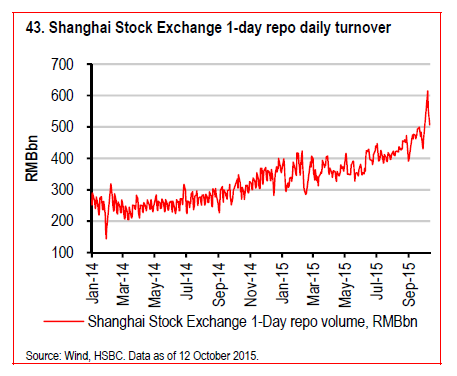
    According to HSBC, the daily volume of one-day repos on the Shanghai Stock Exchange has doubled since 2014, indicating investors are using that particular form of leverage to juice their returns. Meanwhile, structured products that allow investors in more junior tranches to leverage on the senior slices have also appeared, effectively allowing investments to be leveraged by as much as 10 times.


    Source: HSBC
    All of which has culminated in a rather topsy-turvy effect for China's corporate credit market.
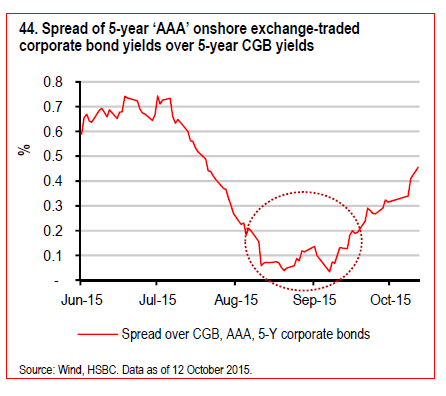
    Where the yield for five-year AAA-rated exchange-traded corporate bonds was about 70 basis points higher than the yield on Chinese government bonds as recently as July of this year, it compressed to as little as 10bps in September.
    One Chinese company — a property developer known as China Vanke — managed that month to sell a 5 billion yuan ($785 million) bond at a yield of 3.5 percent. That was 4 basis points lower than the yield of China Development Bank bonds that effectively come with a government guarantee and a zero risk weighting, meaning investors are asking for less of a return to hold China Vanke debt.

    Source: HSBC
    All of which indicates that China's Great Ball of money has well and truly arrived in the corporate credit space, and has carried with it its hallmark distortive effects.
    Meanwhile, Zhang and Huang argue that the growing intricacy of China's credit markets, and its entwining with other areas of the country's financial system, demands a new approach from policymakers.
    "This new normal is not just simply about slower growth but also the increasing sophistication and linkages between different economic and financial factors and asset classes," they write. "In turn, a wider group of asset classes now requires policy support to ensure the smooth functioning of the financial system. This explains why policy is becoming more experimental — entering uncharted territory requires new thinking."

    Leave a comment:


  • ProdigyofZen
    replied
    Re: Yes Virginia...It's a Bubble...

    even better, you'll be privileged but your wife has to worry.
    Why would the wife have to worry? I suspect I know the answer but I would like to hear it from you...

    Leave a comment:


  • GRG55
    replied
    Re: Yes Virginia...It's a Bubble...

    Two related items a month apart:

    China Said to Remove Sinosteel President Amid Cash Problems
    September 24, 2014 — 12:15 AM MDT
    Bloomberg News

    China is said to have removed Sinosteel Corp. President Jia Baojun from his post, according to people familiar with the situation, after the state-owned steel trader said it’s facing financial difficulties.
    The State-owned Assets Supervision and Administration Commission also discharged him from his position as chairman of unit Sinosteel Corp. Ltd. this month, according to two people who have seen an internal notification of his departure. An official from the Beijing-based Sinosteel said yesterday that the company is facing difficulties amid slowing economic growth, with some account receivables not collected on time.

    Three years ago Jia replaced Huang Tianwen who was removed by the state-owned enterprises watchdog after the company was accused of inflating sales at its units by the National Audit Office. The most recent leadership change comes as the trader battles tumbling steel prices that have sent its peers into financial trouble.


    “Steel trading is money-losing and Sinosteel hasn’t done anything to effectively boost earnings in the past years,” said Xu Zhongbo, chief executive officer of Beijing Metal Consulting Ltd., “Management’s failure to bail out the company may eventually prompt SASAC to restructure Sinosteel.”...


    Chinese Firms Seen Dodging Defaults in Coming Days in Turnaround
    Bloomberg News
    Oct 16, 2015 6:42 am ET


    (Bloomberg) -- A Chinese sausage maker is set to avoid a default in a turnaround, and the authorities were said to have stepped in to help a state-owned steel trader facing a bond deadline next week.

    The National Development and Reform Commission will hold a meeting with investors in government-controlled Sinosteel Co.’s 2 billion yuan ($315 million) of 2017 securities who have an option to sell them back on Oct. 20., people familiar with the matter said. The NDRC will ask them not to do so, according to one of the people. Parent Sinosteel Corp. sent a letter to noteholders pleading with them to not sell the bonds back as Sinosteel would be unable to repay, the people said.

    Sausage maker Nanjing Yurun Foods Co., which said Monday it wasn’t sure it could repay a 1.3 billion yuan note due Oct. 18 amid cash shortages, issued a statement Friday saying it would repay. The statement means the payment will be on time, said Wang Dongliang, contact person at lead underwriter Bank of China Co. The developments come after solar firm Baoding Tianwei Yingli New Energy Resources Co. missed payment on bonds Tuesday in the fifth onshore default this year, according to China International Capital Corp.

    “Investors may not be able to see the real credit risks in the bond market because of the aversions of defaults,” said Ji Weijie, a bond analyst at China Securities Co. in Beijing. “The NDRC’s intervention means Sinosteel may really avoid such a default. It’s reasonable for regulators to step in because the fall of a state-owned company would have an impact on employment."...

    ...Sinosteel Corp. told bondholders the NDRC and the State- owned Assets Supervision and Administration Commission of the State Council are coordinating with related parties to prevent a default. Sinosteel Corp. and its units had more than 100 billion yuan of debt as of December last year, Caixin reported in May, citing data collected by a debt commission led by Bank of China. The company is yet to release its 2014 financial report.

    Leave a comment:


  • ProdigyofZen
    replied
    Re: Yes Virginia...It's a Bubble...

    Thank you for the article!

    Leave a comment:


  • touchring
    replied
    Re: Yes Virginia...It's a Bubble...

    Originally posted by ProdigyofZen View Post
    Apparently I need to move to Singapore. Sounds great to me.

    Part of the problem in America is that the average American worker has to compete with the top 1% worker that is highly skilled and educated from every country on earth. And they want to INCREASE H1B visas to bring in even more......

    It's probably the same case in Singapore as the immigration laws are even more lax than the US, anyone with a college degree from an average institution could get a work visa in a couple of weeks. But the top 1% worker won't come to Singapore anyway, they would probably go to the US, Canada or Australia or the UK where the wages are higher and better standard of living - bigger cars and house.

    Before you come, you should be aware of the reasons why the savings rate is so high, there is no pension system in Singapore, no unemployment insurance, low fertility rate - due to stress, no minimum wage, the cost of living goes up all the time, working hours are among the longest in the world - most people don't have leisure time to spend the money they earn, etc.

    If you're a workaholic, or you need "work therapy" to get over with a bad marriage, divorce, or mid-life crisis, Singapore is a good place for you. If you're Caucasian, includes fair skinned Hispanics, Arabs, Indians, even better, you'll be privileged but your wife has to worry.

    Singapore is also a good place if you've got young kids and are on an expat package with housing covered. You could get your kids through Mandarin classes and it will be useful in the future when they grow up.
    Last edited by touchring; October 15, 2015, 09:57 PM.

    Leave a comment:


  • Southernguy
    replied
    Re: Yes Virginia...It's a Bubble...

    Michelle Davis MichelleF_Davis


    Updated on
    Share on FacebookShare on Twitter


    The Financial District in New York City.

    Photographer: Andrew Harrer/Bloomberg
    • Companies' ability to service debt is lowest since 2009
    • Balance-sheet deterioration is `alarming,' Goldman Sachs says


    Share on FacebookShare on Twitter
    Share on LinkedInShare on RedditShare on Google+E-mail


    The Federal Reserve’s historically low borrowing rate isn’t benefiting corporate America like it used to.
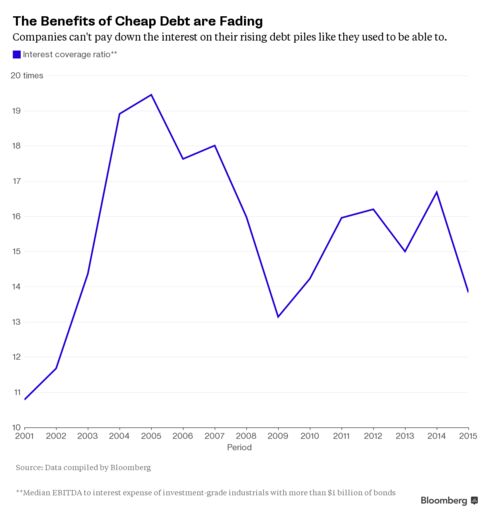
    It’s more expensive for even the most creditworthy companies to borrow or refinance even as the Fed has kept its benchmark at near-zero the last seven years. Companies have loaded up on debt. They owe more in interest than they ever have, while their ability to service what they owe, a metric called interest coverage, is at its lowest since 2009, according to data compiled by Bloomberg.
    The deterioration of balance-sheet health is “increasingly alarming” and will only worsen if earnings growth continues to stall amid a global economic slowdown, according to Goldman Sachs Group Inc. credit strategists led by Lotfi Karoui. Since corporate credit contraction can lead to recession, high debt loads will be a drag on the economy if investors rein in lending, said Deutsche Bank AG analysts led by Oleg Melentyev, the bank’s U.S. credit strategy chief.
    “The benefit of lower yields for corporate issuers is fading,” said Eric Beinstein, JPMorgan Chase & Co.’s head of U.S. high-grade strategy.
    As of the second quarter, high-grade companies tracked by JPMorgan incurred $119 billion in interest expenses over the last year, the most for data going back to 2000, according to the bank’s analysts. The amount the companies owed rose 4 percent in the second quarter, the analysts said.
    The risk of default is negligible for companies with good credit. Even so, their health isn’t likely to improve when the Fed finally raises the lending rate, and it could worsen even without a hike, said Ashish Shah, the global head of credit strategies at AllianceBernstein Holding. A souring economy or a shocking event such as a prominent terrorist attack could also cause borrowing costs to spike, he said.
    Paying Out

    The fallout of more borrowing coupled with lower earnings has raised concern among the analysts who track the debt and the money managers who buy it. Yet it seems the companies themselves are acting as if it’s not happening. They’re still paying out record amounts in buybacks and dividends.
    In the second quarter, the most creditworthy companies posted declining earnings before interest, taxes, depreciation and amortization. Yet they returned 35 percent of those earnings to shareholders, according to JPMorgan.
    That’s kept their cash-payout ratio -- how much money they give to shareholders relative to Ebitda -- steady at a 15-year high.
    The borrowing has gotten so aggressive that for the first time in about five years, equity fund managers who said they’d prefer companies use cash flow to improve their balance sheets outnumbered those who said they’d rather have it returned to shareholders, according to a survey by Bank of America Merrill Lynch.
    Since May, stocks of companies that have spent the most buying back their shares have performed even worse than the S&P 500 index. That comes after buyback stocks outperformed the S&P 500 each year since 2007, according to data compiled by Bloomberg.
    Companies have been using low interest rates to refinance more expensive debt, but the new debt isn’t saving them as much as it used to. As recently as 2012, companies were refinancing at interest rates that were 0.83 percentage point cheaper than the rates on the debt they were replacing, JPMorgan analysts said. That gap narrowed to 0.26 percentage point last year, even without a rise in interest rates, because the average coupon on newly issued debt increased.
    Lower Yields

    Companies saved a mere 0.21 percentage point in the second quarter on refinancings as investors demanded average yields of 3.12 percent to own high-grade corporate debt -- about half a percentage point more than the post-crisis low in May 2013.
    Servicing the debt got tougher for companies in the second quarter, too, at least on paper. Interest coverage, an estimate of how many times a company could pay off its interest using its Ebitda, fell in the last year to a median 13.8 times from 16.7 times for companies with top credit ratings, excluding financial firms, who’ve issued debt, according to data compiled by Bloomberg.
    The weakening has been widespread. If they had to, nearly half of companies could only cover their interest expenses between zero and 10 times with the Ebitda they generate. That compares with the 38 percent of companies that had interest coverage ratios between 0 and 10 times in 2006, according to JPMorgan.

    “It does make some of these companies more vulnerable to a growth slowdown or any type of shock,” said Jeff Cucunato, head of U.S. investment-grade credit for BlackRock Inc., the world’s biggest money manager, which said it’s taking a “cautious” approach to high-grade debt. “You’ll continue to see some land mines out there.”
    More Vulnerable

    Looking into the future, UBS AG’s Matthew Mish sees only tightening lending standards. He warned clients in an Oct. 7 research note that borrowing costs will rise for the most creditworthy borrowers in the first three months of next year.
    It would take a meaningful contraction in earnings along with tighter lending to spark a credit crisis, given that interest coverage remains above its historical average, according to Vanguard Group Inc.
    “We’re more concerned than we were two years ago,” said Stuart Hosansky, principal in Vanguard’s fixed-income group. “We still view overall corporate credit quality as adequate.” Hosansky said the last time he felt that way was 2006.
    Companies that have already issued $9.3 trillion in new debt since the financial crisis are trying to keep the cheap-debt party raging as long as they can. Some investors are joining them for what may turn out to be a nightcap, according to Stephen Antczak, head of U.S. credit strategy at Citigroup Inc.
    “There are more people that want to buy into the bullish argument than I would expect,” Antczak said. “Maybe because the buy-the-dips mentality has worked so many times in the past.”

    Leave a comment:


  • lektrode
    replied
    Re: Yes Virginia...It's a Bubble...

    Originally posted by ProdigyofZen View Post
    Apparently I need to move to Singapore. Sounds great to me.

    Part of the problem in America is that the average American worker has to compete with the top 1% worker that is highly skilled and educated from every country on earth. And they want to INCREASE H1B visas to bring in even more......
    mostly its the age old battle tween capital and labor - and mostly due to whats happened since the 90's...
    (late 90's, 2000 to be uhhhh... precise. )

    Leave a comment:


  • ProdigyofZen
    replied
    Re: Yes Virginia...It's a Bubble...

    Originally posted by touchring View Post
    In Singapore, the lowest savings among anyone, for example a janitor, who has worked full time for about 10 years is about $25k dollars in the CPF - compulsory govt savings program.

    The average unmarried college graduate who has worked for 10 years, would have about $150k in CPF and probably another $100k in the bank/stocks/funds after working for 10 years, so a total of $250k in savings, net of debt, credit card, etc.
    Apparently I need to move to Singapore. Sounds great to me.

    Part of the problem in America is that the average American worker has to compete with the top 1% worker that is highly skilled and educated from every country on earth. And they want to INCREASE H1B visas to bring in even more......

    Leave a comment:


  • GRG55
    replied
    Re: Yes Virginia...It's a Bubble...

    How did China became the "world's second biggest economy", and the darling of every business reporter in the western world? Elementary my dear Watson. Credit. Leverage. More credit and leverage than ever before seen in a single nation in human history.

    BLOOMBERG INTELLIGENCE
    OCTOBER 13, 2015

    This analysis is by Bloomberg Intelligence analysts Kenneth Hoffman and Sean Gilmartin. It appeared first on the Bloomberg Terminal.

    The great mystery of metals is the amount used to finance the Chinese carry trade, or collateral used to borrow cheap dollars to buy yuan-backed high-interest-carrying notes. The Bank for International Settlements says this trade may be $1 trillion to $2 trillion, tying up tens of millions of metric tons of iron ore, aluminum and other metals. About a year of global copper consumption (22 million mt) equals just 5% to 10% of the estimate. The true figure will determine real China metal demand and future inventory...

    ...China carry trade dismantling could be a $2 trillion unwind...

    China traders’ yuan metals carry trade worked, until it didn’t
    A depreciating yuan has hurt the carry trades of those who benefited from when the currency was strengthening, and the trades have begun to unravel, which may cause significant disruption in global metal markets. For almost a decade, the Chinese allowed the yuan to appreciate vs. the U.S. dollar and many other global currencies. In 2014, as the country began to open up its currency to foreign trading, it began to weaken, culminating with a 2% depreciation in August.


    As China stokes economy with lower rates, carry hurts metals
    The rise of the “carry trade,” which used metal as collateral to finance low-cost U.S. dollar-based capital sources to invest in high-interest- yielding yuan credit, could rapidly decline as China sharply cuts interest rates to stoke internal demand. Lower rates inside China may hurt the value of the yuan as the interest-rate differential with other currencies becomes less compelling. Massive amounts of metal could be tied up in this trade, and its unwinding may be the story to watch in 2016.


    Up to 70% of copper imports may be caught in China carry trade...


    Leave a comment:


  • touchring
    replied
    Re: Yes Virginia...It's a Bubble...

    Originally posted by ProdigyofZen View Post
    I believe that more than half of the US has less than 1000 in savings.

    I was chatting with a HF manager the other night. He stated that for a good 30% of the population, there are no jobs for them and they aren't going to get any jobs either. The market "doesn't care about them."

    In Singapore, the lowest savings among anyone, for example a janitor, who has worked full time for about 10 years is about $25k dollars in the CPF - compulsory govt savings program.

    The average unmarried college graduate who has worked for 10 years, would have about $150k in CPF and probably another $100k in the bank/stocks/funds after working for 10 years, so a total of $250k in savings, net of debt, credit card, etc.

    Leave a comment:


  • ProdigyofZen
    replied
    Re: Yes Virginia...It's a Bubble...

    Anybody still believe that 7% statistic?

    The China bubble this thread started watching more than a half decade ago appears to have solid evidence of finally having burst. PoZ's outlook that "China's bust will take down the world" looks increasingly plausible.
    The only way the "outside financial world" or collective mind of all investors worldwide will know there is serious trouble in China is through the exchange rate and defaults/massive revenue declines among corporations and countries most associated with China. I believe this should be a given and has been for awhile now.

    Evidence within China like the article linked above by GRG, as he says, only throws fuel to the fire.

    Leave a comment:


  • GRG55
    replied
    Re: Yes Virginia...It's a Bubble...

    Originally posted by GRG55 View Post
    Thank gawd China still has 7% official growth in the economy as a whole. Where would the world be otherwise

    Seems to me the PBOC should call Janet and inquire how to promote the origination and bundling of subprime auto loans. I Yuan.na new car.


    China Slashes Vehicle Sales Forecast to 3% Amid Stocks Rout


    ...
    Anybody still believe that 7% statistic?

    The China bubble this thread started watching more than a half decade ago appears to have solid evidence of finally having burst. PoZ's outlook that "China's bust will take down the world" looks increasingly plausible.

    2015-10-12 16:39

    The recent announcement by a technology company that it is to shut down its operations in Shenzhen was the latest in a wave of closures of hardware supply companies in the Pearl River Delta Economic Zone, Shanghai's China Business News reported.


    Shenzhen-based Fu Chang Electronic Technology Co announced a few days ago that it is being forced to shut down due to financial problems, but did not offer its employees any severance pay.

    That closure is just one of many among suppliers in the economic zone and the situation has been getting worse since the beginning of this year, according to the report. Prior to Fu Chang's decision, a plastic components and modules supplier to Hewlett-Packard announced it was ending its operations in the economic zone because its payments to its upstream suppliers were in arrears.

    It is rare to see upstream and midstream suppliers such as Fu Chang go out of business. Fu Chang's decision could trigger a chain reaction, causing capital disruption in the industry's downstream supply chain and leading to bigger waves of company closures.


    Founded in 1997, Fu Chang is an electronic parts supplier to domestic telecommunication giants such as Huawei Technologies Co, ZTE Corp and TCL and was a star enterprise in Shenzhen.


    Fu Chang issued a statement on Oct. 8, saying it would stop all operations immediately because it was having liquidity problems after facing legal and debt issues, according to media reports...

    Leave a comment:


  • don
    replied
    Re: Yes Virginia...It's a Bubble...

    Unlike production economies, debt-based economies have little upside in job growth and lend themselves, as many others do, to automation and outsourcing, but the key is that they have no or little ripple effect as a wealth multiplier, but rather the opposite, concentrating wealth from the productive economy, pensions, savings, etc. into the hands of a non-productive few.

    Leave a comment:

Working...
X