For a concise, readable summary of iTulip concepts developed over the past 16 years and a vision of a challenging next decade and how to navigate it, read Eric Janszen's book "Post Catastrophe Economy".
Join the discussion of today's events with a wide range of professionals with an interest in economics and finance.
Register to join our 50,000 plus member registered community from 78 countries today.
Subscribe to iTulip Select for access to the longest running, deep, accurate, and unvarnished macro economic trends analysis and forecasting available, since 1998.
If this is your first visit, be sure to
check out the FAQ by clicking the
link above. You may have to register
before you can post: click the register link above to proceed. To start viewing messages,
select the forum that you want to visit from the selection below.
In the end investment in inrastructure is not a credit-monetary matter. You must divest-defer consumption to be able to invest.
Of course the Chinese are investing too much, particularly in infrastructure. The other way round, there is not such thing as economic development without a sound infrastrucure creation policy.
Yes indeed, a sound model to emulate. Bridges to nowhere in Japan, empty cities in China, and waaaaay to much resource extraction railway and port capacity in Australia. And then the nonsense of "free money" interest rates to compound the problem everywhere else - who cares about investing capital with a requirement to earn a return on it when it's free? Every nation globally should float 50 year, 100 year, 1000 year bonds at today's interest rates, build baby build, and let's see what happens. Can't be any worse than Japan or China or the bombed out mining towns in Oz today, can it?
the u.s. has bridges falling down with people dying in consequence, poor railroad service with relatively slow trains, a creaky electrical grid, 3rd world level airports and some of the slowest internet service in the world. we've got quite a list before we get to the bridges to nowhere [save the one in alaska that someone attempted to ram through congress].
The World Economic Forum’s Global Competitiveness Report for 2012-2013 exposes that U.S. infrastructure compares unfavorably with that of most advanced countries and even some developing nations. The report investigated the quality and availability of roads, railroads, ports, air transport, electricity, and telephones. In terms of overall infrastructure, the U.S. ranks 25th, behind nations such as Oman and Barbados, and only one spot ahead of Qatar. America’s position is buoyed by finishing first in one category: the number of available airline seats. In other words, it's easy for Americans to get a plane ticket to wherever they need to go. Other areas hold the United States’ ranking down. For instance, the quality of air transport infrastructure is ranked 30th in the world, while quality of the electricity supply ranks 33rd. etc.
(slightly dated - 2013)
---------
the american society of civil engineers grades the u.s. infrastructure as a D+. of course they may have some self-interest involved, but i don't think anyone would argue against the proposition that there's a lot of infrastructure work to be done here that would add materially to national productivity, safety and convenience.
Despite a crying need for better infrastructure, investment in it has fallen in 10 major economies, including the U.S., since the financial crisis, according to a new study by the McKinsey Global Institute. Meanwhile, China is still going gangbusters on roads, bridges, sewers, and everything else that makes a country run.
"China spends more on economic infrastructure annually than North America and Western Europe combined," according to the report published on Wednesday.
Economists around the world have been arguing that now is a great time to invest in infrastructure because interest rates are super-low and the global economy could use the spending jolt. "Is anyone proud of Kennedy airport?" Harvard University economist Lawrence Summers likes to ask.
The MGI report cites 10 countries in which infrastructure spending fell as a share of gross domestic product from 2008 to 2013: the U.S., U.K., Italy, Australia, South Korea, Brazil, India, Russia, Mexico, and Saudi Arabia. (The study counts 11 economies, but that's because it lists the European Union as a separate entity.) In contrast to the widespread declines, the institute says, infrastructure spending grew as a share of GDP in Japan, Germany, France, Canada, Turkey, South Africa, and China.
The chart below from the MGI report shows China's strength in infrastructure spending. Its bar is the highest. The colored slices represent different kinds of infrastructure, while the width of the bars signifies the size of the economy. The U.S. bar is wide and short because it represents a big economy with low spending.
Nonetheless, there's such a thing as too much infrastructure spending. At current rates of investment, China, Japan, and Australia are likely to exceed their needs between now and 2030, the McKinsey & Company-affiliated think tank says.
To fund more public infrastructure, the report favors raising user charges such as highway tolls, among other measures. To encourage more private investment in infrastructure, MGI argues for increasing "regulatory certainty" and giving investors "the ability to charge prices that produce an acceptable risk-adjusted return."
Yes indeed, a sound model to emulate. Bridges to nowhere in Japan, empty cities in China, and waaaaay to much resource extraction railway and port capacity in Australia. And then the nonsense of "free money" interest rates to compound the problem everywhere else - who cares about investing capital with a requirement to earn a return on it when it's free? Every nation globally should float 50 year, 100 year, 1000 year bonds at today's interest rates, build baby build, and let's see what happens. Can't be any worse than Japan or China or the bombed out mining towns in Oz today, can it?
Despite a crying need for better infrastructure, investment in it has fallen in 10 major economies, including the U.S., since the financial crisis, according to a new study by the McKinsey Global Institute. Meanwhile, China is still going gangbusters on roads, bridges, sewers, and everything else that makes a country run.
"China spends more on economic infrastructure annually than North America and Western Europe combined," according to the report published on Wednesday.
Economists around the world have been arguing that now is a great time to invest in infrastructure because interest rates are super-low and the global economy could use the spending jolt. "Is anyone proud of Kennedy airport?" Harvard University economist Lawrence Summers likes to ask.
The MGI report cites 10 countries in which infrastructure spending fell as a share of gross domestic product from 2008 to 2013: the U.S., U.K., Italy, Australia, South Korea, Brazil, India, Russia, Mexico, and Saudi Arabia. (The study counts 11 economies, but that's because it lists the European Union as a separate entity.) In contrast to the widespread declines, the institute says, infrastructure spending grew as a share of GDP in Japan, Germany, France, Canada, Turkey, South Africa, and China.
The chart below from the MGI report shows China's strength in infrastructure spending. Its bar is the highest. The colored slices represent different kinds of infrastructure, while the width of the bars signifies the size of the economy. The U.S. bar is wide and short because it represents a big economy with low spending.
Nonetheless, there's such a thing as too much infrastructure spending. At current rates of investment, China, Japan, and Australia are likely to exceed their needs between now and 2030, the McKinsey & Company-affiliated think tank says.
To fund more public infrastructure, the report favors raising user charges such as highway tolls, among other measures. To encourage more private investment in infrastructure, MGI argues for increasing "regulatory certainty" and giving investors "the ability to charge prices that produce an acceptable risk-adjusted return."
there's a limit to how many cement factories and steel plants they want to build [already much more than they need] and the number of ghost cities [same]. aside from these capital "investments" they need to be able to export production if they're not consuming much themselves.
of course they'd like to consume more and better food, but their very low and very polluted water supply limits domestic production, so they're stuck importing agricultural products. [these products are notably indirectly imports of the fresh water it took to grow them.]
i think the current limitation on chinese growth is that their export markets are moribund. china can't keep growing as rapidly as it was unless it quickly ramps up domestic consumption, which isn't happening, or they have healthy export markets, which they don't.
if you've got no medical insurance, no retirement plan and only [on average] a quarter of a descendant per person, you'd better have a high savings rate.
Chinese behavior is very different from American behavior, even here in the U.S. I have never forgotten what I was warned as a child: Americans earn a dollar and spend a dollar (Americans seemed to earn a dollar and spend two dollars during the last two asset bubbles); Chinese people (referring to U.S. citizens of Chinese descent) earn a dollar and spend seventy-five cents. And despite the lesser spending, there is a reasonable amount of consumption; it is not as if every Chinese person in the U.S. is a variant of Ebenezer Scrooge.
The extra twenty-five cents (or more) that Americans spend is for things that I do not believe really help a productive economy: silly services (gym memberships that are never used, cable television, expensive phone plans, etc.), accumulation of goods to keep up with the Joneses, and interest on loans.
Medical care in China is also inexpensive so massive quantities of savings are not required except for serious illnesses such as cancer where treatments can run in to the millions of dollars. If the Chinese government cared about making those expensive treatments available to its citizens, it could always choose to violate IP laws and manufacture and sell the drugs at a nominal cost. Furthermore, traditional Chinese medicine is still in practice in China and some of it works while being inexpensive. This is an option that most Americans and Westerners do not consider. China's savings rate is not something that I believe would be destructive to GDP growth
If China can get out of the being the low cost manufacturer of junk (again, very tall order) and make decent inroads into moving up the value chain, resulting higher wages should juice GDP as Chinese will willingly spend more for certain things. GDP can further be boosted IF China is able to reduce the rampant corruption in its government and society. No, I'm not holding my breath.
My tack is that Shilling seems to have some sort of numerical limit for deciding that China's GDP has hit a plateau as Japan's did. However, Japan really didn't have anywhere else to go having reached the top tier of development. I remember reading an article some years ago of how what a nation exports is indicative of its economic development. At the highest level is culture, which Japan has done a reasonably good job of exporting. China really has not exported culture and they're not even on the second highest tier of economic development. I'm saying that numbers aside, there are qualitative things China can do to wring quite a bit more out of their GDP growth story. Whether they will attempt those things or succeed is a different story.
It's not guaranteed by a long shot that China's GDP growth flatlines as Japan's has for the past twenty years.
The timeframe I am speaking of is 1970 until now because Japan in the 1950s and 1960s was kind of a joke. [I view the Trinitron and the much-improved Japanese automobiles of the 1970s as Japan's coming-out party into the first world.] Since that time, American living standards have increased from a certain perspective: Houses are bigger, cars last longer, everyone has a smart phone, everyone has a large flat-panel television, etc. However, I do not think that the average American is truly better off than he was then. Most people no longer have a defined-benefit pension, many households have both parents working and yet have very little financial buffer in the event of a layoff, and minimum wage is no longer a living wage. Nominally speaking, the U.S. has become wealthier and, in real terms, the wealthy have become wealthier, too. However, it is my opinion that the average American is not wealthier.
I don't recall knowing any children whose families were on welfare and, for certain, housing was much more affordable than it is today. The number of households on foodstamps today is both shocking and depressing compared to historical averages. And it goes without saying that, in the past, one could be relatively unskilled labor and still earn a decent living without a college degree. Unskilled labor today is doomed to a life of semi-poverty unless one somehow skills up. And we all know how college tuition has skyrocketed. I remember graduates of the University of Texas telling me of days when tuition was $400. (I want to say $50 or $75 but my memory is foggy.) Tuition today is around $10,000+.
As for the U.S. being the sole export market, I did not mean to imply that it was. But I don't recall other countries' markets being nearly as open (tax-free) as U.S. markets. I believe that to be true even today although it's much more difficult for countries to not play the race-to-zero game. But I'm not aware of any first world nation where seemingly every consumer good is made in a developing country. If you go to Wal-Mart, Target, Kohl's, it is nearly impossible to find a product that isn't made in a low-cost country. About a year or so ago, I saw a bunch of interviews with college students in China and what their ambitions were. Astonishingly to me, most spoke of joining a company that would export to the U.S. I do not recall any student talking about exporting to Europe or selling to consumers in China itself. Perhaps those were goals but they were not the most important goal.
I am not some immigrant to the U.S. I was born here, raised here, and have spent the vast majority of my life here. I don't think I am imagining things when I say that there is a lot more poverty than I remember as a child.
That may be the perception, but the data do not support it. Although there has been a measurable increase in the past 35 years, the USA remains one of the absolute least trade (imports + exports) dependent nations on earth. That means a large part of what is consumed in the USA is made in the USA, and a large part of what is made in the USA is consumed in the USA.
I was born and raised in Canada, a country that has a trade dependence at ~60% that is roughly double the USA's trade dependence.
Here's a link to some comparative data that may be of interest in that regard:
I'm not 100% certain that a stronger social safety net is required to achieve that, though.
if you've got no medical insurance, no retirement plan and only [on average] a quarter of a descendant per person, you'd better have a high savings rate.
china is capable of producing high quality goods, but only when they're forced to. e.g. foxconn's work for apple. they won't develop an internal market until and unless they have a much stronger social safety net, which doesn't appear to be anytime soon. they are getting older faster than they are getting rich, and as the dependency ratio rises they will have big problems.
Foxconn (Honhai) is kind of a strange company as it's not really a Chinese company. It's a Taiwanese company that chose to offshore to China. As such, my expectation of Foxconn is that the quality of goods would be closer to Taiwan than something coming out of a fully Communist Chinese company.
But I agree with you that for China's GDP to increase noticeably, they must develop their own internal markets, eat their own cooking. I'm not 100% certain that a stronger social safety net is required to achieve that, though.
china is capable of producing high quality goods, but only when they're forced to. e.g. foxconn's work for apple. they won't develop an internal market until and unless they have a much stronger social safety net, which doesn't appear to be anytime soon. they are getting older faster than they are getting rich, and as the dependency ratio rises they will have big problems.
LOL. You incorrectly make it sound as though the USA was the sole export market for these EM economies in the day. And further you state the USA was "all the while becoming poorer". Unless one is willing to swallow Trump's Tweets unquestioningly, I doubt you'll find a way to statistically support that the USA is poorer today than it was when Japan's export economy started to grow in the early 1950s. But I am certainly open to be proven wrong on that.
The timeframe I am speaking of is 1970 until now because Japan in the 1950s and 1960s was kind of a joke. [I view the Trinitron and the much-improved Japanese automobiles of the 1970s as Japan's coming-out party into the first world.] Since that time, American living standards have increased from a certain perspective: Houses are bigger, cars last longer, everyone has a smart phone, everyone has a large flat-panel television, etc. However, I do not think that the average American is truly better off than he was then. Most people no longer have a defined-benefit pension, many households have both parents working and yet have very little financial buffer in the event of a layoff, and minimum wage is no longer a living wage. Nominally speaking, the U.S. has become wealthier and, in real terms, the wealthy have become wealthier, too. However, it is my opinion that the average American is not wealthier.
I don't recall knowing any children whose families were on welfare and, for certain, housing was much more affordable than it is today. The number of households on foodstamps today is both shocking and depressing compared to historical averages. And it goes without saying that, in the past, one could be relatively unskilled labor and still earn a decent living without a college degree. Unskilled labor today is doomed to a life of semi-poverty unless one somehow skills up. And we all know how college tuition has skyrocketed. I remember graduates of the University of Texas telling me of days when tuition was $400. (I want to say $50 or $75 but my memory is foggy.) Tuition today is around $10,000+.
As for the U.S. being the sole export market, I did not mean to imply that it was. But I don't recall other countries' markets being nearly as open (tax-free) as U.S. markets. I believe that to be true even today although it's much more difficult for countries to not play the race-to-zero game. But I'm not aware of any first world nation where seemingly every consumer good is made in a developing country. If you go to Wal-Mart, Target, Kohl's, it is nearly impossible to find a product that isn't made in a low-cost country. About a year or so ago, I saw a bunch of interviews with college students in China and what their ambitions were. Astonishingly to me, most spoke of joining a company that would export to the U.S. I do not recall any student talking about exporting to Europe or selling to consumers in China itself. Perhaps those were goals but they were not the most important goal.
I am not some immigrant to the U.S. I was born here, raised here, and have spent the vast majority of my life here. I don't think I am imagining things when I say that there is a lot more poverty than I remember as a child.
...The U.S. economy was able to absorb the output of roughly ~50 million people in Japan, ~10 million people in Taiwan, ~3 million people in Singapore, and ~25 million people in Korea; all the while becoming poorer. Then China joins the party with approximately 600 million workers with the U.S. deeply in hock and American consumers spent out and blown out by the dot-com bubble and housing bubble. I think the U.S. is going to have a problem sustainably absorbing that output long enough for China to become as wealthy as Korea or Taiwan.
...
LOL. You incorrectly make it sound as though the USA was the sole export market for these EM economies in the day. And further you state the USA was "all the while becoming poorer". Unless one is willing to swallow Trump's Tweets unquestioningly, I doubt you'll find a way to statistically support that the USA is poorer today than it was when Japan's export economy started to grow in the early 1950s. But I am certainly open to be proven wrong on that.
first i thought demographics, but that's not so good. they got a lot richer than china has, but then again never quite as rich as japan. the only other thought i have is that no one ever said south korea was going to take over the world. maybe they were protected from themselves by virtue of being a smaller economy than either japan or china. and they didn't buy either rockefeller center or the waldorf astoria.
Yes, the export-mercantile strategy of getting rich off the U.S. was, I believe, "invented" by Japan. As Japan was successful, other countries copied its blueprint: Taiwan, Korea, and Singapore. All of those countries are now relatively wealthy, too, and you won't find nearly as many foreign students at U.S. universities from those countries as you did a few decades ago.
Also, for whatever reason, the quality of Korean manufactured good have not reached the heights that the Japanese products did. They are trying, though, and Korea even has the same corporate landscape as Japan: chaebol = zaibatsu. The chaebol dominate Korean business. Not surprising, I guess, considering the cultural similarity between Koreans and Japanese.
The U.S. economy was able to absorb the output of roughly ~50 million people in Japan, ~10 million people in Taiwan, ~3 million people in Singapore, and ~25 million people in Korea; all the while becoming poorer. Then China joins the party with approximately 600 million workers with the U.S. deeply in hock and American consumers spent out and blown out by the dot-com bubble and housing bubble. I think the U.S. is going to have a problem sustainably absorbing that output long enough for China to become as wealthy as Korea or Taiwan.
But this is also where I disagree with Shilling. China is still an exporter of junk whereas Japan, Korea, and Taiwan eventually got to a point where the quality of the exported product ranged from excellent (Japan) to pretty good (Korea) to acceptable (Taiwan). If China can actually adapt its economy into producer higher value goods with much better quality--a tall order for any Communist society--they're still going to have substantial GDP growth. Not as much as the past two decades, though, from a percentage perspective because they had nowhere to go up but back then other than descend into utter barbarism.
But China now has all the means of production in the country and, if they do things correctly (let's not hold our breaths), they have the infrastructure and capital to grow their economy tremendously. What's missing from China that was present in Japan and Korea are the large, dominant family enterprises (caifa). In its place are state-owned enterprises that impress nobody.
China appears to have done the same thing the Japanese did using much the same techniques (export mercantilism and enormous credit) in "one-half" the time.
Between these two Asian "economic miracles" was sandwiched South Korea. I wonder why we do not hear about similar growth and debt issues in that economy? What did/are they doing differently from their two Asian peers?
first i thought demographics, but that's not so good. they got a lot richer than china has, but then again never quite as rich as japan. the only other thought i have is that no one ever said south korea was going to take over the world. maybe they were protected from themselves by virtue of being a smaller economy than either japan or china. and they didn't buy either rockefeller center or the waldorf astoria.
just read a piece by gary shilling saying that china climbed the developmental S curve and has come to the end of its period of rapid development - i.e. it's nearing a plateau for gdp/capita. meanwhile the whole commodities bubble was predicated on endless high consumption of commodities by china for capital investment - now it's over. all the manufacturing outsourcing and globalization that could be done has been done. the chinese miracle of accelerated growth in the 1990's-2000's will go the way of the japanese miracle of the 1950's-1980's....
China appears to have done the same thing the Japanese did using much the same techniques (export mercantilism and enormous credit) in "one-half" the time.
Between these two Asian "economic miracles" was sandwiched South Korea. I wonder why we do not hear about similar growth and debt issues in that economy? What did/are they doing differently from their two Asian peers?

 Reprints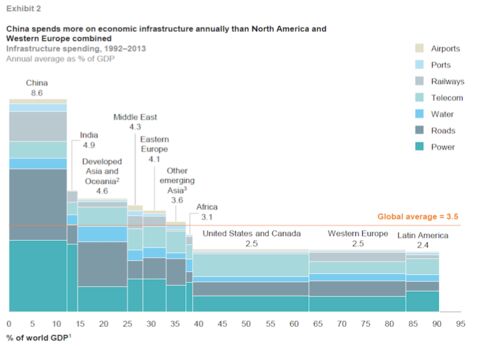


Leave a comment: