Announcement

Collapse
No announcement yet.

Yes Virginia...It's a Bubble...

Collapse
X
 
  • Filter
  • Time
  • Show
Clear All
new posts

  • GRG55
    replied
    Re: Yes Virginia...It's a Bubble...

    Originally posted by touchring View Post
    What I've read and heard is that the bubble situation in 2nd and 3rd tier cities is more serious than Shanghai or Beijing where land is scarce.
    Just as in the Middle East and Central Asia, in an economy as controlled as China's, with an enormous amount owned by the government through SOEs and other vehicles, there are very few options for savers to deploy their capital - stock market speculation, property speculation, noodle stands. That's about it. So the money sloshes back and forth in a small space. Watched the same thing up close in Dubai, Manama and Almaty.

    Interesting to hear this property up cycle has gone beyond the major coastal centres.

    Leave a comment:


  • touchring
    replied
    Re: Yes Virginia...It's a Bubble...

    What I've read and heard is that the bubble situation in 2nd and 3rd tier cities is more serious than Shanghai or Beijing where land is scarce.


    Originally posted by GRG55 View Post
    Vancouver, with Chinese characteristics. It keeps on going and going and going
    [From a ZH post]
    By PandaHedge | February 29, 2016

    ...Anyway, the current crazy bubble in China’s tier 1 cities smells the same as the A share bubble which was boosted by the margin debt in the last two years. We know it will end badly when the margin debt bubble is pierced...


    Leave a comment:


  • Polish_Silver
    replied
    What is "nationwide"

    Originally posted by GRG55 View Post
    Let's take a little trip back in time...to the days of Alan Greenspan before the "Sir" was added. To the bucolic days of the spring of 2005:
    Greenspan Is Concerned About 'Froth' in Housing


    ...Mr. Greenspan emphasized that he sees no sign of a nationwide housing bubble, b. As a result, he said, there are "a lot of local bubbles" around the country...


    Such high rates of growth are of course unsustainable, but it remains too early to talk of bubbles nationwide. Yes, Wang Shi, chairman of developer Vanke, warned that property markets in Beijing, Shanghai and Guangzhou were frothy, but there is more to China than first-tier cities...


    The fearless leaders think that a "nationwide bubble" implies that every single house is over valued.

    Leave a comment:


  • GRG55
    replied
    Re: Yes Virginia...It's a Bubble...

    Originally posted by GRG55 View Post
    Let's take a little trip back in time...to the days of Alan Greenspan before the "Sir" was added. To the bucolic days of the spring of 2005:

    Greenspan Is Concerned About 'Froth' in Housing


    Published: May 21, 2005

    WASHINGTON, May 20 - Alan Greenspan, chairman of the Federal Reserve, suggested on Friday that the red-hot housing market is becoming a little too exuberant for its own good...

    ...Mr. Greenspan emphasized that he sees no sign of a nationwide housing bubble, but he acknowledged concerns over "froth" in the market and pointed to a big increase in speculation in homes - particularly in second homes. As a result, he said, there are "a lot of local bubbles" around the country...

    Just imagine the feeling of "déjà vu all over again" when I read this...

    What bubble?


    January 19, 2010

    Residents of big Chinese cities are worried about bubbles. It's easy to see why: Shanghai mortgages rose 1,600% in 2009 from 2008 to US$15.58 billion, while residential property prices in the city shot up 68% from 2008 to US$4,571 per square meter. The rapid growth has prompted moves to curb speculation, including – in Shanghai at least – tightening of tax and financing policies on second-home purchases.

    Such high rates of growth are of course unsustainable, but it remains too early to talk of bubbles nationwide. Yes, Wang Shi, chairman of developer Vanke, warned that property markets in Beijing, Shanghai and Guangzhou were frothy, but there is more to China than first-tier cities...

    Vancouver, with Chinese characteristics. It keeps on going and going and going
    [From a ZH post]
    By PandaHedge | February 29, 2016

    ...Anyway, the current crazy bubble in China’s tier 1 cities smells the same as the A share bubble which was boosted by the margin debt in the last two years. We know it will end badly when the margin debt bubble is pierced...


    Leave a comment:


  • Polish_Silver
    replied
    Re: Yes Virginia...It's a Bubble...

    If this article is right, Yuan is not about to be accepted as a global reserve currency.

    Leave a comment:


  • GRG55
    replied
    Re: Yes Virginia...It's a Bubble...

    Originally posted by GRG55 View Post
    Are Chinese authorities finally about to end "the dilemma"? Will they stay the course and replace ballooning off-balance-sheet debt with structured municipal bonds? Or will they once again get cold feet in the face of a potential drop in property markets and reverse course "temporarily"? Only time will tell.

    Dec 9, 2014 6:46 AM MT


    ...
    Looks like same old, same old.


    China's Subprime Crisis is Here

    Feb 16, 2016 6:22 PM MST

    Sorry, Kyle Bass, you're a bit late to the game. The debt problem in China has already reached the proportions of the U.S. subprime mortgage debacle. Don't worry, though: Chinese authorities are on the case -- discussing reducing the required coverage for bad loans so that banks can keep booking profits and lending.

    Including ``special-mention" loans, which are those showing signs of future repayment risk, the industry’s total troubled advances swelled to 4.2 trillion yuan ($645 billion) as of December, representing 5.46 percent of total lending. That number is already higher than the $600 billion total subprime mortgages in the U.S. as of 2006, just before that asset class toppled the world into the worst financial crisis since 1929.

    The amount of loans classed as nonperforming at Chinese commercial banks jumped 51 percent from a year earlier to 1.27 trillion yuan by December, the highest level since June 2006, data from the China Banking Regulatory Commission showed on Monday. The ratio of soured debt climbed to 1.67 percent from 1.25 percent, while the industry’s bad-loan coverage ratio, a measure of its ability to absorb potential losses, weakened to 181 percent from more than 200 percent a year earlier.

    The news looks to have scared Chinese authorities into reacting. Note that they aren't curbing the ability of Chinese banks to lend or asking them to write off bad credit. Instead they're considering putting aside checks already in place that are aimed at ensuring the health of the financial system: by reducing the ratio of provisions that banks must set aside for bad debt, currently set at a minimum 150 percent, as Bloomberg News reported on Tuesday.

    Perhaps, they're hoping banks will lend even more if they ease the rules. That's one way to keep the ratio of nonperforming loans under control. As the denominator increases the ratio remains steady or even drops. The absolute number of bad loans, however, keeps swelling.

    Guess what? Banks are lending more. China's new yuan loans jumped to a record 2.51 trillion yuan in January, the People's Bank of China reported on Tuesday, way above the 1.9 trillion yuan median estimate in a Bloomberg News survey. Aggregate financing, the broadest measure of new credit, also rose to a record, at 3.42 trillion yuan.

    China's bad loans have grown 256 percent in six years even as their ratio to total lending dropped. The true amount of debt that isn't being repaid is open for debate. One example of how the data can be distorted: Banks are making increasing use of their more opaque receivables accounts to mask loans and potential losses, as Bloomberg News reports today. Still, adding special-mention loans to those classed as nonperforming gives some measure of the size of the bad-debt problem. Unfortunately, the CBRC started to publish special-mention loan numbers only last year, so it's hard to put them in historical context.

    The dynamic is clear. A splurge of new lending can help to dilute existing bad loans, but only at a cost. This is a game that can't continue forever, particularly if credit is being foisted on to an already over-leveraged and slowing economy...

    Leave a comment:


  • touchring
    replied
    Re: Yes Virginia...It's a Bubble...

    Originally posted by ProdigyofZen View Post
    Working on starting my fund to make this exact bet. I just don't want a large devaluation to occur before that time.

    Another small devaluation may occur right after Chinese New Year, February 8.

    The Chinese would definitely like a big devaluation which I don't doubt that it would happen, but I'm not sure how they will do that without infuriating the other countries as even without a devaluation, Chinese manufacturers are taking away marketshare from American and European counterparts at an increasing pace.

    The Chinese are either buying over small foreign companies or masquerading as a European or Japanese company, you won't know the company is Chinese owned from the name of the company or by looking at their website.

    I've recently switched my main component supplier from a Canadian to a HK company with a European name. The Hong Kong company was started by French people and got acquired by the Chinese, they still have French engineers working for them and made great products at low cost. Their customer support based in HK is in fact better than the Canadian company. A lot of such small acquisition is going on and they don't get published on MSM like when Lenovo took over the ThinkPad brand or with the recent Haier buying over GE appliances.
    Last edited by touchring; January 21, 2016, 05:24 AM.

    Leave a comment:


  • thriftyandboringinohio
    replied
    Re: Yes Virginia...It's a Bubble...

    Originally posted by GRG55 View Post
    ...Basically a Corvette in sedan clothing...
    GRG55, isn't that the approach for the Nissan Maxima / Datsun 810 -to put the top Z car power train in a luxury sedan?
    It's worked pretty well for Nissan, should work for GM too.

    Leave a comment:


  • ProdigyofZen
    replied
    Re: Yes Virginia...It's a Bubble...

    “They’re trying to drive a car with one foot on the brake,” said Hart, who estimates the People’s Bank of China spent more than $100 billion supporting the yuan in onshore and offshore markets during the first 12 days of January. “If China were to devalue to a level that wasn’t actually a true equilibrium they will get run over pretty quickly, they will blow through FX reserves, and then they will lose face because they’ll be forced to devalue.”..
    Working on starting my fund to make this exact bet. I just don't want a large devaluation to occur before that time.

    Another small devaluation may occur right after Chinese New Year, February 8.

    Leave a comment:


  • GRG55
    replied
    Re: Yes Virginia...It's a Bubble...

    Originally posted by jk View Post
    as usual it is capital flows, not trade flows, which determine value in these situations.

    Hedge Fund That Called Subprime Crisis Urges 50% Yuan Drop

    January 19, 2016

    Mark Hart, the hedge fund manager whose bets against U.S. subprime mortgages and European sovereign debt proved prescient, said China should weaken its currency by more than 50 percent this year.
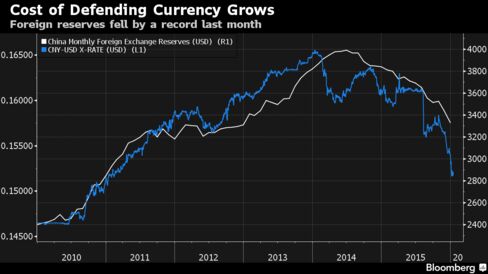
    A one-off devaluation would allow policy makers to “draw a line in the sand” at a more appropriate level for the yuan, easing pressure on China’s foreign-exchange reserves and removing an incentive for capital outflows, according to Hart, who’s been betting against the currency since at least 2011. China should devalue before its $3.3 trillion hoard of reserves shrinks much further, he said, because the country can still convince markets it’s acting from a position of strength...

    ...Hart, whose prescription clashes with consensus forecasts for the yuan and recent comments from senior government officials, said China would be justified in weakening the currency after central banks in Europe and Japan fueled declines in their exchange rates to stoke economic growth in recent years. Such a move would likely come as a surprise to global investors, who were rattled by a drop of less than 3 percent in the yuan last August.


    China’s current approach to managing the currency’s decline has been costly. Foreign-exchange reserves dropped by a record $513 billion last year as the central bank intervened to ease the currency’s slide, while an estimated $843 billion of capital flowed out of China in the 11 months through November as some investors sought to get in front of further yuan weakness.
    Aside from intervention, policy makers have moved to curb bearish bets against the yuan and tighten restrictions on the flow of money across the country’s borders. Those measures have fueled doubts among global investors about the ruling Communist Party’s commitment to give markets a central role in the world’s second-largest economy and make the yuan an international currency.

    “They’re trying to drive a car with one foot on the brake,” said Hart, who estimates the People’s Bank of China spent more than $100 billion supporting the yuan in onshore and offshore markets during the first 12 days of January. “If China were to devalue to a level that wasn’t actually a true equilibrium they will get run over pretty quickly, they will blow through FX reserves, and then they will lose face because they’ll be forced to devalue.”...

    Leave a comment:


  • touchring
    replied
    Re: Yes Virginia...It's a Bubble...

    Originally posted by lakedaemonian View Post
    Im pretty sure I've heard Buick is a well regarded brand in China.
    I sat in a Buick in China 10 years ago, it was the first time I heard of this car brand but it looks luxurious along the lines of the Lexus LS400.

    Leave a comment:


  • GRG55
    replied
    Re: Yes Virginia...It's a Bubble...

    Originally posted by jk View Post
    i think cadillac has rebooted its brand over the last several years. it used be said that the age of the average cadillac owner was somewhere between 70 and dead. i don't think that's true anymore.
    Originally posted by thriftyandboringinohio View Post
    For a little while I worked at a top-tier industrial design firm, and they had worked with Cadillac on interior design, specifically the ergonomics.
    Originally posted by thriftyandboringinohio View Post
    The human factors specialist I worked with told me that the central issue for Cadillac ergonomics was that even the first time buyers were elderly.
    He said they worked the shape of the doors and seats so that the driver and passenger can stand at the open door, lean just a bit, and then collapse into the seats.
    They did thousands of hours of anthropometry and human factors work so that Cadillac interiors were easy to operate by people who are weak and do not move well.
    Ease of entry; easy to grasp control knobs; easy to read displays; stuff like that.
    A few months back got to drive a friend's Caddie CTS-V sedan - a good old American 6.2 litre V-8 engine (with supercharger), paddle shifters and an extraordinarily well done real-world road suspension. Blasted along one of the curvy highways that follows the foothills near the bunker (a favourite local route for the road bikers). That ain't no car for a 70+ grandfather! Basically a Corvette in sedan clothing and without all the creaking, groaning and suspension thumping the plastic fantastic is famous for.

    And easier to get into and out of than a 'Vette too.

    Leave a comment:


  • Polish_Silver
    replied
    Yuan over valued?

    Originally posted by GRG55 View Post
    One of the other things I have posted a few times in the past is my firm belief that, contrary to popular political opinion in the USA, the Chinese currency is OVERvalued, and if it was allowed to free float it would decline, not rise, against the US$. ..
    Stan thinks China has overcapacity, and is headed for a recession. That is a different question than "is the Yuan over valued?"

    For example, the USA had excess capacity in 1929, and the result was deflation (ie, currency appreciation)

    It is easy to devalue a currency by printing more of it. It is difficult to keep it over valued, because market forces would do arbitrage deals

    taking advantage of the difference between the "official" value and the "market" value.

    The relative values of Yuan and Dollar might have changed over the last few years, and certainly could change again. If the Tigers are removing pegs now, it
    may be because they could easily "peg down" but "pegging up" is just too damn expensive.

    Real estate bubbles are typical of a country with a trade surplus (eg 1980's japan). The trade surplus creates "high powered money", which typically starts at home, but
    may even end up on the debtor side of things, thanks to leveraged international banking!

    Leave a comment:


  • thriftyandboringinohio
    replied
    Re: Yes Virginia...It's a Bubble...

    Originally posted by jk View Post
    i think cadillac has rebooted its brand over the last several years. it used be said that the age of the average cadillac owner was somewhere between 70 and dead. i don't think that's true anymore.
    For a little while I worked at a top-tier industrial design firm, and they had worked with Cadillac on interior design, specifically the ergonomics.
    The human factors specialist I worked with told me that the central issue for Cadillac ergonomics was that even the first time buyers were elderly.
    He said they worked the shape of the doors and seats so that the driver and passenger can stand at the open door, lean just a bit, and then collapse into the seats.
    They did thousands of hours of anthropometry and human factors work so that Cadillac interiors were easy to operate by people who are weak and do not move well.
    Ease of entry; easy to grasp control knobs; easy to read displays; stuff like that.

    Leave a comment:


  • jk
    replied
    Re: Yes Virginia...It's a Bubble...

    i think cadillac has rebooted its brand over the last several years. it used be said that the age of the average cadillac owner was somewhere between 70 and dead. i don't think that's true anymore.

    Leave a comment:

Working...
X