Announcement

Collapse
No announcement yet.

Conan Parodies Ron Paul Ad

Collapse
X
 
  • Filter
  • Time
  • Show
Clear All
new posts

  • Re: Conan Parodies Ron Paul Ad

    Originally posted by dcarrigg View Post

    I'm curious to know the cause for which you believe population growth is an effect, short of natural impulses and the availability of food and potable water.
    Mostly the ones you just said. Also, paying people to have more children than they can afford?

    In any event we are left in a conundrum. Any society that values liberty cannot put harsh restrictions on childbearing, so population growth will continue.
    This is one extreme to another. Instead of paying people to have children they can't afford we go right to putting harsh restrictions on childbearing? Why not just restore the link having children and having the resources to care for them as a first step?

    Comment


    • Re: Conan Parodies Ron Paul Ad

      Originally posted by dcarrigg
      One of the great strengths of Democracy is its pragmatic nature. It will, by its very nature, focus on problems of the hear-and-now before achieving some grand vision. Go off on too much of a tangent or "grand plan" as a leader and you do have the ballot box to contend with.
      I disagree with this statement.

      Democracies run off on all sorts of tangents, all the time.

      The true power and benefit of democracy is its changeability: whatever the policy actually made, by whomever, it can be changed. Prohibition is a fine example of both the tangent and the subsequent change.

      You term this pragmatism, I term it flip flopping.

      Of course the solution to this whatever-you-call-it has been found: populate the entire political sphere, in all areas, with those who think and act the same way.

      Comment


      • Re: Conan Parodies Ron Paul Ad

        Originally posted by c1ue View Post
        I disagree with this statement.

        Democracies run off on all sorts of tangents, all the time.

        The true power and benefit of democracy is its changeability: whatever the policy actually made, by whomever, it can be changed. Prohibition is a fine example of both the tangent and the subsequent change.

        You term this pragmatism, I term it flip flopping.

        Of course the solution to this whatever-you-call-it has been found: populate the entire political sphere, in all areas, with those who think and act the same way.
        I think we're on the same page, but simply viewing both positive and negative aspects of the same behavior.

        pragmatism[ˈprægməˌtɪzəm]n1. action or policy dictated by consideration of the immediate practical consequences rather than by theory or dogma
        2. (Philosophy) Philosophya. the doctrine that the content of a concept consists only in its practical applicability
        b. the doctrine that truth consists not in correspondence with the facts but in successful coherence with experience.


        Comment


        • Re: Conan Parodies Ron Paul Ad

          Originally posted by dcarrigg
          I think we're on the same page, but simply viewing both positive and negative aspects of the same behavior.
          Perhaps, but in my mind pragmatism is the acceptance of realism vs. idealism or ideology, whereas flip flopping is swaying with the tide of public opinion with realism being irrelevant.

          Let me put this another way: which was the last President to actually embody any form of realism?

          Comment


          • Re: Conan Parodies Ron Paul Ad

            Originally posted by c1ue View Post
            Originally posted by mikedev10
            yes, securitization allowed them to pass the buck - but you are acting like i said securitization was the catalyst or something. it may have existed before, but without a too easy too long monetary policy too accommodate it, it was far less likely to froth and then blow into a bubble. bubbles generally need a source of easy money. this is where the fed came in, also more exotic products like adjustable rate mortgages. there were no 1 year 4.5% ARMs being offered while stuff was being securitized 20 years ago.
            Monetary policy - unless you exclude regulation - had nothing to do with securitization. The Fed never engaged in securitization except in the last 3 years' buying of crap MBS's.
            i never claimed that it did.

            The ARMs you write about also had nothing to do with monetary policy except in the sense that Greenspan touted them publicly and that rollbacks of consumer protection laws made them far easier to issue, not to mention relaxation of bank capitalization ratios and calculations.
            i never claimed that it did.

            You're trying to link low interest rates with relaxed loan policies - and there is no such link except in the area of de- and non-regulation in FIRE.
            i never claimed that it did.

            this is what i responded to:

            Originally posted by c1ue
            I looked back, and you are correct. Your assertion was that the circumstances between residential real estate and student loans both included a lack of risk: for residential loans because of securitization, for student loans because of the government guarantee.

            However, the point you're missing is that mortgage securitization existed before the housing bubble, and exists even now. And you agreed that this securitization feature was in fact private (i.e. free market).
            and i pointed out that we didn't have a bubble 20 years ago while things were being securitized because we did not have rates lower than a market would set them nor exotic products. it is quite frustrating debating with you c1ue when i make a point like that, and all of a suddent you act like i claimed monetary policy had anything to do with securitization, ARMs, or banks relaxing who they lend to. i respond to your comments and i get 3 straw men in return?


            Perhaps you can quantify why you think it was low interest rates which caused the bubble - the new products were directly due to Greenspan talk and financial de- and non-regulation as noted above.
            there is no absolute number - a point i made in the last post which you failed to get. sometimes 5% is too low, sometimes it's too high, sometimes it's just right. my point is i want a market figuring out that rate and adjusting it rapidly, not men in a room (whereas you just want different men.) when it's too easy you will create more inflation than you should and run the risk of creating a bubble if a lot of it gets targeted somewhere, as it did. a free market aimed the hose at houses, but the fed picked those hose, opened it full blast and watched the house flood.

            Especially given the massive default ratios not just on subprime but Alt-A in general and that defaults clearly point to poor lending standards, not interest rates. We haven't had high interest rates at all yet default continue to proceed apace.
            i never claimed poor lending standards weren't part of the problem. you seem to live in a fantasy where bad monetary policy wasn't?

            Actually you are wrong. A fraudulent student loan would not be covered by government guarantee no more than a clearly fraudulent mortgage would be bought by Fannie, Freddie, investment bank, or MBS-buyer. That's why there are all sorts of lawsuits flying around now concerning the crap MBS's, and there will be all sorts of lawsuits connected to fraudulent student loans in the future.
            again what is the fraud on a student loan? i may lie about my income and assets HIGHER to make it sound like i am capable to pay a home loan back so that it does go through. with a student loan this comes into little if any of the equation - the government backs it, they don't really care about my major and my GPA has to be above failing out. what fraud need i commit? in housing you had to lie to get the loan, in education you have to breathe?

            As for systemic fraud - I cannot speculate as to why you think there was neither systemic fraud in residential real estate as can be seen via internal bankster memos and banksters betting against their own customers, nor why you think there cannot be systemic fraud in student loans given the same players.
            straw man #4 i never said there wasn't widespread fraud in real estate. student loans are different people in a different market and again (as i asked in the last post and my comments above) what is the fraud you are defining? they don't have to lie to get the loan, they will get it anyway!

            As I've noted previously, you seem to share the same belief with the neo-liberals that financial fraud cannot exist.
            this is from my last post - "i saw some old fbi fraud index data that had pretty linear growth 1996-2001 that did not really jump up until 2003 (near double) and 2004 (near double again) - at which point we were definitely past the start of the bubble." obviously if i'm talking about fbi fraud measurements and when they increased, i believe financial fraud can exist, right c1ue? it seems half of my stuff you read and respond to and the other you imagine and respond to.

            Bill Black doesn't think so. Dr. Michael Hudson doesn't think so. Stiglitz doesn't think so. And neither do I.
            and neither do i, outside of positions you make up for me. and i don't read them all but do they deny monetary policy's role as you do c1ue? i've read hudson more than enough times to see him talking about monetary policy promoting eas credit and asset-price inflation. what do you think he's talking about there c1ue? could those assets by HOUSING?


            Originally posted by c1ue
            Originally posted by mikedev10
            again, there is no fraud - it's not a mcdonald's worker saying they are raking money in like a doctor so they can buy a million dollar house. a women's studies major doesn't pretend they are an engineer to get the 20k loan. they don't have to because the lender doesn't care either way - it's guaranteed in both circumstances by the goverment at 100% on the dollar!
            You're again betraying ignorance of the process. A lender's fiduciary duty is to make a good loan. Abrogation of this fiduciary duty is fraud. Documented examples of systemic falsification of mortgage applications shows that there was very much widespread fraud in those making the loans:

            http://www.cjr.org/the_audit/the_cou...e.php?page=all

            But hey, apparently much more convenient for you to blame the borrower.

            If the borrowers themselves misrepresented their income, that too is fraud. And the job to discover that is the lender's.

            No matter how you slice it, fraud was central to this entire process.
            my comments, i thought were rather clear, were 100% on education. you responded 100% on housing.


            Originally posted by c1ue
            Originally posted by mikedev10
            some quick stats i saw on an infographic - 25% of government student loans default. 30% at community colleages and 40% at 2 year colleges. these are all extremely high.
            Please post the link.

            The default rates can be high - they were up to near 20% at one time in the '80s, but equally fell to as low as 5% in the mid-2000s.

            25% seems way too high except perhaps for specific income segments, areas of the country, or some such.

            On the face of it - a high default rate shouldn't be surprising. After all, if the borrower doesn't both get the degree and a good paying job, there simply isn't any way to get repaid. Default rates on pawned items is equally high.
            http://manvsdebt.com/wp-content/uplo...dent-Loans.jpg

            the point is that they are high, and the point is that they are high because the government pays for them when the lenders cannot, and the point is since the lenders get paid anyway they will continue to make even bad loans, and the point is with the excess demand for dollars and total loans then the target, education, is going to rise more rapidly than it should. a lull in the mid 2000s is easy to explain with the easy money that was coming out of housing. flip a house, pay down you student loan. take out a HELOC, pay down your student loan. etc.


            What I've said is that the federal government probably, even likely has a role. But the federal government is neither the instigator nor the ultimate cause.
            a ridiculous claim in that, via the federal reserve and monetary policy, no one else even has a question of whether it was "likely" involved, but that it was absolutely involved.

            The ultimate cause was the 'free market' via fraud. Show me how the government caused the fraud in any way except inaction, and furthermore that this inaction was not due to specific lobbying, then you would go a long way toward making your case.
            and as i pointed out last post, the fraud didn't really tick up until after the bubble was going. fraud made the bubble, it didn't make it bigger. apparently you believe fraud is necessary to make a bubble (it's not) and that easy money is not necessary to make a bubble (although it often involved).

            Continually harping on simplistic points which don't actually match real world behavior isn't going to do the job.
            continually ignoring real world behavior changes from 10 to 7 to 5% interest rates doesn't help you either.


            Originally posted by c1ue
            Originally posted by mikedev10
            much before my time, but i did poke around and see that. i can only throw out some speculative comments there - the exotic ARM products were not available and likely the finance market in general was more conservative and did not haver near the ability to securitize as it does today. where i think a real major difference is that this was after ww2, and a lot of war bonds were maturing, and the personal savings rate was quite high; from a lazy goodle search i found some fed data in 1959 showing it at 7-8. i speculate earlier it was around the same level. the same series of data shows the rate from 1999-2003 to jump around 2-4%. is is not merely the absolute value of the mortgages like you are comparing here that matters; it is a question of is the money too easy or not. sometimes 5% might be just right, others 5% might be too easy. if you have a high savings rate among people, you would have a lot of money in the bank, so you'd lower the interest rate to try and incent people to borrow it out. so what may have been just right for the 50s may be much too easy for the 2000s.
            The problem with the assertions above is again you've failed to show the actual link between federal government positive action and exotic mortgages.

            Exotic mortgages existed since at least the mid '80s - I clearly remember jumbo mortgages and what not as a response to very high Volcker interest rates in 1982. A jumbo mortgage is identical to an interest only loan, while an Alt-A is merely a short term variant of a floating rate loan.
            this is just as bad as your securitization existed back then, so why not a bubble back then argument. forget jumbo what mattered far more were the ARMs - and here you are again with a bad rhyming argument, ARMs were available then too, why no bubble? well i'm saying the federal reserve had a too easy too long monetary policy, and in your own comment you talk about very high volcker interest rates, which are pretty unlikely to go along with an easy monetary policy eh? i guess in your view where you do nothing but ignore monetary policy this doesn't matter, but perhaps you should start considering it a factor.

            Why did these exotic mortgages not explode until 2003 - a good 20 plus years later? Equally so why would exotic mortgages be pushed in the face of low interest rates - when they were invented for the purpose of dealing with short term high interest rates?

            The answer isn't the federal government.
            i do not know why they emerged more popularly around this time, i will surely agree it's much a result of the free market. but the ARMs were used with low interest rates because they created even lower interest rates and lower barriers to participation. and they were enabled by, yes indeed, the federal reserve.

            Even ignoring the question of what interest rates "should" be, and who sets them, and that the government had nothing to do whatsoever with lender fraud/incompetence, why exactly do you think interest rates were too low and held down for too long?

            Is this all just a simple mistake by the sainted Greenspan?
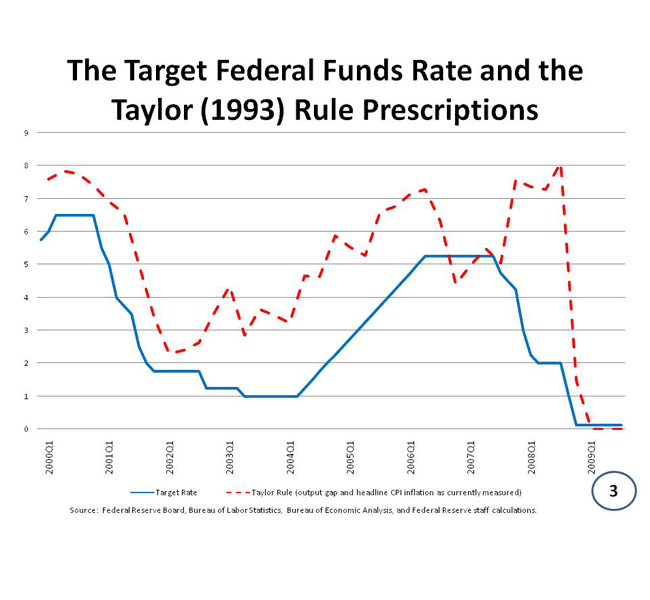
            that should be your understanding of it, if you got past ignoring monetary policy completely. as i have plainly stated throughout this discussion i think the system is flawed to begin with because it depends on a greenspan and group of people in a room, and although you may not like greenspan but like joe smith, i don't think man should have that much influence in the first place. i think the system is broken, plus it had a bad king. you act like what the king did with monetary policy didn't even matter. here is a graph of the taylor rule vs. actual rates btw:


            and hudson, ritholtz, itulip etc. all lay a lot of blame on greenspan. you did use the word "all" which neither they nor i claim, the problem is in your worldview that entity didn't create any of the problem, or it just maybe did a little. the reality is it definitely did a lot.

            Originally posted by c1ue
            Originally posted by mikedev10
            yes, but as noted above, the bubble was well underway when fraud really took up out of any historical norm. you seem to ignore that maybe if credit wasn't so easy, people wouldn't be trying to buy houses and commit the fraud in the first place. in 2005 i wasn't going to make an easy decision nor a highly speculative one if the mortgage rate is 10% you know.

            I'm sorry, but this statement makes no sense whatsoever.

            If credit is so easy, then fraud is unnecessary.

            If you have fraud, then the easyness or hardness of credit is irrelevant.

            Please try again.
            it makes perfect sense when you stop believing as you do, that fraud is required to have a bubble. it's not. fraud made the bubble bigger. it didn't make it. check this out, i'm gonna blow your mind! old data, but from this: http://www.fincen.gov/news_room/rp/r...eLoanFraud.pdf

            we have this:


            itulip, first to do so (to my knowledge) called the housing bubble in august 2002. holy balls!! mind blown!!!


            Originally posted by c1ue
            Originally posted by mikedev10
            the only way i can accept your statement is if you are going to claim the federal reserve is private and not government - but really it is standing in place acting for the government with government power. and again i will point out right or left, this site or others, you are going to find its monetary policy as a major contributor to the bubble. you cannot deny this!! and i said nothing about financial crime never occurring (???!)
            Again you are not being coherent.

            The Federal Reserve is tasked specifically by the federal government with regulating much of the financial industry.

            Whether it is officially federal government or not, this function is very much a federal government function.

            Now, monetary policy - your understanding of which you have not quantified - is it due to the Federal Reserve, due to the federal government, due to both, or due to neither?
            federal reserve

            If the Federal Reserve drops interest rates but simultaneously enforces the regulations it is chartered to do, do we still get a bubble?

            If the federal government via the SEC had regulated the ratings agencies, instead of cutting budget and personnel, would we get a bubble?

            If the federal government via the FBI and Department of the Treasury had regulated mortgage lender behavior, instead of cutting budget and personnel, would we get a bubble?
            we may get high inflation overall, or high for housing, or a small housing bubble, but doubtful a bubble as large as we got. how about if markets influence rates rather than men in a room - if markets see a huge demand, and interest rates rise, discouraging more speculative or less financially sound buyers, do we still get a bubble? did we have to create, enforce and pay for a ton of regulations that we hope is the right mix of enough to stop a bubble but not inhibit growth?

            And for student loans:

            http://chronicle.com/article/Federal...-Lenders/42826

            The question of what actually happened to form the real estate bubble isn't some mystery or exigency of the free market. Equally so, the same forces which formed the real estate bubble are hard at work in the student loan bubble.
            i don't know what to draw from this, your "smoking gun" didn't seem to have any useful details and the link to the report was bad, a quick google didn't find me it either. you're going to need more than the little blurb in this article to convince me of any driving factor not related to guaranteed loan paybacks, a pretty solid one.


            i see. i agree in terms of total dollar amounts - which is because homes are so much more expensive. in terms of how much the target has been inflated however nothing seems to beat education %-wise.[/quote]
            [quote=c1ue]
            Originally posted by mikedev10
            If the amounts don't matter, then the fact that the percentage increases in overall student loan debt from the '60s onward were consistent, even before the guarantee, should matter. This points to some other cause.
            i had trouble poking around for a graph that went back that far. did find:


            sure looks like it started going up pretty rapidly after the system was put in place and matured.


            Originally posted by c1ue
            Originally posted by mikedev10
            how about we reduce the guarantee % and just see what happens eh? i'd be far more sympathetic to your argument if we remove this huge incentive and it doesn't lead to a reduction in prices.
            If you cannot provide a clear case for your action, then why should anyone endorse it?

            If there are no equivalent successful examples, why would this experiment even be worth undertaking?
            well, per my prior post this looks like it is already happening, as it went from 100% to 98% to 95% - i'd just like to see the trend continue and more quickly. since my most equivalent example is a housing scenario that didn't have a 100% bailout gurantee built in and that one resulted in a bubble, i'm pretty comfortable with undertaking this experiment.

            This assertion is no different than the one saying we should all cut CO2 emissions because they *might* be bad, even though historically there have never been non-meteor/non-Krakatoa related tipping points and the cost of doing so is ridiculously high.

            The other reason I would object to experimentation is that the expenditure of political capital and will on an untried and very possibly failure prone action is that it sucks the life out of any real attempt to undertake real reform in education. Higher education, like health care, seems to work just fine in the rest of the 1st world and 2nd world - why again do we have to continue experimenting?

            Thus in a real sense my view is that removing the guarantee is not only highly speculative, it doesn't actually even try to fix the problem.
            i think we can make a health care system that works better than theirs, not just exchnage our problems for theirs or create a system less than what it could be. same with education.


            I continue to be amazed that your belief continues to resist my actual real life examples. I have literally dozens of people who had the exact same price discovery problem I experienced.

            Furthermore my other examples of the health care provider (doctor) and financial services person (bill collector) not even getting within 50% of the actual cost - also seems to have rolled off your ideological duck's back. I suppose you're going to say that this is because no one ever asked for the price of a $35,000 operation.

            How about we all try this as an experiment: before doing any medical related action, ask for a price quote or estimate before hand. If you get one, see just how close said price or estimate approaches the reality.

            That's an easy, repeatable test of competing assertions.
            i actually called around yesterday to price an STD test, girl i might start seeing wants me to get one. i have 3 friends that have gotten them before, none had any idea how much they cost. it took me a while calling around to find someone that could even give me a price. according to you this is because they are hiding prices or it's super complicated or they are super inept, according to me it's because for every me that does it there are 99 that don't. i don't know about 99, but my 3 friends sure didn't know or care what it cost at the time. i would expect insurance to take on the job for those things that are major like a 35k operation, just like my car insurance does for any major auto accidents.


            Originally posted by c1ue
            Originally posted by mikedev10
            but it seemed to be a casual conclusion that health insurance companies by design or malice tried to complicate their process (what business does this? what other insurance industries do? aren't they always trying to do the opposite?)
            It is in no way casual. I have been thinking and writing on this subject ever since the summer of 2009.

            You'll also note that I have never said this was some evil plot by the health insurance companies. This type of outcome is quite consistent as an emergent behavior from an inherently complicated subject like health care.

            Health care is unlike car repair. 2 mechanics, almost all of the time, will perform the exact same action in fixing an identical problem. In medicine, however, this is not the case. Some doctors advocate more surgery, some less. Some advocate more tests, some less. Some are more educated, some less.

            The entire accept/deny paradigm rests on this fact - something which life insurance, home insurance, and car insurance do not share.
            surely the body is much more complicated than a car, but the poblem is also not always obvious in the car either. plus you skip over that the health things that are obvious don't get priced the obvious way. the fact is there are a lot more room for markets in health care. they are not going to do everything or solve all problems. but there is a lot of space for them to grow and provide benefit.


            Originally posted by c1ue
            Originally posted by mikedev10
            businesses do respond to consumer needs, and in most systems consumers are major parts of price discovery. and i am not faulting the consumer for behaving how they do, i am faulting the government for changing incentives that have affected how the consumer behaves.
            Wrong. Businesses respond to making money. Consumer needs are secondary - if a business could make more money not not fulfilling consumer needs, then it is quite highly incentivized to do so.

            You're also making a gigantic assumption: that consumers have the ability to discern what is good for them even in the short term. For a complex subject like health care, much less health insurance which is an appendage of health care, why is it you think consumers can make even an informed choice, much less a good one?

            Can you tell me the difference between an AMD and an Intel processor? What about laser fusing vs. open back surgery?

            There are an infinite number of areas where frankly the typical consumer has zero chance of really understanding what his/her options are.
            yeah, and they make money by responding to consumer demands. if a business could make more money not fulfilling one, like dropping them from health care where they shouldn't, then they are already in breach of contract. i'm all for any regulatory steps required to make sure those contracts are sound and fulfilled. people are given health choices all the time. i don't know anything about laser fusing vs. open back surgery. you can bet your ass if i had problems and those were potential answers that i would collect advice from my doctor and this thing called the internet as well.


            Originally posted by c1ue
            Originally posted by mikedev10
            i already have my health as a goal, the government need not make it for me any more than they need make a goal of me not crashing my car. their role should be to create an environment where i can best achieve my goal. i think the ideal solution is some kind of public-private partnership that has more freedom and market driven forces employed today than are in either the US or australian model. i care a lot less about who builds the building and a lot more about how prices and quality of goods and services and what incentives push them around.
            So what are your views on smoking?

            Because the government has already determined that smoking is a public concern and not a private one. Even beyond second hand smoke, US government at all levels is cracking down via prohibitions and extra taxes on smoking because of the systemic costs.

            How is any other form of health endangerment any different? Being fat? Jumping off ski lifts? Driving without a seat belt? Talking on the cell phone while driving?

            No doubt your response will be that the government should butt out in all these areas, but that response fails to take into account the very real systemic costs.
            whatever secondhand smoking concerns we have to account for they can try and attach to smoking with a tax. i have a hard time believing it's not "taxed enough" already. iirc NH has no seat belt law. it's stupid to do but yeah i will let other people stupidly do it. that is more of a symbolic law anyway. i also support people's ability to be big old fatties. do you want to make that illegal now too?


            I'd like to see some of the evidence you appear to have which states people would be different under private health insurance and in a positive way.

            I've seen plenty of evidence that people behave differently without insurance - they don't see doctors very often and let things get out of hand much more.
            sure i just gave you my example. i looked around for the price of an STD test because i care. i have 3 friends that did not care. if the real ratio is 1 person caring to 99 not, what direction do you think the price of that test is headed?

            if things were not priced so crazily perhaps people would not wait as long and more would be able to afford insurance?


            Originally posted by c1ue
            Originally posted by mikedev10
            as i keep saying, you can't get prices because not enough people are asking for them. if you have 10k people and 25 ask for a price, guess what, no one is going to list them. if you can 10k people and 2k ask for a price, guess what, everyone is going to list them! you act like these things are completely isolated from one another rather than interacting with eachother.
            You keep saying this, and it is plausible for little things.

            It is not, however, in any way plausible when we start talking about any type of operation - all of which involve significant out of pocket money.

            Do you have evidence or is this just a belief?
            i liked you a place earlier that had something like 30 operations. and as i noted before you don't have to do all the work after you get into a car accident either.


            Originally posted by c1ue
            Originally posted by mikedev10
            you showed some increases from an ivy league school then a cali state school, neither of which i have any context on, and i have never claimed there weren't other reasons for prices going up or shifting around. i'm just not fathoming how you downplay the guarantee. the incentive structure is like housing, only worse - and we know that gave us a bubble. before these student loans those increasing fees you mentioned were surely fought much harder than today - where they are simply folded into a loan no one even thinks about paying back for many years. and the fee is hardly fought, as the lender is more than happy to provide the money.
            As stated before:

            If the guarantee is the primary cause of education costs skyrocketing, then there should be a clearly different pattern of student debt accumulation before the guarantee began.

            There is no such thing.
            i don't have the full history of the education world, certainly not by state or school. maybe there were even more students then because more babies rolled in around that time that you picked earlier for 1 or 2 schools? in any case it is pretty clear that the costs have gone up at a much more rapid pace than the period you are touting.

            If the guarantee is the primary cause of education costs skyrocketing, equally so there should be some fundamental difference in behavior between education costs as proxied by student loan increases vs. any other cost: health care, commodities, etc etc. Equally so the evidence is extremely problematic.
            buh? what does an education bubble or not have to do with commodities or health care?

            If the guarantee is the primary cause of education costs going up because of too free credit, then fraud should not be a significant factor. Yet there is plenty of evidence that fraud is playing as much a role in the student loan bubble as it did in the housing bubble.
            you found a an article about some kind of regulations not being adhered to that i did not see expounded upon and i have great doubts are all that relevant in relation to the skyrocketing college prices over the past 30 years.


            Originally posted by c1ue
            Originally posted by mikedev10
            if there was no more fraud than normal historic levels we would have just had a smaller bubble.
            Possible, but not probable. Without massive fraud, we don't get home prices rising at historic levels thus pushing more people to buy houses and take on too much debt.
            we could (and did) get houses rising faster because fraud is no requirement for a bubble. fraud does not change the incentives or how the participants behave once they are playing the game. what fraud did was allow more people to play.

            Originally posted by c1ue
            Originally posted by mikedev10
            my example was not intended to arouse a compare and contrast bewteen china and opium and the us and alcohol. it was a new example of the way you talk and how i believe you misrepresent free markets and blame responses to government rules as failures or results of a free market - rather than the results of a market that has been intervened with.
            The way I talk? Please demonstrate for me a single example where I say that the US should become communist, socialist, dictatorship, or any other government form than the framework which already exists.

            Please equally demonstrate for me a single example where I think that the free market is evil and should be banned in all things.

            What you wrote was pure ad hominem and inaccurate to boot.
            straw man #5, i never said you said the US should become any of those. nor did i say you said the free market is evil and should be banned. what you wrote was again a pure straw man! i have lots of examples above of how you work but i'll repeat one and the point i was making again!

            when the government makes a rule, it uses force, and it intervenes with the market. i saw the results of that rule are from an intervened with market, a less free market, and i blame (or praise, but usually blame) the bad results on the forced rule. in speaking with you you always look at the same situation and blame the results on the free market. which was simply people responding to a new incentive, whose presence, if it resulted in bad things, is what is to blame. not a free market but an intervened with market. not a free market but a bad rule. you act like people responding to the rule are to blame. or that if 80% of people voted for the rule, that the results are because of a free market. which they are not - they are the results of an intervene with, less free market, with a forceful new rule. get it? hopefully this time?


            Originally posted by c1ue
            Originally posted by mikedev10
            i can give you multiple reasons why i think they should be legalized, chief of which is simply that criminalization simply doesn't work.
            And I'll respond as I do whenver I hear this ridiculous sentiment.

            All crimes should be abolished, because historically criminalization doesn't work.
            you always respond with an unequivalent, ridiculous statement? as if a non-violent drug crime is on the same level of theft or murder? give me a break.

            This is the substance of the argument you are making, and it is wrong.
            hardly. i suffer if someone stabs me or steals from me. i don't if my neighbor smokes up or shoots up. or sells their body. what is wrong is that substance of your argument, that these actions are equally damaging.

            Secondly, decriminalization is not the same as legalization. You can make drug abuse and possession an infraction on the order of a traffic ticket - which is what Portugal did - but dealing and selling drugs is still a crime (and rightfully so).
            i'd be fine with that too, although it probably could get better; but that is a significant shrinking of the black market. regardless of drug policy, the only reason i brought this up in the first place was to make another example of how you abuse the word free market, and blame the results stemmed from government actions as a result or failure of a free market.


            Originally posted by c1ue
            Originally posted by mikedev10
            i can give you multiple reasons why i think they should be legalized, chief of which is simply that criminalization simply doesn't work.
            As noted above, wrong. Merely having a difficult to enforce law itself doesn't mean the law should be removed.

            If so, all we need to do to remove all laws is to make all of them difficult to enforce. What a fine incentive to inject into society.
            straw man #6. i've never advocated for removal of a law because it was difficult to enforce. it's because it's my body to do stupid things with it if i want. and it's because prohibition just creates violent dangerous black markets.

            Originally posted by c1ue
            Originally posted by mikedev10
            again, you're arguing incentives don't matter. but that incented employers to provide insurance tied to and spread across employers. and employers behave differently under personal vs. employer plans. so sorry c1ue, incentives do indeed matter. HSAs are simply a choice, you don't "refuse" to pay anything, you switch from one plan to another. i'm not sure what the adoption rate is, but it would be a poor idea to switch for anyone old who doesn't have time to really start saving up in the HSA for one. for another, people have thought about using health care in a similar fashion to what they have been doing now for 60 years - you don't think it might actually take some time to change that, do you? maybe?
            Wrong again. I've never said incentives don't matter.

            What specifically I said is that incentives in these cases are not the driving issue.
            yeah but you consistently imply it.

            There are plenty of areas where incentives do NOT change behavior. If individual health insurance was so wonderful, the plain fact is that the tax deductibility would be irrelevant.
            not true, you say that like the private chocolate tastes better than the employer chocolate. but that's not how it works at all. why didn't my friends shop around or care about price? they didn't need to. employer one sounds easier there. plus silly me, i have to pay for my entire non-catastrophic risk based test. these are easy to see supposed benefits for people on the employer side. same with spreading out the costs of them not caring among other employees. i have no such luxury. i have to call around. i need to get a lot of friends to do the same until we see prices come to market rates - at which point we have the long term real benefit achieved. i pay for my STD test - but it's cheaper, and the right price. and my catastrophic health insurance is much cheaper as well. but this is more cerebral than them simply not caring about price at all today and just kind of hoping things are the right price, isn't it? the plain fact is if the deductibility was equal and no changes occurred THEN you'd be correct. but i suspect we'd see people migrating to individual plans.

            The possibility that you refuse to face is that employer sponsored health insurance is better than what you'd get as an individual now, that even if employers were to pass on 100% of their present health insurance spend to each employee tax free, the result would not be better coverage.

            The average employer spent $9600 per employee in 2009. $9600 individually would not get you anything close to what corporate health care plans cover - this I know for a fact.
            you don't know for a fact what the system i advocate would cover because you act like buying an individual plan then would be the same as buying one today. you ignore the effect that many individuals would have on prices and tailoring insurance to meet their own desires.

            Clearly the rebate was a terrible failure since you cannot even remember what it was.
            i just started the job recently, have been very busy, and still kicked myself for missing it. it won't happen this year and my personal failure is hardly a flaw of the idea!

            Allstate rewards you after the fact for having no accidents. You can actually have a lifetime of no accidents, or at least extremely few.

            You cannot, however, have a lifetime of perfect health. Even if you never get sick, the only way to avoid old-age problems is to die young. As for incentives - how much incentive can an insurance company offer you for not being fat? for not jogging every day? for not drinking too much? none of these factors affect health until much much after the fact.
            it's not meant to stop getting you sick, and as far as that eventuality, with good actuarial science it will be funded. they can give you an incentive for going to a physical, having x level bp, y cholesterol, z body fat, etc.


            Originally posted by c1ue
            Originally posted by mikedev10
            because if people are shopping around they care about price and the tailor options. not everyone you know is an expert on cars or car insurance or car anything but they are still able to choose and purchase car insurance that meets their needs. out of 10k not all 10k need to shop around individually to put pressure down on price or up on offerings. and i assure you many people would. and i absolutely expect it would be better than your "experts" who try and come up with some big generic catch all that meets everyone's needs.
            Frankly this is ludicrous.

            Health care is a very complicated area with completely open ended costs. A car, in contrast, is standardized and a fixed worst case cost.

            It is possible for people to see all the options in insuring a car because frankly there aren't that many. It is not possible for people to understand their options in health insurance outside of a couple numbers like how much they pay per year and deductible cost.

            Ever think why the health insurance plans offered by your employer are complicated? They are because these are ways by which an insurance company tries to separate out the various demographic groups within the employee base: who has kids, who is married, how old, state of health, etc etc.

            To say that the corporate HR people don't know anything is to betray a complete lack of understanding of this process.
            your claim that this simply can't be done runs into a brick wall where people are already buying insurance this way today and obamacare is expected to put a non-trivial amount more in tomorrow.


            Originally posted by c1ue
            Originally posted by mikedev10
            what i find is ridiculous is that is what you are claiming what happens. i agree with your comments in them looking for someone with certain beliefs, but again you said above repealing glass-steagal was a factor in monetary policy - manipulating the availability of money - which is something i'm sure that comes out of a model looking at gdp, inflation, unemployment, etc. and cares little (likely not at all) about glass-steagal.
            Your naivete is breathtaking, but it isn't my problem to resolve.

            And if Glass-Steagall is something Greenspan doesn't care about, why did he talk about it so publicly in such glowing terms?
            i'm not saying he didn't care about it. i'm saying he didn't care when setting MONETARY POLICY. it's not my naivete if you think greeny was looking at inflation, gdp and unemployment metrics and then you think he asked, "y'know what? is glass steagal-still in effect? that changes everything!"

            hey, check out the http://en.wikipedia.org/wiki/Taylor_rule - do you see a variable for glass-steagal?


            Originally posted by c1ue
            Originally posted by mikedev10
            your gun for good or bad just sounds like my good king vs. bad king. and i'm trying to tell you i don't want a monarchy.
            Wrong. My point was that a gun is simply a tool. A king is a decision to put all decisions in the hands of one man.
            lol are you kidding? that man was greenspan. fine, a king and his council! the point is it's a man doing things, not a tool. the federal reserve isn't a tool, and it's not the invisible hand of the market setting rates, it's the benevolent but clumsy velveted government glove weilded by greenspan and held on the side by the other governors because it's so heavy.


            [quote=c1ue]
            Originally posted by mikedev10
            Unfortunately your expectation is not echoed by history. Prior to the Fed, there were all manner of booms, busts, depressions, panics, and what not, all with both a completely 'free market' and a gold standard.

            Thus to ascribe CB planning as a failure, you first need to explain why the free market's monetary policy performance was so crappy that it pushed people to forming the Fed to start with.

            The conspiracy theorists say it was all a plot. Do you?
            and since the fed's inception we've had less panics but even more extremes in booms and busts with the great depression, stagflation in the 70s, and this monstrous housing bubble. one would think with the advancement of technology alone the business cycle would get smoother not more extreme. perhaps we have leapt from the business cycle to a central bank credit induced bubble cycle?

            i hardly thing it's fair to evaluate a present day gold approach to those many types of old ones and on their old technology. your analysis is flawed in simply pointing out failures anyway, as if i cannot do the same for countless more fiat and central bank implementations? the fed is even the 3rd implementation of one in our own country.

            i do believe this bank was plotted in secrecy and passed through with little transparency, but i hardly find that relevant to the conversation?

            Originally posted by c1ue
            Originally posted by mikedev10
            i think a market policy more likely to perform the task accurately. i think a freer market would have raised interest rates much sooner than the fed did, either stopping the bubble in time or at least popping it when it was much smaller. recent historical evidence appears to show that mass hysteria can take place under the current planned system and it seems like it went on and got to be much more of a problem than it would have been under a more market oriented system.
            Again, a belief without any factual or historical basis.
            well it's kind of common sense that if everyone is buying your product you raise the price. i can't see any scenario under a tie to gold where they would have allowed so much new money creation without raising the interest rate much earlier than our fed did.


            Originally posted by c1ue
            Originally posted by mikedev10
            the treasury secretary isn't controlling monetary policy. greenspan and the board is. if they were so directly controlled by the banksters i don't believe so many in finance would spend their time guessing the fed's next move or moving markets on mere utterances or rumors from their mouths. i believe insiders have plenty of influence on a lot of things, but again not on monetary policy. i think that's just some fed model with a bunch of variables in it.
            Sorry, but you are again betraying your ignorance.

            The Treasury Secretary heads up the department which regulates mortgages and ratings agencies. This is a direct influence on monetary policy.

            From the Treasury Department's own website via Wiki:
            everything i was ignorant about sure sounds a lot more like fiscal policy to me in you wikipedia entry...

            try another wiki page - http://en.wikipedia.org/wiki/Monetary_policy


            Originally posted by c1ue
            Originally posted by mikedev10
            because you refuse to understand the exercise had nothing to do with monopolies or what my widget actually was. the entire point was to illustrate to you that what you were calling a free market result - how the market reacted to a government intervention - was not the result of a free market but the result of a government intervention. it doesn't matter what the widget was! i'm just trying to get you to stop claiming when gov does x, and free people do y, that y is a result of a free market rather than the incentives and intervention of the government doing x.
            Choosing an example which doesn't reflect reality is worthless.
            since the point of the example was to show how you abuse the term frequently (something i also noted you did with real world examples above) it didn't really matter whether it was a real world example. none of which seem to help anyway.

            In an example you used previously: a kingdom is great if you have a good king. The reason we don't have kingdoms much anymore is because good kings just aren't common enough to tolerate all the bad ones.
            equally my point in not wanting a fed controlled by a chairman and some governors.


            Originally posted by c1ue
            Originally posted by mikedev10
            c1ue you can loan me 10k for a car at 5% or 20k for a car at 4% or a 100% government guarantee. are you going to claim anyone will ignore that guarantee?
            If I go out of business waiting for the government to pay up, the guarantee doesn't matter. Secondly guarantees change.

            When you're talking about decade plus loans, the law can change anytime.

            A guarantee by itself doesn't mean squat.
            it's like you're sidestepping actually answering the question and inserting meaningless things. you would take that guaranteed one every time.
            the law changing overtime? yes, for future loans. in education we have 30+ years of them not revising past loans downward and no reason to expect anything like that will happen. and the gaurantee is from the government, not your cousin bob.


            You keep saying that the guarantee must be the cause, because it is a guarantee. I keep pointing out that the behavior of student loans and education costs was the same before the guarantee.
            but it wasn't. fewer people took loans then. and the rate of increase wasn't near what it became.

            I also point out a number of other reasons why education costs are going up, as well as a number of other areas which are also increasing dramatically in price and which don't have guarantees.
            well, everything is going up, we target 2% a year inflation. nothing you can point out has inflated %-wise near as much as education, not even close. the other 2 things that have gone up are housing, which was definitely in a bubble, and medical care, which is completely broken in pricing everything.

            The problem here is you think the first sentence explains everything, even as I keep telling you it doesn't.
            the problem is you keep ignoring that there's no greater driver, and then the increase in rates went much higher as the student loan system matured, and the closest area as an example you can find had a bubble based on similar incentives.

            Originally posted by c1ue
            Originally posted by mikedev10
            Originally posted by c1ue
            A snap implies some "free market" natural level which is what the price should be.

            And you still haven't answered my question: what exactly was that level?

            Note that there was a 'snap' in other prices in the '70s as well: oil in particular, commodities in general.

            Yet oil and the other commodities were not tied to some unit of dollars during Bretton Woods.
            gold was fixed by the government to be $35/oz in 1934. in 1971 nixon said the US would no longer convert dollars to gold for foreigners. americans were not allowed to hold it other than in small amounts until 1975.

            here is a chart - http://www.kitco.com/scripts/hist_ch...rly_graphs.plx

            looks like it start moving as participants came in and were able to start actually discovering price. the snap was when the dollar slipped against gold in terms of convertability. i have no clue what else you are looking for.
            We must be looking at different charts, because the price of gold starting going up in 1972, peaked in 1975, then fell back to 1973 levels in 1977 before heading up to the big bubble in 1980, after which it fell more or less continuously for 20 years.

            i simply have no idea for what you are fishing for any longer. you claim there was no snap, then ignore that the end of bretton woods was quite a snap. them you demand to know the free market natural level, which you can clearly read off the chart varied as people were allowed to trade and own it, which i pointed out they couldn't in large quantities until 1975. seems to be hopping around finding price set by a market just fine there. so you wanted a snap, and you wanted to see a free market pricing it, um, ok, there you go?


            The problem, of course, is if you look at the behavior of oil over the same 1971 to 1990 time frame:

            Were people prohibited from owning oil prior to 1971? Was oil ownership legalized in 1975? What was the oil bubble in 1980 about?
            why am i caring about this in answering your questions about gold?


            Originally posted by c1ue
            Originally posted by mikedev10
            Originally posted by c1ue
            Originally posted by mikedev10
            you don't seem to understand that windows, even if you really don't like it, is good enough?
            Ah, so as long as its good enough, then all is well.

            Therefore Standard Oil should not have been broken up, Ma Bell should have retained its monopoly, etc etc.

            All your arguments boil down to: as long as I get what I want, I don't care how it gets to me.
            if someone gained a monopoly through government protection i am fine with breaking them up. my argument doesn't have anything to do with what i want. it has to do with barriers to competition. you are the one saying that since you want something else, and you're not getting it, that something is broken.
            Again you're trying to engage in ad hominem.

            I don't want any for-profit monopolies, anywhere, for any reason.

            You for some reason think private monopolies are fine so long as the government isn't causing it. Maybe you work for Microsoft or something.

            Well, even Microsoft is government protected via patent enforcement. Therefore should it be broken up?
            that's not an ad hominem. an ad hominem is a personal attack, like if i said you are wrong because you are smelly.

            i am saying you are not getting what you expect or what you want, so you are saying something is wrong. maybe just your expectations are wrong? maybe people are not actually interested in a bunch of competing operating systems coming up all the time.

            i am saying if it a monpoly that naturally occurred then i don't have any inherent problem with it.


            Originally posted by c1ue
            Originally posted by mikedev10
            i'll again point to alcoa. and point to lowering prices as not uncompetitive but good for consumers. where are your real life examples of monpolies that weren't getting some benefit from the state? if i can go tech, as i am a computer guy, in their spaces you could argue they have monopolies or close to it - groupon, linkedin, ebay, facebook
            Alcoa doesn't get benefits from the state? You again betray your ignorance on the many subsidies on cheap power, patent protection, and what not.

            As for tech, groupon isn't a monopoly simply because it is irrelevant and has a doomed business model. Linkedin isn't a monopoly equally because it frankly isn't very important for anything, though it can be handy. Facebook equally is simply irrelevant; it may be ubiquitous but even if it were to evaporate magically no one would be affected.

            Ebay is a monopoly, and there has been a steady and pronounced reduction in the utility of the service they offer.
            if alcoa gets benefits its competitors don't then it's no longer natural and the state helped to form it eh?

            your definition of monopoly seems pretty malleable and applied as needed. should we break up ebay?


            Originally posted by c1ue
            Originally posted by mikedev10
            software is not priced by development, it is priced by licenses and demand. amd is a competitor to dell and they have a deal where they share some technology after a while. price/performance seems like it has only become cheaper and better over the years to me. a competitive duopoly i suppose. judging from price/performance when i first started tinkering or making my own machines i hard a hard time concluding i haven't benefit from this competition. not familiar with their anti-competive practices.
            Uh, ok. Any good is priced at a minimum by its cost to develop and market. The ability to price above that reflects utility, and above utility reflects monopoly.

            AMD is a maker of CPUs, Dell is a maker of computers. They don't compete in any way and in fact share space in Austin Texas.

            Your tinkering of machines apparently didn't involve going into the case since you don't seem to understand the difference between a hardware maker and a computer assembler.
            oops i mistyped that. i meant to say amd is a competitor to intel. put that in there and the rest makes sense.


            Originally posted by c1ue
            Originally posted by mikedev10
            mm yes. i fail to see how this is bad for me as a consumer, which is really my only cause to want to break up a monopoly. are you trying to protect me from low prices? i think your analysis is flawed. if there are no barriers to entry competitors will enter a market where there is profit to be made. if the incumbent has deep enough pockets to cut price then hey good for consumers in this market. it's going to cost that monpoly player a lot of money to play that game and to keep playing it if someone else buys up the assets of that competitor in bankruptcy. since the predator needs lots of money to suffer through the loss i also find it hard to believe that's a technique they could use to build up their market share in the first place to become a monopoly. they probably already have some other competitive advantage that is their true power that got them to the point of being able to afford to drop prices very low.
            Monopolies matter just like having kings matter. Sooner or later, they get abusive.
            yeah and if there are no barriers to entry, a competitor shows up and takes all the abused customers.


            Originally posted by c1ue
            Originally posted by mikedev10
            well, what you see what matters is the existence of a monopoly, while i'm more concerned about the results of the monopoly. without government protection i think they will serve their customers demands or their market share will eventually find its way to others that will. i think intel has 80% of market share today and that you think if nothing changes, in 100 years they will have 80% or more market share. while i wonder if they will still be around.
            It is correct that I care about the existence of for-profit monopolies exactly as much as I care about not being subject to the whims of kings or the manipulations of banksters.
            mm no, as i recall you just like other kings at the central bank. you are still subject to ones you like. it's me that doesn't want a monarchy there.


            Your view is essentially one of sloth.
            ooh now that might be an ad hominem. well according to you we should start breaking up ebay. according to me that would be really quite stupid.

            As for Intel - the only reason they're not a monopoly on computer processors in 100 years is if the technology comes to the point where no significant progress is possible and capital costs of production become insignificant, or computer processors are replaced by some magical self replicating nano- or bio- equivalent.
            my phone doesn't have an intel chip. nor do my buddy's or tablets. i sell a baby supercomputer and we saw there may be some competition made from one using an array of these chips as well. i don't think we'll need any of those magical chips to cast doubt on intel being king shit in 100 years. and i'm glad you're not the king of breaking up perceived monpolies.

            Comment


            • Re: Conan Parodies Ron Paul Ad

              Pragmatist's can be corrupted and usually are. A pragmatist is not a realist. A pragmatic person believes in nothing but the religion of pragmatism as the athiest believes in nothing but the religion of no religion. Pragmatist's have no morals or principles and it is the pragmatist who takes us down the path of no return and corruptes the country from within with their insatiable desire for pragmatism and power.

              It is the idealist who brings the country back from it's purgatory and restores it's value's. The pragmatist leads the country into tyranny and dictatorship and the idealist brings the country back from bondage into a Republic and freedom.

              You would be sagacious to choose the correct side.

              Comment


              • Re: Conan Parodies Ron Paul Ad

                Originally posted by mikedev10
                i never claimed that it did.
                Interesting, perhaps you could be so kind as to precisely define what easy credit is, and precisely who or what caused it to occur. Ditto for monetary policy.

                Because your responses indicate that the standard definitions don't seem to apply to what you think.

                Or is it that in your understanding, a low interest rate = easy credit and ZIRP = monetary policy?

                Originally posted by mikedev10
                and i pointed out that we didn't have a bubble 20 years ago while things were being securitized because we did not have rates lower than a market would set them nor exotic products. it is quite frustrating debating with you c1ue when i make a point like that, and all of a suddent you act like i claimed monetary policy had anything to do with securitization, ARMs, or banks relaxing who they lend to. i respond to your comments and i get 3 straw men in return?
                20 years ago we had Glass Steagall. 20 years ago we had regulators that actually regulated sometimes. 20 years ago we did not have an entire chain of banksters making fraudulent loans, of bad loan types, to poor credit individuals, packaged as securities rated AAA by ratings agencies, and then sold to German banks and American pension funds.

                None of these occurred due to government positive action.

                If you could actually provide an example of how the government forced any of the above actions, your argument would have more credibility. As it is you seem to be saying that this all occurred because of low interest rates. This is nonsense because there have been low interest rates in the past, and there are low interest rates now, yet the above chain of fraud didn't occur.

                Your frustration stems from my not agreeing with you.

                Originally posted by mikedev10
                there is no absolute number - a point i made in the last post which you failed to get. sometimes 5% is too low, sometimes it's too high, sometimes it's just right. my point is i want a market figuring out that rate and adjusting it rapidly, not men in a room (whereas you just want different men.) when it's too easy you will create more inflation than you should and run the risk of creating a bubble if a lot of it gets targeted somewhere, as it did. a free market aimed the hose at houses, but the fed picked those hose, opened it full blast and watched the house flood.
                Prior to the Federal Reserve and its interest rate setting capability, and even with a gold standard, there were all sorts of bubbles, recessions, and depressions even with the free market in full control of interest rates and every other monetary aspect anyone could think of.

                Why would anything be different now?

                As for what you said above - you're still losing me. Show me a single mortgage the Fed lent out. Show me a single MBS guaranteed or bought by the Fed prior to 2007. Show me Fed employees counterfeiting loan applications. Show me the Fed putting up billboards, cold calling homeowners, and flipping houses.

                You're trying to assign all blame to interest rates, when in fact the actions which built the bubble were banksters gone wild (and fraudulent).

                Originally posted by mikedev10
                i never claimed poor lending standards weren't part of the problem. you seem to live in a fantasy where bad monetary policy wasn't?
                Bad monetary policy certainly existed - no one debates now that Greenspan kept interest rates low too long. But interest rates are not what built the bubble. We had low interest rates in 1999 - yet no housing bubble then. We had low interest rates in the late war/post war era - yet no housing bubble then.

                If you want to assign blame for the housing bubble on interest rates, you have to explain why the demon low interest rate didn't cause a housing bubble before in past instances.

                Originally posted by mikedev10
                again what is the fraud on a student loan? i may lie about my income and assets HIGHER to make it sound like i am capable to pay a home loan back so that it does go through. with a student loan this comes into little if any of the equation - the government backs it, they don't really care about my major and my GPA has to be above failing out. what fraud need i commit? in housing you had to lie to get the loan, in education you have to breathe?
                Actually, if a student loan is proven to be fraudulent, the government guarantee doesn't apply. Have you ever actually taken out a student loan?

                I don't think so.

                Student loans in general are like any other loan: you have to apply and be approved. It isn't a free money handout window.

                http://studentaid.ed.gov/PORTALSWebA...sh/funding.jsp

                • be a U.S. citizen or an eligible noncitizen,
                • have a valid Social Security number,
                • register (if you haven't already) with the Selective Service, if you're a male between the ages of 18 and 25,
                • maintain satisfactory academic progress in college or career school, and
                • show you're qualified to obtain a postsecondary education by
                  • having a high school diploma or General Educational Development (GED) certificate;
                  • passing an approved ability-to-benefit test (if you don't have a diploma or GED certificate, a school can administer a test to determine whether you can benefit from the education offered at that school);
                  • completing six credit hours or equivalent course work toward a degree or certificate;
                  • meeting other federally approved standards your state establishes; or
                  • completing a high school education in a homeschool setting approved under state law.


                Then under the actual loans as opposed to grants and work-study:

                http://studentaid.ed.gov/PORTALSWebA...udentloans.jsp

                Direct Stafford Loans include the following types of loans:

                • Direct Subsidized Loans—Direct Subsidized Loans are for students with financial need. Your school will review the results of your Free Application for Federal Student Aid (FAFSASM) and determine the amount you can borrow. You are not charged interest while you’re in school at least half-time and during grace periods and deferment periods.
                • Direct Unsubsidized Loans—You are not required to demonstrate financial need to receive a Direct Unsubsidized Loan. Like subsidized loans, your school will determine the amount you can borrow. Interest accrues (accumulates) on an unsubsidized loan from the time it’s first paid out. You can pay the interest while you are in school and during grace periods and deferment or forbearance periods, or you can allow it to accrue and be capitalized (that is, added to the principal amount of your loan). If you choose not to pay the interest as it accrues, this will increase the total amount you have to repay because you will be charged interest on a higher principal amount.

                This is where the fraud comes in.

                Originally posted by mikedev10
                straw man #4 i never said there wasn't widespread fraud in real estate. student loans are different people in a different market and again (as i asked in the last post and my comments above) what is the fraud you are defining? they don't have to lie to get the loan, they will get it anyway!
                You're saying fraud is a straw man, how about showing some evidence of why fraud is not the factor? I put up several links as evidence that fraud played a huge role even early in the bubble; you are welcome to read up on Bill Black's work to see more. The extent of fraud is equally freely available.

                On the other hand, you've still not responded as to why low interest rates caused a housing bubble this time, but not in 2000, or in post WW II period, or even now with ZIRP.

                Originally posted by mikedev10
                this is from my last post - "i saw some old fbi fraud index data that had pretty linear growth 1996-2001 that did not really jump up until 2003 (near double) and 2004 (near double again) - at which point we were definitely past the start of the bubble." obviously if i'm talking about fbi fraud measurements and when they increased, i believe financial fraud can exist, right c1ue? it seems half of my stuff you read and respond to and the other you imagine and respond to.
                As above. You're dismissing the extent of the fraud, perhaps you can provide evidence why it is worth dismissing.

                Originally posted by mikedev10
                and neither do i, outside of positions you make up for me. and i don't read them all but do they deny monetary policy's role as you do c1ue? i've read hudson more than enough times to see him talking about monetary policy promoting eas credit and asset-price inflation. what do you think he's talking about there c1ue? could those assets by HOUSING?
                Bill Black blames the bubble entirely on fraud. Dr. Michael Hudson also blames the bubble on bankster fraud. Stiglitz says this:

                http://www.oregonlive.com/business/i..._bust_tol.html

                You say former Federal Reserve Chairman Alan Greenspan and President George W. Bush's team flooded the market with liquidity and inflated the real estate bubble to get out of the tech crash and 9/11. After the experience with previous economic bubbles -- Japan's implosion and Asia's financial crisis, for example -- how did they let this vast one develop?

                They were so blinded by ideology and hubris. Ideology led them to the view that there were no such things as bubbles: "If you have efficient markets, bubbles can't exist."

                It's a mind-boggling idea, given the history of bubbles. And hubris: "We have in the last few years perfected markets. We have solved this problem."

                There's another interpretation, which is special interests. Wall Street. They were making a lot of money. They didn't want to think about what had happened in the past.
                He doesn't talk about fraud at all but does say the above line, thus it is unclear what his actual position is or whether he's even looked at the fraud issue in any detail.

                Originally posted by mikedev10
                my comments, i thought were rather clear, were 100% on education. you responded 100% on housing.
                The exact same process exists for student loans as it did for housing. See above.

                Originally posted by mikedev10
                http://manvsdebt.com/wp-content/uplo...dent-Loans.jpg

                the point is that they are high, and the point is that they are high because the government pays for them when the lenders cannot, and the point is since the lenders get paid anyway they will continue to make even bad loans, and the point is with the excess demand for dollars and total loans then the target, education, is going to rise more rapidly than it should. a lull in the mid 2000s is easy to explain with the easy money that was coming out of housing. flip a house, pay down you student loan. take out a HELOC, pay down your student loan. etc.
                We're going in circles. You say the guarantee causes fraud because lenders have no incentive to make good loans. I actually agree with that if no other factors exist.

                However, these other factors do exist. I say that the guarantee only causes fraud if the government fails to perform its due diligence (for whatever reason), much like the banks were not performing due diligence in the real estate bubble because they were frantically looking to sell MBS's to suckers. Equally the government was deliberately reining back enforcement in the housing bubble era - so independent due diligence wasn't even being done.

                The fallacy with your statement is assuming that all that matters is money. So long as the lenders make their money, they don't care. But that isn't how the real world works: there are regulations specifically in place to prevent the abuses as you describe.

                When these regulations are ignored or circumvented, this is not a function of interest rates or guarantees.

                Originally posted by mikedev10
                a ridiculous claim in that, via the federal reserve and monetary policy, no one else even has a question of whether it was "likely" involved, but that it was absolutely involved.
                I'm still waiting for some actual evidence that interest rates and/or monetary policy - after you've defined it - is the cause. You believe that, but I've already pointed out several counterexamples where interest rates were equally low and simultaneously there was no housing bubble. What made this time different?

                Originally posted by mikedev10
                and as i pointed out last post, the fraud didn't really tick up until after the bubble was going. fraud made the bubble, it didn't make it bigger. apparently you believe fraud is necessary to make a bubble (it's not) and that easy money is not necessary to make a bubble (although it often involved).
                You've pointed out nothing - you've only said this. If widespread real estate fraud was already being detected in 2003 in 26 states by the FBI, clearly fraud was already quite widespread and prevalent at the start of the bubble which was 2003.

                Originally posted by mikedev10
                continually ignoring real world behavior changes from 10 to 7 to 5% interest rates doesn't help you either.
                And what exactly are these changes? Do real estate purchases triple when interest rates go from 10% to 5%? Is this a historically verifiable fact?

                Originally posted by mikedev10
                this is just as bad as your securitization existed back then, so why not a bubble back then argument. forget jumbo what mattered far more were the ARMs - and here you are again with a bad rhyming argument, ARMs were available then too, why no bubble? well i'm saying the federal reserve had a too easy too long monetary policy, and in your own comment you talk about very high volcker interest rates, which are pretty unlikely to go along with an easy monetary policy eh? i guess in your view where you do nothing but ignore monetary policy this doesn't matter, but perhaps you should start considering it a factor.
                You keep saying too easy too long = ARMs, but this is only a belief. How about some actual evidence?

                Monetary policy in the form of interest rates is a factor, but it is not the cause. I will keep repeating this so long as you keep failing to provide any evidence of the opposite.

                Originally posted by mikedev10
                i do not know why they emerged more popularly around this time, i will surely agree it's much a result of the free market. but the ARMs were used with low interest rates because they created even lower interest rates and lower barriers to participation. and they were enabled by, yes indeed, the federal reserve.
                You don't know why ARMs emerged, yet you blame them for causing the housing bubble. Clearly another belief based view.

                And perhaps you can precisely demonstrate how the Federal Reserve enabled ARMs. Yes, Greenspan did endorse ARMs in a speech, but how exactly did the Federal Reserve enable ARMs?

                Did they change bank capitalization requirements?
                Did they change borrower credit worthiness requirements?
                Did they buy ARMs prior to 2008?
                Did they buy MBS's prior to 2008?
                Please elucidate.

                Originally posted by mikedev10
                that should be your understanding of it, if you got past ignoring monetary policy completely. as i have plainly stated throughout this discussion i think the system is flawed to begin with because it depends on a greenspan and group of people in a room, and although you may not like greenspan but like joe smith, i don't think man should have that much influence in the first place. i think the system is broken, plus it had a bad king. you act like what the king did with monetary policy didn't even matter. here is a graph of the taylor rule vs. actual rates btw:
                The Taylor rule is a hack; for one thing there are multiple versions. The one referenced in your graph is the original, but Taylor himself changed it later on.

                Secondly the Taylor rule is only from 1993 - it performs extremely poorly when back-dated into the '70s.

                Using a mid-expansion era rule of thumb to gauge recessionary and/or inflationary era interest rate policies is naive at best.

                And for that matter, where is the 'free market' if we're using something like the Taylor rule?

                Originally posted by mikedev10
                and hudson, ritholtz, itulip etc. all lay a lot of blame on greenspan. you did use the word "all" which neither they nor i claim, the problem is in your worldview that entity didn't create any of the problem, or it just maybe did a little. the reality is it definitely did a lot.
                I blame Greenspan as well, but not specifically for the interest rate policy. Greenspan's fault (and Dr. Michael Hudson as well as Bill Black say this) is in failing to regulate FIRE whether by mistake, by ideology, or by design.

                Blaming Greenspan does not itself mean just interest rates, for example is the Federal Reserve responsible for bailing out LTCM? Certainly Greenspan was central to that.

                Secondly it should be noted that Greenspan isn't some sort of dictator. The Federal Reserve's interest rate decisions are made by vote.

                Originally posted by mikedev10
                it makes perfect sense when you stop believing as you do, that fraud is required to have a bubble. it's not. fraud made the bubble bigger. it didn't make it. check this out, i'm gonna blow your mind! old data, but from this: http://www.fincen.gov/news_room/rp/r...eLoanFraud.pdf
                iTulip defines the bubble as being from 2002 to 2007.

                The graph clearly shows a fundamental change in growth of fraud in 2003: a near doubling of fraud reports. Yes, it grew more from there but the behavior change was clearly 2002 to 2003.

                Your view is that since fraud reports didn't jump before the bubble, or in the first year of the bubble, surely fraud can't be the primary factor behind the bubble.

                Several problems with this statement:

                1) Correlation is not causation.
                2) If interest rates are the key, why did the housing bubble accelerate in 2004-2007 even as interest rates were rising to 5.25% (by 2006). This 5.25% compares with the peak 2000 rate of 6.5% and is higher than most of 2001's rate. For that matter, by the end of 2008 interest rates were down to 2%.

                Originally posted by mikedev10
                federal reserve
                Wrong. Monetary policy is set by a number of agencies including the Federal Reserve. Issuance of Treasuries is a monetary function and is the province of the Department of the Treasury. Issuance of cash is a monetary function and is the province of the Department of the Treasury. Regulation of lenders is the function of the Department of the Treasury and the SEC as well as state laws. The value of the dollar vs. other currencies is not set by any one US agency, and is definitely not the province of the Federal Reserve.

                The fed funds rate and bank reserve requirements are the only part of monetary policy set by the Fed.

                Originally posted by mikedev10
                we may get high inflation overall, or high for housing, or a small housing bubble, but doubtful a bubble as large as we got. how about if markets influence rates rather than men in a room - if markets see a huge demand, and interest rates rise, discouraging more speculative or less financially sound buyers, do we still get a bubble? did we have to create, enforce and pay for a ton of regulations that we hope is the right mix of enough to stop a bubble but not inhibit growth?
                Interest rates were increased - starting in 2004. The bubble proceeded anyway.

                As for regulations - no regulations needed to be created. All that was needed was for existing regulations to be enforced - which they were not due to regulatory agency cutbacks as well as ideological reasons.

                Originally posted by mikedev10
                sure looks like it started going up pretty rapidly after the system was put in place and matured.
                The rate of increase was above the rate of inflation throughout the entire graph.

                Furthermore if you look at the actual data, the deceptive nature of the graph you posted is more clear.

                The source of data: http://nces.ed.gov/programs/digest/d...s/dt10_345.asp

                Column 12 in above, tuition and fees, universities, with annual change from year before (scroll down for public institution data only):

                public u tuition fee increases annual.png
                No discernable pattern before nor after the guarantee went into place in 1972.

                Originally posted by mikedev10
                well, per my prior post this looks like it is already happening, as it went from 100% to 98% to 95% - i'd just like to see the trend continue and more quickly. since my most equivalent example is a housing scenario that didn't have a 100% bailout gurantee built in and that one resulted in a bubble, i'm pretty comfortable with undertaking this experiment.
                Your prior post was based on a visual view which was false.

                If you like, I'd be happy to email you the Excel source so that you can verify for yourself.

                Originally posted by mikedev10
                i think we can make a health care system that works better than theirs, not just exchnage our problems for theirs or create a system less than what it could be. same with education.
                While improvement is certainly theoretically possible, I personally would advocate first switching to a system that is known to work better, then experimenting.

                Originally posted by mikedev10
                i actually called around yesterday to price an STD test, girl i might start seeing wants me to get one. i have 3 friends that have gotten them before, none had any idea how much they cost. it took me a while calling around to find someone that could even give me a price. according to you this is because they are hiding prices or it's super complicated or they are super inept, according to me it's because for every me that does it there are 99 that don't. i don't know about 99, but my 3 friends sure didn't know or care what it cost at the time. i would expect insurance to take on the job for those things that are major like a 35k operation, just like my car insurance does for any major auto accidents.
                Another irrelevant test. Why is it you can get a quote down to the penny for orthodontic braces, but can't get the same for a broken leg?

                You can keep trying to avoid it, but the reality is still there.

                Originally posted by mikedev10
                surely the body is much more complicated than a car, but the poblem is also not always obvious in the car either. plus you skip over that the health things that are obvious don't get priced the obvious way. the fact is there are a lot more room for markets in health care. they are not going to do everything or solve all problems. but there is a lot of space for them to grow and provide benefit.
                For car insurance, it is always clear. For general car health, not so much. And surprise! collision repair costs are much more regular than diagnosis of mysterious ailments.

                As for markets - I cannot in good conscience say that there can be no benefit to having some market based aspect to health care. For things which do not help/hurt overall long term health and which are completely unnecessary, I would be all for a pure market based mechanism.

                However, the core of health care isn't such frivolities.

                Originally posted by mikedev10
                yeah, and they make money by responding to consumer demands. if a business could make more money not fulfilling one, like dropping them from health care where they shouldn't, then they are already in breach of contract. i'm all for any regulatory steps required to make sure those contracts are sound and fulfilled. people are given health choices all the time. i don't know anything about laser fusing vs. open back surgery. you can bet your ass if i had problems and those were potential answers that i would collect advice from my doctor and this thing called the internet as well.
                Wrong again. AMD had a better processor which the market was well aware of in 1997. What they did not have, what they could not have, were 5 cutting edge fabrication plants which could produce them; rather AMD had 1 of which 1/2 was devoted to creating its much less differentiated older products.

                AMD was not able to meet customer demand and in fact is probably still not able to.

                This is what the real world is like vs. your widgets.

                As for information: the gigantic flaw which is only now starting to be recognized is that efficient markets require perfect information. No one has perfect information. Even if you did have full access to information, you have to have some type of expertise to make use of much of it. I can present my mother with all sorts of graphs and articles and what not on laser fusing vs. open back, but ultimately as neither she nor I are even remotely related to the medical profession, an objective analysis to make the best choice is impossible.

                No efficient market, no working free market.

                Originally posted by mikedev10
                whatever secondhand smoking concerns we have to account for they can try and attach to smoking with a tax. i have a hard time believing it's not "taxed enough" already. iirc NH has no seat belt law. it's stupid to do but yeah i will let other people stupidly do it. that is more of a symbolic law anyway. i also support people's ability to be big old fatties. do you want to make that illegal now too?
                The 'fix' for second hand smoking isn't addressed by a tax on smoking, it was addressed by beating up cigarette companies to obtain a cash settlement. Similarly seat belt laws - while I am personally against them - are based on objective fact: not wearing a seat belt greatly increases your chances of injury or death in an accident. My preference for seat belts would be a law permitting an insurance company to adjust settlements based on whether the injured party was wearing a seat belt. This is much more fair.

                Similarly for fat people: it isn't that I personally want a law against being obese, it is that being obese has very clear and quantifiable health care costs. It is perfectly reasonable for a national health care system to want to both rein in these costs and to promote better overall health by penalizing this.

                A health insurance company, on the other hand, really doesn't care. I'd bet the practice is to just dial up the actuarial results for everyone to reflect general obesity and pump up premiums to compensate.

                This is a fundamental difference.

                Originally posted by mikedev10
                sure i just gave you my example. i looked around for the price of an STD test because i care. i have 3 friends that did not care. if the real ratio is 1 person caring to 99 not, what direction do you think the price of that test is headed?

                if things were not priced so crazily perhaps people would not wait as long and more would be able to afford insurance?
                And as noted above - again a totally unnecessary and voluntary procedure. How many people take STD tests period?

                I've had one only because I was forced to in order to get a visa once.

                My example above: the price of orthodontic braces vs. a broken leg, is far more relevant.

                The price of a broken leg in Germany? $75 in 2007 (acquaintance who broke his leg skiing). Ask your doctor how much to fix a broken leg.

                Originally posted by mikedev10
                i liked you a place earlier that had something like 30 operations. and as i noted before you don't have to do all the work after you get into a car accident either.
                With the power of the internet, no doubt you could find a couple dozen places somewhere in the US with some quotes. A couple dozen out of 5,574 registered hospitals in the US, 40,000 surgeons, and 661000 licensed doctors.

                And this is a good thing?

                Originally posted by mikedev10
                i don't have the full history of the education world, certainly not by state or school. maybe there were even more students then because more babies rolled in around that time that you picked earlier for 1 or 2 schools? in any case it is pretty clear that the costs have gone up at a much more rapid pace than the period you are touting.
                Wrong. See graph above.

                Originally posted by mikedev10
                buh? what does an education bubble or not have to do with commodities or health care?
                If the denominator is devaluing, everything goes up in price. Before you can say student loan debt is unique, you first have to demonstrate it is somehow different than other things which are going up in price simultaneously.

                Originally posted by mikedev10
                you found a an article about some kind of regulations not being adhered to that i did not see expounded upon and i have great doubts are all that relevant in relation to the skyrocketing college prices over the past 30 years.
                The regulations show that there are reasons why the guarantee would not work the way you say it does. Only if there is fraud and/or lack of regulatory oversight does the guarantee become limitless as you believe.

                Originally posted by mikedev10
                we could (and did) get houses rising faster because fraud is no requirement for a bubble. fraud does not change the incentives or how the participants behave once they are playing the game. what fraud did was allow more people to play.
                If you believe that fraud didn't incentivize bad loans, which were made by mortgage houses that were incentivized by banksters buying loans to be fraudulently converted into MBS's, then clearly you think differently than I do.

                Fraud also wasn't limited to the bad credit. Even those with good credit or good incomes would get victimized by mortgage brokers, just as some borrowers would use no doc loans to buy multiple houses.

                But apparently in your book fraud is always just some little thing.

                Originally posted by mikedev10
                straw man #5, i never said you said the US should become any of those. nor did i say you said the free market is evil and should be banned. what you wrote was again a pure straw man! i have lots of examples above of how you work but i'll repeat one and the point i was making again!
                That may be your intention, but your actual practice of putting words in my mouth like:

                Originally posted by mikedev10
                c1ue - "the free market led to an escalation of violence after the government prohibited alcohol as a product they could purchase. the free market is to blame for this problem and how they reacted to the
                says otherwise.

                Originally posted by mikedev10
                you always respond with an unequivalent, ridiculous statement? as if a non-violent drug crime is on the same level of theft or murder? give me a break.
                Frankly I don't see any difference between that and getting 15 years for audio recording or video taping a policeman. If your point is that the punishment is disproportionate - reduce the punishment to something appropriate. There is a big difference between proportionate punishment and legalization.


                Originally posted by mikedev10
                hardly. i suffer if someone stabs me or steals from me. i don't if my neighbor smokes up or shoots up. or sells their body. what is wrong is that substance of your argument, that these actions are equally damaging.
                What if they are actually stealing from you? Someone submerging themselves in drugs - which certainly is not the majority, but who can tell ahead of time - is a burden to society as well as damaging their own selves.

                Originally posted by mikedev10
                i'd be fine with that too, although it probably could get better; but that is a significant shrinking of the black market. regardless of drug policy, the only reason i brought this up in the first place was to make another example of how you abuse the word free market, and blame the results stemmed from government actions as a result or failure of a free market.
                An already illegal substance which has always been illegal, vs. a common everyday substance which was legal but was made illegal, are hardly equivalent examples.

                For one thing, the passing of Prohibition was a political maneuver by a temporarily surging political minority. Their views were clearly not shared by enough other people as the amendment was repealed.

                If so many people want drugs legalized, then it would be so.

                It is your assumption that this is true, and my assertion that it is not.

                Originally posted by mikedev10
                straw man #6. i've never advocated for removal of a law because it was difficult to enforce. it's because it's my body to do stupid things with it if i want. and it's because prohibition just creates violent dangerous black markets.
                So your reason for legalizing drugs is that you can do whatever you want to yourself.

                Sorry, that's another common excuse and it is equally invalid. There are laws prohibiting all sorts of things which have little to do with the individual: we don't allow many type of technology sales to hostile foreign countries. We don't allow people to build crappy houses which might collapse or fall down on them. We don't allow people to beat up their kids.

                Just because you think drugs only affect yourself doesn't mean it is true. Buying heroin supports oppressive regimes in Afghanistan. Buying cocaine supports oppressive regimes in Colombia and Bolivia.

                And while theoretically, and I stress the word 'theory', says that legalization would remove the drug dealers and illegal growers/processors, my answer is: what is the production cost of a tobacco cigarette vs. its retail price? Aren't tobacco companies just as corporate minded as drug dealers and processors - i.e. completely focused on profits? I frankly don't see any difference.

                Originally posted by mikedev10
                not true, you say that like the private chocolate tastes better than the employer chocolate.
                Not sure what you're trying to say, but I'm pretty sure it is the opposite of what you did say.

                Originally posted by mikedev10
                but that's not how it works at all. why didn't my friends shop around or care about price? they didn't need to. employer one sounds easier there.
                So how exactly will tax deductibility of private plans matter?

                Originally posted by mikedev10
                the plain fact is if the deductibility was equal and no changes occurred THEN you'd be correct. but i suspect we'd see people migrating to individual plans.
                The whole point is - deductibility isn't going to be equal. The big corp. does a better job and is pretty much always going to offer better deductibility than an individual plan.

                Originally posted by mikedev10
                you don't know for a fact what the system i advocate would cover because you act like buying an individual plan then would be the same as buying one today. you ignore the effect that many individuals would have on prices and tailoring insurance to meet their own desires.
                Unlike you, I've been in the non-corporate world for 5 years now. I and the people I work with are all in the small business category - i.e. private plans.

                I can categorically state that they're far worse than the corporate ones any of us used to be on. Tailoring is irrelevant except in the sense of exposing yourself to more financial risk at the tradeoff of higher payments.

                Thus I would say I have far more experience in what the reality of a private plan would be like, whereas you are basing your views entirely on theory. I'd also venture that you are young - 30 or so - and so think that your present state of health and cost of insurance will be the same going forward.

                Au contraire, mon frere.

                Originally posted by mikedev10
                it's not meant to stop getting you sick, and as far as that eventuality, with good actuarial science it will be funded. they can give you an incentive for going to a physical, having x level bp, y cholesterol, z body fat, etc.
                In theory, corporations can be humane. In reality, they aren't.

                Originally posted by mikedev10
                your claim that this simply can't be done runs into a brick wall where people are already buying insurance this way today and obamacare is expected to put a non-trivial amount more in tomorrow.
                As noted above, I have far more experience in buying health care both as a private individual and as a company leader. My experience contradicts your view completely.

                Originally posted by mikedev10
                i'm not saying he didn't care about it. i'm saying he didn't care when setting MONETARY POLICY. it's not my naivete if you think greeny was looking at inflation, gdp and unemployment metrics and then you think he asked, "y'know what? is glass steagal-still in effect? that changes everything!"

                hey, check out the http://en.wikipedia.org/wiki/Taylor_rule - do you see a variable for glass-steagal?
                And there you go again, thinking that interest rates are the end-all, be all. So how to you reconcile the lack of a housing bubble now despite several years, and several more years to go, of ZIRP?

                Interest rates are lower than than ever during the real estate bubble. Banks don't even bother with depositor money any more, they're actively turning it away.

                Cognitive dissonance.

                Originally posted by mikedev10
                lol are you kidding? that man was greenspan. fine, a king and his council! the point is it's a man doing things, not a tool. the federal reserve isn't a tool, and it's not the invisible hand of the market setting rates, it's the benevolent but clumsy velveted government glove weilded by greenspan and held on the side by the other governors because it's so heavy.
                You keep trying, but I still don't see an explanation as to why it all happened just now, as opposed to the 70 years prior.

                Originally posted by mikedev10
                and since the fed's inception we've had less panics but even more extremes in booms and busts with the great depression, stagflation in the 70s, and this monstrous housing bubble. one would think with the advancement of technology alone the business cycle would get smoother not more extreme. perhaps we have leapt from the business cycle to a central bank credit induced bubble cycle?
                Uh wrong. The biggest depression wasn't the Great Depression - which by the way had nothing whatsoever to do with low interest rates - nor is it yet this one. It was the Long Depression of 1873 - 1896.

                That one was far more extreme in pretty much any category you can name: GDP, average incomes, etc etc except for unemployment in the Great Depression. And arguably 14% unemployment in an almost entirely agricultural period is higher than the Great Depression 25% in a significantly industrialized US.

                Originally posted by mikedev10
                i hardly thing it's fair to evaluate a present day gold approach to those many types of old ones and on their old technology. your analysis is flawed in simply pointing out failures anyway, as if i cannot do the same for countless more fiat and central bank implementations? the fed is even the 3rd implementation of one in our own country.
                You're mixing your terms. The Federal Reserve is not a national bank as the first 2 were. For one thing the first 2 national banks actually acted like banks, whereas the Federal Reserve acts like a bank to banks. Fiat existed before the Federal Reserve - such as during the Civil War as well as during the founding of the United States.

                As for technology - sure the Fed has computers, but you don't need a computer to whip money out of thin air.

                Originally posted by mikedev10
                well it's kind of common sense that if everyone is buying your product you raise the price. i can't see any scenario under a tie to gold where they would have allowed so much new money creation without raising the interest rate much earlier than our fed did.
                Maybe this is the disconnect. You see interest rates and money expansion as a product, I see them as both carrot and stick tools in economic planning. If you see interest rates as a product, you assume that too much demand would yield higher interest rates. This is very much what the theoretical central banker is supposed to do: take away the punch bowl before the party gets going.

                I suppose this explains why you think the market would act differently than Greenspan - who was very far away from the theoretical central banker.

                It doesn't explain, however, what the market's motivation would be to not always increase the money supply. What companies, individuals or institutions would not want easier credit and lower interest rates?

                Originally posted by mikedev10
                everything i was ignorant about sure sounds a lot more like fiscal policy to me in you wikipedia entry...

                try another wiki page - http://en.wikipedia.org/wiki/Monetary_policy
                Ah, so regulation of financial affairs is fiscal policy?

                That's a new one to me.

                Originally posted by mikedev10
                equally my point in not wanting a fed controlled by a chairman and some governors.
                A fair point, but worthless without a realistic alternative.

                Originally posted by mikedev10
                it's like you're sidestepping actually answering the question and inserting meaningless things. you would take that guaranteed one every time.
                the law changing overtime? yes, for future loans. in education we have 30+ years of them not revising past loans downward and no reason to expect anything like that will happen. and the gaurantee is from the government, not your cousin bob.
                Amusing that you think the government is all powerful, omnipotent, and consistent. Tell that to Fannie, Freddie, and Sallie Mae.

                Oh, and Sallie isn't even chartered to do federal student loans anymore.

                Originally posted by mikedev10
                but it wasn't. fewer people took loans then. and the rate of increase wasn't near what it became.
                The data above on tuition + fee costs contradicts your assertion.

                Originally posted by mikedev10
                well, everything is going up, we target 2% a year inflation. nothing you can point out has inflated %-wise near as much as education, not even close. the other 2 things that have gone up are housing, which was definitely in a bubble, and medical care, which is completely broken in pricing everything.
                Oh I don't know about that. The price of gold today vs. gold in 1971 has increased 9.6% a year. Education as proxied by public university tuition + fees (data for graph far above) is 7.6% a year from 1964 to 2009.

                Is that a bubble due to government guarantee?

                Originally posted by mikedev10
                the problem is you keep ignoring that there's no greater driver, and then the increase in rates went much higher as the student loan system matured, and the closest area as an example you can find had a bubble based on similar incentives.
                As I note above, gold has risen more than education, if less consistently.

                Originally posted by mikedev10
                i simply have no idea for what you are fishing for any longer. you claim there was no snap, then ignore that the end of bretton woods was quite a snap. them you demand to know the free market natural level, which you can clearly read off the chart varied as people were allowed to trade and own it, which i pointed out they couldn't in large quantities until 1975. seems to be hopping around finding price set by a market just fine there. so you wanted a snap, and you wanted to see a free market pricing it, um, ok, there you go?
                You still haven't answered my question: what should the fair price for gold have been in 1971? in 1975? in 1980?

                A snap implies a level snapped to. I don't see any such level.

                How do you know that the actual effect of going off gold wasn't simply to set off a random walk?

                Originally posted by mikedev10
                that's not an ad hominem. an ad hominem is a personal attack, like if i said you are wrong because you are smelly.

                i am saying you are not getting what you expect or what you want, so you are saying something is wrong. maybe just your expectations are wrong? maybe people are not actually interested in a bunch of competing operating systems coming up all the time.

                i am saying if it a monpoly that naturally occurred then i don't have any inherent problem with it.
                Whenever you start characterizing by personality and inferred motivations or desires, that is ad hominem.

                I could as easily say the same about you: that since you're not getting the free market behavior, or interest rate level, or drug legalization, or whatever, that it is just your expectations that are wrong or that you aren't getting what you want.

                The facts are that health care in the US is broken. Microsoft has a monopoly. Monopolies have destroyed companies in the past, and will in the future. Microsoft destroyed many competitors - some possibly legitimately (Apple PCs the 1st time), many others not. I don't decry Microsoft's triumph in the market over Apple because Microsoft had no explicit advantage over Apple in the PC market, nor did Microsoft win due to loss leader pricing.

                Originally posted by mikedev10
                if alcoa gets benefits its competitors don't then it's no longer natural and the state helped to form it eh?

                your definition of monopoly seems pretty malleable and applied as needed. should we break up ebay?
                If Alcoa is getting subsidies from the government via electrical power prices, this definitely isn't natural. If Alcoa is using loss leader pricing to prevent competitors from even forming, this isn't natural.

                You can keep arguing, but the facts remain: even the notoriously corporate focused US government has been down on Alcoa multiple times for monopoly behavior.

                Originally posted by mikedev10
                yeah and if there are no barriers to entry, a competitor shows up and takes all the abused customers.
                Certainly true. Unfortunately the markets with no barriers to entry exist mostly in theory.

                Originally posted by mikedev10
                mm no, as i recall you just like other kings at the central bank. you are still subject to ones you like. it's me that doesn't want a monarchy there.
                I don't like Greenspan, nor do I like Bernanke. However, I like anarchy even less. Until I see a credible alternative to the Fed, I'll stick with what has worked and work instead to figure out how to keep scoundrels out of the position.

                Originally posted by mikedev10
                ooh now that might be an ad hominem. well according to you we should start breaking up ebay. according to me that would be really quite stupid.
                Hardly, since I'm describing exactly what you're saying: I don't care so long as I get a low price. Is the inference incorrect?

                Originally posted by mikedev10
                my phone doesn't have an intel chip. nor do my buddy's or tablets. i sell a baby supercomputer and we saw there may be some competition made from one using an array of these chips as well. i don't think we'll need any of those magical chips to cast doubt on intel being king shit in 100 years. and i'm glad you're not the king of breaking up perceived monpolies.
                Some day perhaps I can do actual work on a smartphone as opposed to work for a smartphone.

                Some day people at home or at work might need a baby supercomputer.

                I've worked on DECs, on VAXs, on Crays; the direction is going Intel's way not the opposite. The Intel or AMD based home computers are far more powerful than any of the mainframes of even 2 decades ago.

                Comment


                • Re: Conan Parodies Ron Paul Ad

                  Originally posted by c1ue View Post
                  Originally posted by mikedev10
                  Originally posted by c1ue
                  Originally posted by mikedev10
                  yes, securitization allowed them to pass the buck - but you are acting like i said securitization was the catalyst or something. it may have existed before, but without a too easy too long monetary policy too accommodate it, it was far less likely to froth and then blow into a bubble. bubbles generally need a source of easy money. this is where the fed came in, also more exotic products like adjustable rate mortgages. there were no 1 year 4.5% ARMs being offered while stuff was being securitized 20 years ago.
                  Monetary policy - unless you exclude regulation - had nothing to do with securitization. The Fed never engaged in securitization except in the last 3 years' buying of crap MBS's.
                  i never claimed that it did.
                  Interesting, perhaps you could be so kind as to precisely define what easy credit is, and precisely who or what caused it to occur. Ditto for monetary policy.
                  easy credit is the fed making money cheaper than a market would. it has nothing to do with securitization. the fed caused it to occur, the fed owns monetary policy. again i never claimed securitization had anything to do with monetary policy. thank you for agreeing with me?

                  Because your responses indicate that the standard definitions don't seem to apply to what you think.
                  Or is it that in your understanding, a low interest rate = easy credit and ZIRP = monetary policy?
                  actually i think you have changed your idea of what a monopoly is a couple times, and questioned all you seemed to be rolling up in monetary policy. as i said before, a low interest rate doesn't mean easy credit, an interest rate lower than what a market would set is. a rate lower than it should be.


                  Originally posted by c1ue
                  Originally posted by mikedev10
                  and i pointed out that we didn't have a bubble 20 years ago while things were being securitized because we did not have rates lower than a market would set them nor exotic products. it is quite frustrating debating with you c1ue when i make a point like that, and all of a suddent you act like i claimed monetary policy had anything to do with securitization, ARMs, or banks relaxing who they lend to. i respond to your comments and i get 3 straw men in return?
                  20 years ago we had Glass Steagall. 20 years ago we had regulators that actually regulated sometimes. 20 years ago we did not have an entire chain of banksters making fraudulent loans, of bad loan types, to poor credit individuals, packaged as securities rated AAA by ratings agencies, and then sold to German banks and American pension funds.

                  None of these occurred due to government positive action.

                  If you could actually provide an example of how the government forced any of the above actions, your argument would have more credibility. As it is you seem to be saying that this all occurred because of low interest rates. This is nonsense because there have been low interest rates in the past, and there are low interest rates now, yet the above chain of fraud didn't occur.

                  Your frustration stems from my not agreeing with you.
                  no c1ue, my frustration stems from your straw men. none of those occurred due to government action? when did i claim they did? remember when i wrote like 5 posts ago that all those things fall under the category where i wrote (free)? remember how you wrote multiple follow up posts as if i pretended the government made those things? then you caught that i said free? do you not understand you are doing it again? where did i claim this "all occurred because of low interest rates"? when i've said in multiple posts that it was a mix of many things? including monetary policy? good christ dude. i can't do this anymore.


                  Originally posted by c1ue
                  Originally posted by mikedev10
                  there is no absolute number - a point i made in the last post which you failed to get. sometimes 5% is too low, sometimes it's too high, sometimes it's just right. my point is i want a market figuring out that rate and adjusting it rapidly, not men in a room (whereas you just want different men.) when it's too easy you will create more inflation than you should and run the risk of creating a bubble if a lot of it gets targeted somewhere, as it did. a free market aimed the hose at houses, but the fed picked those hose, opened it full blast and watched the house flood.
                  Prior to the Federal Reserve and its interest rate setting capability, and even with a gold standard, there were all sorts of bubbles, recessions, and depressions even with the free market in full control of interest rates and every other monetary aspect anyone could think of.
                  when did i claim the federal reserve made every bubble ever? or that it was impossible to ever have a bubble without a federal reserve? or ever in a totally free system? your straw men are unrelenting.

                  As for what you said above - you're still losing me. Show me a single mortgage the Fed lent out. Show me a single MBS guaranteed or bought by the Fed prior to 2007. Show me Fed employees counterfeiting loan applications. Show me the Fed putting up billboards, cold calling homeowners, and flipping houses.

                  You're trying to assign all blame to interest rates, when in fact the actions which built the bubble were banksters gone wild (and fraudulent).
                  no actually i've said 10 times now interest rates were part of the problem. you just don't listen even after that same point has been repeated time and time again. the problem is you completely ignore interest rates.


                  Originally posted by c1ue
                  Originally posted by mikedev10
                  i never claimed poor lending standards weren't part of the problem. you seem to live in a fantasy where bad monetary policy wasn't?
                  Bad monetary policy certainly existed - no one debates now that Greenspan kept interest rates low too long. But interest rates are not what built the bubble. We had low interest rates in 1999 - yet no housing bubble then. We had low interest rates in the late war/post war era - yet no housing bubble then.

                  If you want to assign blame for the housing bubble on interest rates, you have to explain why the demon low interest rate didn't cause a housing bubble before in past instances.
                  i've already done this, again you do not listen. just because there is an interest rate at 5%, doesn't mean it is going to make a bubble, in anything. it was in conjuction with other things, like 1 year ARMS and aggressive market securitization and mispriced risk through failed understanding of the copula formula, to start. and i've said twice if not three times that 5% today isn't the same as 5% in 1961, you act like the number is absolute in either case and ignore what is going on in the world/country/economy. in reality 5% can be high low or just right. for the 2000s i'd say oopsies a little too low too long. guess you agree but then you also don't? how do you agree that greeny kept rates too low too long, according to you they don't even matter.

                  Originally posted by c1ue
                  Originally posted by mikedev10
                  again what is the fraud on a student loan? i may lie about my income and assets HIGHER to make it sound like i am capable to pay a home loan back so that it does go through. with a student loan this comes into little if any of the equation - the government backs it, they don't really care about my major and my GPA has to be above failing out. what fraud need i commit? in housing you had to lie to get the loan, in education you have to breathe?
                  Actually, if a student loan is proven to be fraudulent, the government guarantee doesn't apply. Have you ever actually taken out a student loan?

                  I don't think so.

                  Student loans in general are like any other loan: you have to apply and be approved. It isn't a free money handout window.

                  http://studentaid.ed.gov/PORTALSWebA...sh/funding.jsp


                  Then under the actual loans as opposed to grants and work-study:

                  http://studentaid.ed.gov/PORTALSWebA...udentloans.jsp


                  This is where the fraud comes in.
                  huh? where? you just gave links and didn't even say anything. as i pointed out before, housing fraud occurred when lenders presented themselves to be less risky than what they actually were. outside of identity theft student loan fraud is more likely to be people pretending they are poorer (and more in need) to get the money. you've made up that fraud is necessary for a bubble, and have yet to explain one single time what that mechanism even is. tell me what the fraud is and how that fraud leads to a higher price?

                  Originally posted by c1ue
                  Originally posted by mikedev10
                  Originally posted by c1ue
                  As for systemic fraud - I cannot speculate as to why you think there was neither systemic fraud in residential real estate as can be seen via internal bankster memos and banksters betting against their own customers, nor why you think there cannot be systemic fraud in student loans given the same players.
                  straw man #4 i never said there wasn't widespread fraud in real estate. student loans are different people in a different market and again (as i asked in the last post and my comments above) what is the fraud you are defining? they don't have to lie to get the loan, they will get it anyway!
                  You're saying fraud is a straw man, how about showing some evidence of why fraud is not the factor?
                  do you know why i go through the painful effort of going back and quoting your comments from previous posts? it is because i hope you catch your own ridiculous comments when you see them together. i never said fraud was a straw man, like you just wrote above. i said you claiming i didn't think there was systemic fraud was a straw man - because i never claimed nor implied that. you made it up. so i said you made that up for me, a straw man for you to attack. apparently one you keep erecting.

                  I put up several links as evidence that fraud played a huge role even early in the bubble; you are welcome to read up on Bill Black's work to see more. The extent of fraud is equally freely available.
                  if you actually read my posts i said multiple times fraud was involved and allowed the bubble to grow larger.

                  On the other hand, you've still not responded as to why low interest rates caused a housing bubble this time, but not in 2000, or in post WW II period, or even now with ZIRP.
                  actually i wrote this on 1/4, 6 days ago, addressing exactly that, and have repeated something similar maybe every post since then, you just don't read them or act like everything else in the world is the same or that even having the same % interest now and then is the same.

                  much before my time, but i did poke around and see that. i can only throw out some speculative comments there - the exotic ARM products were not available and likely the finance market in general was more conservative and did not haver near the ability to securitize as it does today. where i think a real major difference is that this was after ww2, and a lot of war bonds were maturing, and the personal savings rate was quite high; from a lazy goodle search i found some fed data in 1959 showing it at 7-8. i speculate earlier it was around the same level. the same series of data shows the rate from 1999-2003 to jump around 2-4%. is is not merely the absolute value of the mortgages like you are comparing here that matters; it is a question of is the money too easy or not. sometimes 5% might be just right, others 5% might be too easy. if you have a high savings rate among people, you would have a lot of money in the bank, so you'd lower the interest rate to try and incent people to borrow it out. so what may have been just right for the 50s may be much too easy for the 2000s.

                  Bill Black blames the bubble entirely on fraud. Dr. Michael Hudson also blames the bubble on bankster fraud.
                  i just did a quick google on the phrase i mentioned, and found http://www.counterpunch.org/2008/08/...-the-economy/:

                  "Only the United States will be free from having to raise interest rates to stabilize its balance of payments, and only it can devote its monetary policy to promoting easy credit and asset-price inflation."

                  what asset do you think he's talking about inflating c1uuuuueeee? with MONETARY POLICY!???////ZOMG!!!11


                  Originally posted by c1ue
                  Originally posted by mikedev10
                  my comments, i thought were rather clear, were 100% on education. you responded 100% on housing.
                  The exact same process exists for student loans as it did for housing. See above.
                  no c1ue how can i make this any clearer - high risk lenders in housing presented themselves as low risk borrowers and banks helped so they could make the loan, then get rid of it. what is your claim for housing? high risk lenders don't have to pretend they are low risk, with student aid it is more likely people present themselves as even poorer (higher risk) so as to get the loan. and the lender, whether they pass it off or not, doesn't need to worry because the loan is guaranteed either way. so tell me what student fraud is occurring and how that fraud ups the price of education already? you have not explained one single time how this works. you've simply come up with a new paradigm where fraud = bubble.


                  We're going in circles. You say the guarantee causes fraud because lenders have no incentive to make good loans. I actually agree with that if no other factors exist.
                  no dude i never said a guarantee causes fraud. i said a guarantee causes a lender to not care about ability to get paid back. this fraud thing is something you are 100% stuck on in your own head.

                  However, these other factors do exist. I say that the guarantee only causes fraud if the government fails to perform its due diligence (for whatever reason), much like the banks were not performing due diligence in the real estate bubble because they were frantically looking to sell MBS's to suckers. Equally the government was deliberately reining back enforcement in the housing bubble era - so independent due diligence wasn't even being done.
                  you seem to ignore that the fraud in housing was people pretending they were richer/lower risk while the likely fraud in education is students pretending they are poorer and need the money more (whereas they actually have more money and are lower risk.) this point seems to be lost on you since you merely think fraud = bubble.

                  The fallacy with your statement is assuming that all that matters is money. So long as the lenders make their money, they don't care. But that isn't how the real world works: there are regulations specifically in place to prevent the abuses as you describe.

                  When these regulations are ignored or circumvented, this is not a function of interest rates or guarantees.
                  it doesn't matter whether the regulations are followed. they will lend a lot of money to someone with mediocre grades to get a crappy degree. they are going to lend a ton of money to people, who, if they actually cared about getting paid back, they would not loan the money too. THAT is the problem.


                  I'm still waiting for some actual evidence that interest rates and/or monetary policy - after you've defined it - is the cause. You believe that, but I've already pointed out several counterexamples where interest rates were equally low and simultaneously there was no housing bubble. What made this time different?
                  again, see all prior posts where i have answered this question.

                  You've pointed out nothing - you've only said this. If widespread real estate fraud was already being detected in 2003 in 26 states by the FBI, clearly fraud was already quite widespread and prevalent at the start of the bubble which was 2003.
                  the bubble started earlier and only in your narrative is fraud a requirement of one.


                  Originally posted by c1ue
                  Originally posted by mikedev10
                  continually ignoring real world behavior changes from 10 to 7 to 5% interest rates doesn't help you either.
                  And what exactly are these changes? Do real estate purchases triple when interest rates go from 10% to 5%? Is this a historically verifiable fact?
                  no and that is no my claim. my claim is when rates should be higher yet have been artificially been set lower than you will see more money borrowed and get general inflation or potentially inflation targeted in an asset such as housing. you seem to ignore what rates are and the climate they are in.

                  You keep saying too easy too long = ARMs, but this is only a belief. How about some actual evidence?
                  no i've never said this. too easy too long is monetary policy. monetary policy did not create ARMs. c1ue just created yet another straw man for me.

                  Monetary policy in the form of interest rates is a factor, but it is not the cause. I will keep repeating this so long as you keep failing to provide any evidence of the opposite.
                  monetary rates + ARMs + aggressive securitization + mispriced risk were what made it, among other things. i'm not saying any one thing was the cause, you just can't seem to understand that even though i've said it repeatedly. you want only 1 cause and you want that 1 cause to be fraud and can't seem to fathom a bubble need not fraud to be created.

                  You don't know why ARMs emerged, yet you blame them for causing the housing bubble. Clearly another belief based view.

                  And perhaps you can precisely demonstrate how the Federal Reserve enabled ARMs. Yes, Greenspan did endorse ARMs in a speech, but how exactly did the Federal Reserve enable ARMs?

                  Did they change bank capitalization requirements?
                  Did they change borrower credit worthiness requirements?
                  Did they buy ARMs prior to 2008?
                  Did they buy MBS's prior to 2008?
                  Please elucidate.
                  i said i did not know why they became more popular at the time, not that i didn't know why they emerged. the fed enabled super low rates which allowed ARMs to go even super lower. i don't know why you're asking me things about the fed buying ARMs or MBS or greenspan endorsing them. i never claimed they did, or it mattered.

                  The Taylor rule is a hack; for one thing there are multiple versions. The one referenced in your graph is the original, but Taylor himself changed it later on.

                  Secondly the Taylor rule is only from 1993 - it performs extremely poorly when back-dated into the '70s.

                  Using a mid-expansion era rule of thumb to gauge recessionary and/or inflationary era interest rate policies is naive at best.

                  And for that matter, where is the 'free market' if we're using something like the Taylor rule?
                  1. it's rather hard to say it performs "poorly" without actually running it in a parallel universe for the 70s
                  2. i'm sure the rates we had were lower than any version of it - and if rates were higher maybe we wouldn't have had a bubble or it may have been much smaller. you are rather dismissive of it without much of an explanation, hmmm.
                  3. i'm not saying it is free market at all - just saying by a traditional rule for the fed the rate was quite low

                  I blame Greenspan as well, but not specifically for the interest rate policy. Greenspan's fault (and Dr. Michael Hudson as well as Bill Black say this) is in failing to regulate FIRE whether by mistake, by ideology, or by design.

                  Blaming Greenspan does not itself mean just interest rates, for example is the Federal Reserve responsible for bailing out LTCM? Certainly Greenspan was central to that.

                  Secondly it should be noted that Greenspan isn't some sort of dictator. The Federal Reserve's interest rate decisions are made by vote.
                  dictator or not it is that the rate is set by a group of people that i take issue with. plus you even said above in your own post greenspan kept rates too low too long - how can you say this if you don't blame him for interest rate policy? what exactly did he keep too low too long then EH?

                  iTulip defines the bubble as being from 2002 to 2007.

                  The graph clearly shows a fundamental change in growth of fraud in 2003: a near doubling of fraud reports. Yes, it grew more from there but the behavior change was clearly 2002 to 2003.

                  Your view is that since fraud reports didn't jump before the bubble, or in the first year of the bubble, surely fraud can't be the primary factor behind the bubble.

                  Several problems with this statement:

                  1) Correlation is not causation.
                  2) If interest rates are the key, why did the housing bubble accelerate in 2004-2007 even as interest rates were rising to 5.25% (by 2006). This 5.25% compares with the peak 2000 rate of 6.5% and is higher than most of 2001's rate. For that matter, by the end of 2008 interest rates were down to 2%.
                  my view as i've made clear before was fraud merely allowed more participants. 2004-2007 just because the rate is rising doesn't mean it is where it should be set. the market was in a mania by that point anyway and there was also a lot of volume. here is itulip's call on the bubble, earliest one known AFAIK - http://www.itulip.com/qc082002.htm - see anything about fraud?

                  Wrong. Monetary policy is set by a number of agencies including the Federal Reserve. Issuance of Treasuries is a monetary function and is the province of the Department of the Treasury. Issuance of cash is a monetary function and is the province of the Department of the Treasury. Regulation of lenders is the function of the Department of the Treasury and the SEC as well as state laws. The value of the dollar vs. other currencies is not set by any one US agency, and is definitely not the province of the Federal Reserve.

                  The fed funds rate and bank reserve requirements are the only part of monetary policy set by the Fed.
                  oh give me a break. the fed tells the treasury how much paper dollars to print, and the treasury physically prints them, so now the treasury is a major component of monetary policy? as if the printed stuff is even the major component of the money supply? the value of the dollar vs other currencies isn't set by any agency, against most of them it trades freely!


                  Interest rates were increased - starting in 2004. The bubble proceeded anyway.
                  if the rate should be 6% but it went from 4 to 4.5% you know that's still too easy right?


                  The rate of increase was above the rate of inflation throughout the entire graph.

                  Furthermore if you look at the actual data, the deceptive nature of the graph you posted is more clear.

                  The source of data: http://nces.ed.gov/programs/digest/d...s/dt10_345.asp

                  Column 12 in above, tuition and fees, universities, with annual change from year before (scroll down for public institution data only):


                  No discernable pattern before nor after the guarantee went into place in 1972.
                  i graphed col 2 for all institutions and public. where did those negative ones go? this data is hardly enough to work off of. if you want to make graphs of any use then you'd also need one with the # students going, # students with aid, how much was spent on aid, and cost of books, off the top of my head. i hardly think your graph is enough to make any case, certainly one of your dismissal of the giant upward incentive of guranteed loans.


                  Originally posted by c1ue
                  Originally posted by mikedev10
                  well, per my prior post this looks like it is already happening, as it went from 100% to 98% to 95% - i'd just like to see the trend continue and more quickly. since my most equivalent example is a housing scenario that didn't have a 100% bailout gurantee built in and that one resulted in a bubble, i'm pretty comfortable with undertaking this experiment.
                  Your prior post was based on a visual view which was false.

                  If you like, I'd be happy to email you the Excel source so that you can verify for yourself.
                  the content of my comment is a factual list of data pulled from a document you posted as i recall. point being, which apparently you missed in your response, that the guarantee part is already shrinking.

                  While improvement is certainly theoretically possible, I personally would advocate first switching to a system that is known to work better, then experimenting.
                  but if you're actually sick we know ours is among one of the best to receive treatment. i'd rather not switch to one of those others you think "works better" at the cost of this if there is a better path towards a system that takes the best from both worlds.


                  Another irrelevant test. Why is it you can get a quote down to the penny for orthodontic braces, but can't get the same for a broken leg?

                  You can keep trying to avoid it, but the reality is still there.
                  what? how is my experience "irrelevant"? people care what braces cost. none of my friends cared what an STD cost. a broken leg is urgent and not something you can shop around for, and also a small % of care that is actually urgent. how do you not understand the difference between these things?

                  For car insurance, it is always clear. For general car health, not so much. And surprise! collision repair costs are much more regular than diagnosis of mysterious ailments.

                  As for markets - I cannot in good conscience say that there can be no benefit to having some market based aspect to health care. For things which do not help/hurt overall long term health and which are completely unnecessary, I would be all for a pure market based mechanism.

                  However, the core of health care isn't such frivolities.
                  you are just being ambiguous, what helps/hurts? what's necessary? my std test could be priced, so could freezing off a wart, so could those surgeries i sent you earlier. a lot of things can be priced. you can have regulations to make sure certain standards are met in those surgeries but a market could still price them.


                  Wrong again. AMD had a better processor which the market was well aware of in 1997. What they did not have, what they could not have, were 5 cutting edge fabrication plants which could produce them; rather AMD had 1 of which 1/2 was devoted to creating its much less differentiated older products.

                  AMD was not able to meet customer demand and in fact is probably still not able to.

                  This is what the real world is like vs. your widgets.
                  as i explained before, the entire point of the widget exercise was to show you how you abused the term "free market" - so i don't understand why you bring it up as if it has any relation to your example whatsoever.

                  iirc there was a short duration of K6 problems due to manufacturing, not sure if that had anything to do with not enough plants. the first computer i built was a k6-2 and i had no trouble getting the chip. neither did i for future versions of amd chips. i actually started a big student organization at my school full of gaming geeks and we were constantly building and upgrading and tweaking the hell out of our computers and i do not ever recall having a problem getting anything from amd. they are probably just fine meeting demand today as they were back then, although i think demand today has shrunk quite a bit. if your story of amd's fate today is based on them not being able to meet chip demand now or then i think you are quite a bit off from the reality of the situation.


                  As for information: the gigantic flaw which is only now starting to be recognized is that efficient markets require perfect information. No one has perfect information. Even if you did have full access to information, you have to have some type of expertise to make use of much of it. I can present my mother with all sorts of graphs and articles and what not on laser fusing vs. open back, but ultimately as neither she nor I are even remotely related to the medical profession, an objective analysis to make the best choice is impossible.

                  No efficient market, no working free market.
                  you don't need 100% perfect information. no one ever said you can't take medical expertise as input either. and you talk about me making up silly unrealistic examples? when did anyone ever ban you of consulting someone with more expertise should you feel you don't have enough information?


                  A health insurance company, on the other hand, really doesn't care. I'd bet the practice is to just dial up the actuarial results for everyone to reflect general obesity and pump up premiums to compensate.

                  This is a fundamental difference.
                  they don't want you to get sick because that's more stuff they have to pay out. if you have a competitive health care market then they can't just pump up some huge arbitrary number, because someone else will do it less and take you from them. if paying for your own plan you'll also be incented to get healthier.

                  Originally posted by c1ue
                  Originally posted by mikedev10
                  sure i just gave you my example. i looked around for the price of an STD test because i care. i have 3 friends that did not care. if the real ratio is 1 person caring to 99 not, what direction do you think the price of that test is headed?

                  if things were not priced so crazily perhaps people would not wait as long and more would be able to afford insurance?
                  And as noted above - again a totally unnecessary and voluntary procedure. How many people take STD tests period?
                  and as noted above - it doesn't matter whether it is necessary or voluntary. what matters if if people care about the price. if they don't, it keeps going up. if my friends all cared, the price would be easier to get, and pressure would be pushing it downward. right now nobodoy cares though. well just me but none of them. how necessary it is is besides the point. what matters is if any of us knows or cares about the price.

                  My example above: the price of orthodontic braces vs. a broken leg, is far more relevant.

                  The price of a broken leg in Germany? $75 in 2007 (acquaintance who broke his leg skiing). Ask your doctor how much to fix a broken leg.
                  again, someone cares about the price of one of those, and the other i would not expect anyone to shop around for anyway.

                  With the power of the internet, no doubt you could find a couple dozen places somewhere in the US with some quotes. A couple dozen out of 5,574 registered hospitals in the US, 40,000 surgeons, and 661000 licensed doctors.

                  And this is a good thing?
                  you still don't seem to understand that the system today is a result of the rules regulations and incentives put in place today. and that if we change them then you'll see a lot more places like this instead of the couple dozen. i think you act like you get incentives yet you seem to completely ignore how they shaped everything today and how everything could be much different.


                  Originally posted by c1ue
                  Originally posted by mikedev10
                  buh? what does an education bubble or not have to do with commodities or health care?
                  If the denominator is devaluing, everything goes up in price. Before you can say student loan debt is unique, you first have to demonstrate it is somehow different than other things which are going up in price simultaneously.
                  eh it's going up more, it's not like it has matched inflation.


                  The regulations show that there are reasons why the guarantee would not work the way you say it does. Only if there is fraud and/or lack of regulatory oversight does the guarantee become limitless as you believe.
                  huh? if there is absolutely zero fraud it still is a huge upward incentive.


                  Originally posted by c1ue
                  Originally posted by mikedev10
                  we could (and did) get houses rising faster because fraud is no requirement for a bubble. fraud does not change the incentives or how the participants behave once they are playing the game. what fraud did was allow more people to play.
                  If you believe that fraud didn't incentivize bad loans, which were made by mortgage houses that were incentivized by banksters buying loans to be fraudulently converted into MBS's, then clearly you think differently than I do.

                  Fraud also wasn't limited to the bad credit. Even those with good credit or good incomes would get victimized by mortgage brokers, just as some borrowers would use no doc loans to buy multiple houses.

                  But apparently in your book fraud is always just some little thing.
                  fraud is an action not an incentive. and i've already said there was a lot and it made the bubble bigger, so not sure how that means i say it is some little thing. i said it was not a part of starting the bubble and it certainly didn't need to be.


                  Originally posted by c1ue
                  That may be your intention, but your actual practice of putting words in my mouth like:
                  Originally posted by mikedev10
                  c1ue - "the free market led to an escalation of violence after the government prohibited alcohol as a product they could purchase. the free market is to blame for this problem and how they reacted to the
                  says otherwise.
                  i was just paraphrasing how you talk about the free market, when you blame it for results that are actually the product of a government law by force not freedom.

                  Originally posted by c1ue
                  Originally posted by mikedev10
                  you always respond with an unequivalent, ridiculous statement? as if a non-violent drug crime is on the same level of theft or murder? give me a break.
                  Frankly I don't see any difference between that and getting 15 years for audio recording or video taping a policeman. If your point is that the punishment is disproportionate - reduce the punishment to something appropriate. There is a big difference between proportionate punishment and legalization.
                  disproportionate or something that should not even be a crime.

                  Originally posted by c1ue
                  Originally posted by mikedev10
                  hardly. i suffer if someone stabs me or steals from me. i don't if my neighbor smokes up or shoots up. or sells their body. what is wrong is that substance of your argument, that these actions are equally damaging.
                  What if they are actually stealing from you? Someone submerging themselves in drugs - which certainly is not the majority, but who can tell ahead of time - is a burden to society as well as damaging their own selves.
                  well unlike you i don't want to pay for things like health care of people that abuse their bodies other than a very base amount.

                  An already illegal substance which has always been illegal, vs. a common everyday substance which was legal but was made illegal, are hardly equivalent examples.

                  For one thing, the passing of Prohibition was a political maneuver by a temporarily surging political minority. Their views were clearly not shared by enough other people as the amendment was repealed.

                  If so many people want drugs legalized, then it would be so.

                  It is your assumption that this is true, and my assertion that it is not.
                  i think i just read pot is at the highest favorability it has been forever? but that is certainly not the case among our representatives is it? nor is it that the feds respect the states right even when they do change their laws? and how many of those "already and always illegal" substances are there? most (all?) were legally available at some point. besides it is not as if alcohol isn't the most widely used and abused, physically, mentally and socially by an order of magnitutde. shouldn't we really be banning that one if we want to protect the people? i know a lot more alcoholics than crackheads you know.

                  Originally posted by c1ue
                  Originally posted by mikedev10
                  straw man #6. i've never advocated for removal of a law because it was difficult to enforce. it's because it's my body to do stupid things with it if i want. and it's because prohibition just creates violent dangerous black markets.
                  So your reason for legalizing drugs is that you can do whatever you want to yourself.

                  Sorry, that's another common excuse and it is equally invalid. There are laws prohibiting all sorts of things which have little to do with the individual: we don't allow many type of technology sales to hostile foreign countries. We don't allow people to build crappy houses which might collapse or fall down on them. We don't allow people to beat up their kids.

                  Just because you think drugs only affect yourself doesn't mean it is true. Buying heroin supports oppressive regimes in Afghanistan. Buying cocaine supports oppressive regimes in Colombia and Bolivia.
                  what does a person doing a drug have to do with selling high tech technology to iran? seems like rather different situations and laws to me. how is beating their kid equivalent either? non-violent act to my body is somehow equivalent to a violent act against a child? i'll let you build your own house, go for it. i hope you are not in your neighborhood's association board on the lookout for rogue backyard sheds and roofs that do not meet the agreed upon amount of degrees of slope. it looks like you jumped over the part of my comment about prohibition creating violent dangerous black markets with profits going to those bad people. if pot was legal (or just a minor ticket if you'd like) in all 50 states, do you think we'd have all these crazy violent cartels in mexico?

                  And while theoretically, and I stress the word 'theory', says that legalization would remove the drug dealers and illegal growers/processors, my answer is: what is the production cost of a tobacco cigarette vs. its retail price? Aren't tobacco companies just as corporate minded as drug dealers and processors - i.e. completely focused on profits? I frankly don't see any difference.
                  do you know people getting killed over tobacco? do you think the profit margin on it is the same as drugs? how much of that retail price is tax??


                  Not sure what you're trying to say, but I'm pretty sure it is the opposite of what you did say.

                  So how exactly will tax deductibility of private plans matter?

                  The whole point is - deductibility isn't going to be equal. The big corp. does a better job and is pretty much always going to offer better deductibility than an individual plan.
                  you were saying if the private plan was so much better, people would ignore the tax deduction and do it anyway. let me try again - with the tax deductibility, right now my employer pays 10k for my 10k plan. if i could buy it as an individual for 10k, and asked my employer to give me the 10k in salary instead, then it would get taxed - i'd only get 9k of it. i have to spend an extra 1k just to get the same plan. big corp only has that advantage because they are big and lobbied for it. if the gov simply gave it to me too, i'd ask for 10k and buy my own plan. and i'd shop around and ask about prices - unlike all of my friends that don't.

                  Unlike you, I've been in the non-corporate world for 5 years now. I and the people I work with are all in the small business category - i.e. private plans.

                  I can categorically state that they're far worse than the corporate ones any of us used to be on. Tailoring is irrelevant except in the sense of exposing yourself to more financial risk at the tradeoff of higher payments.

                  Thus I would say I have far more experience in what the reality of a private plan would be like, whereas you are basing your views entirely on theory. I'd also venture that you are young - 30 or so - and so think that your present state of health and cost of insurance will be the same going forward.

                  Au contraire, mon frere.
                  i don't expect they are anything great now for what you pay - and i think this is because they are not very widely used. the competition between them isn't huge, and the cost to provide services is a lot and keep going up by a lot each year. if many more people in the market used them though, there would be downward pressure on the prices on both the services they'd pay for as well as their profit margins against eachother.


                  In theory, corporations can be humane. In reality, they aren't.
                  they'd rather see you healthy and take all your premium than unhealthy and get paid out or croak and not be a customer.


                  As noted above, I have far more experience in buying health care both as a private individual and as a company leader. My experience contradicts your view completely.
                  well in a rarity both i and obama think it will get better when they have that exchange thing.


                  Originally posted by c1ue
                  Originally posted by mikedev10
                  i'm not saying he didn't care about it. i'm saying he didn't care when setting MONETARY POLICY. it's not my naivete if you think greeny was looking at inflation, gdp and unemployment metrics and then you think he asked, "y'know what? is glass steagal-still in effect? that changes everything!"

                  hey, check out the http://en.wikipedia.org/wiki/Taylor_rule - do you see a variable for glass-steagal?
                  And there you go again, thinking that interest rates are the end-all, be all. So how to you reconcile the lack of a housing bubble now despite several years, and several more years to go, of ZIRP?

                  Interest rates are lower than than ever during the real estate bubble. Banks don't even bother with depositor money any more, they're actively turning it away.

                  Cognitive dissonance.
                  yes and there you go again, pretending i ever said the only thing that causes a bubble is low interest rates, and acting like glass-steagal is a comoponent of monetary policy!

                  Uh wrong. The biggest depression wasn't the Great Depression - which by the way had nothing whatsoever to do with low interest rates - nor is it yet this one. It was the Long Depression of 1873 - 1896.

                  That one was far more extreme in pretty much any category you can name: GDP, average incomes, etc etc except for unemployment in the Great Depression. And arguably 14% unemployment in an almost entirely agricultural period is higher than the Great Depression 25% in a significantly industrialized US.
                  i really think few people consider this one worse than the great depression. you also ignored my point about technology and other extremes and a bubble cycle.


                  Originally posted by c1ue
                  Originally posted by mikedev10
                  i hardly thing it's fair to evaluate a present day gold approach to those many types of old ones and on their old technology. your analysis is flawed in simply pointing out failures anyway, as if i cannot do the same for countless more fiat and central bank implementations? the fed is even the 3rd implementation of one in our own country.
                  You're mixing your terms. The Federal Reserve is not a national bank as the first 2 were. For one thing the first 2 national banks actually acted like banks, whereas the Federal Reserve acts like a bank to banks. Fiat existed before the Federal Reserve - such as during the Civil War as well as during the founding of the United States.

                  As for technology - sure the Fed has computers, but you don't need a computer to whip money out of thin air.
                  while they were no feds they were not "just another bank" either. i wasn't talking about computers to whip money out of thin air, but computers to made something based on gold work better, whether trying an old model or something new with a currency board. or even work a fiat currency differently.

                  Maybe this is the disconnect. You see interest rates and money expansion as a product, I see them as both carrot and stick tools in economic planning. If you see interest rates as a product, you assume that too much demand would yield higher interest rates. This is very much what the theoretical central banker is supposed to do: take away the punch bowl before the party gets going.

                  I suppose this explains why you think the market would act differently than Greenspan - who was very far away from the theoretical central banker.
                  YEs

                  It doesn't explain, however, what the market's motivation would be to not always increase the money supply. What companies, individuals or institutions would not want easier credit and lower interest rates?
                  banks


                  Ah, so regulation of financial affairs is fiscal policy?

                  That's a new one to me.
                  your paste sounded pretty fiscal to me:
                  "The Secretary of the Treasury is the principal economic advisor to the President and plays a critical role in policy-making by bringing an economic and government financial policy perspective to issues facing the government. The Secretary is responsible for formulating and recommending domestic and international financial, economic, and tax policy, participating in the formulation of broad fiscal policies that have general significance for the economy, and managing the public debt. The Secretary oversees the activities of the Department in carrying out its major law enforcement responsibilities; in serving as the financial agent for the United States Government; and in manufacturing coins and currency.

                  "The Chief Financial Officer of the government, the Secretary serves as Chairman Pro Tempore of the President's Economic Policy Council, Chairman of the Boards and Managing Trustee of the Social Security and Medicare Trust Funds, and as U.S. Governor of the International Monetary Fund, the International Bank for Reconstruction and Development, the Inter-American Development Bank, the Asian Development Bank, and the European Bank for Reconstruction and Development."


                  A fair point, but worthless without a realistic alternative.


                  Amusing that you think the government is all powerful, omnipotent, and consistent. Tell that to Fannie, Freddie, and Sallie Mae.

                  Oh, and Sallie isn't even chartered to do federal student loans anymore.
                  so? you think i should be worried about getting the money for my explicitly guaranteed student loan because... they even bailed out the implicitly guaranteed fannie/freddie loans? why am i worrying again?


                  Originally posted by c1ue
                  Originally posted by mikedev10
                  but it wasn't. fewer people took loans then. and the rate of increase wasn't near what it became.
                  The data above on tuition + fee costs contradicts your assertion.
                  that data you provided neither shows how many took loans nor the rate of increase overall


                  Oh I don't know about that. The price of gold today vs. gold in 1971 has increased 9.6% a year. Education as proxied by public university tuition + fees (data for graph far above) is 7.6% a year from 1964 to 2009.

                  Is that a bubble due to government guarantee?
                  there's not much convincing that gold is in a bubble now, and your education example ignores all the other costs associated with college for one.


                  You still haven't answered my question: what should the fair price for gold have been in 1971? in 1975? in 1980?

                  A snap implies a level snapped to. I don't see any such level.

                  How do you know that the actual effect of going off gold wasn't simply to set off a random walk?
                  in 1971 i have no idea, since people were not really allowed to own it. in 1975 since people could just start owning non-trivial amounts it was worth whatever the market would bear. in 1980 it would probably been a lot safer to trade it looking at 200 and 300 day moving averages and sensibly guessing where it would go from there. i'm not sure what you are really trying to get out of me - why don't you just ask what it should be in 2015 too?

                  when are you expecting to see a snap? as i stated 5 times the real snap was the break from the USD. then gold started finding its price after people were finally allowed to buy and own it and a market to really buy it matured.


                  Originally posted by c1ue
                  Originally posted by mikedev10
                  that's not an ad hominem. an ad hominem is a personal attack, like if i said you are wrong because you are smelly.

                  i am saying you are not getting what you expect or what you want, so you are saying something is wrong. maybe just your expectations are wrong? maybe people are not actually interested in a bunch of competing operating systems coming up all the time.

                  i am saying if it a monpoly that naturally occurred then i don't have any inherent problem with it.
                  Whenever you start characterizing by personality and inferred motivations or desires, that is ad hominem.

                  I could as easily say the same about you: that since you're not getting the free market behavior, or interest rate level, or drug legalization, or whatever, that it is just your expectations that are wrong or that you aren't getting what you want.

                  The facts are that health care in the US is broken. Microsoft has a monopoly. Monopolies have destroyed companies in the past, and will in the future. Microsoft destroyed many competitors - some possibly legitimately (Apple PCs the 1st time), many others not. I don't decry Microsoft's triumph in the market over Apple because Microsoft had no explicit advantage over Apple in the PC market, nor did Microsoft win due to loss leader pricing.
                  you could claim that, and it's just as ridiculous an abuse of the term free market as the other times you've said it and something you still don't appear to get. if the interest rate is set by men, it's not a free market. if a drug is illegal, it's not a free market. this has nothing to do with my expectations of a free market, this is simply the definition. i don't think it an ad hominem at all to say you simply expect something that isn't so - you're just wrong. ;) people are not even eager to upgrade from this windows to the next one let alone try out a highly competitive operating system market space.


                  If Alcoa is getting subsidies from the government via electrical power prices, this definitely isn't natural. If Alcoa is using loss leader pricing to prevent competitors from even forming, this isn't natural.

                  You can keep arguing, but the facts remain: even the notoriously corporate focused US government has been down on Alcoa multiple times for monopoly behavior.
                  you are acting like i'm arguing last year, i have no ideas of the last 50 of their business. i'm just talking about the run up to their court case for monopoly. i also don't have a problem with loss leader pricing, which will long term hurt a monopoly and i don't think is a strategy someone can afford unless they are one so i'm not sure how they get to be that big supposedly by using it.


                  Certainly true. Unfortunately the markets with no barriers to entry exist mostly in theory.
                  well we have the gov to thank for that

                  I don't like Greenspan, nor do I like Bernanke. However, I like anarchy even less. Until I see a credible alternative to the Fed, I'll stick with what has worked and work instead to figure out how to keep scoundrels out of the position.
                  whoever you pick is still a man.


                  Hardly, since I'm describing exactly what you're saying: I don't care so long as I get a low price. Is the inference incorrect?
                  you'd be more correct if you said i don't care as long as there were no barriers to entry.


                  Some day perhaps I can do actual work on a smartphone as opposed to work for a smartphone.

                  Some day people at home or at work might need a baby supercomputer.

                  I've worked on DECs, on VAXs, on Crays; the direction is going Intel's way not the opposite. The Intel or AMD based home computers are far more powerful than any of the mainframes of even 2 decades ago.
                  and tablets run games as well as my gaming rig 10 years ago - on zero intel technology.

                  Comment


                  • Re: Conan Parodies Ron Paul Ad

                    back to the topic of the thread...

                    i repeat... janusz palikot for president!


                    THE itulip official candidate!

                    Comment


                    • Re: Conan Parodies Ron Paul Ad

                      Originally posted by mikedev10
                      easy credit is the fed making money cheaper than a market would. it has nothing to do with securitization. the fed caused it to occur, the fed owns monetary policy. again i never claimed securitization had anything to do with monetary policy. thank you for agreeing with me?

                      ...

                      actually i think you have changed your idea of what a monopoly is a couple times, and questioned all you seemed to be rolling up in monetary policy. as i said before, a low interest rate doesn't mean easy credit, an interest rate lower than what a market would set is. a rate lower than it should be.
                      You still haven't responded with what exactly you consider easy credit, and what precisely you define monetary policy to be.

                      Secondly you still haven't explained why 'easy credit' caused a bubble this time when the similar levels of interest rates existed at multiple points in the past without the same results.

                      Thirdly you haven't actually explained the level of easy credit. 4% interest rates according to you must mean easier credit than 5%, but what exactly is the point at which a bubble forms?

                      Fourthly you continue to not want to look into how 'easy credit' is not a solely function of either interest rates or the Fed.

                      The Fed could have 1% interest rates, and require banks to only lend at loan to income ratios of 1 to 1, and you would not have 'easy credit'.

                      In the pre-WW II period, before the advent of ratings agencies and credit scores, credit used to be extended by a banker in person. This banker's personal reputation and livelihood depended on making a loan which would be repaid.

                      Originally posted by mikedev10
                      no c1ue, my frustration stems from your straw men. none of those occurred due to government action? when did i claim they did? remember when i wrote like 5 posts ago that all those things fall under the category where i wrote (free)? remember how you wrote multiple follow up posts as if i pretended the government made those things? then you caught that i said free? do you not understand you are doing it again? where did i claim this "all occurred because of low interest rates"? when i've said in multiple posts that it was a mix of many things? including monetary policy? good christ dude. i can't do this anymore.
                      You keep saying straw men, even as you continue to manufacture your own. You lump all bad things to a single cause without actually having any data or even a coherent theory. You equally dismiss any injection of facts by saying that your end-all, be-all single cause must be the reason.

                      You are then frustrated when I don't agree with your dogmatic pronouncements.

                      Originally posted by mikedev10
                      when did i claim the federal reserve made every bubble ever? or that it was impossible to ever have a bubble without a federal reserve? or ever in a totally free system? your straw men are unrelenting.
                      You've clearly stated that the Fed is bad, and that you think the free market would be better. Yet we have clear historical examples of pre-Fed, free market monetary policy in which there are all sorts of bubbles, depressions, and recessions.

                      If the Fed did badly in creating the real estate bubble, and the free market did badly in creating all those bubbles/depressions/recessions, your assertion that the free market is better is clearly false.

                      Where's the straw man here?

                      Originally posted by mikedev10
                      no actually i've said 10 times now interest rates were part of the problem. you just don't listen even after that same point has been repeated time and time again. the problem is you completely ignore interest rates.
                      You said the real estate bubble was caused by too low interest rates. Then a few times you said it was monetary policy. Then you said it is too easy credit.

                      Clearly articulate then your definitions of monetary policy and 'too easy credit', and then what caused the bubble, since you've shifted several times.

                      Originally posted by mikedev10
                      i've already done this, again you do not listen. just because there is an interest rate at 5%, doesn't mean it is going to make a bubble, in anything. it was in conjuction with other things, like 1 year ARMS and aggressive market securitization and mispriced risk through failed understanding of the copula formula, to start. and i've said twice if not three times that 5% today isn't the same as 5% in 1961, you act like the number is absolute in either case and ignore what is going on in the world/country/economy. in reality 5% can be high low or just right. for the 2000s i'd say oopsies a little too low too long. guess you agree but then you also don't? how do you agree that greeny kept rates too low too long, according to you they don't even matter.
                      The problem with your statement above is that you still don't define what the 'correct' level should be. You're saying 5% today is not the same as what 5% was in 1961 - well what is then? Is 1% today the same as it was in 1951?

                      You further are not defining what caused ARMs to spring into being, as well as aggressive securitization, as well as whatever other excuse you wish to bring forth.

                      In the interests of clarity, why don't you define - in addition to all the above - why ARMs became common? why securitization became aggressive?

                      Originally posted by mikedev10
                      huh? where? you just gave links and didn't even say anything. as i pointed out before, housing fraud occurred when lenders presented themselves to be less risky than what they actually were. outside of identity theft student loan fraud is more likely to be people pretending they are poorer (and more in need) to get the money. you've made up that fraud is necessary for a bubble, and have yet to explain one single time what that mechanism even is. tell me what the fraud is and how that fraud leads to a higher price?
                      If you actually read the link, you might have understood that the institution defining the eligibility and credit worthiness of the student is the school they would be attending. If this isn't a clear motivation for fraud, I don't know what is.

                      Originally posted by mikedev10
                      do you know why i go through the painful effort of going back and quoting your comments from previous posts? it is because i hope you catch your own ridiculous comments when you see them together. i never said fraud was a straw man, like you just wrote above. i said you claiming i didn't think there was systemic fraud was a straw man - because i never claimed nor implied that. you made it up. so i said you made that up for me, a straw man for you to attack. apparently one you keep erecting.
                      Whatever. You clearly said the real estate bubble was not due to fraud, that fraud was merely an accelerator.

                      This is clearly saying that systemic fraud did not cause the bubble.

                      Since you cannot seem to differentiate your own statements, again please clarify: What specifically were the cause or causes of the real estate bubble? Was systemic fraud the cause or one of the causes?

                      Originally posted by mikedev10
                      if you actually read my posts i said multiple times fraud was involved and allowed the bubble to grow larger.
                      See above.

                      Originally posted by mikedev10
                      actually i wrote this on 1/4, 6 days ago, addressing exactly that, and have repeated something similar maybe every post since then, you just don't read them or act like everything else in the world is the same or that even having the same % interest now and then is the same.

                      much before my time, but i did poke around and see that. i can only throw out some speculative comments there - the exotic ARM products were not available and likely the finance market in general was more conservative and did not haver near the ability to securitize as it does today. where i think a real major difference is that this was after ww2, and a lot of war bonds were maturing, and the personal savings rate was quite high; from a lazy goodle search i found some fed data in 1959 showing it at 7-8. i speculate earlier it was around the same level. the same series of data shows the rate from 1999-2003 to jump around 2-4%. is is not merely the absolute value of the mortgages like you are comparing here that matters; it is a question of is the money too easy or not. sometimes 5% might be just right, others 5% might be too easy. if you have a high savings rate among people, you would have a lot of money in the bank, so you'd lower the interest rate to try and incent people to borrow it out. so what may have been just right for the 50s may be much too easy for the 2000s.
                      You wrote this, but clearly failed to read what I wrote. Zero interest loans have existed since the '80s. Zero interest loans are even better in terms of buying power than ARMs. ARMs are merely floating rate loans with a short term interest rate reduction, and furthermore have existed since the 1990s while floating rate loans have been around for decades.

                      Therefore your statements that ARMs and other exotic mortgages were not available is wrong and equally your belief that ARMs suddenly popped out of nowhere is wrong.

                      Originally posted by mikedev10
                      i just did a quick google on the phrase i mentioned, and found http://www.counterpunch.org/2008/08/...-the-economy/:

                      "Only the United States will be free from having to raise interest rates to stabilize its balance of payments, and only it can devote its monetary policy to promoting easy credit and asset-price inflation."

                      what asset do you think he's talking about inflating c1uuuuueeee? with MONETARY POLICY!???////ZOMG!!!11
                      What do you think he's talking about? Again you google for a specific term, but fail to actually read what is written.

                      Here's what Dr. Michael Hudson says specifically:

                      http://michael-hudson.com/2011/10/oc...change-please/

                      the rate of return, you should never–you should regulate the terms of their lending. You should never have let them get into derivatives, period. You should let never let them give zero interest loans, period. You should enforce a fraudulent conveyance act, where if a bank makes a loan without any idea of how the debtor can pay, as you have on the books in New York, the loan is simply wiped off the books. It’s nullified as a fraudulent conveyance. You have the leading banking sectors in America–Bank of America is a fraudulent enterprise. It’s a gang. Let’s be straight about it. It’s a crime gang. Citibank, a crime gang. Wells Fargo, a crime gang. None of these guys are put in jail. Now, the fact that they’re not put in jail, and the fact that today the former securities and exchange regulatory commission was told by the judge, you’re not allowed to fine violators who you have said committed crimes, you’ve said are criminal organizations, you’re not allowed to regulate them, this just shows that what essentially the Obama administration is backing is a long-term Republican and Democratic decriminalization of fraud. Now, how are you going to recriminalize fraud like you used to do? You used to throw these guys in jail. You don’t anymore. That’s why I say the problem goes so deep and is so corrupt–. One of the demands on Wall Street, for instance, that everybody agreed in the Occupy Wall Street is that Tim Geithner, who’s a bank lobbyist, should not be in charge of the Treasury. You have the US Treasury run by a bank lobbyist whose job is to give away free lunches to bank and say the government can give all the money it wants to the banks but it can’t give [a penny] to the workers, it can’t give a penny to increased jobs for the workers.
                      Unlike you, I actually know what Dr. Michael Hudson, Bill Black, Stiglitz, and others have said and are saying. Google is not a substitute for actual knowledge.

                      Originally posted by mikedev10
                      no c1ue how can i make this any clearer - high risk lenders in housing presented themselves as low risk borrowers and banks helped so they could make the loan, then get rid of it. what is your claim for housing? high risk lenders don't have to pretend they are low risk, with student aid it is more likely people present themselves as even poorer (higher risk) so as to get the loan. and the lender, whether they pass it off or not, doesn't need to worry because the loan is guaranteed either way. so tell me what student fraud is occurring and how that fraud ups the price of education already? you have not explained one single time how this works. you've simply come up with a new paradigm where fraud = bubble.
                      Again you're letting your ideology get in the way of actual data.

                      It wasn't the borrowers committing the fraud for the most part, it was the banks and mortgage lenders. Whatever the borrower says or does not say, it is not their job to correctly assess their credit worthiness. It is the lender's job. The morons who continue to blame the real estate bubble on irresponsible borrowers ignore this inconvenient fact.

                      As noted above, the same dynamic exists for student loans.

                      Originally posted by mikedev10
                      no dude i never said a guarantee causes fraud. i said a guarantee causes a lender to not care about ability to get paid back. this fraud thing is something you are 100% stuck on in your own head.
                      My view is based on fact and study. Your view seems to be based on ideology.

                      Originally posted by mikedev10
                      you seem to ignore that the fraud in housing was people pretending they were richer/lower risk while the likely fraud in education is students pretending they are poorer and need the money more (whereas they actually have more money and are lower risk.) this point seems to be lost on you since you merely think fraud = bubble.
                      As noted above.

                      You can walk into anywhere and say whatever you want; this dynamic has existed as long as loans have. The borrowers were not the ones who made the loans, were not the ones who failed in their jobs, and were not the one profiting.

                      I have means, motive, and opportunity as well as supporting evidence behind my statements. You have ideology.

                      Originally posted by mikedev10
                      it doesn't matter whether the regulations are followed. they will lend a lot of money to someone with mediocre grades to get a crappy degree. they are going to lend a ton of money to people, who, if they actually cared about getting paid back, they would not loan the money too. THAT is the problem.
                      Doesn't work that way. In your mind a guarantee is a guarantee, never mind the actual regulations and small print behind it. Never mind the actual data.

                      Originally posted by mikedev10
                      the bubble started earlier and only in your narrative is fraud a requirement of one.
                      Again, a completely unsupported statement which you'll no doubt try to use Google to dig something up for. And fraud isn't the only narrative for any bubble, it is the the narrative for this one.

                      Originally posted by mikedev10
                      no and that is no my claim. my claim is when rates should be higher yet have been artificially been set lower than you will see more money borrowed and get general inflation or potentially inflation targeted in an asset such as housing. you seem to ignore what rates are and the climate they are in.
                      You keep saying were higher than they should have been. Given that you've not stated either what the rates 'should' have been, or how exactly the difference between 'actual' and 'should' made itself felt, this is a completely useless assertion.

                      Originally posted by mikedev10
                      no i've never said this. too easy too long is monetary policy. monetary policy did not create ARMs. c1ue just created yet another straw man for me.
                      As above.

                      Originally posted by mikedev10
                      monetary rates + ARMs + aggressive securitization + mispriced risk were what made it, among other things. i'm not saying any one thing was the cause, you just can't seem to understand that even though i've said it repeatedly. you want only 1 cause and you want that 1 cause to be fraud and can't seem to fathom a bubble need not fraud to be created.
                      So now you're saying fraud was a cause, though clearly you assign it to the wrong side of the transaction.

                      What caused ARMs and other exotic mortgages to become popular? (Already established that they existed before)
                      Why was securitization so aggressive?
                      Why was risk so consistently mispriced?

                      Maybe you're starting to get on the path of understanding.

                      Originally posted by mikedev10
                      i said i did not know why they became more popular at the time, not that i didn't know why they emerged. the fed enabled super low rates which allowed ARMs to go even super lower. i don't know why you're asking me things about the fed buying ARMs or MBS or greenspan endorsing them. i never claimed they did, or it mattered.
                      This is a nonsensical statement.

                      Why exactly would the interest rate level matter with regards to ARM popularity? No matter what the interest rate level, an ARM would yield a mortgage with an even lower starting interest rate and thus the incentive for using ARMs is the same no matter what the interest rate level is.

                      Originally posted by mikedev10
                      1. it's rather hard to say it performs "poorly" without actually running it in a parallel universe for the 70s
                      2. i'm sure the rates we had were lower than any version of it - and if rates were higher maybe we wouldn't have had a bubble or it may have been much smaller. you are rather dismissive of it without much of an explanation, hmmm.
                      3. i'm not saying it is free market at all - just saying by a traditional rule for the fed the rate was quite low
                      Given that no one knows what the 'right' rate is, 1) is pure Monday Morning quarterbacking and irrelevant.
                      2) is equally irrelevant is interest rates in fact were not the cause
                      3) Given that Taylor wasn't part of the Fed, nor does the Fed explicitly follow the Taylor rule, it is difficult to understand why you think it is 'traditional'

                      The Taylor rule is an academic construct intended to mimic the working of the Fed in determining the Fed Funds rate, not the other way around. As such it is worthless as all it really does is attempt to recreate the mechanism by which the Fed determined interest rates in 1993.

                      As the Fed doesn't operate on rote principles - which we've seen quite clearly in the last decade - there is no reason whatsoever to assign any validity to this academic exercise.

                      Its attractiveness is primarily to libertarians and other free market religionists, as it seems to provide a way to independently determine interest rates. However, given that it was nothing but an academic exercise in prediction, this faith is thoroughly misplaced.

                      Originally posted by mikedev10
                      dictator or not it is that the rate is set by a group of people that i take issue with. plus you even said above in your own post greenspan kept rates too low too long - how can you say this if you don't blame him for interest rate policy? what exactly did he keep too low too long then EH?
                      Because we know in retrospect. However, knowing in retrospect is completely worthless in terms of determining actual policy. Having interest rates be too low for too long equally doesn't mean that everything that occurred subsequently was solely due to interest rates - a nuance which you cannot seem to understand.

                      Having effective regulatory policy would certainly have changed what actually happened; the only part of the Greenspan = bad monetary policy = real estate bubble narrative that I could agree on is if you included the massive regulatory failure in permitting massive fraud.

                      Originally posted by mikedev10
                      my view as i've made clear before was fraud merely allowed more participants. 2004-2007 just because the rate is rising doesn't mean it is where it should be set. the market was in a mania by that point anyway and there was also a lot of volume. here is itulip's call on the bubble, earliest one known AFAIK - http://www.itulip.com/qc082002.htm - see anything about fraud?
                      Again, you fail to actually read the article. The primary diagnosis for the bubble wasn't the interest rate level - it was that housing prices were rising far faster than incomes. The belief at the time was that this was due to easy credit - as there was not yet any data on what was going on in the whole up-and-down chain of fraud.

                      Do you understand the difference?

                      Originally posted by mikedev10
                      oh give me a break. the fed tells the treasury how much paper dollars to print, and the treasury physically prints them, so now the treasury is a major component of monetary policy? as if the printed stuff is even the major component of the money supply? the value of the dollar vs other currencies isn't set by any agency, against most of them it trades freely!
                      Wrong again. The Federal Reserve has zero role in determining how much money the Treasury prints, just as the Federal Reserve has zero role in determining how much in Treasuries are sold. The physical money supply does very much have an effect, if perhaps (and I quote perhaps) less than the paper.

                      As for the value of the dollar, if the Treasury was so irrelevant, then why has every single Treasury Secretary going back 2 decades been so public about pumping up the value of the dollar? And as for trading freely - what agency was responsible for the Plaza Accord which directly intervened in the value of the dollar? It was the Treasury.

                      Please at least try not to be ignorant.

                      Originally posted by mikedev10
                      if the rate should be 6% but it went from 4 to 4.5% you know that's still too easy right?
                      Except you're assuming 6% is what it "should" be. Given that 5.25% was clearly too high as it caused the economy to crack, your assertion is very hard to prove.

                      Originally posted by mikedev10
                      i graphed col 2 for all institutions and public. where did those negative ones go? this data is hardly enough to work off of. if you want to make graphs of any use then you'd also need one with the # students going, # students with aid, how much was spent on aid, and cost of books, off the top of my head. i hardly think your graph is enough to make any case, certainly one of your dismissal of the giant upward incentive of guranteed loans.
                      Your data - or I should say, the cartoon you posted - shows no negative numbers.

                      The link posted shows the source data of the cartoon - the Department of Education.

                      The numbers of students, etc are irrelevant with regards to actual per student tuition and fees. The additionals costs can be also examined by looking at the additional room and board numbers, but you're going to be disappointed there. The room and board numbers do not go up anywhere nearly as fast as the tuition and fees.

                      And more importantly, the graph clearly shows no discernable pattern in cost increases. The increases are high and have been that way for more than 4 decades - long before Sallie Mae.

                      The only conclusion that could be drawn is that the ever escalating costs are forcing more people to borrow money in order to attend college - not the other way around. It isn't the guarantee which is driving up student loan debt, it is the cost of education, and this cost has been rising consistently for 4+ decades.

                      Originally posted by mikedev10
                      but if you're actually sick we know ours is among one of the best to receive treatment. i'd rather not switch to one of those others you think "works better" at the cost of this if there is a better path towards a system that takes the best from both worlds.
                      Another assertion without data. Can you actually provide evidence of this, or is this just your belief?

                      Originally posted by mikedev10
                      what? how is my experience "irrelevant"? people care what braces cost. none of my friends cared what an STD cost. a broken leg is urgent and not something you can shop around for, and also a small % of care that is actually urgent. how do you not understand the difference between these things?
                      Irrelevant because an STD test is both voluntary and unusual.

                      Broken legs, however, occur very consistently. As for the division between urgent care and "non-urgent" care and 'cosmetic' care, again you make a statement without actual data.

                      I would actually dispute your statement: in dollar amounts I'd not be surprised if urgent care spending is far higher than non-urgent spending which is also non-chronic and non-cosmetic.

                      Originally posted by mikedev10
                      you are just being ambiguous, what helps/hurts? what's necessary? my std test could be priced, so could freezing off a wart, so could those surgeries i sent you earlier. a lot of things can be priced. you can have regulations to make sure certain standards are met in those surgeries but a market could still price them.
                      The only ambiguity is in your own mind. Wart freezing is in no way a health hazard. Neither is STD testing except in cases where you're doing something like donating blood.

                      I have ample proof of the difficulties in obtaining prices in the US, as well as ample proof of the ease of obtaining prices in many other parts of the world.

                      You continue to rely on generalizations and hyperbole.

                      Here's a simple test: get a price list from all the major hospitals in your area, in any non-elective field. I'm sure there are at least 2 or 3.

                      Originally posted by mikedev10
                      iirc there was a short duration of K6 problems due to manufacturing, not sure if that had anything to do with not enough plants. the first computer i built was a k6-2 and i had no trouble getting the chip.
                      Again, you demonstrate your own ignorance. K6 was a crap chip - at least it was in no way better than its Intel competitor, it was K7 onwards which I refer to.

                      And since I actually was working in AMD in this time period, I know full well what actually happened. Your generalities again run aground of actual fact.

                      Originally posted by mikedev10
                      you don't need 100% perfect information. no one ever said you can't take medical expertise as input either. and you talk about me making up silly unrealistic examples? when did anyone ever ban you of consulting someone with more expertise should you feel you don't have enough information?
                      Given that the doctor who performed my surgery didn't know, and the financial person who collected the payment didn't know, I have zero confidence that there are any 'experts' to consult. Oh, and the doctor's fee from the surgery was 3.4% of the total cost.

                      Again you speak in generalities without actual data.

                      Originally posted by mikedev10
                      they don't want you to get sick because that's more stuff they have to pay out. if you have a competitive health care market then they can't just pump up some huge arbitrary number, because someone else will do it less and take you from them. if paying for your own plan you'll also be incented to get healthier.
                      More theory not backed with real world evidence.

                      Originally posted by mikedev10
                      and as noted above - it doesn't matter whether it is necessary or voluntary. what matters if if people care about the price. if they don't, it keeps going up. if my friends all cared, the price would be easier to get, and pressure would be pushing it downward. right now nobodoy cares though. well just me but none of them. how necessary it is is besides the point. what matters is if any of us knows or cares about the price.
                      Again you're speaking of a voluntary test which is both cheap, and probably obtainable free if desired. Hardly a relevant example.

                      Most people don't care about the price of a diet Coke in a restaurant. Yet the price is still there. Your assertion is again one of ideology.

                      Originally posted by mikedev10
                      you still don't seem to understand that the system today is a result of the rules regulations and incentives put in place today. and that if we change them then you'll see a lot more places like this instead of the couple dozen. i think you act like you get incentives yet you seem to completely ignore how they shaped everything today and how everything could be much different.
                      A generalized statement which says nothing.

                      The fact? There is no rule, regulation, or incentive for a health care provider to give a price list.

                      Originally posted by mikedev10
                      fraud is an action not an incentive. and i've already said there was a lot and it made the bubble bigger, so not sure how that means i say it is some little thing. i said it was not a part of starting the bubble and it certainly didn't need to be.
                      This is really pathetic. A $500 to $1500 commission on a sold mortgage at a time, isn't an incentive? Banksters selling fraudulently rated crap mortgages to pension funds and European banks, then taking home millions in bonuses, is not an incentive? Ratings agencies getting paid tens of millions of dollars to churn out AAA MBS's isn't an incentive? Homes jumping in price because of no-doc loans isn't an incentive for other people to 'join the action'?

                      Whatever, you clearly have a fixated ideology in your mind.

                      Originally posted by mikedev10
                      i was just paraphrasing how you talk about the free market, when you blame it for results that are actually the product of a government law by force not freedom.
                      I'm still waiting for an exposition on the 'government force' which forced all the fraudulent lending, straight out lying by ratings agencies, and institutionalized fraud and double dealing by banksters.

                      Originally posted by mikedev10
                      disproportionate or something that should not even be a crime.
                      Again, your own opinion of which you are welcome to hold. Clearly, however, not enough people share it.

                      Originally posted by mikedev10
                      well unlike you i don't want to pay for things like health care of people that abuse their bodies other than a very base amount.
                      Unlike you, I understand that I do still pay.

                      Whether it is via the Medicare 1% tax and/or health care insurance, a portion of which unquestionably goes to lung cancer victims who smoked a lot, or open heart surgeries for people who had high blood pressure due to obesity, or hip replacements for the lifetime jogger, and so forth.

                      That you don't recognize this is your own failing.

                      Originally posted by mikedev10
                      i think i just read pot is at the highest favorability it has been forever? but that is certainly not the case among our representatives is it? nor is it that the feds respect the states right even when they do change their laws? and how many of those "already and always illegal" substances are there? most (all?) were legally available at some point. besides it is not as if alcohol isn't the most widely used and abused, physically, mentally and socially by an order of magnitutde. shouldn't we really be banning that one if we want to protect the people? i know a lot more alcoholics than crackheads you know.
                      Proof is in the pudding. I see no pudding.

                      Originally posted by mikedev10
                      what does a person doing a drug have to do with selling high tech technology to iran? seems like rather different situations and laws to me. how is beating their kid equivalent either? non-violent act to my body is somehow equivalent to a violent act against a child? i'll let you build your own house, go for it. i hope you are not in your neighborhood's association board on the lookout for rogue backyard sheds and roofs that do not meet the agreed upon amount of degrees of slope. it looks like you jumped over the part of my comment about prohibition creating violent dangerous black markets with profits going to those bad people. if pot was legal (or just a minor ticket if you'd like) in all 50 states, do you think we'd have all these crazy violent cartels in mexico?
                      You again betray your ignorance. High technology isn't selling enrichment machines to Iran, it includes all sorts of things, many of which you'd be surprised at, and includes selling to such famously Axis of Evil nations like the UK, Canada, Germany, and Singapore.

                      Originally posted by mikedev10
                      do you know people getting killed over tobacco? do you think the profit margin on it is the same as drugs? how much of that retail price is tax??
                      As it hasn't been outlawed, difficult to say.

                      As for profit margins, a pack sells for $5 or more these days while the cost is something like $0.25

                      Sure, a lot of this is tax, but why do you think legalized or decriminalized drugs would be any different?

                      Originally posted by mikedev10
                      you were saying if the private plan was so much better, people would ignore the tax deduction and do it anyway. let me try again - with the tax deductibility, right now my employer pays 10k for my 10k plan. if i could buy it as an individual for 10k, and asked my employer to give me the 10k in salary instead, then it would get taxed - i'd only get 9k of it. i have to spend an extra 1k just to get the same plan. big corp only has that advantage because they are big and lobbied for it. if the gov simply gave it to me too, i'd ask for 10k and buy my own plan. and i'd shop around and ask about prices - unlike all of my friends that don't.
                      The first fallacy is that the money spent by the corp. can be funneled directly to you.

                      The second fallacy is that you'd get anywhere as much as you think you do. As you are probably young (30 or younger), the actual cost of health insurance at that age is very low. The corporation is probably farming all you youngsters to subsidize the older employees with wives and children.

                      The third fallacy is that a $10K policy bought by you is equivalent to a $10K policy bought by a large corporation. As someone who's transitioned from a corporation to private, I can tell you that this is not the case, and I shopped around very, very extensively.

                      Originally posted by mikedev10
                      i don't expect they are anything great now for what you pay - and i think this is because they are not very widely used. the competition between them isn't huge, and the cost to provide services is a lot and keep going up by a lot each year. if many more people in the market used them though, there would be downward pressure on the prices on both the services they'd pay for as well as their profit margins against eachother.
                      You're again spouting ideology. You are assuming there is in fact lots of competition possible and lots of margin to cut.

                      You also incorrectly assume that the market is small. There are 4 million small businesses which qualify for a credit under ObamaCare - this means that there are tens of millions of people covered under these 'small' plans.

                      And as I mentioned before, it ain't cheap and it ain't getting cheaper.

                      Originally posted by mikedev10
                      they'd rather see you healthy and take all your premium than unhealthy and get paid out or croak and not be a customer.
                      That's the theory. The reality is different.

                      If the theory was correct, the health insurance company would offer substantial discounts for those who undertook preventative testing every year. Surely a stitch in time saves nine?

                      Yet the best that you'll see is the $150 credit you spoke of - peanuts compared to $9.5K average per employee which is actually spent on health care insurance.

                      Originally posted by mikedev10
                      well in a rarity both i and obama think it will get better when they have that exchange thing.
                      I hope it will get better, but I know it won't.

                      There is no reason for improvement that I can see.

                      Originally posted by mikedev10
                      i really think few people consider this one worse than the great depression. you also ignored my point about technology and other extremes and a bubble cycle.
                      All the economists do. But of course, you prefer to think that everything thinks like you - even when you have no information or experience.

                      Originally posted by mikedev10
                      while they were no feds they were not "just another bank" either. i wasn't talking about computers to whip money out of thin air, but computers to made something based on gold work better, whether trying an old model or something new with a currency board. or even work a fiat currency differently.
                      When did the 2nd Bank of the US get killed by Jackson? It lost its charter in 1836.

                      From 1841 (which is when the bank actually failed) to 1913 there was no central bank of the United States. There was, however, the Treasury all along as well as private banks.

                      As for some new method - sounds nice. But then again they always sound nice.

                      Originally posted by mikedev10
                      banks
                      Wrong. The banksters clearly want ZIRP - so again your belief is trumped by reality.

                      Originally posted by mikedev10
                      that data you provided neither shows how many took loans nor the rate of increase overall
                      The data shows how much tuition and fees cost - which is what the loans are for. Or are you going to try and argue that the student loans are bigger than the actual costs of the institution? The number of people taking loans is irrelevant.

                      If in fact, as you say, the availability of easy credit is what is driving education costs up, then there should be a clear pattern of ever increasing education costs as the volume of student loans grows.

                      The data show clearly that education costs have been increasing consistently irregardless of student loans.

                      Originally posted by mikedev10
                      there's not much convincing that gold is in a bubble now, and your education example ignores all the other costs associated with college for one.
                      The data is there - you're welcome to graph the tuition+room+board costs. There won't be any difference in behavior.

                      Originally posted by mikedev10
                      in 1971 i have no idea, since people were not really allowed to own it. in 1975 since people could just start owning non-trivial amounts it was worth whatever the market would bear. in 1980 it would probably been a lot safer to trade it looking at 200 and 300 day moving averages and sensibly guessing where it would go from there. i'm not sure what you are really trying to get out of me - why don't you just ask what it should be in 2015 too?

                      when are you expecting to see a snap? as i stated 5 times the real snap was the break from the USD. then gold started finding its price after people were finally allowed to buy and own it and a market to really buy it matured.
                      Were you even born in 1975? Do you have actual data or is this again a personal belief?

                      You're also still not answering the question: what was the snap to? Where is the 'fair market price' which the market was pushing gold toward?

                      Originally posted by mikedev10
                      you could claim that, and it's just as ridiculous an abuse of the term free market as the other times you've said it and something you still don't appear to get. if the interest rate is set by men, it's not a free market. if a drug is illegal, it's not a free market. this has nothing to do with my expectations of a free market, this is simply the definition. i don't think it an ad hominem at all to say you simply expect something that isn't so - you're just wrong. ;) people are not even eager to upgrade from this windows to the next one let alone try out a highly competitive operating system market space.
                      Still unclear what you are trying to say. You're still trying to infer something personal which you know nothing about. Ad hominem is to attack the person and not the idea. Wiggle all you want, it is the same result.

                      Originally posted by mikedev10
                      you are acting like i'm arguing last year, i have no ideas of the last 50 of their business. i'm just talking about the run up to their court case for monopoly. i also don't have a problem with loss leader pricing, which will long term hurt a monopoly and i don't think is a strategy someone can afford unless they are one so i'm not sure how they get to be that big supposedly by using it.
                      As has been abundantly demonstrated thus far, you are long on theory and short on fact. Since you cannot seem to muster actual data, there's no point continuing to try and educate you.

                      Equally since you think loss leader pricing is perfectly acceptable, then I only hope that the proof of why this isn't wrong isn't demonstrated to you in your line of work.

                      Originally posted by mikedev10
                      well we have the gov to thank for that
                      And stupid, lazy, and/or ignorant people.

                      Originally posted by mikedev10
                      whoever you pick is still a man.
                      And whatever mechanism you create, is still involving man. So what?

                      Originally posted by mikedev10
                      you'd be more correct if you said i don't care as long as there were no barriers to entry.
                      This statement might be more meaningful if you actually understood what barriers to entry are. So far, you've not shown this.

                      Originally posted by mikedev10
                      and tablets run games as well as my gaming rig 10 years ago - on zero intel technology
                      Oh yes, Angry Birds. That's a leap forward in gaming technology if I ever saw one - not.

                      And games of course are what are really important in computing.

                      Perhaps twitters and bouncing graphics are what matter to you, in which case a smart phone or tablet is fine.

                      In my case, no real work is possible on a tablet or smart phone, not even writing apps for said tablets or smart phones.
                      Last edited by c1ue; January 12, 2012, 12:58 PM.

                      Comment


                      • Re: Conan Parodies Ron Paul Ad

                        i'm tired of quoting everything properly and coming back to the same conversation in the thread, so this is a lazier post.

                        Originally posted by c1ue View Post
                        You still haven't responded with what exactly you consider easy credit, and what precisely you define monetary policy to be.
                        i have actually explained over and over that easy credit = the fed artificially making money cheaper and more available than what a market would. monetary policy is control over the money supply and credit. i think my definition is pretty normal, and yours encompasses things that are tangentially if monetary policy at all in some of your examples.

                        Secondly you still haven't explained why 'easy credit' caused a bubble this time when the similar levels of interest rates existed at multiple points in the past without the same results.
                        i explained over and over that easy credit was just a component among many things. i have also explained over and over that 5% in 1950 or in 2000 or in 2005 does not mean the same thing because they are in very different climates, something i even thought was common sense, yet you keep prodding me on it.

                        Thirdly you haven't actually explained the level of easy credit. 4% interest rates according to you must mean easier credit than 5%, but what exactly is the point at which a bubble forms?
                        here is where you still do not get what i consider the common sense part. the fed making 4% isn't easier than 5% if the market would make credit 3%. then they are both too high. if the market would make it 10% they are both too low. get it? probably not...

                        Fourthly you continue to not want to look into how 'easy credit' is not a solely function of either interest rates or the Fed.

                        The Fed could have 1% interest rates, and require banks to only lend at loan to income ratios of 1 to 1, and you would not have 'easy credit'.
                        sure other parts like the fractions of reserve a bank must keep affect it. irregardless the point was simply that money was too easy during this episode. according to you there's no such thing as too easy apparently. or too easy is a fixed number in space that should it not be able to be precisely calculated, simply doesn't exist.

                        In the pre-WW II period, before the advent of ratings agencies and credit scores, credit used to be extended by a banker in person. This banker's personal reputation and livelihood depended on making a loan which would be repaid.
                        this does nothing to detract from anything i've said, and wish was something you considered more when talking about loans in education.


                        You keep saying straw men, even as you continue to manufacture your own. You lump all bad things to a single cause without actually having any data or even a coherent theory. You equally dismiss any injection of facts by saying that your end-all, be-all single cause must be the reason.

                        You are then frustrated when I don't agree with your dogmatic pronouncements.
                        my complaint was about you saying it "all occurred because of low interest rates" was my stance. in your response above you repeat this. except i have never said it. i don't get frustrated that you don't agree with me. i get frustrated that i've spent 3 weeks saying A, denying i've said B, and you're going to respond to this post as if i've said B, yet again. it's pretty tiring buddy.


                        You've clearly stated that the Fed is bad, and that you think the free market would be better. Yet we have clear historical examples of pre-Fed, free market monetary policy in which there are all sorts of bubbles, depressions, and recessions.

                        If the Fed did badly in creating the real estate bubble, and the free market did badly in creating all those bubbles/depressions/recessions, your assertion that the free market is better is clearly false.
                        my assertion is a free market would have had a smaller if any bubble because rates would have risen. your comparison is kind of silly because you seem to be holding me to a standard of a free market not making any bubbles (never claimed), and these bubbles being related to the monetary system (maybe maybe not) which is somehow a free market system (although i'm sure many cases are quite not) or a fair experiment to equate to the education of people or sophistication of technology 200, 300, etc. years ago. my assertion remains the one i've always had, a market would have made rates rise earlier. the bubble would have been smaller. maybe there wouldn't have been a bubble? i don't know.

                        You said the real estate bubble was caused by too low interest rates. Then a few times you said it was monetary policy. Then you said it is too easy credit.

                        Clearly articulate then your definitions of monetary policy and 'too easy credit', and then what caused the bubble, since you've shifted several times.
                        those are all different terms for saying the same thing. i also acknowledged securitization of assets with mispriced risk, investment houses leveraging up, super low ARM products, etc. but you never listen to those things so i don't even know why i'm typing it again.

                        The problem with your statement above is that you still don't define what the 'correct' level should be. You're saying 5% today is not the same as what 5% was in 1961 - well what is then? Is 1% today the same as it was in 1951?
                        do you not get my whole point with the market and the fed? that i want the market to price things beause i don't know? you must not since you are asking me what number it should be. do you understand why we let the market price a pack of batteries? that is how i want credit to be priced. i don't want the fed setting or targeting a price for batteries, just like i don't want them for credit. and i don't know what the price of a AA 10 pack should be in 2011, 2001, or 1991. get it?

                        as far as the %, we needed higher than 10% to quash inflation when volcker was at the fed, if we had 10% today it would crush the economy even harder. see how 10% is not the same as 10%? get it?

                        You further are not defining what caused ARMs to spring into being, as well as aggressive securitization, as well as whatever other excuse you wish to bring forth.

                        In the interests of clarity, why don't you define - in addition to all the above - why ARMs became common? why securitization became aggressive?
                        i can only speculate that the prevalence of 1 year ARMs was a result of super low rates and them allowing an even lower barrier to entry, allowing even more risky borrowers to participate in home buying, people who wanted to but never thought they could "afford" a home in the past. bs math and mortgage slicing allowed securitizers to pretend mortgages were less risky than they were so they were an easy money maker, spin your loans off to the GSEs or package and sell them yourself.


                        If you actually read the link, you might have understood that the institution defining the eligibility and credit worthiness of the student is the school they would be attending. If this isn't a clear motivation for fraud, I don't know what is.
                        do you know what really makes financial insitutions care about the credit worthiness? not guaranteeing loans. fraud or not, what is the school's job here - to predict how much money you'll be making for years after you graduate, with them having no dog in that fight by then anyway? this is a foolish system even if there is no fraud. know how you eliminate that fraud and the lack of a dog in the fight real quick? by having lenders gauge credit worthiness and not guaranteeing their loans. like in, you know, most everything else we lend money for.


                        Whatever. You clearly said the real estate bubble was not due to fraud, that fraud was merely an accelerator.

                        This is clearly saying that systemic fraud did not cause the bubble.

                        Since you cannot seem to differentiate your own statements, again please clarify: What specifically were the cause or causes of the real estate bubble? Was systemic fraud the cause or one of the causes?
                        i will tell you the same story now as then. fraud allowed more people to participate in a bubble. things like NINJA loans were not needed to start it. i wrote above what i think caused it. note: i said more than easy money.


                        You wrote this, but clearly failed to read what I wrote. Zero interest loans have existed since the '80s. Zero interest loans are even better in terms of buying power than ARMs. ARMs are merely floating rate loans with a short term interest rate reduction, and furthermore have existed since the 1990s while floating rate loans have been around for decades.

                        Therefore your statements that ARMs and other exotic mortgages were not available is wrong and equally your belief that ARMs suddenly popped out of nowhere is wrong.
                        really how many middle class homeowners were able to buy their homes in the 80s for zero interest? how many 1 year ARMs were issued in 1995 to them? note again i am not saying any one thing did it in a vacuum. when you combine easy money with more exotic products then magic happens! just because you have one or another at the time doesn't mean it will.


                        What do you think he's talking about? Again you google for a specific term, but fail to actually read what is written.

                        Here's what Dr. Michael Hudson says specifically:

                        http://michael-hudson.com/2011/10/oc...change-please/


                        Unlike you, I actually know what Dr. Michael Hudson, Bill Black, Stiglitz, and others have said and are saying. Google is not a substitute for actual knowledge.
                        in your quote hudson reels about fraud. i never denied that it existed. i would like fraud to be prosecuted. i don't disagree with any of this. nor does it detract from my point, not one iota. where hudson talks about [b]monetary policy promoting easy credit and asset price inflation[b/]!!!.

                        Again you're letting your ideology get in the way of actual data.
                        isn't it odd how you say that, right after saying you read hudson and believe that monetary policy and easy credit weren't part of the problem? goodness.


                        It wasn't the borrowers committing the fraud for the most part, it was the banks and mortgage lenders. Whatever the borrower says or does not say, it is not their job to correctly assess their credit worthiness. It is the lender's job. The morons who continue to blame the real estate bubble on irresponsible borrowers ignore this inconvenient fact.

                        As noted above, the same dynamic exists for student loans.
                        as noted many times previously, it really doesn't. the fraud for housing was lying about ability to pay back the loan. i know people that have lied to get student loans. but that is what they were doing - lying to get them, not lying about ability to pay them back. i had an ex-roomate who worked as a waiter and made sure to underreport things to exaggerate his need. this is rather different than exaggerating the ability to pay back. i agree that the school has reason to exaggerate that as well - but it's rather unknowable to them, and really, they get paid either way so they don't care. what needs to happen is the lender needs to care about the credit worthiness of the borrower. there is no other way. this is not rocket science. when they don't care the whole system is a scam and abuse. as long as the government makes infinity dollars available to schools that the price of college will keep going up infinitely.


                        You can walk into anywhere and say whatever you want; this dynamic has existed as long as loans have. The borrowers were not the ones who made the loans, were not the ones who failed in their jobs, and were not the one profiting.

                        I have means, motive, and opportunity as well as supporting evidence behind my statements. You have ideology.
                        while i don't consider them 100% blameless, where did i ever claim those things weren't ultimately the banks responsibility? or that borrowers were a major entity to blame? you have... a straw man.


                        Doesn't work that way. In your mind a guarantee is a guarantee, never mind the actual regulations and small print behind it. Never mind the actual data.
                        there is no amount of regulation you could produce that will get a lender under a loan guarantee to lend as sensibly as under no guarantee. or even a 50% guarantee.


                        Again, a completely unsupported statement which you'll no doubt try to use Google to dig something up for. And fraud isn't the only narrative for any bubble, it is the the narrative for this one.


                        You keep saying were higher than they should have been. Given that you've not stated either what the rates 'should' have been, or how exactly the difference between 'actual' and 'should' made itself felt, this is a completely useless assertion.

                        So now you're saying fraud was a cause, though clearly you assign it to the wrong side of the transaction.

                        What caused ARMs and other exotic mortgages to become popular? (Already established that they existed before)
                        Why was securitization so aggressive?
                        Why was risk so consistently mispriced?

                        Maybe you're starting to get on the path of understanding.
                        that they were lower then ever with monetary policy, the economic environment in which home ownership was encouraged, the desire of people to join the "rich" and be a homeowner
                        because it was profitable
                        because they used a complicated formula that no one quite understood

                        This is a nonsensical statement.

                        Why exactly would the interest rate level matter with regards to ARM popularity? No matter what the interest rate level, an ARM would yield a mortgage with an even lower starting interest rate and thus the incentive for using ARMs is the same no matter what the interest rate level is.
                        you act like the choice of choosing a 9% ARM vs a 10% fixed is no different than a 5% ARM vs 6% fixed and that people would behave no differently.

                        Given that no one knows what the 'right' rate is, 1) is pure Monday Morning quarterbacking and irrelevant.
                        2) is equally irrelevant is interest rates in fact were not the cause
                        unless you note hudson attributing its contribution, at least...

                        3) Given that Taylor wasn't part of the Fed, nor does the Fed explicitly follow the Taylor rule, it is difficult to understand why you think it is 'traditional'

                        The Taylor rule is an academic construct intended to mimic the working of the Fed in determining the Fed Funds rate, not the other way around. As such it is worthless as all it really does is attempt to recreate the mechanism by which the Fed determined interest rates in 1993.

                        As the Fed doesn't operate on rote principles - which we've seen quite clearly in the last decade - there is no reason whatsoever to assign any validity to this academic exercise.

                        Its attractiveness is primarily to libertarians and other free market religionists, as it seems to provide a way to independently determine interest rates. However, given that it was nothing but an academic exercise in prediction, this faith is thoroughly misplaced.
                        if you understood libertarinism or free markets you wound understand that the taylor rule is not something i find "attractive" because it is still an attempt at man calculating a rate. the point was merely to show in this rule that attempted to mimic a traditional fed stance that the rate was low. with that and michael hudson maybe some day you will actually believe there is such a thing and too low and this was such a time?


                        Because we know in retrospect. However, knowing in retrospect is completely worthless in terms of determining actual policy. Having interest rates be too low for too long equally doesn't mean that everything that occurred subsequently was solely due to interest rates - a nuance which you cannot seem to understand.

                        Having effective regulatory policy would certainly have changed what actually happened; the only part of the Greenspan = bad monetary policy = real estate bubble narrative that I could agree on is if you included the massive regulatory failure in permitting massive fraud.
                        if you think i've ever denied regulatory failure in this thread then you're just creating another straw man. i've also made it painstakingly clear i don't think anything was "solely due" to interest rates, above and in many posts before.


                        Wrong again. The Federal Reserve has zero role in determining how much money the Treasury prints, just as the Federal Reserve has zero role in determining how much in Treasuries are sold. The physical money supply does very much have an effect, if perhaps (and I quote perhaps) less than the paper.
                        per wikipedia and i'm too lazy to look elsewhere, the fed tells the treasury what to print. which i do consider trivial. i just mentioned that because it seemed to be a way for you to slip your belief they are a major monetary policy component in there.

                        As for the value of the dollar, if the Treasury was so irrelevant, then why has every single Treasury Secretary going back 2 decades been so public about pumping up the value of the dollar? And as for trading freely - what agency was responsible for the Plaza Accord which directly intervened in the value of the dollar? It was the Treasury.

                        Please at least try not to be ignorant.
                        lol oh did geithner say he wanted a strong dollar? did he tell china it was strong? wowee i'm sure that pumped it up a few pips. you speak of the plaza accord as if it wasn't an exceptional event. one executed by the fed via monetary policy with guidance of the treasury to do the major fiscal changes here.


                        Except you're assuming 6% is what it "should" be. Given that 5.25% was clearly too high as it caused the economy to crack, your assertion is very hard to prove.
                        i have no idea why you take my arbitrary numbers in examples and then try to apply them at actual points in time and relate them to numbers. even if that exercise was worth doing you seem to ignore that at 5.25% maybe that rate was just perfect, but the egg was already cracking because the market was saturated with people willing to borrow, etc.


                        The numbers of students, etc are irrelevant with regards to actual per student tuition and fees. The additionals costs can be also examined by looking at the additional room and board numbers, but you're going to be disappointed there. The room and board numbers do not go up anywhere nearly as fast as the tuition and fees.

                        And more importantly, the graph clearly shows no discernable pattern in cost increases. The increases are high and have been that way for more than 4 decades - long before Sallie Mae.
                        for someone to be data driven how can you claim the number of students going, how much with aid and what money was spent on are "irrelevant"? as if we will see the same behavior when 1% of the student population takes loans vs. 99% of them taking loans?

                        The only conclusion that could be drawn is that the ever escalating costs are forcing more people to borrow money in order to attend college - not the other way around. It isn't the guarantee which is driving up student loan debt, it is the cost of education, and this cost has been rising consistently for 4+ decades.
                        do you even consider that it may rise for different reasons one year vs. the next? your comments seem to assume that a rise in the price of tuition in 1965 for x is of the same value and would be met with the same willingness to pay in a rise in 2005 for y.


                        Irrelevant because an STD test is both voluntary and unusual.
                        it doesn't matter. the point was about people looking for prices or not and what it takes to discover them. i bought at stuffed alligator today and some commoditized potato chips. one was more voluntary than the other. one was more unusual than the other. i still checked prices for both. if more people checked prices for STD tests, the price would go down. if more people check for routine non-urgent things, the price will go down. you can whine about data for this but i think it is common sense than 1 out of 100 checking = no price competition and 99 out of 100 checking or even 30 out of 100 checking = price competition.

                        The only ambiguity is in your own mind. Wart freezing is in no way a health hazard. Neither is STD testing except in cases where you're doing something like donating blood.

                        I have ample proof of the difficulties in obtaining prices in the US, as well as ample proof of the ease of obtaining prices in many other parts of the world.

                        You continue to rely on generalizations and hyperbole.

                        Here's a simple test: get a price list from all the major hospitals in your area, in any non-elective field. I'm sure there are at least 2 or 3.
                        as i have pointed out before, you 100% ignore that this is a result of the rules of the system and how it has been set up. my buddies who got STD tests ask about the price of everything else they buy. why not this one? they didn't try and find it hard, they didn't even try. for some reason, when you hear that 99 out of 100 people don't try, and the 1 guy asks, you blame the free market or the providers as trying to be shady or inept and hide prices. completely dismissing that the information is not readily available because people simply do not ask for it. get people to start asking by changing how our system works and you'll start seeing prices. there is little demand today, there would be more then, and lists would be made to meet it, get it?

                        Again, you demonstrate your own ignorance. K6 was a crap chip - at least it was in no way better than its Intel competitor, it was K7 onwards which I refer to.

                        And since I actually was working in AMD in this time period, I know full well what actually happened. Your generalities again run aground of actual fact.
                        as i recall the k6 or k6-2 actually had better integer performance and was a great chip for the value. that's also when i saw some info about production problems. i had an athlon and helped many friends build machines and never had nor heard of any of them having problems, as well as additional chips that were competitive at the time with intel. amd hasn't stayed competitive but according to you this is probably somehow the fault of a monpoly intel rather than amd's own practices and talent.


                        Given that the doctor who performed my surgery didn't know, and the financial person who collected the payment didn't know, I have zero confidence that there are any 'experts' to consult. Oh, and the doctor's fee from the surgery was 3.4% of the total cost.

                        Again you speak in generalities without actual data.
                        i was referring to the choice between back surgeries which you have flipped into one about money which i have noted is not provided because few people look, and which i have also noted is not something you would need to look around for when undergoing major things, just like you don't need to shop around for anyone to fix your car when its in an acident.


                        More theory not backed with real world evidence.
                        what's the theory not backed by real world evidence? that competition reduces profit margins among competitors? or that if you're paying for an individual health plan you're incented to become healthier? i'd consider both of these common sense, rather than mystical theory.

                        Again you're speaking of a voluntary test which is both cheap, and probably obtainable free if desired. Hardly a relevant example.

                        Most people don't care about the price of a diet Coke in a restaurant. Yet the price is still there. Your assertion is again one of ideology.
                        again you're focusing on the irrelevant good/service and ignoring the point, that not enough people try to discover the price. people ignore coke because they expect it to be tolerable, and if it's not they won't get it there again, or if it's outrageous they'll fight it. my assertions are common sense not ideology.

                        A generalized statement which says nothing.

                        The fact? There is no rule, regulation, or incentive for a health care provider to give a price list.
                        i agree! and contrary to your belief it's because they are trying to dupe you or are inept, the reality is because not enough people are asking for it. get people to ask for it and they will start providing it.


                        This is really pathetic. A $500 to $1500 commission on a sold mortgage at a time, isn't an incentive? Banksters selling fraudulently rated crap mortgages to pension funds and European banks, then taking home millions in bonuses, is not an incentive? Ratings agencies getting paid tens of millions of dollars to churn out AAA MBS's isn't an incentive? Homes jumping in price because of no-doc loans isn't an incentive for other people to 'join the action'?

                        Whatever, you clearly have a fixated ideology in your mind.
                        a commission is an incentive to sell more mortgages, it's not an incentive to commit fraud. and for the eleventy billionth time i've never denied the existence of fraud. now you've going into a little path where you try to paint everything i say as ideology so you can dismiss it. it's just too bad that half these things are common sense and the others aren't even things i've said.


                        I'm still waiting for an exposition on the 'government force' which forced all the fraudulent lending, straight out lying by ratings agencies, and institutionalized fraud and double dealing by banksters.
                        oh you mean that one time i straw man said that the government did that inside your head?

                        Unlike you, I understand that I do still pay.

                        Whether it is via the Medicare 1% tax and/or health care insurance, a portion of which unquestionably goes to lung cancer victims who smoked a lot, or open heart surgeries for people who had high blood pressure due to obesity, or hip replacements for the lifetime jogger, and so forth.

                        That you don't recognize this is your own failing.
                        oh i recognize this, that's why i said "base amount" in my comments, i'm just not foolish enough to want to pay more than i should need to.


                        As it hasn't been outlawed, difficult to say.

                        As for profit margins, a pack sells for $5 or more these days while the cost is something like $0.25

                        Sure, a lot of this is tax, but why do you think legalized or decriminalized drugs would be any different?
                        i think the difference would be marijuana inc would be paying taxes, and cartels wouldn't be beheading people.

                        The first fallacy is that the money spent by the corp. can be funneled directly to you.

                        The second fallacy is that you'd get anywhere as much as you think you do. As you are probably young (30 or younger), the actual cost of health insurance at that age is very low. The corporation is probably farming all you youngsters to subsidize the older employees with wives and children.

                        The third fallacy is that a $10K policy bought by you is equivalent to a $10K policy bought by a large corporation. As someone who's transitioned from a corporation to private, I can tell you that this is not the case, and I shopped around very, very extensively.
                        why do you nitpick this stuff? i don't think i'd get 10k. the point is i could take the count spent on me and go buy an individual plan. your own experience today when a low % of people are looking for them does not mean that's how it would be when a high % of people are looking for them. youngsters subsidizing old - low risk always subsidizes high risk, insurance creates their pools and premiums and governments can regulate caps. ta-da. i don't expect 10k. i don't expect to not subsidize higher risk people.


                        You're again spouting ideology. You are assuming there is in fact lots of competition possible and lots of margin to cut.

                        You also incorrectly assume that the market is small. There are 4 million small businesses which qualify for a credit under ObamaCare - this means that there are tens of millions of people covered under these 'small' plans.

                        And as I mentioned before, it ain't cheap and it ain't getting cheaper.
                        no i'm saying there would be if people become independent health insurance buyers. prices for the underlying services would get cheaper if people took them on themselves and allowed insurance to be used (and only used) for the catastrophic things it is intended to cover.

                        That's the theory. The reality is different.

                        If the theory was correct, the health insurance company would offer substantial discounts for those who undertook preventative testing every year. Surely a stitch in time saves nine?

                        Yet the best that you'll see is the $150 credit you spoke of - peanuts compared to $9.5K average per employee which is actually spent on health care insurance.
                        it's something that could emerge had we a more competitive market. it doesn't need to be substantial, it needs to be enough to affect behavior.


                        All the economists do. But of course, you prefer to think that everything thinks like you - even when you have no information or experience.
                        i'm not sure all the economists do, but of course, you prefer to think that everyone thinks like you!


                        Wrong. The banksters clearly want ZIRP - so again your belief is trumped by reality.
                        you asked what insitutions wouldn't want easier credit and lower interest rates - i answered banks. it sounds like the things you like to think are being trumped by reality, why would banks want you to pay as little interest as possible? and why would they want inflation to inflate debts away?


                        The data shows how much tuition and fees cost - which is what the loans are for. Or are you going to try and argue that the student loans are bigger than the actual costs of the institution? The number of people taking loans is irrelevant.

                        If in fact, as you say, the availability of easy credit is what is driving education costs up, then there should be a clear pattern of ever increasing education costs as the volume of student loans grows.

                        The data show clearly that education costs have been increasing consistently irregardless of student loans.
                        but it didn't show loan data. and of course it is relevant how many are taking them.

                        The data is there - you're welcome to graph the tuition+room+board costs. There won't be any difference in behavior.
                        you leave out at least books, which i believe have exploded in price recently as well.


                        Were you even born in 1975? Do you have actual data or is this again a personal belief?
                        uh, it was a law reinstating gold ownership dude?

                        You're also still not answering the question: what was the snap to? Where is the 'fair market price' which the market was pushing gold toward?
                        because i have no idea how to answer this or what you would find an acceptable answer. how about i arbitrarily pick $180. so...? what...?

                        Still unclear what you are trying to say. You're still trying to infer something personal which you know nothing about. Ad hominem is to attack the person and not the idea. Wiggle all you want, it is the same result.
                        i was trying to say you completely abuse the word free market, gave you 10 examples how, and i think you still don't get it. whatever. when i say your expectations that people want a competitive environment of operating systems it is not an ad hominem attack. when i say the market doesn't meet the expectations of what you think it should be doing that is not an ad hominem attack. no wiggling here.

                        As has been abundantly demonstrated thus far, you are long on theory and short on fact. Since you cannot seem to muster actual data, there's no point continuing to try and educate you.

                        Equally since you think loss leader pricing is perfectly acceptable, then I only hope that the proof of why this isn't wrong isn't demonstrated to you in your line of work.
                        i think it much more likely a monopoly formed other ways than the pricing strategy you think formed it.

                        And whatever mechanism you create, is still involving man. So what?
                        no it's note. i don't propose a 100% fully reserved gold backed system but ta-da, there is one that doesn't involve a central man or entity controlling the money supply.

                        This statement might be more meaningful if you actually understood what barriers to entry are. So far, you've not shown this.
                        what you've shown me is an arbitrarily made/applied definition of monopoly, who by definition must be broken up because it exists.

                        Oh yes, Angry Birds. That's a leap forward in gaming technology if I ever saw one - not.

                        And games of course are what are really important in computing.

                        Perhaps twitters and bouncing graphics are what matter to you, in which case a smart phone or tablet is fine.

                        In my case, no real work is possible on a tablet or smart phone, not even writing apps for said tablets or smart phones.
                        be careful you're starting to sound like an old fogey. people do some work on these machines. they are only going to get more powerful. they already have been displacing laptops. you can get keyboards for them. intel's monopoly not as safe as you'd like to think, but that's just your ideology trumping data.

                        Comment


                        • Re: Conan Parodies Ron Paul Ad

                          Originally posted by mikedev10
                          i have actually explained over and over that easy credit = the fed artificially making money cheaper and more available than what a market would. monetary policy is control over the money supply and credit. i think my definition is pretty normal, and yours encompasses things that are tangentially if monetary policy at all in some of your examples.

                          ...

                          i explained over and over that easy credit was just a component among many things. i have also explained over and over that 5% in 1950 or in 2000 or in 2005 does not mean the same thing because they are in very different climates, something i even thought was common sense, yet you keep prodding me on it.

                          ...

                          here is where you still do not get what i consider the common sense part. the fed making 4% isn't easier than 5% if the market would make credit 3%. then they are both too high. if the market would make it 10% they are both too low. get it? probably not...
                          You keep explaining, but you still have failed to say what the 'right' level of credit should have been.

                          You then retreat into dogma: the free market would have determined the correct rate.

                          Why?

                          There is no historical proof whatsoever that the free market is capable of doing what you say. The central bank-less and gold standard period between 1833 and 1913 is ample proof of this: all manner of bubbles, crashes, manias, and panics. Up until the 1880's there wasn't even a single or several large TBTF type banks as JP Morgan created.

                          So why again is the 'free market' better?

                          Originally posted by mikedev10
                          sure other parts like the fractions of reserve a bank must keep affect it. irregardless the point was simply that money was too easy during this episode. according to you there's no such thing as too easy apparently. or too easy is a fixed number in space that should it not be able to be precisely calculated, simply doesn't exist.
                          Again, you fixate on after the fact.

                          Yes, it was too easy credit.

                          No, neither you nor I, nor anyone else knew what the level 'should' have been.

                          No, there is no indication whatsoever that the free market would have known either.

                          Originally posted by mikedev10
                          this does nothing to detract from anything i've said, and wish was something you considered more when talking about loans in education.
                          Unclear what this has to do with anything. Are you advocating that all student loans be made by bankers with lifetime jobs whose reputation depend on the loans always getting repaid? Because the effect of this was to make 'no' the default answer.

                          Perhaps that's your goal: to kill off as much credit as possible.

                          I say that this type of cure would be worse than the disease.

                          Originally posted by mikedev10
                          my complaint was about you saying it "all occurred because of low interest rates" was my stance. in your response above you repeat this. except i have never said it. i don't get frustrated that you don't agree with me. i get frustrated that i've spent 3 weeks saying A, denying i've said B, and you're going to respond to this post as if i've said B, yet again. it's pretty tiring buddy.
                          You've basically been saying nothing except a series of aphorisms like "The free market knows best" and "Monopolies are good, look at Microsoft".

                          I have seen little or no factual content other than the occasional cartoon.

                          Originally posted by mikedev10
                          my assertion is a free market would have had a smaller if any bubble because rates would have risen. your comparison is kind of silly because you seem to be holding me to a standard of a free market not making any bubbles (never claimed), and these bubbles being related to the monetary system (maybe maybe not) which is somehow a free market system (although i'm sure many cases are quite not) or a fair experiment to equate to the education of people or sophistication of technology 200, 300, etc. years ago. my assertion remains the one i've always had, a market would have made rates rise earlier. the bubble would have been smaller. maybe there wouldn't have been a bubble? i don't know.
                          So you are admitting that you only think that the free market would have avoided the bubble, or kept the bubble smaller, even though there is no historical proof any other indication whatsoever that this belief is correct.

                          I equally fail to see what technology has to do with it.

                          Originally posted by mikedev10
                          those are all different terms for saying the same thing. i also acknowledged securitization of assets with mispriced risk, investment houses leveraging up, super low ARM products, etc. but you never listen to those things so i don't even know why i'm typing it again.
                          Yes, but you blame it all on 'too easy credit' due to 'too low interest rates', even though there is ample proof that the credit was due to systemic fraud.

                          Originally posted by mikedev10
                          do you not get my whole point with the market and the fed? that i want the market to price things beause i don't know? you must not since you are asking me what number it should be. do you understand why we let the market price a pack of batteries? that is how i want credit to be priced. i don't want the fed setting or targeting a price for batteries, just like i don't want them for credit. and i don't know what the price of a AA 10 pack should be in 2011, 2001, or 1991. get it?

                          as far as the %, we needed higher than 10% to quash inflation when volcker was at the fed, if we had 10% today it would crush the economy even harder. see how 10% is not the same as 10%? get it?
                          I don't get it.

                          Interest rates are not batteries - batteries are a physical good fulfilling a physical demand. Higher physical demand in the present drives higher future supply, much as high present supply drives lower present price.

                          Interest rates have no physical component. They only drive future behavior, and since there is no physical component there is equally no physical pushback.

                          As for Volcker - you're again betraying your ignorance. I suggest you read up on the events leading up to the big 'interest rate increase' before making such simplistic statements as 'Volcker raised interest rates to quash inflation'.

                          Originally posted by mikedev10
                          i can only speculate that the prevalence of 1 year ARMs was a result of super low rates and them allowing an even lower barrier to entry, allowing even more risky borrowers to participate in home buying, people who wanted to but never thought they could "afford" a home in the past. bs math and mortgage slicing allowed securitizers to pretend mortgages were less risky than they were so they were an easy money maker, spin your loans off to the GSEs or package and sell them yourself.
                          The purpose of the ARM was identical to the mortgage lender's purpose of fraudulently pumping up a borrower's income: to extend a loan which otherwise should not have been extended. The ARMs were only one tool among many, not the cause.

                          Originally posted by mikedev10
                          do you know what really makes financial insitutions care about the credit worthiness? not guaranteeing loans. fraud or not, what is the school's job here - to predict how much money you'll be making for years after you graduate, with them having no dog in that fight by then anyway? this is a foolish system even if there is no fraud. know how you eliminate that fraud and the lack of a dog in the fight real quick? by having lenders gauge credit worthiness and not guaranteeing their loans. like in, you know, most everything else we lend money for.
                          Agreed, except you're still forgetting that the government guarantee doesn't mean a payout no matter what. The lenders still have to meet specific loan and borrower requirements - and quite clearly this is the area where fraud prevails.

                          When a borrower winds up with a loan they can never repay, this is clearly a violation of lending standards - something which you ignore since you simplistically assume the 'government guarantee' pays off no questions asked.

                          That is not how it is legislated to work.

                          Originally posted by mikedev10
                          i will tell you the same story now as then. fraud allowed more people to participate in a bubble. things like NINJA loans were not needed to start it. i wrote above what i think caused it. note: i said more than easy money.
                          At least you acknowledge it is a belief.

                          Those who have studied it are saying differently.

                          Originally posted by mikedev10
                          really how many middle class homeowners were able to buy their homes in the 80s for zero interest? how many 1 year ARMs were issued in 1995 to them? note again i am not saying any one thing did it in a vacuum. when you combine easy money with more exotic products then magic happens! just because you have one or another at the time doesn't mean it will.
                          Same as the numbers of homeowners who could buy in 2003-2007: only the ones who paid 100% cash.

                          Nobody except perhaps some Congressmen and/or GSE officials got zero interest loans.

                          Originally posted by mikedev10
                          in your quote hudson reels about fraud. i never denied that it existed. i would like fraud to be prosecuted. i don't disagree with any of this. nor does it detract from my point, not one iota. where hudson talks about [b]monetary policy promoting easy credit and asset price inflation[b/]!!!.
                          You keep going back to something Hudson said early on, before the facts of the fraud became known. You equally clearly did not either read the transcript or watch the video.

                          The fact is - there is no mention of monetary policy anywhere in the transcript of the link I posted. There is no mention of easy credit.

                          Hudson is saying exactly what I am saying: fraud is the cause.

                          Banks were fraudulently extending loans in order to sell fraudulently rated MBS securities.

                          You see only what you want to see.

                          Originally posted by mikedev10
                          isn't it odd how you say that, right after saying you read hudson and believe that monetary policy and easy credit weren't part of the problem? goodness.
                          Isn't it odd that you must rely on Google Search to understand Dr. Michael Hudson? Because you clearly don't.

                          Originally posted by mikedev10
                          as noted many times previously, it really doesn't. the fraud for housing was lying about ability to pay back the loan. i know people that have lied to get student loans. but that is what they were doing - lying to get them, not lying about ability to pay them back. i had an ex-roomate who worked as a waiter and made sure to underreport things to exaggerate his need. this is rather different than exaggerating the ability to pay back. i agree that the school has reason to exaggerate that as well - but it's rather unknowable to them, and really, they get paid either way so they don't care. what needs to happen is the lender needs to care about the credit worthiness of the borrower. there is no other way. this is not rocket science. when they don't care the whole system is a scam and abuse. as long as the government makes infinity dollars available to schools that the price of college will keep going up infinitely.
                          Wrong again. The people doing the lying in the residential real estate bubble weren't the borrowers - at least no more than normal, it was the lenders.

                          Sure, borrowers lie. They have a vested interest to do so.

                          But it is still the lenders job to make the loan. Your ex-roommate may think he wants to repay the loan, but then if he fails to get a well paying job, no doubt that will change. Most borrowers who lie are that way: they intend to try and pay. The lenders job is to determine whether they will.

                          There is no difference whatsoever in lying to get a loan vs. lying about the ability to repay. Willingness is irrelevant not least because it can change.

                          Originally posted by mikedev10
                          while i don't consider them 100% blameless, where did i ever claim those things weren't ultimately the banks responsibility? or that borrowers were a major entity to blame? you have... a straw man.
                          You call it a straw man, when the facts are the facts. A bad loan is not the fault of the borrower - it is the fault of the lender for making it.

                          Bad loans aren't due to low interest rates. They're due to making bad loans.

                          Originally posted by mikedev10
                          there is no amount of regulation you could produce that will get a lender under a loan guarantee to lend as sensibly as under no guarantee. or even a 50% guarantee.
                          Again an article of faith. You think that the word 'guarantee' has magical powers.

                          The actual policy is: if a loan is made to borrowers which qualify as XXX credit risk, for YYY amount which is within said borrower's ability to repay, then the government will guarantee the loan.

                          In your mind, however, is this dynamic where any loan made for any reason to anyone will be repaid by the government.

                          Originally posted by mikedev10
                          that they were lower then ever with monetary policy, the economic environment in which home ownership was encouraged, the desire of people to join the "rich" and be a homeowner
                          because it was profitable
                          because they used a complicated formula that no one quite understood
                          Home ownership has been encouraged for decades. The mortgage interest deduction has existed ever since the income tax has (1894). Reagan himself specifically assured the NAR that the home mortgage interest deduction would not be changed by him, although later on credit card interest was removed as a deduction. The FHA was created in the 1930s and guaranteed home loans. The Fed Funds rate was 1% in the post WW II period.

                          Still unclear what was different this time.

                          Originally posted by mikedev10
                          you act like the choice of choosing a 9% ARM vs a 10% fixed is no different than a 5% ARM vs 6% fixed and that people would behave no differently.
                          Given that the 2 situations never existed side by side - yes, I say there is no difference. Only if you transpose one interest rate regime directly to another does it matter.

                          Did mortgage rates fall from 9% to 5% ARM, and 10% to 6% fixed, in the 2000 to 2007 time frame? The answer is no.

                          Furthermore you haven't explained why the bubble isn't ongoing with 30 year fixed mortgage rates at 3.88% now.

                          Originally posted by mikedev10
                          unless you note hudson attributing its contribution, at least...
                          Except of course he attributes it to fraud now that the facts are known.

                          Originally posted by mikedev10
                          if you understood libertarinism or free markets you wound understand that the taylor rule is not something i find "attractive" because it is still an attempt at man calculating a rate. the point was merely to show in this rule that attempted to mimic a traditional fed stance that the rate was low. with that and michael hudson maybe some day you will actually believe there is such a thing and too low and this was such a time?
                          Some day perhaps you'll understand that free markets are a myth, and equally that relying on some artificial measurement which panders to your prejudice prevents you from continuing to learn.

                          By this same methodology I should make an model of temperature for one given year and apply it forward forever.

                          That's not how the real world works.

                          Originally posted by mikedev10
                          if you think i've ever denied regulatory failure in this thread then you're just creating another straw man. i've also made it painstakingly clear i don't think anything was "solely due" to interest rates, above and in many posts before.
                          Right, you say this was a factor, that was a factor, but the cause was interest rates.

                          I disagree. The cause was systemic fraud.

                          Originally posted by mikedev10
                          per wikipedia and i'm too lazy to look elsewhere, the fed tells the treasury what to print. which i do consider trivial. i just mentioned that because it seemed to be a way for you to slip your belief they are a major monetary policy component in there.
                          This isn't correct. What actually happens is the Federal Reserve must post a debit to its books for each $1 or other bill created by the Treasury and issued to a Federal Reserve Bank, before issuing into the outside money supply.

                          There is no mechanism stopping the Treasury from creating paper bills itself, and in fact coinage doesn't follow this system.

                          Agreed that the physical currency is a small part of the overall monetary system.

                          But what is not a small part are the Treasury bills and bonds sold - these are not dictated by the Fed except in cases where the Fed wants additional issuance for whatever purpose.

                          Either way, the Fed's primary role is regulating credit issued by US banks, but this is by no means the entirety of monetary policy.

                          Originally posted by mikedev10
                          lol oh did geithner say he wanted a strong dollar? did he tell china it was strong? wowee i'm sure that pumped it up a few pips. you speak of the plaza accord as if it wasn't an exceptional event. one executed by the fed via monetary policy with guidance of the treasury to do the major fiscal changes here.
                          Yes, in fact he did, and just last year:

                          http://www.reuters.com/article/2010/...69H4VO20101019

                          (Reuters) - Treasury Secretary Timothy Geithner vowed on Monday that the United States would not devalue the dollar for export advantage, saying no country could weaken its currency to gain economic health.


                          "It is not going to happen in this country." Geithner told Silicon Valley business leaders of devaluing the dollar.


                          Geithner broke his silence on the dollar's protracted slide ahead of this weekend's meeting of finance leaders from the Group of 20 wealthy and emerging nations in South Korea, where rising tensions over Chinese and U.S. currency valuations are expected to take center stage.


                          "It is very important for people to understand that the United States of America and no country around the world can devalue its way to prosperity, to (be) competitive," Geithner added. "It is not a viable, feasible strategy and we will not engage in it."


                          Answering audience questions before the Commonwealth Club of California in Palo Alto, he said the United States needed to "work hard to preserve confidence in the strong dollar."


                          Geithner, normally reluctant to publicly discuss currency and market movements, has not uttered the so-called "strong dollar mantra" -- a refrain he helped create at Treasury in the 1990s -- since February.
                          Oh yeah, you know what you're talking about.../sarc

                          Originally posted by mikedev10
                          i have no idea why you take my arbitrary numbers in examples and then try to apply them at actual points in time and relate them to numbers. even if that exercise was worth doing you seem to ignore that at 5.25% maybe that rate was just perfect, but the egg was already cracking because the market was saturated with people willing to borrow, etc.
                          Yes, there is no point talking actual numbers because the substance of your views is belief.

                          Originally posted by mikedev10
                          for someone to be data driven how can you claim the number of students going, how much with aid and what money was spent on are "irrelevant"? as if we will see the same behavior when 1% of the student population takes loans vs. 99% of them taking loans?
                          They are irrelevant because the increases in tuition are completely independent of student loan amounts and prevalance.

                          As the tuition increases are way above inflation and/or income growth - and have been for decades before the 'guarantee', then it is completely logical that more and more people would be forced to take out loans in order to attend college.

                          Or put more simply since you can't or won't understand the point: college costs are driving loan growth, not the other way around. The guarantee had no effect whatsoever on college tuition increases.

                          Originally posted by mikedev10
                          do you even consider that it may rise for different reasons one year vs. the next? your comments seem to assume that a rise in the price of tuition in 1965 for x is of the same value and would be met with the same willingness to pay in a rise in 2005 for y.
                          I'd say that this pronouncement is irrelevant as it would apply to any and every year. The willingness to pay is irrelevant - you are still under the mistaken assumption that pricing is a function of willingness to pay in this situation, as opposed to ability to pay.

                          People are clearly willing to pay whether it is 1965 or 2005 - the only difference is that more of them take out loans in 2005.

                          This difference is what underscores the contrast between monopoly and free market competition.

                          Originally posted by mikedev10
                          it doesn't matter. the point was about people looking for prices or not and what it takes to discover them. i bought at stuffed alligator today and some commoditized potato chips. one was more voluntary than the other. one was more unusual than the other. i still checked prices for both. if more people checked prices for STD tests, the price would go down. if more people check for routine non-urgent things, the price will go down. you can whine about data for this but i think it is common sense than 1 out of 100 checking = no price competition and 99 out of 100 checking or even 30 out of 100 checking = price competition.
                          You're still trying to equate unnecessary frivolities with the core of health care.

                          Whether it is an STD test, a stuffed alligator, or potato chips - you don't need any of those things. As such there is ultimate choice: you can not buy, or buy a different brand, or wait to buy, or any of an infinite number of variations. This applies equally to breast enhancements, LASIK, or any other purely esthetic area.

                          Health care defined as prevention and treatment of health problems is not the same.

                          Originally posted by mikedev10
                          as i have pointed out before, you 100% ignore that this is a result of the rules of the system and how it has been set up. my buddies who got STD tests ask about the price of everything else they buy. why not this one? they didn't try and find it hard, they didn't even try. for some reason, when you hear that 99 out of 100 people don't try, and the 1 guy asks, you blame the free market or the providers as trying to be shady or inept and hide prices. completely dismissing that the information is not readily available because people simply do not ask for it. get people to start asking by changing how our system works and you'll start seeing prices. there is little demand today, there would be more then, and lists would be made to meet it, get it?
                          You're making unsupported statements again. Do your friends ask for the price of everything? They may or may not - but the prices of those things in stores are readily available irregardless of their asking.

                          Name me anything sold in a store which doesn't have a clear price. For that matter, even in auto insurance, even if the insurance company is paying, you still get a price.

                          Health care isn't the same way, and the question is why.

                          To say this is because no one asks is an assertion for which you've provided zero proof.

                          Originally posted by mikedev10
                          as i recall the k6 or k6-2 actually had better integer performance and was a great chip for the value. that's also when i saw some info about production problems. i had an athlon and helped many friends build machines and never had nor heard of any of them having problems, as well as additional chips that were competitive at the time with intel. amd hasn't stayed competitive but according to you this is probably somehow the fault of a monpoly intel rather than amd's own practices and talent.
                          Please stop embarrassing yourself. You've made and continue to make factually wrong statements. You don't know anything about this subject.

                          AMD was killed because they could not supply enough processors to make a lasting impact on Intel's business. Since AMD could only supply 10% of the market at the high end, all Intel had to do was cut margins at the high end to zero. The result is that AMD had to cut its own margins in order to not get priced out of most of the 10%. Intel went on making money on the remaining 90% of the market.

                          The lack of profit from what AMD was selling then prevented AMD from building more fabs in order to compete more fully across Intel's full processor spectrum.

                          Originally posted by mikedev10
                          i was referring to the choice between back surgeries which you have flipped into one about money which i have noted is not provided because few people look, and which i have also noted is not something you would need to look around for when undergoing major things, just like you don't need to shop around for anyone to fix your car when its in an acident.
                          You keep trying to equate your $100 STD test with a $35000 operation.

                          And I keep pushing back and saying you are wrong: no matter who is involved, the cost of a $35000 operation is something of interest.

                          To say no one asks in the case of such an operation is ridiculous.

                          Originally posted by mikedev10
                          what's the theory not backed by real world evidence? that competition reduces profit margins among competitors? or that if you're paying for an individual health plan you're incented to become healthier? i'd consider both of these common sense, rather than mystical theory.
                          Competition doesn't reduce profit margins among competitors in all instances. Clearly this hasn't been the case in the health insurance industry.

                          Your 'common sense' doesn't jibe with fact.

                          Originally posted by mikedev10
                          again you're focusing on the irrelevant good/service and ignoring the point, that not enough people try to discover the price. people ignore coke because they expect it to be tolerable, and if it's not they won't get it there again, or if it's outrageous they'll fight it. my assertions are common sense not ideology.
                          Hardly irrelevant since my point was clear: whether or not people care about the price for a soda in a restaurant, store, bar, or whatever, the price is both clear and available. The number of inquiries is irrelevant.

                          Originally posted by mikedev10
                          i agree! and contrary to your belief it's because they are trying to dupe you or are inept, the reality is because not enough people are asking for it. get people to ask for it and they will start providing it.
                          That's your theory, but there is no area anywhere else where it is true.

                          Therefore my view is your theory is not true.

                          Originally posted by mikedev10
                          a commission is an incentive to sell more mortgages, it's not an incentive to commit fraud. and for the eleventy billionth time i've never denied the existence of fraud. now you've going into a little path where you try to paint everything i say as ideology so you can dismiss it. it's just too bad that half these things are common sense and the others aren't even things i've said.
                          Uh ok. Once again your neo-liberal economic tendencies are rising to the top.

                          A commission to sell mortgages is every incentive to commit fraud. The mortgage seller makes money in making a loan. Lack of regulation permits this incentive to run wild.

                          Originally posted by mikedev10
                          oh you mean that one time i straw man said that the government did that inside your head?
                          And again, a failure to actually answer a question.

                          Originally posted by mikedev10
                          i think the difference would be marijuana inc would be paying taxes, and cartels wouldn't be beheading people.
                          Heh who's using the straw man now?

                          No one is getting beheaded over marijuana.

                          Originally posted by mikedev10
                          why do you nitpick this stuff? i don't think i'd get 10k. the point is i could take the count spent on me and go buy an individual plan. your own experience today when a low % of people are looking for them does not mean that's how it would be when a high % of people are looking for them. youngsters subsidizing old - low risk always subsidizes high risk, insurance creates their pools and premiums and governments can regulate caps. ta-da. i don't expect 10k. i don't expect to not subsidize higher risk people.

                          ...

                          no i'm saying there would be if people become independent health insurance buyers. prices for the underlying services would get cheaper if people took them on themselves and allowed insurance to be used (and only used) for the catastrophic things it is intended to cover.
                          As usual, you ignore inconvenient facts.

                          There are tens of millions of small businesses in the United States of which I am one. We are all looking for health care plans. All the plans we have available suck compared to what you get inside a corporation.

                          How many more tens, of millions are needed before the magical free market provides?

                          Your premise is wrong, you just refuse to admit it.

                          Originally posted by mikedev10
                          it's something that could emerge had we a more competitive market. it doesn't need to be substantial, it needs to be enough to affect behavior.
                          Again, more aphorisms based on belief.

                          Originally posted by mikedev10
                          i'm not sure all the economists do, but of course, you prefer to think that everyone thinks like you!
                          Actually I acknowledge full well that most people don't think like I do.

                          I expect full well that I have my own invalid beliefs and assumptions because I see so many invalid beliefs and assumptions everywhere else.

                          Unlike you, however, I seek continually to look at evidence and adjust my beliefs and assumptions, whereas you seem to primarily look for confirmation of what you already 'know'.

                          Originally posted by mikedev10
                          you asked what insitutions wouldn't want easier credit and lower interest rates - i answered banks. it sounds like the things you like to think are being trumped by reality, why would banks want you to pay as little interest as possible? and why would they want inflation to inflate debts away?
                          Frankly your ignorance is appalling. A bank doesn't give a crap how much interest it pays out on deposits so long as it gets paid more interest on loans.

                          Inflation is bad for a bank because the bank is the one giving out the loan. What bank wants the purchasing power of its loan to be eroded away by inflation? Even then the rate of inflation itself isn't a factor - the bank can adjust for that via its interest rate margin between deposits and loans. It is rising inflation which banks dislike; falling inflation is perfectly fine.

                          Originally posted by mikedev10
                          but it didn't show loan data. and of course it is relevant how many are taking them.
                          The loan data is irrelevant because the loans are going to pay for tuition.

                          You're still fixated on your belief that student loans via the government guarantee drive up tuition, when in fact tuition has been going up at a consistent level long before student loans became prevalent or the government guarantee existed.

                          Originally posted by mikedev10
                          you leave out at least books, which i believe have exploded in price recently as well.
                          Show some data. The credibility of your beliefs is low. What percentage of tuition does book outlay represent?

                          Originally posted by mikedev10
                          uh, it was a law reinstating gold ownership dude?
                          Again belief. You made all these statements about gold ownership in 1975, yet you don't actually have any first hand information or read first hand information.

                          Originally posted by mikedev10
                          because i have no idea how to answer this or what you would find an acceptable answer. how about i arbitrarily pick $180. so...? what...?
                          Yes, indeed, so what. Your belief again leads you to say there is some 'level' at which gold 'should' have risen to, but you don't know what it is. You'll know it when you see it perhaps? (referencing the famous obscenity SCOTUS comment)

                          Originally posted by mikedev10
                          i was trying to say you completely abuse the word free market, gave you 10 examples how, and i think you still don't get it. whatever. when i say your expectations that people want a competitive environment of operating systems it is not an ad hominem attack. when i say the market doesn't meet the expectations of what you think it should be doing that is not an ad hominem attack. no wiggling here.
                          Sorry, you can make all the extrapolated comments you want. My dislike for the Microsoft monopoly does not automatically make me an advocate for competing operating systems.

                          Your attack is still ad hominem.

                          Originally posted by mikedev10
                          i think it much more likely a monopoly formed other ways than the pricing strategy you think formed it.
                          Again, a belief system with no evidence or even a theoretical construct, probably by someone who never even saw the PC market in the 80s and early 90s.

                          Originally posted by mikedev10
                          no it's note. i don't propose a 100% fully reserved gold backed system but ta-da, there is one that doesn't involve a central man or entity controlling the money supply.
                          And who verifies the reserves match the issued notes? And who makes the notes? And what is to be done with the existing debts and credits? Surely not men?!?!

                          Again a nice belief, but no basis in reality.

                          Originally posted by mikedev10
                          what you've shown me is an arbitrarily made/applied definition of monopoly, who by definition must be broken up because it exists.
                          The definition of monopoly is neither arbitrary not applied - except in your own mind.

                          And a break-up isn't the only way to handle a monopoly - there are other options like converting it to a utility.

                          And in the case of Microsoft, there are both anecdotal and legal examples where monopoly has been proven - both in behavior and in fact.

                          Originally posted by mikedev10
                          be careful you're starting to sound like an old fogey. people do some work on these machines. they are only going to get more powerful. they already have been displacing laptops. you can get keyboards for them. intel's monopoly not as safe as you'd like to think, but that's just your ideology trumping data.
                          Gee, adding a keyboard to a screen. Isn't that a laptop?

                          As for mobile - wow what a surprise - Intel is getting into that too:

                          http://iphone.cnet.com/Article.rbml?...20117&emvcc=-1


                          ...

                          Though Intel didn't mention what the 'shipping smartphones' were in this slide presented in November, we now know two of those phones were the iPhone 4S and Samsung Galaxy Nexus.
                          Looks like your expertise in the smartphone area is as extensive as your expertise in AMD processors.

                          Comment


                          • Re: Conan Parodies Ron Paul Ad

                            Originally posted by c1ue View Post
                            You keep explaining, but you still have failed to say what the 'right' level of credit should have been.
                            you keep asking for a number, despite that i have made it clear i don't know and man does not know which is why i think man should not be setting it. how have i not made that crystal clear? the right rate should have been higher.

                            You then retreat into dogma: the free market would have determined the correct rate.

                            Why?
                            it's not dogma, it's common sense that should so much demand be made for money that sans a man controlled centrally planned policy that the interest rate would have risen. lots of demand = raise the price, get it? not enough demand = lower the price, encourage people to borrow ya? this is what the banks/monetary policy do riiight?

                            There is no historical proof whatsoever that the free market is capable of doing what you say. The central bank-less and gold standard period between 1833 and 1913 is ample proof of this: all manner of bubbles, crashes, manias, and panics. Up until the 1880's there wasn't even a single or several large TBTF type banks as JP Morgan created.

                            So why again is the 'free market' better?
                            it's a straw man and one you've raised before that i have any claim that free markets mean no bubbles. if you want to talk about some event in there we'd have to pick on in particular and look at what was going on. i didn't even claim a free market would have meant no bubble here. i claimed it would have been smaller or potentially not existed at all.


                            Again, you fixate on after the fact.

                            Yes, it was too easy credit.
                            no according to you it apparently wasn't and there's really no such thing?

                            No, neither you nor I, nor anyone else knew what the level 'should' have been.

                            No, there is no indication whatsoever that the free market would have known either.
                            i don't expect a market to do it perfect, i expect a market to do it better. there is a reason the price of batteries is not determined by battery experts, manufacturers and retailers sitting in a room decreeing what the price of batteries should be. this is the same reason we should not be doing so with credit.

                            Unclear what this has to do with anything. Are you advocating that all student loans be made by bankers with lifetime jobs whose reputation depend on the loans always getting repaid? Because the effect of this was to make 'no' the default answer.

                            Perhaps that's your goal: to kill off as much credit as possible.

                            I say that this type of cure would be worse than the disease.
                            i advocate a system where people would care about getting paid back, it's a crazy idea i know. if not getting rid of the guarantee, drastically reduce it. make it 50% not 100%. make it not take effect until 5 years after someone has graduated.


                            You've basically been saying nothing except a series of aphorisms like "The free market knows best" and "Monopolies are good, look at Microsoft".

                            I have seen little or no factual content other than the occasional cartoon.
                            i've said the free market can do a better job of central planners at setting the rate of credit for the country. i didn't say monopolies are good, i said a monopoly where consumers are having their needs met is fine. you just can't stay away from your straw men though.


                            So you are admitting that you only think that the free market would have avoided the bubble, or kept the bubble smaller, even though there is no historical proof any other indication whatsoever that this belief is correct.

                            I equally fail to see what technology has to do with it.
                            yes as stated again the rates would have risen had we not had this centrally planned and poorly chosen too easy monetary policy. your demand for historic proof acts as if every other bubble in history somehow had the same characteristics from this one and as if they are all apples rather than looking at each situation on their own. but they aren't all apples.


                            Yes, but you blame it all on 'too easy credit' due to 'too low interest rates', even though there is ample proof that the credit was due to systemic fraud.
                            actually i made it clear in the prior post (and many before) i don't blame it "all on too easy credit." i am not sure how this does not make it through your thick skull. go look at my last post where i 100% disagreed with the straw man you just assigned me for the 10th time. fricken a dude. i'm throwing in the towel i'm no longer responding to your repeated silly straw men.


                            I don't get it.

                            Interest rates are not batteries - batteries are a physical good fulfilling a physical demand. Higher physical demand in the present drives higher future supply, much as high present supply drives lower present price.

                            Interest rates have no physical component. They only drive future behavior, and since there is no physical component there is equally no physical pushback.
                            by that logic i guess credit can just go to infinity then huh? no physical component. it's not like banks would raise interest rates to attract capital or lower them to attract borrowers when they had a lot of capital.

                            As for Volcker - you're again betraying your ignorance. I suggest you read up on the events leading up to the big 'interest rate increase' before making such simplistic statements as 'Volcker raised interest rates to quash inflation'.
                            ok so he raised them to 10% for fun and you ignore the point about the absolute number % not being the same from one economic climate to the next.

                            The purpose of the ARM was identical to the mortgage lender's purpose of fraudulently pumping up a borrower's income: to extend a loan which otherwise should not have been extended. The ARMs were only one tool among many, not the cause.
                            i claimed their were many inputs together that were the cause. it's only you that pretends i claim it was only interest rates one minute and only ARMs the next. fradulently pumping up the income was a misrepresentation of the ability of a buyer to repay. that is not what a 1-year ARM is. it does lower the barrier of entry to "home-ownership" and encourage more people to consider purchasing one however.

                            Agreed, except you're still forgetting that the government guarantee doesn't mean a payout no matter what. The lenders still have to meet specific loan and borrower requirements - and quite clearly this is the area where fraud prevails.
                            what requirements do you think these are? as i stated before, my roomate frauduently made himself look POORER to get more loans. this is the opposite of home borrowers. i think you believe these standards are much more meaningful than they really are.

                            When a borrower winds up with a loan they can never repay, this is clearly a violation of lending standards - something which you ignore since you simplistically assume the 'government guarantee' pays off no questions asked.

                            That is not how it is legislated to work.
                            that is how it is working. show me the regulations you think are really putting a cap on this thing that have just been ignored?

                            Same as the numbers of homeowners who could buy in 2003-2007: only the ones who paid 100% cash.

                            Nobody except perhaps some Congressmen and/or GSE officials got zero interest loans.
                            really? because your prior post was pretending all sorts of people were able to do this eh?


                            You keep going back to something Hudson said early on, before the facts of the fraud became known. You equally clearly did not either read the transcript or watch the video.

                            The fact is - there is no mention of monetary policy anywhere in the transcript of the link I posted. There is no mention of easy credit.

                            Hudson is saying exactly what I am saying: fraud is the cause.

                            Banks were fraudulently extending loans in order to sell fraudulently rated MBS securities.
                            really? hudson was unaware fraud occurred when he wrote that? lol give me a break. 2008: http://www.informationclearinghouse....ticle20150.htm

                            "Alan Greenspan at the Federal Reserve flooded the banking system with enough credit to enable debts to be carried by borrowing against the rising price of homes and office buildings, corporate stocks and bonds. In effect, the interest charge was simply added onto the debt balance."

                            "But today, the prospects are dim for paying off debts out of further price gains for homes and real estate. Speculators have pulled out of the market – and as late as 2006 they accounted for about a sixth of new purchases. Asset-price inflation fueled by the Federal Reserve – is giving way to debt deflation."

                            You see only what you want to see.
                            really? you see the above and completely ignore it.

                            Isn't it odd that you must rely on Google Search to understand Dr. Michael Hudson? Because you clearly don't.
                            clearly...

                            Wrong again. The people doing the lying in the residential real estate bubble weren't the borrowers - at least no more than normal, it was the lenders.

                            Sure, borrowers lie. They have a vested interest to do so.
                            it was both

                            But it is still the lenders job to make the loan. Your ex-roommate may think he wants to repay the loan, but then if he fails to get a well paying job, no doubt that will change. Most borrowers who lie are that way: they intend to try and pay. The lenders job is to determine whether they will.

                            There is no difference whatsoever in lying to get a loan vs. lying about the ability to repay. Willingness is irrelevant not least because it can change.
                            for student loans you are ignoring the component about "needing" them to get them. there is a difference between lying about ability to pay and lying about need. and that is the latter one can actually pay.


                            You call it a straw man, when the facts are the facts. A bad loan is not the fault of the borrower - it is the fault of the lender for making it.

                            Bad loans aren't due to low interest rates. They're due to making bad loans.
                            i don't disagree with those statements. i never did. the straw man was you claiming i did.


                            Again an article of faith. You think that the word 'guarantee' has magical powers.

                            The actual policy is: if a loan is made to borrowers which qualify as XXX credit risk, for YYY amount which is within said borrower's ability to repay, then the government will guarantee the loan.

                            In your mind, however, is this dynamic where any loan made for any reason to anyone will be repaid by the government.
                            in your mind, a 95-100% guarantee and the guesswork of a XXX credit risk for someone 4+ years into the future's earning ability is adequate enough to gauge their actual ability to repay even if zero fraud. hey with fraud, do you think there would be the same amount with a 50% guarantee as there is at a 100%? hmm?


                            Home ownership has been encouraged for decades. The mortgage interest deduction has existed ever since the income tax has (1894). Reagan himself specifically assured the NAR that the home mortgage interest deduction would not be changed by him, although later on credit card interest was removed as a deduction. The FHA was created in the 1930s and guaranteed home loans. The Fed Funds rate was 1% in the post WW II period.

                            Still unclear what was different this time.
                            that's because you still don't understand basic concepts like 1% in years x y and z are not the same thing.


                            Given that the 2 situations never existed side by side - yes, I say there is no difference. Only if you transpose one interest rate regime directly to another does it matter.

                            Did mortgage rates fall from 9% to 5% ARM, and 10% to 6% fixed, in the 2000 to 2007 time frame? The answer is no.
                            you ignore that between 9 and 10% there's not a lot more people that may be able to buy in while at 5 and 6% there are a lot more lower credit worthy borrowers that now be able to "afford" to buy in.

                            Furthermore you haven't explained why the bubble isn't ongoing with 30 year fixed mortgage rates at 3.88% now.
                            actually i've explained 20 times how at no time did i ever say a low interest rate is the only creator nor will it always create a bubble or in particular a housing bubble. you just never listen or get it. EVER.

                            Some day perhaps you'll understand that free markets are a myth, and equally that relying on some artificial measurement which panders to your prejudice prevents you from continuing to learn.

                            By this same methodology I should make an model of temperature for one given year and apply it forward forever.

                            That's not how the real world works.
                            probably 20 days ago i said i didn't believe there were any true free markets but you can't do anything but argue against straw men. maybe your predjudice against markets prevents you from continuing to learn where they could be employed to set prices better? i have no idea how you somehow have determined a free market is analogous to you making a temperature model dude.


                            Right, you say this was a factor, that was a factor, but the cause was interest rates.

                            I disagree. The cause was systemic fraud.
                            which is required for a bubble - fraud or an easy source of credit?


                            This isn't correct. What actually happens is the Federal Reserve must post a debit to its books for each $1 or other bill created by the Treasury and issued to a Federal Reserve Bank, before issuing into the outside money supply.

                            There is no mechanism stopping the Treasury from creating paper bills itself, and in fact coinage doesn't follow this system.

                            Agreed that the physical currency is a small part of the overall monetary system.
                            Yes, in fact he did, and just last year:

                            http://www.reuters.com/article/2010/...69H4VO20101019

                            Oh yeah, you know what you're talking about.../sarc
                            uh i know he did dude. i was making fun of him (and i guess you) for acting like that matters. oh he said strong dollar? well i'm sure the dollar just jumped up in strength those days and has held on ever since. since it's value is directly proportional to thoe hot air coming out of geithner's mouth.


                            Yes, there is no point talking actual numbers because the substance of your views is belief.
                            no you nitpick on pointless things in examples and act like anyone knows what some value "should have been" at some time, demand one of me, and ignore the fact that i'm saying it's impossible and no man knows.

                            [quote]They are irrelevant because the increases in tuition are completely independent of student loan amounts and prevalance.

                            As the tuition increases are way above inflation and/or income growth - and have been for decades before the 'guarantee', then it is completely logical that more and more people would be forced to take out loans in order to attend college.

                            Or put more simply since you can't or won't understand the point: college costs are driving loan growth, not the other way around. The guarantee had no effect whatsoever on college tuition increases.

                            you pretend i say things on faith when you are doing the very same thing here. student loan growth could very well have enabled college tuition increases. you can keep raising your price only so long as someone can pay it.


                            I'd say that this pronouncement is irrelevant as it would apply to any and every year. The willingness to pay is irrelevant - you are still under the mistaken assumption that pricing is a function of willingness to pay in this situation, as opposed to ability to pay.

                            People are clearly willing to pay whether it is 1965 or 2005 - the only difference is that more of them take out loans in 2005.
                            what you are missing is willingness to lend which is where high guarantees enable the cycle to continue.

                            You're still trying to equate unnecessary frivolities with the core of health care.

                            Whether it is an STD test, a stuffed alligator, or potato chips - you don't need any of those things. As such there is ultimate choice: you can not buy, or buy a different brand, or wait to buy, or any of an infinite number of variations. This applies equally to breast enhancements, LASIK, or any other purely esthetic area.

                            Health care defined as prevention and treatment of health problems is not the same.
                            you're still trying to pretend that only less necessary things can be priced by markets, while markets price more necessary things all the time.

                            You're making unsupported statements again. Do your friends ask for the price of everything? They may or may not - but the prices of those things in stores are readily available irregardless of their asking.
                            Name me anything sold in a store which doesn't have a clear price. For that matter, even in auto insurance, even if the insurance company is paying, you still get a price.
                            uh you fail to see apparently that the reason prices are on everything is because if they weren't, everyone would ask what the price was? dur?

                            Health care isn't the same way, and the question is why.

                            To say this is because no one asks is an assertion for which you've provided zero proof.
                            why? because people don't need to know. i've told you this over 20 posts now. my friends didn't ask. get it? there's no price readily available because they didn't ask. for everything else they do there is a price listed because everyone asks. if there's not, then then will ask. my friends that got the STD test didn't ask or care, because their health insurance covered most of it. they just went in and said they wanted something and didn't care what it cost at all. 100 or 200? i care. 100 or 200? they don't. they all just went to the doctor, said give me a test, and paid whatever insurance asked them to afterwards. i'm the only one that called places. i know the answer to that question, you still don't get it. you need enough people to ask the question "how much?" today we don't have enough people. obamacare is hoping to create a system where we do have enough people. i advocate more individual plans and/or more health savings accounts to get more people asking "how much?" - you don't care because you think it's not part of the problem.


                            Please stop embarrassing yourself. You've made and continue to make factually wrong statements. You don't know anything about this subject.

                            AMD was killed because they could not supply enough processors to make a lasting impact on Intel's business. Since AMD could only supply 10% of the market at the high end, all Intel had to do was cut margins at the high end to zero. The result is that AMD had to cut its own margins in order to not get priced out of most of the 10%. Intel went on making money on the remaining 90% of the market.

                            The lack of profit from what AMD was selling then prevented AMD from building more fabs in order to compete more fully across Intel's full processor spectrum.
                            as a consumer wow i was really suffering during this time of lower cpu prices c1ue. i wish you were there to protect me with some higher prices.

                            You keep trying to equate your $100 STD test with a $35000 operation.

                            And I keep pushing back and saying you are wrong: no matter who is involved, the cost of a $35000 operation is something of interest.

                            To say no one asks in the case of such an operation is ridiculous.
                            i also provided you with a place that has prices for surgeries. and noted that for major catastrophic things like a 35k surgery that insurance would still be the major player just as it is in auto for major car accidents. the government can step in there to take a look if prices are really out of whack. as i've said overy many days i don't expect markets to fix everything. i do expect that they would create a lot of improvements and come with a cost of free putting pressure down on prices and up on quality, rather than the cost of not free of bureaucrats guessing at prices that can diminish availability and quality if low.


                            Competition doesn't reduce profit margins among competitors in all instances. Clearly this hasn't been the case in the health insurance industry.

                            Your 'common sense' doesn't jibe with fact.
                            what competition for health insurance? once a year i can pick between a few plans offered by the same company. the system as is is not structured for competition.

                            Hardly irrelevant since my point was clear: whether or not people care about the price for a soda in a restaurant, store, bar, or whatever, the price is both clear and available. The number of inquiries is irrelevant.
                            what's clear is you don't understand that prices are available because people ask to see them when they are not. unless a magic 3rd party is paying for everything.


                            That's your theory, but there is no area anywhere else where it is true.

                            Therefore my view is your theory is not true.
                            that's because in all those areas you provide as examples people are paying for things not magic 3rd parties. do you really not see this?


                            Uh ok. Once again your neo-liberal economic tendencies are rising to the top.

                            A commission to sell mortgages is every incentive to commit fraud. The mortgage seller makes money in making a loan. Lack of regulation permits this incentive to run wild.
                            i'll accept lack of regulation is incentive to commit fraud. but a commission is just an incentive to sell more.

                            And again, a failure to actually answer a question.
                            apparently it was so ridiculous a straw man i skipped it.

                            Heh who's using the straw man now?

                            No one is getting beheaded over marijuana.
                            uh, yes they are.
                            https://www.google.com/search?q=mexi...ient=firefox-a

                            cartels make the most money off their mj trafficking.


                            As usual, you ignore inconvenient facts.

                            There are tens of millions of small businesses in the United States of which I am one. We are all looking for health care plans. All the plans we have available suck compared to what you get inside a corporation.

                            How many more tens, of millions are needed before the magical free market provides?

                            Your premise is wrong, you just refuse to admit it.
                            how many are looking for using insurance as just actual insurance for catastrophic things? i know people who are self employed or work in small businesses too. very few have programs where they are incented to shop around.

                            Frankly your ignorance is appalling. A bank doesn't give a crap how much interest it pays out on deposits so long as it gets paid more interest on loans.

                            Inflation is bad for a bank because the bank is the one giving out the loan. What bank wants the purchasing power of its loan to be eroded away by inflation? Even then the rate of inflation itself isn't a factor - the bank can adjust for that via its interest rate margin between deposits and loans. It is rising inflation which banks dislike; falling inflation is perfectly fine.
                            your original question: "It doesn't explain, however, what the market's motivation would be to not always increase the money supply. What companies, individuals or institutions would not want easier credit and lower interest rates?"

                            my answer: banks

                            how about you answer it? because apparently per your beliefs, the market has no motivation to not always increase the money supply. which i guess is why 100 200 300 500 800 years ago we saw all those super low loan rates for borrowing. right?


                            The loan data is irrelevant because the loans are going to pay for tuition.

                            You're still fixated on your belief that student loans via the government guarantee drive up tuition, when in fact tuition has been going up at a consistent level long before student loans became prevalent or the government guarantee existed.
                            this argument would make sense only if tuition and other college costs were going up for the same things year after year. but since the 1% increase in 1965 could be totally different than the 1% increase in 1995 it doesn't.

                            Show some data. The credibility of your beliefs is low. What percentage of tuition does book outlay represent?


                            Again belief. You made all these statements about gold ownership in 1975, yet you don't actually have any first hand information or read first hand information.
                            http://www.presidency.ucsb.edu/ws/in...#axzz1k8Q7RBxv

                            right c1ue belief. i believe the gold price was affected by it not being allowed for americans to legally own much of it. that makes me such a fool right?


                            Yes, indeed, so what. Your belief again leads you to say there is some 'level' at which gold 'should' have risen to, but you don't know what it is. You'll know it when you see it perhaps? (referencing the famous obscenity SCOTUS comment)
                            i have no idea what silly point you are trying to make. since i can't calculate the free market equilibrium value of gold in 1975 (or today, or any other product now or today) then apparently no such value exists? have you been hitting the MJ? or maybe something else...

                            Sorry, you can make all the extrapolated comments you want. My dislike for the Microsoft monopoly does not automatically make me an advocate for competing operating systems.

                            Your attack is still ad hominem.
                            "An ad hominem (Latin for "to the man" or "to the person"), short for argumentum ad hominem, is an attempt to negate the truth of a claim by pointing out a negative characteristic or belief of the person supporting it."

                            guess not, since i just said your expectations were wrong, not that you were smelly or slouched in your chair. i guess you can agree with me monpoly or not windoze is sufficient for consumer needs today.

                            Again, a belief system with no evidence or even a theoretical construct, probably by someone who never even saw the PC market in the 80s and early 90s.
                            i'd love to watch you start a business and undercut your way to monpoly - let me know how that works out. i expect bankruptcy (or pretty satisfied consumers until you give up the effort of working for nothing).

                            And who verifies the reserves match the issued notes? And who makes the notes? And what is to be done with the existing debts and credits? Surely not men?!?!

                            Again a nice belief, but no basis in reality.
                            not a central man or entity controlling the supply, as i originall stated.


                            The definition of monopoly is neither arbitrary not applied - except in your own mind.

                            And a break-up isn't the only way to handle a monopoly - there are other options like converting it to a utility.

                            And in the case of Microsoft, there are both anecdotal and legal examples where monopoly has been proven - both in behavior and in fact.
                            i'm too lazy to go find your prior examples, but do remember you giving a pass to facebook or groupon for fun i guess. you also didn't say how you wanted to destroy ebay which you did say was a monopoly.

                            Gee, adding a keyboard to a screen. Isn't that a laptop?
                            no it's a tablet with a keyboard. and it competes with laptops (keyboard or not) and doesn't have intel in it. so i'm still safe saying i wonder if intel will be around in 100 years, while you're so so sure they'll be a monpoly monster unless we take it to them.

                            As for mobile - wow what a surprise - Intel is getting into that too:

                            http://iphone.cnet.com/Article.rbml?...20117&emvcc=-1
                            good, more competition, cheaper faster stuff for me, yay!

                            Looks like your expertise in the smartphone area is as extensive as your expertise in AMD processors.
                            as someone who purchased several k6's and athlons as well as celerons and pentiums i'm glad i didn't have your expertise there to protect me from the fierce competition in chip advancement and slashed prices!

                            Comment


                            • Re: Conan Parodies Ron Paul Ad

                              I bought my last tower PC in 2004 and my laptop in 2008. I gave the tower to a friend last year and I've been using the laptop as my PC (it's too heavy to carry around) by connecting it to a real keyboard, mouse, monitor and speakers (or headphones). I use the laptop screen as a dual monitor. I'm not sure if I should buy a PC or a laptop next. If it wasn't for my strict need to use Windows programs (audio production stuff) and desire to play a few forthcoming video games (diablo iii, w00t!) I'd abandon the PC OS entirely.

                              The average user is just using the Internet and reading a few office document (which could easily be edited with the free Open Office Suite which is Java based and hence runs on almost anything). The average user can already get by without a Windows operating system. How long will it take people to figure that out and what is that going to do to Intel's market share? Linux based OSs can run on a variety of CPUs. Free is some pretty serious competition as the music industry has found out. What's more, the average user has little need for dramatic increases in computing power these days. So not only is Windows becoming more and more threatened, that makes Intel threatened by proxy I'm sure. I don't think they will lose ground (unless they're just dumb) but it will keep them mostly honest.

                              Comment


                              • Re: Conan Parodies Ron Paul Ad

                                EPIC. Thank you gents. I'm going to find some UFC to unwind with.

                                I applaud mikedev's frankness regarding the realities of dating in this day and age.

                                Here's to marriage!

                                CHINK!

                                Comment

                                Working...
                                X