Announcement

Collapse
No announcement yet.

Bullish Information

Collapse
X
 
  • Filter
  • Time
  • Show
Clear All
new posts

  • Jim Nickerson
    replied
    Re: Bullish Information Re. Investors Intelligence Data

    Here's a bit I copied from today's The Chartist monthly newletter regarding Mike Burke's Investors Intelligence data.

    QUOTE=Burke & Gray via The Chartist

    "The advisors continued to run for the hills as market
    averages moved lower to break important support
    levels. The bulls fell to 27.4% from 31.9% last week
    and 44.8% at the end of May. To find a more
    pessimistic reading, you have to go all the way back to
    early July 1994 when the bulls were below 25%.

    "The bears advanced to 47.3% from 44.7% a week ago.
    Their number was below 30% in May but we currently
    see their highest reading since September 1998 where
    one week it achieved 47.5%.

    "Many advisors are trend followers and don’t want to
    be bullish in a bear market. Of course, the definition of

    a bear market is a decline of 20%, or more, from the
    highs and more and more indexes have now
    accomplished that.

    "The remaining 25.3% of the advisors are classified as
    correction. That was up from 23.4% a week ago and it
    is typical for some bulls to shift to correction prior to
    becoming outright bears.


    "The advisory sentiment readings are getting more
    positive and stronger. The current plethora of seemingly
    endless bad news is what you see at market bottoms.
    Every small negative event is magnified and extended to
    other parties even if the individual situations are
    different. Traders don’t want the small chance of the
    problems spreading to other areas of their portfolios
    and hence they dump almost everything.

    "Last week saw crude oil end at its highest level ever,
    above $145. A drop below $140 on Monday provided
    only a small market boost and that faded on new credit
    woes. Again that failure to react to good signs is typical
    of a bear market.

    "Our short term indicators tuned negative just after the
    May highs and they are now broadly oversold, at the
    low levels shown in January and March 2008 and
    August 2007 prior to that. They are now working on
    bases. Longer term indicators are also oversold and
    down to prior bottom levels. The sentiment has now
    exceeded the readings from October 2002, which was
    the middle of a nine-month bottoming process from
    July 2002 through March 2003. The last six months of
    Presidential Election years traditionally see rallies, and
    with the current increased bearishness and lack of bulls,
    a rally is looking a very high probability in the second
    half of 2008.

    "The difference between the bulls and bears improved to
    -19.9%, from -12.8% a week ago. Those readings are
    even better than those shown at the March low when
    the spread was -13.8%. The current run of negative
    differences has also exceeded the streak of negative
    spreads from October 2002. These levels show a major
    contraction from the very negative 42.4% spread that
    occurred with the early October 2007 index high. Chart
    extremes signal market turnarounds but movement
    rarely occurs in straight lines.


    Below are the II data for the last year. I believe them to be correct, but they might not be.


    SPXBULLSBEARSBu-BrCorrection
    07/13/071552.5052.319.333.028.4
    07/20/071534.1053.918.035.928.1
    07/27/071458.9547.226.420.826.4
    08/03/071433.0643.831.512.324.7
    08/10/071453.6443.832.611.223.6
    08/17/071445.9440.637.43.222.0
    08/24/071479.3741.737.44.320.9
    08/31/071473.9942.937.45.519.7
    09/07/071453.5548.331.017.320.7
    09/14/071484.2553.927.026.919.1
    09/21/071525.7555.625.630.018.8
    09/28/071526.7556.525.031.518.5
    10/05/071557.5960.221.538.718.3
    10/12/071561.8062.019.342.718.7
    10/19/071500.6356.522.933.620.6
    10/26/071535.2853.823.130.723.1
    11/02/071509.6554.522.232.323.3
    11/09/071453.7051.126.724.422.2
    11/16/071458.7447.926.621.325.5
    11/23/071440.7047.329.018.323.7
    11/30/071481.1449.427.621.823.0
    12/07/071504.6653.325.627.721.1
    12/14/071467.9556.522.434.121.1
    12/21/071484.4654.923.131.822.0
    12/28/071479.4952.224.527.723.3
    01/04/081411.6348.525.822.725.7
    01/11/081401.0245.626.718.927.7
    01/18/081325.1941.631.510.126.9
    01/25/081330.6140.232.28.027.6
    02/01/081395.4241.632.69.025.8
    02/08/081331.2936.735.61.127.7
    02/15/081349.9941.633.77.924.7
    02/22/081353.1142.036.45.621.6
    02/29/081330.6341.336.25.122.5
    03/07/081293.3731.143.3-12.225.6
    03/14/081288.1430.944.7-13.824.4
    03/20/081329.5136.741.1-4.422.2
    03/28/081315.3236.437.5-1.126.1
    04/04/081370.4037.438.5-1.124.1
    04/11/081332.8337.837.40.424.8
    04/18/081390.3337.838.9-1.123.3
    04/25/081397.8440.931.89.127.3
    05/02/081413.9044.432.312.123.3
    05/09/081388.2846.029.916.124.1
    05/16/081425.3547.330.816.521.9
    05/23/081375.9337.932.25.729.9
    05/30/081400.3844.831.113.724.1
    06/06/081360.6843.032.610.424.4
    06/13/081360.0336.337.4-1.126.3
    06/20/081317.9333.739.3-5.627.0
    06/27/081278.3831.944.7-12.823.4
    07/03/081262.2327.447.3-19.925.3
    07/11/081252.72

    Leave a comment:


  • Jim Nickerson
    replied
    Re: Bullish Information Re. Soros vs. Kaletsky

    http://www.investmentpostcards.com/w...roundtable.pdf

    Bullish comments on the US economy right now are as rare as hen's teeth.

    Below is how George Soros and Anatole Kaletsky see things.

    JONATHAN FORD (CHAIR): I wantto start by asking where we are in the crisis. Is it over? George Soros, you have said that this is the worst crisis we have been through for 60 years. Presumably you still believe that there is worse to come?

    GEORGE SOROS: There is now a widespread belief that the crisis is over. I think, on the contrary, that the effect on the real economy is yet to be felt. The measures taken by the authorities will not bring recovery. There are four reasons for this. First, the fall in house prices in the US is only halfway over and in Britain it has hardly begun. Second, consumers have been slow to adjust their spending habits, but this is about to happen. Third, the financial system is severely wounded, and even though banks have been remarkably successful at raising more equity, they will cut back on lending and this will feed through to capital spending and business activity. Finally, and most important, there is a threat of inflation at the same time as a slowdown. The rise in energy and food prices will turn the slowdown into a recession.


    ANATOLE KALETSKY:I agree with George that the threat of inflation is potentially the most alarming new factor in this crisis, but I would challenge the other three points. The worst is over in the real economy in the US, although not yet in Britain and Europe. US house prices do not have much further to fall, and consumer spending will hold up. While there are, indeed, several trillion dollars of consumer spending to come out of the system, the impact may be quite comfortably spread over many years. And while the financial system has been wounded, the bank writedowns—in the US at least—have already gone beyond what is plausible in terms of likely losses. There is one shoe that has yet to drop: the continental European banks, which have not recognised the losses to the same extent.

    Last edited by Jim Nickerson; July 04, 2008, 10:26 PM.

    Leave a comment:


  • Jim Nickerson
    replied
    Re: Bullish Information rE. Dollar:Yen

    http://www.bloomberg.com/apps/news?p...tds&refer=home

    Dollar to Rise Against Emerging Markets, Morgan Stanley Says

    By Jamie McGee
    July 4 (Bloomberg) -- The U.S. dollar will appreciate against most emerging market currencies as their economies are hurt by rising energy prices, according to a Morgan Stanley.

    The dollar will also strengthen to $1.53 against the euro by year-end and $1.40 by the end of 2009, Morgan Stanley's chief currency strategist Stephen Jen wrote. The research note was released yesterday after the European Central Bank's quarter- percentage point increase in its benchmark loan rate to 4.25 percent. Jen also forecast the dollar will trade at 97 yen by January and at 110 by the end of 2009.

    ``While the dollar may remain somewhat vulnerable against the euro in the near term, we continue to believe that the dollar is grossly under-valued and should perform better over the longer term against the majors,'' London-based Jen said. ``It is the oil price issue that will likely cause the emerging- market dominos to topple over. Euroland will likely follow.''

    Crude oil rose above $145 a barrel yesterday to a record amid signs global demand for fuels, particularly from China, may strain supplies.

    The euro fell the most against the dollar in more than two months after Trichet signaled that he may not increase interest rates again. The euro dropped 1.1 percent to $1.5703 yesterday in New York, from $1.5882 on July 2. The dollar appreciated 0.8 percent to 106.73 yen, from 105.91.
    If dollar should depreciate from its close today of 106.77/US$ to 97/UD$ that would translate into about a 10% gain in FXY over the next six months.

    Leave a comment:


  • Jim Nickerson
    replied
    Re: Bullish Information Re. Gold $1200?

    http://www.marketwatch.com:80/News/Story/Story.aspx?guid=a0027fb3a3bb41db94196837a51bee7e&siteid=nwhnwhnr&sguid=-w8tVxDtyUmg6jBl4jGhbg

    PETER BRIMELOW 6/29/08
    Fed's flinch galvanizes gold

    Commentary: One expert sees price topping $1,200 an ounce this year

    Originally posted by Brimelow
    NEW YORK (MarketWatch) -- The Fed flinch galvanizes gold, and the gold bugs think victory is at hand.

    Comex August gold closed Friday at $931.30. Australia's The Privateer, adhering to a refreshing national tradition of blunt expression, wrote: "In what is an all but unprecedented event, gold has soared almost $50 straight up in the immediate aftermath of an FOMC meeting at which the Fed did what (almost) everybody expected them to do -- precisely nothing.

    "But it was not the Fed's lack of action that galvanized financial markets, it was the amazingly fatuous 'reasons' they gave for their decision not to decide in the official press release ... Then the stress really did make itself felt. ... Gold woke up with a vengeance. In short, everything that Mr. Bernanke and crew have been desperately seeking to avoid for months blew up in their faces at once. The signal could not have been clearer, and it was heeded. The Fed is helpless."

    The Privateer's magnificent $US 5x3 long-term Point and Figure chart turned upwards decisively. See chart

    Dan Norcini of Jim Sinclair's MineSet Website wrote on Thursday: "Boy howdy, did the market waste no time in letting Ben know what it thought about the recent FOMC statement! Gold began recovering from its yesterday-morning beating minutes after the FOMC statement hit the wire yesterday afternoon Bernanke's bluff has been called and the weakness of his hand revealed ..." See Website

    Dow Theory Letters' Richard Russell added: "Gold began a vicious correction in early-March. The chart suggests that the correction is almost over. If August gold can close above 934, that should end the correction."

    Physical offtake from India continues, according to Bill Murphy's LeMetropole.com, which judges by the Indian gold price's premiums to world gold that it calculates regularly. See March 31 column See Website

    Murphy's stable of writers regard this as critical. If India, far and away the largest bullion importer in the world, is willing to buy, then gold bears simply will not be able to make much downside progress.

    There's a real juncture there. It's a generation since the financial community regarded the Fed with contempt. But memory (alas!) serves to say when the Fed is so regarded, a t was in the 1970s, there are dramatic consequences, especially for gold. Dan Norcini remarked on Friday:

    "This has the 'feel' of being the real deal. Inflation is becoming a serious threat ..."

    Norcini, whose frequently acidic gold comment is usually posted within a few minutes of the Comex close, is reportedly a professional trader in other areas. Gold bugs take his comments very seriously.

    Jim Sinclair, the proprietor of MineSet, has a history of brilliant business decisions in the gold area. Having recently resurfaced after many, many, years, he said on Friday: "The price of gold will find resistance at the high $950s and again at the major round number of $1,000. The opposition at the latter level will have more gusto.

    "The second try on $1,000 will be followed by a modest reaction. After this reaction, a third attempt will see the price of gold burst upward through $1,000. "The pull from the $1,200 magnet is irresistible and will be accomplished in 2008. All else is noise."
    JN emphasis

    Leave a comment:


  • Jim Nickerson
    replied
    Re: Bullish Information Re. Hulbert

    This is now two days old, but possibly pertinent to those who find any usefulness in sentiment.
    http://www.marketwatch.com/news/stor...&dist=morenews

    MARK HULBERT
    Was Friday the bottom?

    Commentary: Capitulation watch continues, but contrarians see bullish omens


    By Mark Hulbert, MarketWatch
    Last update: 11:33 p.m. EDT June 30, 2008

    Originally posted by Hulbert
    ANNANDALE, Va. (MarketWatch) -- Did the Dow's close Friday represent the closing low of the correction that began last fall?


    When I last reviewed the sentiment evidence from a contrarian perspective, 10 days ago, I argued that advisers had yet to throw in the veritable towel and that, therefore, the capitulation that contrarians look for to mark a bottom had yet to take place. I quoted Ned Davis of Ned Davis Research as saying: "We may need more extreme pessimistic sentiment before we can call sentiment clear-cut bullish."

    Since I wrote that column, the Dow Jones Industrial Average ($INDU: has fallen more than 700 points, and -- not surprisingly -- advisers have grown more discouraged.

    But have they become discouraged enough to satisfy contrarians' requirement that pessimism become extreme?

    Let's take a look at the Hulbert Stock Newsletter Sentiment Index (HSNSI), which reflects the average recommended stock market exposure among a subset of short-term stock market timing newsletters tracked by the Hulbert Financial Digest. When I wrote my June 19 column, the HSNSI stood at minus 24.5%. At the close on Monday, June 30, the HSNSI stood at minus 35.9%.

    So, in the wake of a greater-than-700 point drop in the Dow, the average recommended equity exposure among short-term market-timing newsletters has fallen by 11.4 percentage points.

    That may be low enough to qualify as capitulation, but I'm not so sure. It's a close call.

    Contrarians would be more confident that this is a bottom if there had been a more precipitous decline in bullishness over the last couple of weeks. As it was, the decline appears to be a tad too orderly to be classified as, "throwing in the towel."

    To be sure, bullishly-oriented contrarians can find at least some degree of support in the sentiment data. At minus 35.9%, the HSNSI is now lower than it's been any time this decade - lower even than where it stood at the end of the 2000-2002 bear market.

    That's a bullish omen.

    Another bullish omen: The slightly higher low to which the HSNSI descended at the market's March lows (minus 29.4%) was still bearish enough to be the springboard for a rally of more than a thousand Dow points.

    What do the contrarian-oriented newsletter editors have to say?
    Michael Burke and John Gray, editors of Investors Intelligence, are moderately bullish. Last week they reminded subscribers that "bottoms take time to complete." They aren't necessarily saying that the exact bottom has been seen, but they do think we're in a bottoming process.

    Richard Band, editor of the Profitable Investing newsletter, is forecasting a bounce. He wrote after the close Friday, "We're in a very tough phase for the stock market, and there may well be more thunder and lightning before the storm passes. But a sharp bounce is coming."

    Band, you may recall, was forecasting in late March that the Dow would reach the 16K level by late this year or early 2009. See March 27 column
    Band didn't mention that forecast in his communication to subscribers Friday. But, in any case, the rally that he is forecasting this time around is on a smaller scale than what he was recommending then: "We're due for a rebound," he says, "possibly a furious run-up lasting three or four weeks."
    Mark Hulbert is the founder of Hulbert Financial Digest in Annandale
    Using some breadth indicators the equity markets have been oversold back to 6/11/08 using the McClellan oscillators for the NYSE and Nasdaq, and using advance/decline data from 6/23/08 almost continuously except for 6/25/08. And this oversold condition persists through today's close 7/2/08.

    OEX put/call ratios since 6/23 have tended toward bullishness with all ratios below .89 except for 1.32 on 6/30 and 1.53 tonight. If it is correct that the OEX represents the "smart money," then the "smart money" has been relatively bullish while the SPX was losing 78 points.

    Despite the significant drops even accelerating with DJI having some daily losses of -358, -106, -167 points in the last 5 days, the Equity put/call ratio reached its highest on 6/20/08 at 0.91. Now with the SPX 71 points lower today than on 6/20, the Equity put/call ration is at 0.71. Remember this is supposed to be the "dumb money." Usually the "dumb money" gets frightened as the market declines to new lows and the put call ratio generally gets close to 1.0 or higher. Back on 1/15/08 the Equity put/call ratio got up to 1.05. On 3/6/08, two days before the low of the SPX the put/call ratio was at 1.12.

    Even though the markets are at or nearing the previous lows of the year from Jan. and Mar. there seems to have been no capitulation that I see from looking at my own data, and this goes along with what Hulbert noted in the first bolded paragraph above.

    Also the VIX has not yet reached the heights it reached back in Jan and Mar when it got to 31.01 on 1/22/08 and 32.247 on 3/18/08. The VIX was at 25.92 tonight.

    Last week the II bull, bears, neutral were 33.7 33.9 and 27.0 respectively.

    The AAII data were 31.3 52.3 and 16.5. These latter data were through last Wednesday before the DJI lost 465 points over the next two days and 600 total through today's close from a week ago. AAII bulls got down to 19.6 in Jan and bears up to 58.9, and bulls 20.4 and bears 59.2 in March.

    My conclusion for the moment is even though the markets are very oversold, based on reported sentiment the sentiment does not reflect much fear, but new sentiment figures were being collected through today for AAII and perhaps through last Friday for II. I have to presume when reported they should be more bearish that the figures I noted above. Ah, just checked II data which come available sometimes on Wednesday at
    http://www.schaeffersresearch.com/st...inv_intel.aspx

    Bulls 31.9, bears 44.7, neutral or for a correction 23.4.

    I think the markets can still hit a low in here and for sentiment to get a bit worse which should then lead to some upward bounce in the equity indices. Understand that is my opinion.
    Last edited by Jim Nickerson; July 02, 2008, 11:12 PM.

    Leave a comment:


  • Jim Nickerson
    replied
    Re: Bullish Information

    Originally posted by friendly_jacek View Post
    I'm not a permabull and I never heard of Kantor. I actually believe in great depression coming in the next few years. However, the market never goes in a straight line and one can make money both ways. Now, it sounds like the oversold markets will rally for a few weeks or months before plunging more. I admit, that I covered my shorts a few days to early, my timing is less than perfect, but I'm buying heavily now. Today, it sounded like a reversal day. This strategy worked very well for me in August 07, January 08 and March 08. I hope it will work now. It better, as I lost some money shorting oil.
    jacek, I believe you and I are using the same faulty crystal ball. One can make money both ways, IF you get the timing correct. You are correct, the equity markets are oversold, but they were oversold as far back as 6/12, 6/24. and certainly the 30th. I believe only the NDX had a key reversal day today. I was moderately long today, but hit stops right at the bottom of today's down move. I hate to get pissed off at anything the markets do, but that pissed me off. PM's have kept me afloat barely for the past week, and their charts (GLD and SLV) look okay to me. I think I would like to see a bottom on the RSI and some indices and then see a test of that low or a lower low with a positive divergence setup in the RSI and MACD. If you are long, and I am not, then you are probably nicely positioned to benefit from a pop up in here. Hussman has said at times like now, the markets may experience a fast, furious upward move that is prone to failure.

    I'm resting for a while.

    You mentioned FXI a post or so up. Right now $SSEC on stockcharts.com seems to be setup or is setting up technically for an up-move, BUT I think it needs to go up and breakout above 3000 at least. Otherwise buying in here is bottom fishing and my usual experience is the bottom keeps getting deeper.
    Last edited by Jim Nickerson; July 01, 2008, 11:49 PM.

    Leave a comment:


  • friendly_jacek
    replied
    Re: Bullish Information

    Originally posted by Jim Nickerson View Post
    jacek, you, I and the guy in the article below must be the only three people in the world with any bullish sentiments, and after Thursday and Friday, mine have waned. Whew!

    http://www.telegraph.co.uk/money/mai.../ccprof130.xml
    Larry Kantor: The one bullish American economist amid the growling bears


    By James Quinn, in New York
    Last Updated: 1:20am BST 30/06/2008


    Kantor's impression on the current situation is about 100% counter to any sentiment that I have developed.

    Were he to be right, history would mark him as having taken one helluva contrarian stance.
    I'm not a permabull and I never heard of Kantor. I actually believe in great depression coming in the next few years. However, the market never goes in a straight line and one can make money both ways. Now, it sounds like the oversold markets will rally for a few weeks or months before plunging more. I admit, that I covered my shorts a few days to early, my timing is less than perfect, but I'm buying heavily now. Today, it sounded like a reversal day. This strategy worked very well for me in August 07, January 08 and March 08. I hope it will work now. It better, as I lost some money shorting oil.

    Leave a comment:


  • Jim Nickerson
    replied
    Re: Bullish Information

    Originally posted by Orforded View Post
    Jim, yes I finally mustered the courage of my conviction and sold all my personal equity positions in the last market bounce in late April, when the Dow was just under 13,000. As for the profit sharing/401k plan, although the bulk of that asset belongs to me I am also a ficuciary for my employees. I don't think I have the experience or know how to make financial decisions for others. That's the problem. I think as a fiduciary I am obliged to have a professional at least technically responsible for the account. The question is how to find a good one.
    I have no intimate knowledge of John Serrapere who has contributed here, or if your money is enough for someone as he to take you on as a client. It pops into my mind that he hedges his investments. Maybe someone uses him, or has. Search for his articles here and there may be contact information. Just an idea.

    Leave a comment:


  • Orforded
    replied
    Re: Bullish Information

    Jim, yes I finally mustered the courage of my conviction and sold all my personal equity positions in the last market bounce in late April, when the Dow was just under 13,000. As for the profit sharing/401k plan, although the bulk of that asset belongs to me I am also a ficuciary for my employees. I don't think I have the experience or know how to make financial decisions for others. That's the problem. I think as a fiduciary I am obliged to have a professional at least technically responsible for the account. The question is how to find a good one.

    Leave a comment:


  • Jim Nickerson
    replied
    Re: Bullish Information

    Originally posted by Orforded View Post
    This guy Kantor sounds like my broker, "financial advisor" in reality as I recently figured out he's nothing more than a mutual fund salesman. (I mean my advisor, not Kantor, I can't speak for what he is) I ordered my "advisor" against his "advise" to sell all my personal equity positions in the beginning of May. Saved many thousands of dollars. Now in cash with tiny position in DXD for the fun of it.

    A larger problem is that he is also handling the profit sharing 401k plan for my business which he still has about 60% in domestic and international equities. I don't dare manage this account myself but don't know who to turn it over to.

    Unlike Kantor I see no hope for US economic recovery in the short or long term. Who will come to the rescue? The Fed? No can do, between the rock of needing to keep capital as liquid as possible to avoid deeper recession and the hard place of inflation fostered by among other things low interest rates. SWF's why should they invest in this second rate currency or for that matter in this dying economy? The so-called cash on the sidelines? More and more of the US investors money is going overseas where the action is. I see nothing in our economic prospects to bring it back. Soon BRIC consumers will be more significant than US consumers and flight of capital and business away from the US will be complete. And we will then begin the era of our permanant status as a second tier economy. I.e. no recovery of stock market ever. I hope I am wrong about this and if anyone can point out why I would appreciate it. So far all I hear in response to these arguments are platitudes about American "resilency" "ingenuity" etc as if we have the market cornered on these characteristics. Give me a break.
    As I recall, you were hoping/waiting for a bounce to liquidate some things that were losers. I am glad you got the opportunity you were seeking.

    From what I recall, "overseas" may not be totally immune to what's happening here. Right now China is off 51%, India 38%, Russia 11.5% and Brazil as I write 13.5%. Presumably they will recover but who knows when.

    If you are happy with your decisions on your money outside your plan and unhappy with the guy's, it would be a simple decision for me: manage all your own money. Take personal responsibility for your financial future.

    Leave a comment:


  • Orforded
    replied
    Re: Bullish Information

    This guy Kantor sounds like my broker, "financial advisor" in reality as I recently figured out he's nothing more than a mutual fund salesman. (I mean my advisor, not Kantor, I can't speak for what he is) I ordered my "advisor" against his "advise" to sell all my personal equity positions in the beginning of May. Saved many thousands of dollars. Now in cash with tiny position in DXD for the fun of it.

    A larger problem is that he is also handling the profit sharing 401k plan for my business which he still has about 60% in domestic and international equities. I don't dare manage this account myself but don't know who to turn it over to.

    Unlike Kantor I see no hope for US economic recovery in the short or long term. Who will come to the rescue? The Fed? No can do, between the rock of needing to keep capital as liquid as possible to avoid deeper recession and the hard place of inflation fostered by among other things low interest rates. SWF's why should they invest in this second rate currency or for that matter in this dying economy? The so-called cash on the sidelines? More and more of the US investors money is going overseas where the action is. I see nothing in our economic prospects to bring it back. Soon BRIC consumers will be more significant than US consumers and flight of capital and business away from the US will be complete. And we will then begin the era of our permanant status as a second tier economy. I.e. no recovery of stock market ever. I hope I am wrong about this and if anyone can point out why I would appreciate it. So far all I hear in response to these arguments are platitudes about American "resilency" "ingenuity" etc as if we have the market cornered on these characteristics. Give me a break.

    Leave a comment:


  • Jim Nickerson
    replied
    Re: Bullish Information

    Originally posted by friendly_jacek View Post
    Jim,
    I agree, this was a good time to turn bullish again. I did that after the reversal yesterday when dow bounced from the support at 11,750. This time the signals were very mixed and not as clear as mid march or mid august 07, but nevertheless the negative sentiment was peaking indeed.
    If the oil drops, as it should (ouch, I'm underwater on that trade), there should be a huge equities rally. By equities I mean any equities as everything is synchronized these days thanks to leveraged hedge funds. I personally like the FXI play.
    jacek, you, I and the guy in the article below must be the only three people in the world with any bullish sentiments, and after Thursday and Friday, mine have waned. Whew!

    http://www.telegraph.co.uk/money/mai.../ccprof130.xml
    Larry Kantor: The one bullish American economist amid the growling bears


    By James Quinn, in New York
    Last Updated: 1:20am BST 30/06/2008


    Larry Kantor is not like other economists. While his peers have been engaged in a vicious spat as to who can predict the darkest scenario for the American economy, Kantor has been quietly and self-assuredly forecasting quite the opposite.
    Larry Kantor: upbeat on the US


    In spite of oil closing at a new all-time record above $140 on Friday, more than one million Americans facing the loss of their homes, and major US stock markets on the verge of entering a bear market, Kantor remains one of a small band of economists to remain positive on the prospects for US financial wellbeing.

    Kantor, global head of research at Barclays Capital, predicts that the US economy will experience a growth rate of 3pc in the second half.
    Kantor's impression on the current situation is about 100% counter to any sentiment that I have developed.

    Were he to be right, history would mark him as having taken one helluva contrarian stance.

    Leave a comment:


  • friendly_jacek
    replied
    Re: Bullish Information

    Jim,
    I agree, this was a good time to turn bullish again. I did that after the reversal yesterday when dow bounced from the support at 11,750. This time the signals were very mixed and not as clear as mid march or mid august 07, but nevertheless the negative sentiment was peaking indeed.
    If the oil drops, as it should (ouch, I'm underwater on that trade), there should be a huge equities rally. By equities I mean any equities as everything is synchronized these days thanks to leveraged hedge funds. I personally like the FXI play.

    Leave a comment:


  • bart
    replied
    Re: Bullish Information Re. II bearish sentiment.

    Originally posted by Jim Nickerson View Post
    Perhaps bart has the data of Investors Intelligence that would show a longer time frame than just back almost 10 years and would be kind enough to graph it versus the SPX performance. He might be like I was when Barron's stopped publishing II data as a freebie for those who subscribed to Barron's. II cost too much for me to just to continue to collect that data. Currently II data is available free but there is no access to longterm data there.
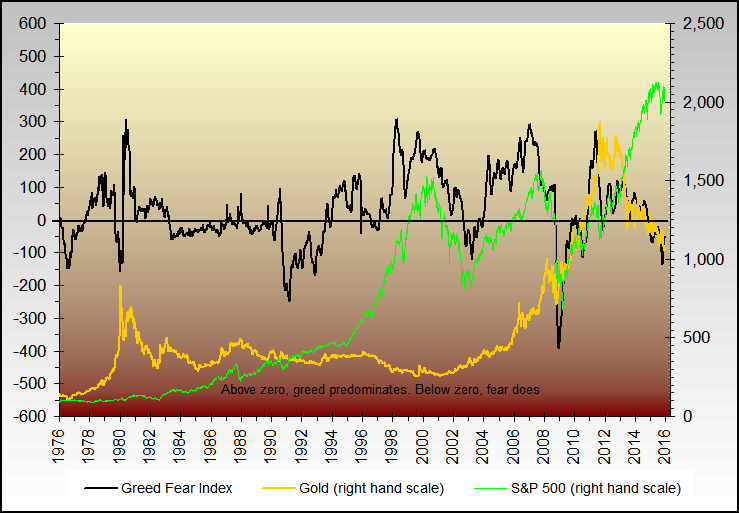
    Unfortunately I neither track it nor do I know where to get data prior to what that chart shows... but do have my own sentiment (calm or greed vs. fear or panic) index that I finally tuned up this year, and it goes back to 1990.

    Although I did splice in other data since things like VIX don't go back into the '70s, my work isn't public yet for periods prior to 1990. I'm still in research mode on it.


    Leave a comment:


  • Jim Nickerson
    replied
    Re: Bullish Information Re. Reality TV an omen?

    Reality Check By JACQUELINE DOHERTY Barron's 6/23/08

    http://online.barrons.com/article/SB121400300766893327.html?mod=9_0031_b_this_weeks_ magazine_columns [Subscription]

    When reality shows feature the market, a bottom may be near.

    CRUDE OIL PRICES NORTH OF $130 AND $4 GAS ARE STARTING to hurt. They've pinched consumer spending. They've sent food prices soaring and squeezed corporate profit margins. They've stoked inflation fears. And all that seemed to catch up with stocks last week as the Dow Jones Industrial Average fell below 12,000 Friday, with the S&P 500 retreating toward 1300.

    Oil punched out FedEx (ticker: FDX), whose shares dropped to 80.54, a three-year low, after the company reported operating costs increased 16% in its May quarter in part owing to higher fuel costs. General Motors (GM) shares, around 14, have returned to levels last seen in the 1970s, as consumers have stopped buying gas-guzzling SUVs. And on Friday Mexico's central bank was the latest to raise interest rates to combat inflation stoked by higher food and oil prices.

    The market's latest tantrum led us to wonder how soon it will be before a ray or two of optimism penetrates the gloom. What if, say, the recent surge in oil prices is indeed a bubble soon to burst, as my colleague Andrew Bary suggests in this week's cover story? Andrew lays out in riveting detail the many reasons why oil could peak, to which we'd add a few more. Like last Wednesday's launch of the latest reality show Black Gold. Airing on the truTV channel, it follows the fate of three groups of guys competing to hit oil first in Texas.

    Why should the financial markets care about the latest reality-TV offering? Because the debut of other market-oriented shows marked the top of two previous bubbles. In 2000, just as dot-com stocks were approaching the moon, Fox launched The $treet and TNT offered up Bull, both short-lived series about the financial world. Likewise, as the housing sector roared in 2005, shows about real estate and home renovations popped up on the tube like McMansions. Among our favorites: Flip This House on the A&E Network, not to be confused with Flip That House on TLC. Both remain on air today.

    So, could it be more than coincidence that Black Gold caught our eye just a day before China announced that it would cut subsidies on gasoline and diesel?

    The folks at Strategas Research Partners cite another contrarian sign: Since 2000, companies that have been added to the S&P 500 have lost 6.6% on average over the next 12 months, while those removed have gained an average of 21.7%. So what companies have been added of late? Southwestern Energy (SWN), Cameron International (CAM) and Range Resources (RRC), among others. And what's out? Financial and consumer names, like Ambac Financia l (ABK) and Circuit City Stores (CC), and companies that were acquired, including Bear Stearns and Tribune.

    If the price of oil falls to $100, then recent inflationary pressures, which have the markets in a lather, will recede. The Federal Reserve won't have to raise rates aggressively. Borrowing costs can stay low. The market's earnings multiple won't compress, as it does during inflationary periods. And the Treasury-bond yield curve will remain steep, helping finance companies reflate their depressed earnings.

    Certainly, the markets weren't forecasting such a future on Friday. But Thomas Lee, chief U.S. equity strategist at JPMorgan, has held onto his year-end S&P 500 target of 1450. He forecasts a second half in which the U.S. economy shows signs of recovery while higher interest rates abroad result in slowing growth in the emerging markets. The U.S. market has outperformed many foreign markets so far this year, and if Lee is on the money, that will continue. Time to change the channel?

    LAST WEEK CITIGROUP ONCE AGAIN SPOOKED the market by warning investors it would report large loan write-downs in the second quarter. Analysts now expect write-offs of around $10 billion and, as you'd expect, the shares fell with a thud -- down 6% on the week, to 19.21. Citi (C) now is down an eye-popping 65% from its 2006 peak and trades just a tad north of its March low.

    Even after the latest news, Dick Bove, an analyst at Ladenburg Thalmann, is positive on the shares. Write-offs will continue, he says, but the bank has raised billions in capital; it's adding low-cost deposits, increasing its loan volume, controlling costs and improving margins.

    Write-offs are like the proverbial pig swallowed by a snake. They take time to work through, and the snake doesn't look too pretty. But once Citi's cleansing is over, Bove says, the company will look better than before. His price target: $25.


    Here is one bullish article.

    Leave a comment:

Working...
X