Announcement

Collapse
No announcement yet.

Bullish Information

Collapse
X
 
  • Filter
  • Time
  • Show
Clear All
new posts

  • Jim Nickerson
    replied
    Re: Bullish Information

    Originally posted by friendly_jacek View Post
    You were right, I should have taken the profit on equities on friday. On the other hand, the PM action exceeded my expectation.

    BTW, I have one more link re: bullish posture in addition to the above ones. This one is from your favorite blog:
    http://www.decisionpoint.com/ChartSp...19_bottom.html
    I don't know that Swenlin is my favorite anything, but I think he puts up clear analyses, and I don' think his articles seem to hyping any investment product, besides showing his stuff as examples of what can be done on his site. I think he is a reasonable analyst.

    Leave a comment:


  • friendly_jacek
    replied
    Re: Bullish Information

    Originally posted by Jim Nickerson View Post
    jacek, there hasn't been that much bullish info that I've encountered. If you are running across it, then pop in here more often and put it up.

    You seem ecstatic. My experience, which may be unique, is when I have felt ecstatic with regard to my market positioning, next thing I know I get my ass kicked. Hang loose, and good luck.
    You were right, I should have taken the profit on equities on friday. On the other hand, the PM action exceeded my expectation.

    BTW, I have one more link re: bullish posture in addition to the above ones. This one is from your favorite blog:
    http://www.decisionpoint.com/ChartSp...19_bottom.html

    Leave a comment:


  • Jim Nickerson
    replied
    Re: Bullish Information

    Originally posted by friendly_jacek View Post
    I was too busy lately to frequent iTulip but I'm surprised by little activity on this thread.
    It turns out that several bloggers and high caliber (often contrarian) analysts with amazing track records stated last week (even before the infamous "no short" Friday) that this is either a major turning point in the markets (aka start of a new bull) or at least immediate tradable bottom with several weeks if not months of rally.
    These folks included Bill Cara, Marc Faber, Jeff Saut, and David Bensimon.
    Some of the links:
    http://www.minyanville.com/articles/.../index/a/19109
    http://www.billcara.com/archives/200...8_20.html#more
    http://www.bloomberg.com/avp/avp.htm...DHyHg0QFIg.asf

    All those imputs alligned perfectly with my sentiment trading and I closed short positions and went long last thursday when VIX spiked to 42. So far so good in all of my investment themes: equities, PM, miners, energy, and short bond. This was my most profitable day ever investing. Some equity selling today but expect to see a healthy rebound tomorrow.

    Good luck!
    jacek, there hasn't been that much bullish info that I've encountered. If you are running across it, then pop in here more often and put it up.

    You seem ecstatic. My experience, which may be unique, is when I have felt ecstatic with regard to my market positioning, next thing I know I get my ass kicked. Hang loose, and good luck.

    Leave a comment:


  • bart
    replied
    Re: Bullish Information

    Originally posted by friendly_jacek View Post
    Some equity selling today but expect to see a healthy rebound tomorrow.
    As do I, but I haven't put my money where my mouth is... yet.

    The trade within a trade...

    Leave a comment:


  • friendly_jacek
    replied
    Re: Bullish Information

    I was too busy lately to frequent iTulip but I'm surprised by little activity on this thread.
    It turns out that several bloggers and high caliber (often contrarian) analysts with amazing track records stated last week (even before the infamous "no short" Friday) that this is either a major turning point in the markets (aka start of a new bull) or at least immediate tradable bottom with several weeks if not months of rally.
    These folks included Bill Cara, Marc Faber, Jeff Saut, and David Bensimon.
    Some of the links:
    http://www.minyanville.com/articles/.../index/a/19109
    http://www.billcara.com/archives/200...8_20.html#more
    http://www.bloomberg.com/avp/avp.htm...DHyHg0QFIg.asf

    All those imputs alligned perfectly with my sentiment trading and I closed short positions and went long last thursday when VIX spiked to 42. So far so good in all of my investment themes: equities, PM, miners, energy, and short bond. This was my most profitable day ever investing. Some equity selling today but expect to see a healthy rebound tomorrow.

    Good luck!

    Leave a comment:


  • Jim Nickerson
    replied
    Re: Bullish Information R. After 4% declines.

    http://bespokeinvest.typepad.com/bespoke/

    9/17/08

    Multiple 4% Declines
    The S&P 500 has now declined more than 4% in two of the last three trading days, and below we highlight all prior occurrences since 1928. As shown, the last time we had two out of three -4% days was during the '87 crash. Prior to that, it hadn't happened since 1948. The majority of the occurrences were during the Great Depression, where 3% and 4% moves were commonplace. Overall, the average performance of the S&P 500 on the day following the last -4% day has been 0.85%. Over the next week, the average performance has been 4.94%, and it has been 6.43% over the next month. Following the last 4 instances, the S&P 500 has been up the next day every time, but just 50% of the time over the next week and month.

    Leave a comment:


  • Jim Nickerson
    replied
    Re: Bullish Information Re. SPX up 17% by 12/31/08

    http://www.bloomberg.com/apps/news?p...2CQ&refer=home

    Still Bullish on Stocks, Levkovich Predicts 17% Gain

    Sept. 8 (Bloomberg) -- Citigroup Inc.'s Tobias Levkovich wrestles every day with his prediction that U.S. stocks are set to stage their biggest year-end rally in a decade.

    ``I spend a lot of time questioning our premises, mostly on the drive home at night,'' said Levkovich, 47, Citigroup's New York-based chief U.S. equity strategist. ``Unless something's broken down on the analytical front, you go past it.''

    As they watch share prices erode, Levkovich and Lehman Brothers Holdings Inc.'s Ian Scott are sticking to forecasts for the Standard & Poor's 500 Index to climb at least 17 percent by Dec. 31. The last time the market ended the year so strong was in 1998, following the bailout of Long-Term Capital Management.

    Leave a comment:


  • Jim Nickerson
    replied
    Re: Bullish Information Re. Bullish US$ crossover

    http://bespokeinvest.typepad.com/bespoke/page/2/

    Dollar Golden Cross 9/3/08

    Originally posted by Bespoke
    The US Dollar index has made a "golden cross" today, as its 50-day moving average has crossed above its 200-day moving average as both are rising. The "golden cross" is viewed as a positive by market technicians, as it is thought to signal a significant favorable turning point. Regardless of your thoughts on technical analysis, the chart below highlights a clear shift in the Dollar over the last few weeks.
    We recently highlighted how the Dollar has performed following all prior "golden crosses" at Bespoke Premium. Click here to subscribe and view the report.
    And here is a long term chart showing the degree of $ apprecication after the last crossover in Q2 05 http://stockcharts.com/h-sc/ui?s=$US...66&a=132940973

    Leave a comment:


  • raja
    replied
    Re: Bullish Information Re. Sy Harding Seasonal Timing Model

    Originally posted by Jim Nickerson View Post
    Below is something one does not often see from those investment gurus and pundits on the internet at free sites.


    Harding's work and his record are reasonalby impressive to me. For some of those who may be learning or wishing to learn how to manage their own monies, Harding's system seems to me to be worth a trial for at least a portion of one's allocation that could be deployed in an DJI or SPX index fund.

    In the link and http://www.streetsmartreport.com/sts.html (in case the link doesn't work) he discusses his seasonal timing. He mentions the use of the MACD indicator as an integral part of his system. However, he does not discuss the parameters he uses for loading the MACD.

    In the link above he shows the DJI with a line to show the price action. I'm going to see if I can figure out what parameters he uses to contruct the MACD, and will post it here if I figure it out.

    Edit: Here http://stockcharts.com/h-sc/ui?s=$IN...d=p72423097340 is a stockcharts.com chart using daily value and the default MACD settings on stockcharts. (12,26,9). To my eyes this seems to match Harding's example closely if not exactly. Thus one could use the dates Harding uses and the stockcharts.com $INDU (DJI) to determine the MACD signals or just a well use bigcharts.marketwatch.com charts, where the MACD default perameters are the same as mentioned above.
    Seems like a good system.
    I know someone who uses something similar, and claims it's quite successful.
    However, I think at the moment we are in very unusual times, and I wouldn't bet on the seasonal trends holding . . . .

    Leave a comment:


  • Jim Nickerson
    replied
    Re: Bullish Information Re. Sy Harding Seasonal Timing Model

    Below is something one does not often see from those investment gurus and pundits on the internet at free sites.

    Originally posted by Sy Harding, 8/29/08
    However, the time is approaching to be sure you're aware of the most important and consistent pattern of at least the last 60 years. That is the market's annual seasonal pattern, the tendency for the market to make most of its gains in the fall and winter months, and suffer most of its corrections in the summer months.
    That seasonal pattern was noticeable even under the old-time Wall Street maxim "Sell in May and Go Away". It showed that, because of the frequency of significant corrections in the 'unfavorable season', over the long-term an investor in the market only for the six-month period from November 1 to May 1 matched the performance of an investor invested for the entire year. A 'seasonal investor' also avoided 50% of market risk over the years, by virtue of being safely on the sidelines earning interest on cash for six months out of every twelve.

    But obviously the market does not begin to rally exactly on November 1 each year. Nor does it top out exactly on May 1 each year.
    So in 1998, after much research and development, my firm, Asset Management Research Corp, developed our Seasonal Timing Strategy to better identify the entry and exit points for the market's annual 'favorable season'.
    That research made the important discovery that rather than being a six month in - six month out seasonal pattern, the seasons vary year to year from four to seven months depending on conditions. So the strategy uses a momentum-reversal indicator in conjunction with the calendar, to indicate when the favorable season has begun and ended. In back-testing over a 50-year period, it more than doubled the total return of the Dow and S&P 500. More importantly, in real time since 1999 (which has included five years of bull market and four years of bear market), it has performed even more impressively. It has more than tripled the total return of the S&P 500, with no down years, even during the serious 2000-2002 bear market. We use the strategy for one of the portfolios in my newsletter. But investors need not subscribe just for that strategy. They can follow the strategy's simple rules on their own.
    Harding's work and his record are reasonalby impressive to me. For some of those who may be learning or wishing to learn how to manage their own monies, Harding's system seems to me to be worth a trial for at least a portion of one's allocation that could be deployed in an DJI or SPX index fund.

    In the link and http://www.streetsmartreport.com/sts.html (in case the link doesn't work) he discusses his seasonal timing. He mentions the use of the MACD indicator as an integral part of his system. However, he does not discuss the parameters he uses for loading the MACD.

    In the link above he shows the DJI with a line to show the price action. I'm going to see if I can figure out what parameters he uses to contruct the MACD, and will post it here if I figure it out.

    Edit: Here http://stockcharts.com/h-sc/ui?s=$IN...d=p72423097340 is a stockcharts.com chart using daily value and the default MACD settings on stockcharts. (12,26,9). To my eyes this seems to match Harding's example closely if not exactly. Thus one could use the dates Harding uses and the stockcharts.com $INDU (DJI) to determine the MACD signals or just a well use bigcharts.marketwatch.com charts, where the MACD default perameters are the same as mentioned above.
    Last edited by Jim Nickerson; August 29, 2008, 09:18 PM.

    Leave a comment:


  • FRED
    replied
    Re: Bullish Information Re. Maund: Gold and Silver bottoms.

    Originally posted by Jim Nickerson View Post
    8/25/08


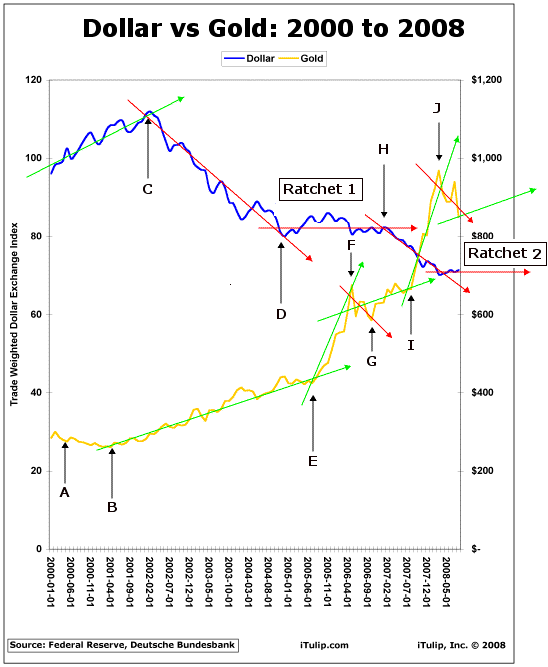
    If the rise in the US$ were to continue in here for a while, $GOLD might at best go sideways as it rather much did in the first 6 months of 2005. At least since first of 2007 gold and dollar have moved in near perfect unison--oppositely.

    Here's a chart: http://stockcharts.com/h-sc/ui?s=$US...232&a=80445168
    Reminder of the iTulip position on gold per FIRE Economy and the Dollar Ratchet: commodity prices are 80% a function of dollar purchasing power, dollar purchasing power 80% a function of foreign central bank demand for dollar denominated finance assets. The dollar is managed down by central banks in a series of depreciations such as 2001 to 2005 and 2006 to 2008 that we call the "Dollar Ratchet." Next depreciation starts up again in 2009 but the dollar and commodities move sideways until then, unless there is an accident.

    Medium Term (six months to a year):


    Dollar Ratchet price of gold
    Long Term (two to seven years):

    Dollar versus gold across four major economic epochs

    Leave a comment:


  • Jim Nickerson
    replied
    Re: Bullish Information Re. Maund: Gold and Silver bottoms.

    8/25/08

    If the rise in the US$ were to continue in here for a while, $GOLD might at best go sideways as it rather much did in the first 6 months of 2005. At least since first of 2007 gold and dollar have moved in near perfect unison--oppositely.

    Here's a chart: http://stockcharts.com/h-sc/ui?s=$US...232&a=80445168
    Last edited by Jim Nickerson; August 27, 2008, 12:15 AM. Reason: added chart link

    Leave a comment:


  • Jim Nickerson
    replied
    Re: Bullish Information Re. Faber comment on Bonar.

    From Barron's http://online.barrons.com/article/SB...ost_viewed_day

    in a column by Randall Forsyth, Thursday 8/21/08

    Originally posted by Forsyth
    But is this engine of inflation, the credit bubble that resulted in the massive U.S. external deficit, about to go into reverse?

    At this point, it is speculative to conclude that. But alert investors should consider that possibility.

    Indeed, Barron's Roundtable member Marc Faber suggests this could happen in his latest missive to subscribers to his Gloom Boom & Doom Report.

    A declining U.S. current account deficit could lead to a tightening of global liquidity as foreign central banks accumulate less dollar reserves, which are recycled into the global capital markets. The U.S. current account gap has shrunk from a peak over 6% of gross domestic product to under 5% as weakening consumer demand has cut imports while exports remain relatively robust as growth continues in emerging economies and the dollar is cheap.

    As the growth of foreign monetary dollar reserves slows, the dollar is boosted and gold and commodities are hurt, Faber points out. Further, he writes:

    "I have a friend who is an outstanding economist who thinks that the Asian current account surpluses will shrink in 2009 by about 50% from their peak in 2007. In this scenario, globally liquidity would become extremely tight and would have a devastating impact on asset markets including real estate, commodities, non-AAA bonds and equities. Such a decline in the Asian current account surpluses would cut the U.S. current account deficit by half and lead to a very strong U.S. dollar."

    Let's recap. The credit crunch that has resulted in the U.S. recession (that's yet to be officially recognized) is being transmitted abroad by the reduction of the U.S. current account deficit and the quasi-fixed exchange-rate currency system.

    Indeed, if Asian currencies begin to come under downward pressure, either in an international flight to quality or as a consequence of a declining trade surpluses, their central banks could use their cache of foreign exchange—mainly dollars—to stabilize their exchange rates. That would turn them into sellers of dollar assets or at least less vigorous buyers.

    The inflationary tide in global liquidity could be turning as a result. The sharp break in gold suggests that could be happening, and that's being transmitted through the commodities markets. The dollar has stopped going down, and even has flattened out against the renminbi. The bear market in risk assets, such as stocks and particularly the Chinese market, also is symptomatic of a liquidity squeeze. As for the U.S. housing market, it is at the nexus, resulting in wealth losses for borrowers and a reduction in lenders' ability and willingness to extend credit.

    Leave a comment:


  • Jim Nickerson
    replied
    Re: Bullish Information Re. Maund mining stocks

    Hussman noted in this week's note that he had opened an 8% position in PM stocks in his total return fund, I guess just this past week.

    Here is a link to Clive Maund's latest note and his assessment of where mining stocks are. http://www.safehaven.com/article-10970.htm

    I disagree with his notion: "it is wise to start buying ahead of the bottom." That all depends upon where the bottom turns out to be. A week ago and two weeks ago were periods that were "ahead of the bottom" and perhaps grapejelly could comment on how well that has worked.

    A more ideal set up, as an example, is in the bottom chart. Look at the MACD bottom at end of 1997 and the higher bottom of it in July or so 1999. Unless one trades in and out from the earlier bottom, one took some sort of a bath. The ideal part would have been to enter in July 1999, again unless one traded the first up turn.

    I report, you decide.

    Also a leveraged mutual fund PMPIX made me a lot of money, despite selling it a year early. It moves 1.5X the DJ PM index--and I forget what all that is, but I think major PM mining companies.

    Leave a comment:


  • Jim Nickerson
    replied
    Re: Bullish Information

    Originally posted by metalman View Post
    for the moment, granville is correct. for the year, ej is correct. itulip has made me money... out of techs, into gold, out of rre, out of stocks dec. 07... etc. but, as you say, you have to act.
    That is the crux of investing, betting, speculating. One has to act, and if successful, right more often than wrong.

    Leave a comment:

Working...
X