Announcement

Collapse
No announcement yet.

The Elusive Canadian Housing Bubble

Collapse
X
 
  • Filter
  • Time
  • Show
Clear All
new posts

  • GRG55
    replied
    Re: The Elusive Canadian Housing Bubble

    Originally posted by jk View Post
    "the markets can continue to irrational..." and so on. i learned that from bitter, and expensive, experience, when i shorted u.s. housing companies around 2006. given that canada's cd has yet to achieve the zero bound, the canadian housing market may wait on a move from the u.s. fed to begin its journey to overshoot below the mean.
    I have a deep dislike for rush hour traffic, so when last year I once again started keeping downtown office hours (after almost 15 years avoiding it), I developed a habit of getting in early and leaving late. The collapse in the oil patch has been so traumatic that the downtown rush hour has almost disappeared; traffic out of downtown at 5 pm (the previous peak time) is now noticeably less than it used to be at 6 pm four months ago.

    That is an indication that the actual number of job losses in the city core is much higher than the headline numbers suggest. And it also means that family income levels in this Canadian city of professionals are headed for a drop once the severance package amounts are exhausted. Given the over-leveraged state of property markets, and the idiotic prices to which local housing has been elevated (not to mention all the late model Bimmers and Audis + the proliferation in private school enrollments) I expect there are many two-professional-income families around these parts that cannot long tolerate the loss of even one of those incomes.

    Canadians have become complacent about debt; I doubt there is much discrimination by income level in that characteristic. It takes time for the housing market to turn, but I would not be surprised to see lots of signs of acute stress in this city before this year is over.
    Last edited by GRG55; March 21, 2015, 03:09 PM.

    Leave a comment:


  • don
    replied
    Re: The Elusive Canadian Housing Bubble

    Lazarus arises yet again . . . . 'equity' debt insatiable

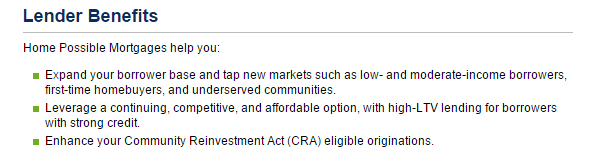
    The return of risky loans: Freddie Mac offering a 3 percent down loan called Home Possible Advantage targeted to cash strapped buyers. FHA loans and interest only loans permeate market.

    I love when mortgage products get creative in their titles. We had those wonderful “option ARMs” that basically gave you the option to not pay your mortgage principal. But what people forget beyond the egregious toxic mortgages, most foreclosures hit people with vanilla 30-year fixed mortgages. That is right, of the 7,000,000+ completed foreclosures most were boring traditional mortgages. Since the stock market has been on a massive run for six years now, people have forgotten that recessions routinely hit our economy. It is part of the economic system.

    If you can’t pay your mortgage, it doesn’t matter if you have a 30-year fixed, ARM, interest only loan, or other variety of payment you are making to the bank. Now that banks know they can boot you out and sell to an investor, the foreclosure process started humming along. A reader pointed out that Freddie Mac is entering once again into offering low down payment loans to cash strapped borrowers dreaming of their first crap shack. The product is called Home Possible Advantage but in reality, you are making a big bet with little equity.

    Home Possible Advantage

    For all intents and purposes, Freddie Mac and Fannie Mae were nationalized during the housing crisis. Free market Kool-Aid drinkers conveniently forget that we conducted some massive socialism in bailing out the financial sector. In theory the free market sounds good for housing but the housing market is one heavily subsidized segment of our economy (i.e., government backed loans, mortgage deductions, property taxes, etc).
    So it was interesting that resurrected and nationalized player Freddie Mac is introducing a very low down payment product:


    This is adding a high level of risk for new buyers. Since Americans are tapped out and the banking industry has juiced home values up thanks to investors, it is time to hand this game off to cash strapped Americans. That is, unless you can offer riskier products.
    3 percent down immediately puts you in a negative equity position if you need to sell. The standard commission is 5 to 6 percent so right there you are underwater. You are fully betting on home prices going up. But given the dwindling pool of buyers constrained by incomes, Home Possible Advantage is going to target those least able to weather a minor economic setback:


    Don’t you think it would serve the community better if home prices weren’t jacked sky high by investors and social welfare benefitting banks? Rents are being pushed up not because incomes are going up but because of insane restrictions and massive speculation brought on by easy Fed money (the bank of all banks). Rental Armageddon is a reality not because people are seeing great jumps in wages. This product is a reflection of simply adding on more debt while trying to keep inflated prices alive.
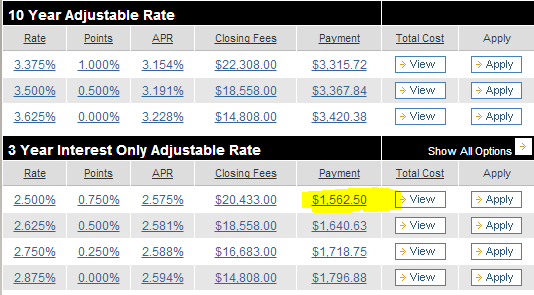
    You can add this product to the menu of already risky loans including FHA insured loans. All these loans need is a minor recession to set off another chain of reaction. Then you have ridiculous interest onlyproducts that are a massive subsidy to the wealthy, the exact opposite of the Home Possible Advantage product:


    Assumptions: $1,000,000 home purchase, $250,000 down payment, FICO 740 and higher

    If you are a wealthy household, you have every incentive to pay a big portion in interest since you can write this off against your taxes. Why should the government subsidize giant home mortgages? Now, at the very end where momentum is dying, the government is going to extend riskier products to lower income Americans that can’t even scratch up 5 or 10 percent as a down payment. Yet somehow, they are in a position to buy a $500,000 or $700,000 crap shack?
    Everything circles back and Home Possible Advantage is a funny name for putting a new batch of Americans at a very big disadvantage should a minor hiccup in the economy occur. But we are in a permanent bull run right? Housing values only go up until they don’t. But that is the mantra.

    Leave a comment:


  • jk
    replied
    Re: The Elusive Canadian Housing Bubble

    Originally posted by GRG55 View Post

    Still, can you really blame Canadians for their belief in the resilience of real estate? For years, sourpusses like me have been banging on about Canada’s teetering housing market, and it’s only continued to go up, up, up. The Bank of Canada once used to fret regularly that house prices and debt levels were too high, but you don’t hear that much anymore. As for Finance Minister Joe “there is no bubble” Oliver, he’s sticking to his claim that a soft landing for Canadian real estate is just around the corner...
    "the markets can continue to be irrational..." and so on. i learned that from bitter, and expensive, experience, when i shorted u.s. housing companies around 2006. given that canada's cb has yet to achieve the zero bound, the canadian housing market may wait on a move from the u.s. fed to begin its journey to overshoot below the mean.
    Last edited by jk; March 21, 2015, 03:10 PM.

    Leave a comment:


  • santafe2
    replied
    Re: The Elusive Canadian Housing Bubble

    Just out today, a new book by Hilliard MacBeth, "When the Bubble Bursts", Surviving the Canadian Housing Bubble. I just ordered a copy but they're not yet in stock for your Southern neighbors.

    http://www.amazon.com/When-Bubble-Bu...sap_bc?ie=UTF8

    And I thought the US housing bubble was the perfect storm. The Bank of Canada is not even done lowering rates. Oh...Can-a-da!

    Leave a comment:


  • don
    replied
    Re: The Elusive Canadian Housing Bubble

    ...But Canadians should put aside what they might think about the importance of oil prices to the economy. Because, for all the talk of Canada being an energy superpower, we’ve clearly shown that our greater strength lies in buying, selling, renovating and renting houses and condominiums. The economy certainly relies more on what gets built above ground than what lies beneath. Back in the 1990s, the manufacturing and energy industries were larger than the real estate sector, but, over the years, they’ve changed places...

    ...Put another way, real estate now makes up close to 13 per cent of Canada’s GDP, compared to less than 10 per cent for energy...
    Aren't equities a FIRE fundamental . . . .

    Leave a comment:


  • GRG55
    replied
    Re: The Elusive Canadian Housing Bubble

    Never mind oil. If housing goes bust, we’re screwed

    Despite naysayers, Canadians still believe in the resiliency of the housing market

    Jason Kirby
    March 12, 2015

    A big part of a bank economist’s job is to get the institution’s research in front of as many eyeballs as possible, and one of the best ways to do that is to be the first to spot a juicy new trend. If it happens to relate to Canada’s primary obsession, real estate, all the better. So Bank of Montreal senior economist Sal Guatieri had a winner on his hands last October when he analyzed the Canadian housing market and showed that three cities alone—Toronto, Vancouver and Calgary—were driving most of the overall price and sales gains in the country, while almost everywhere else, activity was slowing. He dubbed these cities the “Hot 3” and, for a short time, it became the main lens through which people talked about the Canadian housing market. That is, until one of the Hot 3 plunged into a deep freeze. And then there were two.

    The speed with which that narrative crumbled—with Calgary falling as quickly as it did out of the ranks of the Hot 3—is being taken in stride around water coolers and at dinner parties in the remaining Hot 2 cities. Calgary, it gets said, is a special situation because of its connection to the floundering oil patch. The report this week from the International Monetary Fund (IMF) warning that the debt levels of Canadian households dwarf those of many other developed countries is also unlikely to push Canadians toward prudence any more than the IMF’s previous half-dozen similar warnings did. Even the latest report on housing starts, which showed an 18.8 per cent plunge in February from the year before, was quickly explained away as a weather effect.

    At the same time, tales of excess from the market fail to shock anymore. Or, at least, they shock a lot less than they did a few years ago. And so, as the average price of a detached home in Toronto passes the $1-million mark—the price having climbed nearly nine per cent in the last year alone—it was noted with more amusement than alarm. In Vancouver, where a mansion just sold for $52 million (that’s not even a record), rundown shacks continue to list for close to $1 million. And why not? Lenders are hard at work pushing mortgages with rates as low as 2.24 per cent for two years, barely a notch above the Bank of Canada’s latest core inflation reading of 2.2 per cent.

    Still, can you really blame Canadians for their belief in the resilience of real estate? For years, sourpusses like me have been banging on about Canada’s teetering housing market, and it’s only continued to go up, up, up. The Bank of Canada once used to fret regularly that house prices and debt levels were too high, but you don’t hear that much anymore. As for Finance Minister Joe “there is no bubble” Oliver, he’s sticking to his claim that a soft landing for Canadian real estate is just around the corner...

    ...But Canadians should put aside what they might think about the importance of oil prices to the economy. Because, for all the talk of Canada being an energy superpower, we’ve clearly shown that our greater strength lies in buying, selling, renovating and renting houses and condominiums. The economy certainly relies more on what gets built above ground than what lies beneath. Back in the 1990s, the manufacturing and energy industries were larger than the real estate sector, but, over the years, they’ve changed places...

    ...Put another way, real estate now makes up close to 13 per cent of Canada’s GDP, compared to less than 10 per cent for energy...

    Leave a comment:


  • santafe2
    replied
    Re: The Elusive Canadian Housing Bubble

    Originally posted by GRG55 View Post
    Household debt to disposable income was 163.3% at the end of the last quarter but the increase comes as household net worth increased 7.5%...
    I think the peak ratio in the US was about 130% but this was during a period of more normalized interest rates. In the current environment it makes perfect sense to me that this bubble has well exceeded the US bubble but unfortunately the market and interest rates will still revert to mean sometime in the future.

    When home prices reverted to mean in the US many home owners simply stopped making payments, squatted in their homes until evicted and then handed the keys over to the bank. The Canadian mortgage system is quite different. As an example if I have a mortgage for $163,300, (nowhere near Toronto), and my home suffers mean reversion and is now worth $100,000, I can’t walk away from my full recourse mortgage.

    And to add fuel to the fire, after 5 years I have to renegotiate my loan with my bank. I’m about 40% under water and my loan now looks foolish. Does the bank give me a new loan? The risk is now much greater, do they raise my interest rate? This sounds like the proverbial rock and hard place.

    Looks like a lost generation financially unless the Bank of Canada takes a few plays from the US disappearing debt play book….now you see it, now we own it…poof, it never existed.

    Leave a comment:


  • GRG55
    replied
    Re: The Elusive Canadian Housing Bubble

    Originally posted by EJ View Post
    We have many such charts.

    The question is, Is there a maximum threshold for household debt, credit market debt, public debt, and foreign (external) public debt?

    Here's the official answer from Larry Summers when I asked him in 2011. Having asked around I can assure members that Summers' answer is The Official Answer.

    The answer is that previously estimated thresholds have been "comfortably surpassed." Apparently they think it can go on forever. Or maybe they think it can go on for as long as they are in office and accountable and the next guy in line will have to deal with the ultimate debt crisis.
    Yep...forever!

    Canada household debt ratio hits new record of 163.3%

    March 12, 2015 | Last Updated: Mar 12 5:22 PM ET

    Cuts to the Bank of Canada overnight lending rate appear to be the driver behind consumers ratcheting up their debt, which Statistics Canada said Thursday reached record levels in the four quarter of 2014.

    Household debt to disposable income was 163.3% at the end of the last quarter but the increase comes as household net worth increased 7.5%...

    ...“It’s partly fuelled by the Bank of Canada’s rate cut and party fuelled by the strength in the Toronto and Vancouver housing market,” said Mr. Porter.
    New data from the Teranet-National Bank House Price Index, also released Thursday, show prices continue to increase in those two cities, with Vancouver existing home prices up 5.7% in February from a year ago and Toronto up 7.3% during the same period.

    Leave a comment:


  • GRG55
    replied
    Re: The Elusive Canadian Housing Bubble

    February data in (Vancouver and Toronto remind me of some lyrics from a 5th Dimension song from the late '60s: "In my beautiful, my beautiful balloon...up, up and away".)

    The oil price fall effects on Calgary and Edmonton will take a while to filter through I expect.

    Leave a comment:


  • GRG55
    replied
    Re: Escape from Toronto

    Originally posted by Fiat Currency View Post
    The only people who would say that, have never visited Montreal !!
    +1

    +2 if you visit Montreal during F1 week.

    Leave a comment:


  • ProdigyofZen
    replied
    Re: Escape from Toronto

    Originally posted by Fiat Currency View Post
    The only people who would say that, have never visited Montreal !!
    A deep French accent on a female is intoxicating.

    Leave a comment:


  • Fiat Currency
    replied
    Re: Escape from Toronto

    Originally posted by Polish_Silver View Post
    Are you claiming that Toronto is not one of the world's great cities?

    Where I lived, in the 80's, it had a reputation for good looking women.
    The only people who would say that, have never visited Montreal !!

    Leave a comment:


  • Polish_Silver
    replied
    Escape from Toronto

    Originally posted by GRG55 View Post
    If I was in Toronto, and managed to get out of Toronto (to Buffalo, or anywhere else), the last thing I would want to do is return to Toronto. I might be tempted to dig a tunnel...
    Are you claiming that Toronto is not one of the world's great cities?

    Where I lived, in the 80's, it had a reputation for good looking women.

    Leave a comment:


  • santafe2
    replied
    Re: The Elusive Canadian Housing Bubble

    Originally posted by GRG55 View Post
    If I was in Toronto, and managed to get out of Toronto (to Buffalo, or anywhere else), the last thing I would want to do is return to Toronto. I might be tempted to dig a tunnel...
    Under Lake Ontario...now that's a tunnel...

    Leave a comment:


  • GRG55
    replied
    Re: The Elusive Canadian Housing Bubble

    Originally posted by santafe2 View Post
    It must be partly due to the ~20% fall in the value of the Canadian dollar. Maybe it's time to skip the 416 and head south to Buffalo. Buy a nice place, a Cessna 172 and commute. You could do that for about half the price. With your spare change, have a limo waiting for you at the airport. Problem solved.
    If I was in Toronto, and managed to get out of Toronto (to Buffalo, or anywhere else), the last thing I would want to do is return to Toronto. I might be tempted to dig a tunnel...

    Leave a comment:

Working...
X