Announcement

Collapse
No announcement yet.

“One in 31 Adults”

Collapse
X
 
  • Filter
  • Time
  • Show
Clear All
new posts

  • #46
    Re: “One in 31 Adults”

    You'll have to trust me that we had an explosion of violent crime starting when the graph starts because I don't have the time or interest in doing a google search to curb your skepticism. Check it our yourself if you want, make personal attacks about my use of statistics, but in the end it's true--crime in this country exploded after 1960. And I acknowledged that other factors beside the exclusionary rule were at issue as well. But my personal conviction is that if you teach people to blame others to avoid responsibility, they will do that. If you teach people that it's someone else's fault that they are being punished, they have no incentive to conform their conduct to societal standards. Disagree if you want. Raise your kids under an exclusionary rule theory and see how they turn out; I wouldn't.

    You've shifted the debate and suddenly are talking about drug users. I'm talking about drug dealers. The sentences for drug users are very light. Even in the federal system, where drug crimes tend to be punished severely, drug possession is a nothing misdemeanor. The people who spend any real time in prison are people who deal drugs, usually drugs that they do not personally use (remember the old maxim: don't get high on your own supply). If you don't think drug dealers belong in prison, vote to overturn the drug laws and legalize them. But unless and until that's done, it's a crime. If you want to criticize America for putting people in jail for doing something that every other OECD country believes is a serious offense, go ahead, but I don't see how you can justify that.

    You say it's a problem that we investigate that crime more than other countries? How does that make sense? If we spent a bunch of resources rooting out corruption and fraud and so had 40,000 fraudsters in prison, would you criticize America for its incarceration rate? If we spent a bunch of resources rooting out rapes and so had 40,000 rapists in prison, would you criticize America for its incarceration rate? Your beef fundamentally is not with the incarceration rate, it's with the choice to expend resources on a particular crime that apparently you do not agree with. That's a different argument. But just because you personally think that drugs should be legalized or decriminalized does not make it, in fact, any less a crime today on the books (one that all OECD countries have on their books), and societies have a right to expect that citizens obey the laws and when they don't, to put them in jail. As you've already acknowledged, our average sentence length is completely in line with the world, so we're not putting people in jail way longer for the same crime. We've just caught more people committing that crime.

    Really, all you are doing is minimizing the crime you don't like and asserting that those drug dealers should have gotten a ticket like a jay walker. Well, I don't agree with that at all. Drugs are highly valuable. You catch a drug dealer with a couple ounces of methamphetamine, cocaine, heroin, ecstasy, whatever, that's several thousand dollars of product (and there is no shortage of people you could catch with that amount of drugs). You say give him a $40 ticket? That's how much his crumbs sell for. You've basically decriminalized methamphetamine and the rest of those drugs because really, who wouldn't take that bargain. I can make several hundred thousand dollars a month and the risk is a couple $40 tickets now and then? That's effectively legalization.

    Which is really what you're promoting. We have approximately 40,000 guilty drug dealers in prison. How can you criticize that unless you believe that the conduct itself should not be punished? You're certainly entitled to that view, but that in and of itself acknowledges that it's a problem of criminal activity and how you define it and not of incarceration rates.

    Comment


    • #47
      Re: “One in 31 Adults”

      Figuring out causality is a very difficult thing. -- We do know the following


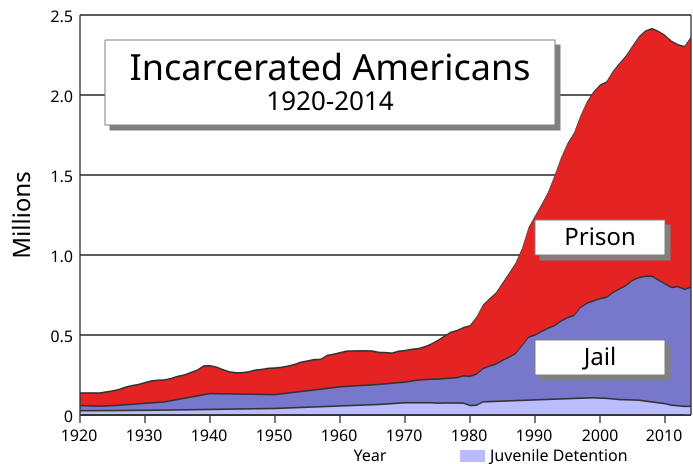
      Starting 1980, the incarceration rate jumped.

      A few things occured, during the early 80s that may have something to do with this -

      One was the crack epidemic - so well documented by Gary Webb

      The second was the "War on drugs"

      Third, as violence from drug turf wars increased, and people that were typically involved in it were repeat felons, it led to the "Three strikes" laws that started in the early 1990s.

      Comment


      • #48
        Re: “One in 31 Adults”

        Originally posted by rdrees View Post
        We have approximately 40,000 guilty drug dealers in prison. How can you criticize that unless you believe that the conduct itself should not be punished? You're certainly entitled to that view, but that in and of itself acknowledges that it's a problem of criminal activity and how you define it and not of incarceration rates.
        Your 40,000 figure is from 1980!!
        Today we have 500,000 people in prison for drug offenses. This is both drug users and dealers.
        This is 25% of all the people in prison in the USA.
        This is 5% of all the people in prison in the world!!
        It's 20X the world norm.

        It's common knowledge that possession over a certain amount (2oz?) automatically makes you a "drug dealer" in the US system and so yes, the definitions of users and dealers blurs. Except for possession, most federal marijuana arrests are for "Sale/Manufacture" which includes home cultivation for personal use. More of those nasty "dealers" we have jailed. But the dealer of a bit of pot out of the back of his house is quite different from a Meth drug lord. The former is practically legal in California while the latter kills people. You try and categorize everybody the same and state they you're glad they're all locked up. But this issue is more complex and the stats reflect that.

        "Prisoners sentenced for drug offenses constituted the largest group of Federal inmates (55%) in 2001, down from 60% in 1995 (table 18)." Source: Harrison, Paige M. & Allen J. Beck, PhD, US Department of Justice, Bureau of Justice Statistics, Prisoners in 2002 (Washington, DC: US Department of Justice, July 2003), p. 11.

        Over 80% of the increase in the federal prison population from 1985 to 1995 was due to drug convictions. Over half of these were marijuana offenses. Source: US Department of Justice, Bureau of Justice Statistics, Prisoners in 1996 (Washington DC: US Department of Justice, 1997)

        (2007) Marijuana accounts for 47.4% of all drug arrests. Source: Crime in the United States

        (2007) 775,138 Americans were arrested for mere marijuana possession, only 597,447 people were arrested for all violent crimes combined, which includes murder, non-negligent manslaughter, forcible rape, robbery, and aggravated assault. Source: Crime in the United States

        Of course RDrees this is somewhat of a resource allocation issue. Everything always boils back to bucks. It's also a choice of enforcement issue (as is proven by Obama on pot), an issue of law and an issue of sentencing.

        As I said before:
        --I can agree that 50% of the overall incarceration issue is higher violent crime in the USA.
        --For the non-violent 50%, the sub-stats prove (and you've stated) incarceration is out of whack. You can call it a resource allocation issue, a choice of enforcement issue, bad laws, and a sentencing issue. And yes, it also requires people to break the law. Of course.

        It takes all of those to lock-up 1,000,000 non-violent Americans at a rate that is over 20X the world norm.

        Comment


        • #49
          Re: “One in 31 Adults”

          "The real question is are these people deserving of being in jail? Did they commit crimes against the law? (regardless of whether the law is right on a subjective measure) and was the process fair? should be the real questions."

          I disagree with your logic. I agree that the real question is whether or not these people are deserving of being imprisoned. However, if we are concerned about the fairness of our judicial system then we cannot disregard the righteousness of the laws. These outrageous numbers are indicative of a system of unjust laws. The laws in this country have become so numerous and onerous that it has been estimated that an average U.S. citizen commits 3 felonies/day. The legitimacy of these laws IS the main issue here.

          Comment


          • #50
            Re: “One in 31 Adults”

            MarkL, I think your anti-drug law viewpoint is clouding your judgment on the underlying issue. Let's assume that I agree with you that marijuana should be legalized. The point remains that it is not. We live in a democracy, and the way to change a law is not to criticize police for enforcing it--that's their job, after all. Would you really want the police to have the absolute discretion to just decide that they won't enforce a valid law that's on the books? That's dangerous, in my opinion. Rather, the way to change a law is to have our elected representatives repeal it.

            There is no such thing as "practically legal." Something is either a crime or it is not. Just because "everyone's doing it" doesn't make it legal. And unless and until the law making marijuana illegal is repealed, possessing or dealing marijuana is a crime, just like in every other OECD country. So what if we're 20X more successful than the rest of the world at solving drug crimes? What's wrong with that? Yes, you may think those were wasted resources, yes you may think that conduct should be legal, but bottom line, our elected representatives disagree with you and if you have a problem with that you have a problem with democracy.

            And I'm sorry, but a number of your premises are innacurate or misleading, so let me go through them.

            (1) Your "common knowledge" about drug crimes is wrong. A person cannot be convicted of dealing drugs unless he or she pleads guilty or a jury finds beyond a reasonable doubt that the person either actually dealt drugs or specifically intended to deal the drugs in his or her possession. That's a constitutional right. Your practical assumption that 2oz could be possession (apart from MAYBE marijuana) is wrong, too. As a practical matter, someone in possession of 2 oz of an illegal drug is likely to be convicted as a drug dealer. Consider crack cocaine: one "hit" is 1/5 gram. A person with 2 oz of crack cocaine, therefore, is in possession of approximately 280 "hits" of crack at a street value of several thousand dollars. I would suspect most juries would believe that person was in possession of that much crack because they intended to sell it. You are sadly misinformed or far out of the mainstream if you think that this "blurs the line" between dealer and user.

            (2) You make it sound like a crime to punish someone who grows pot. It's exactly the opposite: it's a crime to grow pot. You may disagree with it, but that's a fact. But you bring up pot because there's a much more vocal group of people in favor of legalizing it and so it's an argument that may have an emotional pull. You point out that there are more pot arrests than anything else. Well, it's illegal! What are the cops supposed to do? Ignore it? As I noted before, that's dangerous and anti-democratic. And in any event, you're talking about arrests, not incarceration. Pot possession in some states is a ticket after the arrest. Even in the federal system, where drug offense sentences tend to be severe, there's a special section that reduces marijuana sentences for growing/selling less than 50 kg/50 plants compared to all other illegal drugs. Marijuana offenses are barely a blip in the incarceration debate.

            (3) You point to federal prison statistics and the growth in drug convictions as the only evidence of marijuana offenses being any part of the incarceration rates. As noted, as long as you've got less than 50kg/50 plants, your sentence is vastly shorter than any other illegal drug: get caught with 45 kg of marijuana, and your MAXIMUM sentence is 5 years. Get caught with 45 kg of cocaine and your MINIMUM sentence is 5 years. If it's 45 kg of heroin, crack, or meth, your MINIMUM sentence is 10 years. And, by the way, relying on federal incarceration rates are totally misleading because they are a small proportion of the overall US incarceration rate, with federal prisoners making up barely more than 12% of the US prison population.

            You say that I agree that incarceration is out of whack. That is as false a claim as you can make. My entire position on this has been that incarceration is not out of whack in the US, crime is. For incarceration to be out of whack, we would have to show that we had a lot more prisoners with about the same amount of crime and resources put into catching criminals. That's not the case at all: we have much more crime than the OECD median, and we expend a lot more resources ferretting out certain types of crime, but CRIME IT IS. You think it shouldn't be a crime, that's your opinion, but it is not the law and it is not the OECD norm.

            To give you one thought experiment on your fallacy, consider this: Country A has 10 burglaries per 100,000, but a barely functioning/resource deprived police force that catches 1 out of 100 burglars. Country B also has 10 burglaries per 100,000 and an extremely well functioning/resource rich police force that has explicit instructions to focus extra resources on burglaries and so catches 8 out of 10 burglars. Country B, of course, will have a much higher incarceration rate. Is it out of whack? Hell no! They did spend more resources going after burglars, but burglars are still burglars and that's illegal in both countries!

            Now let's imagine a poster on a message board named "MarkP" who happens to think that burglarly just isn't a big deal and that most burglars, except for maybe home invasion burglars, should not be jailed. MarkP complains about how Country B's incarceration rate is "totally out of whack." How do you respond to that? You'd say, OK, it sounds like your disagreement is with the crime of burglary, which you're entitled to harbor, but let's take it as a given that burglarly is a crime in BOTH countries--because it is. Assuming that inescapable fact, Country B's incarceration rate is not out of whack, it's just that Country A has chosen not to/is unable to catch as many burglars. How can you criticize Country B for putting people in jail for a crime they committed that's on the books in both places, even if you don't necessarily agree that it should be a crime? Sure, try to get burglarly overturned as a crime if you'd lke, and more power to you. But unless and until that happens, Country B has every right to enforce burglarly which is a crime in both countries.

            We're country B, enforcing drug crimes more vigilantly than other OECD countries, but drug dealing is still a crime in all OECD countries. I repeat one final time: the incarceration "problem" in this country is fundamentally a crime problem. You, MarkL, disagree that drug dealing is a crime. Fine, get a majority of our elected representatives to agree with you and your concern is solved. But that concern is fundamentally different, and is a concern about what should be considered criminal in the first place.

            Comment


            • #51
              Re: “One in 31 Adults”

              Originally posted by Chomsky View Post
              IMO the elephant in the room is racism. Few countries live with former slave populations the way we do in the U.S. The prison system is overwhelmingly populated with people of African descent (40%, when they make up only about 12% of the total U.S. population). Connect the dots.
              The problem is not racism; it is race.

              You mentioned Iceland in connection with this issue and asked why it is at the bottom of the crime statistics. The simple answer is that it's full of the whitest white people on the face of the earth, with virtually no one else.

              Modify Iceland to have a 38% non-white population like the USA and then see how their crime statistics change.

              Your comment puts me in mind of a scandinavian who was interviewing Milton Friedman. "Scandinavia has no poverty," noted the Scandinavian, proudly.

              Friedman's response, paraphrased, was: "How interesting. There is no poverty among Scandinavians in America, either."

              And I'll bet Scandinavians have significantly lower per-capita income than the Scandinavian-Americans do, too.

              What no one wants to notice is that black people and hispanic people commit crimes at a significantly higher rate than whites do. It's not racism. That's based on victim crime reports. They are actually committing crimes at much higher rates than whites.

              Of course some are determined to find blacks and hispanics blameless for their behavior, attributing it all to white racism. Which personally I find hilarious in this hyper-politically correct age when to be called a "racist" is just a step above being called a child molester. What white person would dare engage in "racism" towards a minority now? And if somehow they did, how in the world would "white racism" make black people commit more rapes and murders and robberies? Could you draw out that chain of cause and effect for me? White people are terrified to even go into areas which are majority black. Does a white guy sitting out in the suburbs thinking "racist" thoughts somehow telepathically force a black guy in his neighborhood to sell drugs and murder someone?

              It's like Larry Auster says: the worse the behavior of blacks and hispanics, the more vociferiously it must be blamed on white people.

              Comment


              • #52
                Re: “One in 31 Adults”

                Originally posted by rdrees View Post
                MarkL, I think your anti-drug law viewpoint is clouding your judgment on the underlying issue. Let's assume that I agree with you that marijuana should be legalized.
                It's interesting... I've never before in my life been or considered myself in favor of legalizing marijuana. But this discussion and studying how our government is disproportionately pursuing and incarcerating Marijuana users (12.5% of all incarcerated!) and misclassifying home growers as "manufacturers" (aka dealers) has made me rethink my position. And although I've never before this moment in any of my posts said I'm in favor of legalizing pot, I think your statement in the first paragraph (surprising myself a bit) is probably now true.

                Originally posted by rdrees View Post
                The point remains that it is not. We live in a democracy, and the way to change a law is not to criticize police for enforcing it--that's their job, after all. Would you really want the police to have the absolute discretion to just decide that they won't enforce a valid law that's on the books? That's dangerous, in my opinion. Rather, the way to change a law is to have our elected representatives repeal it.
                Police (and the chiefs/etc in their departments) actually do have a fair amount of discretion in deciding what they choose to pursue and not pursue, and the intelligent and fair enforcement of laws really falls first to the police on the front line. Police can (and many do) fully consider a situation before carting folks off and deciding what to write them up for.

                Laws are often (maybe usually?) changed first through populist movements, civil and uncivil disobedience, police start looking the other way, and eventually the laws catch up. Pot in Canada is a great example. Pot in California is a great example in process. Even the repeal of prohibition is somewhat of an example. Laws either follow over time, or are ignored... and in Oakland some already have changed and others are being ignored. But these things don't (typically) happen because the populace wakes up one day, votes, and everything changes. It happens because of gradual public groundswell, changes in interpretation and enforcement and sometimes the laws follow. We are in the middle of this with Pot, Gay marriage, and other issues now... when my Dad was 10 we were in this with equal rights, and in the 20's with women's rights.

                I hate to think of what you would've said or done in 1955. "Sitting in the front of the bus is a CRIME! Do you want our police to take discretions with the LAW? The bottom line is our elected representatives disagree with you and if you have a problem with that you have a problem with democracy! Rosa belongs in JAIL!"

                Originally posted by rdrees View Post
                There is no such thing as "practically legal." Something is either a crime or it is not. Just because "everyone's doing it" doesn't make it legal.
                Boy are you disconnected with our legal system. There are thousands (if not tens of thousands!) of laws on the books that are not enforced. Many with good reason. Similarly some laws are enforced when convenient and others are over-enforced. The police and the structures that surround them have a tremendous degree of influence over what and who is pursued, who is arrested and not, who is prosecuted and not, of course sentencing, and finally over probation. The pursuit and enforcement of laws is much like TV shows in that they come into and out of popularity over time. Sure.. any single individual in the process is subject to "the system" to a large degree and simply required to do their job. But lots of individuals, their bosses, and their coworkers doing their job a little to the left or a little the right influences the entire system dramatically.

                And single individuals hold significant sway too. As an example on October 20th of 2009, last year, "Attorney General Eric H. Holder Jr. directed federal prosecutors Monday to back away from pursuing cases against medical marijuana patients, signaling a broad policy shift..." None of the beloved laws that you said we needed to change were changed here. And this is an extreme example where a simple policy change coming from the very top causes a dramatic change in how laws are interpreted. IMHO this will take pot laws from over-enforced to something less than that.

                Do you think the the Attorney General of the USA is the only one that can do this? What about the mayor and police chiefs of Oakland and Sheriff of Mendocino county? All of have been in public forms stating their enforcement positions! What about the Governor of California through lack of commentary? What about all mayors and all governors? What about to some degree every person involved with Police and Legal systems?

                The black/white world you see where everything happens perfectly according to perfectly enforced rules established by our elected officials just doesn't exist.
                Originally posted by rdrees View Post
                And unless and until the law making marijuana illegal is repealed, possessing or dealing marijuana is a crime, just like in every other OECD country.
                Is it really? Technically of course you're correct. A crime is a crime, legally speaking. But is a crime, a crime if it's not enforced? Take pot sales in Oakland. Is it a crime? The state and city say not for medicinal purposes. Enforcement largely says pretty much not for any reason. And Oakland recently passed a law opening the door to commercial growers. Meanwhile the Federal government under Bush said "HELL NO" and under Obama as of Oct 20th 09 says... umm, we'll look the other way.

                So you tell me. Is pot a crime in Oakland? The reality of daily life (with a few exceptions) for citizens and the walk in retail stores that sell it, is it's not a crime. Federal law still says yes. Federal enforcement says no. State law says not for medicinal purposes...and it's easy as heck to qualify for a medicinal purpose. On 60 minutes (or 2020?) the Sheriff of Mendocino Country took the reporter on a drive pointing out grower after grower after grower. When asked why he wasn't enforcing the law he cited resources, they weren't hurting anybody, and his deputies had better things to do.

                No rdrees, there are crimes and CRIMES and CRIMES and our law enforcement personnel have a great degree of influence over how the laws are handled and enforced. My point is that the incarceration of crimes vs CRIMES is out of whack.

                Technically lots of things are crimes. For most of our grandparent's lives, cheating on one's spouse was a crime. In some states it still is. But... we never locked up 500,000 people for that now did we? BUTBUTBUT you say... it's a CRIME! But today it's far more common for someone to be prosecuted for spying on their cheating spouse than it is to arrested for cheating. Times change, public mores change, the enforcement of laws change, and eventually (sometimes) the laws change to follow them.

                Originally posted by rdrees View Post
                (1) Your "common knowledge" about drug crimes is wrong. ...As a practical matter, someone in possession of 2 oz of an illegal drug is likely to be convicted as a drug dealer.
                Did you completely miss that the context of most of that post was pot? It was in the very next sentence, several quotes, and multiple paragraphs....

                Originally posted by rdrees View Post
                (2) You make it sound like a crime to punish someone who grows pot. It's exactly the opposite: it's a crime to grow pot. ... Marijuana offenses are barely a blip in the incarceration debate.
                More precisely I make it sound like it's unethical to dramatically prosecute and incarcerate some minor crimes disproportionately with other major crimes. It's "out of balance." I've already referenced FBI stats that show it's 12.5% of the prison population or 250,000 folks, which is a helluva big "blip."

                Originally posted by rdrees View Post
                You say that I agree that incarceration is out of whack. That is as false a claim as you can make.
                Your exact words were... "With respect to drugs, we did embark on a war on drugs back in the 80s that rages on today. In other words, we spent a lot of resources trying to catch people who were selling drugs. Of course that will result in an out of balance incarceration rate..."

                You justified the "out of balance" incarceration rate. But you did seem to agree with it.
                You've also stated that you believe many sentences are too long.

                Originally posted by rdrees View Post
                My entire position on this has been that incarceration is not out of whack in the US, crime is.
                And you've never addressed my statistic that our drug offenses are actually lower than the weighted average of other countries... from the site that you directed me to. Do you think the US has higher drug offenses than the world? Or do you agree that drug crimes are in-line with other countries and our prosecution and incarceration has resulted in "an out of balance incarceration rate" as you said before?

                Your thought experiment reflects our previous discussions regarding violent crimes...and I've already agreed with you that the higher violent crime rate warrants a higher violent crime incarceration rate. But you have failed to address the US lower than average drug offenses problem and the related "out of balance" incarceration rate.

                You harped on and made the point earlier that I had a problem with resource allocation. Maybe you're right. Maybe our country should have allocated a higher percentage of resources into fighting violent crime than locking up 12.5% of our prisoners for pot offenses. Although I still think it's not solely resource allocation, it's local enforcement choices, prosecution choices, laws (as you point out), judicial interpretations, sentencing, mayors, governors, and US AGs... all in sum total.

                Originally posted by rdrees View Post
                You, MarkL, disagree that drug dealing is a crime.
                No I do not. Please do not put words in my mouth. Speeding is a crime too. However I do think that the incarceration rate of 1,000,000 of our citizens for non-violent crimes is out of whack. I also think that incarceration of 500,000 for drug offenses is (to use your words) "out of balance."

                You say I should blame the laws, and not the police or prosecutors or judges for things being out of whack. But these folks are our first line of defense in the fight for justice. And laws are partially to blame, but humans enforce and interpret them. Police, prosecutors, their bosses, and coworkers make daily choices that affect these stats, influence each other's actions and determine whether justice occurs or is denied. While Hitler directed that millions be sent to their death, it was thousands that "followed orders" that resulted in the Holocaust. Fortunately today America is nowhere near that situation and is only locking up lots of people. But blind belief in what our leaders say and decide has caused America terrific heartache in Iraq and Vietnam and is not what has made America great. We all have the ability to think for ourselves and fight for justice despite resource allocation issues, bad priorities, and even against bad interpretations, wrong sentences and even occasionally bad laws themselves... and none more so than those on the front line of crime.
                Last edited by MarkL; August 14, 2010, 05:24 AM.

                Comment


                • #53
                  Re: “One in 31 Adults”

                  Originally posted by Mn_Mark View Post
                  The problem is not racism; it is race.

                  You mentioned Iceland in connection with this issue and asked why it is at the bottom of the crime statistics. The simple answer is that it's full of the whitest white people on the face of the earth, with virtually no one else.
                  You are guilty in your post of what's called selection bias. That is indeed the "simple" answer... but it's certainly not the accurate one. Let's consider the fact that crime has been shown in many studies (even with rats!!) to rise with population density. It's a simple fact... if you know your neighbors you're less likely to mug them. If you're crammed in 100 to a box, you're more likely to hurt them and take their food. Iceland has a mere 317,000 people. Just the State of California has 100 times as many people in only 3X the space. Do you think the minimal population of Iceland where everybody knows everybody else walking down the street might reduce crime a touch??

                  Decades of scientific criminal research leads one away from race as a causative factor. When all race, geographical and cultural differences are first factored out, and then the data is studied using multivariate analysis, income (or lack of it) is by far the best predictor of criminality.

                  I'd suggest you read this article that attacks associates of the KKK for a booklet that made huge errors similar to the above.
                  Last edited by MarkL; August 14, 2010, 11:48 AM.

                  Comment


                  • #54
                    Re: “One in 31 Adults”

                    Perhaps the US can outsource Incarceration to the Chinese. The number of felonies will drop drastically.

                    A peek into a detention facility for the "privileged" in China. One can infer what normal criminals will get.

                    http://www.stuff.co.nz/business/worl...hina-jail-cell

                    Rio Tinto executive Stern Hu and his three Chinese colleagues have spent most of the past nine months sitting upright or sleeping on a communal board, wearing orange DayGlo uniforms, in the Shanghai Detention Centre in Pudong.
                    Each shares a cell with about a dozen others but otherwise they have been kept in near isolation.
                    They have had little opportunity to see how their case became a storm that has darkened global attitudes to doing business in China.
                    To many expatriate business people, it signalled they are no longer insulated from the Chinese legal system's more arbitrary and politically driven rough edges.
                    "Our chief research analyst left because of that case,'' said a manager at one of the world's larger commodities trading firms in Beijing.
                    "And our junior researchers will no longer go out for karaoke nights with officials from the [National Development and Reform Commission] to find out what's going on. We just don't have the market information flow that we did before Stern Hu.''
                    Mr Hu has not seen his wife, Julie, or their two boys since the morning of July 5 when State Security officials escorted him from their apartment in Hongqiao, not far from one of Shanghai's airports.
                    Stern and Julie are well educated, politically savvy and known for their poise. But that does not make it easy.
                    ''His physical condition is good and his mental condition has been up and down, as you'd expect,'' says a friend of the family.
                    ''But in many ways it's harder on the partner at home than the man inside.''
                    She can write letters to him or send family photos, which an Australian official can hold up to the glass that separates him from Mr Hu at their monthly consular visits. Mr Hu can dictate letters in reply, for the official to transcribe and take to Julie.
                    Rio Tinto's top executives frequently drop by her home to show their support - the chief executive, Tom Albanese, has made at least two visits. But they have no access to information about Mr Hu's case or well-being beyond what the lawyers and consular officials have passed on.
                    Mr Albanese is in Beijing for an economic forum and is likely to remain in China until the end of the case, which is scheduled to run from today to Wednesday.
                    Mr Hu and three iron ore salesmen who reported to him, Wang Yong, Ge Minqiang and Liu Caikui, have been charged with receiving bribes and stealing commercial secrets and will be tried in the same proceedings.
                    But they are Chinese citizens and do not qualify for Australian consular visits. Their only contact with the outside world is occasionally through their interrogators and Shanghai lawyers.
                    Ad Feedback
                    In many ways the most difficult and disorienting stage of Mr Hu's incarceration is about to end. Chinese detainees receive liberties such as occasional telephone contact with family members only after they move from pre-trial detention to the prison system.
                    The Sydney Morning Herald has interviewed a 29-year-old American detained for seven months last year in the high-security Beijing No. 1 Municipal Detention Centre. He was arrested on drug charges, and the process of getting him out was diplomatically complicated. He has requested that he not be identified.
                    "David" was detained in the same centre as Huang Guangyu, who was China's richest man before being arrested late in 2008 and charged with bribery after more than a year in legal limbo.
                    The case against the billionaire has triggered a huge corruption investigation inside the Communist Party.
                    Several sources say the investigation has reached ''the doorstep'' of a member of China's top leadership group.
                    Conditions at his detention centre - sitting up straight all day on a communal wooden board, ritual ''confession'' sessions and learning how to qualify for small privileges - might have been comparable with those experienced by other highly politicised defendants, such as Mr Hu.
                    The Herald has also interviewed a Chinese citizen who has just been released from three months' detention.
                    "George" signed several confessions for prostitution-related offences, which he said were fabricated and which he was never given the opportunity to read. He was released only after family members arranged for 250,000 yuan ($51,000) in bribes to be paid to unknown recipients through contacts in the Beijing Public Security Bureau.
                    David was processed as a foreigner through the formal criminal system. George is a Chinese citizen subjected to the even more opaque administrative detention system.
                    There are differences but also commonalities peculiar to China's detention system that provide insights into what Mr Hu, Mr Wang, Mr Ge and Mr Liu have experienced since July 5.
                    David shared his cell with up to 14 others, half Chinese and half foreign. It was too crowded for them all to fit on the communal wooden board so a few would sleep on the floor.
                    Fluorescent lights burnt 24 hours a day. David sometimes glimpsed the billionaire defendant Huang Guangyu walking past his cell.
                    "Zhou was taken out of the cell for interrogation much more than anyone else, including nights and weekends,'' David said.
                    Mostly the detainees sat on "the board".
                    "We didn't have to sit completely upright on the board but if we were leaning forward on our knees someone would usually yell at us.'' Occasionally they would have group ''confession days''.
                    ''We would watch videos of other prisoners confessing crimes they knew of or participated in,'' David said.
                    "We would also be encouraged to confess, for which we might be rewarded with a big chunk of pork elbow.''
                    Small privileges and punishments were at the discretion of a "head board" or "No. 1", a fellow detainee with personal qualities or outside connections that entitled him to leadership. Privileges might include being taken out by the head guard for a chat, or given food or a cigarette.
                    They were given 15 minutes for "exercise" on a balcony, where they would walk around in a slow circle. Each evening they would watch the news on China Central Television. Occasionally they would get a few pages of the English-language China Daily. Life for foreign detainees can be excruciatingly bland but not uncivilised.
                    ''No torture, no abuse beyond the obvious awfulness of being in a Chinese jail,'' David said.
                    George, the Chinese citizen, was subjected to a much more arbitrary and disorienting system. The first few weeks were designed to break prisoners into submission, he said, with minimal food and no amenities such as toothbrushes, soap or dishwashing water.
                    Up to 18 people were so tightly packed onto the sleeping board they had to sleep sideways. Violence was strategic rather than arbitrary and apparently designed to compel co-operation.
                    ''There were some who wore electric prod and chain marks.''
                    In George's case there was no lawyer or information about where they were heading or how long for - not even a court order. In the early weeks there were endless rounds of confessional paperwork.
                    ''They build up the case, revising over and over the previous draft, which I didn't even see. I just signed them and gave them a thumb print.''
                    There were endless questions apparently designed to assess suicide risk and access to wealth. George got out only after his family discovered a ''guanxi'' channel to pay a bribe.

                    Comment


                    • #55
                      Re: “One in 31 Adults”

                      This is getting pretty tiresome, as I don't have a lot of patience for people who present false information to make their points, whether that's unintentionally or not.

                      From http://www.ncjrs.gov/ondcppubs/publi..._for_marij.pdf

                      "In 1997, the year for which the most recent data are available, just 1.6 percent of the state inmate population were held for offenses involving only marijuana, and less than one percent of all state prisoners (0.7 percent) were incarcerated with marijuana possession as the only charge, according to the U.S. Department of Justice’s Bureau of Justice Statistics (BJS). An even smaller fraction of state prisoners in 1997 who were convicted just for marijuana possession were firsttime offenders (0.3 percent).
                      The numbers on the federal level tell a similar story. Out of all drug defendants sentenced in federal court for marijuana crimes in 2001, the overwhelming majority were convicted for
                      trafficking, according to the U.S. Sentencing Commission. Only
                      2.3 percent—186 people—received sentences for simple possession, and of the 174 for whom sentencing information is known, just 63 actually served time behind bars."

                      Marijuana crimes are a blip in the incarceration statistics, and to claim otherwise is irresponsible. Yes, drug offenders make up about 20% of our prison population, but marijuana offenses are only 13% of that. And that 13% includes all marijuana offenders, including major traffickers and growers.

                      You've precisely made my point about the discretion of law enforcement, with respect to resource allocation. That's what I've been saying: we made a political decision to put resources into catching people who commit the particular crime of drug dealing. And as a result, we ignore other crime to various extents because we don't have infinite resources. I don't know why that merits an ad hominem attack about how I am disconnected from the legal system since that has been my point all along.

                      Would I have arrested Rosa Parks if I were a police officer? Of course because that would be my job (of course, I personally find abhorrent the "crime" for which she was arrested, which today is clearly unconstitutional. But it took Rosa Parks's courage, in part, to make it clear that such a "crime" was unconstitutional). What she did is called civil disobedience, which generally does result in the arrest of the protestor, no matter how just their cause. Do you think Rosa Parks would have brought any attention at all to the cause of civil rights if the police said, "eh, whatever" and just moved on? Yes, the police at the departmental level have discretion about where to spend their resources. But on the ground, if the police are confronted with a crime--if they are witness to it--they generally have to arrest (there are some on-the-ground exceptions for certain plain clothes units, but that is a small minority of the police force). Because that's their job. If they pull someone over for speeding and the driver has a big bag of marijuana out in the open on the front seat, the police officer has witnessed a crime and generally must arrest.

                      That's the kind of discretion I'm talking about that's dangerous to allow. Do you really want the police officer on the ground to be able to make a personal decision about "crimes and CRIMES and CRIMES" when they are personally made aware of one? That's crazy! Under that theory, one police officer who happens to think marijuana is only a "crime" lets everyone go who he finds with pot. Another police officer happens to think that marijuana is a "CRIME" and arrests everyone he catches with pot. And a third police officer who thinks marijuana is a "CRIME" executes a felony arrest (gun drawn, suspect on the ground) of everyone he catches with marijuana. That is the very definition of injustice, and that's what you're advocating? Sorry, but I will never agree with that. There is no universally accepted definition of "crimes and CRIMES and CRIMES" because where a particular crime falls within that spectrum is a matter of personal taste. Sure, there's going to be some general agreement on certain crimes, but for many crimes it's not at all clear. Some people who live in Northern California and are assailed on a daily basis with the violence and gang activity that accompany mass marijuana production may think marijuana is a "CRIME." A college student who likes to get high and listen to Pink Floyd may think it's not a crime at all. But apparently, you want to criticize America because our elected representatives don't have the exact same definition of "crimes and CRIMES and CRIMES" as you personally do. Well, sorry, but this is not a monarchy and you are not king. That's your opinion; it's not the law.

                      Civil disobedience results in laws getting overturned because that's democracy at work. Rosa Parks got arrested and that's why we changed the law. You're mistaken or misinformed if you think that laws just kinda change because the police kinda just stop caring. They change because people call attention to them, sometimes by intentionally violating them so people will vote to overturn them. Are there some laws that are antiquated and forgotten about that are still on the books? Sure, but something like drug dealing is not one of them, neither here nor in any other OECD country.

                      You keep conflating disproportionate punishment with disproportionate resource allocation. We do not, in general, disproportionally punish people in this country. Our average sentence length compares favorably to the rest of the world. Instead, we disproportionally investigate drug crime (and have higher violent crime) and that's why so many people are in jail here. Not because we leave them there to rot; because we catch more and have more crime in the first place.

                      You seem to have been wilfully blind to my thought experiment. You say "I've already agreed with you that the higher violent crime rate warrants a higher violent crime incarceration rate." The whole POINT of the thought experiment was that both country A and country B had the same RATE of burglaries. It's just that country B spent more money to catch more of them. So I did, indeed, respond to your point that drug offenses are lower here by that thought experiment.

                      I'll try one more time and more directly: Let's say Canada and the US both criminalize crack. Let's say that the average penalty for dealing crack is five years in prison in both countries. And let's say that there are 1,000,000 crack dealers in Canada and 750,000 in the US. But here's the critical difference: we catch 8 out of 10 crack dealers because we invest resources into catching crack dealers, while they only catch 2 out of 10 crack dealers because they don't invest the same resources. That means they'll have 200,000 drug dealers in prison while we'll have 600,000. Is our incarceration rate out of balance? Yes: we have three times more drug dealers in prison here. Is it out of whack in the sense that there's something morally wrong with what we did compared to Canada? Absolutely not! They imprison crack dealers just like we do, and they imprison them just as long as we do. We just caught more because we focused our attention there. You can disagree with the resource allocation issue, you can disagree that crack dealers should be in prison in the first place, but you can't call what we did "unjust" compared to Canada unless you think that crack dealers have a natural "right" to get away with their crime 80% of the time (Canada) instead of 20% of the time (America). That is completely untenable in my mind.

                      You say you think drug dealing should be a crime, but your position is simply not consistent with that. No OECD country treats drug dealing like speeding--not one. The fact that their average sentences are close to our average sentences shows that we treat the severity of crimes, including drug crimes, about the same as they do. The only real difference is that we catch more people doing the same kinds of drug dealing as in other countries and sentence them to the same kind of sentences as in other countries. To say that it is "wrong" for us to do that can only mean one of two things: either that all drug dealers have a right not to go to prison (in which case you think drug dealing is not a crime), or that some subset of drug dealers have a right not to go to prison (in which case...I don't even know how to label that viewpoint. Which drug dealers have that right? Why?). At bottom, you have to be saying one of those two things if you're going to criticize America's incarceration rate for drug crimes. So deny it if you want, but the only logical implication of your argument remains: you think some or all drug dealing should be legal.
                      Last edited by rdrees; August 14, 2010, 04:52 PM.

                      Comment


                      • #56
                        Re: “One in 31 Adults”

                        A specific reply to your final paragraph where you argue that police and prosecutors have some undefined obligation to refuse to enforce certain laws because you disagree with those laws. I can't tell you how off base I believe that to be.

                        The job of the executive branch is to execute the laws. Should there be some discretion built into that execution? Yes, there has to be because all laws require some amount of interpretation, no one has the resources to ensure full compliance with all laws all the time, and every individual circumstance is unique and deserves consideration.

                        But if the executive branch refuses to enforce some or all of the laws enacted by the legislature simply because they disagree with them--simply because the executive thinks it's got a better idea of what the laws should be--we would no longer be in a democracy. We would be in a totalitarian state where the will of the people was irrelevant and subverted by the will of the executive.

                        Are there some limited occasions where the executive should refuse to comply with the will of the people? Yes, such as when the will of the people is contrary to the Constitution that binds us all, including the legislature. If the legislature passes a law requiring black people to sit in the back of the bus today, any reasonable executive should refuse to enforce that law because it is clearly inconsistent with our current understanding of the Constitution as interpreted by the judiciary (not as clearly so in Rosa Parks's day; it was her arrest, in part, that forced us to confront that question head on).

                        But no one--I doubt even you, MarkL--would seriously dispute that legislatures have every right to criminalize drugs as a constitutional matter. In other words, there is no constitutional amendment requiring drugs to be legal. In our system--under our Constitution--the choice whether to outlaw drugs has been left to the people, not the executive branch. Your argument to the contrary is fundamentally anti-democratic and I could not disagree with it more.
                        Last edited by rdrees; August 14, 2010, 06:51 PM.

                        Comment


                        • #57
                          Re: “One in 31 Adults”

                          Originally posted by rdrees View Post
                          This is getting pretty tiresome, as I don't have a lot of patience for people who present false information to make their points, whether that's unintentionally or not.

                          From http://www.ncjrs.gov/ondcppubs/publi..._for_marij.pdf

                          "In 1997, the year for which the most recent data are available, just 1.6 percent of the state inmate population were held for offenses involving only marijuana, and less than one percent of all state prisoners (0.7 percent) were incarcerated with marijuana possession as the only charge, according to the U.S. Department of Justice’s Bureau of Justice Statistics (BJS). An even smaller fraction of state prisoners in 1997 who were convicted just for marijuana possession were firsttime offenders (0.3 percent).
                          The numbers on the federal level tell a similar story. Out of all drug defendants sentenced in federal court for marijuana crimes in 2001, the overwhelming majority were convicted for
                          trafficking[SIZE=2][COLOR=#211d1e], according to the U.S. Sentencing Commission. Only
                          2.3 percent—186 people—received sentences for simple possession, and of the 174 for whom sentencing information is known, just 63 actually served time behind bars."
                          So... cite your own incomplete figures, call mine wrong and redefine the question. Can't we have an honest conversation?

                          1: There is a huge difference between "prison" and "jail." The sum of these two figures make up those "incarcerated" in the USA... which is what we were talking about. I suppose you will exclude 60% of those in jail because they are awaiting trial... although they certainly are technically "incarcerated." But still. Of the 864,000 folks in jail, 345k are convicted of whom about 45% are for drug minor possession. Yes, your facts for "prison" are correct. But the USA has a rolling population of almost 150k possession users that your stats conveniently exclude. Prison is not where most of the drug "users" and marijuana offenders are held. Jail is. Add jail figures to prison figures and voila, you get USA incarcerations... the 250,000 stat I referenced before.

                          2: You've failed to address my point that "Drug Dealers" as you call them, include people with over 2-5oz of Marijuana and people who are growing in their home. Some figures (not very reliable, but they're hard to get because the government doesn't publish them) claim that as many as 70% of all "drug dealers" are charged on the basis of relatively small home marijuana operations and amounts that break the marijuana possession limit. Disagree? Show me the stats.

                          Originally posted by rdrees View Post
                          Marijuana crimes are a blip in the incarceration statistics, and to claim otherwise is irresponsible. Yes, drug offenders make up about 20% of our prison population, but marijuana offenses are only 13% of that. And that 13% includes all marijuana offenders, including major traffickers and growers.
                          I've addressed this 4 times now and am getting tired of repeating myself. 250,000 is not a blip.

                          Originally posted by rdrees View Post
                          You've precisely made my point about the discretion of law enforcement, with respect to resource allocation. That's what I've been saying: we made a political decision to put resources into catching people who commit the particular crime of drug dealing. And as a result, we ignore other crime to various extents because we don't have infinite resources. I don't know why that merits an ad hominem attack about how I am disconnected from the legal system since that has been my point all along.
                          My attack was based on your statement "There is no such thing as practically legal. Something is either a crime or it is not."
                          My response was that there are thousands of laws that are not enforced. "Practically legal" is real.

                          Originally posted by rdrees View Post
                          [SIZE=2][COLOR=#211d1e]Would I have arrested Rosa Parks if I were a police officer? Of course because that would be my job...
                          You identify yourself as one of those that doesn't think for themselves and is part of the problem, not the solution. When something is wrong, it's WRONG, regardless of ones orders or "job." Police officers are capable of civil disobedience, having conversations with their boss, letting people off, too... and more importantly they have the capability to "talk down and through" situations without necessarily arresting folks. It happens every day. Have you ever been let off for a speeding ticket?

                          Originally posted by rdrees View Post
                          That's the kind of discretion I'm talking about that's dangerous to allow. Do you really want the police officer on the ground to be able to make a personal decision about "crimes and CRIMES and CRIMES" when they are personally made aware of one? That's crazy! Under that theory, one police officer who happens to think marijuana is only a "crime" lets everyone go who he finds with pot.


                          The reality is police are called on to make these types of judgment calls every day.
                          I mentioned to you the Sheriff in Mendocino and the Chief of Police in Oakland as examples.
                          It's impossible not to allow. Police simply can't pursue and arrest all crime... they have to pick and choose.

                          Originally posted by rdrees View Post
                          You seem to have been wilfully blind to my thought experiment. ... You can disagree with the resource allocation issue, you can disagree that crack dealers should be in prison in the first place, but you can't call what we did "unjust" compared to Canada unless you think that crack dealers have a natural "right" to get away with their crime 80% of the time (Canada) instead of 20% of the time (America). That is completely untenable in my mind.
                          The allocation of resources is what determines how many people are put in jail and for what. I think that America's incarceration for minor drug offenses compared to it's incarceration of violent crimes, when violent crimes are clearly the bigger problem is unjust. If I allocate extra resources to arresting black folks... it's also unjust. There should be a just relationship between resource allocation and severity of crime. No two ways about it.

                          Originally posted by rdrees View Post
                          You say you think drug dealing should be a crime, but your position is simply not consistent with that. No OECD country treats drug dealing like speeding--not one.


                          You have to define "drug dealing" to answer that question. In the USA growing in your home for personal use is "manufacturing" which is categorized and penalized as drug dealing. But in Switzerland, Australia (some states), Belgium, and Denmark home growth for personal use is either legal, decriminalized, or a minor ticket. In Vancouver pot possession is a ticket that is very similar to a speeding ticket. This even true in several states in the USA, although the fines in the USA tend to be higher than speeding tickets. Other states put people away for pot possession for years. It's not consistent even within our own country... and again thus unjust.

                          Originally posted by rdrees View Post
                          So deny it if you want, but the only logical implication of your argument remains: you think some or all drug dealing should be legal.
                          Originally posted by rdrees View Post
                          I didn't deny it... in fact I said in my first paragraph that I've recently started thinking that pot should be decriminalized.

                          I also think Drug Dealing should be defined accurately, as actually dealing/selling drugs. Not as "manufacturing" which means growing a few plants in the home and not as "possession" over a relatively arbitrary amount, both of which have been abused to swell the incarceration figures beyond anything close to what is normal in other countries.

                          Comment


                          • #58
                            Re: “One in 31 Adults”

                            You claim not to be a marijuana activist, but that is plainly not true. Your stat about 250,000 people imprisoned for marijuana offenses is a lie. As of 2003, there are barely more than 300,000 drug offenders IN TOTAL in prison in the United States. http://bjs.ojp.usdoj.gov/content/pub/pdf/p05.pdf. Only 13% of those are pot offenders, which means you are off by an order of magnitude. I assumed you had unintentionally provided false information about marijuana incarceration, but when called on it, you stick to it.

                            It is not productive or meaningful to have a debate with a liar.

                            Comment


                            • #59
                              Re: “One in 31 Adults”

                              Originally posted by rdrees View Post
                              ...you argue that police and prosecutors have some undefined obligation to refuse to enforce certain laws because you disagree with those laws. I can't tell you how off base I believe that to be.

                              The job of the executive branch is to execute the laws. Should there be some discretion built into that execution? Yes, there has to be because all laws require some amount of interpretation, no one has the resources to ensure full compliance with all laws all the time, and every individual circumstance is unique and deserves consideration.

                              But if the executive branch refuses to enforce some or all of the laws enacted by the legislature simply because they disagree with them--simply because the executive thinks it's got a better idea of what the laws should be--we would no longer be in a democracy. We would be in a totalitarian state where the will of the people was irrelevant and subverted by the will of the executive.
                              Are we talking constitutional theory or reality? In theory I can agree with you.
                              In reality words are vague, laws can be interpreted in radically different ways and resources can easily be allocated to effectively emasculate a law. Is water boarding legal? Is wiretapping without warrants? What about holding terrorists without due process? The fact of the matter today is that the executive branch has a large portion of the authority you attribute to a totalitarian state... which Thank-God is why we reelect our President every 4 years.

                              Theoretically disagree with it all you want... but that's reality.

                              Originally posted by rdrees View Post
                              If the legislature passes a law requiring black people to sit in the back of the bus today, any reasonable executive should refuse to enforce that law because it is clearly inconsistent with our current understanding of the Constitution as interpreted by the judiciary (not as clearly so in Rosa Parks's day; it was her arrest, in part, that forced us to confront that question head on).
                              President Eisenhower had the ability to confront this issue far more easily and with less bodily risk than Rosa... but he chose not to. Why? No moral center and no courage... not because he couldn't have led the redefinition of law. Our Presidents have constantly redefined and challenged the meaning of law! I believe that President Eisenhower and every other citizen of the USA for the previous 92 years either didn't recognize what was right or was too afraid to stand up for it. THIS is why President Lincoln and Rosa Parks are heros... and why Eisenhower and the policeman that arrested Rosa are not.

                              There are lots of people in the world who have subjugated what they know to be RIGHT because of orders, a job, political fear or an inability to lead. THESE are the weak and will never be heros in our society. If, when Rosa parks made her stand, you had stood beside her you could've been a hero. But even today with the benefit of hindsight... you fail that test.

                              Originally posted by rdrees View Post
                              In our system--under our Constitution--the choice whether to outlaw drugs has been left to the people, not the executive branch. Your argument to the contrary is fundamentally anti-democratic and I could not disagree with it more.
                              I made no argument to the contrary. The argument I made was that the enforcement and interpretation of that responsibility (excluding adjudicated opinions), and the allocation of resources to those various laws has been left to the executive branch... and to a greater or lesser degree every individual within it. Do you believe the US AGs Oct09 announcement stating that the Fed would no longer pursue medical marijuana was illegal?
                              Last edited by MarkL; August 14, 2010, 10:58 PM.

                              Comment


                              • #60
                                Re: “One in 31 Adults”

                                Originally posted by rdrees View Post
                                You claim not to be a marijuana activist, but that is plainly not true. Your stat about 250,000 people imprisoned for marijuana offenses is a lie. As of 2003, there are barely more than 300,000 drug offenders IN TOTAL in prison in the United States. http://bjs.ojp.usdoj.gov/content/pub/pdf/p05.pdf. Only 13% of those are pot offenders, which means you are off by an order of magnitude. I assumed you had unintentionally provided false information about marijuana incarceration, but when called on it, you stick to it.

                                It is not productive or meaningful to have a debate with a liar.
                                I not only stuck with it... I proved it.

                                Incarcerated doesn't refer to only those in prison, but those in prison and in jail. Reread my post. You continue to insist that incarcerated in America means only those in prison, conveniently overlooking 860,000 incarcerated folks. Your distortion and limitation of the definition of the word "incarcerated" is the lie.

                                Comment

                                Working...
                                X