Announcement

Collapse
No announcement yet.

Fifth Generation of Warfare (5GW) is "indistinguishable from magic"

Collapse
X
 
  • Filter
  • Time
  • Show
Clear All
new posts

  • don
    replied
    Re: General Bolger

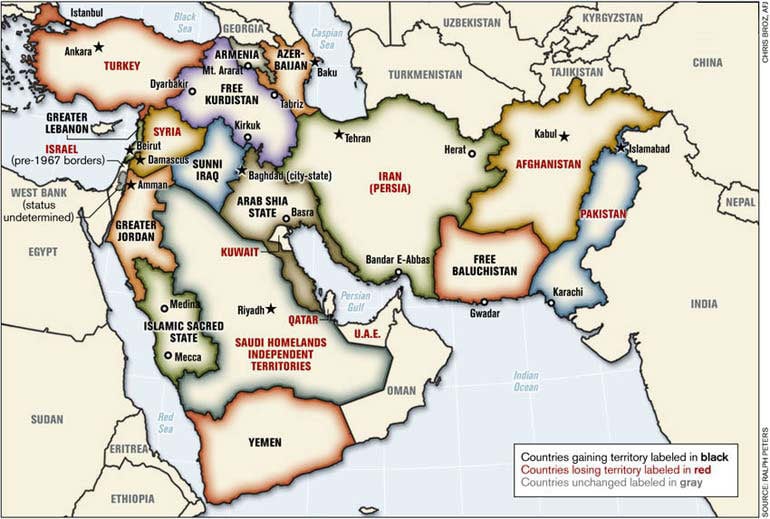
    MAP OF THE NEW MIDDLE EAST

    Nationalist states always bad, puppets best.

    Leave a comment:


  • sutro
    replied
    Re: General Bolger

    Originally posted by don View Post
    More importantly we should not avoid consideration of "Victory Accomplished" as being truly the case and intent. Can't forget the West Point map of a "new" ME, fragmented to fit a new Great Power reality.
    I forget where I came across this. If it was here, forgive me for the duplicate post. Some folks have been thinking about the porspects of breaking up the currnet order for while now.
    http://crashrecovery.org/fischer/article0005345.html

    Leave a comment:


  • don
    replied
    Re: General Bolger

    we should be careful to avoid the intentional fallacy of assuming what happened was what was intended.
    More importantly we should not avoid consideration of "Victory Accomplished" as being truly the case and intent. Can't forget the West Point map of a "new" ME, fragmented to fit a new Great Power reality.

    Leave a comment:


  • jk
    replied
    Re: General Bolger

    Originally posted by sutro View Post
    It would have required that many troops to topple the regime and stabilize the country during the transition period. But what if the real goal, or the "unintentended" consequnece of the seemingly botched invaison, was actually the breakup of Iraq and sowing chaos in the middle of the Middle East?
    we should be careful to avoid the intentional fallacy of assuming what happened was what was intended. i'm not so impressed by the competence and predictive abilities of the people who made these decisions in the past, nor frankly the ones making decisions now. given the low esteem in which i hold them, i tend to view the consequences of their actions as indeed unintended.

    Leave a comment:


  • sutro
    replied
    Re: General Bolger

    Originally posted by jk View Post
    iirc shinseki didn't talk about the time required, but he did testify that iraq would require several hundred thousand american troops. of course that didn't change anyone's mind, it just cost shinseki his job at the time.
    It would have required that many troops to topple the regime and stabilize the country during the transition period. But what if the real goal, or the "unintentended" consequnece of the seemingly botched invaison, was actually the breakup of Iraq and sowing chaos in the middle of the Middle East?

    Leave a comment:


  • jk
    replied
    Re: General Bolger

    iirc shinseki didn't talk about the time required, but he did testify that iraq would require several hundred thousand american troops. of course that didn't change anyone's mind, it just cost shinseki his job at the time.

    Leave a comment:


  • shiny!
    replied
    Re: General Bolger

    Thanks.

    Leave a comment:


  • don
    replied
    Re: General Bolger

    Originally posted by shiny! View Post
    Good find, Don. Got a link for it?
    http://www.theguardian.com/us-news/2...an-why-we-lost

    Leave a comment:


  • shiny!
    replied
    Re: General Bolger

    Good find, Don. Got a link for it?

    Leave a comment:


  • don
    replied
    General Bolger

    Dan Bolger is not looking to add to the debate over the Iraq and Afghanistan wars. The retired three-star army general, out of patience with unresolved conflicts, means to end it.

    On Tuesday, Bolger will publish his 500-page attempt to make sense of both the wars in which he served. Its blunt title preemptively maneuvers conversation over the book on to Bolger’s terrain: Why We Lost.

    Senior army officers tend not to use the “L” word, certainly not in public, despite one war stretching into its 14th inconclusive year and the other one restarting. Bolger is not used to being out of step with the army. A tall man who speaks deliberately, he is respected in military circles for being a historian as well as an officer. Bolger deadpanned during an hour-long interview with the Guardian that he won’t get any more Christmas cards from his old friends in uniform.

    But Bolger considers a reckoning with the military’s poor record in Iraq and Afghanistan overdue. The army in which he soldiered for three decades comes in for the greatest amount of blame, a decision that flatters the military’s pretensions about being above politics but arguably lets the Bush and Obama administrations off the hook. Bolger, a senior officer responsible for training the Iraqi and Afghan militaries, includes himself in the roster of failed generals.

    “Here’s one I would offer that should be asked of every serving general and admiral: general, admiral, did we win? If we won, how are we doing now in the war against Isis? You just can’t get an answer to that question, and in fact, you don’t even hear it,” Bolger said.

    “So if you can’t even say if you won or lost the stuff you just wrapped up, what the hell are you doing going into another one?”

    Bolger has several explanations for why the US lost. The post-Vietnam army was built, deliberately, for short, conventional, decisive conflicts, yet the post-9/11 military leadership embraced – sometimes deliberately, sometimes through miscalculation – fighting insurgents and terrorists who knew the terrain, the people and the culture better than the US ever would.

    “Anybody who does work in foreign countries will tell you, if you want long-term success, you have to understand that culture. We didn’t even come close. We knew enough to get by,” Bolger said.

    More controversially, Bolger laments that the US did not pull out of Afghanistan after ousting al-Qaida in late 2001 and out of Iraq after ousting Saddam in April 2003. Staying in each conflict as it deteriorated locked policymakers and officers into a pattern of escalation, with persistence substituting for success. No one in uniform of any influence argued for withdrawal, or even seriously considered it: the US military mantra of the age is to leave behind a division’s worth of advisers as insurance and expect them to resolve what a corps could not.

    The objection, which proved contemporaneously persuasive, is that the US would leave a vacuum inviting greater dangerous instability. “It would be a mess, and you’d have the equivalent of Isis,” Bolger conceded.

    “But guess what: we’re in that same mess right now after eight years, and we’re going to be in the same mess after 13 years in Afghanistan.” The difference, he said, is thousands of Americans dead; tens of thousands of Americans left with life-changing wounds; and untold hundreds of thousands of Iraqis and Afghans dead, injured, impoverished or radicalized.

    “Moreover, you’d be doing a real counterinsurgency, where they’d have to win it. That’s what the mistake is here: to think that we could go into these countries and stabilize their villages and fix their government, that’s incredible, unless you take a colonial or imperial attitude and say, ‘I’m going to be here for 100 years, this is the British Raj, I’m never leaving,’” he said.

    It is there that Bolger plants his flag in an interminable debate within the army about the wisdom of counterinsurgency. He savages its proponents, chiefly Generals David Petraeus and Stanley McChrystal, for overpromising and under-delivering in Iraq and then recycling the formula to brew a weaker tea in Afghanistan. It leads Bolger’s book to some dubious places, like comparing the pre-Petraeus Iraq commander George Casey to Ulysses S Grant, the savior of the union, even though Casey under-promised and under-delivered.

    Some in military circles view Bolger’s book as the first shot of an internecine fight to purge the army of counterinsurgency, much as the post-Vietnam generation attempted. It is an uphill struggle. While many officers of Bolger’s generation share his views, the Iraq surge saw the greatest tactical results of either long war past the invasion phase. Repudiating it is difficult without conceding the futility of either conflict, as Bolger has done, which, for much of the contemporary military, is a psychological step too far.

    John Nagl, a retired army lieutenant colonel and prominent counterinsurgency advocate, praised Bolger as a “smart, dedicated army officer” while rejecting his thesis.

    “While I haven’t yet read his new book, I don’t agree with him that we lost, and find it hard to believe that he does,” Nagl said.

    But if the wars succeeded, Bolger said, “how come two or three years later, everything’s a pile of crap?”

    One of the reasons was an “unstated assumption” that undergirded the American construction of the Iraqi and Afghan militaries, supposedly the US ticket out of both wars.

    Bolger, who led the training of Afghan soldiers and held a senior post training the Iraqis, said US trainers banked on being present alongside their foreign charges for decades, guaranteeing their performance and compensating for weaknesses.

    “The thought was to leave a conventional division, Korean-type model and you’d be there for 40 or 50 years with a mutual defense treaty and all that kind of stuff. Hey, the Korean army in 1953 was not very good. It takes a generation to build a good army: you need to retrain leaders, you have to build a non-commissioned officer corps,” he said.

    The anticipated length of the US training helps explain the immaturity of both forces. The collapse of entire divisions of the Iraqi military against the Isis advance this year sent shockwaves through Washington. The Afghans are judged to lack critical air support, medical evacuation, intelligence and other capabilities, which helps explain how 9,000 soldiers have died in two years, as a US general revealed last week.

    Yet never has an administration official or senior military officer – to include Bolger – told the American people to expect a half-century stay in a hostile foreign country. Instead, officials vaguely discuss a “long war”, leaving the actual anticipated duration unstated, to say nothing of the price in money and blood.

    Surveying the latest war against Isis, Bolger sees the same pattern repeating.

    “Here’s what wasn’t said: we never had the discussion where we said, ‘Hey, Mr President, you realize you’re signing up for a 50-year commitment, or plus, in Afghanistan and Iraq. Where was that discussion? We talk about surges, but those are all short-fuse things. We’re still not having that.

    “Has President Obama come to the American people and said, ‘By the way, this fight against Isis is going to last 30 or 40 years. You guys good with that?’”

    Leave a comment:


  • c1ue
    replied
    Re: Fifth Generation of Warfare (5GW) is "indistinguishable from magic"

    Originally posted by Woodsman
    Except that it would have absolutely occurred had JFK made it home from Dallas; of this I am certain, as was MacNamara.
    Interesting - I would agree that the phased withdrawal plan would have gone begun had JFK gone home, however, the Galbraith review makes it seem like LBJ also had deep reservations about Vietnam - but felt compelled to 'make a statement' before initiating withdrawal. The latter seems in opposition to much of what I have seen (MSM wise and public school history book wise) concerning LBJ's actions and motivations.

    I'd also note that the Gulf of Tonkin incident might well have had an impact - much as it did in on the record.

    The Soviet Union in 1964 had begun widespread deployment of the R9, thus ending the previously one-sided ICBM nuclear delivery capability enjoyed by the US.

    Leave a comment:


  • Woodsman
    replied
    Re: Fifth Generation of Warfare (5GW) is "indistinguishable from magic"

    yankees and cowboys

    Leave a comment:


  • jk
    replied
    Re: Fifth Generation of Warfare (5GW) is "indistinguishable from magic"

    makes me think part of the problem has been presidents from texas.

    Leave a comment:


  • Woodsman
    replied
    Re: Fifth Generation of Warfare (5GW) is "indistinguishable from magic"

    ...irrespective of what Kennedy had ordered, the assumption that the planned withdrawal from Vietnam would have occurred is at best, premature.
    Except that it would have absolutely occurred had JFK made it home from Dallas; of this I am certain, as was MacNamara.

    And it's not at all correct to call it an assumption. The weight of the evidence is too great. On top of the documents and recordings, there are too many private statements, too many hearsay accounts confirming JFK's intentions. Getting out was totally consistent with JFK's policy in the Congo, Laos, Indonesia and Cuba. Staying in and escalating was entirely counter to JFK's many statements in support of third-world nationalism. We were going to get out, if Kennedy had anything to do with it. A late morning drive in Dallas ensured he wouldn't.

    You can look at the shift in policy between October 63 and March of 64, but the issuance of NSAM 273 is pretty clear that there is a policy reversal in place just days after Kennedy's murder. Soon after that, Johnson tried giving Mac "the treatment" to get him to reverse himself on the withdrawal. There's even an audio recording that should set the record straight (why it never seems to, I won't speculate):

    Johnson:"I always thought it was foolish for you to make any statements about withdrawing. I thought it was bad psychologically. But you and the president thought otherwise and I just sat silent."

    He grinds MacNamara down in his usual style without the slightest consideration as to Mac's obvious doubts about staying in Vietnam. Every time MacNamara makes a point, Johnson shoots him down. Mac even gets a bit testy, as in this exchange.

    Johnson: "How in the hell does McNamara think, when he's losing the war, that he can pull men out?"

    McNamara: "McNamara's not fighting a war...he's made a commitment to train [the South Vietnamese] to fight. And if he trains them to fight and they won't fight, he can't do anything about it. Then he's got to choose whether he want's to fight, or let them have it."

    In a follow-up conversation on March 2 1964, Johnson appears to give Mac a way out of the box and get back into the president's favor.

    "Now why'd you say you'd send a thousand home? I'd put in a sentence in that "because they'd completed their mission...That doesn't mean everybody comes back, but that means your training ought to be in good shape by that time. That's what said, not anything inconsistent [with Johnson's reversal of JFK's policy in NSAM 273.]"

    MacNamara would not bite and remained mostly silent. Nevertheless, by spring of 64 Mac understood LBJ would not allow any dissent in policy and it seems he decided to get on board until his resignation and replacement by Clark Clifford in 68. MacNamara kept his silence almost until his death. Not until the publication of his memoir did MacNamara finally call our escalation in Vietnam correctly - a calamitous mistake.
    Last edited by Woodsman; August 09, 2013, 03:29 PM.

    Leave a comment:


  • c1ue
    replied
    Re: Fifth Generation of Warfare (5GW) is "indistinguishable from magic"

    Originally posted by Woodsman
    No book has done more to change the view of scholars and academics on the subject of American involvement in Vietnam than Prof. John Newman’s JFK and Vietnam. I don't think you'll find a better one.
    Thank you again for a very elucidating reference.

    The conclusion put forward by Galbraith in his book review seems eminently reasonable to me - irrespective of what Kennedy had ordered, the assumption that the planned withdrawal from Vietnam would have occurred is at best, premature. Of particular interest is the exposition of the conflicting interests and agendas - yet more example of how the illusion of central conspiracy is so wrong.

    Leave a comment:

Working...
X