Announcement

Collapse
No announcement yet.

Alt energy, Robots, and reduced work weeks

Collapse
X
 
  • Filter
  • Time
  • Show
Clear All
new posts

  • #16
    Re: Alt energy, Robots, and reduced work weeks

    Originally posted by blazespinnaker View Post
    Yes, but the real value of necessities have come down. In 1974, the basic things .. food/shelter/clothing .. you needed a $30 per hour job in order to pay for that stuff.
    Huh?? Are you unclear on how the two CPIs are calculated?

    Comment


    • #17
      Re: Alt energy, Robots, and reduced work weeks

      I find the CPI to be such a broad measure that it is pretty much useless. Also, it has changed over time as to how it measures things.

      Comment


      • #18
        Re: Alt energy, Robots, and reduced work weeks

        Originally posted by Rajiv View Post
        If we were to get back to the same real wage as 1974 minimum wage as per the old CPI methodology (used by shadowstats) without hedonic adjustments etc., (new BLS methodology)

        -- the minimum wage that was $2 per hour in 1974, today would have to be $30 per hour.

        Since people worked for 2000 hours per year -- $4000 per year minimum wage -- or corrected to $60,000 minimum wage annually.

        Where will that money come from, other than reducing the income and wealth disparity???

        The only other way is to increase the money supply (which means increasing the debt) -- but that will not work, as that in itself is inflationary and increases the wealth disparity under the current tax structure. So what is your way???
        Rajiv, I don’t think that inflation conversion is correct. I can't offer a calculation, just a personal anecdote.

        I'm old enough that I worked for that minimum wage in 1974, I was 16 years old washing dishes in a nursing home kitchen.
        My $2/hr in 1974 did not spend like $60,000 today. No way would I have been able to make a house payment and car payment from that wage
        None of my friends in 1974 could afford an apartment alone on that minimum wage; typically it was 3 roommates living poor but keeping the rent paid, the lights on, their 3 used cars running, and saving nothing after buying beer.

        While it may be a little less today, it’s close. Three kids combined gross of $45K a year today will pay apartment rent and keep 3 used cars running.
        Maybe not quite.

        Comment


        • #19
          Re: Alt energy, Robots, and reduced work weeks

          In 1974, at 3.25 times minimum wage, working 750 hours a year as a student assistant, worked out to about the same as minimum wage full time. I would say that the after tax income would likely have the same living standard as with $60,000 per annum if I choose not to take on any debt -- in 1974 one had to save money before buying large ticket items. The main difference is that today I am able to leverage that income by taking loans - in 1974, I could not take loans, because nobody would give me the loans. It is the monthly payment consumer -- that produces the illusion of wealth. We only look at payments and never at the depreciation of assets and the repayment of debt principal and the time span we are on the hook.

          On that $4000, I was able to make my yearly rent for apartment, keep used car running, save money. I did not have kids, but other grad students were able to support 3 kids while living in subsidized student housing on a similar income. What was not available then were the trinkets (ipad, ipod, iphone etc. etc.) which are nice to have, but not necessary in the bigger scheme of things. In part, that is why most probably, the true inflation is probably somewhere between the BLS number and the Shadowstats number -- My experience would suggest more towards the shadowstats number, because I have chosen not to take on debt. If I had chosen to take on debt, my living standards would probably have gone up, but at the large expense of having had to become a debt serf.

          In 1974 those living near minimum wage could not take on debt -- other than through loan sharks -- and most were quite wary of those types.

          Comment


          • #20
            Re: Alt energy, Robots, and reduced work weeks

            Originally posted by blazespinnaker View Post
            Interesting idea inspired by the following article from 1929

            http://www.worklessparty.org/timework/ford.htm

            It seems to me the unemployment problem could be solved with reduced work weeks.

            Unfortunately, we still have a military and a medical system we have to support, so working less only works if we can produce more. Ie, the deficits matter.

            Solution? Alt energy (nuclear,solar,wind,etc) to power robots that do all the work.

            This way we can produce more and import way less. The deficits are brought down and we can afford to pay our doctors and soldiers.

            The japanese are already doing this, btw.

            Anyways, next problem? I'm hoping to solve a couple more before breakfast.
            Why the future doesn't need us.
            Bill Joy,
            Co-founder, Sun Microsystems
            Wired Magazine, Aprill 2000
            http://www.wired.com/wired/archive/8.04/joy.html
            The greatest obstacle to discovery is not ignorance - it is the illusion of knowledge ~D Boorstin

            Comment


            • #21
              Re: Alt energy, Robots, and reduced work weeks

              Rajiv, I fear I have distracted from your point, that wages are down significantly in real terms.
              It's more illuminating to look at wages above minimum.

              In 1974 many people earned 6 to 10 times minimum wage in central Ohio.
              Today, with minimum at $7.25/ hr, a job at 6 to 10 times that is a salary of $87,000 to $150,000 per annum, which is less run-of-the-mill and more of a plum in my area.

              While minimum wages are a floor, all wages are being compressed downwards towards the floor, be it falling or not in real terms.
              I doubt they are paying student assistants more than $47,000/year up the street at Ohio State these days.

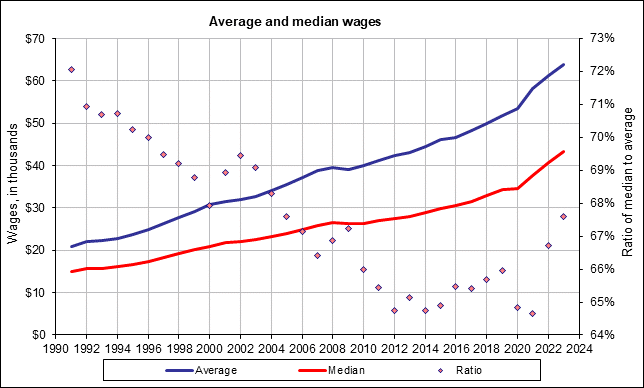
              That trend should show up in a difference between median wages and mean wages, and here is that chart for 20 years, from US Social Security Admin wage data:

              Last edited by thriftyandboringinohio; July 08, 2010, 03:03 PM.

              Comment


              • #22
                Re: Alt energy, Robots, and reduced work weeks

                Originally posted by blazespinnaker View Post
                Interesting idea inspired by the following article from 1929

                http://www.worklessparty.org/timework/ford.htm

                It seems to me the unemployment problem could be solved with reduced work weeks.

                Unfortunately, we still have a military and a medical system we have to support, so working less only works if we can produce more. Ie, the deficits matter.

                Solution? Alt energy (nuclear,solar,wind,etc) to power robots that do all the work.

                This way we can produce more and import way less. The deficits are brought down and we can afford to pay our doctors and soldiers.

                The japanese are already doing this, btw.

                Anyways, next problem? I'm hoping to solve a couple more before breakfast.
                Oh yeah, but if this is a case how are you going to earn for the living. In a current conditions most of the people will be unemployed all their lives. Even if you manage to share the resources somehow you will still have a big existential problem in many aspects. Although it will happen sooner or later but humankind would better find the way to expand itself before the end of this process.

                Comment


                • #23
                  Re: Alt energy, Robots, and reduced work weeks

                  Originally posted by Rajiv View Post
                  It is the monthly payment consumer -- that produces the illusion of wealth. We only look at payments and never at the depreciation of assets and the repayment of debt principal and the time span we are on the hook.

                  I have chosen not to take on debt. If I had chosen to take on debt, my living standards would probably have gone up, but at the large expense of having had to become a debt serf.
                  The following article reinforces my point of view - American middle class slowly disappearing under mounds of debt – How Wall Street and government sucked working and middle class Americans into perpetual debt serfdom.

                  People quickly forget about the nearly 1,000 point “flash crash” brought on by glitches in the Wall Street casino machinery. Still no sensible explanation has been given but today the stock market now stands below the flash crash moment. The middle class is witnessing the largest wealth transfer in history take place and it is all happening because of the Wall Street infrastructure and the government’s lack of respect for the working class of the United States. Even last month as we lost 125,000 workers the unemployment rate actually went down because over 500,000 Americans simply dropped out of the workforce. In other words people simply threw their hands up in exhaustion and gave up. The government is literally not counting tens of thousands of Americans. What does this tell you about how much they value the middle class?

                  Let us break down some income data first:


                  47 percent of American households make less than $50,000 a year. 66 percent make less than $75,000. This should give you a sense of the household income in the U.S. Only 4.3 percent of U.S. households make more than $200,000. Income for working and middle class Americans has remained stagnant for one agonizing decade. What has occurred over this time is the artifacts of a middle class lifestyle like a decent home and a college education have been juiced with massive amounts of banking debt. As banks have tried to put their hands on every aspect of American life, prices have zoomed up in every industry they have jumped into. Look at housing and higher education for dramatic examples. 50 years ago most middle class Americans could afford a college education and a starter home without sacrificing every single penny to servicing debt.

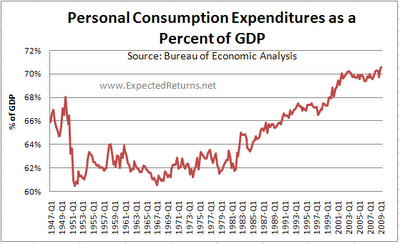
                  Debt has engulfed our nation. If we look at personal consumption as a percent of GDP we can start seeing where problems started:


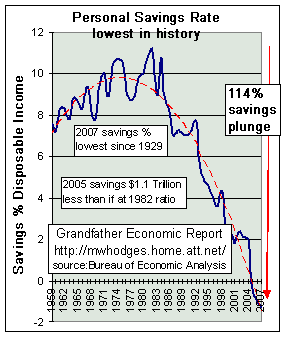
                  Personal consumption makes up over 70 percent of our GDP. Banks love using this figure to beat on middle class Americans to blame them for the problems in the current recession. Keep in mind that the above chart also includes giant increases in health care costs and also, large piles of cash going to service debt that banks are so happy to take. Yet the above point of the chart does hold steady. That is, we have gone from producing to spending too much as a nation. It is fun while things are good but is definitely unsustainable. And don’t think this spending came from actual savings:


                  The drop in personal savings is incredible. As we went negative for a short period of time, banks were capitalizing by allowing people to spend more money than they actually had. If we look at the trillions of dollars given out to banks that made poor bets in the last decade, we’ll see that they are also the largest players in the credit card game:


                  Source: Reuters

                  The above chart is basically the too big to fail. They have fed massive amounts of credit cards into the system with little due diligence since they knew in the end, taxpayers would bail them out. Now that things have gotten bad (not for too big to fail banks since they have gotten the ultimate gold plated bailouts) they are now crunching down on the middle class. High interest charges, onerous fees, and other trickery are merely ways of sucking real wealth from those who work to a class that is largely unproductive and has led us into this economic predicament. The government has worked hand in hand with the banks here.

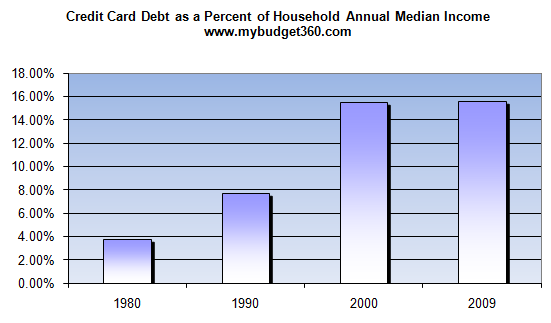
                  Credit card debt eats up a large portion of annual household income for millions:


                  Much of what we consider to be middle class living has been kept on life support by banking debt. Yet no system can go on forever with too much debt and too little production. Banks have become a dangerously large part of our economy. That is why so much focus is given to Wall Street and the banking sector. It is a largely idle industry that merely attempts to suck off the wealth creation of actual real work. The housing bubble was the pinnacle of banking neurosis. The idea that you can simply repackage toxic mortgages into “sophisticated” debt products and sell them off as diamonds to unsuspecting fools is appalling. Yet in most cases, all this was legal because our Senators write the laws that should be protecting us. Instead, they have allowed Wall Street to control every aspect of finance and now here we are with 40 million Americans on food assistance and a close to 17 percent unemployment and underemployment rate. Yet things are getting better for the middle class?

                  The current system is not capitalism but a form of state sponsored cronyism for banks. Most of us can understand that if you have a good product then by all means make a profit. This is the essence of any small business and their survival. But the banking system operates under perverse rules. They created inordinate amounts of debt products that serve no purpose and assured destruction of those taking on the product. Think of option ARMs that actually grew the balance of the mortgage! Horrible products that have destroyed large portions of the real economy and have pushed many off the middle class path. How many foreclosures could have been avoided over the past decade with more prudent banking? Yet this isn’t what the system wants. Banks wouldn’t mind if all you did was work and had to open your beat up leather wallet and pull out 99.99 percent of your net pay to service your debt. In fact, this is probably their ultimate wish.

                  Where do people spend their money?


                  Source: BLS

                  Housing by far is the largest line item above. Yet categories like medical care and education are growing at rates that outpace the overall rate of inflation. Ironically these are areas that are favorites of Wall Street. As long as you can slap a loan onto something, the big investment banks will be there drooling over every penny they can tack on.

                  There was a time when paying off your mortgage was a good thing. We have a good number of Americans who own their home mortgage free:


                  Over 30 percent of homeowners in the U.S. own a home with no mortgage. Yet these are typically people from an era that allowed them to pay down their mortgage even with a modest income. How likely is it that someone in say a state like California who bought a home at $500,000 with a $70,000 income is going to pay off that home? They’re not going to do it so that is why in the chart above you see distress levels off the charts.

                  Even if we look at current metrics for 3 of the largest states, we find that debt is not necessarily a good thing:


                  California and Florida both had major home price appreciation and relied heavily on the housing bubble. Both areas have seen bubbles pop. The difference however is that Florida prices have come down to more reasonable levels. California prices are still too high. A reasonable metric is 3 times annual household income for home prices (both Texas and Florida are close to that range). California is still out of that range. So why are economic problems still deep? Because current income data will be lower when Census data comes out in September and that is not reflected above.

                  The ability for Wall Street to turn many things into a commodity has allowed them to gamble and speculate on the well being of middle class Americans. Housing prices would not have gone into a massive bubble without banks pushing other people’s money out the door. Wall Street is good at taking risk when their money is not at stake. They are fine taking the biggest risk since they know the U.S. taxpayer will be on the hook eventually for their irresponsible decisions with a large safety new. Do you think banks would have loaned out of their own treasury like they did if it was their money on the table? Of course not. Yet if something isn’t changed then middle class Americans are going to find it harder and harder to stay afloat while debt starts coming down over them like a tsunami.

                  It is time to break the chains from the Wall Street banks. Split them up. There is no need to have commercial and investment banking comingled. The banking needs for most Americans are simple. Why mix it up with banks that now operate like hedge funds and take needless risk? If there is no change, people are going to start seeing more and more of their paycheck going to servicing debt and guess who ends up with that money in the end?

                  Comment


                  • #24
                    Re: Alt energy, Robots, and reduced work weeks

                    Originally posted by blazespinnaker View Post
                    Well, how the french did it was pretty crazy. i'm not saying we should outlaw the 40 hour work week, but we should start enforcing overtime at 35 hours, provide tax breaks for companies to hire more part time work.

                    but only after we solve the deficits.
                    You should just abolish the damn work week...

                    Comment


                    • #25
                      Re: Alt energy, Robots, and reduced work weeks

                      Originally posted by c1ue View Post
                      Keep it up - you're turning more French every day

                      http://en.wikipedia.org/wiki/35-hour_workweek


                      Oh wait, they've stopped doing that.

                      http://www.time.com/time/world/artic...826227,00.html
                      What if a 35 hr, or less workweek was applied universally?

                      I'm playing devil's advocate here, but I also agree with blaze as well - or at least where he's going with this.

                      Can someone answer me what makes a 40 hour workweek so damn magical? Why did the French fail by lopping off a whole 5 hours? My guess, is it was not applied universally/globally, so realtively speaking, the companies that had the 35 hr workweek were at a disadvantage. But again, what if every company in the world did this? What if every nation had a three day weekend?

                      Is slowing down life, and consumption really that evil? Because that's the mood I'm getting in this thread.

                      I'm interested in logical analysis here... no Marxist epithets, no lazy characterizations, etc... I just want to know who came up with the 40 hr workweek, 50 weeks a year as being the optimum level of hours worked by all of mankind. Before workplace laws, and even before that, when the world was mostly an agricultural existence, people worked from sun up to sun down - including the young children. So I'm sure, the 40 hr workweek was a blessing at the time it became standard in modern industrial life. So when the 40 hr workweek was adopted - were there people that called the shorter workweek a useless utopian goal? I'm sure they existed.

                      Just curious.

                      Last edited by gnk; July 09, 2010, 09:32 PM.

                      Comment


                      • #26
                        Re: Alt energy, Robots, and reduced work weeks

                        Originally posted by gnk View Post
                        Can someone answer me what makes a 40 hour workweek so damn magical?

                        Where the 40-Hour-Workweek Came From and How it Hurt the Economy

                        Can you imagine working a 30-hour week not because your working hours were cut, but because it was the standard of the country? It's something many workers have dreamed of but simply assume its not a possibility. But in actuality, there was a time around the Great Depression that the government actually fought for a work week of this length.

                        This makes you wonder just how many hours we should be working to have an effective day, especially when some other countries working shorter days and weeks? The history of the 40-hour work week is an interesting one, especially when it comes to its economic impact.

                        The Pre-Depression Era Work Week

                        The standard work week has an interesting past. If you work from a time-line point of view, you will see that the work week fluctuated substantially throughout history. For instance, in the 4th century A.D., the Roman Empire had a whopping 175 holidays in a year, something workers of today would love.

                        In the Middle Ages, people were obligated to work eight hours a day, six days a week, excluding holidays. A saying from King Alfred the Great of England was "Eight hours work, eight hours sleep, eight hours play, make just and healthy day."

                        As time moved on, the work schedules actually increased a bit, especially in the United States. In around the year 1800, a 14-hour work day was customary in the U.S. for men, women and children. This was largely due to the Industrial Revolution. Then in 1840, President Martin Van Buren issued an executive order that laborers and mechanics be limited to working 10 hours in a day.

                        But it wasn't until the International Labor Organization held its first conference in Oct. 1919 that "Hours of Work" convention established an 8- or 9-hour work day, which constituted a max of 48 hours worked per week.

                        Just as the work week seemed to settle, the Great Depression hit. In an effort to avoid layoffs, President Herbert Hoover proposed a bill that would reduce the work week to 30 hours. It passed in Senate; however, it didn't make it through the House.

                        When Franklin D. Roosevelt entered office, he tried to push again for shorter hours, but they were overruled by the U.S. Supreme Court. Instead, the Walsh-Healy Public Contracts Act of 1936 passed, which required the federal government to pay its contractors overtime wages after eight hours of work in a day. And then the Fair Labor Standards Act of 1938 passed, which established the five-day, 40-hour work week for everyone, a standard we observe today.

                        What Are the Work Weeks of Other Countries?

                        The work weeks for countries around the world have varied over the years, but overall seem to have increased a bit so that they are similar to the work week of the United States. What's interesting though is that, according to statistics from the Organization for Economic Co-Operation and Development, the average work week for many countries is relatively lower than one might assume.

                        According to a map produced by the organization, the average work week for the United States is 35 hours and since the recession hit (which was after the map was produced) the average work week dropped even lower to 33 hours. This is lower than Poland and the Czech Republic, which average 38 hours per week, Greece, which averages 41 hours per week, and South Korea, which averages 44 hours per week.

                        However, the majority of the world, according to the map, works fewer average hours per week than the United States.

                        For instance, in Spain, Denmark and Ireland, the average work weeks are 31 hours. In France and Belgium, the average work week is 30 hours. And in the Netherlands and Norway, the average week is an unbelievable 27 hours.

                        Also, in many countries, the average number of paid vacation days averages 20 hours (or four weeks), whereas in the United States, the average vacation period is 10 days.

                        What Would Happen if We Reduced Hours?

                        While the work week may show a decrease when averaged with part-time workers who have managed to keep their jobs as a result of their employers' attempts to keep them employed in exchange for fewer hours, the standard is still 40 hours. However, some question how reducing working hours could impact productivity if doing so were made a standard.

                        Eric Rauch from MIT noted in his 2000 paper Productivity and the Workweek that "An average worker needs to work a mere 11 hours per week to produce as much as one working 40 hours in 1950." In other words, we should be able to work reduced hours with no impact on productivity.

                        Even more interesting is that his research says that "polls and surveys have shown that people in countries with the standard of living that the US enjoyed in the 1950s are no less satisfied than todays Americans."

                        The only problem is that no one will be able to accept a 1950 standard of living after having already lived a 2010 standard. But then again, would we really have to give anything up? Think about all of the cars you see sitting on lots around the country. There are tons of products in stores nationwide with no threat of surplus reduction anytime soon.

                        Most likely, even if hours were reduced, there wouldnt be a reduction in productivity due to the advancements in technology that have made it possible to increase productivity while working fewer hours. This is evidenced by the number of companies that have found ways to reduce their work weeks while maintaining or increasing productivity since the beginning of the recession. Despite having to layoff workers, they were able to keep their companies running.

                        In fact, Iowa's state employees were recently awarded a four-day work week in order to cut energy costs with the understanding that productivity standards would not reduce. Other states have tried the work-week reduction as well, including Hawaii and Washington state, while Virginia and West Virginia are looking into the idea.

                        An official from Utah said that the five-day work week in the state is likely going to be a thing of the past because productivity isn't suffering and energy costs have dropped.

                        Maybe in time, if the pilot states are able to show that there has been no true impact on their economies, the nation as a whole will follow suit on a standard reduction in hours, something that could not only reduce energy costs, but also create more productive individuals after receiving an extra day of rest. But in the meantime, it seems that workers must prepare to be laid-off and also know how to survive a layoff, because it's much more cost-effective to just let a worker go (wages, benefits and all) than to reduce hours across the board.

                        Comment


                        • #27
                          Re: Alt energy, Robots, and reduced work weeks

                          Thanks for that info Rajiv. There is a lot of negative knee-jerk reaction to reducing the workweek.

                          Whenever I see a radical proposal - before analyzing it, I always start with this point - question the status quo before attacking a proposal. This article you posted shows that compared to Europeans, we Americans are definitely overworked, and enjoy every minute of our slavery, because we are "free" and don't need to question the status quo - that's what our oligarchs want us to do!

                          Comment


                          • #28
                            Re: Alt energy, Robots, and reduced work weeks

                            The problem with the reduced work week in my opinion is that with a reduced work week, with no reduction in output per worker, there is a temptation on part of the employer to reduce wages paid, and to increase the contribution to the bottom line. The reduced work week can easily be a path to increased worker poverty, and if implemented that way, can lead to a deflationary spiral.

                            As it is, the income/wealth disparity has steadily increased from its low point in the early 1970s to very close to its high point over the last 100 years.

                            Comment


                            • #29
                              Re: Alt energy, Robots, and reduced work weeks

                              Originally posted by Rajiv View Post
                              The problem with the reduced work week in my opinion is that with a reduced work week, with no reduction in output per worker, there is a temptation on part of the employer to reduce wages paid, and to increase the contribution to the bottom line. The reduced work week can easily be a path to increased worker poverty, and if implemented that way, can lead to a deflationary spiral.

                              As it is, the income/wealth disparity has steadily increased from its low point in the early 1970s to very close to its high point over the last 100 years.
                              Companies are already cutting down the workweek and not hiring - but that's due to the economic crisis. I think this is happening regardless. As for a deflationary spiral - it's actually long overdue. But for the government, it would have been the situation right now. I'm not pro-deflationary spiral, but I'm not pro currency destruction either.

                              In my view, the wealth disparity is not caused by the workweek length, but by other factors - taxation policies, fed policy, bank regs, national/private healthcare, etc... Just look at the top tax bracket from the 1950s to 1970. There's your main answer. In the 1950s and 60s, the top marginal tax rates were 70-90%!!! Corporations also paid much more in taxes than interest on debt - and that trend reversed in the 1980s. I'm not saying I'm pro taxes either - I'm just drawing a conclusion as to the wealth disparity causation.

                              Comment


                              • #30
                                Re: Alt energy, Robots, and reduced work weeks

                                The problem is we're running out of *real* jobs for people to do.

                                Not everyone can become research scientists.

                                Coming up with pointless jobs like "dog therapist" is not a solution either. Those people have jobs which are not necessary and they will just get laid off everytime we go through a boom/bust cycle.

                                What we need to do is reduce the work week so everyone can share the jobs that actually have meaning .. the ones that generate necessary things or truly save time (simply shifting time around from one person to another does not make sense).

                                However, before we can do that, we need to take care of the deficits. Robots will do the trick here.

                                Comment

                                Working...
                                X