Announcement

Collapse
No announcement yet.

China trims Treasury holdings yet again. Only $17B sold in January 2010 to foreigners

Collapse
X
 
  • Filter
  • Time
  • Show
Clear All
new posts

  • China trims Treasury holdings yet again. Only $17B sold in January 2010 to foreigners

    A mere few days after the 'review' of data which dug $328B in extra foreign holdings in US Treasuries - only $17B net sales in January 2010.

    To put this in perspective: More than $100B in net Treasury sales is necessary to pay the deficit for every single month for the next several years...

    http://finance.yahoo.com/news/China-...6&asset=&ccode=

    WASHINGTON (AP) -- China retained its spot as the biggest foreign holder of U.S. Treasury debt in January even as it trimmed its holdings for a third straight month. The string of declines underscored worries that the U.S. government could face much higher interest rates to finance soaring budget deficits.
    The Treasury Department said Monday that China's holdings dipped by $5.8 billion to $889 billion in January compared with December. Japan, the second-largest foreign holder of U.S. government debt, also trimmed its holdings but by a much smaller $300 million, to $765.4 billion.
    Net foreign purchases of long-term securities, a category that includes both government and corporate debt, totaled $19.1 billion in January, as net purchases of private corporate bonds fell by $24.8 billion, the biggest drop on record.
    A month ago, Treasury initially reported that China had cut its holdings so sharply that it had lost its top spot as America's largest foreign creditor, a position it had held since its holdings overtook Japan in September 2008.
    However, 10 days later, Treasury released its annual update of the figures. The revised data showed that China, while reducing its holdings, still retained the top spot. Treasury revises the data based on more detailed readings of the statistics, which do a better job of sorting out actual ownership of the bonds. This review determined, for example, that some bonds credited to Britain because they were purchased there were actually purchased on behalf of Chinese investors.
    The decline in Chinese holdings is coming at a time of increased tensions between the two nations. Chinese Premier Wen Jiabao on Sunday rejected American pressure on China to allow its currency to rise in value against the dollar, saying such efforts amounted to a kind of trade protectionism.
    A group of 130 House members sent a letter to the administration on Monday urging the Treasury Department to cite China as a currency manipulator in a report that is scheduled to be released next month. The group also called on the Commerce Department to impose trade sanctions on China on the basis that its currency system was an unfair trade practice.
    "If the administration fails to act on this issue it will hold back our economic recovery and hurt the ability of American small businesses and manufacturers to increase their production, keep their doors open and create jobs," said Rep. Mike Michaud, one of the signers of the letter.
    Treasury spokeswoman Natalie Wyeth said Treasury was still reviewing the congressional letter. She said there would be no direct response to Wen's comments beyond President Barack Obama's comments in a trade speech last week. Obama said that China would make an "essential contribution" to rebalancing the global economy by moving to a more market-oriented currency regime.
    The Obama administration is hoping China will resume allowing its currency to rise in value against the dollar as a way of trimming the huge trade gap between the two nations. The United States ran a deficit of $226.8 billion with China last year, the largest deficit recorded with any country. A cheaper dollar would make American products less expensive in China while making Chinese goods more expensive for American consumers.
    Treasury's latest report on international capital flows showed that foreign holdings of Treasury securities increased by $17 billion in January to $3.71 trillion.
    While China and Japan decreased their holdings, oil exporting countries boosted their holdings to $218.4 billion, up from $207.4 billion in December, and holdings of Treasury securities in Great Britain rose to $206 billion, up from $178.1 billion.
    Rick McDonald, an economist at Action Economics, said the January report reflected a normalization of purchasing activities following a two-year credit crisis in which investors had flocked to the safety of U.S. securities in the wake of severe turmoil in global financial markets.
    Julian Jessop, chief international economist at Capital Economics, said the Treasury report just affirmed market information in January that showed the dollar rising in value against most currencies with Treasury interest rates falling. Jessop said this pattern did not support concerns that foreigners were losing their appetite for U.S. bonds.
    Strong foreign demand for U.S. Treasury debt helps to keep the interest rates that the government pays for that debt from rising. However, there are other factors that influence U.S. interest rates beyond foreign demand, including decisions by the Federal Reserve.
    Fed policymakers have kept a key short-term interest rate at a record low of zero to 0.25 percent for more than a year and many economists believe that the Fed will continue to pledge to keep rates exceptionally low as a way to boost the economy when they conclude their regular meeting on Tuesday.
    The federal budget deficit hit an all-time high of $1.4 trillion in 2009, and the Obama administration is projecting that this year's deficit will climb even higher to $1.56 trillion. But the administration is also pledging to get the deficits under control once the economy has resumed sustained growth.

  • #2
    Re: China trims Treasury holdings yet again. Only $17B sold in January 2010 to foreigners

    China is buying via its "UK" account. ;)

    Comment


    • #3
      Re: China trims Treasury holdings yet again. Only $17B sold in January 2010 to foreigners

      Comment by Krugman yesterday:
      China’s Water Pistol

      Dean Baker gets upset by this line in today’s very useful Keith Bradsher article:
      China is the biggest buyer of Treasury bonds at a time when the United States has record budget deficits and needs China to keep buying those bonds to finance American debt.
      As I said, this was a very good article about China; the debt line was probably inserted because it’s considered obligatory to say this in any article about US-China relations. As it happens, however, while it’s part of what everyone knows, it’s also completely false.
      Why don’t people get this? Part of the answer is that it’s really hard for non-economists — and many economists, too! — to wrap their minds around the Alice-through-the-looking-glass nature of economics when you’re in a liquidity trap. Even if they’ve heard of the paradox of thrift, they don’t get the extent to which we’re living in a world where more savings — including savings supplied to your economy from outside — are a bad thing.
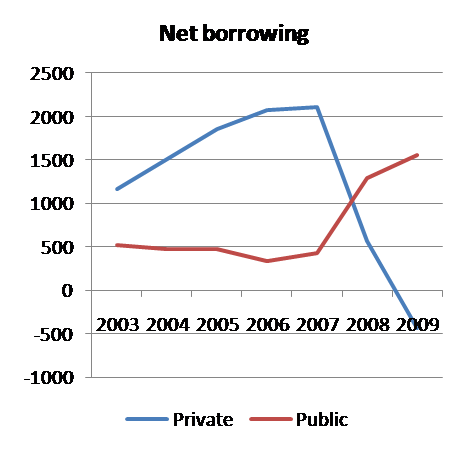
      Also, and I think harder to forgive, is the way many commentators seem oblivious to how we got here. Yes, we have large budget deficits — but those deficits have arisen mainly as the flip side of a collapse in private spending and borrowing. Here’s what net borrowing by the US private and public sectors looks like in the Fed’s flow of funds report:
      Federal Reserve Board of Governors
      The US private sector has gone from being a huge net borrower to being a net lender; meanwhile, government borrowing has surged, but not enough to offset the private plunge. As a nation, our dependence on foreign loans is way down; the surging deficit is, in effect, being domestically financed.
      The bottom line in all this is that we don’t need the Chinese to keep interest rates down. If they decide to pull back, what they’re basically doing is selling dollars and buying other currencies — and that’s actually an expansionary policy for the United States, just as selling shekels and buying other currencies was an expansionary policy for Israel (it doesn’t matter who does it!).
      As Dean nicely puts it, “China has an unloaded water pistol pointed at our heads.” Actually, it’s even better: China can, if it chooses, throw some cold water on us — but it’s a hot day, and we would actually enjoy it.

      raja
      Boycott Big Banks • Vote Out Incumbents

      Comment


      • #4
        Re: China trims Treasury holdings yet again. Only $17B sold in January 2010 to foreigners

        Originally posted by raja View Post
        Comment by Krugman yesterday:
        China’s Water Pistol

        Dean Baker gets upset by this line in today’s very useful Keith Bradsher article:
        China is the biggest buyer of Treasury bonds at a time when the United States has record budget deficits and needs China to keep buying those bonds to finance American debt.
        As I said, this was a very good article about China; the debt line was probably inserted because it’s considered obligatory to say this in any article about US-China relations. As it happens, however, while it’s part of what everyone knows, it’s also completely false.
        Why don’t people get this? Part of the answer is that it’s really hard for non-economists — and many economists, too! — to wrap their minds around the Alice-through-the-looking-glass nature of economics when you’re in a liquidity trap. Even if they’ve heard of the paradox of thrift, they don’t get the extent to which we’re living in a world where more savings — including savings supplied to your economy from outside — are a bad thing.
        Also, and I think harder to forgive, is the way many commentators seem oblivious to how we got here. Yes, we have large budget deficits — but those deficits have arisen mainly as the flip side of a collapse in private spending and borrowing. Here’s what net borrowing by the US private and public sectors looks like in the Fed’s flow of funds report:
        Federal Reserve Board of Governors
        The US private sector has gone from being a huge net borrower to being a net lender; meanwhile, government borrowing has surged, but not enough to offset the private plunge. As a nation, our dependence on foreign loans is way down; the surging deficit is, in effect, being domestically financed.
        The bottom line in all this is that we don’t need the Chinese to keep interest rates down. If they decide to pull back, what they’re basically doing is selling dollars and buying other currencies — and that’s actually an expansionary policy for the United States, just as selling shekels and buying other currencies was an expansionary policy for Israel (it doesn’t matter who does it!).
        As Dean nicely puts it, “China has an unloaded water pistol pointed at our heads.” Actually, it’s even better: China can, if it chooses, throw some cold water on us — but it’s a hot day, and we would actually enjoy it.

        What a f*cking joke.

        Comment


        • #5
          Re: China trims Treasury holdings yet again. Only $17B sold in January 2010 to foreigners

          Looks like they were busy buying elsewhere:

          CNOOC gets LatAm foothold with $3.1 bln Argentina deal


          http://www.reuters.com/article/idUSSGE62E0MT20100315

          Comment


          • #6
            Re: China trims Treasury holdings yet again. Only $17B sold in January 2010 to foreigners

            Originally posted by lsa420 View Post
            What a f*cking joke.
            Krugman's line of thinking is dangerous I think, especially because it is so popular among oh-so-clever economists.

            There is a reason why the red line suddenly took a nose-dive, and it wasn;t because the private sector suddenly discovered virtue and decided to save money. It was because everyone suddenly realized that the private sector had borrowed too much money, and would not be able to pay it back.

            Ramping up govt borrowing to replace private borrowing simply means that the US has found another way to continue borrowing too much money. Keep in mind that all of the govt borrowed money eventually has to be paid back by the private sector - ie. by the same people who already cannot pay back what they borrowed on their own account.

            In time, the red line will follow the blue line.
            Last edited by unlucky; March 16, 2010, 11:06 AM.

            Comment


            • #7
              Re: China trims Treasury holdings yet again. Only $17B sold in January 2010 to foreigners

              Originally posted by Krugman via raja
              The US private sector has gone from being a huge net borrower to being a net lender; meanwhile, government borrowing has surged, but not enough to offset the private plunge. As a nation, our dependence on foreign loans is way down; the surging deficit is, in effect, being domestically financed.
              Every day that goes by, Krugman shows more and more what a moron he is.

              Any economist with an ounce of integrity would look at the massive amounts of free or even paying Fed lending residing in the TBTF banks and wonder if the 'domestic' financing is really new money or Ponzi money.

              Comment


              • #8
                Re: China trims Treasury holdings yet again. Only $17B sold in January 2010 to foreigners

                As Dean nicely puts it, “China has an unloaded water pistol pointed at our heads.” Actually, it’s even better: China can, if it chooses, throw some cold water on us — but it’s a hot day, and we would actually enjoy it.
                Originally posted by lsa420 View Post
                What a f*cking joke.
                Of course, who cares about the water pistol.

                Yes, it is a hot day, but the base is flooded(dead manufacturing sector), and the roof on fire(FIRE+GOVERN sucking the life out of everyone else).

                A mere 10 ounces of cold water from China really doesn't do anything to the US e-CON.
                Last edited by skyson; March 16, 2010, 02:23 PM. Reason: add content

                Comment


                • #9
                  Re: China trims Treasury holdings yet again. Only $17B sold in January 2010 to foreigners

                  Originally posted by c1ue View Post
                  Every day that goes by, Krugman shows more and more what a moron he is.

                  Any economist with an ounce of integrity would look at the massive amounts of free or even paying Fed lending residing in the TBTF banks and wonder if the 'domestic' financing is really new money or Ponzi money.

                  China needs to create 20 million new jobs a year. This is a survival game, the RMB has to be as cheap as possible to create that so many jobs.

                  Comment


                  • #10
                    Re: China trims Treasury holdings yet again. Only $17B sold in January 2010 to foreigners

                    Originally posted by touchring View Post
                    China needs to create 20 million new jobs a year. This is a survival game, the RMB has to be as cheap as possible to create that so many jobs.
                    touchring, I disagree with you there.

                    In 2000 the USDX was what 120+ and the US' U3 was less than 5% correct?

                    Today the USDX is not even 80 and U3 is just under 10%, so what gives?

                    My point is that a weak currency is not synonymous with high employment; that is a fallacy.

                    Comment


                    • #11
                      Re: China trims Treasury holdings yet again. Only $17B sold in January 2010 to foreigners

                      Originally posted by LargoWinch View Post
                      touchring, I disagree with you there.

                      In 2000 the USDX was what 120+ and the US' U3 was less than 5% correct?

                      Today the USDX is not even 80 and U3 is just under 10%, so what gives?

                      My point is that a weak currency is not synonymous with high employment; that is a fallacy.
                      We rarely talk about currencies on iTulip. As it relates to China - it seems that the consensus is that the Yuan will rise relative to the $US as soon as they depeg.

                      I can think of essentially no one out there who thinks the Yuan might fall when China depegs. Perhaps the Chinese are holding off on revaluation for a reason??

                      As "contrarians" shouldn't this be a warning sign for us? 100% consensus on something as complex as the value of the RMB in the future - especially after a potential stock/property bubble burst - seems a little premature to me at best.

                      I think this is an issue that we should be looking at seriously - and quickly. I am.:eek:
                      Last edited by lsa420; March 16, 2010, 10:32 PM.

                      Comment


                      • #12
                        Re: China trims Treasury holdings yet again. Only $17B sold in January 2010 to foreigners

                        i think krugman has it right vis a vis the "threat" that the chinese will sell bonds. as ej pointed out in economic m.a.d., they don't dare unless there is no u.s. market left to lose. [i.e. they sell bonds, the dollar weakens and the renminbi appreciates, raising their cost of production and raising prices for ever-less wealthy americans, who will reduce consumption of chinese-manufactured goods.]

                        Comment


                        • #13
                          Re: China trims Treasury holdings yet again. Only $17B sold in January 2010 to foreigners

                          Originally posted by jk View Post
                          [i.e. they sell bonds, the dollar weakens and the renminbi appreciates, raising their cost of production and raising prices for ever-less wealthy americans, who will reduce consumption of chinese-manufactured goods.]
                          if the renminbi appreciates, it adds cost to their labor but at the mean time decreases the cost of material and transportation.

                          profit margin for chinese products is razor thin, and i heard that the material + logistic + marketing are the major costs, not the labor.

                          why do we automatically think that once the renminbi appreciates, the chinese exports will suffer tremendously?

                          Comment


                          • #14
                            Re: China trims Treasury holdings yet again. Only $17B sold in January 2010 to foreigners

                            Originally posted by touchring
                            China needs to create 20 million new jobs a year. This is a survival game, the RMB has to be as cheap as possible to create that so many jobs.
                            China's need to create jobs is not synonymous with buying US dollars.

                            The reality is that China has not been buying US dollars since May 2009.

                            Secondly only a floating currency has to worry. It has yet to be demonstrated that China cannot fiat declare the value of the RMB.

                            Lastly, China doesn't need to sell Treasuries. It only needs to not buy.

                            I have noted numerous times that there are good strategic reasons why China would want to keep its existing store of dollars. These same reasons do not dictate that China must continue buying more.

                            Comment


                            • #15
                              Re: China trims Treasury holdings yet again. Only $17B sold in January 2010 to foreigners

                              Originally posted by skyson View Post
                              if the renminbi appreciates, it adds cost to their labor but at the mean time decreases the cost of material and transportation.

                              profit margin for chinese products is razor thin, and i heard that the material + logistic + marketing are the major costs, not the labor.

                              why do we automatically think that once the renminbi appreciates, the chinese exports will suffer tremendously?
                              a. china's competitive advantage has been cheap labor.
                              b. material inputs and the cost of transport [energy] are all internationally priced, and a weaker dollar will make them more expensive when priced in dollars.
                              c. commodities will be cheaper for chinese domestic consumption, not for re-export.
                              d. those are reasons i - for one- automatically think that once the renminbi appreciates, chinese exports will suffer.
                              e. but for the same reasons i don't think the chinese will allow this to happen.
                              f. sufficient cuts in american consumption will make the issue moot for the chinese.
                              g. but in the meantime they'd like to buy things of value with the dollars they hold.

                              Comment

                              Working...
                              X