Announcement

Collapse
No announcement yet.

Last Lap for Bretton Woods

Collapse
X
 
  • Filter
  • Time
  • Show
Clear All
new posts

  • c1ue
    replied
    Re: Last Lap for Bretton Woods

    Once again, is it hype or is it scientific reality?

    A good candidate for the last previous opening of the Northwest Passage was the period 5,000-7,000 years ago, when the Earth's orbital variations brought more sunlight to the Arctic in summer than at present. Prior to that, the Passage was probably open during the last inter-glacial period, 120,000 years ago. Temperatures then were 2-3 degrees Centigrade higher than present-day temperatures, and sea levels were 4-6 meters higher.
    There it is again, the sun and the earth's orbital tilt.

    Yes, the Northwest Passage is open for the first time European recorded history (Eskimos don't have calendars). But that is best case only 500 years to draw on - a lot of time if human intervention scales are at question, but not a lot of time in solar/earth orbital terms.

    http://www.wunderground.com/blog/Jef...&tstamp=200710

    Lest you think Dr. Masters is a Republican plant:

    Jeffrey Masters, Ph.D.

    Director of Meteorology
    Jeff Masters grew up in suburban Detroit, and attended the University of Michigan, where he received his B.S. and M.S. degrees in Meteorology in 1982 and 1983, respectively. While working on his Masters degree, he participated in field programs studying acid rain in the Northeast U.S. and air pollution in the Detroit area.

    Leave a comment:


  • Guest's Avatar
    Guest replied
    Re: Last Lap for Bretton Woods

    Chris -

    You wrote:

    << The Northwest Passage was open this year. 1 million Sq Kms of ice were lost this year. Methane is bubbling up all over the vast arctic areas where perma frost was completely frozen all year around until 2001/2 since when it has now been covered by water for the last five summers. >>

    You are wasting your efforts putting this data forward for consideration here - C1ue will advise you (with a commiserating smile), that you are "jumping to conclusions". Every train must have a Caboose - that's the part that comes clicking across the tracks at the brow of the hill, after the engine and forward cars are already traveling across the bottom of the next valley.

    Leave a comment:


  • Chris Coles
    replied
    Re: Last Lap for Bretton Woods

    As I seem to be the starting point for a furious debate back and forth about the merits of global warming, I feel I should intercede with Cold Hard Facts and let them talk for themselves. So, do not take my word for anything. Look at the reality which is that the Arctic ice melt is accelerating way beyond anything forecast. I am not sure that I will be able to find the other recent films of some guys larking around with Methane that is now suddenly bubbling up under new surface ice over the previous years UNFROZEN perma frost. They dig a hole down to the bubbles and set light to the gas, providing a very startling "whoosh!" of flame about 10 feet high.....

    I tell you what I SEE.... ice is melting many times faster than ANY previous prediction, by ANYONE. Period.


    A global warning for UN chief : Polar experts fear an ice sheet covering a fifth of Antarctica could crumble causing sea levels to rise by six metres http://www.timesonline.co.uk/tol/new...MC-Bltn=EFKCF4

    There has been a lot of news about arctic ice. This seems the best report as it is by the very people at the heart of the problem. http://www.canada.com/edmontonjourna...21430f&k=24062

    More on Arctic Ice http://eospso.gsfc.nasa.gov/newsroom...ory.php?id=804

    This is a very large web page and you need to go nearly to the bottom to get at a continuous video of the loss of the ice from 1995 to 2007.

    http://nsidc.org/news/press/2007_sea...810_index.html

    Also, Geophysical Research Letters announced a major report on Arctic Ice 4th October. http://www.agu.org/journals/gl/

    http://www.agu.org/pubs/crossref/200...GL031138.shtml

    BBC science and environment correspondent David Shukman joined the Canadian Coast Guard research vessel, the Amundsen, as it attempted to make a crossing of the Northwest Passage. Record summer melting of the sea-ice made this famous waterway that connects the Atlantic with the Pacific fully navigable this year.

    http://news.bbc.co.uk/1/hi/sci/tech/7033831.stm

    These are NOT predictions or opinions, they are the reports of the facts. The Northwest Passage was open this year. 1 million Sq Kms of ice were lost this year. Methane is bubbling up all over the vast arctic areas where perma frost was completely frozen all year around until 2001/2 since when it has now been covered by water for the last five summers. So, in my humble opinion, stop thinking it won't happen, even to your grandchildren and start to accept, it might happen within our lifetimes. Within the next decade.

    Leave a comment:


  • Guest's Avatar
    Guest replied
    Re: Last Lap for Bretton Woods

    Uh huh. Whatever you say C1ue. S'aright.


    Originally posted by c1ue View Post
    I never said I was buying Siberian land - I was just joking ... I monitor the global warming racket just as I do a number of others.

    Leave a comment:


  • c1ue
    replied
    Re: Last Lap for Bretton Woods

    Originally posted by Lukester
    I have only this observation on your responses to date on this topic - your elaborate professed lack of curiosity. You've acknowledged elsewhere on this forum, that you were buying a big chunk of land in the Siberian tundra on the thesis it will thaw, and provide you good farmland and a big jump in valuation consequently.
    Lukester,

    I never said I was buying Siberian land - I was just joking ;), I said if you truly believed in global warming, that you should buy Siberian land as that is the one region likely to become productive farmland in a global warming scenario.

    As for lack of curiosity, I'm not sure how my examination of global warming theories and hype to date qualifies.

    I monitor the global warming racket just as I do a number of others - maybe the thesis will pan out, but then again maybe not.

    Leave a comment:


  • Guest's Avatar
    Guest replied
    Re: Last Lap for Bretton Woods

    Originally posted by fogger View Post
    Will our C02 emissions eventually cause a problem? Yes, of course. Is the ecosystem going to implode in your grandchildren's lifetime? No. C02 is the least of our problems.
    Fogger - I would suggest you think about it with a little more altruism. I suggest you keep your eyes firmly upon the price of grains and the food complex in the next decade, to see how accurate your assessment will be. They are already leaping, and anyone telling you this is due to primarily to currency debasement is not giving you the whole story.

    If you have discretionary income to re-route to doubling your cash allocation to feeding yourself and your family you are more fortunate than 50% - 60% of the global population. Are you then being a good sport to take the risk of the "other 50%" so cavalierly?

    Look elsewhere, toward groups for whom the food budget comprises 50% - 60% of their income (hint - they are very many). You may come to reassess the importance of CO2 as a factor, relative to your (our) quite narrow economic class firstly, and secondarily recognise that 50%++ of the world population does not have anything remotely like your discretionary income to act as a shock absorber if food costs soar much higher this decade - which I am here to assure you, due to the future soaring price of petroleum derived fertilizer and soil erosion - they most certainly will.

    Global deserts are growing apace, arable land is diminshing apace, global population is cruising from 6.5 billion to 7.5 billion by mid-century, deforestation is reducing an irreplaceable old growth forest in a land mass equivalent to the State of Texas yearly from the world, while you profess serene confidence? Allow me to suggest your comment is entirely too glib on your grandchildren's behalf, if nothing else.

    Are you aware there are food price riots occurring scattered around the world already, and do you stop to note why those food prices are beginning to soar uncontrollably at the present time? Food inflation is starting to soar all over the world - and contrary to the very popular view on these pages, it's NOT primarily due to currencies.

    This is called "situational awareness" in the global context. These people, on the other side of the discretionary food budget barrier from you and I, would be highly appreciative of your increased "situational awareness" of these issues. They would doubtless much prefer you and I were part of any eventual "die off" due to soaring food costs and insufficient global food production rather than that they should go down obligingly for us.

    And yes, as outlandish as "die off" sounds, take note that the present world's population has exploded precisely due to cheap petroleum in farming, and just as the global population wanting something more than a subsistence dieat is exploding, the availability of larger amounts of petroleum to expand food production is faltering.

    Why the soaring cost of food production? Look for the redirection of corn to ethanol, the soaring cost of fertilizer, the rise of 3 billion people who want the same varied diet you and I consider our birthright. Hell, you need only look at the soaring price of food itself, up 20% - 30% across the board in most Western countries in one year alone. CO2 is one part of the equation bearing in on us - but a good subset of components in all that other supposedly "trendy" eco-stuff that sets so many people's teeth on edge is actually bearing down on us too (it's called limit's to growth, and it's about to slam into us in a big way), and is inextricably tied up with those "pesky soaring food prices" at the supermarket.

    So needless to say, if the tables were turned and it was you and I who's food security was actively threatened here, we'd suddenly discover a good deal more lively a concern, no? You don't have to go far to discover these people Fogger - just take a trip down to Chiapas state, in Mexico, and you'll find a good representative group of the millions in this predicament all over your world.

    Now broaden the focus a bit elsewhere - a mere 2-4 degree change in global mean temperatures will wipe out tens of thousands of species. Another symptom - half the world's coral beds are dying already - with entire ecosystems of rich aquatic life which exist only around coral reefs dying with them. This is not Sierra Club chit-chat - it's actually well along in it's trend already, (for those with a scrap of conscience for their grandchildren's inheritance who wish to look).

    Further - I've read a third of the old growth forest in some parts of Canada are already dead trees, due to the encroachment of a beetle which never existed at these latitudes prior to the warming of the past half dozen years, and we apparently are just getting started? The trees die off because they never encountered this beetle at that latitude before. This is highly significant to some of us, but maybe not worth more than a yawn to others.

    Curious, how such large damage proceeds from so slight a temperature change, or other variables which can easily tip the scales into hundreds of millions sliding towards food hardship (the euphemism for "starving") due to a mere slowdown in the formerly robust rate of petroleum production growth. Where then do you derive your serene convictions that this will not do real damage to the ecosystem in your grandchildren's lifetimes?

    From what I've read, it will do (is doing!) considerable damage within your own lifetime. Are you really confdent you are being as good a steward of your grandchildren's inheritance as you presently believe?

    I can imagine, if your family encounter steeply rising insurance costs, or commuting costs, or the cost of health coverage, or schooling for your kids - you'll spend an evening at the kitchen table discussing it seriously with your spouse? What gives you the assurance then to assume that similar soaring costs in mere food prices, (that inert, low tech stuff we consider the least threatening of our survival worries), does not have the power to be utterly devastating to people who have nothing in the world and who's great majority of earnings go merely towards buying enough food to stay alive? They who don't own a single scrap of all the stuff you buy and pay for monthly on an installment plan - but they spend 60% of their income just to feed their families. You think CO2, and it's (apparently still hotly disputed here) potential to influence the price of the food they buy is an issue they take as lightly as you do?
    Last edited by Contemptuous; December 06, 2007, 03:49 AM.

    Leave a comment:


  • bart
    replied
    Re: Last Lap for Bretton Woods

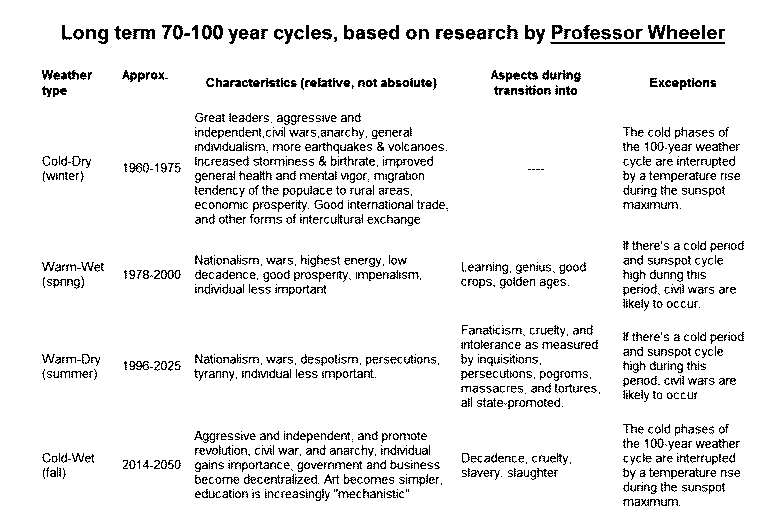
    Professor Wheeler's research of climate cycles:
    http://www.cyclesresearchinstitute.org/wheeler.html


    Leave a comment:


  • fogger
    replied
    Re: Last Lap for Bretton Woods

    Will our C02 emissions eventually cause a problem? Yes, of course. Is the ecosystem going to implode in your grandchildren's lifetime? No.

    Everything we know is going to be redefined in the next 30-50 years:
    money
    govt
    hierarchical structures
    societal organization
    consciousness
    human

    C02 is the least of our problems.

    Leave a comment:


  • Guest's Avatar
    Guest replied
    Re: Last Lap for Bretton Woods

    C1ue -

    I've got a great deal of respect for the overwhelming majority of your other posts, but frankly I think you are blowing a lot of smoke in my face here. It's fluff.

    I have scrupulously avoided drawing the inference that CO2 and TEMP 'must' be correlated. I only inquired as to your elaborate avoidance of any acknowledgement that they 'might' be correlated, which has you posting labyrinthine "enumerative circumlocutions" (which look to me like just a bunch of smoke), such as this:
    ____________

    If CO2 is the smoking gun AND the predicted trend holds, then you will be right. Now the question is whether the predictions AND the remediation are correct.

    If CO2 is NOT the smoking gun AND the predicted trend fails, then you will be VERY wrong. All the remediation done was a waste of time, but felt good.

    If CO2 is the smoking gun and the predicted trend fails, then you will be wrong. Wrong but for the right reasons.

    If CO2 is NOT the smoking gun, and the predicted trend holds, then something else is doing it.
    ____________

    I have only this observation on your responses to date on this topic - your elaborate professed lack of curiosity. You've acknowledged elsewhere on this forum, that you were buying a big chunk of land in the Siberian tundra on the thesis it will thaw, and provide you good farmland and a big jump in valuation consequently.

    How is it that your anticipation of that, so that you seriously consider putting money into this as a business plan, is completely mismatched with your elaborate lack of curiosity on the topic of warming we are discussing here?

    I put the two together and conclude you have indeed bought into the warming thesis, due to some cause, and in this topic's posts, you have also clearly acknowledged that CO2 is admittedly "very high", yet you can't seem to offer the smallest acknowledgment that these two events could have anything remotely to do with each other? That's not a "chartist shark" replying, that seems like plain old fudge replying.

    __________

    Originally posted by Chris Coles
    You are correct, but the country that will gain by far the best advantage is Russia. They have a vast area of permafrost, possibly several times the area in Canada that has been thawed out during every summer since 2000. (I flew over it twice during 2001) and it is prime land. We sometimes get reports of Mammoths being found and when they show us the region it is a thirty foot thick layer of alluvial soil through which runs a river, exposing the Mammoths in the river bank.
    Originally posted by c1ue
    Damn, you have my secret plan found out!
    Last edited by Contemptuous; December 03, 2007, 11:20 PM.

    Leave a comment:


  • c1ue
    replied
    Re: Last Lap for Bretton Woods

    Lukester,

    Your faith in the charts is heartwarming - as I am a chartalist shark.

    You should know by now that any argument can be made - on both sides - by playing with charts. This includes scales, included data, excluded data, logarithms, whatever.

    I am an engineer - but trained as a statistician.

    But as a statistician in the real world, I am inherently distrustful of hypothesis based on data concentrated on only 2 data fields. Very little in real life moves only in 2 axes.

    This is where the engineer part comes in. As an engineer I seek validation of any chart derived hypothesis using different situations which should elicit similar behaviors.

    Your arguments repeat - the chart doesn't lie, the chart doesn't lie.

    My point is that the chart doesn't speak to other factors.

    If CO2 is the smoking gun AND the predicted trend holds, then you will be right. Now the question is whether the predictions AND the remediation are correct.

    If CO2 is NOT the smoking gun AND the predicted trend fails, then you will be VERY wrong. All the remediation done was a waste of time, but felt good.

    If CO2 is the smoking gun and the predicted trend fails, then you will be wrong. Wrong but for the right reasons.

    If CO2 is NOT the smoking gun, and the predicted trend holds, then something else is doing it.

    All of the CO2 rigmarole was wasted time and effort, unless fortunately the CO2 reduction also happens to reduce the other effect. Thus you could be right for the wrong reasons.

    I prefer deriving a complete understanding of what is going on, THEN acting. Being right for the right reasons.

    From my point of view, I am the one being agnostic as to CO2 being the smoking gun.

    You consider my failure to agree that CO2 is the smoking gun shows my stubbornness or arrogance.

    Whatever.

    I'm not trying to change YOUR mind.

    And you're not going to change mine waving the CO2 gospel chart in my face.

    And if you think I'm one of those anti-carbon warming to save expenses, certainly there are those who grasp any argument to fight against carbon minimization requirements.

    Just as in my previous example of management promotion of 'X', certainly there are companies where 'X' = anti global warming.

    But in reality most businessmen don't give a s**t. They know full well for something with so much hype behind it, additional costs are eminently able to be passed on - just like no one complains about having to pay for seat belts or air bags in cars. Most of these businessmen are figuring on how to add EXTRA profit in as pricing power is not something to be dismissed lightly.

    Just as Stalin's liquidation lists grew 10x from conception to execution, so too does capitalist implementation of social responsible products.

    Leave a comment:


  • Guest's Avatar
    Guest replied
    Re: Last Lap for Bretton Woods

    C1ue -

    You are reiterating, "charts are bad", and "there are no charts even giving an approximate clue what CO2 has done for 400K years", and then again "half the scientists in the world studying climate are victims of groupthink", and then "or they are merely venal, sucking up to the popular science for a Nobel", so the insight you would have me gain is that"everybody out there who disagrees with me on this is also a victim of groupthink", and so forth.

    You posted:
    Originally posted by c1ue View Post
    ... I've never said global warming is false. ... What I've said over and over again is that I see zero conclusive proof that ... CO2 is the primary culprit
    and again:
    Originally posted by c1ue View Post
    ... And my point wasn't that CO2 itself was /was not well documented ... As for CO2 being clearly above historic levels - sure. Neither an anomaly nor the size of an anomaly proves causation. ... More global warming related BS ...
    So now the question has been reduced down to it's bare essentials.

    You are claiming you see nothing in the below chart that suggests to you that there is any "remotely discernible relationship" between CO2 levels and temperature?

    In the above excerpt you say in effect "sure, CO2 levels are high - so what?"

    I had a much more involved discussion on this with GRG55 - At first he was a hard skeptic - but I was quite impressed by his complete agnosticism after we hashed it back and forth a few times, with some great input from JK on what it means to be "agnostic" towards new ideas.

    When I pointed out the chart below which maps correlation between CO2 and Temperature to GRG55, and how temperature normally spikes over the CO2 at the peaks but in this chart at present CO2 is leading by a large margin (implying the potential for a chatch up move in Temp), this was sufficient to spark his curiosity. I certainly did not change his mind, but he was curious to understand what that might imply. I submit to you, that the spirit of innocent curiosity is the most serious form of discovery.

    I understand he is placing inquries with some of his colleagues in the Gulf as a result of our discussion.

    GRG55 became interested enough to entertain the idea that CO2 may indeed now be anomalously high (which you now grudgingly acknowledge) and that there does seem to be a quite interesting correlation between CO2 and temperature spanning a quite a long time frame, at least in the posted chart. Maybe we can dig up another couple of charts and see if this is borne out, without any more talk, and that would settle it for you?

    He was intrigued, because at the end of the day, GRG55 apparently just keeps an open mind to any possibility. He gets my considerable respect for that.

    I believe you are a software or hardware engineer? GRG55 is a petroleum engineer, so arguably a little more tuned in to geology. He demonstrated an agnosticism in recognizing the above points (and he I think also took duly into consideration, that calling 2500 scientists findings accumulated after a full decade "deluded nonsense" right off the bat, may not be the most serious methodology for at least preliminarily checking out the implications of very high CO2).

    I discussed this issue thoroughly with GRG55, and he now professes to be at least "intrigued" by the possibility. That is a serious response. I am no more sure of the implications of CO2 for global warming than he is (and I'm less qualified!), but I am equally curious as is GRG55, and that's a quality you conspicuously don't display on this topic.

    Rather, you seem to hold the caliber of your intellect in such high regard that you find it easy to suggest flatly that a few thousands of other scientists, who presumably trained just as rigorously as you in objective methodologies, all flouted that training and methodology in coordinated unison to the point of being specious in complete unison, all while you presumably have maintained an unerring corner on hard headed truth.

    This approach of yours seems exacerbated to the point where while you are acknowledging "CO2 is high, but so what?" you are in the next breath apparently denying the below chart shows any correlation, or even a hint of a correlation, sufficient to arouse your intellectual curiosity, between CO2 and temperature? :p :p :p


    Last edited by Contemptuous; December 03, 2007, 12:04 AM.

    Leave a comment:


  • c1ue
    replied
    Re: Last Lap for Bretton Woods

    Originally posted by Lukester
    This is a very, very, very long data set, and it is not a computer model, it implies no particularly sophisticated interpolations whatsoever - it merely notes the present CO2 is one full standard deviation outside half million year trends.
    Size isn't everything ;). And my point wasn't that CO2 itself was /was not well documented, it is that I have not seen conclusive evidence that CO2 itself is the primary cause. As for relative strength, the Sun is the big boy on the block. 1% change in solar radiation would have major impact on Earth as an example.

    As for CO2 being clearly above historic levels - sure, but there are many other things above historic levels. Numbers of people ('green' or otherwise). Numbers of cows. Metal in refined form. Corn. Wheat. Pigs. Chickens. Concrete. Asphalt. Electricity. Electromagnetic radiation in various forms. Neither an anomaly nor the size of an anomaly proves causation.

    Why is it so difficult for the IPCC to prove CO2 is the smoking gun? Because it is NOT clear - unlike HFCs which were clearly proven.

    To paraphrase from the legal system - circumstantial evidence is not sufficient in and of itself to constitute proof.

    Originally posted by Lukester
    Your scientific training should bring you to acknowledge this is an issue you would best not simply summarily dismiss, for the sake of your own children, if nothing else.
    Now you're talking like Pascal: if there is a God, and unbelief = eternity in Hell, then I should believe because avoiding infinite Hell is worth a little worship - as opposed to the alternative of unbelief and being wrong.

    I don't agree with Pascal - Gimme the facts only.

    As for my kids, they'll be sitting on the mountaintop with stored food, guns, and gold :cool:

    Originally posted by Lukester
    Measured on a per-unit-of-oil-consumed scale, the U.S. produces less GHG than every other major developed or developing nation except Japan (we’re on a par with militantly green Germany).
    That's because we've outsourced most of our dirty manufacturing production to China, while still being able to get the results. But we can't pay so much anymore...

    I had relatives involved in this type of business - buy scrap metal, process in China/Taiwan, sell back to the US. The US is absolutely the entity which engenders this particular pollution, but the pollution wound up in another country. More global warming related BS...

    Leave a comment:


  • Guest's Avatar
    Guest replied
    Re: Last Lap for Bretton Woods

    Bill -

    I apologize for the snippet of already "lengthy" and "tired" global warming discussion here you refer to, within one of E.J.'s threads which is dedicated to the international monetary system.

    Actually I was trying to move this discussion to the thread where it was already being discussed at length - elsewhere. I got sidetracked by some banter about "wearing Wellingtons in Riyadh".

    I find the implications of your post very interesting. The issues are very hard to untangle into a viable system which can permit the world to continue to grow without producing compounding problems. Here is an eye-opener, and a further complication to add to the difficult calculations your post reveals:


    US MOST EFFICIENT OIL CONSUMER PR UNIT OF GDP


    Derived from statistics from GeoHive, the Pew Center, the World Resources Institute and other sources:
    • Measured on a per-unit-of-oil-consumed scale, the U.S. produces less GHG than every other major developed or developing nation except Japan (we’re on a par with militantly green Germany). While consuming 25.4% of the world’s oil in 2000, we emitted only 20.6% of the GHGs. Compare that to China’s 6.5% of world oil consumption versus 14.8% of the GHGs (2.8 times as much as the U.S. per unit of oil consumed); India’s 3.0% consumption versus 5.5% GHG (2.26 times as much as the U.S. per barrel); and Russia’s 3.5% consumption versus 5.7% GHG (more than twice as much per unit as the U.S.). Even darling of the greenies Canada belches more GHG per barrel of oil consumed than the U.S.
    • Measured in terms of economic yield (meaning how much we get from the oil we use), one need only compare GHG emission to gross domestic product (GDP) to get the full picture of just how much more effectively the U.S. consumes fossil fuels than almost any other industrialized nation on Earth (again, Japan and Germany are the exceptions). In 2000, America produced 39% more dollars in domestic GDP per unit of GHG expelled than Canada, 569% more dollars per GHG than India, a whopping 642% more dollars per GHG than China, and an incredible 1,041% more GDP per unit of GHG than the Russian Federation.
    Last edited by Contemptuous; December 02, 2007, 01:56 PM.

    Leave a comment:


  • bill
    replied
    Re: Last Lap for Bretton Woods

    Originally posted by Lukester View Post
    We've been through this in great detail, and I think it was debunked, and covered much of your other points as well, on another thread.

    If you insist on bringing global warming into this thread lets do it. What reserve currency will be used for co2 tax, credits, trading? What price will be set on carbon?
    One opinion:http://www.feasta.org/events/debtconf/sleepwalking2.htm

    Basing money on the scarcest resource

    Moreover, reviving SDRs would be a missed opportunity. To deliver the maximum level of human welfare, every economic system should try to work out which scarce resource places the tightest constraint on its development and expansion. It should then adjust its systems and technologies so that they work within the limits imposed by that constraint. In line with this, an international currency should be linked to the availability of the scarcest global resource so that, since people always try to minimise their use of money, they automatically minimise their use of that scarce resource.

    What global resource do we most need to much use less of at present? Labour and capital can be immediately ruled out. There is unemployment in most countries and, in comparison with a century ago, the physical capital stock is huge and under-utilised. By contrast, the natural environment is grossly overused especially as a sink for human pollutants. We believe that the scarcest resource is the planet’s ability to absorb greenhouse gases and that a new world currency should therefore be based on CO2 emissions rights.

    How could that be done? We’ve already seen that, under Contraction and Convergence, emissions permits would be issued to every adult in the world. Let’s make an ironic bow to the IMF and call these permits Special Emission Rights or SERs. As we saw, these would essentially be ration coupons. They would be issued by an international Issuing Authority, distributed to individuals, bought up by dealers and sold on to fossil energy distributors such as electricity companies and oil and coal merchants. These companies would then pay over SERs in addition to normal money to fossil fuel producers whenever they bought fresh supplies. An international inspectorate would monitor the fuel producers to ensure that their sales did not exceed the number of SERs they received. This would be surprisingly easy to do as nearly 80 per cent of the fossil carbon that ends up as manmade carbon dioxide in the earth's atmosphere comes from only 122 producers of carbon-based fuels7. Once a producer’s sales had been checked, the inspectors would remove and destroy the SER coupons the producer had collected. Any not used would lapse at the end of a year.

    Besides the SERs, the Issuing Authority would supply governments with a new international money called ebcus (emissions-backed currency unit) to be used for all international trade, not just for buying permits. Like SERs, ebcus would be issued to each country on the basis of its population but, unlike the SERs, they would be given to each country’s central bank rather than to individuals. The ebcu issue would be a once-off, to get the system started, and the Issuing Authority would announce that it would always be prepared to sell additional SERs at a specific ebcu price. This would fix the value of the ebcu in relation to a certain amount of greenhouse emissions. It would make holding the unit very attractive as rival monies such as the dollar have no fixed value and everyone would know that SERs would become scarcer year by year as fewer and fewer were going to be issued.

    If a buyer actually used ebcus to buy additional SERs from the Issuing Authority in order to be able to burn more fossil energy, the number of ebcus in circulation internationally would not be increased to make up for the loss. The ebcus paid over would simply be cancelled and the world would have to manage with less of them in circulation. This would cut the amount of international trading it was possible to carry on and, as a result, world fossil energy consumption would fall. On the other hand, there would be no limit to the amount of trading that could go on within a country provided its fossil energy use was kept down. We recognise that selling these additional emissions permits would lead to the C&C emissions limit being exceeded in each year that sales took place. However, because a fixed amount of ebcus would be put into circulation at the start of the scheme and no more would ever be issued, the total excess over the years could never exceed the amount of SERs that the original sum of money could buy.

    Essentially, the system is a version of the Bretton Woods arrangement that President Nixon destroyed except that the right to burn fossil energy replaces gold and ebcus play the role of the US dollar. Its introduction would ensure that the level of economic activity around the world was always consistent with the ability of the Earth to cope with it, at least as far as greenhouse emissions were concerned. It would re-link the money system to reality and the world.

    The combined C&C/ebcu arrangement would not end economic growth but it would mean that growth could only proceed in countries that increased the economic value they extracted per tonne of CO2 emitted at a faster rate than they were having to cut their CO2 emissions back. There is no point in denying that this requirement would make global growth very difficult. Incomes in many countries would fall back although whether the quality of life would do so is another matter. However, some sectors of most national economies would grow very quickly – those connected with saving energy and capturing power from renewable sources, for example – and businesses ought to be able to get good returns on investments made in those sectors.

    By encouraging people to borrow enough to maintain the money supply, these profit opportunities would reduce the risk of continuing to operate a national debt-based money systems during the period of emissions contraction. After that, however, the rate of change would become much slower and countries would be wise to gradually switch to using a money stock that was spent into circulation by the state. This type of money is described in James Robertson and Joseph Huber’s NEF book, Creating New Money. Its advantage is that growth and continual borrowing are not required to keep an adequate amount of it in circulation. This helps to ensure a very stable economy because, if one sector goes into decline, there is still the same amount of purchasing power about and other sectors will expand to compensate.

    The massive investment required to free the ‘advanced’ countries from their reliance on fossil fuels should be the last act of the growth-reliant economic system. As roughly half of all energy gets used to achieve economic growth, it is absolutely imperative that richer countries adopt a money system that doesn’t require them to keep growing to avoid an economic collapse. This is not only because they will have to buy fewer emissions permits if they cease to grow but also because they would free resources for use by much poorer countries.

    In any case, economic growth in the richer countries is bringing negligible results in terms of increases to human welfare and happiness. The American economist Herman Daly thinks that growth has become uneconomic in a lot of rich countries because it is increasing costs more rapidly than benefits. In other words, it is proving damaging rather than beneficial. The Index of Sustainable Economic Welfare, which Daly developed, shows that this is the case in almost every country for which it has been calculated, even though the calculations ignored the damage potential of CO2 emissions. If estimates for this damage are factored in, the case for saying that rich country growth is seriously damaging becomes overwhelming.

    But, as Daly pointed out in a speech to the World Bank in 2002,

    The current policy of the IMF, the World Trade Organisation and the World Bank, however, is decidedly not for the rich to decrease their uneconomic growth to make room for the poor to increase their economic growth. The concept of uneconomic growth remains unrecognized. Rather the vision of globalization requires the rich to grow rapidly in order to provide markets in which the poor can sell their exports. It is thought that the only option poor countries have is to export to the rich, and to do that they have to accept foreign investment from corporations who know how to produce the high-quality stuff that the rich want. The resulting necessity of repaying these foreign loans reinforces the need to orient the economy towards exporting, and exposes the borrowing countries to the uncertainties of volatile international capital flows, exchange rate fluctuations, and unrepayable debts, as well as to the rigors of competing with powerful world-class firms.

    The whole global economy must grow for this policy to work, because unless the rich countries grow rapidly they will not have the surplus to invest in poor countries, nor the extra income with which to buy the exports of the poor countries.

    In other words, the present system makes it impossible for the poor to rise out of poverty. We are not merely playing a zero-sum game in which the gains of the winners equal the loss of the losers. We are playing a negative sum game in which even the people who think themselves winning are, in reality, losing out. Stopping damaging growth in the rich countries is not a cost but a gain.

    Keep a eye on IPCC:http://unfccc.int/meetings/cop_13/items/4049.php

    Leave a comment:


  • GRG55
    replied
    Re: Last Lap for Bretton Woods

    Originally posted by zoog View Post
    Wasn't me. I think that was you, man. Your barrier idea also reminds me of the proposed operable barriers for Venice. There was a Nova program about the sinking city back in 2002. Last I heard, the project was unlikely to move forward due to lack of financing.
    Actually it was DemonD here:

    http://www.itulip.com/forums/showthr...ighlight=dubai

    Leave a comment:

Working...
X