Announcement

Collapse
No announcement yet.

You're not going to believe this: Inflation/deflation debate still alive?

Collapse
X
 
  • Filter
  • Time
  • Show
Clear All
new posts

  • Jim Nickerson
    replied
    Re: You're not going to believe this: Inflation/deflation debate still alive?

    http://www.safehaven.com/article-10652.htm

    Who's that knocking at my door and shouting "deflation"? Would you guess, Mike Shedlock.

    Snips.
    Originally posted by Shedlock
    We had a crack-up-boom. What else can you call the financial engineering that went with SIVs, Conduits, Toggle Bonds, Covenant Lite loans, Pay Option ARMs, etc., etc? That crack-up-boom is over. And just like every credit boom in history, the backside, once the credit boom ends is deflation. Previous examples include Tulip Mania, the South Sea Bubble, John Law Mississippi scheme, the Great Depression, and the property bust in Japan.
    .
    .
    The odds of a significant bout of inflation now are about the same as they were in 1929. Next to none. History is about to repeat.
    Edit: and the article at safehaven.com above Shedlock's is titled "We have Inflation not Deflation." http://www.safehaven.com/article-10653.htm I post that link without having read a word of the article. My attitude about this whole issue is becoming as the student who was asked, "What is the difference between ignorance and apathy"? To which he replied, "I don't know and I don't care."

    For myself I am not convinced anyone knows how things will be in months, years, or a decade. For my own money, I have a bit toward inflation and a bit toward deflation. However it turns out between now and whatever is finally the answer, I hope to play the trends which is no easier than playing whatever one sees as the best long-term bet.
    Last edited by Jim Nickerson; July 01, 2008, 12:10 AM.

    Leave a comment:


  • bart
    replied
    Re: You're not going to believe this: Inflation/deflation debate still alive?

    Originally posted by Jim Nickerson View Post
    Here's a bit more, and it looks to me the ECB is serious.

    "Jean-Claude Trichet, the bank's president, has warned of an "acute risk" of a wage-price spiral unless inflation is wrung out of the system."
    They may very well raise and they do seem a bit less profligate than the Fed, but talking about only a 1/4 point raise in the context of wringing inflation out of the Euro area doesn't strike me as being highly comparable data points.

    Leave a comment:


  • Jim Nickerson
    replied
    Re: You're not going to believe this: Inflation/deflation debate still alive?

    Here's a bit more, and it looks to me the ECB is serious.

    "Jean-Claude Trichet, the bank's president, has warned of an "acute risk" of a wage-price spiral unless inflation is wrung out of the system."

    http://www.telegraph.co.uk/money/mai...1/ccecb101.xml

    Stagflation grips Eurozone as interest rates look set to rise

    By Ambrose Evans-Pritchard, International Business Editor

    Last Updated: 1:20am BST 01/07/2008


    Eurozone inflation surged to an all-time high of 4pc in June despite worrying signs of a slump in manufacturing, confronting the European Central Bank with the toughest challenge since its creation a decade ago.

    Soaring oil and food prices guarantee a quarter-point rise in interest rates to 4.25pc on Thursday, further widening the gulf in rates between Europe and America.

    The only question is whether the ECB opts for a "one-and-done" move or sets the course for yet more rises in the autumn.

    Jean-Claude Trichet, the bank's president, has warned of an "acute risk" of a wage-price spiral unless inflation is wrung out of the system.

    But a growing chorus of critics fears that overkill could tip the eurozone into a severe downturn at this delicate juncture, and risk a dangerous chain of political events in southern Europe and Ireland - where voters have already thrown the EU into chaos by rejecting the Lisbon Treaty.

    The Irish economy contracted at a rate of 1.5pc in the first quarter and is now facing the worst recession since the crash of the mid-1980s. Investment fell 19.1pc. House prices have now fallen for 15 months in a row.

    Spanish premier Jose Luis Zapatero was forced to reassure his nation's media this weekend that he was still on speaking terms with his finance minister Pedro Solbes, who has refused to endorse the government's economic crisis plan.

    Both Mr Zapatero and Italy's Silvio Berlusconi have lashed out at the ECB in recent days, but even Germany's finance minister Peer Steinbrück has begun to question Frankfurt's hard-line policy.

    "An interest rate increase could have a pro-cyclical impact at a point when the economy is slowing down," he said.

    The comments come after five months of falling orders in Germany, the worst run since the early 1990s. Siemens, Volkswagen and other big industrial exporters have begun to cut jobs.The ECB has held rates steady at 4pc since the credit crunch began last summer, even though Euribor lending rates have jumped 120 basis points. The euro has rocketed against the dollar, sterling, yen and yuan.

    The full effects of the monetary and currency squeeze will feed through the eurozone over the next year or so. There is a risk that the impact could hit just as the global economy slows sharply.

    France's finance minister, Christine Lagarde, praised the apparent policy shift in Berlin. "For the first time my German colleague, who was resolutely determined to back the ECB whatever it does, is telling Mr Trichet, 'Be careful'.

    "There is more than one indicator. There is inflation, certainly, but there is also growth. Quite a few of us would like Mr Trichet to keep his eye on both barometers. Until now he has had only inflation on his radar," she said.

    Her choice of words is significant. EU ministers have the ultimate power - under Maastricht Article 109 - to shape the eurozone exchange rate, giving them a backdoor means of forcing a change in the ECB's policy. The implicit threat to invoke this clause is a warning to ECB hawks that independence has limits.

    The remarks by Paris and Berlin come as US Treasury Secretary Hank Paulson prepares to visit both Mr Trichet and Bundesbank chief Axel Weber today. The Bush administration is reportedly furious with the ECB for undercutting US efforts to stabilise the dollar and halt the oil spike in very dangerous circumstances.

    The ECB is playing with fire, forcing the US to pursue a more restrictive monetary policy than it might think safe at a time when the financial system is already in dire trouble. The dispute has echoes of the Transatlantic rift before the stock market crash in October 1987.
    Oil jumped $16 a barrel in two days earlier this month on the back of a rising euro after Mr Trichet signalled an ECB rate rise. The market response was a prize exhibit for those who argue that hedge funds have now run amok on the oil markets, using crude futures as a sort of "anti-dollar" currency - with multiple leverage.

    It also revealed that ECB tightening in this environment is counter-productive since it pushes inflation even higher. Critics say the bank is chasing its own tail, failing to adapt to the complexities of the modern global economy.

    Stephen Lewis, chief strategist at Insinger de Beaufort, said the ECB is right to raise rates, despite the risks. "If they were to back off now after signalling a rise it would cause a catastrophic loss of credibility that would further harm global stability," he said.

    "The bank cannot formulate policy on the basis that this might be a short-term price spike. It would destroy consumer confidence and blast economic growth prospects if it lets inflation run ahead."

    Leave a comment:


  • bart
    replied
    Re: You're not going to believe this: Inflation/deflation debate still alive?

    Originally posted by Charles Mackay View Post
    I think the war of words that is developing is the most interesting aspect of this rash of articles. On the other hand, the U.S. collapsed interest rates to 2% with inflation at over 7% (according to John Williams) so the ECU is definitely protecting it's currency better than the Fed. That really cannot be questioned, although I certainly agree that they don't hold a candle to the protection of real money.
    Truth, and it's just all part of the "game".


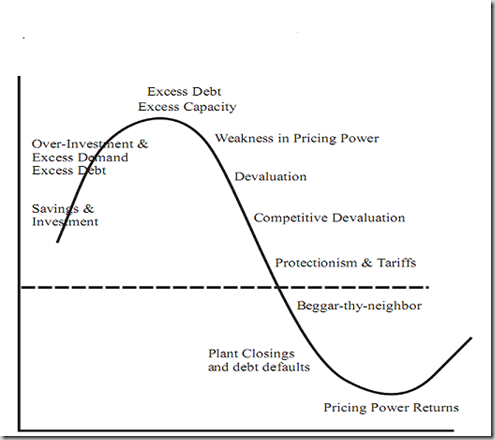
    In other words, it appears that we agree that the competitive devaluation and tariff etc. games gets fought in financial and war-of-words areas too.


    That 7% number you noted from John Williams is only adjusting per the pre Clinton methodology. The full correction when the 1982 methodology is used is running around 11.5%.

    The ECU is indeed protecting their currency a little better, but also do take into account:
    • Their yield curve was inverted for almost the full first half of 2007 and its a reasonably good predictor of a future recession.
    • Their current 10 year bond is at 4.03%, almost identical to the US 10 year TNote.
    • Their current 3 month eurodollar rate is 3%, only about 1.2% higher than the US 3 month TBill.
    • They say their CPI is only 3.7% in the most recent data I have, but some incomplete research I'm doing shows is to be at least 6.2-6.8% and probably higher - perhaps as much as 8.5-9.5%. To state it another way, their interest rates are negative too.
    • Their GDP growth rate has been falling rapidly since early to mid 2007 and per the last report is only about 2.5%.

    Leave a comment:


  • Charles Mackay
    replied
    Re: You're not going to believe this: Inflation/deflation debate still alive?

    Originally posted by bart View Post
    Indeed. Better than the US - yes. Much better - no way.
    I think the war of words that is developing is the most interesting aspect of this rash of articles. On the other hand, the U.S. collapsed interest rates to 2% with inflation at over 7% (according to John Williams) so the ECU is definitely protecting it's currency better than the Fed. That really cannot be questioned, although I certainly agree that they don't hold a candle to the protection of real money.

    Leave a comment:


  • bart
    replied
    Re: You're not going to believe this: Inflation/deflation debate still alive?

    Originally posted by GRG55 View Post
    Methinks the ECB is getting too much credit. Far too much credit.
    Indeed. Better than the US - yes. Much better - no way.

    Their M3 bottomed in mid 2004 at about 5% growth rate and probably peaked at over 12% last September.

    Their credit creation (MFI) numbers are also similar and similar to the US - a bottom in early 2003 at about 2.5% annual growth rate, and a likely peak in Jan 2008 at about 11% growth rate.

    I also have a blue light special on some ocean front property in Idaho for anyone who believes their CPI is being correctly reported at under 4%.

    There's this too:
    Europe’s Ailing Social Model: Facts & Fairy-Tales
    Last edited by bart; June 30, 2008, 08:56 PM.

    Leave a comment:


  • Charles Mackay
    replied
    Re: You're not going to believe this: Inflation/deflation debate still alive?

    Originally posted by GRG55 View Post
    Methinks the ECB is getting too much credit. Far too much credit.

    Do you really think the ECB tweaking its administered rate upward [and that is nowhere near certain yet] is going to do anything material to deal with, or protect Europeans from, the inflation that stalks the planet?
    Not as much as gold is! . You're right, just in comparison with the corrupt FED they are.

    I see tonight that Goldman has followed with a left jab.. recommending shorting European stocks "in case of a crash" :p

    http://www.bloomberg.com/apps/news?p...Neg&refer=home

    Leave a comment:


  • GRG55
    replied
    Re: You're not going to believe this: Inflation/deflation debate still alive?

    Originally posted by Charles Mackay View Post
    ...They also are not willing to follow the US down a hyper inflationary path and in no uncertain terms have broadcast that they will do the right thing and raise rates to arrest the inflationary spiral that we are now in. They know they have the US in between a rock and a hard place and are going to squeeze us hard.

    Methinks the ECB is getting too much credit. Far too much credit.

    Do you really think the ECB tweaking its administered rate upward [and that is nowhere near certain yet] is going to do anything material to deal with, or protect Europeans from, the inflation that stalks the planet?

    Has the ECB really been any less profligate than numerous other Central Banks? Or does it look good only in comparison with the Fed?


    Last Updated: Tuesday, 18 December 2007, 23:16 GMT
    ECB lends $500bn to lower rates

    The European Central Bank has allocated 348.7bn euros ($502bn; £249bn) to banks at a below-market rate in a refinancing move to ease tightened credit markets.

    It is one of five central banks that have injected billions in emergency cash into money markets...

    ...The two-week ECB refinancing operation is the first time it has said it would offer banks unlimited funds, above a certain interest rate, since 9 August when the credit crisis started...

    ...The size of the offer surprised some analysts. "The sheer magnitude of the operation caught the market off guard," said Win Thin, a senior currency strategist at Brown Brothers Harriman...
    http://news.bbc.co.uk/2/hi/business/7149329.stm

    Leave a comment:


  • Charles Mackay
    replied
    Re: You're not going to believe this: Inflation/deflation debate still alive?

    Originally posted by Jim Nickerson View Post
    And here is some more regarding the BIS's comments by the departing chief economist: Dr. Bill White. He has nothing good to allow for Alan Greasepan

    http://www.telegraph.co.uk/money/mai...0/ccbis130.xml
    Jim, I've read all these latest pronouncements by Barclays, RBS, BIS etc. and have been trying to figure out just what it all means. I understand that BIS came out a few months before the Sub Prime crisis in 2007 with warnings and a recommendation to buy the Yen in a carry trade unwind. They in effect announced the August crisis in advance.

    It appears to be quite a pissing contest.. apparently Europe has been stuck with a trillion in bad paper passed off by the US banking con artists. The article said they'd already written off 800 billion $.

    They also are not willing to follow the US down a hyper inflationary path and in no uncertain terms have broadcast that they will do the right thing and raise rates to arrest the inflationary spiral that we are now in. They know they have the US in between a rock and a hard place and are going to squeeze us hard.

    I think this is a huge story and probably THEE "great game" to follow right now. It's Robert Zoellick, Paul Wolfowitz, and Ben Bernanke (The IMF, the World Bank, and the FED) against the EURO and the BIS.

    Leave a comment:


  • Jim Nickerson
    replied
    Re: You're not going to believe this: Inflation/deflation debate still alive?

    How about a "booster-shot" of Hyperinflationary Depression"?

    http://www.bloomberg.com/avp/avp.htm?N=av&T=Hennecke%20Says%20U.S.%20Faces%20'Hyperinflation ary%20Depression'&clipSRC=mms://media2.bloomberg.com/cache/vVkI8WexWY2M.asf

    This is a 5 minute video from early Monday morning.

    Hennecke Says U.S. Faces 'Hyperinflationary Depression'

    Leave a comment:


  • Jim Nickerson
    replied
    Re: You're not going to believe this: Inflation/deflation debate still alive?

    And here is some more regarding the BIS's comments by the departing chief economist: Dr. Bill White. He has nothing good to allow for Alan Greasepan

    http://www.telegraph.co.uk/money/mai...0/ccbis130.xml


    BIS renews slump fears as global economy pays the price

    Last Updated: 1:19am BST 30/06/2008

    The central bankers' bank renews fear of second depression, writes Ambrose Evans-Pritchard

    A year ago, the Bank for International Settlements startled the financial world by warning that we might soon face challenges last seen during the onset of the Great Depression. This has proved frighteningly accurate.
    The venerable body, the ultimate bank of central bankers, said years of loose monetary policy had fuelled a dangerous credit bubble that would entail "much higher costs than is commonly supposed".

    In a pointed attack on the US Federal Reserve, it said central banks would not find it easy to "clean up" once property bubbles have burst.
    If only we had all listened to the BIS a long time ago. Ensconced in its Swiss lair, it has fired off anathemas for years, struggling to uphold orthodoxy against the follies of modern central banking.

    Bill White, the departing chief economist, has now penned his swansong, the BIS's 78th Annual Report, released today. It is a disconcerting read for those who want to hope the global crisis is over.

    "The current market turmoil is without precedent in the postwar period. With a significant risk of recession in the US, compounded by sharply rising inflation in many countries, fears are building that the global economy might be at some kind of tipping point," it said.

    "These fears are not groundless. The magnitude of the problems yet to be faced could be much greater than many now perceive," it said. "It is not impossible that the unwinding of the credit bubble could, after a temporary period of higher inflation, culminate in a deflation that might be hard to manage, all the more so given the high debt levels."

    Given the constraints under which the BIS must operate, this amounts to a warning that monetary overkill by the Fed, the Bank of England, and above all the European Central Bank could prove dangerous at this juncture.

    More on banking

    European banks have suffered worse losses on US property than American banks. Their net dollar liabilities are $900bn, mostly short-term loans that have to be rolled over, a costly business with spreads still near panic levels. Mortgage and consumer credit has "demonstrably worsened".

    The BIS cautions the ECB to handle its lending data with great care. "The statistics may understate the contraction in the supply of credit," it said.
    The death of securitisation has forced banks to bring portfolios back on to their balance sheets, while firms in need are drawing down pre-arranged credit lines. This is a far cry from a lending recovery.

    Warning signs are flashing across Eastern Europe (ex-Russia) where short-term foreign debt is 120pc of reserves, mostly in euros and Swiss francs. Current account deficits are 14.6pc of GDP.

    "They could find it difficult to secure foreign funding if global financing conditions were to tighten more severely," it said. Swedish, Austrian and Italian banks have drawn on wholesale markets to lend heavily to subsidiaries across the region. This could "dry up".

    China is not immune, although the BIS has dropped last year's comment that growth is "unstable, unbalanced, unco-ordinated and unsustainable".
    The US accounts for 20pc of China's exports, but that does not capture the inter-links across Asia that ultimately depend on US shopping malls. "There is a risk that China's imports overall could slow down sharply should the US economy weaken further," it said.

    More on economics

    Global banks - with loans of $37 trillion in 2007, or 70pc of world GDP - are still in the eye of the storm.

    "Inter-bank money markets have failed to recover. Of greatest concern at the moment is that still tighter credit conditions will be imposed on non-financial borrowers.

    "In a number of countries, commercial property prices are beginning to soften, traditionally bad news for lenders. These real-financial interactions are potentially both complex and dangerous," it said.

    Do not count on a fiscal rescue. "Explicit and implicit debts of governments are already so high as to raise doubts about whether all non-contractual commitments will be fully honoured."

    Dr White says the US sub-prime crisis was the "trigger", not the cause of the disaster. This is not to exonerate the debt-brokers. "It cannot be denied that the originate-to-distribute model (CDOs, CLOs, etc) has had calamitous side-effects. Loans of increasingly poor quality have been made and then sold to the gullible and the greedy," he said.

    Nor does it exonerate the watchdogs. "How could such a huge shadow banking system emerge without provoking clear statements of official concern?"

    But there have always been excesses in booms. What has made this so bad is that governments set the price of money too low, enticing the banks into self-destruction.

    "The fundamental cause of today's emerging problems was excessive and imprudent credit growth over a long period. Policy interest rates in the advanced industrial countries have been unusually low," he said.

    The Fed and fellow central banks instinctively cut rates lower with each cycle to avoid facing the pain. The effect has been to put off the day of reckoning.

    They could get away with this as long as cheap goods from Asia kept a cap on inflation. It seduced them into letting asset booms get out of hand. This is where the central banks made their colossal blunder.

    "Policymakers interpreted the quiescence in inflation to mean that there was no good reason to raise rates when growth accelerated, and no impediment to lowering them when growth faltered," said the report.
    After almost two decades of this experiment - more or less the Greenspan years - the game is over. Debt has reached extreme levels, and now inflation has come back to life.

    The easy trade-off has metamorphosed into a vicious trade-off. This was utterly predictable, and was indeed forecast by the BIS, which plaintively suggested in this report that central banks might like to think of an "exit strategy" next time they try such ploys.

    In effect, this is an indictment of rigid inflation targets (such as Britain's), which prevent central banks from launching a pre-emptive strike against asset bubbles. In the 1990s, they should have torn up the rule-book and let inflation turn negative in light of the Asia effect.

    The BIS suggests that a mix of "systemic indicators" should be used. The crucial objective is to slow credit growth and make sure that the punchbowl is taken away before the drunks run riot. "We need policy measures to lean against credit-drive excess," it said.

    If there are going to be more bail-outs on both sides of the Atlantic - as there will be - the "socialised risks" should be taken on by political systems, and not dumped on the books of central banks.

    "Should governments feel it necessary to take direct actions to alleviate debt burdens, it is crucial that they understand one thing beforehand. If asset prices are unrealistically high, they must fall. If savings rates are unrealistically low, they must rise. If debts cannot be serviced, they must be written off.

    "To deny this through the use of gimmicks and palliatives will only make things worse in the end," he said.
    Let us all cheer Dr White off the stage.

    Leave a comment:


  • Jim Nickerson
    replied
    Re: You're not going to believe this: Inflation/deflation debate still alive?

    http://www.telegraph.co.uk/money/mai...0/cnbis130.xml

    Global economy faces deep slowdown, warns central bankers' club

    By Edmund Conway, Economics Editor

    Last Updated: 1:19am BST 30/06/2008


    The global economy may be heading for a far deeper crisis than is expected and a bout of deflation in the world's biggest economies is now a possibility, according to one of the world's most highly regarded economic institutions.

    The Bank for International Settlements has warned that many in the City and elsewhere may have underestimated the scale of the coming economic downturn in one of its most sombre portraits yet of the international financial system.

    The Swiss institution - known as the central bankers' bank - issued the alert in its annual report, released today.

    It warned that the sub-prime crisis in financial markets was merely a reflection of growing debt burdens in the developed world, which could soon contribute to a deep slowdown.

    The financial crisis in full "The difficulties in the sub-prime market were a trigger for, rather than a cause of, all the disruptive events that have followed," it said. "Moreover... the magnitude of the problems yet to be faced could be much greater than many now perceive.

    The warning will cause particular concern among participants in the financial sector, as the BIS was among the earliest major institutions to warn that the world could face a credit crisis and financial slump.
    The report draws stark comparisons between the current crisis and a variety of others including the Great Depression.

    It said: "Historians would recall the long recession beginning in 1873, the global downturn that began in the late 1920s, and the Japanese and Asian crises of the early and late 1990s respectively.

    " In each episode, a long period of strong credit growth coincided with an increasingly euphoric upturn in both the real economy and financial markets, followed by an unexpected crisis and extended downturn.

    "In virtually every instance, some form of new economic discovery or new financial development provided a further 'new era' justification for rapid credit expansion, and predictably became a focus for blame in the downturn."

    More on economics

    Most sobering is the report's warning that developed economies including the US and Britain could face deflation.

    It said: "The eventual global slowdown could prove to be much greater and longer lasting than would be required to keep inflation under control. This could potentially even lead to deflation, which would evidently be less welcome."

    Profitability in financial services is falling at its fastest rate in at least 19 years as the credit crisis continues to hurt, a new study indicates. A balance of 44pc of firms have reported a fall in profits in the quarterly financial services survey released today by the CBI and PricewaterhouseCoopers. It is the worst result since the survey began in 1989.
    This deflation issue just does not seem to die out.

    Leave a comment:


  • Jim Nickerson
    replied
    Re: You're not going to believe this: Inflation/deflation debate still alive?

    I don't know that this "argument" or the concerns for deflation is going to soon disappear.

    From John Mauldin's Weekly E-Letter, check http://www.safehaven.com/ later to likely find the entire article.

    Originally posted by Mauldin
    Now, let me offer a hypothetical series of events which could alter the current environment and maybe even bring back the specter of deflation.

    The US trade deficit is roughly where it has been for four years, running in the neighborhood of 6% of GDP. Only a few years ago, less than 30% of that was for oil. Now, that has changed. Roughly 60% of our trade deficit is spent on oil, much of it sadly going to countries that are not necessarily our friends.

    The US consumer has cut his spending on non-oil items by almost 40% in terms of GDP over the past few years, and the trend is clearly down every quarter.

    Financial assets are clearly deflating. Banks are cutting leverage as aggressively as they once expanded their balance sheets. Even though the data shows that bank assets (lending) are increasing, it is because they are being forced to take assets that have been off the balance sheet and put them on the balance sheet. That trend in the data is going to reverse, and with a vengeance. [JN: if that observation is correct, doesn't it refute any data interpretation that money supply or credit creation are stoking inflation?]

    We are also watching home values decline, not just here but in the United Kingdom and soon to be so in a lot of Europe, which will put European banks under even more pressure. That is serious wealth deflation.

    I have been pounding the table for over a year that financial stocks are going to continue to show losses for at least through the end of this year. Dividends will be cut. More shares will be sold and further dilution will be a fact for many banks both in the US and in Europe. Trying to pick the bottom in the financial stocks is like catching a falling anvil.

    And their distress is going to translate into distress for businesses and individuals who need to borrow money. All of this is deflationary. It is a strange world indeed in which we are in the middle of two bubbles bursting and for inflation to be the headline topic of every financial medium.

    The source of the inflation is clear. One is rising food costs. World demand for grain is growing at 1.2% a year, yet yield increases are growing at 1.1% a year. The developed world, both the US and Europe, uses a lot of food for bio-fuels. The major areas where we could increase production are areas like Africa where the infrastructure and production methods are poor.

    Everyone now believes that food costs are going to go up, energy will continue to rise and the dollar will continue to fall. And maybe all these trends continue. But let me offer a very contrarian thought or two.
    Farmers around the world are going to respond to high food prices and by this time next year we could see a rise in supply that more meets the rise in demand. Prices might begin to actually fall.

    Energy prices have risen so much that demand destruction is beginning to happen. US drivers are using less gas, and as Asia takes away its subsidies demand will fall as well. You could see oil prices drop over the next year.

    And if oil prices drop, that means the US is shipping less of our dollars offshore, which slows the growth of available dollars, raises the price of the dollar which further lowers the cost of commodities.

    In a world of decreased leverage, debt and housing deflation, coupled with lower food and energy costs and a higher dollar, it is possible that inflation drops below 2% by this time next year. Maybe more.

    Far-fetched? Maybe. But it is a possibility that few are considering. In the inflationary commodity boom of the 70's, there was a 30% correction, which most don't remember. Everyone was convinced that commodity prices could only go one way. And we do not have the wage pressures and inflation that we did in the 70s.

    The cure for high prices is high prices. High prices stimulate production and reduce demand. I see no reason that this could not happen again. Over time, I am along term commodity bull. I think oil could indeed go to $200 or more in the next decade, and as a developing world increases its need for commodities of all types, I see growing demand and prices. But that is then long term.

    Stagflation on a world wide basis is going to have an effect on demand in the short term. I would be cautious about long only commodity funds. While I do not expect anything to change abruptly, I would be more vigilant and recognize that trends which look so good now can change. I am not suggesting that you get out, just pay attention to supply and demand figures coming out of the developing world.

    Five years ago everyone was worried about deflation. A lot can happen in a short time. Ben Bernanke may be dusting off his helicopter speech in a few years, as deflation once again becomes the concern.
    [BOLD EMPHASIS JN]

    Leave a comment:


  • Guest's Avatar
    Guest replied
    Re: You're not going to believe this: Inflation/deflation debate still alive?

    Rick Ackerman wrote:

    Quote:
    Rick: Like Mish, I’m not looking for an argument -- I simply don’t have the time.


    Here is a suggestion to Rick Ackerman and Mish Shedlock -

    We here at iTulip well understand and appreciate that you are very busy further elaborating your investment theses for your clients. Such industriousness is laudable. However, in pursuit of that worthy aim, perhaps an occasional read of Doug Noland (from PRUDENT BEAR) might inform and enhance your investment theses on your client's behalf? Always good to read a few of the ideas of competent analysts with whom one disagrees, no? I must conclude instead, that you don't read him (or if you do, you summarily ignore his fact finding), as incorporating even a small fraction of Mr. Noland's painstakingly precise collection of data (which he collects and posts at Prudent Bear weekly) into your own investment advice would considerably complicate your task of rendering a coherent opinion on real-world, actionable trends to your clients. The question that comes to my mind rather, is whether you even permit any "agnostic" pursuit of developing macro-economic data as no trace of such capable reporting (these are not "op ed" pieces which Noland writes, after all) seems to find it's way into your analyses.

    One has to wonder whether this is because incorporating this type of manifestly inflation-saturated data, which has been compiled quite factually and non-polemically by diligent analysts such as Doug Noland (or John Williams of SHADOWSTATS, whom Mish glibly refers to as a "nutcase") irreparably contradicts the present deflationist recommendations you offer to your clients.

    Your writing has the function of encouraging people's viewpoints to adjust their investments for deflation. Writing articles about deflation is not a form of creative self expression. It is instead a form of investment advice. As advice, it actively works to dispel people's doubts that inflation may instead be a greater threat. Whenever these people "use their own eyes" and look around noticing the myriad intruding data to the contrary, such as Doug Noland notices, a read of your articles then "corrects" their viewpoint back to your deflation oriented ideas. You therefore bear at least degree of answerability, insofar as your articles may be persuasive in guiding people's investments, to make sure that you read sources which are contrary and incompatible with your deflationist theses - in order to effectively "challenge your ideas" on a regular basis with inputs which will ideally ensure your theses remain in a continual state of evolution. Inflation or deflation are not ideological positions which one "must maintain belief in" - they are merely an attempt to interpret present danger accurately in order to defend against it. Circumstances are in a permanent state of flux, so investment theses should evidence some change and "permeability from changing facts on the ground" over time as well.

    I have seen Mr. Janszen's ideas here in a continual state of evolution in the past two years. For example, he has notably widened his views regarding the inputs to inflation, taking due note of many non-financial sources to that inflation (inputs from oil as well as inputs from fiat currency) which were not opinions much mentioned here 24 months ago. He has also openly questioned his own "ka-poom" thesis in terms of wondering whether the "ka" phase of deflation which was originally envisioned as the precursor to ramping inflation may have been bypassed entirely. In short, he finds it important to remain "agnostic". I have not seen you or Mish modify or broaden your ideas to incorporate ANY inflationary inputs which are occurring worldwide. Quite aside from whether the US is or is not experiencing inflation, it is manifestly clear that a large portion of the rest of the world IS experiencing it, no? (We invite your acknowledgement of that fact!!) Your resolute omission of the fact that half the world is indeed experiencing inflation from any part of your analyses suggests that you may feel that permitting even a small fraction of this data to creep into your macro thesis is regarded as a mortal peril - as though it would fatally infect your macro deflationist view. Indeed it would - as it would then be your task to explain how the US, the world's lynchpin economy until now, could be experiencing massive deflation (as you suggest) while the rest of the world could be experiencing massive inflation, as Doug Noland so painstakingly maps out each and every week.

    The term "stringently agnostic" is not one that comes readily to mind, when viewing the net contributions of "deflationista" analysts in this decade. They are being pressed on all sides by an avalanche of data points, by an entire world full of data inimical to their views. Find the time to digest Mr. Noland's data below Mr. Ackerman - and then take due note whether any scrap of this information is permitted to enter into your macro-world picture. If not, there may be a problem with "hermetic viewpoints".

    ____________________

    Commodities Watch:

    June 24 – Bloomberg (Stewart Bailey and Dale Crofts): “ArcelorMittal Chief Executive Officer Lakshmi Mittal said the world may be facing its first steel shortage in decades because of accelerating demand and a lack of investment… ‘There is short supply; all steel companies are running at full capacity,’ he said… ‘We’re facing for the first time in decades a potential shortage of steel.’ Steel prices have surged as emerging markets including India and China build more bridges and houses and their increasingly affluent populations buy more cars and appliances… Hot-rolled steel sheet… climbed to an average $1,020 a ton in the U.S. in May from $850 in April… Prices have gained 76% since January and are about 86% higher than a year ago.”

    June 24 – Financial Times (Javier Blas and Rebecca Bream): “Global inflation fears deepened as Chinese steelmakers agreed to a record increase in annual iron ore prices in a move likely to boost the cost of cars, machinery and other products. Chinese millers agreed to pay Anglo-Australian miner Rio Tinto up to 96.5% more for their ore supplies this year, the largest ever annual increase… The rise – an average 85% – surpasses the record increase of 71.5% agreed in 2005…”

    June 27 – Bloomberg (Feiwen Rong and Aya Takada): “Natural rubber futures in Tokyo climbed to the highest in 28 years as crude oil surged to a record for a second day, boosting production costs for the alternative synthetic product used to make car tires.”
    June 23 – Bloomberg (Yuriy Humber): “The uranium industry’s worst year is about to collide with a nuclear construction program in India and China that rivals the ones undertaken during the oil crisis of the 1970s. The result is likely to be a 58% rebound in uranium to $90 a pound from $57 now, according to Goldman Sachs JBWere Pty and Rio Tinto Group… Uranium plunged 57% in the past year…”

    Gold rose 2.9% to a one-month high $928, and Silver 1.2% to $17.71. July Crude jumped $4.85 to a record $140.21. July Gasoline gained 1.8% (up 41% y-t-d), and July Natural Gas added 0.6% (up 76% y-t-d). July Copper gained 1.2%. July Wheat rose 3.3% and Corn 4.4%. The CRB index increased 2.0% to a new record high (up 29.5% y-t-d). The Goldman Sachs Commodities Index (GSCI) jumped 2.8% to a new record (up 42% y-t-d and 77% y-o-y).


    Global Inflation Turmoil Watch:

    June 25 – Financial Times (Francesco Guerrera, Krishna Guha and Javier Blas): “The spectre of inflation returned to haunt the global economy on Tuesday as companies ranging from Dow Chemical of the US to South Korea’s Posco unveiled sharp price rises to combat the soaring cost of energy and raw materials. The moves by Dow, the biggest chemical group in the US, and Posco, the world’s fourth largest steelmaker, came as Charles Holliday, chief executive of… DuPont, warned of rising inflationary pressures… ‘Inflation is here big time,’ Mr Holliday told the Financial Times, adding that companies such as DuPont faced ‘tremendous cost pressures’ and had the ‘obligation’ to raise their prices to offset higher costs.’”

    June 27 – Financial Times (Jonathan Birchall): “Soaring energy prices are forcing Procter & Gamble, the US consumer goods company that is the world’s biggest, to rethink how it distributes products and to consider shifting manufacturing sites closer to consumers to cut its transport bill. Keith Harrison, head of global supply at P&G… said the era of high oil prices was forcing P&G to change. ‘A lot of our supply chain design work was really developed and implemented in the 1980s and 1990s, when our capital spending was fairly high as a cost of capacity and oil was 10 bucks a barrel… I could say that the supply chain design is now upside down. The environment has changed… Transportation cost is going to create an even more distributed sourcing network than we would have had otherwise.’”

    June 26 – Financial Times (Raphael Minder): “South Korean authorities yesterday sold as much as $1bn to shore up the won… underlining concerns in several Asian countries about weakening currencies in the face of oil-fuelled inflation… The government ‘hopes the foreign currency trend will not interfere with stable prices’, Choi Jong-ku, head of the finance ministry’s international finance bureau… said… South Korea’s predicament is shared by other Asian nations that have seen an abrupt currency reversal compound inflationary pressures…”

    June 26 – Bloomberg (Beth Thomas and Shamim Adam): “Vietnam’s consumer prices accelerated for a 16th month in June… Consumer prices gained 26.8% from a year earlier, the biggest jump since at least 1992…”


    Unbalanced Global Economy Watch:

    June 26 – MarketNews International): “Contrary to most forecasts, eurozone M3 money supply growth did not slow in May after a pick-up to 10.5% in April, remaining at a rapid double-digit annual pace for the 18th month in a row… Growth of loans to the private sector slowed for the fifth-straight month to 10.4% while remaining over 10% for the last two years.

    June 26 – Bloomberg (Jurjen van de Pol and Meera Louis): “Inflation in Belgium accelerated to the fastest in more than 23 years in June on surging energy prices. The inflation rate rose to 5.8%...”

    June 25 – Bloomberg (Tasneem Brogger): “Denmark’s consumer confidence index slumped more than economists expected to the lowest since 1999 this month as inflation accelerated and borrowing costs rose.”

    June 27 – Bloomberg (Ben Sills): “Spanish inflation accelerated to the fastest pace on record in June as oil and food prices surged. Consumer prices rose 5.1% from a year ago after increasing 4.7% in May…”

    June 26 – Bloomberg (Tasneem Brogger): “Iceland’s inflation rate rose to 12.7% in June, more than five times the central bank's target, after a slump in the krona sent import prices surging, maintaining pressure on the central bank to raise interest rates. Inflation accelerated from 12.3% the month before…”

    June 23 – Bloomberg (Alex Nicholson): “Russian retail sales growth unexpectedly accelerated to 14.6% in May from the slowest pace in almost a year and a half the month before.”

    June 26 – AFP: “Nigeria’s inflation rate rose in May to 9.7% from 8.2% in April, driven by increases in the cost of food and household items…”

    June 24 – Bloomberg (Jason McLure): “Ethiopia’s annual inflation rate surged to 39.1% in May as food and fuel costs increased, the Central Statistical Agency said. Inflation accelerated from 29.6% in April…”

    June 25 – Bloomberg (Nasreen Seria and Mike Cohen): “South African inflation accelerated to an annual 10.9% in May…”


    Bursting Bubble Economy Watch:

    June 24 – Bloomberg (Kevin Orland): “Dow Chemical Co., the largest U.S. chemical maker, said surging costs for energy and raw materials to make Styrofoam, pesticides and plastics are forcing the company to raise prices by as much as 25% in July. In addition to the price increases, freight surcharges of $300 per truck shipment and $600 per rail shipment will become effective Aug. 1… Chief Executive Officer Andrew Liveris last month raised prices for June by 20%, the biggest boost in the company’s 111-year history… The additional increases were needed because of a ‘relentless’ rise in the cost of energy and hydrocarbon materials, Dow said. ‘The staggering increase in our costs over the past few months have forced us to take these further measures in order to restore our margins,’ Liveris said…”

    June 23 – Bloomberg (Rich Miller): “What’s good news for U.S. businesses may turn out to be bad news for Federal Reserve Chairman Ben S. Bernanke’s fight against inflation. The surging oil prices that are raising exporters’ costs to ship everything from steel to sofas to America are encouraging customers to buy more domestically made goods -- and giving the producers of those goods more room to raise their prices. The result: As Bernanke and fellow policy makers meet in Washington this week, they may find themselves starting to lose the benefit of the flow of inexpensive imports the chairman cited in a June 3 speech as a key force holding down living costs. ‘It’s changing global costs,’ says Jeffrey Rubin, chief economist at CIBC World Markets… ‘It’s a huge inflationary threat.’”

    Leave a comment:


  • GRG55
    replied
    Re: You're not going to believe this: Inflation/deflation debate still alive?

    Originally posted by c1ue View Post
    Once the Olympics are over, history will look at that event as the turning point in the China 'miracle'.

    With the choice between raising the yuan (and internal incomes) to compensate for dollar depreciaion or risking a second revolution as increasing numbers of hungry people get angry, China chooses instead to convert its previous growth bent into an internal domestic satisfaction policy.

    Rising wages and yuan drop China's growth into the moderate range: 5% a year. Investments into infrastructure slow down considerably.

    The long term result is what is to be expected of a large, populous, but fairly resource poor nation: permanent 2nd world status.

    Think Turkey.
    Capital inflows to China
    Hot and bothered

    Jun 26th 2008 | BEIJING
    From The Economist print edition
    Despite strict capital controls, China is being flooded by the biggest wave of speculative capital ever to hit an emerging economy


    Illustration by Satoshi Kambayashi
    A POPULAR game this summer among watchers of the Chinese economy is to guess the size of speculative capital or “hot money” flowing into the country. One clue is that although China’s trade surplus has started to shrink this year, its foreign-exchange reserves are growing at an ever faster pace. The bulk of its net foreign-currency receipts now comes from capital inflows, not the current-account surplus.

    According to leaked official figures, China’s foreign-exchange reserves jumped by $115 billion during April and May, to $1.8 trillion. In the five months to May, reported reserves swelled by $269 billion, 20% more than in the same period of last year. But even this understates the true rate at which the People’s Bank of China (PBOC) has been piling up foreign exchange.

    Logan Wright, a Beijing-based analyst at Stone & McCarthy, an economic-research firm, has done some statistical detective work to make sense of the figures. The first problem is that reported reserves exclude the transfer of foreign exchange from the PBOC to the China Investment Corporation, the country’s sovereign-wealth fund. The reserve figures have also been reduced in book-keeping terms this year by the PBOC “asking” banks to use dollars to pay for the extra reserves that they are now required to hold at the central bank. Adding these two items to reported reserves, Mr Wright reckons that total foreign-exchange assets rose by an astonishing $393 billion in the first five months of 2008 (see chart), more than double the increase in the same period last year.


    China’s trade surplus and foreign direct investment (FDI) explain only 30% of this. Deducting investment income and the increase in the value of non-dollar reserves as the dollar has fallen still leaves an unexplained residual of $214 billion, equivalent to over $500 billion at an annual rate. Some economists use this as a proxy for hot-money inflows. But some of it may reflect non-speculative transactions, such as foreign borrowing by Chinese firms. Mr Wright therefore estimates that China received up to $170 billion in hot money in the first five months of 2008. This far exceeds anything previously experienced by any emerging economy.

    Michael Pettis, an economist at Peking University’s Guanghua School of Management, reckons that speculative inflows during that period were perhaps well over $200 billion, because hot money also comes into China through companies overstating FDI and over-invoicing exports. Foreign firms are bringing in more capital than they need for investment: the net inflow of FDI is 60% higher than a year ago, yet the actual use of this money for fixed investment has fallen by 6%. Some of it has been diverted elsewhere.

    It is one thing to deduce how much money is coming in. It is another to work out where it is going and how it gets past China’s strict capital controls. The stockmarket, which continues to plunge (see article), is no home for hot money. Some has gone into property. The lion’s share is in bog-standard bank deposits. An interest rate of just over 4% on yuan deposits compared with 2% on dollars, combined with an expected appreciation in the yuan, offers a seemingly risk-free profit for those who can get money into China.

    It comes in via various circuitous routes. Big Western investment funds which care about liquidity would find it hard to move money into China, although rumours abound of hedge funds that are investing money through Chinese partners. Trade and investment offers a big loophole for Chinese and foreign firms. Resident individuals can use the $50,000 annual limit for bringing money into China from abroad—many also use their friends’ and relatives’ quotas. Another big loophole lets Hong Kong residents transfer 80,000 yuan ($11,600) a day into mainland bank deposits.

    The government is trying to crack down, but that risks shifting the activity towards underground money exchangers. And if the government were to increase its monitoring of FDI and trade flows, the extra bureaucracy could harm the real economy. China needs to reduce the incentive for destabilising capital inflows, rather than block the channels.

    Massive hot-money inflows present two dangers to China’s economy. One is that capital could suddenly flow out, as it did from other East Asian countries during the financial crisis a decade ago and Vietnam this year.

    China’s economy is protected by its current-account surplus and vast reserves, but its banking system would be hurt by an abrupt withdrawal.
    A more immediate concern is that capital inflows will fuel inflation. The more foreign capital that flows in, the more dollars the central bank must buy to hold down the yuan, which, in effect, means printing money. It then mops up this excess liquidity by issuing bills (as “sterilisation”) or by lifting banks’ reserve requirements. But all this complicates monetary policy. China’s interest rates are below the inflation rate, but the PBOC fears that higher rates would attract yet more hot money and so end up adding to inflationary pressures. The central bank has instead tried to curb inflation by allowing the yuan to rise at a faster pace against the dollar—by an annual rate of 18% in the first quarter of this year. But this encouraged investors to bet on future appreciation, exacerbating capital inflows. Since April the pace of appreciation has been much reduced, in a vain effort to discourage speculators.
    Mass sterilisation

    Some economists argue that the problems caused by hot money have been exaggerated. After all, the PBOC has so far succeeded in sterilising most of the increase in reserves. Inflation, at an annual rate of 7.7% in May, has also started to decline, and the impact of last week’s rise in fuel prices is likely to be offset over the next couple of months by falling food-price inflation.

    The snag is that money-supply growth would explode without sterilisation, which is now close to its limit. It is becoming very costly for the central bank to mop up liquidity by selling bills, so it is now relying more heavily on raising banks’ reserve requirements (the PBOC pays banks only 1.9% on their reserves, against over 4% on bills). Since January 2007 the minimum reserve ratio has been raised 16 times, from 9% to 17.5%. But it cannot climb much higher without hurting banks’ profits. To curb future inflation, China therefore needs to stem the flood of capital.

    One solution would be a large one-off appreciation of the yuan so that investors no longer see it as a one-way bet. This, in turn, would give the PBOC room to raise interest rates. The snag is that the yuan would probably have to be wrenched perhaps 20% higher to alter investors’ expectations, and this is unacceptable to Chinese leaders, especially when global demand has slowed and some exporters are already being squeezed.

    This implies that monetary policy will remain too loose. The longer that the torrent of hot money continues and interest rates remain too low, the bigger the risk that underlying inflation will creep up.

    Leave a comment:

Working...
X