Announcement

Collapse
No announcement yet.

You're not going to believe this: Inflation/deflation debate still alive?

Collapse
X
 
  • Filter
  • Time
  • Show
Clear All
new posts

  • phirang
    replied
    Re: You're not going to believe this: Inflation/deflation debate still alive?

    Originally posted by FRED View Post
    Interesting comments. Not clear who is the "he" your friend is referring to?
    "firiend"

    I think the two big mistakes that people make is to judge inflation by wage prices, and to fail to understand the debt default is not deflationary.
    First, Rick and Mish do not understand that inflation is created by borrowing money. That is how money is created. Through borrowing. Inflation happens when people borrow at a rate that exceeds the rate of economic growth.
    Second, folks like Rick and Mish believe deflation happens through defaulted loans. Their argument is that widespread defaults lead to deflation.
    But when loans are written off through default, there is no deflation because the money that was borrowed into existence was already spent and remains in the economy.
    Only paying back loans results in deflation, because only paying a loan back removes that money from the economy. Paying back loans is flipside of inflation. Defaults are not the flipside of inflation. You can have widespread defaults and still have high inflation, but you cannot have people paying back their loans without a falling money supply and deflation.

    Leave a comment:


  • FRED
    replied
    Re: You're not going to believe this: Inflation/deflation debate still alive?

    Interesting comments. Not clear who is the "he" your friend is referring to?

    Leave a comment:


  • Guest's Avatar
    Guest replied
    Re: You're not going to believe this: Inflation/deflation debate still alive?

    Rick Ackerman is a very smart, persuasive and eloquent commentator. He's a decent guy too. But he has his head firmly tucked under the blankets in 2008. What part of this data does not at least inspire his professional curiosity?

    The following table lists year-over-year inflation as of June 2008


    Leave a comment:


  • phirang
    replied
    Re: You're not going to believe this: Inflation/deflation debate still alive?

    from my econ friend at MIT:

    Empirical facts:
    1. define seignorage as revenue from money creation. historically hyper inflation -- has it been due to bubbles or money growth policies which don't maximize seignorage?
    A: if you take the perspective of adaptive expectations, you will find that it is due to bad mismanaged money growth policies. if you take the perspective of rational expectations, bubble theories can explain it. personally -- i am inclined to think adaptive expectations paints a more accurate picture of the mechanism. i think most neuro research and most psych+econ research suggests that people operate with adaptive type expectatiosn.
    2. real variables are pro-cyclical (consumption, investment vary with output). here by cyclical i mean the phase is in sync with gdp or output.
    3. real wages are acyclical.
    4. exportation is acyclical -- the us is surprisingly closed despite what people like to thikn.
    5. government spending is acyclical.
    6. employment procyclical but lagged -- so movement in output followed by movement in employment.
    7. productivity procyclical but in terms of ability explain output, productivity becomes a very small component.
    8. real interest rate is slightly counter cyclical.
    9. nominal interest rate is slightly pro cyclical.
    10. money is procyclical, both nominal and real money. this also means that in the short run M can move with Y and M/P can move with Y, meaning we can think of P not responding one for one with Y. (suggests rigidity in P, where P is some average price measure.)
    11. firms are not perfectly competitive.
    Why do I list off this? Because any framework or language to discuss macro questions actually needs to be able to account for all of this behavior. The way most people talk about typical macro issues, they look at things in isolation. They have a theory of inflation in their head or a theory of employment. But it isn't clear that when you put these isolated narratives together, they actually can co-exist in a macro-framework story!
    Framework stuff:
    1. stories without nominal rigidities do not allow us to say that money is neutral or super neutral. this means that unless we assume a sort of nominal rigidity (general commodity prices or wage prices) we won't have real effects of money. but our stylized facts suggest otherwise.
    2. because no1 seriously thinks there is perfect competition, monopolistic competition is a much better way to look at things. the nice thing is that this framework treats firms as seeing a market average price, and pricing their marginally differentiated good accordingly. this actually is a good language to discuss rigidities.
    3. we want to model the mechanism of the rigidity. there are a number of different stories you could tell. you could think about at each t, some group of firms seek to reevaluate their prices, p_it-1, and make it into p'_it. so now at t, the market average price P_t-1 changes to P'_t. the way to spice up the story -- (a) firms only respond in price to sufficient changes in their own cost above a threshold -- they don't change/respond to differential movements, (b) menu costs, (c) mis-pricing theories, (d) timed price contracts -- think about labor-wage contracts that go on for months or years that do not respond to things like changes in CPI or other factors. the point is there are a LOT of (fairly convincing) stories to be told why firms aren't magically updating their prices perfectly. this is one simplified story i am giving you, but you can do much more intricate narratives. the point is you get very similar results.
    the result from these stories is: (a) price stickiness, (b) not (much) inflation stickiness. observe that these frameworks still adhere to a rational expectation. this suggests we need to...
    4. modify the narrative a bit by including adaptive expectations. people overweight recent information relative to other past information.
    Conclusions to be drawn:
    1. loosely speaking you have 3 margins to discuss:
    (A) the output today is increasing in expected future output, and decreasing in the real interest rate. (this means that output today is decreasing in the nominal interest rate and increasing in expected inflation). this makes sense right? if the real interest rate is really high, you want to save more. or alternatively, if inflation is going to be super high tomorrow, you might as well just build your products today and sell today right?
    (B) the nominal interest rate is decreasing in money balance, increasing in price, increasing in output. again this should pass the intuition of the smell test.
    (C) inflation today is not only an increasing function of our deviation from optimum (i.e. our output without rigidities minus output due to rigidities, shocks), but also of future expected inflation, and with adaptive expectations a bit due to previous inflation. so an oil shock, think about it as a productivity shock, actually decreases the output due to rigidities, shocks, and therefore increases inflation today. the actual mechanism of this is due to the micro individual and firm behavior story we told before.
    by the way, why do we talk about this difference between output w/o rigidities and output with rigidities. well if you believe that efficiency is a good normative outcome, w/o rigidities, in a market w/ monopolistic competition, this outcome is pareto optimal. let us call it the second best outcome. it is second best is b/c first best would be if we had perfect competition, but unfortunately we do not. so the way to understand it is that rigidities, shocks -- they move us away from second best which means that it is welfare harming. so our policies should be reactionary to move us back to second best to be welfare improving. (this is the intuition.)
    now this is a very trivialized story and in practice no1 uses this per se. it is a pedagogical tool. but for conversation purposes, the reason it is a good thing to have in mind is because it gives you a coherent narrative of the macro economy that does fairly well to systematically explain all the macro-metric facts. in practice what is used is called Dynamic Stochastic General Equilibrium.
    by the way it is worthwhile to mention that this stuff is actually used in practice. now i dont know if people are aware of this at the everyday level on wall st. because what happens is that it is usually contracted or some really hardcore quant phd is hired to run these things. and then the general conclusions are presented more in the style that i talk of above. but the pt is any real macrometric analysis that is done nowdays is only through DSGE. the Fed uses DSGE, the IMF, and more importantly every consulting company for businesses, they hire lots of macro-metric guys to run DSGE for them. so i imagine the macro-metric guys don't get the big bucks for nothing, otherwise mckinsey is just being dumb, no? many (most?) hedge funds also seem have quants that run DSGE somewhere. i think the problem w/ DSGE is that it is pedagogically and conversationally unattractive cuz of its complexity. so basically if you have intuition X, just ask a quant to run a DSGE to see if the conclusion is close to X. if so, just present your intuition X in the meeting and then move on, instead of using the DSGE, you know?
    2. ok so let us look at the quote there.
    my big issue is up top where he says basically people borrow "too" much relative to economic growth. specifically he says "do not understand that inflation is created by borrowing money. That is how money is created. Through borrowing. Inflation happens when people borrow at a rate that exceeds the rate of economic growth."
    what does that mean? well, let's write a simple linearized model so i can talk about variables:
    (A) y = Ey - a(i-Epi) = Ey - ar
    (B) m-p=by-ci
    (C) pi=Epi+d(y - y_sb) where y_sb is the second best output.
    that is today's output is a function of expected future output and decreasing in real interest rate. why is it linear? well if you had a multi-dimensional model in which people were making decisions about things through time, you will have some equilibrium path. because firms and people are trying to do the best they can (i.e. optimizing), their decisions actually lead to a welfare optimum point. so what we care about is when the system moves away from the welfare optimum-- that is, deviations from equilibrium path. therefore you can log-linearize the system around a steady state and think of the linear equations above as log deviations from steady state.
    what does people borrowing too much mean. intuitively this means that people today are demanding too much, higher y, and therefore in (C) the y-y_sb term is too high, i.e. non-zero, and therefore pi is higher. that is fine. except when you think about it, people borrow whatever they want given interest rates. that is actually the equilibrium outcome. this model talks about deviation from trend. so we can even think of the inflation here as deviation from trend inflation. the type of inflation your friend is talking about isn't the central "bad" inflation. there is, if you will, some regularized or trend notion of inflation that will occur, just like you will have some regularized or trend notion of growth, etc. where things are "bad" is when we get pushed out of an efficient equilibrium -- deviations from trend. people borrowing is an optimizing behavior in response to some price/interest rate scheme. so there isn't anything out of equilibrium with that unless you give a neuroscience style story of time inconsistent consumer myopia. (now i do research on that and i'm inclined to listen to such stories. but this isn't the position your friend is offering.)
    now maybe what your friend wants to say is something like there is an adverse productivity shock which means y_sb (the natural output) is actually lower now because productivity is lower. and say we expect this to be persistent, so y_sb tomorrow, day after, all are lower. in turn people don't want to save and want to eat more today by borrowing. this means that the y-y_sb term is lower and therefore by (C) pi is higher. but observe that it wasn't borrowing or "over-borrowing" that was the exogenous culprit of the inflation increase. it was actually a productivity shock that bucked us off trend. over-borrowing was only the mechanism through which people could actually eat too much today.
    my more broad point is that i think he doesn't frame thinking about inflation problems the right way. it is important to frame things correctly to draw the right conclusions. look some of his descriptions, mechanistically, sure, they are correct. but they do not at all tackle the deeper inflation problems. and that doesn't help us because it doesn't address what we could do to fix the problem.
    yeah people shouldn't make snapshot judgments of inflation by wage prices perhaps. (does he mean real or nominal by the way?!) but a deeper reason for why is because wage prices themselves could have lots of rigidities. they are certainly not rapid moving creatures. and the way you tell your rigidities stories, that fully informs how you use wage data and price data to get a sense of the inflation!
    i hope that helps ... it was probably annoyingly long ... anyway i am not a macro guy. i have a lot of methodological and theoretical issues with macro. that is for another day though =) ...

    Leave a comment:


  • zmas28
    replied
    Re: You're not going to believe this: Inflation/deflation debate still alive?

    I'm not understanding this too well.
    Lets say A lends B $100. B ends up with $100 cold hard cash, and $100 in hock in the ledger. A ends up with no change, since he gave up $100 to B but got back an IOU for $100 which security we assume he can mark to market at $100. Net system result is that we generate a security (IOU) worth $100 for a -$100 entry in B's ledger. The negative entry has no value as it cannot be traded. This increases the credit in the system by $100. This is System at state 1 (up $100 in tradeable assets).

    If B now defaults on the loan and is unable or unwilling to pay, the only effect I see (other than the fact that A is screwed) is that the IOU now becomes worthless. This represents a deflationary change from state 1 at which time our monetary system was up by $100. The debt default was deflationary because the security became worthless.

    If, instead B repays the loan amount to A, then A returns the IOU to B and we're back to where we started at time zero. Net result zero, which represents a deflationary change from state 1.

    So terminating the loan and therefore the security is deflationary either way. The green stuff doesn't die unless someone retires it; it can grow by printing more. The virtual stuff (credit) can grow or die. Yess-no?

    Leave a comment:


  • ASH
    replied
    Re: You're not going to believe this: Inflation/deflation debate still alive?

    Originally posted by *T* View Post
    Some say the world will end in fire,
    Some say in ice.
    From what I’ve tasted of desire
    I hold with those who favor fire.
    But if it had to perish twice,
    I think I know enough of hate
    To know that for destruction ice
    Is also great
    And would suffice.

    Robert Frost
    You, sir, win the Galactic Institute's Prize for Extreme Cleverness! Bravo!

    Leave a comment:


  • bart
    replied
    Re: You're not going to believe this: Inflation/deflation debate still alive?

    Originally posted by FRED View Post
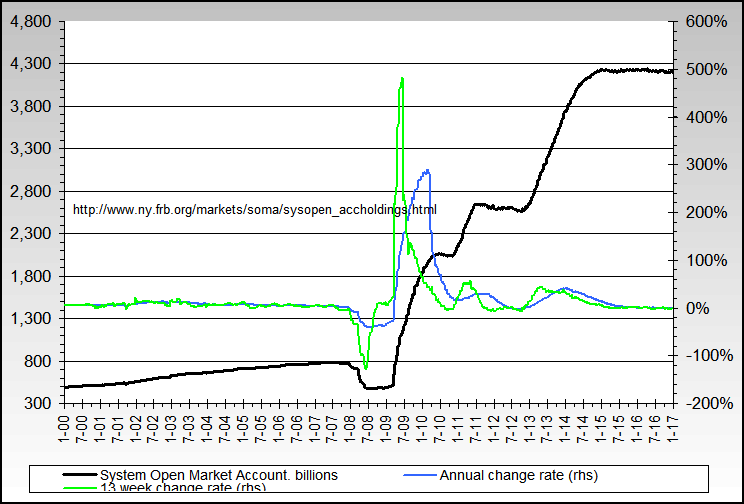
    As consumers and businesses reduce their borrowing of new money into existence, the government can increase its borrowing of new money into existence.
    And how "convenient" the cover of the drop in the System Open Market Account is for that eventuality.

    Leave a comment:


  • FRED
    replied
    Re: You're not going to believe this: Inflation/deflation debate still alive?

    Originally posted by grapejelly View Post
    Mish and Rick don't get this. And they don't get the fact that consumers and businesses don't need to borrow...the borrowing can be done by other actors.
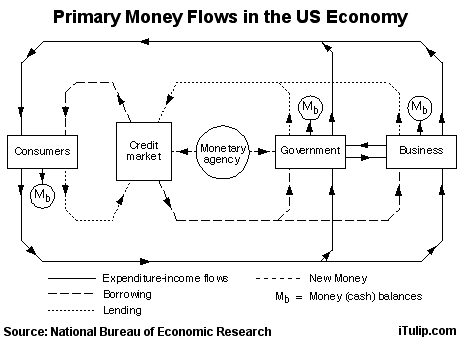
    Indeed, we've showed them this diagram and explained it to them before.


    We're patient guys. We're happy to explain it again.

    Money once borrowed into existence rarely disappears. Most money continuously changes form as it flows through the economy. As consumers and businesses reduce their borrowing of new money into existence, the government can increase its borrowing of new money into existence.

    Leave a comment:


  • phirang
    replied
    Re: You're not going to believe this: Inflation/deflation debate still alive?

    Originally posted by ASH View Post
    Just like the preposterous recruiting commercial!

    But seriously... there are people whom I think know more about economics than I, who seem to take the deflationary scenario seriously. I am under the impression that the debate really boils down to what the government (and Fed) will do -- and how American consumers of credit will respond. I think EJ and the iTulip crowd have it right, but fundamentally this argument is more about handicapping government strategy and consumer response than it is about objective economics. I mean -- it isn't as though deflation is technically impossible. Rather, it is a question of how alert the Fed is to deflationary threats versus inflation (cue snide reference to helicopters), whether they have the ability to successfully halt a collapsing credit bubble and re-inflate (cue snide references to printing presses), and whether over-extended American consumers will borrow if even more credit is extended to them under easier terms (cue snide reference to deranged weasels).
    You're completely correct: a friend of mine is doing his econ phd at MIT, and while he's not macro, he knows bernanke's work... and ultimately, it's the capricious voting masses that will drove the inflationary sword into their own bellies'.

    Ceterius paribus and without politiks, without a doubt we'd enter a deflationary spiral. Yet, that tenacious political dimension persists and makes everything a fking 6-sigma event.

    Leave a comment:


  • ASH
    replied
    Re: You're not going to believe this: Inflation/deflation debate still alive?

    Originally posted by phirang View Post
    gaaaah ash, you're slaying the deflationary demons!!!
    Just like the preposterous recruiting commercial!

    But seriously... there are people whom I think know more about economics than I, who seem to take the deflationary scenario seriously. I am under the impression that the debate really boils down to what the government (and Fed) will do -- and how American consumers of credit will respond. I think EJ and the iTulip crowd have it right, but fundamentally this argument is more about handicapping government strategy and consumer response than it is about objective economics. I mean -- it isn't as though deflation is technically impossible. Rather, it is a question of how alert the Fed is to deflationary threats versus inflation (cue snide reference to helicopters), whether they have the ability to successfully halt a collapsing credit bubble and re-inflate (cue snide references to printing presses), and whether over-extended American consumers will borrow if even more credit is extended to them under easier terms (cue snide reference to deranged weasels).

    Leave a comment:


  • grapejelly
    replied
    Re: You're not going to believe this: Inflation/deflation debate still alive?

    Originally posted by jk View Post
    but the note was near-money. when i own a tbill, e.g., i think i'm holding money, even though i'm just holding a note. when loans are written off through default, the holders of those formerly valuable loans feel much poorer.
    Yes, but a default affects the ability of the holder (like a bank) to extend credit in the future but is not deflationary itself.

    This is a key point and I don't know why people miss it. We can have widespread defaults on loans and no deflation. Deflation will happen if the money supply shrinks through people paying down their debts.

    Think of it in central bank terms.

    When they want to shrink the money supply (hahahaha they never do), the central banks sell debt to the banks, and take back dollars. This is the same as borrowing from the banks. When they want to increase the money supply, they buy debt from the banks...same as lending money to the banks.

    Borrowing is inflationary.

    Paying back is deflationary.

    Debt default is not deflationary.

    And, further, inflation is a big problem when there are widespread debt defaults because new money is borrowed into existence and this new money WON'T go into more investment. It will be borrowed in order to be invested in tangibles and therefore result in higher commodity prices.

    (Not higher real estate prices due to the fact that real estate prices are credit-dependent.)

    Mish and Rick don't get this. And they don't get the fact that consumers and businesses don't need to borrow...the borrowing can be done by other actors.

    Leave a comment:


  • FRED
    replied
    Re: You're not going to believe this: Inflation/deflation debate still alive?

    Rick and EJ continue the discussion, below.

    Rick: Better you should ask how the yen performed relative to all other classes of yen assets. Answer: Just fine. Gold in fact has always done relatively well as an investable (sic) during deflationary times. Still, as a hard-core deflationist, I have my doubts that the POG will get to Sinclair’s promised land above $5000 oz.
    The yen performed well because the yen is not a reserve currency, the Japanese experienced a hyperinflation after the war, and so protecting the yen was more important than preventing deflation. In contrast, the Fed is throwing the dollar under the bus to prevent deflation. It works – too well.

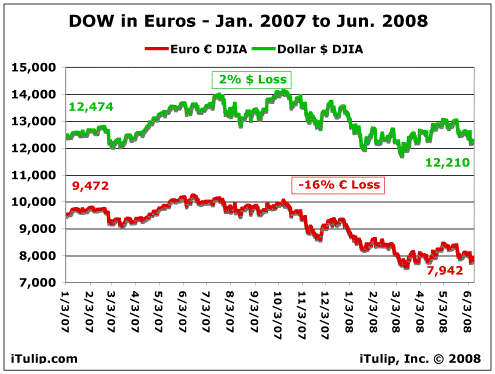
    Please take another look at the Argentina example. The relationship between the dollar and gold now for the US is similar to the relationship between the peso and the dollar for Argentina in the late 1980s. Deflation in domestic peso terms, yes, inflation in dollar terms, yes also. Asset prices are falling in dollar terms but crashing in euro terms.


    Not only US stocks but US real estate is cheap if you are a European.

    Wage rates increased in Argentina during their 1988 - 1991 inflation but an American company could buy labor in Argentina for pennies on the dollar. Today US wage rates are 50% lower in euro terms than a few years ago -- great if you are a European company paying employees in the US. US wages are deflating against commodities priced in dollars, and domestic commodity prices, to the extent that these are determined by imports, are continuing to inflate.

    Oil not gold is the ultimate money as it is the critical input to everything else. As Peak Cheap Oil arrives, everything is deflating against oil, which we experience as commodity price inflation. This event is widely misunderstood as a demand shock. Oil demand in OECD nations has declined to 2% annual growth rates since 2004 as oil prices doubled then doubled again. As China and oil producers are starting to reduce subsidies, demand may fall some more, but we'll see how long the oil kelptocracies and Chinese state continues with that program -- government give-aways are all they have to maintain political legitimacy. Meanwhile, oil producers have demonstrated that they intend to keep more of the oil they have left in the ground, so in spite of politically motivated assertions to the contrary they are not increasing supply but cutting it faster than demand is falling.

    Rick: But I have no qualms about assuring my subscribers that gold is all but certain to hold its purchasing power – not only relative to all other classes of assets, but relative to anything that you would care to call money.
    Gold is an international currency. As governments print to reflate economies, the value of national currencies deflate against gold.

    My theory since 2001 is that this process will eventually take gold to $2500. Needless to say, that was contrarian back when gold was trading at $270. At $900 we have new entrants with very deep pockets to take us to the next stage of the market:
    "Gold prices may rise to $5,000 an ounce as investors seek to protect themselves against accelerating inflation, said Schroder Investment Management Ltd., which oversees $277 billion of assets globally."
    If funds keep throwing billions at the gold market, and CBs become net buyers as Schroder expects, who knows – maybe we'll get to $5000. The paradox is that the guys who created this mess are the same guys who are now struggling to maintain the purchasing power of all the money they made on it. The rest of us are collateral damage.

    Rick: Even more certain is that, on a day in the not-too-distant future, Americans will realize that the hundred dollar bills they carry in their wallets are fundamentally and intrinsically worth no more or less than the $1 bills. I can’t tell from your writing whether you understand this, but if you do, it should disabuse you of the notion that the economy is somehow going to continue to muddle along. Muddling is one thing we deflationists all strongly agree cannot continue for much longer.
    I have no allusions that the US economy can muddle along. For a quick summary of my positions, I recommend:
    Rick: Concerning deflation and its symptoms, there is little I would care to add to the story I linked from the Chicago Tribune (which you have yet to acknowledge and presumably did not bother to read). When middle-class America cuts out lattes and starts refilling soda-pop containers, that is not inflation, or stagflation, or hyperinflation; it is a small step toward Depression, when almost nothing pleasurable, or that we currently take for granted, will be affordable.
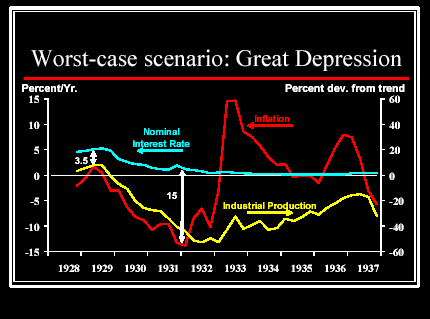
    I did read it. Substitution always occurs during inflations. See:This will go on and on for years and years as living standards decline. Inflation is easier for people to adjust to than you'd think, certainly easier than 25% unemployment and no money around to buy anything, as was the policy choice in the 1930s as wealth holders pressured the State to stick to the gold standard which tied the Fed's hands to create inflation. As soon as the US went off the gold standard in 1933 and gold was re-priced, an instantaneous spike in inflation from -10% (deflation) to +15% (inflation) resulted.


    This inflation occurred after thousands of banks failed and the banking system had basically cratered. Those who hold fast to the theory that we are going to see commodity and wage price deflation as an outcome of this credit bubble don't seem to understand this part of the history of the last US credit bubble.

    By the way, the gasoline sign using to illustrate the Five Signs of Inflation piece was created using a web tool atom.smasher.org. Actual gas prices at the time in April were around $3.50 for regular and few believed that regular gas was going to rise of over $4. Now the sign looks like what you see everywhere. Soon those prices will look quaint.

    Rick: Like Mish, I’m not looking for an argument -- I simply don’t have the time.
    If I'd been forecasting deflation for years on end and a google news search produced 136 times as many results for a search on "inflation" versus "deflation" (142,539 search results vs 1,043 search results), I'd be looking to make some adjustments in my model.

    The only major adjustment that I've had to make is my forecast is on long term interest rates. I expected they'd have turned up by now, given the high levels of inflation. A friend who is a hedge fund manager running $1B told me in March he was finally taking huge short positions in long treasuries. He moved into the 10 yr at 3.34% and now it's at 4:16%. Good move. Will yields continue up and prices down?

    Here's a surprising voice added to the inflation chorus:
    When asked about the potential for stagflation, a combination of weak growth and high inflation, Greenspan said, "Oh certainly."

    Greenspan also said, contrary to the opinion of many, that there isn't a commodities bubble building. "Once you get inflation pressure starting to emerge, you don't get bubbles." he said. (Forbes, May 2008)
    I'm sure Bernanke wasn't too happy about that pronouncement.

    But I would be grateful if you would provide me with a bullet-point synopsis of the major economic events that you expect to occur over the next 7-10 years. That will be the easiest way for me to determine whether I may have misunderestood you. Do we perhaps envision the same endgame -- an economy in smouldering ruins, credit markets wrecked for at least a generation, widespread poverty and unemployment to match or exceed the Great Depression, and the U.S. having to rebuild its manufacturing capacity almost from scratch in order to make an honest living in the global marketplace? If that’s “stagflation,” or hyperinflation, then you needn’t bother to respond.

    I'm writing a book for Penguin that explains a tough transition period. We took a wrong turn in the 1970s. Now we have to go back and fix it.

    The thesis of the book may help you understand where I'm coming from:

    Working title: The New New Deal, Re-industrialization of Post Depression America

    The recession that the US is entering in the early part of 2008 is not a typical business cycle recession or even a post bubble recession as occurred in 2001. The collapse of the housing bubble and the energy price shock are the triggers that started a process of major structural change in the US and World economy. When the transition is over in a decade, the US economy will hardly resemble its current form:
    • Dependence on foreign borrowing to finance consumption and operate the government will end and reverse
    • Dominance of the Finance, Insurance and Real Estate (FIRE) sectors of the economy for economic growth will give way to new productive industries in transportation, energy, and communications
    • Trade deficits that started in the early 1980s will reverse and the US will begin to run a trade surplus
    • Burden of economic rent extraction in the form of interest on public and Private sector debt will be lifted via a combination of inflation, restructuring, and debt cancellation
    • Low national and household savings rates will rise to 1960s levels
    • Consumption will decline by half, from 70% of GDP today to 50% of GDP
    • Energy intensity, the amount of energy needed to produce a dollar of GDP growth will decline by half, led by conservation initiatives

    The US will experience the transition as a series of recessions which,
    cumulatively, may be as severe as in The Great Depression, but inflationary versus deflationary. We are seeing the first of these now.

    The New New Deal asks and answers:

    How did we get into this mess?
    • Why have US financial markets been in turmoil for over a year?
    • Why has the dollar weakened over 40% since 2002?
    • Why is inflation rising?
    • Why is unemployment rising?
    • Why are asset prices falling?

    How are we going to get resolve our crises?

    My publisher doesn't want me sharing the solutions part of the book, but basically the idea is that unlike the old New Deal, this time we unleash markets on the problem, with equity versus debt based financing.
    Last edited by FRED; June 24, 2008, 09:21 AM.

    Leave a comment:


  • phirang
    replied
    Re: You're not going to believe this: Inflation/deflation debate still alive?

    gaaaah ash, you're slaying the deflationary demons!!!

    Leave a comment:


  • ASH
    replied
    Re: You're not going to believe this: Inflation/deflation debate still alive?

    Originally posted by grapejelly View Post
    But when loans are written off through default, there is no deflation because the money that was borrowed into existence was already spent and remains in the economy.
    Originally posted by jk View Post
    but the note was near-money. when i own a tbill, e.g., i think i'm holding money, even though i'm just holding a note. when loans are written off through default, the holders of those formerly valuable loans feel much poorer.

    I recently got around to reading Galbraith's "Money: Whence it Came; Where it Went", and he says pretty clearly that both the credit and the loan function as money. It makes sense to me. The borrower can spend the credit, and the debt can be bundled and sold, or used as the capital base for futher lending. Therefore, the way I understand it, creating a loan for $X effectively increases the money supply by twice $X.

    It seems to me that if the loan is defaulted upon, then instead of twice $X running around in the economy, we are left with $X -- so the money supply has decreased. That said, the money supply is still larger than it was before the loan was made, since $X is still out there.

    Is this perhaps the distinction between dis-inflation and deflation? It seems that default does destroy money, but only the half that was created by the original loan.

    Complications occur to me. Even if the money supply doesn't shrink relative to its size before the loan was made, it still shrinks relative to what it was before the default. Further, it could shrink relative to the supply of goods and labor. You could see prices decline, I suppose. There's also the impact upon money creation to consider -- loan defaults lead to weak balance sheets and reduced credit creation. Banks could choose to collect payment on outstanding loans but not re-lend the money. If the capital base contracts as the result of some defaults, then you would expect a period of money destruction as loans that aren't in default get paid off, but banks fail to re-loan the money. There is also a leverage effect, since banks loan a multiple of their reserves. Default on a small number of loans could result in destruction of a much larger sum of money in the form of paid-off loans that aren't re-issued.

    By the way -- I am not a deflationist. I drink the iTulip koolaid (plus I tend to believe my own eyes.) I just wanted to point out that it isn't the change in the supply of money which matters, but rather that change relative to the change in the supply of things you can buy with money that matters. One should also think about the capital base from which banks make loans.
    Last edited by ASH; June 23, 2008, 04:24 PM.

    Leave a comment:


  • GRG55
    replied
    Re: You're not going to believe this: Inflation/deflation debate still alive?

    Originally posted by phirang View Post
    a chat I had with an econ friend of mine who's at MIT:


    " inflationary spiral .. that's the key thing to control here ... i mean all you need is sufficient consumption curtailings to induce that to not happen -- could include maintaining low wages among other things ... the oil shocks i think as they run their course will induce this anyway .. im not concerned about an inflationary spiral. .. this is cuz the oil shocks .. ppl tend to misread it as an increase in the price of a huge component of our consumption bundle. the better way to understand it is like an adverse productivity shock -- it makes us less cost effective in production in all industries because its like increasing the marginal cost everywhere. "
    Presumably there wasn't sufficient "consumption curtailings" to contain the inflationary spiral that was ignited by the oil shock in 1973 then?

    The food and fuel "shocks" we are seeing are the manifestation of an inflationary spiral that is now looks very much baked in the cake. The danger I sense is the belief that some sort of "consumption curtailment" is the modestly painful and politically manageable (as opposed to excruciatingly painful and politically unacceptable) exit solution from the box the Central Bankers and FIRE economy interests have put us in.

    Leave a comment:

Working...
X