Announcement

Collapse
No announcement yet.

The deflation case: caught, gutted, poached and eaten

Collapse
X
 
  • Filter
  • Time
  • Show
Clear All
new posts

  • GRG55
    replied
    Re: The deflation case: caught, gutted, poached and eaten

    Originally posted by metalman View Post
    and another thing... you will readily acknowledge that the gummit is lying about cpi inflation, about "productivity", about gdp, etc.

    what makes you so darn sure the gummit ain't also lying about wage inflation? hmmmm?

    itulip diggers... get digging on the data!
    Good point. I don't live in the USA, but I'm prepared to make a small wager that wages in many sectors are going up faster than folks realise.

    Has the fellow that fixes your car raised his rates in the last year?

    Just askin'

    Leave a comment:


  • metalman
    replied
    Re: The deflation case: caught, gutted, poached and eaten

    and another thing... you will readily acknowledge that the gummit is lying about cpi inflation, about "productivity", about gdp, etc.

    what makes you so darn sure the gummit ain't also lying about wage inflation? hmmmm?

    itulip diggers... get digging on the data!

    Leave a comment:


  • GRG55
    replied
    Re: The deflation case: caught, gutted, poached and eaten

    Originally posted by brucec42 View Post
    I'm wondering how gold can't continue to rise as more money is printed.
    Perhaps your question is rhetorical, but I'll rise to the bait.

    Throughout the 1980's and 1990's money was printed. And in no small quantities. Look what happened to the purchasing power of the US$ (and most other paper currencies) over those 20 years. If you wanted to buy a roof over your head in 2001, when gold hit bottom, it cost you a hell of a lot more in nominal terms than it did in 1981 - and that's before the housing bubble really got started. Over two decades, gold did nothing but head south (as did silver, platinum, base metals, oil, natural gas, coal, aluminum, uranium...), with periodic and brief rebounds that only served to disillusion all but the most ardent gold bugs. Perhaps money printing by itself isn't the only consideration?

    Originally posted by brucec42 View Post
    But more importantly, looking longish term, how can we expect our dollars to be anything but diminished in real value when our government has what, 50 trillion in unfunded obligations that apparently it is mathmatically all but impossible for them to meet in the coming years?

    To me, the obvious solution is that they will just pay people what they owe them, but in new peso-like dollars. You'll be able to cash a $1,000 savings bond and go buy a pack of gum with it.
    "We can guarantee cash benefits as far out and at whatever size you like, but we cannot guarantee their purchasing power"
    --Alan Greenspan responding to a question from Senator Jack Reed (D) of Rhode Island, February 2006 --

    Originally posted by brucec42 View Post
    Are there any currencies that are not depreciating rapidly or that won't if ours collapses?
    I have been invested in the Yen and Swissie since Dec 2006. Early, but now finally well in the money. The Swissie may now be vulnerable to a sympathy fall alongside the Euro, but the Yen still appears a reasonable bet. In both cases the interest they pay is essentially zero, so they have no room to play the "let's devalue the currency through rate cuts" game. They can use other means to devalue, but those are much more difficult, and involve bellying up to the bar and buying bonars.
    Last edited by GRG55; March 03, 2008, 05:17 PM.

    Leave a comment:


  • Guest's Avatar
    Guest replied
    Re: The deflation case: caught, gutted, poached and eaten

    I'm wondering how gold can't continue to rise as more money is printed.

    But more importantly, looking longish term, how can we expect our dollars to be anything but diminished in real value when our government has what, 50 trillion in unfunded obligations that apparently it is mathmatically all but impossible for them to meet in the coming years?

    To me, the obvious solution is that they will just pay people what they owe them, but in new peso-like dollars. You'll be able to cash a $1,000 savings bond and go buy a pack of gum with it.

    In that event, what could you own besides gold and commodities that would keep up with this drop in the value of the paper currency?

    Gold sounds magical and mysterious and a lot like UFO sightings, until you start thinking "what else can I buy to store value in?" Homes? Maybe in 5 years or so when they bottom out and return to the normal values and oversupply is absorbed.

    Land? Possible if you know where to buy and have connections to use government to make your cheap land worth more in the future, but overall, not a ton of demand for that during a long economic downturn.

    Are there any currencies that are not depreciating rapidly or that won't if ours collapses?

    Stocks? Can they possibly keep up with the currency drop even w/o a recession and adjustment from our over-consuming, over borrowing ways?

    I think gold has a long way to go up before anyone decides its a mania and its price collapses. Something better will have to replace it first. Any ideas what that might be?

    Leave a comment:


  • dcarrigg
    replied
    Re: The Deflation Case: Caught, Gutted, Poached and Eaten

    Originally posted by FRED View Post
    Editing error. My bad. Changed the tense back.
    Not a problem. I needed a little inspiration for my avatar

    Leave a comment:


  • GRG55
    replied
    Re: The deflation case: caught, gutted, poached and eaten

    Originally posted by FRED View Post
    EJ writes in:
    With so much riding on the inflation bet, vigilance bordering on paranoia is called for. That said, with statements like these, it's difficult to see how the Fed will be able to engineer a serious and sustained decline in oil prices.
    Sun Mar 2, 2008 9:03am EST

    ALGIERS (Reuters) - Oil prices won't fall below $60 to $70 a barrel as this is the minimum level at which alternative fuels are economically viable, Saudi Oil Minister Ali al-Naimi said in remarks published on Sunday by Algeria's APS news agency.

    "From now there's a line below which prices won't fall," the official agency quoted him as saying in an interview with Petrostrategies magazine.

    He said this involved "the marginal cost of production of alternative fuels, whether that's biofuels or tar sands" which had a threshold "between $60 and $70", APS reported.
    I met with the largest investment bank in the Middle East in NYC a couple of months ago. They were offering a product to funds interested in GCC equities exposure. Their investment thesis was well summed up by one of the hedge fund managers in the room as "long oil." With oil already over $90, everyone was skeptical. But what if oil producers are in fact committed to holding supplies below demand to maintain prices over the price of alternatives in order to support a US Alternative Energy boom? What if that's the new political arrangement with the west?
    1. It is against my nature to be making the kinds of musings I have posted in the past few days. My investing method is to buy what is cheap and hold it until it is dear. Many of the oil positions I hold today were purchased back in 1999 and 2000 when everyone was ga ga over tech, and nobody wanted petroleum. However, the vigilance bordering on paranoia description is exactly how I feel for the first time this decade.
    2. To be clear, I do not expect the Fed to be able to engineer a "serious and sustained decline in oil" or any consumed commodity. My concern is Central Bank reaction to a near term parabolic overshoot that is not driven by fundamentals, but is purely a short term financial "event". No matter how well the rationalization is presented, wheat limit-up EVERY DAY in a week is no longer being driven by fundamentals. This is money smelling blood. If, for example, bond holders are hedging with commodities, they will not hesitate to close those hedges if there is any hint the Fed decides it needs to deal with skyrocketing grain and gasoline because of public and political considerations. This is, after all, an election year...and powerful as Wall St is, they cast only a small number of the total votes in November.
    3. The absolute change is not important. A steady doubling of oil over the next, say four years that supports the US led Alternate Energy Bubble will be tolerated, and perhaps even quietly welcomed. A doubling of oil by the end of this summer, in concert with a collapsing US$ is a political nightmare. The latter will prompt a Fed and global Central Bank response IMO, before it gets to that extreme. It's all about first-derivative, rate-of-change.
    4. The thesis of a "new political arrangement with the west" is intriguing. The benefit to the GCC producers is the security of high revenues to fund their massive social programs that the unrepresentative governments here must have to keep everyone happy. Entitlement expectations are growing very, very rapidly. Inflation is rampant. Subsidies for everything from petrol to baby food are expanding rapidly. A collapse in oil prices would be potentially devastating to social stability, and the political grip the Ruling Families hold. Now that the threat from Saddam has been permanantly removed, there may be a new symbiosis, along the lines you suggest, developing between the Gulf states sub-set of OPEC and the west/USA, that is less military and more economic in nature?

    Leave a comment:


  • metalman
    replied
    Re: The deflation case: caught, gutted, poached and eaten

    can i butt in?

    Originally posted by jk View Post
    re the fed tolerating commodity prices- i think high commodity prices will be viewed as ultimately deflationary, a "tax" on consumption, not inflationary, in the absence of wage inflation.
    no. you're sounding ackermishian! high prices cannot be deflationary. deflation: reduction in the money supply resulting in a decline in the general price level. inflation: rise in the money supply resulting in an increase in the general price level. any other definitions are nonsense hand waving.

    the question is: can fire econ interests maintain political influence over the fed to keep the inflation pain directed toward the politically weak in american society?

    who lanced the subprime bubble? a margin clerk who demanded more collateral from 2 bear stearns funds. that's what started the ball rolling iirc.
    yeh, same as every bubble... someone started selling.

    as food and energy go higher, ben will worry about consumption of other goods going lower as j6p is squeezed, not to mention his mortgage resetting next month.
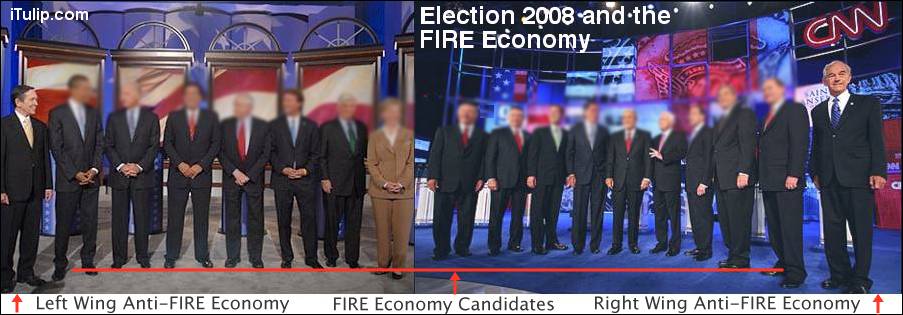
    so what's j6p gonna do about it? vote? bwah ha-ha ha ha ha-ha ha, ho ho, ho! pick yer fire econ candidate...

    from...

    Forget the Fed - Part II: Politics of FIRE


    gee, look who got pushed out of the race first?

    there is a reason for the big inflation-deflation debates we hold. there are a lot of deflationary forces, mainly a lot of debt, a lot of leverage. ben is an expert on the great depression and the japanese deflation. the dual mandate gets tossed overboard when there is a threat of deflation, a threat of the fed funds rate reaching the zero bound. the g7 issued a warning about disorderly dollar depreciation, i know, but i can't see more than a coordinated currency intervention someday. and that will hit commodities, temporarily.
    you ain't following this are you? not price deflation forces, debt deflation forces! monetary inflation is a form of debt deflation. the japanese owe money to themselves... are a net creditor. the us has a natural mechanism of debt deflation via inflation: trillions of bonars overseas. we've been over and over this for years.

    now the us is pushing its inflation problem onto the world. when does the world say "uncle"? how do they say uncle? those are the questions. rogers thinks it all goes to shit in acrimonious shitstorm of political/currency crisis. don't know if ej's taken a position on that recently but his interview with galbraith and others way back in 2006... inevitable... transitions to new currency regimes are never smooth or pretty.

    i think the real risk to the commodity trade is a big-time deflation scare, a deeper recession than anyone expects, or at least some data that points in that direction. THEN there will be a sell-off of commodities, including pm's.
    that's dopey. deflation scare... that was fall 2006. over. you blinked. you missed it. right here...

    http://www.itulip.com/forums/showthread.php?t=428

    where itulip said ka-poom this time is too tough to trade...

    The implications of poor distribution of wealth are less obvious. What happened in the 1930s will likely happen again. In a recession, a small minority of the nation's population that garners most of the income and holds most of the nation's wealth and assets cannot generate enough demand to re-employ the majority. As the credit bubble winds down, the US government will find itself with a politically similar challenge as in the 1930s: How to get the wealth spread around and the economy going again? But inflation is much easier to create today without the constraints of the gold standard. Stubborn adherence to the gold standard was in fact blamed for much of the pain, and The Great Depression could have been avoided if only the Fed had been free to print money and buy stuff, just as they are today.

    Conclusion

    The economic, monetary, financial market, and political antecedents are all in place for a Ka-Poom event. As I mentioned last week, the disinflationary part of the event appears to have started, but no one can say how far it will go before policy makers reverse course, making the transition difficult to time and trade.

    Leave a comment:


  • jk
    replied
    Re: The deflation case: caught, gutted, poached and eaten

    Originally posted by GRG55 View Post
    Wrong on the first point. The banks won't be "made whole" for quite some time, and some will never be made whole - - ever. The Fed knows this. And after Bernanke's comments last week, we know they know this:
    "Feb. 29 (Bloomberg) -- The credit-default swap market had its worst two months on record amid investor concern that mounting losses on securities linked to home loans will trigger bank failures...Federal Reserve Chairman Ben S. Bernanke said yesterday some smaller banks will probably fail and unemployment will rise, fueling concern that a recession is inevitable..."
    As long as the US$, gold and the publicly visible commodities (food and fuel) price behaviour doesn't get completely out of control, the Fed has the luxury of buying time for the financial sector to continue to repair itself. I agree they want a still lower US$ (note that Boeing couldn't land the air tanker defense contract even at this exchange rate!!! ) and will tolerate higher commodity prices - but only to a point.
    re the fed tolerating commodity prices- i think high commodity prices will be viewed as ultimately deflationary, a "tax" on consumption, not inflationary, in the absence of wage inflation.


    Originally posted by grg55
    Who is lining up and eager to lance that abcess? When will "they" do it? What is their motive? Who benefits? Anyone? Not that it won't happen, but "The market can remain irrational longer than..."
    who lanced the subprime bubble? a margin clerk who demanded more collateral from 2 bear stearns funds. that's what started the ball rolling iirc.

    Originally posted by grg55
    Money now smells blood and I'll bet the short dollar, long commodity positions are piling up rapidly as market speculators do what they always do...push a trend to excess to see how far they can profitably take it. What do you think the Fed and the other Central Banks will do if the moves in the US$, grain, and maybe oil go parabolic? Deliberately lance that abcess? Stand aside? Order lunch? Call Sikorsky?
    as food and energy go higher, ben will worry about consumption of other goods going lower as j6p is squeezed, not to mention his mortgage resetting next month.

    Originally posted by grg55
    I think they take a stand. Force some losses on the less nimble traders, take the froth off the inflation trade, and buy themselves more time to deal with the putrid mess nobody wants to admit to.

    The Fed has a dual mandate. And all the other major Central Banks have some sort of inflation target band. Investors who are long commodities and precious metals (like me), and who ignore this, or underestimate these Central Banks, do so at their potential peril IMO.
    there is a reason for the big inflation-deflation debates we hold. there are a lot of deflationary forces, mainly a lot of debt, a lot of leverage. ben is an expert on the great depression and the japanese deflation. the dual mandate gets tossed overboard when there is a threat of deflation, a threat of the fed funds rate reaching the zero bound. the g7 issued a warning about disorderly dollar depreciation, i know, but i can't see more than a coordinated currency intervention someday. and that will hit commodities, temporarily.

    i think the real risk to the commodity trade is a big-time deflation scare, a deeper recession than anyone expects, or at least some data that points in that direction. THEN there will be a sell-off of commodities, including pm's.

    Originally posted by grg55
    By the way, is that a CAPITAL "G" I see at the start of your point 3? Wow. You can't assume that anything will remain constant these days...
    i composed the post in microsoft word and then pasted it. word did automatic capitalization following a period. accidents happen.:p

    Leave a comment:


  • FRED
    replied
    Re: The deflation case: caught, gutted, poached and eaten

    Originally posted by GRG55 View Post
    Wrong on the first point. The banks won't be "made whole" for quite some time, and some will never be made whole - - ever. The Fed knows this. And after Bernanke's comments last week, we know they know this:
    "Feb. 29 (Bloomberg) -- The credit-default swap market had its worst two months on record amid investor concern that mounting losses on securities linked to home loans will trigger bank failures...Federal Reserve Chairman Ben S. Bernanke said yesterday some smaller banks will probably fail and unemployment will rise, fueling concern that a recession is inevitable..."
    As long as the US$, gold and the publicly visible commodities (food and fuel) price behaviour doesn't get completely out of control, the Fed has the luxury of buying time for the financial sector to continue to repair itself. I agree they want a still lower US$ (note that Boeing couldn't land the air tanker defense contract even at this exchange rate!!! ) and will tolerate higher commodity prices - but only to a point.

    Who is lining up and eager to lance that abcess? When will "they" do it? What is their motive? Who benefits? Anyone? Not that it won't happen, but "The market can remain irrational longer than..."

    Money now smells blood and I'll bet the short dollar, long commodity positions are piling up rapidly as market speculators do what they always do...push a trend to excess to see how far they can profitably take it. What do you think the Fed and the other Central Banks will do if the moves in the US$, grain, and maybe oil go parabolic? Deliberately lance that abcess? Stand aside? Order lunch? Call Sikorsky?

    I think they take a stand. Force some losses on the less nimble traders, take the froth off the inflation trade, and buy themselves more time to deal with the putrid mess nobody wants to admit to.

    The Fed has a dual mandate. And all the other major Central Banks have some sort of inflation target band. Investors who are long commodities and precious metals (like me), and who ignore this, or underestimate these Central Banks, do so at their potential peril IMO.

    By the way, is that a CAPITAL "G" I see at the start of your point 3? Wow. You can't assume that anything will remain constant these days...
    EJ writes in:
    With so much riding on the inflation bet, vigilance bordering on paranoia is called for. That said, with statements like these, it's difficult to see how the Fed will be able to engineer a serious and sustained decline in oil prices.
    Oil prices won't fall under $60-$70: Naimi
    Sun Mar 2, 2008 9:03am EST

    ALGIERS (Reuters) - Oil prices won't fall below $60 to $70 a barrel as this is the minimum level at which alternative fuels are economically viable, Saudi Oil Minister Ali al-Naimi said in remarks published on Sunday by Algeria's APS news agency.

    "From now there's a line below which prices won't fall," the official agency quoted him as saying in an interview with Petrostrategies magazine.

    He said this involved "the marginal cost of production of alternative fuels, whether that's biofuels or tar sands" which had a threshold "between $60 and $70", APS reported.

    I met with the largest investment bank in the Middle East in NYC a couple of months ago. They were offering a product to funds interested in GCC equities exposure. Their investment thesis was well summed up by one of the hedge fund managers in the room as "long oil." With oil already over $90, everyone was skeptical. But what if oil producers are in fact committed to holding supplies below demand to maintain prices over the price of alternatives in order to support a US Alternative Energy boom? What if that's the new political arrangement with the west?

    Leave a comment:


  • GRG55
    replied
    Re: The deflation case: caught, gutted, poached and eaten

    Originally posted by jk View Post
    3. Grg55’s fed tightening “once the banks are made whole” [or words to that effect]
    This scenario is contingent on the banking problems being, relatively speaking and to coin a phrase, “contained.” On the other hand, I am of the view that the rot in the banking/credit system goes much deeper than has been revealed to date, and the abcess will be lanced to release a putrid mass of bad paper and counterparty failures. I think bernanke would likely love grg’s posited opportunity, but I don’t think he’ll get it.


    Wrong on the first point. The banks won't be "made whole" for quite some time, and some will never be made whole - - ever. The Fed knows this. And after Bernanke's comments last week, we know they know this:
    "Feb. 29 (Bloomberg) -- The credit-default swap market had its worst two months on record amid investor concern that mounting losses on securities linked to home loans will trigger bank failures...Federal Reserve Chairman Ben S. Bernanke said yesterday some smaller banks will probably fail and unemployment will rise, fueling concern that a recession is inevitable..."
    As long as the US$, gold and the publicly visible commodities (food and fuel) price behaviour doesn't get completely out of control, the Fed has the luxury of buying time for the financial sector to continue to repair itself. I agree they want a still lower US$ (note that Boeing couldn't land the air tanker defense contract even at this exchange rate!!! ) and will tolerate higher commodity prices - but only to a point.

    Who is lining up and eager to lance that abcess? When will "they" do it? What is their motive? Who benefits? Anyone? Not that it won't happen, but "The market can remain irrational longer than..."

    Money now smells blood and I'll bet the short dollar, long commodity positions are piling up rapidly as market speculators do what they always do...push a trend to excess to see how far they can profitably take it. What do you think the Fed and the other Central Banks will do if the moves in the US$, grain, and maybe oil go parabolic? Deliberately lance that abcess? Stand aside? Order lunch? Call Sikorsky?

    I think they take a stand. Force some losses on the less nimble traders, take the froth off the inflation trade, and buy themselves more time to deal with the putrid mess nobody wants to admit to.

    The Fed has a dual mandate. And all the other major Central Banks have some sort of inflation target band. Investors who are long commodities and precious metals (like me), and who ignore this, or underestimate these Central Banks, do so at their potential peril IMO.

    By the way, is that a CAPITAL "G" I see at the start of your point 3? Wow. You can't assume that anything will remain constant these days...
    Last edited by GRG55; March 03, 2008, 07:36 AM.

    Leave a comment:


  • Guest's Avatar
    Guest replied
    Re: The deflation case: caught, gutted, poached and eaten

    The Subtle Art Of Neo-Epistemological Forecasting -


    NEO_EPISTEMOLOGICAL_FORECAS.gif

    [ATTACH]281[/ATTACH]

    DEFLATIONISTAS_TO_ARCHERY-R.gif
    Last edited by Contemptuous; March 03, 2008, 02:08 PM.

    Leave a comment:


  • metalman
    replied
    Re: The deflation case: caught, gutted, poached and eaten

    Originally posted by jk View Post
    4. the unit of account and “inflation” and “deflation”
    I’m with metalman, who brings us back to the point that you can have all-price inflation and all-price deflation simultaneously depending on your unit of account. Are we counting in dollars, euros, yen, real, gold, bushels of wheat, fixed commodity baskets or those huge round stone wheels that they use somewhere or other? Tell me that, then we can talk inflation or deflation.
    thx but can't take credit. learned it here years ago.

    6. the problem of wages
    the paper from the cleveland fed says that inflation has caused increased wages more than vice versa. But we still need to elucidate the mechanism for that to happen under current conditions, or if we can’t elucidate the mechanism, at least find the evidence for that happening. Aggregated compensation figures hide the disproportionate distribution of incomes and, I would guess, the even more disproportionate distribution of income increases. ej’s story of the poor selling the family jewelry while the rich buy precious metals captures the issue. I think the issue of wage inflation is key. Mauldin’s piece is correct, I think, in saying that the fed will tend to feel retlatively sanguine about inflation IN THE ABSENCE OF WAGE INFLATION.
    yes, but who's wages? working class j6p's wages or the rent extracted via the debt serf system? that latter inflation = good, the former bad. in fact fire inflation isn't even measured. no fire cpi and if it were measured the higher it was the better.

    Leave a comment:


  • jk
    replied
    Re: The deflation case: caught, gutted, poached and eaten

    1.
    Originally posted by ej quoting thatcher
    "There is no such thing as Society. There are individual men and women, and there are families."
    that’s why we don’t worry about crowd phenomena around here, huh? I prefer the saying that the iq of a group equals the highest iq of any member divided by the number of people in the group. An exaggeration, no doubt, but it says crowd phenomena are real. Similarly, there’s no such thing as social trends, huh? And so on.


    2. deflation v inflation and The melting of the monetary ice-caps
    global warmists worry about the rise of sea level once big chunks of ice melt. In similar fashion, the vast frozen reserves of u.s. financial instruments held by foreign c.b.’s are “melting” into circulation, raising our monetary sea-level.

    3. Grg55’s fed tightening “once the banks are made whole” [or words to that effect]
    This scenario is contingent on the banking problems being, relatively speaking and to coin a phrase, “contained.” On the other hand, I am of the view that the rot in the banking/credit system goes much deeper than has been revealed to date, and the abcess will be lanced to release a putrid mass of bad paper and counterparty failures. I think bernanke would likely love grg’s posited opportunity, but I don’t think he’ll get it.

    4. the unit of account and “inflation” and “deflation”
    I’m with metalman, who brings us back to the point that you can have all-price inflation and all-price deflation simultaneously depending on your unit of account. Are we counting in dollars, euros, yen, real, gold, bushels of wheat, fixed commodity baskets or those huge round stone wheels that they use somewhere or other? Tell me that, then we can talk inflation or deflation.

    5. let’s not assume that all prices move in the same direction
    whatever the unit of account, there is no law saying that all prices must move the same way. In fact, such coordinated and unanimous movement seems pretty unlikely. The inflation-deflation debate usually treats global pricing as unitary, but it seems to me that a benefit of ej’s model is that it disaggregates the economy. Real estate prices down. Most equity prices down. Leveraged financial instruments down. Commodities up, but not necessarily all commodities. This is an area that remains for analysis.

    6. the problem of wages
    the paper from the cleveland fed says that inflation has caused increased wages more than vice versa. But we still need to elucidate the mechanism for that to happen under current conditions, or if we can’t elucidate the mechanism, at least find the evidence for that happening. Aggregated compensation figures hide the disproportionate distribution of incomes and, I would guess, the even more disproportionate distribution of income increases. ej’s story of the poor selling the family jewelry while the rich buy precious metals captures the issue. I think the issue of wage inflation is key. Mauldin’s piece is correct, I think, in saying that the fed will tend to feel retlatively sanguine about inflation IN THE ABSENCE OF WAGE INFLATION.

    Leave a comment:


  • metalman
    replied
    Re: The deflation case: caught, gutted, poached and eaten

    Originally posted by Lukester View Post
    Perhaps the following brief data might serve as a book-end for this thread?

    We could even put a nice engraved brass plaque underneath this datum and frame it for posterity - the "gutted deflation case", entitled "actionable hints and epistemological methodology - concerning the presence or absence of inflation in all-goods prices - 2008"

    > Prices are skyrocketing: The U.S. Department of Labor reported that wholesale prices soared 1% in January. That was three times more than economists forecast. And it bumped the inflation rate for the preceding 12 months to 7.4% — the worst since the fall of 1981.

    > Oil prices are soaring: Oil topped $103 per barrel — up more than 1,000% since we first wrote that prices were set to skyrocket.

    > Gold is exploding higher: It hit still another all-time high of $976 per ounce in Hong Kong Friday morning — more than triple the price it was when we first began forecasting this new gold market ... and only a scant $24 away from the historic $1,000 mark.

    > Nearly all commodity prices are through the roof: The Reuters CRB Index, which tracks 17 key commodities prices, has soared a staggering 18% just since late January.

    Mr. Ackerman, what ever are we to do with this irksome data?
    rick (waving his hands around to distract you): what about debt deflation? huh? if i stop talking about price deflation like i used to and slip the word "debt" in front of it no one will notice. he-he. i still get to use the word "deflation" and... i'm right! there is debt deflation, right? you said so yourself.

    itulip: no, silly. the most popular form of debt deflation is expanding the money supply to allow the repayment of debt with depreciated dollars ala ka-poom ala 2001 (or whenever). true then, true now.

    rick: ok, i'll shut up now.

    Leave a comment:


  • Guest's Avatar
    Guest replied
    Re: The deflation case: caught, gutted, poached and eaten

    Originally posted by FRED View Post
    ... You [ Ackerman] say: "Portends only a more spectacular bust when prices at the pump reach $5, and eggs $12 a carton." ... You have been calling for all-goods price deflation. Don't you mean "prices at the pump reach $1, and eggs $0.50 a carton." What, now you're calling for inflation? ... Welcome to the inflation team!
    Perhaps the following brief data might serve as a book-end for this thread?

    We could even put a nice engraved brass plaque underneath this datum and frame it for posterity - the "gutted deflation case", entitled "actionable hints and epistemological methodology - concerning the presence or absence of inflation in all-goods prices - 2008"

    > Prices are skyrocketing: The U.S. Department of Labor reported that wholesale prices soared 1% in January. That was three times more than economists forecast. And it bumped the inflation rate for the preceding 12 months to 7.4% — the worst since the fall of 1981.

    > Oil prices are soaring: Oil topped $103 per barrel — up more than 1,000% since we first wrote that prices were set to skyrocket.

    > Gold is exploding higher: It hit still another all-time high of $976 per ounce in Hong Kong Friday morning — more than triple the price it was when we first began forecasting this new gold market ... and only a scant $24 away from the historic $1,000 mark.

    > Nearly all commodity prices are through the roof: The Reuters CRB Index, which tracks 17 key commodities prices, has soared a staggering 18% just since late January.


    Mr. Ackerman, what ever are we to do with this irksome data?

    Leave a comment:

Working...
X