Announcement

Collapse
No announcement yet.

Housing Bubble Correction

Collapse
X
 
  • Filter
  • Time
  • Show
Clear All
new posts

  • Jim Nickerson
    replied
    Re: Housing Bubble Correction

    What Will Collapse Housing Prices?

    By Gary Shilling

    This is from John Mauldin's site http://www.investorsinsight.com/thoughts.aspx

    It seems to be a thorough discussion on housing collapse and the fallout.

    I think it is worth reading.

    Schilling, page 7: "So, the Fed won't ease until housing is clearly collapsing and the resulting recession prospects obvious. This point may come early next year, but the Fed's patriotic rate-cutting then will come too late to reverse the downward housing spiral. Given the prospects for a severe U.S. and global recession, however, an eventual return to a 1% federal funds rate is indeed likely."

    Deflation and Treasury's

    "A major global recession initiated by a collapse in U.S. house prices will probably usher in the chronic deflation we've been forecasting. Crude oil and other commodity prices will nosedive along with all fears of inflation. This deflation of 1% to 2% annual declines in major price indices will be the good deflation of tech-led, productivity-soaked excess supply, much like the late 1800s and the 1920s when concentrations of new technology propelled supply faster than demand increased. Nevertheless, a complete breakdown in housing and stubborn mortgage debt burdens could spawn the bad deflation of deficient demand, as in the 1930s in the U.S. and in Japan more recently, as consumer spending becomes moribund.

    Regardless, the next year or so will probably be miserable for most stocks, but great for Treasury bonds as these ultimate safe havens rally as their yields follow inflation rates down. What we luckily identified as "the bond rally of a lifetime" in 1981 when Treasury bond yields peaked at 14.7% will continue toward our ultimate target of 3% yields. If this occurs over two years, so two years of interest are added to capital appreciation, the 30-year Treasury bond will enjoy a total return of about 50% as its yield falls from the current 4.8% to 3.0%. The 30-year zero coupon bond will return even more, around 80%."

    Leave a comment:


  • Jim Nickerson
    replied
    Re: Housing Bubble Correction

    http://www.marketwatch.com/News/Stor...o&dist=myyahoo

    This is a nice article discussing the relationships between the Housing Market Index and the SPX, which suggests the SPX could fall to 530 by Fall of 2007.

    Leave a comment:


  • jk
    replied
    Re: today's "good" new sales data

    from a reader at bill fleckenstein's site:

    This morning's press release announcing a "4.1% increase" in new home sales came as quite a surpise in light of other data points in the housing area. As expected the TV shills were touting this great number and its goldilocks implications.

    A reading of the actual press release reveals that the 4.1% increase is based on a comparison of the August ESTIMATE of 1,040K to the July REVISED number of 1,009K. The July estimate number was 1,072, thus the REVISED July number is down 5.8% from the estimate and the July reported 4.3% drop from June is now a 9.9% drop from June. Using the apples to apples comparison of August estimate vs. July estimate, new home sales DROPPED 3%.


    and from another reader:
    On the residential real estate front, numbers came in for our ABS traunches. Payment shortfalls (delinquencies / defaults) continued at about the same pace as last month (some traunches better others worse), but there WAS one new (and welcome) development: actual foreclosures jumped. Looks like the servicers are getting more aggressive on the foreclosure front (probably due to greater concern about losses now that prices aren't going up). In the past (as prices were rising) the incentive was to be patient (work with the borrower / drag their feet on actual foreclosure) because losses would be lower the longer you waited. NOW, however, the reverse is starting to look possible and that appears to be spooking servicers.

    Another interesting data point, losses on foreclosures on 2003/2004 loans are coming in at about 20% despite substantial price increases since then...I wonder what they'll look like on 2005/2006 loans? 40-50%?

    and

    Here is a link to a Reuters article on MSN titled "Home Loan Demand Falls Despite Rate Plunge."

    http://news.moneycentral.msn.com/pro...927&ID=6056444
    Last edited by jk; September 27, 2006, 03:42 PM.

    Leave a comment:


  • Ed
    replied
    Re: Housing Bubble Correction Update: August 24, 2006

    Originally posted by Ed
    OVERAGES of: homes + stocks = 1.3 GDP
    Referring to Real Dow & Real Homes here
    http://homepage.mac.com/ttsmyf/RDandRJShomes.html
    I recently reckoned each as ca. 1.85x historical trend.
    In trillions, for late/end 2005, USA: GDP = $13.0; homes = $21.5 (= 1.65 GDP); stocks = $15. (= 1.15 GDP).
    The sum of the two above trend overages = 1.3 GDP.
    (I reckon all the above is a little rough, not a lot.)
    How long to save this much: OVERAGES = 1.3 GDP?
    I sought to express 1.3 GDP in terms of the US personal savings rate -- of ‘back in the old days’ when it approached 10% of personal income -- I use annual personal savings rate = 8% of GDP = 0.08 GDP per year. 16.25 years times 0.08 GDP per year equals 1.3 GDP. Time-consuming!

    Leave a comment:


  • Ed
    replied
    Re: Housing Bubble Correction Update: August 24, 2006

    OVERAGES of: homes + stocks = 1.3 GDP
    Referring to Real Dow & Real Homes here
    http://homepage.mac.com/ttsmyf/RDandRJShomes.html
    I recently reckoned each as ca. 1.85x historical trend.
    In trillions, for late/end 2005, USA: GDP = $13.0; homes = $21.5 (= 1.65 GDP); stocks = $15. (= 1.15 GDP).
    The sum of the two above trend overages = 1.3 GDP.
    (I reckon all the above is a little rough, not a lot.)

    Leave a comment:


  • jk
    replied
    Re: Housing Bubble Correction

    Originally posted by Jim Nickerson
    jk, this morning I read my wife the info about the couple who had 3.4million in mortgages and the two words I used to describe them were "stupid" & "greedy." No telling how much of this sort of utter foolishness exists, and who is ultimately going to have to bail out them out? A lot of people who had nothing whatsoever to do with the whole situation. Before all this is over, everyone is going to grow quite sick of reading and hearing about it.

    Hey, what happen to Thelonius? Becoming accustomed to that cuddly bear is going to take some time. Are we now to believe you are a bear?
    in the "roubini is eyeore" thread i noted that jim cramer must be tigger, i didn't know who was rabbit, but that when my positions go against me i feel like pooh, "a bear of little brain."

    Leave a comment:


  • Jim Nickerson
    replied
    Re: Housing Bubble Correction

    Originally posted by jk
    scary indeed. you wonder about how the fed pumping liquidity down the road is going to help the people who worked in the closed restaurants, the mortgage holders going under, etc. i have to say i don't feel sorry for the couple with us $3.4million in mortgages - stupidity i can be understanding about, but stupidity coupled with greed doesn't generate a lot of sympathy from me. there will be a lot of casualties; plenty of deserving objects for sympathy or, perhaps, help.
    jk, this morning I read my wife the info about the couple who had 3.4million in mortgages and the two words I used to describe them were "stupid" & "greedy." No telling how much of this sort of utter foolishness exists, and who is ultimately going to have to bail out them out? A lot of people who had nothing whatsoever to do with the whole situation. Before all this is over, everyone is going to grow quite sick of reading and hearing about it.

    Hey, what happen to Thelonius? Becoming accustomed to that cuddly bear is going to take some time. Are we now to believe you are a bear?

    Leave a comment:


  • jk
    replied
    Re: Housing Bubble Correction

    Originally posted by Jim Nickerson
    I found Shedlock's anecdotes on housing bubble collapse informative and scarry if one considers the couple with 3.4million bonars in mortgages.

    http://www.safehaven.com/article-5936.htm
    scary indeed. you wonder about how the fed pumping liquidity down the road is going to help the people who worked in the closed restaurants, the mortgage holders going under, etc. i have to say i don't feel sorry for the couple with us$3.4million in mortgages - stupidity i can be understanding about, but stupidity coupled with greed doesn't generate a lot of sympathy from me. there will be a lot of casualties; plenty of deserving objects for sympathy or, perhaps, help.

    Leave a comment:


  • Jim Nickerson
    replied
    Re: Housing Bubble Correction

    I found Shedlock's anecdotes on housing bubble collapse informative and scarry if one considers the couple with 3.4million bonars in mortgages.

    http://www.safehaven.com/article-5936.htm

    Leave a comment:


  • jk
    replied
    Re: Housing Bubble Correction

    NATIONAL FORECLOSURES INCREASE 24 PERCENT IN AUGUST
    By RealtyTrac Staff
    Foreclosures Up Nearly 53 Percent from August 2005, 38 Percent Year-to-Date
    IRVINE, Calif. – Sept. 13, 2006 – RealtyTrac™ (http://www.realtytrac.com/), the leading online marketplace for foreclosure properties, today released its August 2006 U.S. Foreclosure Market Report, which shows 115,292 properties nationwide entered some stage of foreclosure during the month, a 24 percent increase from the previous month and an increase of nearly 53 percent from August 2005. The report also shows a national foreclosure rate of one new foreclosure filing for every 1,003 U.S. households, the second highest monthly foreclosure rate reported year to date. [emphasis added]

    Leave a comment:


  • Jim Nickerson
    replied
    Re: Housing Bubble Correction

    Posted yesterday on Financialsense.com is an article by Kurt Richebacher titled "A Tightening Farce" http://www.financialsense.com/editor...006/0915b.html

    Originally posted by Richebacher
    Present American folklore has it that a protracted slump in house prices is impossible. Let us say for many people it is unthinkable. And that is precisely one reason why this housing bubble could go to such unprecedented excess. The little historical knowledge we have about bursting housing bubbles is from a study published by the International Monetary Fund in its World Economic Outlook of April 2003. It presents past experience in a very different light. Here are some excerpts on decisive points:
    Richebacher lists 4 points he thought pertinent from the above study, the last of which is
    Originally posted by Richebacher
    The authors then give a fourth reason, which was true in the past, but in which the situation in America today radically differs:
    "Housing price busts were associated with tighter monetary policy than equity price busts, reflecting the fact that most housing price busts occurred during either the late 1970s or the late 1980s, when reducing inflation was an important policy objective. The disinflation increased the real burden of debt, which exposed inflation-related overinvestment and associated financial frailty."
    Richebacher argues that credit in the USA has not been seriously tightened so far by the Fed.

    It seems to Richebacher is arguing that the housing bubble may not be over; however, I am not very good in devining the meaning of many things regarding economics. What might anyone else gather from Richebacher's article?

    Leave a comment:


  • EJ
    replied
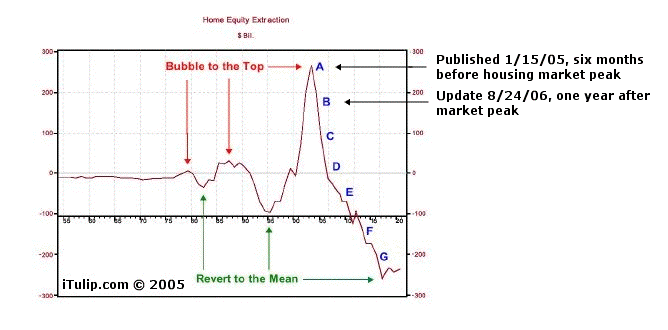
    Housing Bubble Correction Update: August 24, 2006

    As the housing market goes through the ten to fifteen year, seven step decline originally predicted January 15, 2005, I'll update this post when I believe we're transitioning from one step to the next.

    At this time most housing markets that experienced bubble growth in the US are exiting Step B and entering Step C.


    Step C: After prices have declined for two years, large numbers of buyers who purchased near the top of the market will begin to feel the psychological effects of being underwater on their mortgage. They will be less inclined to borrow money, or to spend money fixing up their home, as home improvement value increases will be swallowed up by general market price declines. There will still be profits to be made by those who bought very early in the previous boom cycle, but fewer people will have this option.

    As transaction volumes continue to fall, demand for housing-related employment will decline too. The first signs of labor market distress will start to show up, as more and more of that 43% of the private sector who found jobs in the housing industry are no longer needed. Coincidentally, major employers—such as the U.S. auto industry—will be going through major restructuring, adding to pressures on housing prices in some areas. Some home owners will need to sell at a loss in order to move to regions of the country where the labor picture is better, and will do this if they have enough equity and are not paying cash out of pocket to cover their remaining mortgage obligations. These sales will further depress home prices.
    We are now 12 to 18 months into a ten to fifteen year decline. We are starting to see major press stories covering the decline. Not in the Real Estate section, of course, but in the Business section of the newspaper. After prices decline for another year, you will stop seeing stories in the press. Why? Housing price declines won't be "news" anymore. They will be a fact of life that everyone accepts.

    When I was first researching for iTulip.com back in 1997, I'd go to the library and read newspapers on microfilm from the 1930s, looking for stories on The Great Depression during
    The Great Depression. To my surprise, there were none. The Depression wasn't news. The Depression simply "was." More interestingly, as you'd expect there were many ads for inexpensive property in the classified ads section (home prices declined an average of 80% as the banking system imploded), but at the same there were ads for commercial flights to California from New York. "Cross country in only 24 hours!" And for the equivalent of about $10,000 in today's money. This at a few thousand feet, the bumpiest altitude, in a very noisy propeller plane without radar.

    A good number of our readers sold their homes a year ago or more and are now renting. One of these readers who writes in from time to time wrote in last week to tell us he and his wife just renewed the lease on their rented home for another year and are keeping an eye on home prices in the neighborhood with an eye toward buying when the prices appear to be bottoming out. Prices are going down, but the declines appear to be picking up pace, so they'll wait.

    The most common worry expressed by these folks is the continued loss of purchasing power of the money they made as capital gains from selling their home. While the prices of homes are declining, the prices of items on the menus of local restaurants, for example, keep going up. Invest in printing companies?

    I wrote in September 2001 when gold was trading at $270 that I believed gold was a good hedge against the inflation I predicted to occur following government efforts to reflate the economy after the stock market bubble decline. I maintain that a $2000 to $2500 price at the top of the cycle is reasonable, but caution that diversification across precious metals is necessary. I have done well with gold since then, but better with silver and platinum.
    Last edited by FRED; August 24, 2006, 12:16 PM.

    Leave a comment:


  • jk
    replied
    national may foreclosures up 28% yoy

    Irvine, Calif. – June 26, 2006 – RealtyTrac™ (www.realtytrac.com), the leading online marketplace for foreclosure properties, today released its May 2006 U.S. Foreclosure Market Report, showing 92,746 properties nationwide entering some stage of foreclosure during the month, an increase of less than 2 percent from April 2006, but still a 28 percent increase from May 2005.

    Leave a comment:


  • jk
    replied
    time nailed the peak

    the peak was nailed by time magazine, with its june 13, 2005 cover:

    Home $weet Home

    Leave a comment:


  • qwerty
    replied
    Schwab bringing the message to the masses June 26

    "
    * Housing affordability in free-fall.
    * New and existing home inventories surging.
    * Adjustable rate mortgage holders to get pinched.
    * Real estate now a big chunk of household net worth.
    "
    http://www.schwab.com/public/schwab/...ting_ugly.html

    Leave a comment:

Working...
X