Announcement

Collapse
No announcement yet.

New Covid-19 Thread

Collapse
X
 
  • Filter
  • Time
  • Show
Clear All
new posts

  • shiny!
    replied
    Sweden is healthier than the U.S. The United States' hospital rate (not the infection rate) is a direct consequence of a pre-existing large-scale public health crisis.

    Pharma Deluge: How Much Medication is Too Much?

    Back in the good old days, people would generally take a medication, one at a time, when they were sick, and discontinue it when they were well. But we currently live in an age where it is relatively common for people, particularly the elderly, to be taking multiple medications, (often 10 or more) for years, if not a lifetime. This is known as polypharmacy: the concurrent use of multiple medications by a patient, and the problem is only growing.

    In the US, 31% of older adults were taking 5 or more medications per year in 2006. Five years later, that number had increased to 36% . In a Swedish population study, 17% of adults were taking five or more drugs per day in 2006. This had increased to 19% in 2014.

    Leave a comment:


  • shiny!
    replied
    Originally posted by FrankL View Post

    Those figures don't distinguish between people who would have otherwise lived a long life if it wasn't for covid, or if they already were ailing and about to kick the bucket, covid or no covid. It'd be much better to look at the total death and compare to previous years (and other countries), which will also take into account deaths caused by policy decision (eg. economic downturn from too rigid lockdowns).
    What's much harder to estimate is the long term health effects of Covid on those who survive an infection... we might not know for many years to come.
    The high death rate is Sweden in the first round was almost entirely among their elderly who were already ill with co-morbid conditions. The scientist who recommended the "no lockdown" policy conceded that they didn't do enough to protect their elderly and they would do it differently going forward now that they know better. It looks like during this second wave their case count has gone up but deaths have not risen commensurately.

    In the meantime, this is discouraging. Brave man: Professor, 69, risked his life by deliberately catching COVID-19 to test his immune response

    By The Siberian Times reporter 28 October 2020
    Alexander Chepurnov had already recovered once when he re-infected himself in an experiment.


    The virologist experimented with his own health to check how long the body’s immune response lasted after his first bout of COVID-19.
    A former researcher at the Vector Centre of Virology and Biotechnology who currently works at the Institute of Clinical and Experimental Medicine, Chepurnov was first infected at the end of February 2020.

    ‘I was on my way to a skiing holiday from Siberia to France with a stopover in Moscow,’ he said. ‘After getting to the mountains I felt unwell with a high fever and sharp chest pain. My sense of smell has gone, too.’

    It was impossible back then to do a COVID-19 test in Europe, he told Komsomolskaya Pravda newspaper in Novosibirsk.

    He cut the holiday short, returned home to Novosibirsk, and was promptly diagnosed with double pneumonia.

    A month later in March he did a test which showed antibodies to Covid, confirming that he had been infected with the new virus.

    ‘I was the first in my team who had COVID-19,’ he said. ‘We started to follow the way antibodies ‘behaved’, how strong they were, and how long they stayed in the body.

    ‘The observation showed that they were fast to decrease. By the end of the third month from the moment I felt sick the antibodies were no longer detected.’

    The scientist, 68 when he was first hit by COVID-19, said that he wanted to study the probability of getting re-infected.


    Alexander Chepurnov's conclusion is that there will be no collective immunity to coronavirus despite earlier hopes. Picture: Alexander Chepurnov


    To test the strength of his own immune response, Chepurnov deliberately exposed himself to COVID-19-positive patients wearing no protection.

    ‘My body’s defence fell exactly six months after I got the first infection. The first sign was a sore throat. The nasopharyngeal PCR smear immediately showed a positive reaction to COVID-19 on the 27th cycle, and two days later already on the 17th cycle, which corresponds to a high viral titre’, Chepurnov said of the second bout.

    The second illness was more acute, with Chepurnov needing hospitalisation after his saturation fell below 93.

    ‘For five days, my body temperature remained above 39C,’ he said. ‘I lost the sense of smell, my taste perception changed.

    ‘On the sixth day of the illness, the CT scan of the lungs was clear, and three days after the scan the X-ray showed double pneumonia.

    ‘The virus went away rather quickly - after two weeks it was no longer detected in the nasopharyngeal or in other samples.’

    His conclusion is that there will be no collective immunity to coronavirus despite earlier hopes.

    The virus is here to stay for a long while, and while vaccines may give immunity this is likely to be temporary.

    ‘We need a vaccine that can be used multiple times, a recombinant vaccine will not suit,’ he said.

    ‘Once injected with the adenoviral vector-based vaccine we won’t be able to repeat it because the immunity against the adenoviral carrier will keep interfering.’

    His former employer Vector centre is manufacturing Russia's second vaccine which will require a repeat dose.


    Leave a comment:


  • FrankL
    replied
    Originally posted by jk View Post
    the poor health of the american people is largely the result of gov't policies, esp. subsidies to the corn industry. the agriculture bill is really a nutrition bill, and the standard american diet [sad] sucks. the fact that it's cheaper for poor people to eat fast food than buy real food is a travesty. obesity, diabetes, hypertension, coronary artery disease - dietary, and all risk factors for more severe outcomes with covid.

    also, you're wrong if you thing sweden did well with covid. that's misinformation
    https://www.statista.com/statistics/...n-the-nordics/

    sorry i couldn't find per capita data with a quick search and don't want to put more time into it.
    Those figures don't distinguish between people who would have otherwise lived a long life if it wasn't for covid, or if they already were ailing and about to kick the bucket, covid or no covid. It'd be much better to look at the total death and compare to previous years (and other countries), which will also take into account deaths caused by policy decision (eg. economic downturn from too rigid lockdowns).
    What's much harder to estimate is the long term health effects of Covid on those who survive an infection... we might not know for many years to come.

    Leave a comment:


  • jk
    replied
    the poor health of the american people is largely the result of gov't policies, esp. subsidies to the corn industry. the agriculture bill is really a nutrition bill, and the standard american diet [sad] sucks. the fact that it's cheaper for poor people to eat fast food than buy real food is a travesty. obesity, diabetes, hypertension, coronary artery disease - dietary, and all risk factors for more severe outcomes with covid.

    also, you're wrong if you thing sweden did well with covid. that's misinformation
    https://www.statista.com/statistics/...n-the-nordics/

    sorry i couldn't find per capita data with a quick search and don't want to put more time into it.
    Last edited by jk; October 27, 2020, 09:55 PM.

    Leave a comment:


  • shiny!
    replied
    Originally posted by jk View Post
    hospitalization rates are rising sharply, deaths should follow in a few weeks. e.g. patients are being air-evaced from idaho to seattle because the local hospitals are overwhelmed. i think i read something similar is going on with netherlands patients evaced to germany. there will always be a series of delays - first cases rise, then hospitalizations, then deaths.

    the case rate may be affected by how much you're testing, so it's the least reliable comparative measure. hospital admissions, otoh, are quite reliable, as are deaths. when we get back to refrigerator trucks outside hospitals because the morgues can't hold the corpses, we can count those too.
    I tend to agree.

    Covid-19 hits hardest those who are already in bad health. Is Sweden's low death rate, in spite of the fact that they didn't do lockdowns, a reflection of the general good health of the Swedish population? I can't recall ever seeing an obese Swede in a picture.

    OTOH, the U.S. population has an inordinately high rate of obesity, diabetes, heart disease... exascerbated in communities that suffer from poverty. This should be a wakeup call.

    Leave a comment:


  • jk
    replied
    hospitalization rates are rising sharply, deaths should follow in a few weeks. e.g. patients are being air-evaced from idaho to seattle because the local hospitals are overwhelmed. i think i read something similar is going on with netherlands patients evaced to germany. there will always be a series of delays - first cases rise, then hospitalizations, then deaths.

    the case rate may be affected by how much you're testing, so it's the least reliable comparative measure. hospital admissions, otoh, are quite reliable, as are deaths. when we get back to refrigerator trucks outside hospitals because the morgues can't hold the corpses, we can count those too.

    Leave a comment:


  • shiny!
    replied
    Comments? Follow the Science! 1.2 Million COVID deaths edition

    outofthecave.io/articles/follow-the-science-1-2-million-covid-deaths-edition/
    October 26, 2020 This post was originally my comment to a person on Facebook, which somebody then deleted. This person repeatedly throws out the 1.2 M deaths worldwide number and I finally lost it and posted a response to him after he scolded people for “spreading disinformation and not listening to science”. He actually told people disputing the Second Wave Hysteria to “shut up and listen to the government and science”.
    As one of my all-time favourite economists, Thomas Sowell, would say…. “Oh dear, where to begin?”
    1 million or 1.2 million deaths worldwide sounds like a big number and on its own you can use it to club “Covidiots” into silence, that is, until you actually look at it.
    For starters, bandying out a number, any number in isolation is meaningless. For any number to have any relevance, to anything, it has to be part of a data set or otherwise part of some meaningful comparison.
    If we take the 1.2 million COVID deaths worldwide, at it’s face (more on that below), the obvious question then becomes “is that good or bad?”
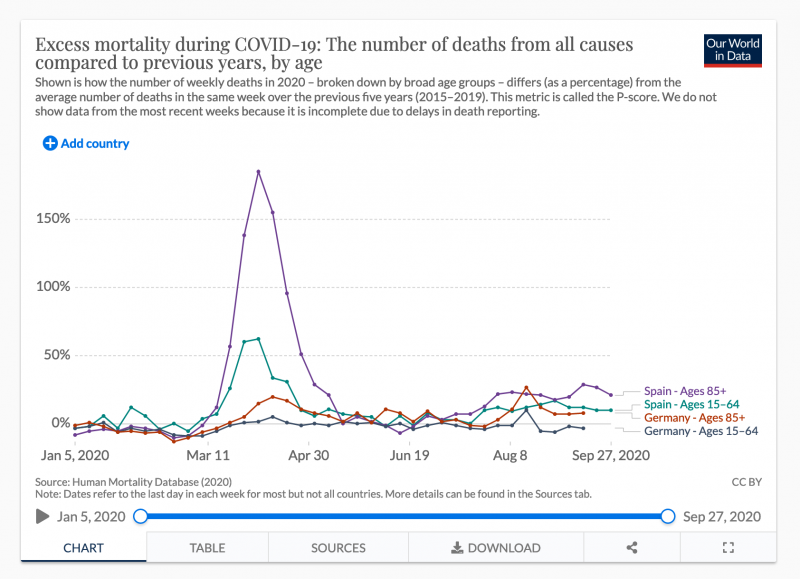
    The most useful signal we can get from a global COVID death toll is how it compares to what is called the “Absolute Fatality Rates” globally, which is simply the rate of all fatalities from all causes.
    Source https://ourworldindata.org/excess-mortality-covid You can pick different countries. Canada was not an option, but most of the curves look the same.

    From the charts, we can clearly see, there was a lot of excess mortality in March and April, and then, like every other meaningful metric around Coronavirus, it drops off drastically and starts to level out, with a slight seasonal rise as we head into the winter.
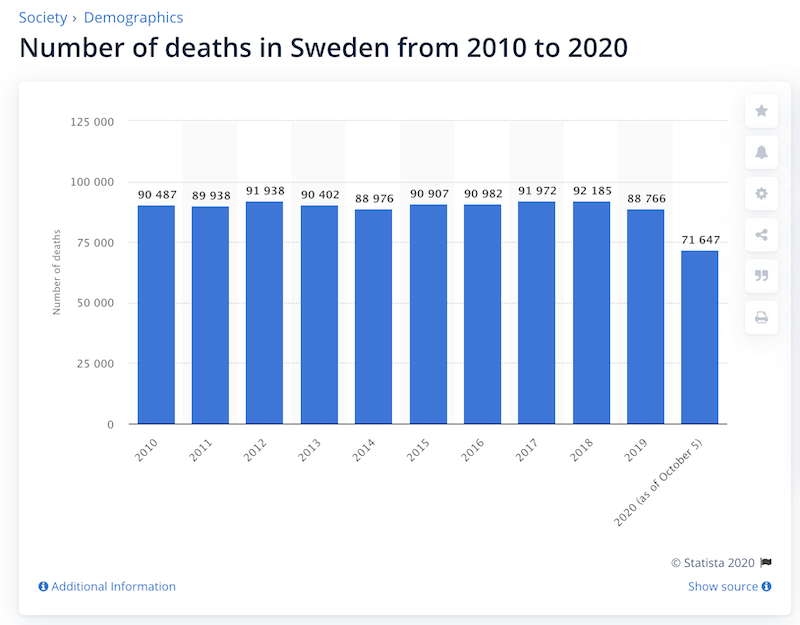
    Interestingly, in “no lockdown” Sweden, it turns out their absolute death toll is much lower than one would think:
    Source: https://www.statista.com/statistics/...ber-of-deaths/

    It could possibly come in lower by the end of the year, but if not, will come in not that much higher. Not as high as, say, the US or England.
    If reducing fatalities is the goal, there is a much easier way to do that

    Sadly, a lot of people die every day, and I’m sure you’ve seen memes on social media on how many more people die from other causes like Tuberculosis (1.4M in 2019) than COVID-19.
    In the US, where the COVID death toll currently sits at 225K, it is estimated that medical malpractice kills 250K Americans a year.
    But an even bigger number, according to the WHO, is that alcohol abuse kills 3 million people annually, and that number will surely go even higher this year given the massive spike in mental illness, domestic violence, child abuse, depression and suicide caused by the lockdowns.
    If this is about saving lives, we could literally bring those alcohol related deaths to zero, turning it off like the flick of a switch by instituting a global ban on alcohol. We could do it tomorrow. Should we? The lives we save may include your own.
    In fact if we banned alcohol then we could let Coronavirus run and still be ahead nearly 2M preventable deaths annually, provided COVID-19 kept going with the same intensity it was going in March and April, which it clearly isn’t (see below).
    Of course, nobody would seriously entertain that, and they could probably articulate some decent logic around why we shouldn’t.
    But they may dismiss it without considering how closely the lockdown approach toward reducing COVID fatalities is analogous to a worldwide ban on alcohol to eliminate alcohol related deaths would be. Especially since we also know that a large portion of coronavirus fatalities die with COVID-19 and numerous other comorbidities* than of it (however, see my footnote on that at the end of this post).
    In that sense, alcohol related carnage is very similar. Few alcoholics drink themselves to death outright. Far more kill themselves (and others) in car accidents, commit suicide, or generally wreck their livers, hearts, kidneys, brains or generally run themselves down so low nearly anything else will finish them off.
    Second Wave Hysteria

    Case counts are clearly rising again globally, that much is true and we have oodles of data to track it. With it, there come fears of the dreaded “Second Wave” of fatalities.
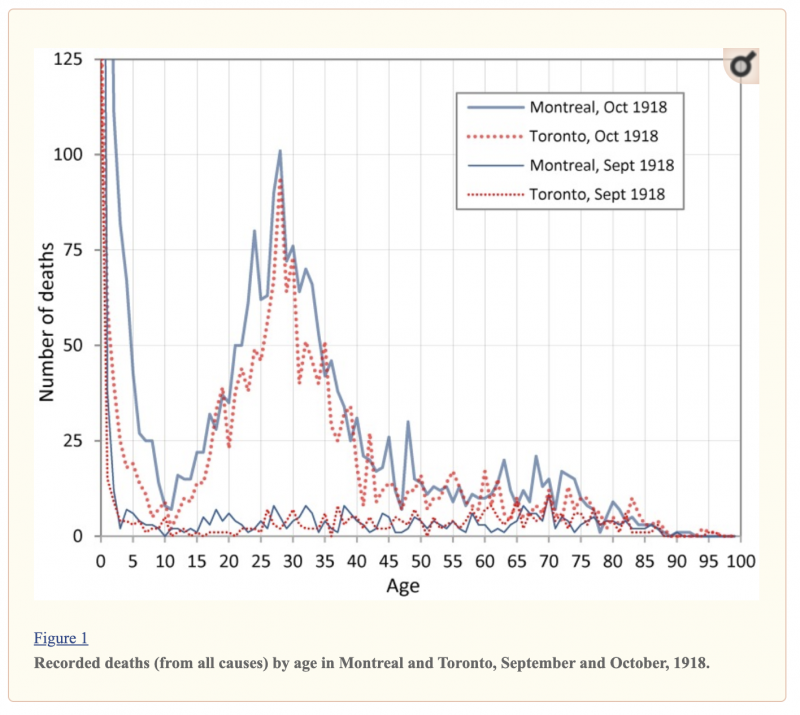
    In the often cited Spanish Flu of 1918, the bulk of the fatalities came in the second wave. However, the Spanish Flu was a very different pandemic than the one we have today. That one attacked people right in the early years of the prime-of-life age curve:
    Source: https://www.ncbi.nlm.nih.gov/pmc/articles/PMC3734171/

    Scientists believe the nature of that strain caused “cytokine storms”, the phenomenon where the immune system overreacts and attacks itself. In a perverse twist of fate, this made the population with the strongest immune systems more vulnerable to the flu.
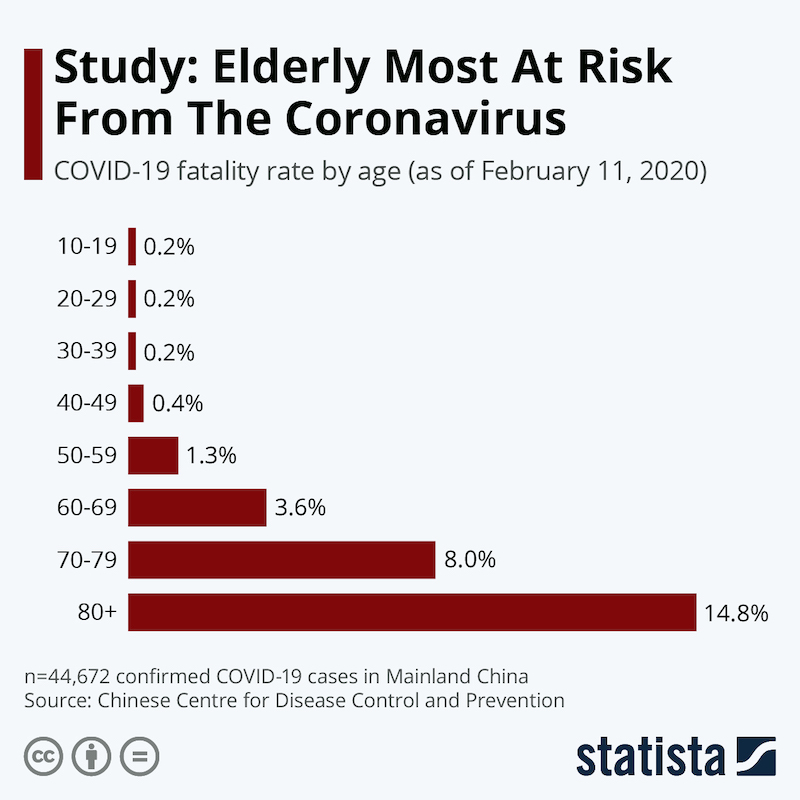
    Contrast with COVID-19 where nobody disputes that the most vulnerable members of the population are the elderly and those with underlying medical conditions that render them immuno-compromised. In this sense, comparing 1918 to COVID-19 is not accurate or useful.
    Source: https://www.statista.com/chart/20860...y-rate-by-age/

    So, bear this in mind as I put in the graph below of how the Coronavirus Second Wave is playing out when it comes to case counts vs fatalities:

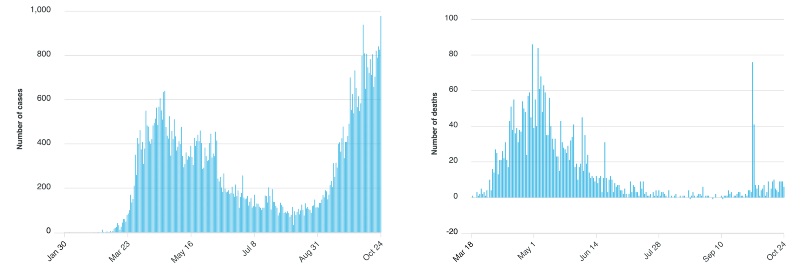
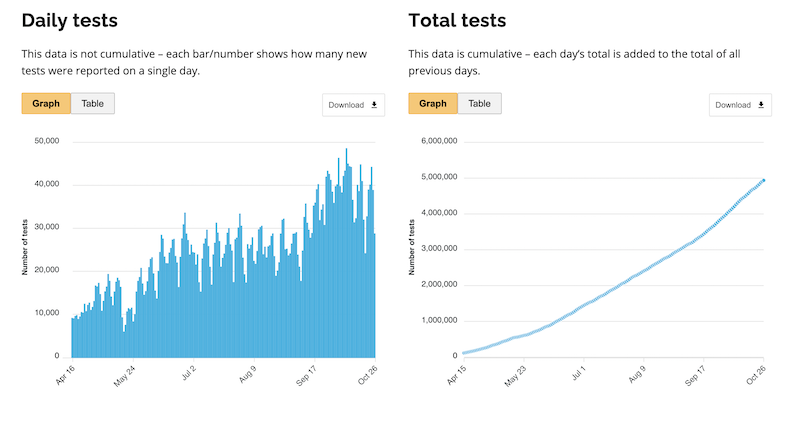
    If we were in for a 1918-style Second Wave fatality overrun, we would see it in the data. As I pointed out in my previous post, the above data comes from the Province of Ontario, but pretty well all graphs from locales undergoing second waves in case counts, look the same. The fatalities are riding the floor (that “spike” in the fatality count was a data correction where they took previously missed data from the proceeding 90 days, and added them all to 2 data points), but the case counts are going up, as are the number of tests.

    Right now the slope of the case count far exceeds the slope of the fatalities.
    For the fatalities to come in anywhere near the Second Wave of 1918 scenario, the slope of the fatality line needs to blast off in a near vertical line right now. In the Ivor Cummins interview he mentioned Dr. Sunetra Gupta’s work indicating that COVID seems to peter out when it hits 20% of the population (but I can’t find the cite). If true, it is hard to envision a scenario where that is mathematically possible.
    If not true, and we’re about to experience a Second Wave of fatalities, it would be impossible to occur without seeing it in the data and right now, all of the data, everywhere is showing either a moderate rise with seasonality, or an aggregate, overall decrease in fatalities.
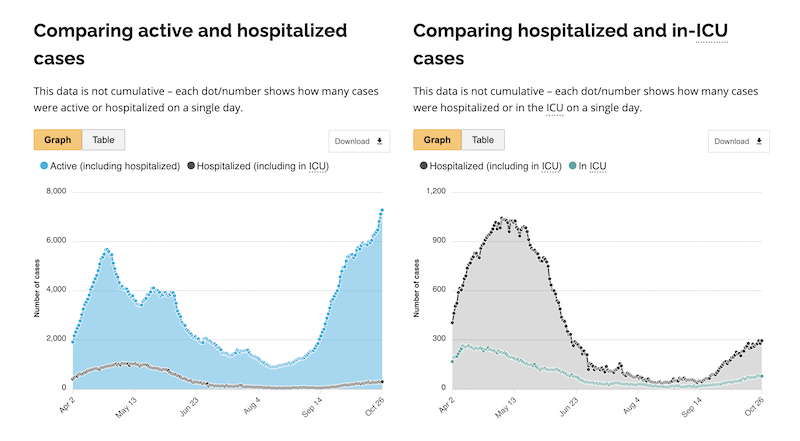
    It’s also been pointed out that the rationale behind the lockdowns was to prevent the healthcare system from being overrun. Aside from a few notable exceptions in Phase 1, that didn’t happen. If we look at the data now, it doesn’t look like that’s going to happen now, either. When I first started posting about the second wave numbers, I pointed out that even the ICU cases line was diverging from the hospitalizations line (right side, below). Right now it looks like the total hospitalizations are lower in Wave 2, then they were in Wave 1, even against a case count exceeding previous highs.
    Source: https://covid-19.ontario.ca/data

    All of this should be good news, but for some reason, people become very upset when you try to walk them through this. I’m open to all logic, data and science based objections or counter-points to where I am wrong on this, bearing in mind that “SHUT UP AND LISTEN TO THE GOVERNMENT AND SCIENCE” isn’t a logical, scientific or data driven counter-argument.
    What to do next.

    I would close out with two additional reading exercises, one, I would go look at The Great Barrington Declaration and if you think they’re approach of focused protection makes sense, sign it. Number two: have a look at the comparison of The Great Barrington Declaration with what’s called “The John Snow Memorandum“.
    If you want to follow my work, and I seem to be covering more about the lockdowns lately, then sign up for the mailing list here, or follow me on Twitter here.
    Footnote on Comorbidities

    (*The number you see bandied around a lot is 94% of all COVID-19 fatalities had comorbidities. This number largely keys off CDC data that only 6% of fatalities list only COVID-19 as a c.o.d. If you look at the CDC data on what the comorbidities are, the biggest one accounting for close to half of all fatalities, especially in the elderly, is pneumonia and influenza. I think it’s inaccurate to just net-out all of those cases and dismiss them as comorbidities because that is one of the most common ways respiratory viruses manifest. But that said, the data, when you consider comorbidities and the looseness with which COVID gets added to c.o.d’s, what all this means is that the headline number for fatalities is the top boundary. They aren’t higher, and they are probably for all practical purposes, lower).

    Mark E. Jeftovic

    Leave a comment:


  • touchring
    replied
    https://www.realclearmarkets.com/art...te_577391.html


    “We don’t realistically anticipate that we would be moving to either tier 2 or reopening K-12 schools at least until after the election, in early November.”

    Leave a comment:


  • Techdread
    replied
    Re: Was COVID-19 spreading freely before last Christmas? It appears so.

    First case of Coronavirus Disease 2019 (COVID-19) pneumonia in Taiwan

    On December 31, 2019, an outbreak of respiratory illness later proved to be caused by a novel coronavirus, officially named Coronavirus Disease 2019 (COVID-19), was notified first in Wuhan, a city of Hubei province, People's Republic of China (PRC). COVID-19 rapidly spreads in China and to other parts of the world. Currently more than 70,000 laboratory-confirmed cases in China have been reported, and the case count has been rising daily. Some travelers-related transmission were also identified in many countries, including Taiwan, Singapore, Vietnam, Republic of Korea, Malaysia, Thailand, Japan, Germany, France, United States (U.S.), Australia, etc. through an international conveyance, and raised a global health emergency.1 As of February 18, 2020, there were 22 confirmed cases in Taiwan. Herein we presented the first case identified in Taiwan on January 21, 2020.
    I don't think it could have been widespread in the rest of the world, why because its just too bloody contagious, it as simple as that.
    There would have been health-care staff dying of the disease long before February 18, 2020.

    https://www.sciencedirect.com/scienc...29664620300449

    Leave a comment:


  • shiny!
    replied
    Was COVID-19 spreading freely before last Christmas? It appears so.

    Was Covid-19 spreading freely worldwide BEFORE last Christmas? The evidence keeps stacking up

    11 Sep, 2020 17:29 / Updated 3 days ago

    By Peter Andrews, Irish science journalist and writer based in London. He has a background in the life sciences, and graduated from the University of Glasgow with a degree in genetics.

    A new study from America indicates that people were falling ill with coronavirus-like symptoms in December 2019, but doctors at the time dismissed it as ordinary flu.

    A team of doctors from Los Angeles scouring the hospital records from last winter has discovered a series of smoking gun clues which almost guarantee that Covid-19 was present in America well before Christmas.

    Scientists from UCLA have been analysing over 10 million hospital records from December 1, 2019 to February 29, 2020. Comparing that winter to previous ones, they noticed a 50-percent increase in ‘coughing’ as a symptom on admission forms. In addition, 18 more people than would ordinarily be expected were hospitalised with acute respiratory failure.

    In fact, the scientists estimate that there may have been 1,000 or more Covid sufferers in LA alone last winter – and presumably those are just the symptomatic minority. At the time, of course, all of this was put down to a moderately bad flu season. Officially, Covid did not turn up in LA until January 22, when a traveller in LAX airport fell ill. He was from Wuhan, and was identified as Covid-positive four days later.

    This bombshell fits an emerging body of evidence on an earlier coronavirus timeline. Many people may remember the reports of a strange vaping-related illness that ravaged Americans towards the end of last year. There was a good deal of study on it. Scientists at first thought it was the oils in the e-cigs congealing in people’s lungs, but soon debunked that hypothesis. In hindsight, it is difficult to look past Covid as the real culprit. Pneumonia-like symptoms, ordinarily fit people falling severely ill… it was Covid all over.

    These revelations come hot on the heels of a very different story from England, which nonetheless points to the same conclusion. Peter Attwood died at the age of 84 on January 30, having been sick for over a month. But in recent weeks, an autopsy has confirmed that he died of Covid, which he probably was infected with in 2019. Underlining this, Attwood’s daughter was sick with similar symptoms two weeks earlier still.

    All of this happened in Kent, England. But according to the government there, the first Covid death in the UK did not happen until March. Now, Attwood’s family want answers from the Chinese government on why they did not tell the WHO earlier about the coronavirus, which we know from leaked memos was identified in mid-November at the latest.

    If coronavirus burned a track through the US and the UK towards the end of last year, is there any reason to suspect it wasn’t doing the same everywhere else? In July, reports came in of coronavirus DNA being found in Spain, Italy and South America as long ago as the spring of 2019. How far back does this story go? We will probably never know.

    Nor will we ever be able to track the precise journey of the novel coronavirus around the globe, despite being nearly certain of its origin in Wuhan. But when the inquiry is done, surely findings like these have to be taken seriously, and built into the retrospective model of the pandemic. And if the coronavirus was spreading freely in 2019, the questions are: What was the point in beginning lockdowns in March this year? Is it really credible that they could have made a blind bit of difference, coming as late as they did?

    This whole mess demonstrates the problem with relying on official data and records, as they are bound to be incomplete and tardy, particularly at this stage. Despite such understandable failings in government information, people have an unfortunate habit of treating it like the gospel truth. This is absurd, and yet thinking of this quality seems to inform so much coronavirus policy.

    Leave a comment:


  • Techdread
    replied
    Re: How a Simple Fatal Math Mistake Caused Worldwide Panic, Lockdowns


    https://www.ft.com/content/5cc92d45-...6-26501693a371

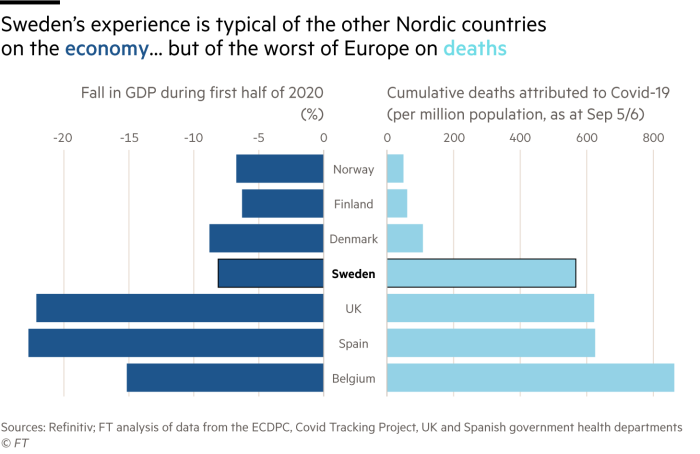
    Sweden is not a model big countries with high population centres could have carried ou even if they wanted to, Boris would have head his head on a spike.
    Go and compare their death rate compared to the other Nordic countries. And did it save their economy.

    Leave a comment:


  • Mega
    replied
    Re: How a Simple Fatal Math Mistake Caused Worldwide Panic, Lockdowns

    Leave a comment:


  • Chris Coles
    replied
    Re: How a Simple Fatal Math Mistake Caused Worldwide Panic, Lockdowns

    I very simply do not believe for one moment that this was anything other than a quite deliberate action taken by an industry that has come to realise that their "game" is up.

    Leave a comment:


  • shiny!
    replied
    How a Simple Fatal Math Mistake Caused Worldwide Panic, Lockdowns

    The 1% blunder: How a simple but fatal math mistake by US Covid-19 experts caused the world to panic and order lockdowns

    Malcolm Kendrick
    RT
    Sun, 06 Sep 2020 20:28 UTC

    In February, US Covid guru Anthony Fauci predicted the virus was 'akin to a severe flu' and would therefore kill around 0.1 percent of people. Then fatality rate predictions were somehow mixed up to make it look ten times WORSE.

    When you strip everything else out, the reason for lockdown comes from a single figure: one percent. This was the prediction that Covid, if left unchecked, would kill around one percent of us.

    You may not think that percentage is enormous, but one percent of the population of the world is 70 million people - and that's a lot. It would mean 3.2 million Americans dead, and 670,000 Britons.

    But where did this one percent figure come from? You may find this hard to believe, but this figure emerged by mistake. A pretty major thing to make a mistake about, but that's what happened.

    Such things occur. On September 23, 1998, NASA permanently lost contact with the Mars Climate Orbiter. It was supposed to go round and round the planet looking at the weather, but instead it hit Mars at around 5,000 mph, exploding into tiny fragments. It didn't measure the weather; it became the weather - for a few seconds anyway.

    An investigation later found that the disaster happened because engineers had used the wrong units. They didn't convert pound seconds into Newton seconds when doing their calculations. Imperial, not metric. This, remember, was NASA. An organisation not completely full of numbskulls.

    Now you and I probably have no idea of the difference between a pound second and a Newton second (it's 0.67 - I looked it up). But you would kind-of hope NASA would. In fact, I am sure they do, but they didn't notice, so the figures came out wrong. The initial mistake was made, and was baked into the figures.

    Kaboom!

    With Covid, a similar mistake happened. One type of fatality rate was substituted for another. The wrong rate was then used to predict the likely death rate - and, as with NASA, no-one picked up the error.

    In order to understand what happened, you have to understand the difference between two medical terms that sound the same - but are completely different. Rather like a pound second or a Newton second.

    Which fatality rate, did you say?

    First, there's the Infection Fatality Rate (IFR). This is the total number of people who are infected by a disease and the number of them who die. This figure includes those who have no symptoms at all, or only very mild symptoms - those who stayed at home, coughed a bit and watched Outbreak.

    Then there's the Case Fatality Rate (CFR). This is the number of people suffering serious symptoms, who are probably ill enough to be in hospital. Clearly, people who are seriously ill - the "cases" - are going to have a higher mortality rate than those who are infected, many of whom don't have symptoms. Put simply - all cases are infections, but not all infections are cases.

    Which means that the CFR will always be far higher than the IFR. With influenza, the CFR is around ten times as high as the IFR. Covid seems to have a similar proportion.

    Now, clearly, you do not want to get these figures mixed up. By doing so you would either wildly overestimate, or wildly underestimate, the impact of Covid. But mix these figures up, they did.

    The error started in America, but didn't end there. In healthcare, the US is very much the dog that wags the tail. The figures they come up with are used globally.

    On February 28, 2020, an editorial was released by the National Institute of Allergy and Infectious Diseases and the Centers for Disease Control and Prevention (CDC). Published in the New England Journal of Medicine, the editorial stated: "... the overall clinical consequences of Covid-19 may ultimately be more akin to those of a severe seasonal influenza."

    They added that influenza has a CFR of approximately 0.1 percent. One person in a thousand who gets it badly, dies.

    But that quoted CFR for influenza was ten times too low - they meant to say the IFR, the Infection Fatality Rate, for influenza was 0.1 percent. This was their fatal - quite literally - mistake.


    Comment: A more skeptical mind might think that this was no mere mistake, but deliberate.

    The mistake was compounded. On March 11, the same experts testified to Congress, stating that Covid's CFR was likely to be about one percent, so one person dying from a hundred who fell seriously ill. Which, as time has passed, has proved to be pretty accurate.

    At this meeting, they compared the likely impact of Covid to flu. But they used the wrong CFR for influenza, the one stated in the previous NEJM editorial. 0.1 percent, or one in a thousand. The one that was ten times too low.

    Flu toll 1,000 - Covid toll 10,000

    So, they matched up the one percent CFR of Covid with the incorrect 0.1 percent CFR of flu. Suddenly, Covid was going to be ten times as deadly.

    If influenza killed 50, Covid was going to kill 500. If influenza killed a million, Covid was going to get 10 million. No wonder Congress, then the world, panicked. Because they were told Covid was going to be ten times worse than influenza. They could see three million deaths in the US alone, and 70 million around the world.

    I don't expect you or I to get this sort of thing right. But I bloody well expect the experts to do so. They didn't. They got their IFR and CFR mixed up and multiplied the likely impact of Covid by a factor of ten.

    Here's what the paper, "Public health lessons learned from biases in coronavirus mortality overestimation",says: "On March 11, 2020,... based on the data available at the time, Congress was informed that the estimated mortality rate for the coronavirus was ten-times higher than for seasonal influenza, which helped launch a campaign of social distancing, organizational and business lockdowns, and shelter-in-place orders."

    On February 28 it was estimated that Covid was going to have about the same impact as a bad influenza season - almost certainly correct. Eleven days later, the same group of experts predicted that the mortality rate was going to be ten times as high. This was horribly, catastrophically, running-into-Mars-at-5,000-miles-an-hour wrong.

    Enter the Mad Modellers of Lockdown

    In the UK, the group I call the Mad Modellers of lockdown, the Imperial College experts, created the same panic. On March 16, they used an estimated IFR of 0.9 percent to predict that, without lockdown, Covid would kill around 500,000 in the UK.

    Is this prediction anywhere close?

    So far, the UK has had around 40,000 Covid deaths. Significantly less than 0.1 percent, but not that far off. Of course, people will say... "We had lockdown... without it so many more would have died. Most people have not been infected..." etc.

    To answer this, we need to know the true IFR. Is it a 0.1 percent, or one percent? If it is one percent, we have more than 400,000 deaths to go. If it is 0.1 percent, this epidemic has run its course. For this year, at least.

    With swine flu, remember that the IFR started at around two percent. In the end, it was 0.02 percent, which was five times lower than the lowest estimate during the outbreak. The more you test, the lower the IFR will fall.

    So where can we look to get the current figures on the IFR? The best place to look is at the country that has tested more people than anywhere else as a proportion of their population: Iceland.

    As of last week, Iceland's IFR stood at 0.16 per cent. It cannot go up from here. It can only fall. People can't start dying of a disease they haven't got.

    This means that we'll probably end up with an IFR of about 0.1 percent, maybe less. Not the 0.02 percent of Swine Flu - somewhere between the two, perhaps. In short, the 0.1 percent prophecy has proved to be pretty much bang on.

    Which means that we've had all the deaths we were ever going to get. And which also means that the lockdown achieved almost precisely nothing with regard to Covid. No deaths were prevented.

    Mangled beyond recognition

    Yes, we are testing and testing, and finding more so-called cases. As you will. But the hospitals and ICUs are virtually empty. Almost no-one is dying of Covid anymore, and most of those who do were otherwise very ill.

    Instead of celebrating that, we've artificially created a whole new thing to scare ourselves with. We now call a positive test a Covid "case." This is not medicine. A "case" is someone who has symptoms. A case is not someone carrying tiny amounts of virus in their nose.

    Now, however, you test positive, and you're a "case." Never in history has medical terminology been so badly mangled. Never have statistics been so badly mangled.

    When researchers look back at this pandemic, they'll have absolutely no idea who died because of Covid, or who died -coincidentally- with it. Everything's been mashed together in a determined effort to make the virus look as deadly as possible.

    Lockdown happened because we were told that Coivid could kill one percent. But Covid was never going to kill more than about 0.1 percent - max.

    That's the figure estimated back in February, by the major players in viral epidemiology. A figure that has turned out to be remarkably accurate. Bright guys... bad mistake.

    We've killed tens of thousands - for nothing

    But because we panicked, we've added hugely to the toll. Excess mortality between March and May was around 70,000, not the 40,000 who died of/with Covid. Which means 30,000 may have died directly as a result of the actions we took.

    We protected the young, the children, who are at zero risk of Covid. But we threw our elderly and vulnerable under a bus. The very group who should have been shielded. Instead, we caused 20,000 excess deaths in care homes.

    It was government policy to clear out hospitals, and stuff care homes with patients carrying Covid, or discharge them back to their own homes, to infect their nearest and dearest. Or any community care staff who visited them.

    We threw - to use health secretary Matt Hancock's ridiculous phrase - a ring of steel around care homes. As it turned out, this was not to protect them, but to trap the residents, as we turned their buildings into Covid incubators. Anyone working in care homes, as I do, knows why we got 20,000 excess deaths. Government policy did this.

    That is far from all the damage. On top of care homes, the ONS estimates that 16,000 excess deaths were caused by lockdown. The heart attacks and strokes that were not treated. The empty, echoing hospitals and A&E units. The cancer treatments stopped entirely.

    Which means that at least as many people have died as a result of the draconian actions taken to combat Covid, as have been killed by the virus itself. This has been a slow-motion stampede, where the elderly - in particular - were trampled to death.

    We locked down in fear. We killed tens of thousands unnecessarily, in fear. We crippled the economy, and left millions in fear of their livelihoods. We have trapped abused women and children at home with their abusers. We have wiped out scores of companies, and crushed entire industries.

    We stripped out the NHS, and left millions in prolonged pain and suffering, on ever lengthening waiting lists, which have doubled. There have also been tens of thousands of delayed cancer diagnoses - the effects of which are yet to be seen, but the Lancet has estimated at least sixty thousand years of life will be lost.

    Lockdown can be seen as a complete and utter disaster. And it was all based on a nonsense, a claim that Covid was going to kill one percent. A claim that can now be seen to be utterly and completely wrong. Sweden, which did not lock down, has had a death rate of 0.0058 percent.

    It takes a very big person to admit they have made a horrible, terrible mistake. But a horrible, terrible mistake has been made. Let's end this ridiculous nonsense now. And vow never to let such monumental stupidity happen ever again.
    By Malcolm Kendrick, doctor and author who works as a GP in the National Health Service in England. His blog can be read here and his book, 'Doctoring Data - How to Sort Out Medical Advice from Medical Nonsense,' is available here.

    Leave a comment:


  • Mega
    replied
    Re: Tests Returning High Percentage of False Positives

    https://news.sky.com/story/coronavir...onday-12066910

    Leave a comment:

Working...
X