Announcement

Collapse
No announcement yet.

Saudi gets SLAPPED !

Collapse
X
 
  • Filter
  • Time
  • Show
Clear All
new posts

  • GRG55
    replied
    Re: Saudi gets SLAPPED ! (Oil going to $100?)

    Originally posted by lakedaemonian View Post
    If China has a substantial long term deal with Iran then that sounds like a really logical(and integral) part of China’s One Belt, One Road initiative over the next 25-50 years.

    Iran’s large population would be a substantial potential export market for Chinese goods/services and Iran’s energy shipped overland to fuel China would be safer than vulnerable SLOCs.

    It’s hard to tell how this will play out.

    I suspect Iran’s increasing aggression is linked to the increasing pain of sanctions...

    The same could be said with Zimbabwe and it’s Chinese nexus

    Even if currently enduring substantial pain, Iran likely has much more capacity to endure sanction hardship if Zimbabwe/Venezuela as analog Chinese supported pariah nations are anything to go by.

    It’s a funny world.

    Iran and the US governments hate each other.

    Iran and Saudi governments truly hate each other.

    Iran and China aren’t exactly allies, but share “adversaries of adversaries as allies of convenience”.

    Perhaps the Russia/Turkey alignment, thought impossible just a few years ago due to very long simmering feuds and now on track to be geopolitical BFFs are an indication of tectonic change, but I seriously doubt it.

    But I can’t see a Nixon goes to China moment exploiting the Sunni/Shia divide like Nixon did between Soviet/Chinese communism.

    Perhaps Putin in Turkey was it, or the start of it?
    It is the natural alliance of overtly authoritarian regimes. Think of it as a multinational mutual support society. I agree with your observation the Chinese are looking to find durable markets for their goods and services to reduce their dependence on the USA, and Europe.
    It's also one of the reasons I think the pundits are wrong about India. At least at this time in history, India doesn't look like a natural participant, despite its longstanding ties with Russia.

    Almost two decades ago even the Saudis and Mubarak in Egypt were tiring of hearing incessant lectures about human rights and democratic reforms from their American benefactors. China looked very appealing back then, and I have recollections of writing some posts on this forum about those subtle realignments underway when I lived in the Gulf. To the point that I believed (and still do) that it will be the Chinese navy that replaces the 5th Fleet as the USA's "Fortress America" inclinations play out in time.

    Leave a comment:


  • lakedaemonian
    replied
    Re: Saudi gets SLAPPED ! (Oil going to $100?)

    Originally posted by jk View Post
    china's recent $400B deal with iran gives it primacy in development of iranian energy, gives it a guaranteed discount from world prices, and - importantly- give it the privilege of paying in local currencies, i.e. rmb, instead of dollars. similarly, its arrangement with russia allows settlement in rmb or rub. thus, how much world prices affect the prices paid by china to these two suppliers is a direct function of the rmb exchange rate, which can be manipulated by the pboc.

    another interesting note is that recently there was an agreement signed between saudi and china that was to have made ksa china's largest supplier once again. the terms are not, to my knowledge, public. one has to wonder whether china would have made such a deal, given its arrangements with russia and iran, if ksa insisted on usd payment. further, it points to at least one motive for iran and/or russia to demonstrate the unreliability of saudi sourcing.

    [sorry, just realized that this is mostly repeat of #12 above, but responds to your comment re assessing china's concern about "rising energy prices." if they can print rmb, and pay in rmb, perhaps the global reference is not so important.]
    If China has a substantial long term deal with Iran then that sounds like a really logical(and integral) part of China’s One Belt, One Road initiative over the next 25-50 years.

    Iran’s large population would be a substantial potential export market for Chinese goods/services and Iran’s energy shipped overland to fuel China would be safer than vulnerable SLOCs.

    It’s hard to tell how this will play out.

    I suspect Iran’s increasing aggression is linked to the increasing pain of sanctions

    https://www.bbc.com/news/world-middle-east-49760200
    “Iran's oil exports are close to zero, its revenue stream is drying up, and its reserves of hard currency are thought to be sufficient only for several more months. The fall in the value of its currency has pushed the inflation rate to 40% and almost halved the purchasing power of Iranians, who are finding it difficult to make ends meet.”


    But the Chavez/Madura Venezuela regime has endured despite horrific deprivation for citizens, likely in part due to Russia/Chinese support.

    The same could be said with Zimbabwe and it’s Chinese nexus

    Even if currently enduring substantial pain, Iran likely has much more capacity to endure sanction hardship if Zimbabwe/Venezuela as analog Chinese supported pariah nations are anything to go by.

    It’s a funny world.

    Iran and the US governments hate each other.

    Iran and Saudi governments truly hate each other.

    Iran and China aren’t exactly allies, but share “adversaries of adversaries as allies of convenience”.

    Perhaps the Russia/Turkey alignment, thought impossible just a few years ago due to very long simmering feuds and now on track to be geopolitical BFFs are an indication of tectonic change, but I seriously doubt it.

    But I can’t see a Nixon goes to China moment exploiting the Sunni/Shia divide like Nixon did between Soviet/Chinese communism.

    Perhaps Putin in Turkey was it, or the start of it?

    Leave a comment:


  • jk
    replied
    Re: Saudi gets SLAPPED ! (Oil going to $100?)

    Originally posted by lakedaemonian View Post

    Magnified by Iran/Russia increasingly desperate for higher energy prices and less likely to be impacted by a global shock in a relative sense.

    Although I suspect China must be increasingly concerned at how rising energy prices would seriously impact China at. Cost that could easily exceed the value of relative change to US/China geopolitical power/influence.
    china's recent $400B deal with iran gives it primacy in development of iranian energy, gives it a guaranteed discount from world prices, and - importantly- give it the privilege of paying in local currencies, i.e. rmb, instead of dollars. similarly, its arrangement with russia allows settlement in rmb or rub. thus, how much world prices affect the prices paid by china to these two suppliers is a direct function of the rmb exchange rate, which can be manipulated by the pboc.

    another interesting note is that recently there was an agreement signed between saudi and china that was to have made ksa china's largest supplier once again. the terms are not, to my knowledge, public. one has to wonder whether china would have made such a deal, given its arrangements with russia and iran, if ksa insisted on usd payment. further, it points to at least one motive for iran and/or russia to demonstrate the unreliability of saudi sourcing.

    [sorry, just realized that this is mostly repeat of #12 above, but responds to your comment re assessing china's concern about "rising energy prices." if they can print rmb, and pay in rmb, perhaps the global reference is not so important.]

    Leave a comment:


  • lakedaemonian
    replied
    Re: Saudi gets SLAPPED ! (Oil going to $100?)

    Originally posted by Woodsman View Post
    You know a great deal and it's always a pleasure and a privilege to hear your thoughts on these matters.
    I wonder if the focus should shift to more towards the macro?

    By that I mean the following:

    US Middle East policy recently and moving forward(and mentioned by EJ as well) is one of increasing disengagement.

    At the moment, the US appears to be somewhere in the middle of the engaged <—> disengaged continuum.

    Still engaged enough to be sucked into every crisis.

    But disengaged enough to no longer effectively deter kinetic action by adversaries.

    Multiplied by an increasingly fragile global economic environment.

    With authoritarian adversaries further attracted by the western election(vulnerability) cycle.

    ——-
    In military operations, rearguard actions(retreat) while in contact with the enemy are amongst the most difficult and dangerous to properly execute. If an adversary accurately identifies a rearguard action, that is typically a lower risk, higher reward time to press an attack.

    In military operations, the US led west have historically “owned the night” based on superior sensing technology down to the individual combatant. So fighting at night with no moon creates the greatest unfair advantage over adversaries.

    ——-
    This may be an oversimplistic assessment and analogy, but I think it’s valid at the basic macro level:

    The US is partway thru it’s geopolitical rearguard(retreat) action and is particularly vulnerable to adversaries pressing both direct/indirect attack until the US is geopolitically disengaged and consolidated in whatever the new normal becomes.

    Authoritarian US adversaries “own the night” when it comes to US election cycles and have the greatest advantage in the lead up to and during elections if carefully leveraged.

    So I would posit the US is most vulnerable in the next 12 months, despite the fact the US is actually trying to disengage from the region(despite the superficial schizophrenic appearance).

    Magnified by Iran/Russia increasingly desperate for higher energy prices and less likely to be impacted by a global shock in a relative sense.

    Although I suspect China must be increasingly concerned at how rising energy prices would seriously impact China at. Cost that could easily exceed the value of relative change to US/China geopolitical power/influence.

    ——-
    Maybe my theory is valid. Maybe not.

    But what I know is that I really struggle to find any innocent actors with clean hands in this.

    We could get into arguments about force ranking hands by how dirty(or bloody) they are, but it would likely be quite futile.

    I think a far more important question is: which hands are likely to start washing and which hands are likely to get dirtier/bloodier?

    Leave a comment:


  • Woodsman
    replied
    Re: Saudi gets SLAPPED ! (Oil going to $100?)

    Originally posted by lakedaemonian View Post
    I’ve got a few years working on the weaponised COTS drone problem, offensive & defensive, with a solid high level understanding of both 5 Eyes(well, 3 out of 5) and adversary capability.

    But what do I know.

    Maybe it was a 4 owner Ex-Russian, Ex-Iraqi, Ex-Iranian, current Houthi SU25 that also shot down MH17?
    You know a great deal and it's always a pleasure and a privilege to hear your thoughts on these matters.

    Leave a comment:


  • lakedaemonian
    replied
    Re: Saudi gets SLAPPED ! (Oil going to $100?)

    Originally posted by Woodsman View Post
    And yours is overestimating our capacities and competencies. Time will tell.
    I’ve got a few years working on the weaponised COTS drone problem, offensive & defensive, with a solid high level understanding of both 5 Eyes(well, 3 out of 5) and adversary capability.

    But what do I know.

    Maybe it was a 4 owner Ex-Russian, Ex-Iraqi, Ex-Iranian, current Houthi SU25 that also shot down MH17?

    Leave a comment:


  • Woodsman
    replied
    Re: Saudi gets SLAPPED ! (Oil going to $100?)

    Originally posted by lakedaemonian View Post
    I think your bias is portraying the Russians/Iranians too optimistically...
    And yours is overestimating our capacities and competencies. Time will tell.

    Leave a comment:


  • lakedaemonian
    replied
    Re: Saudi gets SLAPPED ! (Oil going to $100?)

    Originally posted by Woodsman View Post

    one of which is that over the last several decades it's been plainly evident that Russia and Iran both needed to develop some means to protect themselves against the threat from the United States and its allies. Both found unique ways to build deterrence that fit their situation, and true to form, neither the U.S. nor its allies reacted to those developments by adapting their strategies or military means.

    A few things to clarify.

    Neither Russia nor Iran can afford to compete with the US militarily. They lack the economic tax base to compete with the depth and breadth of us capability, so they have to make some tough choices, such as actively choosing not to compete with the US in conventional terms and accept the very real risks associated with it.

    The US and it's closest allies have been distracted for 18 years with everything other than peer or near peer threats.


    It is only recently that the U.S. woke up to the real situation. Maybe the loss of half its oil export capacity will finally wake up Saudi Arabia? Most of our other allies are still asleep and dreaming.

    See above the pivot from countering non state actors towards peer and near peer threats.

    When NATO extended into eastern Europe and the U.S. left the ABM Treaty, Russia announced that it would develop countermeasures to keep the U.S. deterred from attacking it. Ten years later, Russia delivered on its promise. It had developed a number of new weapons that can defeat the ballistic missile defense the U.S. installed.

    Russia has capability. And in a few narrow realms broad and deep technical capability.

    But more times than not proven out of many decades and many conflicts, Russian capability on paper has not translated into actual battlefield results. In fact, there's a troubling list of catastrophic military failures by the Russians, lastly including a horrible loss of top in-house nuclear engineering talent as a result of a nebulous event, likely involving a Russian nuclear powered wonder weapon.


    It also put emphasis on its own air and missile defense, as well as on radar and on electronic countermeasures that are so good that a U.S. general described them as "eye-watering". Stealth isn't really all that stealthy anymore.

    EW against peer threats is an area the US Army admits it has done practically nothing since the end of the Cold War.

    But the same can not be said of USAF or US Navy.


    Did you happen to see Putin troll Trump by offering him Russian hypersonic missiles a few days back? Well, just yesterday during a press conference in Ankara with his Turkish and Iranian colleagues, Putin trolled Saudi Arabia (@38:20) with a similar offer as he had made to Trump. Erdogan, Rouhani and Putin all laughed over this exchange.

    Turkey going with S-400 is all about geopolitics rather than missile performance. I posted here years ago of my belief that a Turkey/Russia alliance of convenience around energy distribution influence over Europe and splintering NATO was a considerable threat.

    U.S. allies, who have to buy U.S. weapons, have followed a similar defense investment strategy as the U.S. itself. They bought weapon systems that are most useful for wars of aggression but never felt the need to invest in defensive weapon systems that are needed when their enemies prove capable of hitting back. That's why Saudi Arabia has more than 350 modern fighter planes but only a relative few medium and long-range air defense systems and these root back to the days when I used to wear OD green and a ball cap one weekend a month and wide ties and bell bottoms the rest of the time.

    The Saudi air defense is only able to protect certain economic and social centers. Most of its borders and its military bases are not covered. Moreover the protection it has in place is unidirectional. The PAC-2 and PAC-3 systems are sector defenses as their radars do not rotate. They can only see an arc of 120°. In the case of the Saudis those radars only look towards the east to Iran which they see as the most likely axis of attack. That left the crude oil processing plant in Abqaiq completely unprotected against attacks from any other direction. And my guess is neither Saudi Arabia nor the U.S. really know where the attack came from.

    I have to punch a hole in your argument here. Saudi Arabia actually follows more of an early Cold War era Soviet PVO Strany(and a bit of US NORAD) model with Air Defence as a seperate dedicated service. So like the Army, Navy, Air Force....they have Air Defence as a seperate service employing over 50,000 people.

    Money and people don't make you effective, but your base argument is incorrect.


    Maybe I overestimate the Russian kit, but their experience against the U.S. directed drone swarm attacks against its airbase in Hmeymim, Syria was impressive.

    Perhaps in their own press releases...but serious doubts have been cast:

    https://www.rferl.org/a/weher-was-th.../28417014.html

    https://warisboring.com/can-russias-...-drone-swarms/

    https://www.uawire.org/pantsir-s1-sy...-base-in-syria

    They showed us that short range air defenses and electronic countermeasures are the best defense against mass drone and cruise missile attacks. And why is it that Saudi Arabia doesn't have short range air defenses against drones and cruise missiles? Because the U.S. doesn't have one worth a damn, that's why. It also doesn't have sophisticated electronic countermeasures because the U.S. can't sell them any decent ones, either. What they need are the Russian Pantsyr-S1 short range air defense, dozens of them, and the Krasukha-4 electronic warfare system. The Russians may well offer at least the first item, but the U.S. would never allow the Saudis to buy them. And it's too bad we can't buy them either, as it would save us a bundle in R&D (wink).

    The US has allowed the Saudis to purchase a frightening amount of very high end offensive systems. The idea that the US wouldn't allow the Saudis to purchase high end defensive only systems(under the constant aegis of US contractors and end user agreements) is kind of silly.

    As stated prior, US Army may be behind the curve on EW, but that's just not the case for other services and some coalition partners, trust me.

    The pampered princes in Saudi Arabia, like our own planners, generals, and politicians, never took their opponents seriously. KSA bombed Yemen to smithereens and never really expected to be hit back. It long rallied the U.S. to wage war on Iran but took little measures to protect itself from an Iranian counter-reaction. And now the chickens are coming home to roost. After the long range attack from Yemen in August it knew that the Houthi's missile reach had increased, but it ignored the warning and took zero measures to protect the Abqaiq processing center which is a choke point for half its income.

    Iran, in contrast, developed its weapons along an asymmetric strategy just as Russia did. Iran does not have a modern air force. It doesn't need one because it is not aggressive or expansive, and where they do go on the offense, they employ small, targeted, unconventional operations. It has long developed other means to deter the U.S., Saudi Arabia and other opponents in the Middle East. It has a large number of self-developed medium range ballistic missiles and a whole zoo of short to medium range drones and cruise missiles. It can hit any economic or military target within 2,000 kilometers.

    It also makes its own air defenses and have a pretty good track record putting them to work, recently taking down an expensive U.S. drone. And they're getting pretty good at reverse engineering those trophies.

    1 drone went down. Is there confirmation it was lost due to adversary action, or could it have been mechanical failure? ;) We lose aircraft and drones often due to systems/crew failure.

    As far as reverse engineering goes, I'm sure you understand that a superficial external photo of a drone's structure and aerodynamic profile is insignificant compared to mass replica table ISR capability right?

    As far as believing the Iranians technical prowess, here's something that will lighten the mood and provide some chuckles:

    https://theaviationist.com/2013/02/0...ne-cannot-fly/


    They're also pretty good diplomats. Iran developed relations to friendly population groups in other countries and trained and equipped them with the necessary defensive means. These are Hizbullah in Lebanon, various groups in the Syria, the PMG/Hashd in Iraq, the Houthi in Yemen and Islamic Jihad in Gaza. Now none of these groups is a full proxy for Iran and they all have their own local politics and aren't shy about disagreeing with their partner. But when pressed or when interests align, they are willing to act on Iran's behalf.

    I certainly acknowledge Iranian diplomatic capability over the decades since the revolution.

    Iran developed a number of weapons exclusively for its allies that differ from the ones it itself uses. It enables its partners to build those weapons themselves. The cruise missile and drones that the Houthi in Yemen use are different from the one Iran uses for its own forces. Iran thereby has plausible deniability when attacks like the recent one on Abquiq happen. And more importantly, if Iran supplied drones with 1,500 kilometer reach to its allies in Yemen, that means that its allies in Lebanon, Syria and Iraq and elsewhere have access to much the same.

    I stated much the same previously.

    The Saudis long failed to take Iran's counter strategy into considerations just like the U.S. failed to consider the Russian one. Both will have to change their aggressive strategies. Both will now have to re-develop real defensive means.
    I think your bias is portraying the Russians/Iranians too optimistically. They are both similar in that they are over reliant on energy for income. And their respective national intellectual capacity is on a very short leash due to authoritarian governments.

    Saudi on the other hand is a black hole of failure with the only things keeping it from going supernova is an endless supply of money and a shrinking list of allies of convenience.

    As far as the drone thing goes it might be worth your reading about the Soviet AT-3 Sagger Gen 1 anti tank guided missile(ATGM).

    It temporarily gave the Israelis the sh!ts in '73, and accelerated both defence to ATGMs and advancements in development/utility of ATGMs. Temporarily.

    But it didn't mean the end of tanks, in fact tank development and tank ATGM defence is quite extraordinary. Modern tanks have highly effective anti missile defence systems now.

    Drones can be defeated, often quite easily. Measure, counter measure. Solution, counter solution.

    And those much vaunted layered Russian air defence systems(also a shock in '73) such as S400, Pantsir, and EW wagons?

    https://www.youtube.com/watch?v=DjUdVxJH6yI

    Leave a comment:


  • Mega
    replied
    Re: Saudi gets SLAPPED ! (Oil going to $100?)

    Leave a comment:


  • jk
    replied
    Re: Saudi gets SLAPPED ! (Oil going to $100?)

    Originally posted by Woodsman View Post
    I prefer DuckDuckGo, but Google works too.
    sure, but since you put a specific link in, i thought you had something specific in mind and just clicked the wrong link.

    Leave a comment:


  • Woodsman
    replied
    Re: Saudi gets SLAPPED ! (Oil going to $100?)

    Originally posted by jk View Post
    the article you link describes 2 [maybe 3- writing is unclear] small vehicles being destroyed over a period of 2-3 days. any other info to support defense from "swarm" and "[/COLOR]mass drone and cruise missile attacks"?
    I prefer DuckDuckGo, but Google works too.
    Last edited by Woodsman; September 18, 2019, 08:46 AM.

    Leave a comment:


  • jk
    replied
    Re: Saudi gets SLAPPED ! (Oil going to $100?)

    Originally posted by woodsman
    their experience against the U.S. directed drone swarm attacks against its airbase in Hmeymim, Syria was impressive

    the article you link describes 2 [maybe 3- writing is unclear] small vehicles being destroyed over a period of 2-3 days. any other info to support defense from "swarm" and "
    mass drone and cruise missile attacks"?

    Leave a comment:


  • Woodsman
    replied
    Re: Saudi gets SLAPPED ! (Oil going to $100?)

    Originally posted by lakedaemonian View Post
    I have a different view of Yemen....
    Different view, of course, and appreciated. And yes, we armchair analysts have our biases. Unlike the pro's who are ever so objective.

    I don't have any insider info. Just interested and have plenty of time to read and make inferences, one of which is that over the last several decades it's been plainly evident that Russia and Iran both needed to develop some means to protect themselves against the threat from the United States and its allies. Both found unique ways to build deterrence that fit their situation, and true to form, neither the U.S. nor its allies reacted to those developments by adapting their strategies or military means. It is only recently that the U.S. woke up to the real situation. Maybe the loss of half its oil export capacity will finally wake up Saudi Arabia? Most of our other allies are still asleep and dreaming.

    When NATO extended into eastern Europe and the U.S. left the ABM Treaty, Russia announced that it would develop countermeasures to keep the U.S. deterred from attacking it. Ten years later, Russia delivered on its promise. It had developed a number of new weapons that can defeat the ballistic missile defense the U.S. installed. It also put emphasis on its own air and missile defense, as well as on radar and on electronic countermeasures that are so good that a U.S. general described them as "eye-watering". Stealth isn't really all that stealthy anymore.

    Did you happen to see Putin troll Trump by offering him Russian hypersonic missiles a few days back? Well, just yesterday during a press conference in Ankara with his Turkish and Iranian colleagues, Putin trolled Saudi Arabia (@38:20) with a similar offer as he had made to Trump. Erdogan, Rouhani and Putin all laughed over this exchange.

    U.S. allies, who have to buy U.S. weapons, have followed a similar defense investment strategy as the U.S. itself. They bought weapon systems that are most useful for wars of aggression but never felt the need to invest in defensive weapon systems that are needed when their enemies prove capable of hitting back. That's why Saudi Arabia has more than 350 modern fighter planes but only a relative few medium and long-range air defense systems and these root back to the days when I used to wear OD green and a ball cap one weekend a month and wide ties and bell bottoms the rest of the time.

    The Saudi air defense is only able to protect certain economic and social centers. Most of its borders and its military bases are not covered. Moreover the protection it has in place is unidirectional. The PAC-2 and PAC-3 systems are sector defenses as their radars do not rotate. They can only see an arc of 120°. In the case of the Saudis those radars only look towards the east to Iran which they see as the most likely axis of attack. That left the crude oil processing plant in Abqaiq completely unprotected against attacks from any other direction. And my guess is neither Saudi Arabia nor the U.S. really know where the attack came from.

    Maybe I overestimate the Russian kit, but their experience against the U.S. directed drone swarm attacks against its airbase in Hmeymim, Syria was impressive. They showed us that short range air defenses and electronic countermeasures are the best defense against mass drone and cruise missile attacks. And why is it that Saudi Arabia doesn't have short range air defenses against drones and cruise missiles? Because the U.S. doesn't have one worth a damn, that's why. It also doesn't have sophisticated electronic countermeasures because the U.S. can't sell them any decent ones, either. What they need are the Russian Pantsyr-S1 short range air defense, dozens of them, and the Krasukha-4 electronic warfare system. The Russians may well offer at least the first item, but the U.S. would never allow the Saudis to buy them. And it's too bad we can't buy them either, as it would save us a bundle in R&D (wink).

    The pampered princes in Saudi Arabia, like our own planners, generals, and politicians, never took their opponents seriously. KSA bombed Yemen to smithereens and never really expected to be hit back. It long rallied the U.S. to wage war on Iran but took little measures to protect itself from an Iranian counter-reaction. And now the chickens are coming home to roost. After the long range attack from Yemen in August it knew that the Houthi's missile reach had increased, but it ignored the warning and took zero measures to protect the Abqaiq processing center which is a choke point for half its income.

    Iran, in contrast, developed its weapons along an asymmetric strategy just as Russia did. Iran does not have a modern air force. It doesn't need one because it is not aggressive or expansive, and where they do go on the offense, they employ small, targeted, unconventional operations. It has long developed other means to deter the U.S., Saudi Arabia and other opponents in the Middle East. It has a large number of self-developed medium range ballistic missiles and a whole zoo of short to medium range drones and cruise missiles. It can hit any economic or military target within 2,000 kilometers.

    It also makes its own air defenses and have a pretty good track record putting them to work, recently taking down an expensive U.S. drone. And they're getting pretty good at reverse engineering those trophies. They're also pretty good diplomats. Iran developed relations to friendly population groups in other countries and trained and equipped them with the necessary defensive means. These are Hizbullah in Lebanon, various groups in the Syria, the PMG/Hashd in Iraq, the Houthi in Yemen and Islamic Jihad in Gaza. Now none of these groups is a full proxy for Iran and they all have their own local politics and aren't shy about disagreeing with their partner. But when pressed or when interests align, they are willing to act on Iran's behalf.

    Iran developed a number of weapons exclusively for its allies that differ from the ones it itself uses. It enables its partners to build those weapons themselves. The cruise missile and drones that the Houthi in Yemen use are different from the one Iran uses for its own forces. Iran thereby has plausible deniability when attacks like the recent one on Abquiq happen. And more importantly, if Iran supplied drones with 1,500 kilometer reach to its allies in Yemen, that means that its allies in Lebanon, Syria and Iraq and elsewhere have access to much the same.

    The Saudis long failed to take Iran's counter strategy into considerations just like the U.S. failed to consider the Russian one. Both will have to change their aggressive strategies. Both will now have to re-develop real defensive means.
    Last edited by Woodsman; September 18, 2019, 08:08 AM.

    Leave a comment:


  • lakedaemonian
    replied
    Re: Saudi gets SLAPPED ! (Oil going to $100?)

    Originally posted by Woodsman View Post
    Indeed, although I'd push that timeline back another 20 years or so, recalling the truth of who fired the first shot in that unconventional war. Specifically, Operation Ajax and our overthrow of Time Magazine's Man of the Year Prime Minister Mohammad Mosaddegh. And while that bought us a sort of peace for a time, during the interregnum of the Shah's dictatorship, we continued making war on the Iranian people with our financial and technical support of his brutal regime. Suffice to say, our difficulties with Iran did not begin with the seizure of the US embassy and its staff and those actions did occur within a historical and political context that does not exactly leave us bathed in righteousness and glory.

    You could go further into contextual rabbit holes with US Marine barracks in Lebanon conducted by Iranian proxies; EFPs in Iraq by Iranian proxies; Karbala kidnapping/executions by Iranian proxies; US ignoring WMDs used by Iraq against Iran; Iran Air 655 shot down by USS Vincennes, the skipper gets a medal and his wife's car explodes; Iranian nuclear scientists unable to get life insurance.....the list is endless.

    As is the unconventional war that has been, is, and will continue to be fought.

    But back to the Houthi strike. I don't discount your back of the napkin analysis. But rather than speculate, informed as your speculation is, let's do our best to stick to the evidence that we have available, namely the satellite pictures.

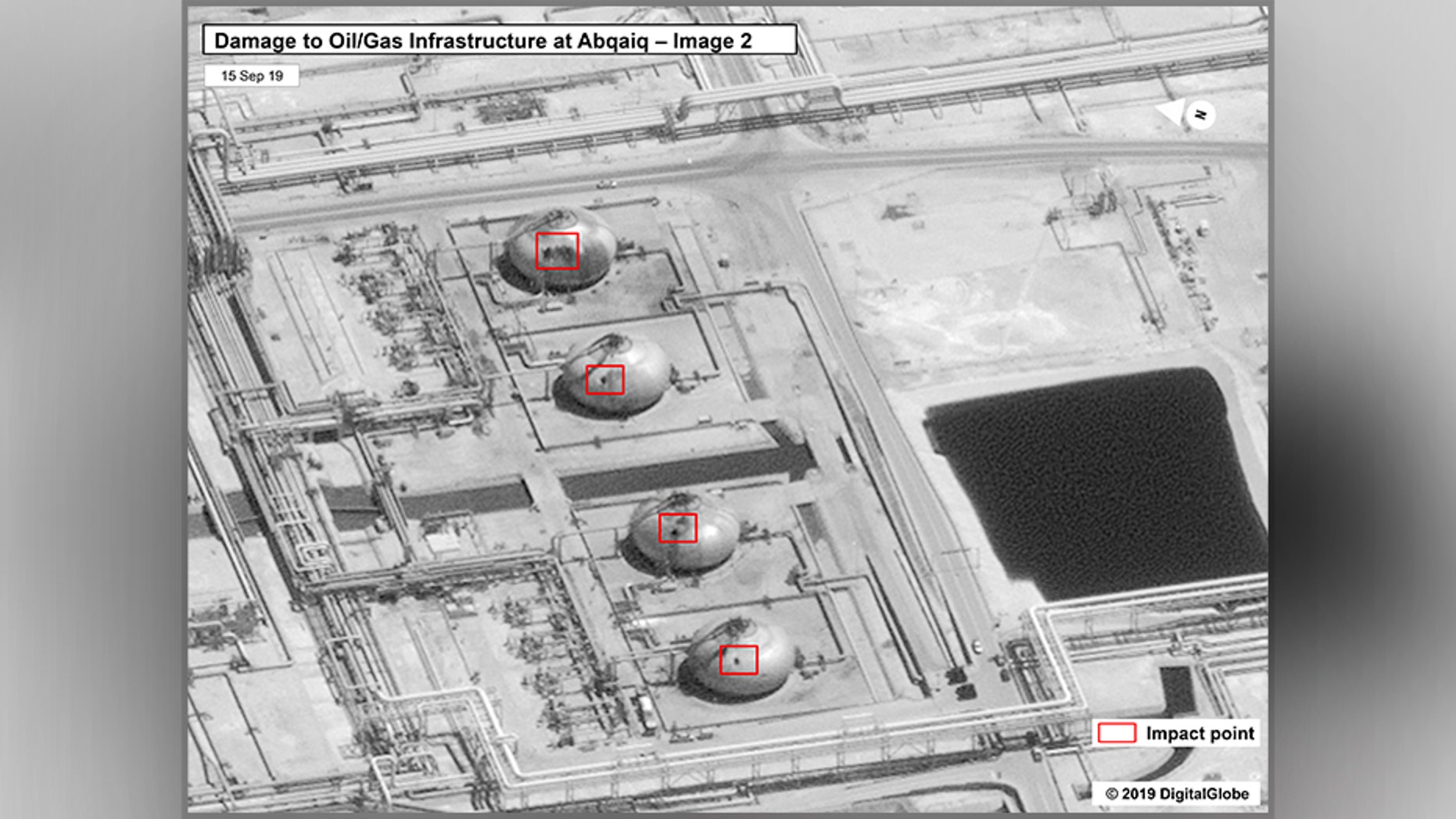
    The U.S. government published two detailed pictures of the attack's result.


    The pictures show some 17 points of impact. There are cars visible in the more detailed picture that demonstrate the gigantic size of the place.


    Clearly, the targets were carefully selected. At least 11 of those were egg shaped tanks with a diameter of some 30 meters (100 feet). These are likely tanks for pressurized (liquidized) gas that receive the condensate vapor from the stabilization process. They all have neat holes in their upper shells.

    The piping to and from the egg shaped tanks shows that these were configured in groups with double redundancy. Two tanks beside each other share one piping system. Two of such twin tanks are next to each other with lines to their processing train. There are a total of three such groups. That means that damage to any one tank or group would not stop the production process, as the products would be routed to another similar tank or group. But with all tanks of this one special type taken out, the production chain is interrupted. Two processing areas were hit and show fire damage and the control equipment of both appear to have been completely destroyed. What that all means is that the targeting for this attack was done with very detailed knowledge of the process and its dependencies.

    CARVER matrix.

    While there are many insurgent/rebel groups capable of detailed and innovative planning, the engineering expertise required to achieve the maximum impact with minimum effort on this particular target set would be quite high, which drastically narrows the list of those capable of pulling off just the detailed planning required, let alone technical execution of it.

    Look at the north arrow in the upper right corner of second picture. It points to the left and the visible shadows confirm the direction. The holes in the tanks are on the western side. So that means they were attacked from the west.

    Be careful with assuming that the attack originated from the west. Back bearing is meaningless with guided missiles & drones

    Terminal guidance appears to be from the west, but in all modern missile systems(and easy to code for weaponised COTS) attack routes are programmable.

    IE: antiship missile doesn't have to go directly west to east. It can be programmed to go north, east, south, west and terminal attack from the opposite direction, or multiple directions to avoid counter missile fire down the back bearing.

    There could be technical and tactical reasons behind the direction of terminal guidance.

    Look at the extreme precision of the hits. The Yemeni armed forces claimed it attacked the facility with 10 drones (really, cruise missiles).

    Conventional missiles or custom build COTS hybrid drones.

    But the hits on these targets look like neither. A total of 17 hits with such precise targeting would lead us to conclude that these were some kind of drones or missiles with man-in-the-loop control.

    There are in-service weapons that have the autonomous computer vision capability to hit with that consistent level of precision, but they are limited to a small number of users.

    Shorter range man in the loop optically guided systems are much more broadly available.


    And as you say, they may have been launched from within Saudi Arabia.

    I don't recall speculating that they may have been launched within Saudi, more a mention of the considerable engineering & tactical challenges of launching from Yemen and crossing vast Saudi open ground within being interrogated/identified/intercepted.

    The Houthi have taken credit, but I agree with you that Yemen is unlikely to have this capability without drawing on extensive support from elsewhere. Then again, the U.S. and Israel are able to commit such attacks. And Iran, too. And whoever is the prime actor, it's clear that the planing for this operation must have taken months.

    I think your bias is showing with Israel/US. I think this is highly unlikely as risk/reward is insanely bad. This isn't like Clinton throwing some cruise missiles during the Lewinsky Scandal or having a Kuwaiti kid tell lies to Congress following the Iraqi invasion. This is a few entire levels of magnitude greater.

    At this stage, recuperability of production is what I'm most interested in.

    As well as SSE forensics.

    Effect and Recognisability is very high from a macro perspective.


    As a soldier and planner, it does not surprise me at all to learn you are not in favor of open war against Iran. It would be a shit storm in the short run and a long term geopolitical disaster orders of magnitude beyond the Iraq debacle. The immediate impact of any direct attack on Iran would be swarms of missiles hitting U.S. military installations in the United Arab Emirates and Qatar. Saudi water desalination plants, refineries and ports, indeed nearly all Saudi installations of any significance would also be targeted.

    The Iranians aren't morons, but they have done some very stupid things in the past.

    Operation Praying Mantis in 1988 was an entirely one sided short/sharp series of military incidents that didn't lead to the apocalypse.

    The difference today is the US is far better equipped and the Iranians just aren't.


    And Saudi Arabia has no defenses against these kind of attacks.

    The Saudis have a fully integrated and overly expensive(kickbacks) AWACS and air defence network that is very capable.

    But Saudi forces, with very few exceptions, are very poorly regarded. Outsourcing non kinetic services to very well trained western contractors is very common.


    The U.S. has no system that could be used for that purpose and what systems we have in place are better targets than counters.

    Unless you've got first hand info, I'd strongly disagree.

    No systems are perfect, but there's been a lot of investment and innovation in this space in recent years. ;)

    Counter drone, in particular, is experiencing extremely rapid capability development and deployment.

    Russia is the only country that can provide the necessary equipment.

    What is this based on exactly?

    Russian kit didn't perform as advertised in the one drone swarm they got hit with during their "Syrian Arms Sales Show".

    S400/500 seem like solid systems, but Russia doesn't exactly have the R&D budget to back up their bluster.

    But even if the Saudi's chose to incur the wrath of their American clients and buy Russian, it would take some time to field, be extremely costly, and still be insufficient to protect all of the Saudi's vital facilities from similar attacks.

    I'm sure the Russians will offer as they have tried to crack that nut for decades. But the Saudis buying Russian kit would likely have nothing to do with operational effectiveness and everything to do with a nuclear equipped superpower sponsor swap.

    Despite the bluster, I doubt that Trump or the Saudis are ready to risk such a response. Although Bibi might find it a welcome distraction from his electoral and legal difficulties.

    The bottom line is that attacks of this kind will only end when Saudi Arabia admits the reality of their situation and makes peace with Yemen. And part of that peace will require the U.S. to end its sanctions of oil exports from Iran. As Iran's President Rouhani said, if the Americans, Saudis or Israelis prevent the export of Iran’s oil, then no oil will be exported from the Persian Gulf. It is high time for the neocon hawks and their Saudi/Israeli paymasters to recognize that Iran means what it says. And they have the tools and wherewithal to fulfill that promise.
    I have a different view of Yemen.

    I've stated here before I believe Yemen is a much slower burning/simmering analog to the Normandy invasion.

    The Saudis have validated this theory displayed by throwing the kitchen sink at Yemen with indiscriminate brutality, largely from the air in a princely cockpit or by paying for coalition proxies/mercenaries on the ground.

    Yemen, due to terrain and ethno/demo history is the perfect platform for launching attacks into Saudi proper.

    And I'm not talking just the few remaining shade tree modified Scuds that have caused considerable concern for the Saudis, we're talking loss of local control and governance if Yemen "infected" Saudi.

    I just don't see the Saudis publicly humbling themselves.

    Massively expensive back channel agreements for "peace with honour", definitely.

    But if not, I see killing fields.

    What would they do to protect trillions of dollars in wealth? Absolutely anything.

    And with a disengaging disinterested US, who knows?

    What hasn't been covered anywhere is whether Saudi faces any internal/factional attack risk?

    I think it highly unlikely this was the result of Saudi internal/factional strive, especially after MBS squeezed every single major player in Saudi to submit wealth, power, fealty.

    But surely there was deemed to be enough risk to gently waterboard all the major players recently at the Riyadh Ritz?

    Houthi backed by Iran, or a rogue princely capo in the Saudi mafioso throwing $25-50 million at this sounds more likely than an Israeli/US false flag.

    Leave a comment:


  • Woodsman
    replied
    Re: Saudi gets SLAPPED ! (Oil going to $100?)

    Originally posted by lakedaemonian View Post
    Credibility from telling the “truth” is so hard to build and far easier to lose.
    .
    .
    .

    I am most decidedly NOT for an open conventional war with Iran, but:

    1)there are Iranian fingerprints all over this
    2)this is yet another, but escalated, chapter in the now 40 year long unending unconventional war with Iran.
    Indeed, although I'd push that timeline back another 20 years or so, recalling the truth of who fired the first shot in that unconventional war. Specifically, Operation Ajax and our overthrow of Time Magazine's Man of the Year Prime Minister Mohammad Mosaddegh. And while that bought us a sort of peace for a time, during the interregnum of the Shah's dictatorship, we continued making war on the Iranian people with our financial and technical support of his brutal regime. Suffice to say, our difficulties with Iran did not begin with the seizure of the US embassy and its staff and those actions did occur within a historical and political context that does not exactly leave us bathed in righteousness and glory.

    But back to the Houthi strike. I don't discount your back of the napkin analysis. But rather than speculate, informed as your speculation is, let's do our best to stick to the evidence that we have available, namely the satellite pictures.

    The U.S. government published two detailed pictures of the attack's result.


    The pictures show some 17 points of impact. There are cars visible in the more detailed picture that demonstrate the gigantic size of the place.


    Clearly, the targets were carefully selected. At least 11 of those were egg shaped tanks with a diameter of some 30 meters (100 feet). These are likely tanks for pressurized (liquidized) gas that receive the condensate vapor from the stabilization process. They all have neat holes in their upper shells.

    The piping to and from the egg shaped tanks shows that these were configured in groups with double redundancy. Two tanks beside each other share one piping system. Two of such twin tanks are next to each other with lines to their processing train. There are a total of three such groups. That means that damage to any one tank or group would not stop the production process, as the products would be routed to another similar tank or group. But with all tanks of this one special type taken out, the production chain is interrupted. Two processing areas were hit and show fire damage and the control equipment of both appear to have been completely destroyed. What that all means is that the targeting for this attack was done with very detailed knowledge of the process and its dependencies.

    Look at the north arrow in the upper right corner of second picture. It points to the left and the visible shadows confirm the direction. The holes in the tanks are on the western side. So that means they were attacked from the west.

    Look at the extreme precision of the hits. The Yemeni armed forces claimed it attacked the facility with 10 drones (really, cruise missiles). But the hits on these targets look like neither. A total of 17 hits with such precise targeting would lead us to conclude that these were some kind of drones or missiles with man-in-the-loop control. And as you say, they may have been launched from within Saudi Arabia. The Houthi have taken credit, but I agree with you that Yemen is unlikely to have this capability without drawing on extensive support from elsewhere. Then again, the U.S. and Israel are able to commit such attacks. And Iran, too. And whoever is the prime actor, it's clear that the planing for this operation must have taken months.

    As a soldier and planner, it does not surprise me at all to learn you are not in favor of open war against Iran. It would be a shit storm in the short run and a long term geopolitical disaster orders of magnitude beyond the Iraq debacle. The immediate impact of any direct attack on Iran would be swarms of missiles hitting U.S. military installations in the United Arab Emirates and Qatar. Saudi water desalination plants, refineries and ports, indeed nearly all Saudi installations of any significance would also be targeted. And Saudi Arabia has no defenses against these kind of attacks. The U.S. has no system that could be used for that purpose and what systems we have in place are better targets than counters. Russia is the only country that can provide the necessary equipment. But even if the Saudi's chose to incur the wrath of their American clients and buy Russian, it would take some time to field, be extremely costly, and still be insufficient to protect all of the Saudi's vital facilities from similar attacks.

    Despite the bluster, I doubt that Trump or the Saudis are ready to risk such a response. Although Bibi might find it a welcome distraction from his electoral and legal difficulties.

    The bottom line is that attacks of this kind will only end when Saudi Arabia admits the reality of their situation and makes peace with Yemen. And part of that peace will require the U.S. to end its sanctions of oil exports from Iran. As Iran's President Rouhani said, if the Americans, Saudis or Israelis prevent the export of Iran’s oil, then no oil will be exported from the Persian Gulf. It is high time for the neocon hawks and their Saudi/Israeli paymasters to recognize that Iran means what it says. And they have the tools and wherewithal to fulfill that promise.

    Leave a comment:

Working...
X