Announcement

Collapse
No announcement yet.

Hudson on the Piketty Phenomenon

Collapse
X
 
  • Filter
  • Time
  • Show
Clear All
new posts

  • Woodsman
    replied
    Re: Hudson on the Piketty Phenomenon

    Originally posted by DSpencer View Post
    People protesting for $15 an hour don't want income equality. They want to make 70% more than what the average worker in the world makes.
    Really, that's what you think? Ever consider how much more do these people take, spence, percentage-wise?

    Top 1% = $368,238 (20.9% of income)
    Top 0.5% = $558,726 (16.8% of income)
    Top 0.1% = $1,695,136 (10.3% of income)
    Top 0.01% = $9,141,190 (5% of income)>

    click for larger chart
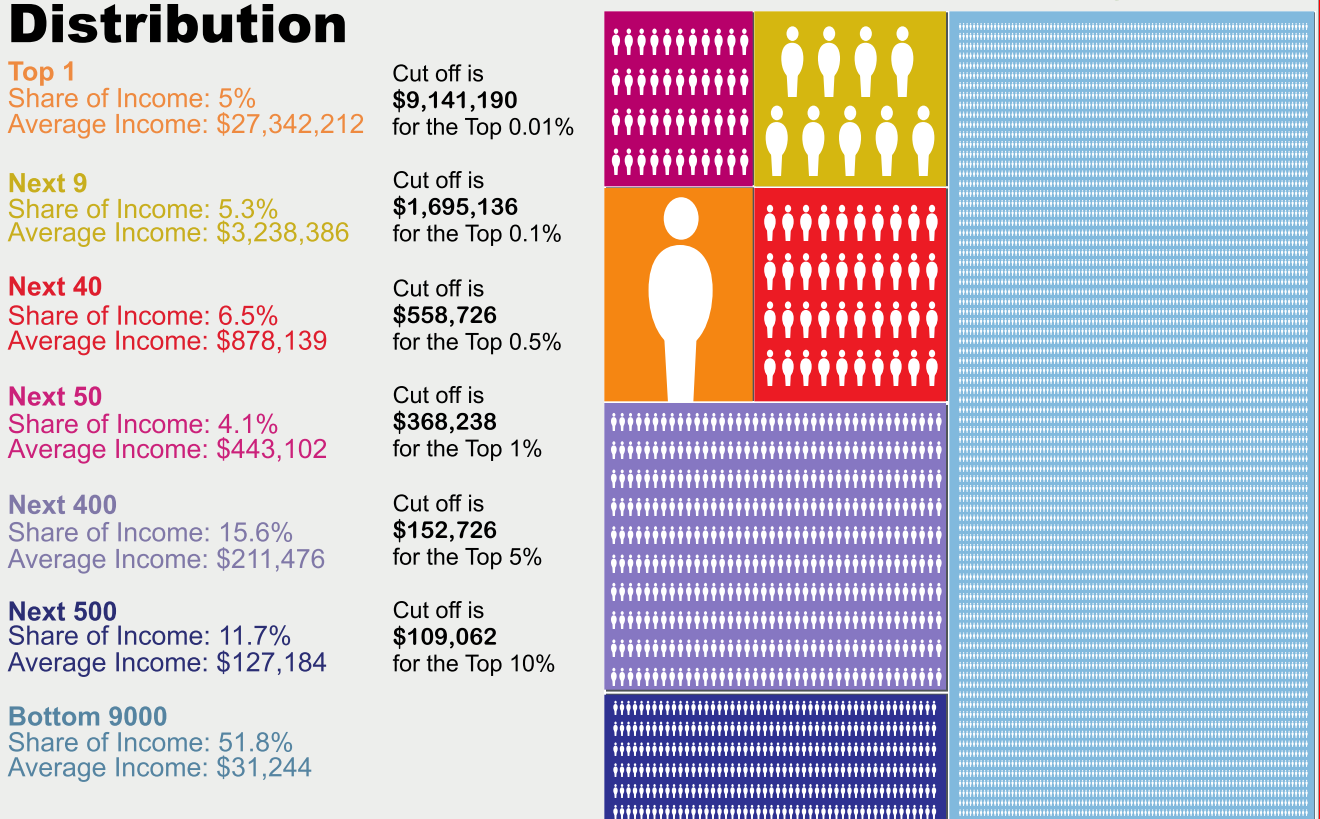

    Does this matter at all to the conversation on inequality?

    It sure seems we are quick to put blame on the weakest and least powerful among us. Why, I wonder?


    Leave a comment:


  • Milton Kuo
    replied
    Re: Hudson on the Piketty Phenomenon

    Originally posted by DSpencer View Post
    People protesting for $15 an hour don't want income equality. They want to make 70% more than what the average worker in the world makes.
    It costs at least 70% more to live in the U.S. than where the average world worker lives.

    Leave a comment:


  • ProdigyofZen
    replied
    Re: Hudson on the Piketty Phenomenon

    On a global basis this study claims the average wage (using purchasing power, not nominal which is even lower) is about $18,000. Only the very bottom sliver of the US workforce would benefit from globalized equal income.

    People protesting for $15 an hour don't want income equality. They want to make 70% more than what the average worker in the world makes.


    Spencer this isn't much of an argument. Sure everything is relative but the poor living in the US have to live in the US and compete with wages here not the wages in China or India.

    But I can agree that usually people who think something should be done are on the lower end (as it benefits them) but then again the people on the high end have benefited from FIRE policies for the better part of 30+ years, why would they complain?

    Every leader of every country is "supposed" to enact policies that help their own citizens not the citizens of other countries.


    Leave a comment:


  • DSpencer
    replied
    Re: Hudson on the Piketty Phenomenon

    Originally posted by ProdigyofZen View Post
    Rarely have I ever been called God, it doesn't suit me. The reality is that inequality is at its historical highs, that is not debatable but what is debatable is the why and how and should we do anything about it.

    If we can't even agree that inequality is at its historical high than there is no use in debating the reasons for it.
    The issue I have with the people who think "something" should be done is that they only think this if they will be on the receiving end (or want to sell books).

    People on the lower end in the US want more income equality within the US. But they sure don't want income equality if it includes India and China.

    http://www.bbc.com/news/magazine-17512040

    On a global basis this study claims the average wage (using purchasing power, not nominal which is even lower) is about $18,000. Only the very bottom sliver of the US workforce would benefit from globalized equal income.

    People protesting for $15 an hour don't want income equality. They want to make 70% more than what the average worker in the world makes.

    Leave a comment:


  • DSpencer
    replied
    Re: Hudson on the Piketty Phenomenon

    Originally posted by Polish_Silver View Post

    There's no particular relationship between a person's income and their value to society.
    I'd say police and sanitation inspectors are near the top in terms of protecting my safety, but they lag way behind lawyers, advertising executives, and pharmaceutical representatives in terms of salary.

    In Japan, police had very high prestige, and it was a very sought after job. Perhaps the important jobs should be paid in "prestige" if they lack payment in $.

    I can't think of a solution to this very fundamental problem, and it deserves to have a special word referring to it.
    In fact there IS a particular relationship between a person's income and their value to society. It's called supply and demand. It's partially distorted in the case of government workers but even then there is usually some supply and demand relationship.

    Your logic is that because something is important, it should be expensive. Water is vital to your safety/survival, but because it is so plentiful, it is very cheap. Do you propose that the price of water be artificially inflated to match it's importance in your life?

    The people that take away your garbage are also critically important to ensuring you have a safe living environment. I dare say the service they provide is far more beneficial to society than a surgeon who can remove a brain tumor. However, the skills needed to drive a truck and throw garbage in it are far more common than those of a brain surgeon. For this reason society is willing to pay more for the skills of the surgeon.

    This isn't a problem so much as it is a fact of life. The problem comes when people think they can suspend reality and that everyone will benefit as a result.

    As for paying people in prestige...If you have a boss I'm sure he will gladly cut your pay and pay you in prestige instead.

    Leave a comment:


  • ProdigyofZen
    replied
    Re: Hudson on the Piketty Phenomenon

    Originally posted by Slimprofits View Post
    Not debateable? Thanks, God, for weighing in.
    Rarely have I ever been called God, it doesn't suit me. The reality is that inequality is at its historical highs, that is not debatable but what is debatable is the why and how and should we do anything about it.

    If we can't even agree that inequality is at its historical high than there is no use in debating the reasons for it.

    Leave a comment:


  • Thailandnotes
    replied
    Re: Hudson on the Piketty Phenomenon

    Treat all compensation as salary and tax it as such and things would change overnight. Many CEO’s have a salary of 1 dollar but take home 400 times median worker income. It’s been going on for decades. Corporate profits could be negative, but when earnings on workers’ pension funds were factored in, the CEO collected a big bonus. Stock options should be eliminated. Instead upper management should be required to buy and own the stock. This debate is much more robust in Canada.

    Originally posted by Polish_Silver View Post
    There's no particular relationship between a person's income and their value to society. I'd say police and sanitation inspectors are near the top in terms of protecting my safety, but they lag way behind lawyers, advertising executives, and pharmaceutical representatives in terms of salary.
    The former are public servants. The latter are in the private sector. Part of the answer is higher taxes on the people raking it in. In my opinion, if you are making 30 million dollars a year and only paying 6 million in taxes, you are ripping off the country.

    Leave a comment:


  • Polish_Silver
    replied
    Re: Hudson on the Piketty Phenomenon

    Originally posted by Thailandnotes View Post
    Perfect!

    Thailand,

    I have to agree with your earlier comments on the CEO pay etc. Some of us have pondered ways to bring the CEO pay down to some reasonable multiple of the companies median salary. Perhaps the best thing would be just to change the leadership structure. In German companies the labor union has a seat at the top level. Forget "union". How about someone elected by all the employees, who can veto the salary structure?

    Another problem, I don't think raised by Piketty, is inherent in market based incomes, regardless of return on capital vs wage growth:

    There's no particular relationship between a person's income and their value to society.
    I'd say police and sanitation inspectors are near the top in terms of protecting my safety, but they lag way behind lawyers, advertising executives, and pharmaceutical representatives in terms of salary.

    In Japan, police had very high prestige, and it was a very sought after job. Perhaps the important jobs should be paid in "prestige" if they lack payment in $.

    I can't think of a solution to this very fundamental problem, and it deserves to have a special word referring to it.

    Leave a comment:


  • Thailandnotes
    replied
    Re: Hudson on the Piketty Phenomenon

    Many aspects of it are not debatable.

    The soaring number you get dividing CEO pay/average worker.
    The 6.5 billion taxpayer dollars for Walmart workers on food stamps.
    Household debt as percentage of income marches steadily upwards for the bottom 90 %.

    Leave a comment:


  • Slimprofits
    replied
    Re: Hudson on the Piketty Phenomenon

    Originally posted by ProdigyofZen View Post
    Haha shills for the financial elites, the inequality in wealth is far worse than what was laid out in Piketty's book.

    It is not even debatable but it won't stop people from trying.
    Not debateable? Thanks, God, for weighing in.

    Leave a comment:


  • ProdigyofZen
    replied
    Re: Hudson on the Piketty Phenomenon

    Haha shills for the financial elites, the inequality in wealth is far worse than what was laid out in Piketty's book.

    It is not even debatable but it won't stop people from trying.

    Leave a comment:


  • vt
    replied
    Re: Hudson on the Piketty Phenomenon


    Piketty: A Wealth of Misconceptions

    Gene Epstein barrons May 31, 2014

    Capital in the Twenty-First Century, Thomas Piketty's thoughtful manifesto, sadly gets capitalism all wrong.

    Reviewed by Donald J. Boudreaux

    Thomas Piketty's Capital in the Twenty-First Century might soon stand with Karl Marx's Capital, which inspired its title, as one of the most influential economic masterworks of the past 150 years. But sad to say, this 696-page tome, ably translated by Arthur Goldhammer, is no more enlightening about capitalism in the 21st century than Marx's Capital was about capitalism in the 19th century.

    As a publishing phenomenon alone, the Paris School of Economics professor's treatise, which has been hailed by three Nobel laureates—Paul Krugman, Joseph Stiglitz, and Robert Solow—commands our attention. It is also noteworthy as a symptom of a perverse ideology that seems to dominate progressive thinking, including that of President Barack Obama and President François Hollande of France, and of a flawed method of economic analysis.

    Many of us care about whether, and to what extent, the broad masses of people have improved absolutely their material conditions of life. While Piketty (pronounced "PEEK-et-tee") doesn't entirely ignore that question, he focuses instead on the causes and cures of relative disparities in monetary income and wealth across groups of people and over centuries. Some ways of narrowing those disparities, such as punitive rates of taxation, might run the risk of dragging down everyone, rich and poor alike. But for Piketty, the importance of diminishing monetary inequalities is so monumental that he all but totally ignores such risks.

    Piketty's method of doing economics involves frequent grand proclamations about "social justice" and economic "evolutions," but he offers no analyses of the dynamics of individual decision-making, often referred to as "microeconomics," that should be central to the issues he raises.

    The author hovers instead in the economy's stratosphere, gazing down on the only phenomena visible from such a distant perch—big statistics such as population growth or the share of national income "claimed" by the very rich. Revealingly, Piketty writes of income and wealth as being claimed or "distributed," never as being earned or produced. The resulting statistics are too aggregated—too big-picture—to reveal what is happening to individuals on the ground.

    Instead of actually looking at the behavior behind his statistics, the author serves up ad hoc and ultimately unpersuasive theories about the "behavior" of his big statistics themselves, including such hulking impersonal aggregates as the return to capital and the ratio of national wealth to national income. He imagines that such aggregates interact in robotic fashion through a logic of their own, unmoved by individual human initiative, creativity, or choice.

    CONSIDER PIKETTY'S CENTRAL theory, that the rate of return on capital, which he labels "r," tends to be greater than the rate of economic growth, or "g." For the author, the fact that r runs faster than g—by several percentage points, by his reckoning—alone seals capitalism's fate, because it implies that owners of capital must get increasingly richer than nonowners. Because capital ownership is itself unevenly "distributed" across society, wealth and income disparities must in turn worsen, "impoverishing" the middle classes and the poor alike, while giving a relatively small number of rich elites both vast resources and disproportionate influence over government policy-making.

    Despite the logical implications of return on capital being greater than economic growth, Piketty doesn't think that the plutocraticization of society is inevitable. First of all, it can be arrested and even reversed by calamities such as world wars or Soviet-style communism, the destructive effects of which fall disproportionately upon the rich. Alas, he opines that the welcome consequences of such correctives are only temporary.

    But another, more lasting remedy is readily at hand: hard-hitting taxation. Piketty calls for greater and more progressive taxation, not only of incomes—at a top bracket of at least 80%—but also of wealth, preferably to be enacted globally, lest differential tax burdens prompt plutocrats to flee from high-tax to low-tax jurisdictions. While he isn't optimistic about the likelihood of the necessary government cooperation, he's willing to settle for whatever steps more-enlightened governments might take to soak the rich—and especially such steps as might be accompanied by greater cross-border sharing of information about bank accounts and other investments owned by foreigners.

    Flaws aplenty mar Piketty's telling of the capitalist saga, flaws that spring mainly from his disregard for basic economic principles. None looms larger than his mistaken notion of wealth.

    Every semester, I ask my freshman students how wealthy they would be if they each were worth financially as much as Bill Gates but were stranded with all those stocks, bonds, property titles, and bundles of cash alone on a desert island. They immediately see that what matters is not the amount of money they have but, rather, what that money can buy. No principle of economics is more essential than the realization that, ultimately, wealth isn't money or financial assets but, rather, ready access to real goods and services.

    Piketty seems barely aware of this reality, focusing on differences in people's monetary portfolios. He therefore ignores the all-important supply side: what people—rich, middle class, and poor—can buy with their money. Yet, to the extent that inequalities are at all relevant, the only ones that really matter are inequalities in access to real goods and services for consumption. Bill Gates' living quarters are larger and more elegant than mine and, I dare say, yours. But even the poorest people in market economies have seen their ability to consume skyrocket over time. And the poorer they once were, the greater has been the enhancement of their ability to consume.

    If we follow the advice of Adam Smith and examine people's ability to consume, we discover that nearly everyone in market economies is growing richer. We also discover that the real economic differences separating the rich from the middle class and the poor are shrinking. Reckoned in standards of living—in ability to consume—capitalism is creating an ever-more-egalitarian society.

    THE U.S. IS THE bête noir of Piketty and other progressives obsessed with monetary inequality. But middle-class Americans take for granted their air-conditioned homes, cars, and workplaces—along with their smartphones, safe air travel, and pills for ailments ranging from hypertension to erectile dysfunction. At the end of World War II, when monetary income and wealth inequalities were narrower than they've been at any time in the past century, these goods and services were either available to no one or affordable only by the very rich. So regardless of how many more dollars today's plutocrats have accumulated and stashed into their portfolios, the elite's accumulation of riches has not prevented the living standards of ordinary people from rising spectacularly.

    Furthermore, these improvements in real living standards have been undeniably greater for ordinary folks than for rich ones. In 1950, Howard Hughes and Frank Sinatra could easily afford to pay for the likes of overnight package delivery, hour-long transcontinental telephone calls, and air-conditioned homes. For ordinary Americans, however, these things were out of reach. Yet, while today's tycoons and celebrities still have access to such amenities, so, too, do middle-class and even poor Americans. This shrinking gap between the real economic fortunes of the rich and the rest of us should calm concerns about the political dangers of the expanding inequality of monetary fortunes.

    Flaws in the author's stratospheric viewpoint are also on display when we try to think in human terms about the inevitability of the return on capital, at 4% to 5%, exceeding the growth rate of economy, at 1% to 1.5%. According to the author, that gap of a few percentage points, when compounded over many years, can render economic inequality "potentially terrifying." But two key factors make it quite difficult for that tendency to persist for very long in the lives of most individuals.

    To begin with, advance and retreat, rather than permanence, tends to characterize the pattern of most successful businesses. Sooner or later, the entry of competitors and of changing consumer tastes curbs their growth, when not reducing their size absolutely or even bankrupting them. In 2013 alone, 33,000 businesses in the U.S. filed for bankruptcy, a typical figure for a year of economic expansion. Second, and more importantly, successful capitalists rarely spawn children and grandchildren who match their elders' success; there is regression toward the mean. Note that the terrifyingly successful capitalist Bill Gates will likely not be succeeded by younger Gateses prepared to capitalize on his success.

    Even leave aside plans like those of Gates and Warren Buffett to give away much of their fortunes, or the redistributive role of philanthropy generally. The empirical data suggest that turnover is the norm among wealthy capitalists, rather than the building of a permanent plutocracy. The IRS' list of "Top 400 Individual Tax Returns" provides evidence of instability at the top. Over the 18 years from 1992 through 2009, 73% of the individuals who appeared on that list did so for only one year. Only a handful of individuals made the list in 10 or more years. Wealth gets diluted over time when left to multiple heirs, and is further diluted by estate taxes, philanthropy, and changes in market conditions.

    PIKETTY'S PRONOUNCEMENTS about the stability of capitalist wealth deny such realities. He writes, for example, that "Capital is never quiet: it is always risk-oriented and entrepreneurial, at least at its inception, yet it always tends to transform itself into rents as it accumulates in large enough amounts—that is its vocation, its logical destination." Read: The risky, entrepreneurial element in business formation eventually recedes in importance until the business naturally evolves toward its "logical destination"—that of a perpetual cash machine that regularly spits out "rents."

    In a similar vein, Piketty observes, "[W]hat could be more natural to ask of a capital asset than that it produce a reliable and steady income: that is in fact the goal of a 'perfect' capital market as economists define it." It may be "natural" to ask this of a capital asset. But only economists who talk of "perfect" capital markets are naive enough to expect a "yes" answer.

    If Piketty really believes in a "perfect" capital market yielding capitalists reliable and steady income, he might wonder why the bankrupt book-selling giant Borders is no longer around to sell his books, while Amazon.com has grown up to challenge all manner of bricks-and-mortar retailers. In his world, capitalism is a system of profits; in the real world, it's a system of profit and loss.

    Piketty's disregard for basic economic reasoning blinds him to the all-important market forces at work on the ground—market forces that, if left unencumbered by government, produce growing prosperity for all. Yet, he would happily encumber these forces with confiscatory taxes.
    Commendably, though, he expresses concern about the potential for his tax regime to expand the size of government: "[B]efore we can learn to efficiently organize public financing equivalent to two-thirds to three-quarters of national income," he cautions, "it would be good to improve the organization and operation of the existing public sector." It would indeed be "good" to make such improvements. I'd like to imagine that, if Karl Marx were alive today, he'd sadly inform his less-experienced colleague that, 150 years ago, socialists had that very same idea. It did not work out as hoped.
    _________________

    Leave a comment:


  • Thailandnotes
    replied
    Re: Hudson on the Piketty Phenomenon

    Galbraith...

    Quote from video placed in the middle of the article: "In the United States in 1965, 19 out of 20 men between the ages of 25 and 54 were working. Now we're down to 6 and 7." ??????

    http://www.ft.com/cms/s/0/8eb5e942-e...#axzz33LAfoRIV


    Rising inequality is not necessarily a sign of bad times. The boom creates jobs, reduces poverty and expands well-being. But high inequality tends to prefigure a crisis. After a crisis inequality falls – like blood pressure after a heart attack. But that is a bit late.

    Inequality, like blood pressure, can be controlled. We do not find an unstoppable trend – not even in the past 40 years. Much depends on global forces, bearing against the strength and determination of national policies and institutions.

    Data work is difficult. We made many tweaks in order to arrive at reasonable measures. We have tried to document them, and we think they are consistent and justified. As with everything in this field: use with caution."
    Last edited by Thailandnotes; May 31, 2014, 09:19 PM.

    Leave a comment:


  • sutro
    replied
    Re: Hudson on the Piketty Phenomenon

    Originally posted by vt View Post
    Piketty Findings Undercut By Errors:

    http://www.ft.com/cms/s/2/e1f343ca-e...#axzz32ae7JM5S

    High quality global journalism requires investment. Please share this article with others using the link below, do not cut & paste the article. See our Ts&Cs and Copyright Policy for more detail. Email ftsales.support@ft.com to buy additional rights. http://www.ft.com/cms/s/2/e1f343ca-e...#ixzz32aeaFwm2

    May 23, 2014 7:00 pm
    Piketty findings undercut by errors

    By Chris Giles in London

    ©GettyEconomist and author Thomas Piketty

    Thomas Piketty’s book, ‘Capital in the Twenty-First Century’, has been the publishing sensation of the year. Its thesis of rising inequality tapped into the zeitgeist and electrified the post-financial crisis public policy debate.
    Chris Giles outlines his issues with data in ‘Capital in the 21st Century’

    Some issues concern sourcing and definitional problems. Some numbers appear simply to be constructed out of thin air.
    Continue reading ...

    But, according to a Financial Times investigation, the rock-star French economist appears to have got his sums wrong.
    The data underpinning Professor Piketty’s 577-page tome, which has dominated best-seller lists in recent weeks, contain a series of errors that skew his findings. The FT found mistakes and unexplained entries in his spreadsheets, similar to those which last year undermined the work on public debt and growth of Carmen Reinhart and Kenneth Rogoff.
    The central theme of Prof Piketty’s work is that wealth inequalities are heading back up to levels last seen before the first world war. The investigation undercuts this claim, indicating there is little evidence in Prof Piketty’s original sources to bear out the thesis that an increasing share of total wealth is held by the richest few.
    Prof Piketty, 43, provides detailed sourcing for his estimates of wealth inequality in Europe and the US over the past 200 years. In his spreadsheets, however, there are transcription errors from the original sources and incorrect formulas. It also appears that some of the data are cherry-picked or constructed without an original source.

    More


    ON THIS STORY


    For example, once the FT cleaned up and simplified the data, the European numbers do not show any tendency towards rising wealth inequality after 1970. An independent specialist in measuring inequality shared the FT’s concerns.
    Contacted by the FT, Prof Piketty said he had used “a very diverse and heterogeneous set of data sources ... [on which] one needs to make a number of adjustments to the raw data sources.
    “I have no doubt that my historical data series can be improved and will be improved in the future ... but I would be very surprised if any of the substantive conclusion about the long-run evolution of wealth distributions was much affected by these improvements,” he said.
    His contention to have found a “central contradiction of capitalism” has in recent months made him a hero of the left. Although his conclusions have stirred controversy, there has, until now, been near unanimous praise for the quality of his statistical work.
    On a tour of the US last month, Prof Piketty met Jacob Lew, US Treasury secretary, gave a presentation to the White House Council of Economic Advisers and lectured at the International Monetary Fund and the UN.


    Nobel prize-winning economists have heaped praised on Mr Piketty’s work. Professor Paul Krugman of Princeton University, said it was safe to say the book “will be the most important economics book of the year – and maybe of the decade”.
    Professor Joseph Stiglitz of Columbia University said Prof Piketty’s “fundamental contribution” was the provision of data on the distribution of wealth. It was the subject of laudatory reviews in the Financial Times and other publications.
    In Britain, Ed Miliband, Labour leader, told the Evening Standard: “I’m in the early stages of the book. In a way, he is symptomatic of what people are actually feeling”.
    In his response to the FT, Prof Piketty said that more recent data not in his work showed “the rise in top wealth shares in the US in recent decades has been even larger than what I show in my book”.


    Piketty responds,
    http://blogs.ft.com/money-supply/201...data-concerns/?

    Dear Chris,
    I am happy to see that FT journalists are using the excel files that I have put on line! I would very much appreciate if you could publish this response along with your piece.
    Let me first say that the reason why I put all excel files on line, including all the detailed excel formulas about data constructions and adjustments, is precisely because I want to promote an open and transparent debate about these important and sensitive measurement issues (if there was anything to hide, any “fat finger problem”, why would I put everything on line?).
    Let me also say that I certainly agree that available data sources on wealth are much less systematic than for income. In fact, one of the main reasons why I am in favor of wealth taxation and automatic exchange of bank information is that this would be a way to develop more financial transparency and more reliable sources of information on wealth dynamics (even if the tax was charged at very low rates, which you might agree with).
    For the time being, we have to do with what we have, that is, a very diverse and heterogeneous set of data sources on wealth: historical inheritance declarations and estate tax statistics, scarce property and wealth tax data, and household surveys with self-reported data on wealth (with typically a lot of under-reporting at the top). As I make clear in the book, in the on-line appendix, and in the many technical papers I have published on this topic, one needs to make a number of adjustments to the raw data sources so as to make them more homogenous over time and across countries. I have tried in the context of this book to make the most justified choices and arbitrages about data sources and adjustments. I have no doubt that my historical data series can be improved and will be improved in the future (this is why I put everything on line). In fact, the “World Top Incomes Database” (WTID) is set to become a “World Wealth and Income Database” in the coming years, and we will put on-line updated estimates covering more countries. But I would be very surprised if any of the substantive conclusion about the long run evolution of wealth distributions was much affected by these improvements.
    For instance, my US series have already been extended and improved by an important new research paper by Emmanuel Saez (Berkeley) and Gabriel Zucman (LSE). This work was done after my book was written, so unfortunately I could not use it for my book. Saez and Zucman use much more systematic data than I used in my book, especially for the recent period. Also their series are constructed using a completely different data source and methodology (namely, the capitalisation method using capital income flows and income statements by asset class). The main results are available here: http://gabriel-zucman.eu/files/SaezZucman2014Slides.pdf.
    As you can see by yourself, their results confirm and reinforce my own findings: the rise in top wealth shares in the US in recent decades has been even larger than what I show in my book.
    In the attached graph, I compare their series with the approximate series that I provide in the book. As you can see by yourself, the general historical profiles are very similar. This is exactly what I expect as we collect more data in other countries as well: we will certainly improve upon my series and adjustments (some of which can certainly be discussed), but I don’t think this will have much of an impact on the general findings.
    (see also this paper pp. 91-92 of pdf: http://gabriel-zucman.eu/files/PikettyZucman2014HID.pdf)
    Finally, let me say that my estimates on wealth concentration do not fully take into account offshore wealth, and are likely to err on the low side. I am certainly not trying to make the picture look darker than it it. As I make clear in chapter 12 of my book (see in particular table 12.1-12.2), top wealth holders have apparently been rising a lot faster average wealth in recent decades, at least according to the wealth rankings published in magazines such as Forbes. This is true not only in the US, but also in Britain and at the global level (see attached table). This is not well taken into account by wealth surveys and official statistics, including the recent statistics that were published for Britain. Of course, as I make clear in my book, wealth rankings published by magazines are far from being a perfectly reliable data source. But for the time being, this is what we have, and what we have suggests that the concentration of wealth at the top is rising pretty much everywhere. Of course, if the FT produces statistics and wealth rankings showing the opposite, I would be very interested to see these statistics, and I would be happy to change my conclusion! Please keep me posted.
    Best, Thomas

    Leave a comment:


  • vt
    replied
    Re: Hudson on the Piketty Phenomenon

    Piketty Findings Undercut By Errors:

    http://www.ft.com/cms/s/2/e1f343ca-e...#axzz32ae7JM5S

    High quality global journalism requires investment. Please share this article with others using the link below, do not cut & paste the article. See our Ts&Cs and Copyright Policy for more detail. Email ftsales.support@ft.com to buy additional rights. http://www.ft.com/cms/s/2/e1f343ca-e...#ixzz32aeaFwm2

    May 23, 2014 7:00 pm
    Piketty findings undercut by errors

    By Chris Giles in London

    ©GettyEconomist and author Thomas Piketty

    Thomas Piketty’s book, ‘Capital in the Twenty-First Century’, has been the publishing sensation of the year. Its thesis of rising inequality tapped into the zeitgeist and electrified the post-financial crisis public policy debate.
    Chris Giles outlines his issues with data in ‘Capital in the 21st Century’

    Some issues concern sourcing and definitional problems. Some numbers appear simply to be constructed out of thin air.
    Continue reading ...

    But, according to a Financial Times investigation, the rock-star French economist appears to have got his sums wrong.
    The data underpinning Professor Piketty’s 577-page tome, which has dominated best-seller lists in recent weeks, contain a series of errors that skew his findings. The FT found mistakes and unexplained entries in his spreadsheets, similar to those which last year undermined the work on public debt and growth of Carmen Reinhart and Kenneth Rogoff.
    The central theme of Prof Piketty’s work is that wealth inequalities are heading back up to levels last seen before the first world war. The investigation undercuts this claim, indicating there is little evidence in Prof Piketty’s original sources to bear out the thesis that an increasing share of total wealth is held by the richest few.
    Prof Piketty, 43, provides detailed sourcing for his estimates of wealth inequality in Europe and the US over the past 200 years. In his spreadsheets, however, there are transcription errors from the original sources and incorrect formulas. It also appears that some of the data are cherry-picked or constructed without an original source.


    More


    ON THIS STORY


    For example, once the FT cleaned up and simplified the data, the European numbers do not show any tendency towards rising wealth inequality after 1970. An independent specialist in measuring inequality shared the FT’s concerns.
    Contacted by the FT, Prof Piketty said he had used “a very diverse and heterogeneous set of data sources ... [on which] one needs to make a number of adjustments to the raw data sources.
    “I have no doubt that my historical data series can be improved and will be improved in the future ... but I would be very surprised if any of the substantive conclusion about the long-run evolution of wealth distributions was much affected by these improvements,” he said.
    His contention to have found a “central contradiction of capitalism” has in recent months made him a hero of the left. Although his conclusions have stirred controversy, there has, until now, been near unanimous praise for the quality of his statistical work.
    On a tour of the US last month, Prof Piketty met Jacob Lew, US Treasury secretary, gave a presentation to the White House Council of Economic Advisers and lectured at the International Monetary Fund and the UN.


    Nobel prize-winning economists have heaped praised on Mr Piketty’s work. Professor Paul Krugman of Princeton University, said it was safe to say the book “will be the most important economics book of the year – and maybe of the decade”.
    Professor Joseph Stiglitz of Columbia University said Prof Piketty’s “fundamental contribution” was the provision of data on the distribution of wealth. It was the subject of laudatory reviews in the Financial Times and other publications.
    In Britain, Ed Miliband, Labour leader, told the Evening Standard: “I’m in the early stages of the book. In a way, he is symptomatic of what people are actually feeling”.
    In his response to the FT, Prof Piketty said that more recent data not in his work showed “the rise in top wealth shares in the US in recent decades has been even larger than what I show in my book”.


    Leave a comment:

Working...
X