Announcement

Collapse
No announcement yet.

Inequality much worse than most think

Collapse
This topic is closed.
X
X
 
  • Filter
  • Time
  • Show
Clear All
new posts

  • metalman
    replied
    Re: Visit the right places--change your tune

    Originally posted by jk View Post
    he glosses over the fact that median incomes haven't improved since the 1970's. all the economic growth is going to the top earners. so why should the median voter care about economic growth? there's nothing in it for him.
    glosses over the fact that his fire industry pals caused the recession... that created the output gap... that is 'why' the slow growth... & if not for big gov't spending the inequality is even worse.

    i gets a headache reading the wsj... so don't.

    same old sheet....

    Leave a comment:


  • jk
    replied
    Re: Visit the right places--change your tune

    Originally posted by jiimbergin View Post
    he glosses over the fact that median incomes haven't improved since the 1970's. all the economic growth is going to the top earners. so why should the median voter care about economic growth? there's nothing in it for him.

    Leave a comment:


  • newnewthing
    replied
    Re: Visit the right places--change your tune

    Originally posted by jk View Post

    "The United States has about 5 percent of the world's population, but we have 25 percent of the world's prisoners - we incarcerate a greater percentage of our population than any country on Earth," said Michael Jacobson, director of the non-partisan Vera Institute of Justice. He also ran New York City's jail and probation systems in the 1990s.
    A report by the organization, "The Price of Prisons," states that the cost of incarcerating one inmate in Fiscal 2010 was $31,307 per year. "In states like Connecticut, Washington state, New York, it's anywhere from $50,000 to $60,000," he said.
    http://www.cbsnews.com/news/the-cost...incarceration/
    Many decades ago we criticized the USSR and South Africa for similarly disproportionate stats.

    Leave a comment:


  • jk
    replied
    Re: Visit the right places--change your tune

    Originally posted by santafe2 View Post
    The median will continue to ratchet down and the cost of social overhead will continue to ratchet up. People on the lower rungs of US society know they better stay in line or their job as welfare recipient can be replaced with a better job as prisoner. Prisoners are some of our best products in the US. They not only create jobs during the manufacturing process, the maintenance is ongoing with a 30-40 year life cycle. The dichotomy between freedom at the top and underclass living in the US is striking.

    "The United States has about 5 percent of the world's population, but we have 25 percent of the world's prisoners - we incarcerate a greater percentage of our population than any country on Earth," said Michael Jacobson, director of the non-partisan Vera Institute of Justice. He also ran New York City's jail and probation systems in the 1990s.

    A report by the organization, "The Price of Prisons," states that the cost of incarcerating one inmate in Fiscal 2010 was $31,307 per year. "In states like Connecticut, Washington state, New York, it's anywhere from $50,000 to $60,000," he said.
    http://www.cbsnews.com/news/the-cost...incarceration/

    Leave a comment:


  • newnewthing
    replied
    Re: Inequality much worse than most think

    Originally posted by jk View Post
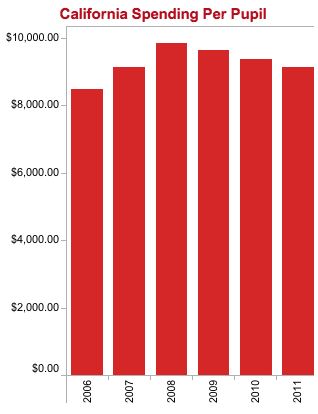
    re school spending. i once spent some time with the data about the 169 towns in ct. i chose groups of towns with similar housing values to control for socio-economics, and then looked at expenditure per pupil and 4 year college attendance [unfortunately the only outcome measure that was available]. bottom line, expenditure per pupil predicted nothing. socio-economic status predicted academic outcomes.
    I don't see this as getting any better. Education is undergoing disintermediation and the higher socio-economic classes will, on the whole, see to it that their kids have access. I would have loved to have grown up with the stuff people take for granted today. Sure the price of "credentials" spirals upward but the cost of acquiring knowledge is going down at the same time. We live in a autodidact's dream while the dream of "no child left behind" is increasingly a fiction. The best of times and the worst of times.

    Leave a comment:


  • BK
    replied
    Re: Visit the right places--change your tune

    Gov Christie is just as interested in playing the inequality card - he just chooses his timing. If he wants to court the main stream Republican he will talk up how wrong the inequality issue is......if Gov Christie is pandering for votes he will assure people here illegally that their children can get the in state rate and Gov Christie will sign the Bill the Thursday prior to Christmas so no one is watching or reporting on it.
    My point as nothing to do with the immigrant issue, just that its hard to tell Gov Christie is a Republican or Democrat......he's just a politician trying to keep the best kind of work he is qualified to do. http://www.washingtonpost.com/blogs/...n-immigration/

    Leave a comment:


  • jiimbergin
    replied
    Re: Visit the right places--change your tune

    What do you all think of this Wall Street Journal opinion piece
    http://online.wsj.com/news/articles/...trending_now_1

    By Robert E. Grady


    Dec. 22, 2013 6:07 p.m. ET
    In his widely noted speech, President Obama said that "a dangerous and growing inequality and lack of upward mobility" is "the defining challenge of our time." This belief makes Mr. Obama unique: Unlike the other presidents since World War II, he places inequality above economic growth as the organizing principle of U.S. economic policy. The president's Dec. 4 speech, at an event hosted by the Center for American Progress, also stressed that increasing inequality is a "decades-long trend"—which carries with it the strong implication that the country needs to reverse the direction it has taken for the last three decades. But like so many of his other pronouncements, the assumptions behind his defining challenge are misleading.
    Enlarge Image


    President Obama at an event hosted by the Center for American Progress, Dec. 4. Reuters


    Virtually all of the data cited by the left to decry the supposed explosion of income inequality, as Lee Ohanian and Kip Hagopian point out in their seminal paper, "The Mismeasure of Inequality" (Policy Review, 2011), use a Census Bureau definition of "money income" that excludes taxes, transfer payments like Medicaid, Medicare, nutrition assistance, the Earned Income Tax Credit, and even costly employee benefits such as health insurance.
    Thus the data that is conventionally used to calculate the so-called Gini coefficient—the most commonly used measure of income inequality—ignore America's highly progressive income tax system and the panoply of benefits and transfer payments. According to Messrs. Ohanian and Hagopian, once the effect of taxes and transfer payments is taken into account, "inequality actually declined 1.8% during the 16-year period between 1993 and 2009, when the Gini coefficient dropped from .395 to .388."
    In his speech, Mr. Obama cited a recent study from economists at Columbia University that found that already enacted benefits and tax programs have reduced America's effective poverty rate by 40% since 1967—to 16% from 26%. But he ignores all this when he claims that inequality is increasing.
    The Columbia study shows that Messrs. Ohanian and Hagopian's research is hardly an outlier. The Congressional Budget Office released a study that came to a similar conclusion in October 2011. The CBO study picked an artificial starting point of 1979, amid a crushing period of stagflation. Yet it still showed that family income, including benefits, on average experienced a 62% gain above inflation from 1979 to 2007. It also showed that all five quintiles of the income distribution spectrum experienced real gains in family income.
    The CBO study contradicts Mr. Obama's claims in the 2008 presidential campaign and early in his first term that the middle class was "falling behind." The real concern is that some people were getting too far ahead.
    With respect to upward mobility, longitudinal studies conducted by the U.S. Treasury have found that there was "considerable income mobility" in the decades 1987-1996 and 1996-2005. For example, roughly half of those in the bottom income quintile in 1996 had moved to a higher quintile by 2005. The "median incomes of those initially in the lowest income groups increased more in percentage terms than the median incomes of those in the higher income groups" in that decade, while the real incomes of two-thirds of all taxpayers experienced an increase.
    Here is the bottom line: In periods of high economic growth, such as the 1980s and 1990s, the vast majority of Americans gain, and have the opportunity to gain. In periods of slow growth, such as the past four and a half years since the recession officially ended, poor people and the middle class are hurt the most, and opportunity is curbed.
    Consider the Census Bureau data, which measure only money income. The data show that median family income adjusted for inflation has not been on a steady or stagnating path since the 1970s. It fell, in real terms, by 5.7% from 1974-1982, when slow growth and high inflation ravaged the average family. Tellingly, in this period, real income fell for the bottom four quintiles, but held steady for the top 20%.
    From 1983 to 2007, however, median family income grew substantially—by 21.6% above inflation—and real income grew for all five quintiles. Then, beginning in 2008, real income plunged again, both for the median family and for all quintiles.
    The point is this: If the goal is to deliver higher incomes and a better standard of living for the majority of Americans, then generating economic growth—not income inequality or the redistribution of wealth—is the defining challenge of our time.
    Regarding growth, Mr. Obama claimed in his speech that we should use some money "to create good jobs rebuilding our roads and our bridges and our airports, and all the infrastructure our businesses need." Yet a recent analysis by BCA Research shows a sharp drop in real spending by the government on nondefense infrastructure since the president took office. When a Democratic Congress passed the president's massive $800 billion stimulus bill, seven-eighths of the total went to transfer payments like Medicaid, food stamps and sending a check to millions of Americans who do not pay income taxes.
    The president claims to be concerned about spurring private investment. But investors at home and abroad can readily see that his steadfast refusal to reform the country's entitlement programs threatens spending on physical infrastructure, education, university research and other items that will contribute to the future productivity of the United States. That same unrestrained entitlement growth, and the debt that comes with it, will ultimately compromise the value of dollar-denominated assets. Public companies have trillions of dollars of cash to invest sitting on their balance sheets, but the Obama economy's growth record is weak, and insufficient to attract capital investment.
    Straining credulity, Mr. Obama also pointed in his income inequality speech to the Affordable Care Act as one of his initiatives to improve the economy, despite clear evidence that the law's employer mandate is discouraging full-time employment. For most of this year, the overwhelming majority of jobs added to the U.S. economy have been part-time, not full-time. Gallup's payroll-to-population ratio, the proportion of the American population working full time, has dropped almost two full percentage points in the last year, to 43.8%.
    Mr. Obama said in his speech that "making sure our economy works for every working American" is what "drives everything I do in this office." Accomplishing this worthy goal requires growth, not redistribution.
    Mr. Grady, a managing director at the private-equity firm Cheyenne Capital Fund, is the chief economic adviser to New Jersey Gov. Chris Christie and chairman of the New Jersey State Investment Council.


    Leave a comment:


  • santafe2
    replied
    Re: Visit the right places--change your tune

    Originally posted by jpatter666 View Post
    Sigh, no of course not. I suppose I'm having a button pushed, probably because my wife works in this area and I'm overly familiar with it. I've seen real extreme poverty up close and personal.
    In some ways extreme poverty without hope in a land that offers no hope is no worse than extreme poverty supported by handouts in a land where the majority are not just hopeful but are moderately successful. It's no accident that Obama had two main themes; Hope and Change you can believe in. Both are intended to give people the impression, the hope, that change is coming when in fact there will be no structural changes. The median will continue to ratchet down and the cost of social overhead will continue to ratchet up. People on the lower rungs of US society know they better stay in line or their job as welfare recipient can be replaced with a better job as prisoner. Prisoners are some of our best products in the US. They not only create jobs during the manufacturing process, the maintenance is ongoing with a 30-40 year life cycle. The dichotomy between freedom at the top and underclass living in the US is striking.

    I get your point of view regarding absolute poverty. These people are dying by the tens of thousands every day. This is obviously not happening in the US but it does not make what is happening here less relevant and certainly not less important to other Americans.

    Leave a comment:


  • Polish_Silver
    replied
    Re: Sunday Evening Ramble #1

    Originally posted by EJ View Post
    That's a bingo.


    California -- America's Argentina -- continues to devolve.
    Is the idea that more spending per pupil results in higher education?

    GRG's idea seems that parental pressure is the key to the whole thing.

    I think parents should maintain realistic expectations.

    Outside Lake Wobegon, not all the children can be #1

    My mother taught in California 1957-1961. She said the student behavior, curriculum, books and everything were the worst of all the states she had taught in (Iowa, Illinois, Colorado were the others.)

    The national graduation rate is around 77%. In rural Iowa, it is close to 99%. (My cousins school has 300 students, and he knows all of them, unlike my California alma Mater, which had 1400 students of which I knew about 10%. We had about 30% drop out rate. Maybe there's a connection there . . .)

    I believe it is possible to set goals in such a way that every child can reach the goals, and all of them are challenged. ( ' Not saying it is easy)

    Leave a comment:


  • ProdigyofZen
    replied
    Re: Inequality much worse than most think

    Originally posted by jr429 View Post
    I believe "morality" is just a word used to characterize a state of mind. While human nature has always been able to be at its very best and very worse I believe culturally our morality has degraded over the years. In this particular case I suppose greed versus generosity.
    Nietzsche wrote in his Genealogy of Morality (second essay of three):

    "All morality is founded upon the extraction of debt under the threat of violence. The sense of obligation instilled in the debtor is the origin of civilization itself"

    Leave a comment:


  • ProdigyofZen
    replied
    Re: Inequality much worse than most think

    Originally posted by dcarrigg View Post
    . But I think it will take another shock before the bulk of the turkeys come home to roost.
    Through some fortuitous luck last Monday night I was in Greenwich CT having dinner with a major player in the hedge fund community who now manages his own money in a family office style.

    He told me he thought 2008 would be the reset that the world needed but obviously it wasnt. He sees everything ending badly but can't pinpoint when or how it is going to occur and is just waiting until it does.

    Even though he could afford his own private jet, he still lives in the same home he bought in CT back in 2005/06 and flys coach. A very down to earth and intelligent guy.

    It was interesting to listen to his perspective as he use to manage 9 billion in AUM. It is rare to find a hedge fund manager who thinks the house is coming down and isnt tied to the groupthink of the FIRE economy.

    Leave a comment:


  • jpatter666
    replied
    Re: Visit the right places--change your tune

    Originally posted by jk View Post
    i'm not sure what the point is of saying that the poor in the u.s. aren't as badly off as those in haiti or south sudan. does this mean we shouldn't concern ourselves with the poor in america? no kwashiorkor? no worries!
    Sigh, no of course not. I suppose I'm having a button pushed, probably because my wife works in this area and I'm overly familiar with it. I've seen real extreme poverty up close and personal.

    Leave a comment:


  • jk
    replied
    Re: Visit the right places--change your tune

    i'm not sure what the point is of saying that the poor in the u.s. aren't as badly off as those in haiti or south sudan. does this mean we shouldn't concern ourselves with the poor in america? no kwashiorkor? no worries!

    Leave a comment:


  • jpatter666
    replied
    Re: Visit the right places--change your tune

    Originally posted by santafe2 View Post
    There are 1.5MM households in the US living in extreme poverty, defined as living on $2 a day or less before government support. This is double the number of families in 1996, almost 3MM children.
    http://npc.umich.edu/publications/po...icybrief28.pdf
    If we must compare the US to South Sudan and Haiti instead of countries in Europe, our fate is sealed. BTW, the poverty you describe is simply inhumane but it does not excuse the same level of poverty in the US because it is less wide spread and most of these people are supported by government programs.
    An interesting paper -- I'll pass along to my wife. However, my view is not changed -- "extreme poverty" in the US is not even in the same building as extreme poverty in the third world and it is playing word games to even pretend so.

    Leave a comment:


  • santafe2
    replied
    Re: Visit the right places--change your tune

    Originally posted by jpatter666 View Post
    Disagree.

    Go to South Sudan, Myanmar, Haiti, the slums of Indonesia and India. *That* is deep and menacing poverty, living on $1 or $2/day. Most of those people aspire to be where the poor in the US are by default. The difference is that in the US if you want to pull yourself up, there is the ability to do so. Very little chance of that in many other countries (although that is the essence of what my wife's organization does and they have a *long* waiting list).

    This is not to say there aren't problems, but going to those other countries is an eye-opening experience as to relativity.
    There are 1.5MM households in the US living in extreme poverty, defined as living on $2 a day or less before government support. This is double the number of families in 1996, almost 3MM children.
    http://npc.umich.edu/publications/po...icybrief28.pdf
    If we must compare the US to South Sudan and Haiti instead of countries in Europe, our fate is sealed. BTW, the poverty you describe is simply inhumane but it does not excuse the same level of poverty in the US because it is less wide spread and most of these people are supported by government programs.

    Leave a comment:

Working...
X