Announcement

Collapse
No announcement yet.

Eric Janszen on Hyperinflation vs. High Inflation

Collapse
X
 
  • Filter
  • Time
  • Show
Clear All
new posts

  • Re: Eric Janszen on Hyperinflation vs. High Inflation

    Originally posted by bart View Post
    And back on the issue of Koo's opinion about Central Banks being unable to do anything effective via monetary policy and related actions, I point out all the intervention/manipulation or control activities from the Fed - not only for many decades, but also lately with pushed lower interest rates, interest rate "guidance" and pushed higher stock prices. Those are massive effects.
    I wonder whether Fed policies designed to increase money supply in unorthodox ways that don't involve US Treasury purchases may undermine the ability to manage interest rates. As of now, most stimulus discussions are focused on Treasury purchases which of course work mechanistically to lower rates. It is a 1, 2 punch. If the balance of stimulus shifts away from Treasury purchases at its core and is perceived to be a new and lasting policy regime, would the Fed risk losing control of rates? I don't necessarily mean from the inflation excessive unorthodox money supply may generate but even more fundamentally from the mechanistic change in stimulus transmission. Also, how would banks respond to this, would they unleash reserves once the primary dealers are removed, at least to a degree, from the stimulus transmission loop? Or could the banks tighten up even further if there a knock on effect to existing debt deflation that arises from stimulus that doesn't create more debt based money supply (treasuries) itself but creates more direct cash increases? How the "private" credit system may be tied to debt based money supply growth as opposed to direct cash based expansion is something the Fed may need to consider. To the degree that future backstopped Treasury supply/demand dynamics are assumed in current private credit market functioning, any "unorthodox" policies may need to be viewed with that consideration in mind.

    I'm not sure if these considerations are part of Koo's view. I'm just thinking out loud because I find the topic very interesting.

    Comment


    • Re: Eric Janszen on Hyperinflation vs. High Inflation

      Originally posted by Bundi View Post
      I wonder whether Fed policies designed to increase money supply in unorthodox ways that don't involve US Treasury purchases may undermine the ability to manage interest rates. As of now, most stimulus discussions are focused on Treasury purchases which of course work mechanistically to lower rates. It is a 1, 2 punch. If the balance of stimulus shifts away from Treasury purchases at its core and is perceived to be a new and lasting policy regime, would the Fed risk losing control of rates? I don't necessarily mean from the inflation excessive unorthodox money supply may generate but even more fundamentally from the mechanistic change in stimulus transmission. Also, how would banks respond to this, would they unleash reserves once the primary dealers are removed, at least to a degree, from the stimulus transmission loop? Or could the banks tighten up even further if there a knock on effect to existing debt deflation that arises from stimulus that doesn't create more debt based money supply (treasuries) itself but creates more direct cash increases? How the "private" credit system may be tied to debt based money supply growth as opposed to direct cash based expansion is something the Fed may need to consider. To the degree that future backstopped Treasury supply/demand dynamics are assumed in current private credit market functioning, any "unorthodox" policies may need to be viewed with that consideration in mind.

      I'm not sure if these considerations are part of Koo's view. I'm just thinking out loud because I find the topic very interesting.


      I'm glad that you brought Treasuries up, since it's another issue with Koo under valuing Central Bank actions and effectiveness.
      Who has bought very large quantities of US Treasuries the last few years? And if fiscal stimulus is part of Koo's expectations or forecast, then CBs will likely greatly help in buying them & creating the money needed.


      As far as the Fed losing control of rates, eventually it will happen of course - nothing lasts forever. But there's no sign of it occurring for quite a while from where I sit, especially given their successes for decades with the Securities Lending Open Market Operations.

      Primary Dealers can't be removed from the loop either, unless they resign as Primary Dealers. The regulations require Primary Dealers to bid on all Treasury auctions. And hopefully I haven't misunderstood your point(s).


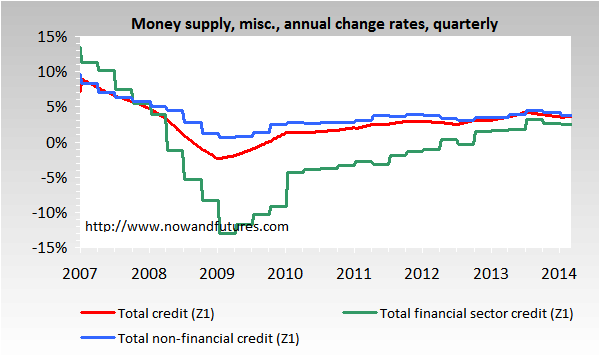
      Lastly and from a total credit view, the actual drop in credit creation and usage is far and above #1 in the actual financial sector, as opposed to the non financial sectors like households. Financial sector credit has been consistently shrinking since all the way back to 2007, and is still shrinking on an annual change rate basis.

      In other words and in direct opposition to MSM and other noise about lending & households etc., it's not that banks aren't lending, it's that the financial sector is not borrowing.


      Last edited by bart; June 18, 2012, 09:18 AM.
      http://www.NowAndTheFuture.com

      Comment


      • Re: Eric Janszen on Hyperinflation vs. High Inflation

        Originally posted by EJ View Post
        Another member of our group asked precisely this question. Her answer was that "the situation is unfortunate," but what is the Fed supposed to do? Allow a deflation spiral to develop and preside over a second Great Depression?

        The Fed's original sin was allowing the credit bubble to develop in the first place.
        Yes, the Fed's "original sin" was allowing the credit bubble to develop. And the Fed was an active participant in the credit bubble during the Greenspan years (with the full support and continuous cheerleading of Easy Al's little toad, "Bubbles" Ben.)

        However... aren't we having a long, lingering depression anyway? And isn't the real pain only being delayed, not avoided?
        What a deflation spiral would do is punish the fraudulent bastards who most profited - they would have their holdings defaulted on and would have already lost their jobs - instead of the working stiffs and the elderly being slowly skinned alive by Bernanke's inflation.

        EJ I know you're in the "what will happen" business, not the "what should happen" business. But wouldn't a three or even five-year Depression be better than Economic Mononucleosis that drags on for ten to fifteen+ years while allowing the guiltiest of the guilty to abscond with their loot?

        Comment


        • Re: Eric Janszen on Hyperinflation vs. High Inflation

          Originally posted by Raz View Post
          Yes, the Fed's "original sin" was allowing the credit bubble to develop. And the Fed was an active participant in the credit bubble during the Greenspan years (with the full support and continuous cheerleading of Easy Al's little toad, "Bubbles" Ben.)

          However... aren't we having a long, lingering depression anyway? And isn't the real pain only being delayed, not avoided?
          What a deflation spiral would do is punish the fraudulent bastards who most profited - they would have their holdings defaulted on and would have already lost their jobs - instead of the working stiffs and the elderly being slowly skinned alive by Bernanke's inflation.

          EJ I know you're in the "what will happen" business, not the "what should happen" business. But wouldn't a three or even five-year Depression be better than Economic Mononucleosis that drags on for ten to fifteen+ years while allowing the guiltiest of the guilty to abscond with their loot?
          But those aren't the real world options. In the real world it goes like this:

          1. The Fed stops reflating and allows deflation to run its course
          2. Defaults spike, credit markets sieze up, thousands of perfectly viable businesses fail along with the unviable
          3. The output gap opens to 25% of GDP; unemployment reaches 30% and stays that way for more than three years
          5. A socialist administration is elected in year four that redistributes remaining wealth and raises taxes on the top income brackets to 90%

          Compared to that, the slow torture method doesn't look so bad.

          Comment


          • Re: Eric Janszen on Hyperinflation vs. High Inflation

            Originally posted by EJ View Post
            But those aren't the real world options. In the real world it goes like this:

            1. The Fed stops reflating and allows deflation to run its course
            2. Defaults spike, credit markets sieze up, thousands of perfectly viable businesses fail along with the unviable
            3. The output gap opens to 25% of GDP; unemployment reaches 30% and stays that way for more than three years
            5. A socialist administration is elected in year four that redistributes remaining wealth and raises taxes on the top income brackets to 90%

            Compared to that, the slow torture method doesn't look so bad.
            Not disagreeing with you but I think #5 happens either way. I used to think a right wing hardliner was a possible option as well, but now I think that comes much farther down the road, after #5 have had their turn to fail. I fully expect the far ends of the political spectrum to be the norm for a long time. Romney will be our last "moderate" President for a good while.

            Comment


            • Re: Eric Janszen on Hyperinflation vs. High Inflation

              Originally posted by flintlock View Post
              Not disagreeing with you but I think #5 happens either way. I used to think a right wing hardliner was a possible option as well, but now I think that comes much farther down the road, after #5 have had their turn to fail. I fully expect the far ends of the political spectrum to be the norm for a long time. Romney will be our last "moderate" President for a good while.
              I have more hope.
              Things change, including attitudes. There's a good chance that the people in their 20's today will drop all the ideological posturing and become cooperative and practical, and they could well drag many of us old combative baby boomers along with them.

              Comment


              • Re: Eric Janszen on Hyperinflation vs. High Inflation

                Originally posted by thriftyandboringinohio View Post
                I have more hope.
                Things change, including attitudes. There's a good chance that the people in their 20's today will drop all the ideological posturing and become cooperative and practical, and they could well drag many of us old combative baby boomers along with them.
                I dunno, have you ever tried to drag a combative old baby boomer anywhere? They get very upset. ;)

                But more seriously, the demographic bulge is part of the problem. Even if younger people do have better ideas, they don't really have the demographics to realize them. That opportunity for better or worse went to the boomers, with the results that you see around you.

                Comment


                • Re: Eric Janszen on Hyperinflation vs. High Inflation

                  Originally posted by astonas View Post
                  I dunno, have you ever tried to drag a combative old baby boomer anywhere? They get very upset. ;)

                  But more seriously, the demographic bulge is part of the problem. Even if younger people do have better ideas, they don't really have the demographics to realize them. That opportunity for better or worse went to the boomers, with the results that you see around you.
                  Perhaps, but the boomers seem to split pretty evenly down party lines, allowing the millennial echo-boomers a chance to throw the results.

                  And I DO get very upset when people try to drag me anywhere!

                  Comment


                  • Re: Eric Janszen on Hyperinflation vs. High Inflation

                    Originally posted by thriftyandboringinohio View Post
                    Perhaps, but the boomers seem to split pretty evenly down party lines, allowing the millennial echo-boomers a chance to throw the results.
                    True, but if things could be solved merely by allowing one side or the other to win, then it wouldn't be such a sticky problem. The issue is that presently neither side really offers an acceptable outcome, as each represents only an extreme. I suspect we've chased this one full circle now, and come back to flintlock's point:

                    Being a spoiler to favor of the lesser of two evils isn't the same as having one's ideas heard. If the echo-boomers are going to change that, it'll have to be by getting elected themselves, not just by voting. And that's going to take a few more election cycles, since there is little sign that the older generation is eager to retire, at least when it comes to the political scene.

                    For most voters, they'd have to be really upset to vote for the 20-year-old when they've got someone with similar positions but a longer resume, and more connections, who also wants the job.

                    I think flintlock is right here. This one may take a while.

                    Comment


                    • Re: Eric Janszen on Hyperinflation vs. High Inflation

                      Originally posted by thriftyandboringinohio View Post
                      I have more hope.
                      Things change, including attitudes. There's a good chance that the people in their 20's today will drop all the ideological posturing and become cooperative and practical, and they could well drag many of us old combative baby boomers along with them.

                      likely we wont have much choice in that, as we'll be depending upon them (necessarily and hopefully) to break the logjam and push us to the next 'quantum leap' (like the railroads, interstate highway system, jet travel and the wild wild web did after them)

                      methinks it all comes down to a breakthru in energy policy - meaning: aside from the .mil complex and the social/welfare complex - what has the bigger drain on the treasury/wealth of The US?

                      nears i can tell, its the primary drain, since it has cost us over 7 TRILLION in the past 30years.

                      and until we dump the insanity that passes for 'energy policy'
                      with OPEC as its master and the results being the ultimate 'inside job', with the Dept of Energy being the other head of the hydrocarbon monster - we will continue to flush any 'hope for change' right down the toilet.

                      the primary impediment at the moment, IMHO, is the near hysterical and absolutely irrational fear of the BEST IMMEDIATE SOLUTION - that we not only own all the technology outright to develop, but own the lions share of the raw material to fuel it.

                      so if people like krugman - somehow - might happen to be correct, that PILING ON MORE DEBT is the answer to BEING CRUSHED BY DEBT ??? (and the definition of insanity is? ) - then i say we need a JFK-inspired, Moonshot-Mission-Critical, all-out competition - by the private sector - to design/build the next gen nuke energy plant - then borrowing/printing - or better yet: selling off useless military bases/infrastructure to free up funds to get it going - IMMEDIATELY would make the most sense - and why do i refer to 'useless' .mil infrastructure?

                      because its simple: we likely wont ever fight another land/sea war like ww2 again, if for no other reason than we no longer have the collective/social will/stomach to do what it takes to WIN such a war - fat chance in hell, IMO - and this has just been proven beyond any shadow of doubt over the past dozen years - how in hell COULD we ever win such or any real war again for that matter? - not when the lilliputians have so tied down the pentagon they now need to bow to political-correct dogma and not offend anybody, not cause any 'collateral damage', not kill any 'innocents', and be expected to mop things up in such a short time as to not even need to account for it in the budget? (vs all-out war as in the old days, you know - when bombing the enemy into submission accomplished the job in as short a time possible, ww2 took what, all of 4years?) - i mean its almost hilarious to think what the outcome of ww2 would've been under the same 'rules of engagement' (sprechen sie deutsch? or have a nice day &BTW, Nihongo de nan to iimasu ka ?)

                      instead, with the present policies, methinks it only a matter of time before we'll be asking:
                      Hal beemkani mosa’adatuk?

                      we need the younger generation to be educated more by mech/electrical/chemical engineers and physicists than social and political 'scientists' so they can get past the prev 30years of PC anti-everything-sides-solar luddite-brigade (of crony capitalists) that has so thoroughly screwed things up (and hey! i'm a solar/alt energy kinda guy, REALLY!) that we are now blowing trillions in borrowed money to turn whats left of our RAPIDLY DWINDLING TOPSOIL into corn ethanol that causes our cars the GET LESS MPG - dumping yet more trillions of dollars in borrowed money to fight wars WE WILL **NEVER** 'win' in the mideast??? - while encouraging /forcing the most spoiled rotten generation in history (boomer offspring) to go yet trillions more into debt to get degrees in 'gender and ethnic studies' (or law degrees...)

                      and for what?

                      because some are afraid of 'radiation' ?

                      but think not for one second about climbing into their cars, accelarating to 60mph and launching themselves headlong onto a 2 lane road, barely inches from oncoming vehicles - and somehow think because they have fastened their seatbelts they are somehow 'safe' ?
                      (never mind climbing into an aluminum tube, hurtling thru space at 5-600mph that navigates thru and drops down to land at 150mph, thru/around several hundred others, all at the same time - AFTER - being groped and IRRADIATED by the TSA?

                      i dunno.... but somewhere/how theres gotta be some rational debate on the absolute failure of the dept of energy over the past 30+ years and how the corruption of the political class is dooming the rest of us - meanwhile the banskters getting paid billions to loot/bankrupt the economy goes ignored by dept of justice, who focuses on 'insider trading' by wall st - and then allows it to continue in congress ????

                      but - what do i know, i'm just a J6P workin stiff...

                      Comment


                      • Re: Eric Janszen on Hyperinflation vs. High Inflation

                        Originally posted by astonas View Post
                        ..... And that's going to take a few more election cycles, since there is little sign that the older generation is eager to retire, at least when it comes to the political scene.

                        For most voters, they'd have to be really upset to vote for the 20-year-old when they've got someone with similar positions but a longer resume, and more connections, who also wants the job.

                        I think flintlock is right here.
                        This one may take a while.
                        why we need TERM LIMITS
                        even the private sector/fortune1000 has to contend with them - even ole warren buffet himself isnt planning on croaking in HIS exec suite

                        SO WHY SHOULDNT THE POLITICAL CLASS?

                        Comment


                        • Re: Eric Janszen on Hyperinflation vs. High Inflation

                          One other question.

                          for members out there praying for giant debt deflation, I have responded, that they better be careful what they ask for because they just might get it.
                          In this monetary system my money is someone else's debt, correct? When I look at my money market fund it is not full of money but short term debt instruments.
                          My bank is full of loans, public pension systems which I implicitly back with my tax dollars are chock full of debt instruments. And I assume that even my green backs
                          would suffer (because of currency confidence/inflation) if the treasury/fed complex became shaky.

                          A massive write off of debt is going to hurt us. There will be no winners. I do support a resolution trust type arrangement that would provide an orderly restructuring of debt. A punishing market panic debt default would not be pretty.

                          Comment


                          • New question for "JK and the Choir"...

                            Ok, to JK and the "Choir" who prefer written over audio/video: Please indicate which of the following statements most closely reflects your views:

                            A) Podcast transcripts are great! They allow me to process the material in writing, the way I prefer, and I appreciate the chance to participate in "listening" to an interview I would not have enjoyed in pure audio.
                            B) Podcast transcripts are a futile effort to turn an ill-conceived interaction format into something useful. I prefer thoughtful ARTICLES that were WRITTEN carefully by people who had A POINT TO MAKE, and don't care to spend my time reading transcripts of audio interviews unless there's just no other way to get the perspective of an interesting person.

                            I'm just trying to figure out whether "adding transcripts for all interviews" would appeal to this audience, or if the very premise of an audio podcast is so far at odds with your desires that it's not worth trying. Candid feedback welcome.

                            Thanks,
                            xPat

                            Comment


                            • Re: New question for "JK and the Choir"...

                              Originally posted by xPat View Post
                              Ok, to JK and the "Choir" who prefer written over audio/video: Please indicate which of the following statements most closely reflects your views:

                              A) Podcast transcripts are great! They allow me to process the material in writing, the way I prefer, and I appreciate the chance to participate in "listening" to an interview I would not have enjoyed in pure audio.
                              B) Podcast transcripts are a futile effort to turn an ill-conceived interaction format into something useful. I prefer thoughtful ARTICLES that were WRITTEN carefully by people who had A POINT TO MAKE, and don't care to spend my time reading transcripts of audio interviews unless there's just no other way to get the perspective of an interesting person.

                              I'm just trying to figure out whether "adding transcripts for all interviews" would appeal to this audience, or if the very premise of an audio podcast is so far at odds with your desires that it's not worth trying. Candid feedback welcome.

                              Thanks,
                              xPat

                              I prefer the articles, but transcripts are fine. I can still skim quickly to see what, if anything, I want to concentrate on. Thanks for all you are doing.

                              Comment


                              • Re: New question for "JK and the Choir"...

                                Originally posted by jiimbergin View Post
                                I prefer the articles, but transcripts are fine. I can still skim quickly to see what, if anything, I want to concentrate on.
                                For me, it really depends on what I am reading for, which depends in turn on who is being interviewed. In general I side with jimbergen. Articles preferred, but transcripts fine too.

                                However, there are also occasions where the candid phrasing of an individual adds real value. People say things off-the-cuff that may reveal something deeper than they would admit to if they had time to think it over, in much the same way that the question-and-answer session of a press conference can be more revealing than the scripted part. In general, the phrasing here is more likely to be related to how they arrived at a conclusion, rather than what they later considered to be the best way to present that conclusion. The skilled interviewer adds very real value by knowing how to draw these out of a person, past their normal level of guard. And some interviewers are just plain brilliant at this part, and worth following. For these, the article format would lose an incredible depth of information. For less brilliant interviewers, not so much.

                                So when I'm trying to get inside the interviewee's head, anticipate their next move, or really get a handle on the factors that influence their decisions, I'll prefer the interview format, taken verbatim. If it's a person who's really influential, and hard to access (if you score an interview with a voting member of a major policy body, for example) I'll generally take the time to listen (preferably while looking at a transcript). But when I'm just trying to understand the point that is being made, I'll prefer the article. As in everything else, preferred form follows desired function.

                                Generally, but not always, it comes down to whether the person being interviewed is someone who is making policy decisions, or someone who is merely commenting on other people's decisions. I'm sure you can now see why the TV interview with a pundit has so little value in my book. Along with the point, you get a flood of irrelevant contextual information to distract you, information that would only be relevant if the pundit were independently influential.

                                How to handle an interview with EJ, however, is tricky. He fits both categories. He is making decisions about when to rebalance the iTulip portfolio (and I want to know everything I can about the factors he considers in his decision-making) even while he is in general providing commentary about the current situation. To someone who relies on his advice (or is considering doing so), I would present the transcript. To someone not similarly vested, perhaps an essay might be sufficient.

                                And regardless of the subject, if you sit down with what you've gotten from an interview, and there's nothing there that reveals any subtleties beyond the textual content (perhaps because the subject is politician enough to hide such things well) the best thing to do might be to make it more coherent by re-ordering it in an article anyway. There's nothing that says that the format you received the information in is the best one to present it in.

                                Is there a reason you want to go with a more unified approach, rather than mixing it up and just doing what you think is appropriate for a given piece? Are you looking to define your "thing," a constant format that you can easily brand, to make it easier to market the page? If not, it may be easier to maximize your communicative throughput by mixing it up a bit. If marketing is a major factor, however, you may be stuck choosing the format that best suits the bulk of your work. Columnists are often stuck writing columns, even when they get occasional information that would best be presented in interview format.

                                Originally posted by jiimbergin View Post
                                Thanks for all you are doing.
                                +1 I'll second that!

                                Also, thank you for asking these questions. I can't say how often I've been in a position where I had to consume news or commentary inefficiently, while fully aware that the presentation format was poorly matched to the material, just so I could extract some small tidbit I wanted to learn. The fact that someone is actually thinking these things through as they get going is very refreshing. Many, sadly, do not seem to even consider the subject. It is evidence of a desire to be professional in your work, and that already sets you apart from the herd.

                                After all, one of the many reasons I read the 'Tulip is that EJ does a pretty good job at matching his presentation to both the information, and the audience.

                                Comment

                                Working...
                                X