Announcement

Collapse
No announcement yet.

If you wondered why laptops and TV you buy today can breakdown in days or weeks even when brand new.

Collapse
X
 
  • Filter
  • Time
  • Show
Clear All
new posts

  • #16
    Re: If you wondered why laptops and TV you buy today can breakdown in days or weeks even when brand new.

    Originally posted by renewable
    That the Japanese didn't quite catch up with the west (fractionally in a few areas) does not preclude a vastly larger command economy from doing so. Japan has less than half of the US' population. China has nearly 5 times the US' population - potentially a fearsome network effect.

    Remember the walkman? I'd argue that the very hierarchical Japanese should be culturally much less innovative than competitive Chinese or Americans, yet they came extremely close.
    I agree that a vastly larger (in population) command economy might be able to, but I'd say that there is very little historical evidence supporting this possibility. It is also interesting that you posit a command economy as a factor, thereby presumably removing the possibility that India could become a center of innovation despite its size and economic/population growth rate.

    As for competition driving innovation, how then would you describe Germans? Germany has a similar level of wealth, has a similarly (if less so) consensus driven culture, and is a similar size (1/3 smaller).

    Originally posted by Techdread
    Are you sure about that, Sharp make very good Android phones.
    I'm sure Sharp phones are nice, but then again Sharp in Japan is very different than Sharp outside Japan.

    http://www.gartner.com/it/page.jsp?id=1764714

    Table 1
    Worldwide Mobile Device Sales to End Users by Vendor in 2Q11 (Thousands of Units)
    Vendor
    2Q11
    Units
    2Q11 Market Share (%)
    2Q10
    Units
    2Q10 Market Share (%)
    Nokia
    97,869.3
    22.8
    111,473.7
    30.3
    Samsung
    69,827.6
    16.3
    65,328.2
    17.8
    LG
    24,420.8
    5.7
    29,366.7
    8.0
    Apple
    19,628.8
    4.6
    8,743.0
    2.4
    ZTE
    13,070.2
    3.0
    6,730.6
    1.8
    Research In Motion
    12,652.3
    3.0
    11,628.8
    3.2
    HTC
    11,016.1
    2.6
    5,908.8
    1.6
    Motorola
    10,221.4
    2.4
    9,109.4
    2.5
    Huawei Device
    9,026.1
    2.1
    5,276.4
    1.4
    Sony Ericsson
    7,266.5
    1.7
    11,008.5
    3.0
    Others
    153,662.1
    35.8
    103,412.6
    28.1
    Total
    428,661.2
    100.0
    367,986.7
    100.0
    Source: Gartner (August 2011)
    Of the names on the list, only Sony Ericsson is even remotely Japanese - though in reality it was Ericsson who bought Sony's mobile phone division.

    Sharp's worldwide market share? maybe 1% - the vast majority of which is in Japan.

    I've worked directly with most of the Japanese handset makers; their problem is that they each created very efficient custom platforms - these allowed extremely rapid turnaround times for new products (6 months) but in turn prevented easy adoption of outside technology.

    Originally posted by Techdread
    Japan is also world leader's in Robotics.
    I guess it depends on what you term Robotics. Automotive? certainly. Horribly expensive humanoform robots? absolutely.

    The problem is that the entire robotics industry revenue was $3.3 billion in 2008 according to its own statistics:

    http://www.everything-robotic.com/20...-robotics.html
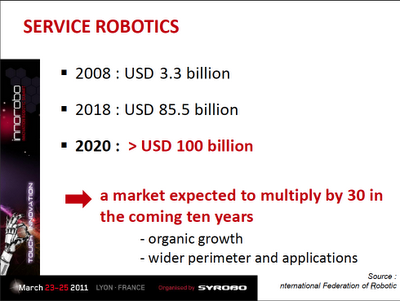
    I wonder how much of this is defense and Roombas.

    Either way, these projections seem very optimistic.

    Are we at the $8.5 billion revenue run rate for the industry given we're 3 years into a 10 year forecast of 25,900% growth?
    Last edited by c1ue; November 15, 2011, 09:29 AM.

    Comment


    • #17
      Re: If you wondered why laptops and TV you buy today can breakdown in days or weeks even when brand new.

      Originally posted by c1ue View Post
      I agree that a vastly larger (in population) command economy might be able to, but I'd say that there is very little historical evidence supporting this possibility. It is also interesting that you posit a command economy as a factor, thereby presumably removing the possibility that India could become a center of innovation despite its size and economic/population growth rate.
      Not really. I am highlighting that a command economy can theoretically overcome internal barriers to innovation relatively easily. India does indeed have the demographic advantage, and the English speaking advantage. They seem to be just as big a threat to the US empire as China does, but perhaps in the slightly longer term. I don't know how innovative India is compared to other countries.

      Originally posted by c1ue View Post
      As for competition driving innovation, how then would you describe Germans? Germany has a similar level of wealth, has a similarly (if less so) consensus driven culture, and is a similar size (1/3 smaller).
      Germany is culturally very different to Japan. It's nowhere near as hierarchical - much of German industry is driven by SMEs rather than rigid monoliths. Their industrial progress does have two main similarities to Japan's; it is based on quality, and on hard work.

      Who is to say that China's recent rapid growth is not based on the transformation in China that has already happened - the transition to capitalism that rewards individual hard work - and that this economic progress will continue by making the relatively small step to a fully innovative economy. Teamed with Kaizen and what will probably be the biggest networked group of people in history (the future Chinese language internet that companies such as Google are shut out of) would result in a formidable competitor. The US' best hope of staying ahead must be political upheaval in China, not that they are somehow culturally less capable of innovating.

      India and China haven't been very good at innovating so far because they have been dirt poor, the west has grabbed all the resources, and they have been more concerned about where the next meal is coming from.

      Britain, probably the most innovative nation in history, the empire where the sun never set, used to believe that other nations wouldn't be able to surpass them.

      Comment


      • #18
        Re: If you wondered why laptops and TV you buy today can breakdown in days or weeks even when brand new.

        Originally posted by renewable
        Germany is culturally very different to Japan. It's nowhere near as hierarchical - much of German industry is driven by SMEs rather than rigid monoliths. Their industrial progress does have two main similarities to Japan's; it is based on quality, and on hard work.
        You have in interesting understanding, one which is dramatically different than what I have. From my own experience in the semiconductor industry, there are no differences in terms of hierarchy or innovation between Siemens, Bosch, Matsushita, Fujitsu, or Toshiba. There are outward differences; Germans work really hard during work times but then they stop work on the dot, while Japanese still largely have the view that you keep working until your manager leaves - even if the work actually performed isn't peak.

        Originally posted by renewable
        Who is to say that China's recent rapid growth is not based on the transformation in China that has already happened - the transition to capitalism that rewards individual hard work - and that this economic progress will continue by making the relatively small step to a fully innovative economy. Teamed with Kaizen and what will probably be the biggest networked group of people in history (the future Chinese language internet that companies such as Google are shut out of) would result in a formidable competitor. The US' best hope of staying ahead must be political upheaval in China, not that they are somehow culturally less capable of innovating.
        I'd say that so long as the Great FireWall of China exists, the number of web pages will increase but the diversity will not increase nearly as much.

        In some respects you have the same issue with the overall culture: the US is a melting pot of everyone from everywhere, with all kinds of views, all jammed together. China in contrast is an exceedingly homogeneous population; can you achieve innovation when everyone is a rebel like all their friends?

        China and most of Asia also take many of their cultural and economic development cues from Japan.

        But time will tell.

        Comment


        • #19
          Re: If you wondered why laptops and TV you buy today can breakdown in days or weeks even when brand new.

          Originally posted by renewable View Post
          The US' best hope of staying ahead must be political upheaval in China, not that they are somehow culturally less capable of innovating.
          There won't be a political upheaval in China that can overthrow the communist party, it will never happen. It didn't happen in Tibet, it didn't happen in Xinjiang.

          But while Chinese soldiers can deal with local unarmed insurgency and unrest, fighting a foreign adversary is a different matter. Chinese generally dislike war and are not good soldiers. I would expect it to be worst today given the one child policy. If there were war, they will need to enforce a draft because certainly no one will volunteer.

          There are many cases in history when an economically prosperous China is brought down by a relatively smaller and poorer armed adversary. The Manchurians were able to conquer China despite only having a relatively backward army of 200,000 versus the Ming dynasty 2 million soldiers armed with the best cannons of the time.

          Should China decide to go on the path of aggression with respect to the Spratly and Taiwan, that will be their downfall.
          Last edited by touchring; November 15, 2011, 10:49 AM.

          Comment


          • #20
            Re: If you wondered why laptops and TV you buy today can breakdown in days or weeks even when brand new.

            Originally posted by c1ue View Post
            You have in interesting understanding, one which is dramatically different than what I have. From my own experience in the semiconductor industry, there are no differences in terms of hierarchy or innovation between Siemens, Bosch, Matsushita, Fujitsu, or Toshiba. There are outward differences; Germans work really hard during work times but then they stop work on the dot, while Japanese still largely have the view that you keep working until your manager leaves - even if the work actually performed isn't peak.
            I have only worked in German SMEs, and that was a long time ago. Perhaps that colours my perception.

            Originally posted by c1ue View Post
            I'd say that so long as the Great FireWall of China exists, the number of web pages will increase but the diversity will not increase nearly as much.

            In some respects you have the same issue with the overall culture: the US is a melting pot of everyone from everywhere, with all kinds of views, all jammed together. China in contrast is an exceedingly homogeneous population; can you achieve innovation when everyone is a rebel like all their friends?

            China and most of Asia also take many of their cultural and economic development cues from Japan.

            But time will tell.
            There are different models of innovation. Britain - as I said probably the most innovative nation in history - was homogeneous. The US melting pot, combined a with a much greater number of people beat the UK. Little Japan with their Kaizen got very close to the US. Germany, with their own model and much smaller population are pretty much on a par (Germany also soundly beats the US per capita economically - they are holding up the whole of Europe, even after integrating East Germany!).

            I don't think that you can look at the model of the current leader, then say that others cannot compete because of theoretical difficulties in adopting the same model. If the leader is beaten, it will probably be with a different model again.

            Comment


            • #21
              Re: If you wondered why laptops and TV you buy today can breakdown in days or weeks even when brand new.

              Originally posted by c1ue View Post
              http://www.gartner.com/it/page.jsp?id=1764714

              Of the names on the list, only Sony Ericsson is even remotely Japanese - though in reality it was Ericsson who bought Sony's mobile phone division.

              Sharp's worldwide market share? maybe 1% - the vast majority of which is in Japan.
              In your list, there are 3 Chinese companies - much more than from any other country. They're not there yet on market share, though...

              Comment


              • #22
                Re: If you wondered why laptops and TV you buy today can breakdown in days or weeks even when brand new.

                Originally posted by c1ue View Post
                I'm sure Sharp phones are nice, but then again Sharp in Japan is very different than Sharp outside Japan.

                http://www.gartner.com/it/page.jsp?id=1764714
                Yes I wish Sharp would market their phones outside Japan.

                That survey you quote is lumping Smartphones with dumb phones,


                Originally posted by c1ue View Post
                Of the names on the list, only Sony Ericsson is even remotely Japanese - though in reality it was Ericsson who bought Sony's mobile phone division.
                Sony are now taking full control of that joint venture, I have an Xperia Play a highly under rated phone.

                Originally posted by c1ue View Post
                Sharp's worldwide market share? maybe 1% - the vast majority of which is in Japan.
                More if you just looking at Smart phones.
                http://wirelesswatch.jp/2011/10/29/j...market-shares/

                And even so they have had Qhd screens, NFC, waterproofing, Dual camera's for 3D capture. Which is hardly Two generations behind, (Android is the world leading smartphone OS).

                http://www.engadget.com/2011/09/10/s...nife-comes-ou/

                Comment


                • #23
                  Re: If you wondered why laptops and TV you buy today can breakdown in days or weeks even when brand new.

                  Originally posted by TechDread
                  Yes I wish Sharp would market their phones outside Japan.

                  That survey you quote is lumping Smartphones with dumb phones,
                  The worldwide market for non-smart phones is 600 million 1 billion per year - and is not expected to decrease due to 1st/2nd world decreases being offset by new 3rd world customers.

                  Smart phones are expected to be where nearly all overall growth will be in the next decade, true.

                  Nonetheless you're going to have to do a lot better to say that any Japanese makers are serious players in the Smartphone market. Apple for one is digging deep into the Japanese market.

                  Originally posted by Techdread
                  Sony are now taking full control of that joint venture, I have an Xperia Play a highly under rated phone.
                  I'd say that Sony buying out Ericsson's half in their joint venture is hardly a sign of outstanding success, though of course that may change.

                  Originally posted by TechDread
                  More if you just looking at Smart phones.
                  http://wirelesswatch.jp/2011/10/29/j...market-shares/
                  The report speaks only to Japan market share; Sharp is supposed to have shipped a bit over 2 million smart phones in one half (2 quarters).

                  To put this in perspective, worldwide smart phone sales in Q3 2011 were 115 million units: http://gigaom.com/2011/11/15/android...rtphone-sales/

                  Seems like the 1% share is at least reasonably accurate.

                  Originally posted by TechDread
                  And even so they have had Qhd screens, NFC, waterproofing, Dual camera's for 3D capture. Which is hardly Two generations behind, (Android is the world leading smartphone OS).

                  http://www.engadget.com/2011/09/10/s...nife-comes-ou/
                  With Android, much of the custom flow issues are removed. The consequences aren't all positive, however.

                  Differentiation is more difficult to achieve when every single new smartphone has all the same features.

                  And again, it isn't that Japan cannot become a player in the mobile phone market.

                  It is that they aren't.
                  Last edited by c1ue; November 15, 2011, 03:04 PM. Reason: Edit number data

                  Comment


                  • #24
                    Re: If you wondered why laptops and TV you buy today can breakdown in days or weeks even when brand new.

                    Originally posted by touchring View Post
                    China doesn't have to leapfrog the West in IP. Just look at how 20 million Chinese control the economies of 500 million people in South East Asia. Capitalism is about controlling resources and people. Let others do the innovation and hard work.
                    Huh. That sounds more like a definition of socialism than capitalism.

                    Comment


                    • #25
                      Re: If you wondered why laptops and TV you buy today can breakdown in days or weeks even when brand new.

                      Originally posted by Mn_Mark View Post
                      Huh. That sounds more like a definition of socialism than capitalism.
                      No, it's capitalism all right. Crony capitalism.

                      Comment

                      Working...
                      X