
DeGraw updates OWS . . . .
-
Re: Occupy Movement: First Fruit - Paradigm Shift
If something is different, you first have to demonstrate difference.Originally posted by reggie
Pharisees+moneylending = corrupted religion
Government+campaign donations/revolving door = corrupted government
Just because the term du jour involves OODA or whatever, doesn't mean that what is occurring is necessarily new.Leave a comment:
-
Re: Occupy Movement: First Fruit - Paradigm Shift
How can you even make such an argument when you don't even know what the current techniques are, let alone understand them when I try to introduce the concepts. Hence, how can you even be the judge of what's "credible" or not? Further, the techniques in play now do not remotely resemble anything this world has seen before, at least not produced by man. Finally, if I were take your view, that the techniques are no different, then why discuss technique at all?Originally posted by c1ue View PostLeave a comment:
-
Re: Occupy Movement: First Fruit - Paradigm Shift
Hey DS,
Missed this first time around... wonder how one should interpret the real meaning of "more replies below current depth" eh? Actually I think that's just become one of my favourite pregnant phrases... So many possible interpretations. Could be "my" (oddlots) current depth, the forum's, the administrator's. Sort of disappointed that hadn't occurred to me sooner.
I read the above and your "Inventing the Enemy" piece. It's helpful to have the on-again off-again collusion between imperial powers and Islamists laid out and much of it is news to me. But where you see some kind of ideological whole all I see is non-ideological, improvisational mess with the only common thread being an - often barely achieved - desire to control: my enemy's enemy is my friend... until he's not. As an example, it's not surprising to me that the British supported the Muslim Brotherhood in it's early days. Divide and rule. But that doesn't in itself make them any more or less "authentic" a voice ~ 60 years hence (a period where the same group has been repressed by, some would say, a Western client-state such as Egypt post-Nasser.)
I just don't see justification for a statement like this:
This just strikes me as extremely over-determined. You seem to start from the premise that there are in existence "democratic movements" in the ME or Egypt, as an example, whose failure can only be explained by some "exogenous shock," that their victory has somehow been stolen, in some sense. If you further tar religious movements with the reactionary label and then give the purported "democratic movements" the heroic quest of challenging "Western domination" then you've pretty much sewn the whole thing up.The MB continues to be an important means for the U.S. and UK to attempt to control Muslims and deflect them away from democratic movements that would truly challenge Western domination into reactionary religious movements.
How do you know it's true? Or false?
This sounds sinister but could be interpreted any number of ways, with the most obvious being: the Muslim Brotherhood, being the likely victor by a wide margin in the elections, now has to somehow figure out how to deliver on its mandate while keeping the vast subsidies from the the Egyptian state is dependant on flowing. That seems less like a US operative visiting his mole and more like a new Roman governor being sent to remind an unruly protectorate who's in charge. Or perhaps it's the moment where the MB has to transform itself from the eternal opposition into a political actor, with all the soul-sapping consequences that this requires, not the least of which being their dependance on US support.As was widely reported, Sen. John Kerry, heard of the Senate Foreign relations Committee, met with representatives of the MB on 12/10/11. According to Haaretz (4.06.09), President Obama met privately with members of the Muslim Brotherhood in the U.S. earlier in 2009--that is, long before the Arab Spring.
What is political Islam? I can see that it is something that your argument requires, but beyond that I'm stumped. Is it Sunni or Shiite? Can it be both at the same time? How can the US coherently support a Sunni uprising - broadly speking - in Syria while ignoring a Shiite uprising - again, broadly speaking - in Bahrain while working "hand and glove" with "political Islam," a term that apparently overarches both.None of this should come as a surprise. The U.S. has been working hand in glove with political Islam for more than half a century, ever since the U.S. embraced the extreme conservative Salafist rulers of Saudi Arabia.
Or is it simply whatever movement or uprising that serves to destabilise a given regime viewed as hostile to US interests at a given moment. Honestly this seems a far more robust, less demanding theory, no? And makes the "blowback" a lot less hard to explain.Leave a comment:
-
Re: Occupy Movement: First Fruit - Paradigm Shift
Well, Don, being a militant of social causes has to have some upside; doesn´t it?Leave a comment:
-
Re: Occupy Movement: First Fruit - Paradigm Shift
Your comments would be a lot more credible if the ongoing bankster takeover wasn't a situation literally millenia old.Originally posted by reggie
Whether it be Pharisees or the Vampire Squid, the techniques and results are identical.
Thus all your hue and cry over OODA seems completely pointless since the means, goals, and results have been unchanged.Leave a comment:
-
Re: Occupy Movement: First Fruit - Paradigm Shift
Nice find Don. Missed it.
This is exactly what is needed IMHO.Leave a comment:
-
Re: Occupy Movement: First Fruit - Paradigm Shift
What's so ironic about the arrogance and flippancy inherent in this trite post, is that the auother of the reference article does indeed recognize the shifting of social models, where societal changes occur more quickly due to the breakdowns in institutional structure and borders. This is, in fact, a recognition of the acceleration of societal OODA loops, where the public has less time to react due to accelerating swarms of information, propaganda, and attitudinal flows. This is not accidential, and is consistent with a system seeking a structure governed by power laws. Glad to see that at least "some" arerecognizing the major shifts and their potential impacts, albeit, they might not be aware of the long developing science behind them. Further, I'm pleased to see that not all uses these disucssions as an opportunity to "mock" them.Originally posted by c1ue View PostLeave a comment:
-
Re: Occupy Movement: First Fruit - Paradigm Shift
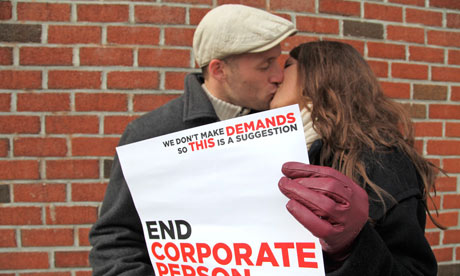
Tim and Lily, kissing and standing up against corporate personhood.
Lily & Tim
Tim: I quit my job in Connecticut to be at Occupy. The movement was a platform for people to innocently engage with one another. Everybody was friendly and like-minded and I wanted to make as many friends as possible. I wasn't looking to hook up with anyone.
Lily: Yet every single time I saw Tim before we actually got together, he had a gaggle of women around him! I wasn't down at Occupy to meet anyone either. I was preparing to return home to the UK. I was ready to leave New York. I heard that this thing was happening. I wasn't that compelled to go and check it out at first, but basically the first time I went to Zucotti Park I realised that that was something significant. I'd forgotten that I'd always been an activist. There'd been nothing to inspire that side of me.
Tim: We completely disagree on the first time we met. I remember it very vividly: we were right underneath the red structure in Zucotti Park. The second time we met we went out for Indian food with one other woman. Basically I was in trouble from then on …
Lily: Getting away from everyone was hard. We had to escape to Brooklyn. We met for breakfast really early the next day and ended up spending the entire day together. It was really nice.
Tim: Lily's just amazing. She just has this energy. We seemed to share so much and have some sort of a connection. It was the type of thing that was irresistible. Despite me saying "I don't want to get involved with anybody", I had no choice. It was as Wu Wei would have it: "Action without action".
Lily: I was attracted to Tim very quickly. He was different. I hate to stereotype, but most of the people I've met in New York – men and woman – really struggle to be comfortable with their feelings. They find it hard to love openly. They're very singular, exciting and doing awesome stuff, but when it comes to being OK with loving someone, that's a whole journey that apparently requires anti-depressants and therapy. Tim has absolutely no shame, no struggle with his feelings. They're just out there and it's amazing.
Ravi & Geoff
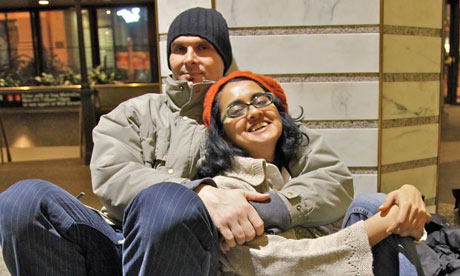
Ravi and Geoff, both 34. Photograph: Zina Saro-Wiwa
Ravi: I think the moment where we really connected is when Geoff said something completely outrageous in one of our large meetings. There was a very long discussion about race and he said something outrageous. Well, he doesn't think it was outrageous. But I thought, he seems confident and intelligent.
Geoff: I was simply making a counterintuitive argument, a reference to the demographics in various institutions. That's all I'll say!
Ravi: Then that Sunday I was stuck in the office working on something and he walked in. We ended up talking for three hours. And that's when all of this other really interesting stuff about race and culture came out. At that point I'd been at Occupy for over a month, and this was the first really serious political discussion I'd had.
Geoff: We got together sometime after Thanksgiving. The end of November. Is Ravi my usual type? Well I tend to try and stay away from hippies of all types! So yes.
Ravi: Is Geoff my type? Well I don't usually date men! But he's really smart, and that's very attractive, absolutely. So he's my type in that he's smart. I like people I can argue with.
Geoff: I rarely think about the future. The future usually counts for the next two days. You could put in 16-hour days seven days a week in this movement. Sincerely, I put in easily 100 hours a week on this movement, if not more. Ravi has a day job but she often comes down and visits on site and attends after-hours meetings. So when she's not doing her day job she has no personal life.
Ravi: You're my personal life, babe! The movement has changed me in other ways though. I'm busy, I actually have genuinely interesting, exciting, absorbing things to do all day. Also I'm not like "I'm bored I'm going to go out for a fancy meal". To be finally out of that, that's really a profound change.
Geoff: We as a group would like to see a change in society to things that are based less on your involvement in either earning money or spending money. The idea that you can be involved in organisations that do things constructively that don't involve payment or transactions, that's a big narrative for us.
Haywood & Christine

Haywood, 29, and Christine, 23, originally from Chapel Hill, North Carolina, at Zuccotti Park. Photograph: Zina Saro-Wiwa/The Guardian
Christine: We were together before Occupy but we had broken up last August so we weren't together when Occupy started. We had both worked on political campaigns, that's our background. But Hayward wasn't really sure what he was in it for anymore and he was deeply frustrated and depressed and that had a negative impact on our relationship. He knew he needed to move some place bigger with some more opportunities for his own well-being.
Haywood: I hitched a ride from North Carolina to Zucotti Park. I had mainly been involved in electoral politics and campaigns. But when Occupy Wall Street came up I knew I had to come here. This is what I should have been doing the whole time.
Christine: Although Hayward and I had split up we were still friends. So he went up there and was calling me and talking about it being wonderful and beautiful. I hadn't seen him so excited about anything political in years. I thought it was worth taking a look. I showed up and immediately I got sucked into it. I was working at the info table and then I was sleeping under the info table. Then I was getting arrested, and then I was living in New York.
Haywood: I remember watching her march up to Goldman Sachs arm-in-arm with 18 other people knowing that the cops were going to arrest them. It took coming up to Occupy and seeing each other passionate about something else to remember why we were so passionate about one another. But also, Jesus, she's beautiful. She's the most beautiful person I can think of.
Christine: Haywood was funny and smart and encouraged other people. Wherever he was needed, whether it was helping sanitation sweep or staying up from midnight to 6am on community watch, he stepped up and took a leadership role. I saw that and thought: "That's the sort of person I want to be with". I also feel like Occupy, as a result of all our meetings, has made me learn truly honest, open communication. I feel like I've become more patient and more open.
Haywood: I feel our relationship is entirely independent of Occupy. It's not a love that came out of it, it was a love that was made stronger because of it.
http://www.guardian.co.uk/world/2012...valentines-dayLeave a comment:
-
Re: Occupy Movement: First Fruit - Paradigm Shift
The value is in understanding that we're shifting into a world model based upon Complexity, where social swarms eminate out of nothingness and large events "emerge" from seemlessly minor system pertebations.Originally posted by oddlots View PostLeave a comment:
-
Re: Occupy Movement: First Fruit - Paradigm Shift
Sorry, didn't have time to fix formatting the other day. Post (link below) has now been appropriately formatted.Originally posted by c1ue View Post
http://www.itulip.com/forums/showthr...438#post221438Leave a comment:
-
Re: Occupy Movement: First Fruit - Paradigm Shift
Clearly paragraphs are unnecessary in understanding the OODA, or the New Order, or whatever is filling up several entire pages edge to edge.Originally posted by reggieLeave a comment:
-
Re: Occupy Movement: First Fruit - Paradigm Shift
Terrible as journalism and worse as philosophy.
I like difficult texts but there has to be a reward.
I really can't see anything here of value. Just as an example, I love how the whole (admittedly, originally false) modesty of Hegel's "Owl of Minerva" is invoked and then immediately forgotten as the author launches into a really pedestrian comparison of the "attributes" of various Occupy "phenomena."
Why do you think this is worth your time?
To put a finer point on it:
- I think there's enough cognitive dissonance in the world right now to keep philosophes gainfully employed for the next 50 years sorting out how it got this f'ed up. We live in a world where, under the watchful eye of an apparently single, vengeful God (read capitalism) "bankruptcy" can result in you getting a stimulous cheque from the government (US circa 2008), all your national assets sold off (Argentina circa 2002 (?)) and massive unemployment, a continuing career as a banker, despite having destroyed whole government's balance sheets almost singlehandedly, not to mention share-holder-value (hey, it's lonely at the top) etc., etc.
Reading pieces like the one above drive me to distraction. What a waste of effort.Last edited by oddlots; February 11, 2012, 02:40 AM.Leave a comment:
-
Re: Occupy Movement: First Fruit - Paradigm Shift
moving the thread in a slight different direction.....
Starting from Year Zero: Occupy Wall Street and the Transformations of the Socio-Political
http://www.unemployednegativity.com/...cupy-wall.html
Presented atOccupy Philosophy Conference
Michigan State University
To consider what Occupy Wall Street has to do with philosophy, to Occupy Philosophy, is already to depart from one of the longstanding dictums of the relationship between philosophy and political invents. I am thinking of Hegel, who as much as he argued that philosophy is its own time comprehended in thought, also famously argued that philosophy can only comprehend its own time retrospectively, can only paint grey on grey once the ink has dried. Occupy, or OWS to use a preferred moniker, preferred not because it ties the movement to the hashtag, making it one of the many instances of the supposed twitter revolutions, but because it abstracts the movement from a specific place making it a general political transformation and not a specific occupation, is very much an active movement. Any statement about it, about its ultimate meaning, possibility, or limitations, must confront the fact that it is still in the process of shaping and forming.
This difficulty, the difficulty of saying something about a movement in process, is complicated by at least three other factors. First, there is the complexity of the movement itself. The fact that there are one, two, many occupations means that any one of the occupations may have very different characteristics, characteristics determined by local histories and reactions. Occupy Oakland with its militant “general strike” against the ports, its refusal of police cooperation, and its occupation is very different from the Occupations elsewhere, such as Maine or Cleveland, that have actively courted support from the local police. Second, any description of what Occupy means must confront not only this geographical complexity, but the complexity of orientations and interpretations that defines and divides each occupation. The political goals of occupation are diverse, from a destruction of capitalism itself and the creation of a new political and economic order through the general assemblies and commons of the occupation to political and economic reforms brought about through a left counterweight to the “Tea Parties.” The tactics are no less diverse, from direct attempts at the communization of existing private property to organized exodus of money from large international banks to local banks and credit unions. This strategic and tactical diversity can be seen as a symptom of a certain void a lack of dominant intellectual and political voice or organization to address the fundamental issues at the heart of occupy. Every issue addressed by Occupy, from the most reformist, the dominance of lobbying and big money in politics, to the most radical, the dominance of capital itself over all elements of life, is outside of the range of the dominant parties, unions, and mainstream political organizations in the US. Of course this void can be space of possibility, a space that has been kept open by the sustained attempt on the part of the occupations to not be coopted by a party or organization. However, this void is also a gap between the critiques of capital that have at the very least persevered (if not flourished) in various sections of Anglo-American academia and anything like a movement or political party. Just as the dominant political parties were caught off guard by people suddenly wanting to discuss the very issues that the immense political spectacle is meant to conceal, academics and intellectuals have been caught off guard by the idea that someone outside of a lecture hall or hotel conference room might actually want to hear and discuss what they want to talk about. So is not only Occupy difficult to discuss because of its active transformations and contradictions, talking about it involves speaking to new audiences, creating new vocabularies and new modes of transmission.
The difficulties and contradictions could be enumerated ad nauseam, but it might be possible to work through them, rather than use them as an excuse or statement of (false) academic modesty. What I propose here is to work through some of the tensions and contradictions. To begin with, and at the most basic level, it might be worth starting with a few of the things that differentiates Occupy from a long history of protests against wars and other government acts, that have vanished from memory almost as soon as they begin. First, we have the location itself, the occupation of Wall Street rather than another march on Washington. This entails a shift of focus, and a shift of an awareness of the locus of power, from the Capitol to the symbolic center of capital. As much as the focus is on Wall Street, on the center of financial capital, many of the signs and slogans refer to the decision of Citizen’s United, to the idea of corporations as personhood, not to the economic power of corporations, power over work and consumption, but to the political power of corporations, the power that corporations wield in the writing of laws, policy, and the election of candidates. The very slogan, “We are the 99%” is situated in the space between economics and politics. Statistically it refers to the 99% of the population that controls a dwindling percentage of wealth in this country, in contrast to the immense wealth of the 1%. However, it gets much of its rhetorical force from its appeal to majority rule, to the populist idea of 99% of the population excluded from political power. Thus, despite the focus on Wall Street, on inequality and wealth, the focus of Occupy Wall Street is on the political effects of the economy, not the economy itself. Hence the often repeated slogan of getting the money out of Washington and the goal of destroying corporate personhood, all of which are about the idea of not so much changing the economy, of contesting capitalism, but limiting its influence on the political process.
Another way to sum up these aspects of Occupy Wall Street would be to say that they are gatherings of citizens rather than workers. Their goal has been to reclaim a public space, a public space that is increasingly disappearing, rather than to politicize the factories, workplaces, and offices. Following Étienne Balibar and Bernard Stiegler’s work on Gilbert Simondon, we can define a citizen as a particular kind of transindividual individuation, a particular formation of collectivity, a “we,” and individuality, an “I.” The citizen is a transindividual individuation in which the collective and the individual reinforce each other, in which every claim for rights, even the rights to be left alone, unaffected by others, is dependent upon its recognition by others. The citizen is neither exclusively collective nor individual, neither simply equal or free, but the intersection between equality and liberty, what Balibar calls “equaliberty.”[i] This transindividual relation is thus always in flux, not just between the individual and the collective, but between its role as constituted power, function as the basis for state authority, and its constituent, or insurrectionist dimension, claiming the right to contest power and legitimate new structures. In the case of Occupy, we see a claim for the citizen as not only an insurrection, as a right to revolt, but one that claims the will of the people as the source of authority, against representatives and the perversion of the political process by corporations and money, the citizen against Citizen’s United. This is what differentiates the Occupy Movement, even in its most populist dimensions, from the Tea Party; the latter fetishized a founding moment, a founding document, as the source of authority, a source that we could only be viewed as having fallen from, while the former claims the right to revolt, to invent new structures and new relations in the present. Moreover, the spaces that are occupied are what remains of public space, parks, town commons, etc., which initially had a political as well as a recreational function. The conflicts over these occupations, conflicts over the right to occupy, have pitted first amendment principles against a series of laws against public loitering, public sleeping, and public urination aimed at the homeless and guaranteeing “quality of life.” Thus in this sense to, in the control of space, they could be understood as claims by citizens against the reconstruction of urban space around a public that is only a docile consumer.
Focusing on the claims for citizenship, for the restoration of democracy, or even the invention of new forms of democracy, risk concealing the manner in which the economy, capitalism, figures in a more direct way in the politics of Occupy even if it does not take the recognizable form of past demands against capitalism, demands for increased wages and benefits, demands structured around the transindividual individuation of the worker. A quick purview of the “We are the 99%” tumblr site which emerged in the opening days of the Occupation, sees debt, housing debt, student debt, and the debt incurred through medical costs, appearing again and again as a central complaint. The centrality of debt begins to foreground a different relation between politics and money than the demand to simply remove the former from the influence of the latter. This is still not exploitation in its Marxist definition; the economic equation at the center of these protests is not framed between wages and profit, the exploitation that defines surplus value, but between wages and debt. This difference is immense, as students, unemployed individuals, and others burdened with massive debt calculate the gap that separates debt and earnings. These debts are not just quantitatively huge, qualitatively they are unpayable; houses are underwater, caught between a high mortgage and current devaluations, and students who took on massive debt to finance their education find that there are no jobs waiting for them when they graduate. Or, to quote, After the Fall, a document produced by the wage of Occupations in the University of California, “We work and we borrow in order to work and to borrow. And the jobs we work toward are the jobs we already have.”[ii] Or, to put it more succinctly, “No future.” Future is what debt, especially the debt of student loans, counts on, the promise of future earnings, and it is precisely this promise that appears radically foreclosed. The future appears to be sold off in advance.
Starting from debt, from the economics and politics of debt, offers another understanding of the intersection of politics and economics than the populist idea of democracy without capitalism, even if this idea is not articulated. In both case it is a matter of a fundamental blurring of the divides between economics and politics, private and public, but in the first case, that of the citizen against Citizen’s United, there is the idea of a possible reform, a restoration of politics without money, however flawed it may be. The focus on debt, however, changes the focus on both economics and politics. Economics is no longer restricted to the power of big business, of corporations, to lobby and influence politics, but is the exploitation of day-to-day life; in a similar fashion, politics is no longer democracy, either in its representative form, or in the invention of new direct forms, but is the control over life. As Gilles Deleuze states in his text on control, “A Man is no longer a man confined, but a man in debt.”[iii] Which is to say that debt, student debt, housing, and the debts of health care is as much about control over life as it is an extraction of wealth. As Maurizio Lazzarato argues, debt “functions equally as an apparatus of production and a way to govern individual and collective subjects.”[iv]
On the economic side, debt is situated in the transformations of neoliberalism. With respect to the debtor, debt was able to augment the declining real wages of the last forty years, making it possible for people to still make the same purchases and maintain the same status, and it provided access to things such as higher education, even as state expenditure to such services declined. With respect to the creditor, we have an increase of the power of money, and the possibility to extract money from activities that were once expenditures. Declining wages and declining state services not only tip the balance from expenses to profits, as labor becomes cheaper and payments to the state is reduced, but become themselves a source of wealth. We can already begin to see the “subjective” dimension of this accumulation by debt as well. First, at the most basic level debt, in the form of second mortgages and credit card debt, makes it possible for people whose wages are declining to see themselves as still able to purchase the same things, as middle class. Middle class being defined less on a particular economic status, let alone a relation to the means of production, but on the capacity to purchase certain goods, homes, cars, and higher education. In the US much of the legitimacy of the political and economic order rests on the ability of the majority to identify with this class.
The subjective dimension of debt is not limited to the way in which it extends class belonging, patching over a decline of wages. There is a dark side as well; debt infuses this belonging with insecurity, and isolation. There is a qualitative difference in going to college because it has been made affordable by public funding and financing an education through loans. The first is won and maintained collectively as a social good, the second is not only maintained individually, but individuates, subjecting people to their debt. This individuation takes many levels, some of it takes place beyond one’s back, in the form of a credit score and the multiple ways one’s activity can be tracked online. In other ways it is directly manifest in actions and relations. This can be seen in student loan debt. As students take on more and more loans to fund their education, their education changes form. Anyone who teaches at a University is perhaps aware of the chilling effect that student debt has an intellectual inquiry and education. Students do not ask themselves the questions: what interests me? And what discipline or field do I show talent for? But ask instead: what will get me a job? What will the market demand? Debt is the future acting on the present. The idea of future debt, of the cost of student loans, acts on the present, determining choices and limiting possibilities. Debt is mode of governmentality, a way to restrict and curtail actions; a mode that is all the more effective in being internalized.
Student debt can be understood as a transformation of the educational experience and the university, one that uses the power of the state, taxation and the allocation of funds, to restructure the university from below.[v] Indebted students, students desperately seeking wages adequate to their debt, are less likely to demand courses and programs engaging in critical thinking, let alone engage in the political activism that made the “student” a political transindividual individuation, defined by its liminal position between home and work. Debt produces students who are desperately try to match their actions to the mercurial job market, rather than rethink society and their place within it. The politics of debt are produced from above, but the effects are felt from below in the daily actions of not only students, who ask only “how can this course get me a job,” but also an increasingly precarious adjunct teaching faculty forced to tailor their teaching to whatever can get them work.
In an early text by Marx this internalization of credit is described as transformation of morality and human relationships. With debt, everything that was outside of the monetary relation, particular skills, talents, desires, and aptitudes, becomes part of it. As Marx writes,
Credit is the economic judgment on the morality of a man. In credit, the man himself, instead of metal or paper, has become the mediator of exchange, not however as a man, but as the mode of existence of capital and interest. The medium of exchange, therefore, has certainly returned out of its material form and been put back in man, but only because the man himself has been put outside himself and has himself assumed a material form. Within the credit relationship, it is not the case that money is transcended in man, but that man himself is turned into money, or money is incorporated in him. Human individuality, human morality itself, has become both an object of commerce and the material in which money exists. Instead of money, or paper, it is my own personal existence, my flesh and blood, my social virtue and importance, which constitutes the material, corporeal form of the spirit of money. Credit no longer resolves the value of money into money but into human flesh and the human heart. Such is the extent to which all progress and all inconsistencies within a false system are extreme retrogression and the extreme consequence of vileness.
As Lazzarto argues, the entire economy of debt is implicated within a work on the self, in which the individual is governed by the idea of maximizing value and managing risks in a series of choices that are not only radically individuated but moralized. Morality is not the subordination of economic concerns to moral criteria, to some concern with the individual person, but the reverse, the subordination of morality to the economy, the subsumption of morality to the economy. Trust, responsibility, and obligation become concepts of the moralization of the economy, the point where economic relations become moralized. Debt is a mutation of homo economicus: it is no longer, as Marx argued, the subject of “freedom, equality, and Bentham,” but the subject of obligation, inequality, and Becker.
The subject of debt is isolated, separated from others, who are no longer seen as part of a collective condition. With debt there is only one’s responsibility, one’s isolation, one’s fears up against an economic situation of abstract calculation. It is very difficult to say “we” debtors, in the way one could say “we” citizens or “we” workers. Part of debt passes beneath us, in the calculations, quantifications, and aggregations that make up our digital self, our virtual identity, and is this respect we cannot even say “I.” But even that part that individuates us, the part that we carry with us as a burden, does not allow for the creation of a “We.” This is because debt is seen less as a collective condition, as part of a new regime of accumulation and a new governmentality, than as an individual fate. Debt splinters into its myriad kinds, student debt, mortgage debt, and consumer debt, and the various individual relations to it, the choices made and risks taken. Viewed in this way debt, or financialization, is perhaps only an extreme point in the neo-liberal economy. Its general characteristics are, as we have seen, an extraction of wealth from relations outside of the worker-capital relationship, as not just production but reproduction become the basis for debt and wealth, and a production of subjectivity, that is oriented towards isolation, fragmentation, and inequality. In this manner debt is consistent with transformations of labor in the thirty years, which have lead to short term contracts, temp work, limited union membership and collective bargaining. It is also consistent with the rise of digital technologies that create new possibilities of individuation in consumer profiles, tailored advertisements, etc. all of which transform consumption and leisure into ways of capturing attention and generating profits.
If one looks beyond the focus on lobbyists, on the claims for citizenship, to the anxiety about debt and precarious labor, then it is possible to begin to understand a different relationship with the economy and politics. Yes, it is true, the various occupations are not organizing as workers, in terms of the identities, tactics, and spaces occupied and this has lead some to dismiss the occupations as simply populist movements with no real critique of capital. We should not rush to conclude that the lack of the worker as transindividual individuation to be a negative thing, there is, after all, a long tradition of writing in the Marxist tradition, which has argued against the ideal of critique capital from the perspective of workers. This tradition, beginning with Mario Tronti and the autonomist tradition and continuing through the idea communization, has stressed that the politics of such a critique can only be a politics of reform, a struggle for better wages and benefits. “To abolish capital is at the same time to negate oneself as a worker and not to self-organize as such: it’s a movement of the abolition of enterprises, of factories, of the product, of exchange (whatever its form).”[vi] From this perspective we should not spend too much time mourning the lack of the worker as an identity organizing Occupy Wall Street, or hold out hopes for unions to be revitalized. Such actions can only lead to reforms, to better wages and more work, and would return us to the division of worker and student, waged work and unpaid reproductive work. There is a positivity to this absence, a positivity that only takes an inchoate form in not just the politicization of debt, but also in the global nature of the protests, a positivity that recognizes the full spectrum of exploitation.
The question remains, however, as to how to articulate this nascent critique of capital that is framed in terms of debt and insecurity and how to organize this mass of debtors, unemployed, and precariously employed. Some writers, such as David Graeber, have turned to the long history of debt to see the current situation as yet another chapter in a long history of debt revolts. In this five thousand year history, the struggle over wages and exploitation, appears only as a brief chapter in a long durée of struggle of debtors against creditors. The present is the time of jubilees. Opposed to this return of the past there are those who argue that we find in the contemporary production process an entirely new subjectivity, a new conception of politics, a multitude or precariat. As work becomes increasingly oriented towards the reproduction of social relations, knowledge and affects, it also becomes increasingly vulnerable as the boundaries between waged and unwaged become even more permeable. The present is understood as either the reflection of the oldest inequalities, or to be made up of new exploitations. This same contradiction between the new and the old can be found at the level of liberation, at the level of the possibilities for organizing: some point to the resilience of the oldest tactics, direct democracy, direct action, and even espouse an ideal of locality as a goal, as the general assembly becomes the new democratic model; on the opposite side there are those who point to the role of facebook, twitter, and social networking as the central organizing tools, placing these actions, like the revolts in the Arab world, under the rubric of twitter revolutions, as new political possibilities opened up by networks of communication. Exploitation and liberation is caught between the old and the new. Rather than reconcile these two points of view in a sort of on the one hand and then the other, or attempt to find some kind of dialectical sublimation of the two, it is necessary to examine the contradictions and limitations of the Occupy Wall Street movement through an examination of its composition.
Composition in this sense follows the work of the Italian autonomists who emphasized the examination of class composition. This work, which began with the early autonomists such as Mario Tronti, was intended to move away from taking class as a given, as a subject forever poised between the in-itself and the for-itself of the “now hidden, now open” class struggle. In its place there is an examination of both the way in which class is constituted, according to its technological and political components, the division of labor and the level of organization, and constitutive, reshaping capitalist accumulation through its struggles. I would add to this, following the worker of Franco Berardi, Stephven Shukatis and Maurizio Lazzarato, that this composition the subjective composition, the affects (hope, fear) ideas and images that motivate and drive individuals and collectives. We have already seen how these three elements combine in the case of debt: debt is dependent upon a new technological regime of surveillance and data sharing, is part of a political strategy of neoliberal governmentality, and perpetuates a subjectivity of isolation and anxiety. A fleshed out compositional analysis would examine this not just in terms of debt, but also work, consumption, and the relation to the state. I can only provide a few notes in that direction here.
The various relations to the kinds of debt, housing, student, and consumer, is one of the constituent dimensions of the occupations. As such it defines both a commonality, a common grievance against Wall Street, against the power of finance, and a point of contradiction and division. As I have already stated this division concerns the various types of debt, student, housing, and consumer, all of which are endlessly individuated according to risks and choices, responsibility as fragmentation. It constitutes an economic and affective commonality, but one that is experienced in terms of individuation. The fragmentation and isolation of debt, with its individualization through surveillance and anxiety, is mirrored in the sphere of production. Work has been restructured through temporary contracts, loss of collective bargaining, and generalized insecurity all of which lead to similar isolation and individuation. Work, even the work at a given office, call center, or distribution site, is no longer that of a “we,” of a collective identity, but is individualized into temporary contracts, continual performance reviews, and dispersed incentives. To call this an “I” with all of its connotation of independence and autonomy, is not entirely accurate. As with debt the balance sheet of any one’s particular performance and hard work remains completely outside of their efforts. People are hired and fired not because of their efforts, but because of the balance of profits and losses, and the cost of wages halfway around the globe. Despite this the “work ethic” remains, or it is perhaps all that remains. Work ceases to be the predominant productive force, displaced by the general knowledge of society externalized in various machines, what Marx called the “general intellect” but it remains the enforced measure. All that remains of work as it loses its central economic function and its transindividual dimension, constituting the basis for collective belonging and individual identity, is its disciplinary function, the demand to “be professional.” Thus to some extent work goes full circle: it began with the protestant ethic, with a discipline without guarantee, a work on oneself to remind oneself of one’s chose status, and it ends that way as well.[vii] All one is left with is a dogged determination to keep working, to take out another loan to learn a new skill, to maximize one’s potential.
The transformation of work from an economic necessity to an ethical or disciplinary imperative is reflected in some of the opposition to Occupy Wall Street. The first real reaction to Occupy Wall Street, the “We are the 53%” tumblr site not only shifted the entire idea from exploitation to taxes, but the various testimonies stressed the idea of hard work, often including testimonies of people who worked multiple jobs. That these individuals had to work multiple jobs, or worked long hours, was not presented as a critique of the economic system but a testament to their individual worth and virtue. This idea, or at least an inclination of it can be found in all of the counter-protesters who some up their opposition by yelling, “Get a job!” As much as this critique carries with all of the old ideological ghosts of welfare queens, of people living off of the public, it also expresses a kind of disciplinary injunction. The “job” is not so much an economic imperative, but a moral and political one, a job is understood as precisely what keeps people off the street, keeps people from protesting, keeping them too buy or too tired to do anything but work. The idea of everyone doing their job and nothing but their job, the fantasy of Plato’s Republic returns as work is shrinking. What we are dealing with is not the work ethic living on long past its economic usefulness, an imperative to work haunting an economy that automates and out sources jobs, but an intensification of it. As work disappears especially in the face of a mounting recession, it becomes all the more imperative at the level of ethics and morality. The unemployed are told to blame themselves, for some failure in their attitude, rather than look to the economic and social conditions of their situation. This insistence of the moral over and above the economic can also be seen in terms of debt as well. As much as it might make political and economic sense to offer some kind of debt forgiveness to those burdened with mortgages or students facing loans that they cannot pay, it is argued that the moral risk is too great, forgiveness would corrupt the foundations of the republic. The moral imperative to pay one’s debts and to work hard outlasts the economic imperative and possibility. If the obligation to pay one’s debts and the work ethic are ghosts, remnants of another economic era, then they are angry and vengeful ghosts, becoming more intense as they become more impossible.
To complete the picture of the current historical moment, one would have to add punishment and the penal regime to debt and work. Punishment and law have also combined the individualizing techniques of surveillance and the moralizing rhetoric of individual responsibility to impose a new authoritarian regime. Individual responsibility has become the lynchpin linking debt, work, and law. Any discussion of social conditions, especially the social conditions that have driven people into debt, left them without work, makes the drug trade the only possible economic activity for some, is excluded in advance, all that remains is individual responsibility. Collective action to remedy these conditions is thus also excluded, and when government acts it can only act to further discipline individual responsibility. This moralizing lynchpin is absent when it comes to discussing the collapse of the economy, all accountability disappears in the supposed complexity of the economy itself. It is for this reason that Loïc Wacquant describes the contemporary state as a Centaur, with fundamentally different rules for those who find themselves at the top or bottom. “Actually existing neoliberalism extolls ‘laissez faire et lasser passer’ for the dominant, but it turns out to be paternalist and intrusive for the subaltern, and especially for the urban precariat whose life parameters it restricts through the combined mesh of supervisory workfare and judicial oversight.” [viii]
The common denominator of debt, work, and punishment in the current conjuncture is not only that of their ethical dimension, their existence as individual imperatives rather than collective economic condition, but of insecurity and precariousness. This precariousness is often branded, which is to say marketed, as autonomy and freedom. The lack of collective bargaining contracts, of stable commitments, and of social provisions that pass through the state, is presented as a kind of freedom and liberation. The subject of contemporary society, of neoliberal society, is one who is free to maximize his or her human capital, as well as other resources such as a home, benefiting from the lack of constraints and connections to maximize profit. This is a situation in which any lateral connection, any connection with other workers, students, or even other customers of insurance, that is not networking, not oriented towards maximizing one’s potential is unnecessary or avoided. It is perhaps more accurately described as class decomposition than composition, as students and workers are isolated and fragmented into individuals and aggregates of fragmented bits of intelligence and knowledge. The identification is not between other individuals, any collective, but with capital itself, with the enterprise. The worker becomes an entrepreneur of the self, and the student an investor in one’s own human capital. It is perhaps in this sense that “corporate personhood” should be taken as issue: it is not that capitalism would be better if we could some how just return it to individual’s exploiting individuals, but capitalism functions by modeling a person that aligns his or her striving, with its functioning.[ix]
The identity of individual striving with the functioning of capital has its limits, however, and these limits came to the front as the economy collapsed. One could possibly say that just as there was a housing bubble, and we are in the midst of a higher education bubble, there is also a subjectivity bubble. As long as housing prices increased, as long as it seemed possible to continue to maximize one’s potential, one’s profit, then this identification of individual striving with the economy as a whole persisted. As the economy collapsed so too did this ideal of subjectivity, this way of relating to other and the world. The turn out, the popularity of the occupations around the country, is itself a symptom of a breakdown of the identification of individuals and the interest of capital. The occupations are a cause as well as an effect of this rupture, the presence of occupations all over the country makes it easier for people to identify, to act. The action and presence of others becomes a catalyst. It is precisely this spiral of cause and effect that has intensified the Occupy Wall Street movement in the last few months. However, the collapse of the asocial sociality of debt and precarity does not in itself constitute a new collectivity, a new transindividual individuation. Instead, as we have seen, there is a return to all the old ideologies and histories of the past, such as the ideal of the citizen and the populist ideal of a 99%. While this language of citizenship and a republic sold out makes for snazzy placards and effective slogans, something different takes place in the actual occupations, as people from different economic strata, differently situated with respect to risk and uncertainty, to exploitation, come together. The problem is immense as a society lacking class composition, or even any identification across class is suddenly confronted with forming relations and solidarity across divisions of class, race, and other inequalities.
The occupations have become not just symbols, protests against inequality, but symptoms as well, as the collapsing “safety” of a society of debt and inequality dumps people into one place. As much as there is a unification, albeit an inchoate one, of a central message, there is also a division across the degrees of precarity, the difference that divides a student facing immense debt and an uncertain job situation from an unemployed person who has lost her home As George Caffentzis has argued, unemployment and homelessness has been one of the major divisions within the occupy camps. The media has presented this as a division between the dedicated, principled occupiers and the dangerous and unstable freeloaders that have come to the occupations. That dichotomy has not been confirmed by my experience, or much of what I have read of Occupy. However, it has forced the occupations to deal in a concrete way with the very effects of the policies and politics they are protesting. It is one thing to be opposed to the wars in Afghanistan and Iraq, against the cutting of mental health programs, and the defunding of homeless shelters, but it is another to be in a sleeping bag woken up by someone suffering post-traumatic stress order. To suggest that the homeless are a burden to the camps is incredibly unfair. In my experience many homeless have embraced the camps, sometimes even leaving the disciplinary confines of shelters that police their comings and goings to enter into a space where they are not only fed and sheltered but where they can act and speak, changing the world around them. It is in this aspect that the occupations deserve the name communes, in place of a system that can only deal with collective conditions individually, moralizing and disciplining dependence, the occupations suggest another possibility based on solidarity and commonality. They are factories for generating solidarity.
This does not mean that there are not divisions within the occupations. The division might best be described as a division between different stakes in the occupation themselves. For some they are homes, providing necessary food and shelter, while for others they are symbols, actions, even if they are suggest the possibility of another economy. It might be useful to think of the compositions of the occupations as crisscrossed with different relations to not only the contemporary situation of exploitation, debt and work, but investment in the existing system, the capacity or desire to identify with it. There are those that believe that the existing economic system can be reformed, that its failures can be traced to recent transformations, and those who understand, sometimes at the core of their being, that it cannot. Which is not to see that these two axes are coordinated, not all of those who are most exploited are most radical in their demands and comfortably employed activists and tenured radicals can be seen in the occupations. There is, however, a heterogeneity of concrete needs and abstract desires, of economic and affective composition.
Any discussion of the composition of the occupations must also include the transformative effect of the occupation themselves. The four months of occupation have provided lessons for those inside and outside the occupations about the functioning of power. First, and foremost the very existence of the Occupy Wall Street has proven that what we speak of in monolithic terms as “the media” or the spectacle, that distracts people from the economic and political realities of the world, is not as monolithic as it appears. It can be punctured by actions, coopted by memes, and gradually infiltrated by narratives that outside of its purview. Second, it has exposed the brutality and corruption of the police. The police have shown themselves again and again to be protectors not of “the peace” but of existing property relations, of exploitation. The entire history of occupy is punctuated by images from the pepper-spray in New York, to Scott Olsen, and the cop at UC Davis, which have exposed (to some) the violence of our own social order. Of course many of these images have been circulated through the internet, drawing these two points together: the images of police violence and the protests against inequality combine in a corrosive mixture that eats away at the dominant image of a benevolent and just order. This is not news to everyone, but the occupation has become an education to many, as videos of a very different America than the one broadcast on television is shown on youtube. However, as much as these two lessons have transformed the movement, and have shifted the very contours of political action, the central point of Occupy, the economy, inequality, or capitalism, has not emerged with any clarity. This is not a matter of demands, demands are always addressed to some power, rather it is a matter of internal theoretical understanding and clarity. For Occupy to last, for it to truly become a transformative moment in national and global politics, it must counter the tendencies of isolation and fragmentation with shared concepts and shared debates, with an intellectual project that can outlast the shared campsites and cooking pots. This is difficult given the long history of not only anti-intellectualism, but of the intellectual hegemony of the spontaneous philosophies of fragmentation and isolation. As I have already suggested, this lack can be seen in the gulf that separates the stories that the 99% tells about itself—stories of debt and economic insecurity—which indicate a fundamental intensification of exploitation, and the slogans it carries—which suggest an ideal of a kinder and gentler capitalism.
As much as Occupy signals a change in the relation between economics and politics, a relation that still needs to be thought out, still needs to be theorized. It also involves a fundamental transformation of the relationship between theory, between intellectual production, and political action. For decades, at least in the US, this relation was primarily a non-relation: academics talked of critiques of capital, of exploitation, of the new power relations, knowing full well that only other academics were listening. Occupy Wall Street has changed this, as inequality, class, debt, and even the nature of capitalism itself suddenly emerges on the national and global discourse, like the return of the repressed. This represents a challenge and an opportunity for renewal and transformation of thinking, for political thought that is not just a reflection on something called politics, but thought that actively engages with the conditions and limits of its transmission, articulation, and reception (conditions that are primarily economic). It is is a matter of not just a thought of politics, but a politics and economics of thought. The challenge then is that this is happening at the very moment where the institution that has historically supported such political reflection, the university, is being undermined from within by debt and the economic insecurity of casualization. The opportunity is that suddenly all these questions and intellectual traditions that have remained sequester in graduate seminars, like so many terrariums for endangered species, have the chance to not only be heard but critically examined and transformed. How and why the current economic order can be transformed is appearing to be less and less of academic question. Working through these limitations and opportunities is what it might mean to occupy philosophy. As I have suggested here, the starting point that I would suggest for such an occupation, is first and foremost the intersection of politics and economics, an intersection that goes beyond the influence of lobbyists to encompass the transformation of daily life according to new economic structures, and secondly it involves the articulation of individuation and collectivity.Leave a comment:

Leave a comment: