Announcement

Collapse
No announcement yet.

Exit Strategy from Gold & Silver?

Collapse
X
 
  • Filter
  • Time
  • Show
Clear All
new posts

  • #16
    Re: Exit Strategy from Gold & Silver?

    We don't believe fiat currency is "doomed". Really. LOL Tell me how USD can SURVIVE.

    USD go to zero. No other way around it. Unless buildings can collapse at free fall speed. Why there are so many idiots in this world. I don't understand.

    Comment


    • #17
      Re: Exit Strategy from Gold & Silver?

      There's another scenario I can think of:

      (6) Gold is permanently revalued to a higher value, a la FOFOA or Jim Sinclair. So there's no urgent need to try to time your way out of it. The dollar will plummet in value until the US realizes it must link it to some kind of backing again, and uses the gold in Fort Knox to back dollars at anywhere from $5k - $50k/ounce. At that point the fluctuations in the dollar/gold price essentially stop. Then you survey the investment landscape for other interesting investments but you have no need to worry that the dollar price of gold is going to suddenly plummet as in the 1980s.

      Comment


      • #18
        Re: Exit Strategy from Gold & Silver?

        In the book "When Money Dies", which describes the events in the Weimar hyperinflation, the author describes how some people got very rich by correctly timing their exit from "things" back into cash. The central bank printed and printed until a point was reached where the very last shreds of public belief in the value of paper currency was gone. This occurred at somewhere in the trillions of marks per dollar range. When that last shred of faith was gone, and the public simply would not take the mark anymore (using exclusively foreign currencies or barter) then the government came up with the Rentenmark, which was theoretically backed somehow with mortgages on public land or something like that. They allowed the public to exchange 1 trillion marks for one Rentenmark. That little fig leaf of "backing" was enough to encourage the public that the Rentenmark could be used as a store of value and stopped the hyperinflation. The people who got very rich were the ones who recognized that the appearance of a new, dependable currency was the signal to sell "things" and get cash. Soon, everyone wanted to sell their "things" to get some of the new, reliable cash, and the value of "things" plummeted. Meanwhile, the country was starved for cash, so those who were able to get out of "things" quickly and into the new currency loaned their cash out at interest rates of as much as 100%.

        So those who got rich during Weimar were the ones who borrowed money as the currency collapsed, used it to buy "things" and then paid the loans back a few weeks or months later in devalued marks, and then watched for the appearance of a new reliable (relatively) national currency and took that as a signal to sell everything and get into the new currency and then loan it out at astronomical rates of interest.

        Comment


        • #19
          Re: Exit Strategy from Gold & Silver?

          Originally posted by Mn_Mark View Post
          In the book "When Money Dies", which describes the events in the Weimar hyperinflation, the author describes how some people got very rich by correctly timing their exit from "things" back into cash. The central bank printed and printed until a point was reached where the very last shreds of public belief in the value of paper currency was gone. This occurred at somewhere in the trillions of marks per dollar range. When that last shred of faith was gone, and the public simply would not take the mark anymore (using exclusively foreign currencies or barter) then the government came up with the Rentenmark, which was theoretically backed somehow with mortgages on public land or something like that. They allowed the public to exchange 1 trillion marks for one Rentenmark. That little fig leaf of "backing" was enough to encourage the public that the Rentenmark could be used as a store of value and stopped the hyperinflation. The people who got very rich were the ones who recognized that the appearance of a new, dependable currency was the signal to sell "things" and get cash. Soon, everyone wanted to sell their "things" to get some of the new, reliable cash, and the value of "things" plummeted. Meanwhile, the country was starved for cash, so those who were able to get out of "things" quickly and into the new currency loaned their cash out at interest rates of as much as 100%.

          So those who got rich during Weimar were the ones who borrowed money as the currency collapsed, used it to buy "things" and then paid the loans back a few weeks or months later in devalued marks, and then watched for the appearance of a new reliable (relatively) national currency and took that as a signal to sell everything and get into the new currency and then loan it out at astronomical rates of interest.
          Fascinating insight, thanks.

          It seems that one important difference between 1932 and today is computerized accounts -the window of opportunity for arbitrage in the 30's was likely due to the physical process of printing and distributing currency, and hand-copying ledger books. Today a new currency could flash out in minutes.
          Last edited by thriftyandboringinohio; February 24, 2011, 09:43 AM.

          Comment


          • #20
            Re: Exit Strategy from Gold & Silver?

            OP:

            Personally, I believe this time is different as cliche as that is. Measuring PMs in dollars will work as long as dollars are a proxy for useful or income generating "things". If that confidence breaks down then I plan to ignore the dollar price (could be zero in the futures markets because NOBODY will trade their PMs for paper). The time to get out would be, like others have said, when there is either a new currency (global, amero, whatever) or some reasonable backing or legistlative promise to the dollar. I suppose this could be after real inflation (as opposed to gov't quoted CPI or PPI) has lowered the real debt of the country to a managable level. Or at least, managable to the bankers that really run the country.

            I would say that stocks would be a buy then. However, I personally don't know the legalities behind owning equities through a broker in the event of a currency change. Even if you get some great buys on stocks, are the dividends still paid in worthless currency? Does the USG pull an Argentina and nationalize the retirement or stock accounts of the little people? During great upheavals is when the lawyers, politicians and their oligarch puppet masters would make off with the true ownership of the countries assets like in Russia. I don't believe regular folk like me would have any insight into it until after everything was decided. I will look to someone that has the time, inclination and contacts to predict such a thing (EJ). That probably makes me more "gold buggy" than others but after looking at the big picture of the last 24 months I think most economic rationality goes out the window when the feds can pick and choose who wins.

            However, EJ says inflation is a process, not an event. So in that case the dollar proxy should hold. I'm guessing here but a Dow/Gold ratio nadir or S&P P/E of like 8 or whatever the historical lows are would be a good point.

            Hunting, growing food, gathering water, to me, seems like a rather opportunity cost expensive venture. If you predict some sort of road warrior scenario then I guess be ready. I bought a few packs of sterlization tabs at a army surplus store, a few gallons of storage and know where I can walk to water source. I also bought a cheap .22 rifle just in case and because its pretty fun to plink with. No reason to go beyond that IMO. However, we won't be the first country to go through a debt default or hyperinflation and none of the others in the past collapsed civilization. I think you'd be fine with a few months supply of food to ride out the transition. Thats just me though. If I had the land I would be growing crops but more for the fun or inflation(of taxes/fees brough from the gov't) than anything else.

            Those are the conclusions I've come to. Perhaps that will help.

            So perhaps one should be an ant, but walk, talk, and smell like a grasshopper, however difficult this may be.
            So you recommend melting your gold down to make rims for a '83 Nova? Great way to hide in plain sight!


            So those who got rich during Weimar were the ones who borrowed money as the currency collapsed, used it to buy "things" and then paid the loans back a few weeks or months later in devalued marks, and then watched for the appearance of a new reliable (relatively) national currency and took that as a signal to sell everything and get into the new currency and then loan it out at astronomical rates of interest.
            Yes but I thought those were also people thad had access to foreign markets via their own companies or could otherwise skirt the various regulations. There was a guest on Jim Pulplava's podcast a week or two ago talking about the same thing and that was my major take away. The economicly rational free market actions could only be accomplished by the wealthy at the time; the average joe had no such avenues. Perhaps that is different now with online brokers and the like but that doesn't preclude a gov't grab in desperation.

            Comment


            • #21
              Re: Exit Strategy from Gold & Silver?

              Originally posted by mn_mark
              So those who got rich during Weimar were the ones who borrowed money as the currency collapsed, used it to buy "things" and then paid the loans back a few weeks or months later in devalued marks....
              this is essentially dan amerman's strategy/recommendation- take out long term fixed rate mortgages on residential and/or commercial real estate, and wait for inflation to make your payments a tiny joke.

              Comment


              • #22
                Re: Exit Strategy from Gold & Silver?

                Originally posted by snakela View Post
                So you recommend melting your gold down to make rims for a '83 Nova? Great way to hide in plain sight!
                Silver's much better for that

                Comment


                • #23
                  Re: Exit Strategy from Gold & Silver?

                  Gold went from under $300 to over $1,300. I've already exercised a fair bit of my exit strategy.

                  Other parts of my strategy are using my IRA to invest in "gold" like CEF and Fidelity Select Gold. That way the unfair capital gains treatment doesn't hurt so much.

                  And my #1 exit strategy is this: I don't have much gold, so I don't need an exit strategy.

                  I don't have the money to buy farm land in Argentina or some exotic locale for a backup. I'm tied to the fate of the US pretty firmly, so I keep most of my assets in US cash and US real estate (plus some stocks, bonds and other such stuff).

                  I suppose it's not much comfort, but life is simpler when you're "asset challenged".

                  Comment


                  • #24
                    Re: Exit Strategy from Gold & Silver?

                    Originally posted by Mn_Mark
                    So those who got rich during Weimar were the ones who borrowed money as the currency collapsed, used it to buy "things" and then paid the loans back a few weeks or months later in devalued marks, and then watched for the appearance of a new reliable (relatively) national currency and took that as a signal to sell everything and get into the new currency and then loan it out at astronomical rates of interest.
                    This is the message that different people with their hands out are trying to sell you.

                    What they don't tell you is the detritus of failures which led up to the final hyperinflation collapse - the ones who bought too early, who bought the wrong thing, who were undercapitalized and had to sell early, etc etc.

                    What they also don't tell you is that this 'brilliant strategy' was in fact one of the factors for the Weimar economic collapse. Well before the actual thousand percent inflation per month, people were already throwing all their assets into all sorts of 'hard' goods: food, land, factories, commodities, gold, silver, etc etc.

                    This led to a major underinvestment in actual productivity.

                    Equally so they don't tell you about all those who had to sell their gold/silver/coal/whatever in order to buy food, to pay taxes, to get educations, to get health care, etc etc.

                    The ones who made out are those with foreign incomes - this consistent income was most closely indexed to inflation and had the benefit of not forcing a person to guess the 'right' time to buy.

                    Comment


                    • #25
                      Re: Exit Strategy from Gold & Silver?

                      Originally posted by snakela View Post
                      I would say that stocks would be a buy then. However, I personally don't know the legalities behind owning equities through a broker in the event of a currency change. Even if you get some great buys on stocks, are the dividends still paid in worthless currency?
                      Would have thought that dividends would be paid in the new/good currency for 2 reasons:
                      - A zero percent yield would reduce the share price a lot
                      - Directors & managers hold lots of shares & options

                      Comment


                      • #26
                        Re: Exit Strategy from Gold & Silver?

                        I don’t blame anyone for being afraid to buy gold near an all-time high nominal prices where they are in early 2010. Rule number one of making money from investments: Don’t lose money. Rule number two: Buy cheap. But the operative word here is nominal.

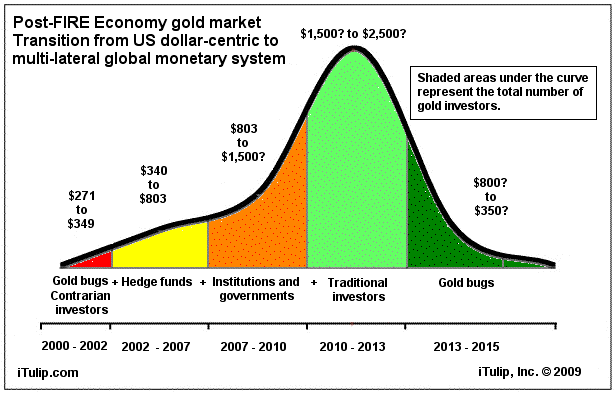
                        When I bought it in 2001 at $265 the metal was universally considered the worse investment you could make, and for more than 20 years before 2001, it was. It was like going to a run down ballpark of a baseball team that had been in slow decline for decades. The bleachers were 95% empty except for a few diehard fans, the goldbugs. Paint peaked off the seats. The toilet was stopped up. The players lumbered and staggered around the field like they were on Thorazine. When on rare occasion a batter actually connected with the ball, a faint murmur arose from long-suffering fans who had grown weary of repeated failures of the team to rally. You never read about the team in the papers. It’d been written off years before.


                        In 2010, nine years later, when gold trades over $1,100, the bleachers are nearly full, hedge fund managers and a few institutional investors mingle with the market contrarians and gold bugs. Every new price rise elicits a roar of approval from the crowd. The score appears on the front page of the Wall Street Journal. Now that gold is popular, does this mean its days of glory are numbered? Is gold a bubble? I’ve been asked that question every year since 2006, as the gold price went up from $500 to $600, $700, and $800. Every year I responded the same way: If the reasons for the price rise since 2001 remain in place, the combination of peak cheap oil and government policies to prevent debt deflation through dollar depreciation, then there is no reason why gold prices will not continue to rise.


                        The reluctant gold buyer did get another bite at $720 in October 2008, under the most extreme of conditions possible, when the whole world was selling anything and everything to raise cash in a panic. Unfortunately, the same fear that kept that person from buying at $700 in 2007 before the price spiked to $1,000 in 2008 probably kept them out of the gold market at $720 later that year. During the panic that pushed gold down to $720, fear had them holding off, with many market pundits calling for gold to fall to $600. A few hard-core deflationists at the time even called for gold prices to collapse as far as oil did, by 75 percent, to $250.


                        It’s human nature to think that the day we started to notice gold beating stocks is the day that gold prices started to beat stocks. But the truth is that gold has been beating stocks for ten years. The real story of gold versus stocks since 1998 is that gold has produced better year-over-year results than stocks, and with less volatility. Here are the facts:


                        • The gold price has finished higher at the end than at the start of each of the last ten years, except for 2000, when gold prices fell 3 percent.

                        • Even in 2000, the only year over the past ten when gold prices fell, the price of gold fell less than one third as far as stocks fell.
                        • Gold performed worse than the S&P 500 during the stock bubble years of 1998 and 1999, when gold and stocks gained 14 percent and 23 percent, respectively. Even so, gold prices went up 1 percent in each of those years.
                        • The S&P 500 gave it all back and more from 2001 to 2002, when stocks fell 10 percent and 26 percent, while gold prices increased 20 percent and 17 percent.
                        • The S&P 500 finished higher in only six out of the past ten years.
                        • In three out of the four years that the S&P 500 finished lower, gold finished higher.

                        So far the stock market reflation rally of 2009 through 2010 is looking similar to the reflation rally of 2003, when the now famously asset-inflation happy Greenspan Fed launched the housing bubble with 1 percent interest rates and deregulation of mortgage credit. The S&P 500 shot up 23 percent that year and gold rallied 17 percent; the year after, gold rallied 20 percent and the S&P fell 26 percent.


                        In the first two years of that post-bubble bust reflation, in 2003 and 2004, the S&P grew 3 percent net, while the gold price went up 27 percent. The “bubbles in everything” that resulted from the reflation policy produced lackluster returns on the S&P 500, while gold had three strong years between 2005 and 2008. The bubbles collapsed in 2008, with the S&P 500 down 38 percent. Even so, gold finished higher that year.

                        Turns out that the early 2000s reflation after the collapse of the technology stock bubble did create “bubbles in everything”—everything except gold, that is.
                        Gold can only be considered a refuge from calamity if by “calamity” we mean the decade-long process of credit-financed asset bubbles and collapses of the domestic FIRE Economy that, along with an equally disastrous foreign policy, resulted in a 40 percent depreciation of the dollar against major currencies.

                        Gold does not rise in response to future inflation fears but in response to currency risk. As the risk to the dollar has risen every year since 1998, so has gold; the greater the risk, the greater the rise.


                        If the United States runs out of sovereign credit before the economy becomes self-sustaining, we get the sovereign debt and currency event that I have warned since 1999 may be the eventual payback for decades of FIRE Economy policies. And if that happens, not only will gold rise even more than it has nearly every year for the past decade, it may rapidly rise to the $2,500 to $5,000 range that I forecast in 2001 as the eventual gold price peak.


                        Some of the factors that increase dollar risk are also bullish for stocks in the short term. Near zero interest rates and heavy government borrowing to fund deficits are reinflating parts of the economy but not others. The difficulty will be in selecting which stocks benefit and which do not. We will maintain a steady discussion on the topic on iTulip.com to stay top of trend changes as they occur.


                        Peak cheap oil will be a hazardously hard trend to invest in. Terminally high oil prices suggest a simple strategy to invest in oil production companies, but high and rising oil prices may not translate into high and rising oil producer profits. In fact, the opposite is more likely the case as the price that oil producers can charge for oil fails to keep up with the capital costs of finding and getting ever more difficultly found and produced oil out of the ground. Oil trusts are another example of an oil investment that at first blush looks like an obvious way to make money from rising oil prices. But the value of a trust is based on the value of the oil reserves behind it. If the oil is depleting, the price of the trust is falling. It may turn out that the only viable way to invest in peak cheap oil and a weakening dollar is by investing in commodities themselves, in particular precious metals that have industrial uses, such as silver and platinum, but also agricultural commodities such as wheat.


                        Rules number one and two in investing are: Don’t lose money and buy cheap. Locking in gains and avoiding bear markets is as important as buying cheap in the first place. It’s hard to make money if you are constantly trying to make up for past losses. Don’t get too attached to any asset class. Don’t fall into the kind of trap the goldbugs fell into in 1980s or stock market investors in 1999. There will be a time to sell gold and commodities, just as there was a time to get out of the stock market in early 2000, but it’s not likely to happen for many years. You can’t make money watching the markets every day and trying to “beat the market” by trading on a short-term basis. The opportunity cost of frequent trading is that you can’t both focus on that activity and also focus on finding under-priced new investments. Spend your time trying to understand how the economy is changing and let that drive your long-term investment thesis. Look for investments that you can sit in for ten years without expending time and money on buying and selling in and out of positions. Every time you do you incur transaction costs, fees and taxes. Your brokerage firm and the IRS will love you for it, but it’s no good for your portfolio. Leave the trading to the gamblers.


                        - thepostcatastropheeconomy, Chapter 6, Economic and Market Forecasting in a Post-bubble World, Stocks and Gold

                        Ed.

                        Comment


                        • #27
                          Re: Exit Strategy from Gold & Silver?

                          Yes, I tend to consider EJ's scenario in regard to gold prices the probable one. So far, the macro-concept makes sense and it has served me well. Still, one should never dismiss the unexpected...

                          Comment


                          • #28
                            Re: Exit Strategy from Gold & Silver?

                            Originally posted by dcarrigg View Post
                            Yes, I tend to consider EJ's scenario in regard to gold prices the probable one. So far, the macro-concept makes sense and it has served me well. Still, one should never dismiss the unexpected...
                            starting in 2001... the scenario... improbable... happened...

                            http://www.itulip.com/gold.htm

                            gold/dow mean reversion forecast 2001...


                            10 yrs later...


                            here's to wishes the rest doesn't happen...

                            ej forecast in 2006... gold rally ends in 2011...


                            Comment


                            • #29
                              Re: Exit Strategy from Gold & Silver?

                              so pull the trigger on silver around 200/1? That implies silver at $65 is dow is at 13000?

                              Comment


                              • #30
                                Re: Exit Strategy from Gold & Silver?

                                Wow ! A lot of great diversity and information. Thank-you to all for sharing. I've quickly read all of it, but need some more time to go back and digest, compare & contrast the various answers.

                                With the amount of interest on this topic, may I assume that others were thinking the same things for some time now, and the huge cloud of moisture only needed a small speck of dirt to seed the torrential downpour.

                                Comment

                                Working...
                                X