
 Tweet
Tweet
Cheap Peak Oil/Credit....
-
Cheap Peak Oil/Credit....
-
Re: Peak Oil, Peak Credit: Gregor MacDonald
Peak Cheap Oil Cycle
Before we summarize the Peak Cheap Oil Cycle framework, we review the normal workings of oil prices, supply and demand, in a credit cycle without Peak Cheap Oil production limits.
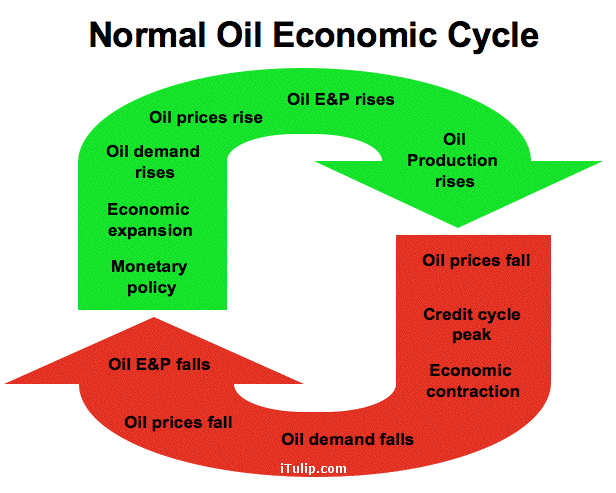
Before Peak Cheap Oil, the price of oil and the oil industry’s response to it was driven by economic expansions and contractions that were themselves a function of the credit cycle.
Starting from the economic policy response to recession at the bottom of the green arrow in the diagram above, the economy begins to expand. As the economy expands, oil demand rises and oil prices rise. Higher prices induce energy companies to increase oil exploration and production (E&P). Then the oil supply rises, and prices fall. Eventually the economy reaches a peak of credit growth in the credit cycle and turns down. The economy turns down or even goes into recession. Oil demand declines, prices fall, and oil E&P declines. Monetary policy then restarts the next period of economic growth. This is the cycle that the U.S. economy has experienced for decades, although it was exaggerated by the asset bubble cycle of the FIRE Economy since the early 1980s.
Starting in 2004, this all changed.
The fundamental change that occurred starting in 2004, around the time that the housing bubble financed economic “recovery” was picking up steam, is that world oil production peaked and reached a plateau even as the economy expanded and oil demand continued to rise. This produced a sharp increase in oil prices in 2007 and 2008, later amplified by investment banks and hedge funds—who do nothing better than take a trend and push it to the nth degree. Just as in the 1970s, the oil price spike diverts household and business expenditure from goods and services in the economy; an oil price spike acts like an added “energy tax” on the economy. The 2008 oil price spike accelerated the recession that began late 2007, as we forecast, a year after the start of the collapse of the housing bubble.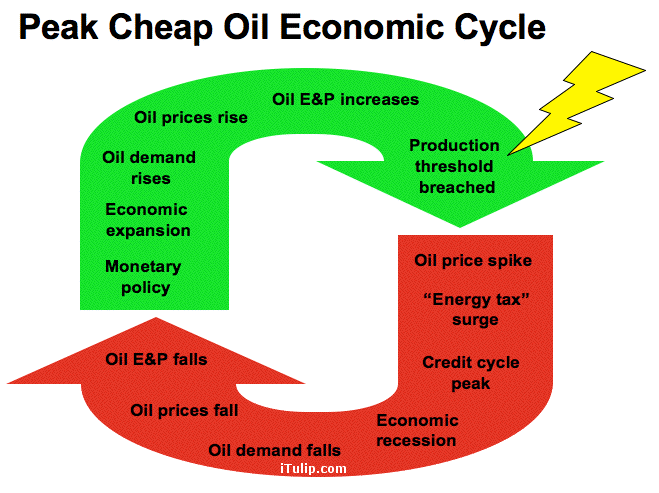
Starting with this first Peak Cheap Oil price spike, from here on out every economic expansion will be throttled by a spike in oil prices as the production threshold of around 85 million barrels per day is reached, and—over time—shrinks. Each cycle will produce a higher oil spike and each application of orthodox counter-credit cycle monetary policy will put a higher floor on oil prices.
See: Peak Cheap Oil Update - Part II: The First Peak Cheap Oil Cycle, March 2009
Ed. -
Re: Peak Oil, Peak Credit: Gregor MacDonald
I hold oil sands income-trusts in Alberta. I hold stock in GE and Duke Energy Company. I hold stock in BP, Husky Oil, and other oil companies. Take this as a disclosure of where my investment interests lie: I am pro-atomic power. I am pro-hydro-electric power, and I am pro-oil. With these disclosures, I can proceed to make a comment.
There is going to be a bright future for mankind with oil, with atomic energy, and with hydro-electric energy. Living-standards will rise, not fall. ( I am the optimist in this debate. )
In my lifetime, I have never seen interest rates as low as they are now. Stock prices are low, too. So, credit is available to develop energy projects, worldwide.
What I have never witnessed before in my lifetime is a lack of will on the part of the developed countries, especially America, to do the work and develop the energy projects.
Witness the energy policy or energy plan of the Obama Administration: 1.) bird-habitat preservation along the Gulf Coast; 2.)
preservation of white sand beaches; 3.) cementing-up oil wells; 4.) hostility toward Alberta for development of Alberta's heavy oil; 5.) hostility toward the internal-combustion engine; 6.) neglect of nuclear power; 7.) hostility toward commuters; 8.) neglect AMTRACK; 9.) neglect of California's offshore oil reserves; 10.) neglect of diesel power and diesel fuel; 11.) wishful-thinking about ethanol; 12.) wishful-thinking about algae; 13.) wishful-thinking about windmills; 14.) wishful-thinking about solar power; 15.) wishful-thinking about conservation; 16.) wishful-thinking about OPEC; 17.) wishful-thinking about "smart-grids" and "super-conductors"; 18.) hostility toward natural gas consumption.
I could go on, but I would be posting all day here. But the point is clear: The Obama Administration, especially with Dr. Chou from the Sierra Club heading the U.S. Department of Energy does not want to develop North America's energy resources. The Obama Administration is following a policy of neglect. The Obama bunch wants living-standards to fall.
I am going through this same battle here with authorities in government in British Columbia. They don't want to develop energy resources, especially not hydro-electric power, not natural gas, not atomic power, not coal, and not oil.
I don't know how to describe what I am witnessing?
 Last edited by Starving Steve; November 20, 2010, 03:02 PM.
Comment
-
Re: Peak Oil, Peak Credit: Gregor MacDonald
the 3rd embed mistakenly repeats the 2nd. here's a link to part3: http://www.youtube.com/watch?v=kqMPg83d6Qo


Comment

Comment