Announcement

Collapse
No announcement yet.

Yes Virginia...It's a Bubble...

Collapse
X
 
  • Filter
  • Time
  • Show
Clear All
new posts

  • GRG55
    replied
    Re: Yes Virginia...It's a Bubble...

    Originally posted by coolhand View Post
    ...Look at the trade balance of the BRICS v. the US. There is nothing those nations need the US for on a net basis. The US needs those nations very desperately on a net basis. American Wal-Mart would be empty in just weeks without the BRICS...
    So what? Do you actually believe that Wal Mart is the American economy? Or even closely reflective of it?

    Some Economyths need to busted. Wal Mart clocked $264 Billion in US sales in 2012. The US economy was more than $15 Trillion.

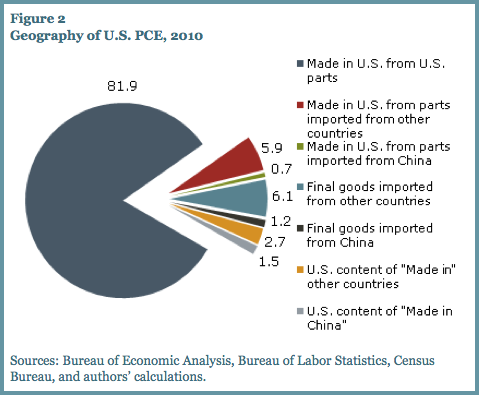
    From the Federal Reserve Bank of San Francisco (full study available at the link):

    The U.S. Content of “Made in China”

    Galina Hale and Bart Hobijn


    Goods and services from China accounted for only 2.7% of U.S. personal consumption expenditures in 2010, of which less than half reflected the actual costs of Chinese imports. The rest went to U.S. businesses and workers transporting, selling, and marketing goods carrying the “Made in China” label. Although the fraction is higher when the imported content of goods made in the United States is considered, Chinese imports still make up only a small share of total U.S. consumer spending. This suggests that Chinese inflation will have little direct effect on U.S. consumer prices.


    Originally posted by coolhand View Post
    ...Read what the former World Bank Chief Economist (Chinese, advising Chinese gov't) said last week - the dollar is the problem, the yuan is not the solution (but is part of the solution) - a supra-national currency is needed to eliminate the Triffin Dilemma of using the dollar. China absolutely understands this & is buying gold like crazy likely b/c of it.
    Of course the US Dollar is a problem. The good thing, to paraphrase the late John Connolly, is that it's their problem. The manipulated currency of a corrupt kleptocracy is hardly part of the solution...unless of course one is part of the manipulation, the corruption and the kleptocracy. Unfortunately China and USA are hardly different in that regard any longer...

    Leave a comment:


  • GRG55
    replied
    Re: Yes Virginia...It's a Bubble...

    Originally posted by jk View Post
    america is still the consumer of last resort. the em's are productive economies, no doubt, but what they produce they are not prepared to consume. the product mix is wrong, and em incomes are inadequate. they are export led economies, not easily or quickly refashioned.

    china, i would think, would be loath to both cut itself off from american markets and effectively decimate - literally- their reserves by marking up gold about 10x. at some point they may be willing to pay that price, when they have either found other markets or reshaped their production and raised domestic incomes. in the meantime, the dollar remains the world's reserve currency. i think it is likely to be the last fiat standing, the last to go, not among the first.
    There are some extraordinary myths that persist in the minds of some of the China/EM bulls that post here. Some day maybe EJ should do a fact based iTulip Economic Mythbuster's posting.

    Here is my small contribution. It is a bit out of date but what I had readily at hand in the time available. As you point out, China needs the USA market a whole lot more than the USA needs Chinese suppliers. That is even more so since the financial crisis drove the US cost structure down.

    But then facts may not matter for those who are emotionally caught up with the idea that "the USA is finished" as a world power and the Dollar is toast. The Dollar may ultimately be headed for the toaster, but the exorbitant privilege looks to remain intact for quite some time yet.

    Leave a comment:


  • jk
    replied
    Re: Yes Virginia...It's a Bubble...

    Originally posted by coolhand View Post
    IMO, people are making this way more complicated than it is. There are only 2 currencies that have ever priced oil since it became the world's primary energy source, which is the key to economic growth & the ultimate WACC for any economy (energy): Gold & dollars.

    The world didn't like using dollars b/c it involved taking an IOU from the Americans that everyone knew the US could never pay back in real terms but everyone went along w/it b/c it worked & b/c there was no alternative, & the Americans were the biggest trader of real stuff.

    As of 2008, that system no longer works (witness 6 years of nonstop QE just to avoid collapse) & an alternative is being made by China - trade in yuan, settle in gold, the only other currency that has ever settled oil. This seems extreme but its the same system (but without a fixed price for gold, which dooms such a system) that has existed for all of mankind's history ex-1914-1920 & 1971-present. It is just Keynes' "Bancor" proposal from Bretton Woods come to fruition.

    It wouldn't just be Chinese products you could get for $20,000 gold - I am sure Russia, India, Saudi Arabia, Iran, Iraq, Brazil - all would be happy to take gold valued at $20,000/oz in exchange for oil, food & other products & services. Ditto the Europeans - their 10,000 tons marked-to-mkt qtrly would nearly fully collateralize all sovereign debt.

    This is what the world is still missing IMO - in the next emerging market crisis, they won't need dollars for real goods b/c they are the dominant producers of real goods. The world expects emerging markets to hold a fire sale on assets just to preserve a status quo that is not in their interest when they can just as easily recollateralize their system by changing the trade settlement mechanism. In English - this time, they won't write down their assets to get dollars, they will leave the dollar & write up gold to recollateralize the system. The trade settlement system has been set up to settle trade in yuan/gold. If you are the BRICS, if the shit hits the fan, why scramble for dollars when you can just change the system, trade in yuan & settle in gold.

    Look at the trade balance of the BRICS v. the US. There is nothing those nations need the US for on a net basis. The US needs those nations very desperately on a net basis. American Wal-Mart would be empty in just weeks without the BRICS; Chinese Wal-Mart would not be empty without the US - this was NOT the case in 1997.

    Read what the former World Bank Chief Economist (Chinese, advising Chinese gov't) said last week - the dollar is the problem, the yuan is not the solution (but is part of the solution) - a supra-national currency is needed to eliminate the Triffin Dilemma of using the dollar. China absolutely understands this & is buying gold like crazy likely b/c of it.
    america is still the consumer of last resort. the em's are productive economies, no doubt, but what they produce they are not prepared to consume. the product mix is wrong, and em incomes are inadequate. they are export led economies, not easily or quickly refashioned.

    china, i would think, would be loath to both cut itself off from american markets and effectively decimate - literally- their reserves by marking up gold about 10x. at some point they may be willing to pay that price, when they have either found other markets or reshaped their production and raised domestic incomes. in the meantime, the dollar remains the world's reserve currency. i think it is likely to be the last fiat standing, the last to go, not among the first.

    Leave a comment:


  • shiny!
    replied
    Re: Yes Virginia...It's a Bubble...

    Originally posted by coolhand View Post
    IMO, people are making this way more complicated than it is. There are only 2 currencies that have ever priced oil since it became the world's primary energy source, which is the key to economic growth & the ultimate WACC for any economy (energy): Gold & dollars.

    The world didn't like using dollars b/c it involved taking an IOU from the Americans that everyone knew the US could never pay back in real terms but everyone went along w/it b/c it worked & b/c there was no alternative, & the Americans were the biggest trader of real stuff.

    As of 2008, that system no longer works (witness 6 years of nonstop QE just to avoid collapse) & an alternative is being made by China - trade in yuan, settle in gold, the only other currency that has ever settled oil. This seems extreme but its the same system (but without a fixed price for gold, which dooms such a system) that has existed for all of mankind's history ex-1914-1920 & 1971-present. It is just Keynes' "Bancor" proposal from Bretton Woods come to fruition.

    It wouldn't just be Chinese products you could get for $20,000 gold - I am sure Russia, India, Saudi Arabia, Iran, Iraq, Brazil - all would be happy to take gold valued at $20,000/oz in exchange for oil, food & other products & services. Ditto the Europeans - their 10,000 tons marked-to-mkt qtrly would nearly fully collateralize all sovereign debt.

    This is what the world is still missing IMO - in the next emerging market crisis, they won't need dollars for real goods b/c they are the dominant producers of real goods. The world expects emerging markets to hold a fire sale on assets just to preserve a status quo that is not in their interest when they can just as easily recollateralize their system by changing the trade settlement mechanism. In English - this time, they won't write down their assets to get dollars, they will leave the dollar & write up gold to recollateralize the system. The trade settlement system has been set up to settle trade in yuan/gold. If you are the BRICS, if the shit hits the fan, why scramble for dollars when you can just change the system, trade in yuan & settle in gold.

    Look at the trade balance of the BRICS v. the US. There is nothing those nations need the US for on a net basis. The US needs those nations very desperately on a net basis. American Wal-Mart would be empty in just weeks without the BRICS; Chinese Wal-Mart would not be empty without the US - this was NOT the case in 1997.

    Read what the former World Bank Chief Economist (Chinese, advising Chinese gov't) said last week - the dollar is the problem, the yuan is not the solution (but is part of the solution) - a supra-national currency is needed to eliminate the Triffin Dilemma of using the dollar. China absolutely understands this & is buying gold like crazy likely b/c of it.
    Sounds entirely logical, but I'm not knowledgeable enough to see a "gotcha" in this argument that could be apparent to others.

    How would the U.S. gov't respond to an overnight repricing of gold to $20,000? Would it have to go along to get along, or could the U.S. somehow resist? Given our national debt, I would think that gold at $20,000/oz be in our best interest as well.

    Even if gold were to be repriced to $20,000/oz, I don't think the U.S. gov't will allow small individual holders who bought when gold was low to profit when they try to sell. I have nothing to base this on other than a gut feeling.

    Leave a comment:


  • coolhand
    replied
    Re: Yes Virginia...It's a Bubble...

    Originally posted by jk View Post
    1. the immediate answer is that their care would be inversely proportional to their gold holdings.
    2. the bigger answer is that that they would care to the degree that they feel threatened by china's assertion of the power to make such a unilateral declaration.
    3. another thought is that this is essentially equivalent to china making a market bid for gold at $20k/oz, but redeemable only in the equivalent value of chinese products.
    4. gold would then trade at a discount to the 20k value for market participants who don't themselves want to buy chinese products with the proceeds.

    IMO, people are making this way more complicated than it is. There are only 2 currencies that have ever priced oil since it became the world's primary energy source, which is the key to economic growth & the ultimate WACC for any economy (energy): Gold & dollars.

    The world didn't like using dollars b/c it involved taking an IOU from the Americans that everyone knew the US could never pay back in real terms but everyone went along w/it b/c it worked & b/c there was no alternative, & the Americans were the biggest trader of real stuff.

    As of 2008, that system no longer works (witness 6 years of nonstop QE just to avoid collapse) & an alternative is being made by China - trade in yuan, settle in gold, the only other currency that has ever settled oil. This seems extreme but its the same system (but without a fixed price for gold, which dooms such a system) that has existed for all of mankind's history ex-1914-1920 & 1971-present. It is just Keynes' "Bancor" proposal from Bretton Woods come to fruition.

    It wouldn't just be Chinese products you could get for $20,000 gold - I am sure Russia, India, Saudi Arabia, Iran, Iraq, Brazil - all would be happy to take gold valued at $20,000/oz in exchange for oil, food & other products & services. Ditto the Europeans - their 10,000 tons marked-to-mkt qtrly would nearly fully collateralize all sovereign debt.

    This is what the world is still missing IMO - in the next emerging market crisis, they won't need dollars for real goods b/c they are the dominant producers of real goods. The world expects emerging markets to hold a fire sale on assets just to preserve a status quo that is not in their interest when they can just as easily recollateralize their system by changing the trade settlement mechanism. In English - this time, they won't write down their assets to get dollars, they will leave the dollar & write up gold to recollateralize the system. The trade settlement system has been set up to settle trade in yuan/gold. If you are the BRICS, if the shit hits the fan, why scramble for dollars when you can just change the system, trade in yuan & settle in gold.

    Look at the trade balance of the BRICS v. the US. There is nothing those nations need the US for on a net basis. The US needs those nations very desperately on a net basis. American Wal-Mart would be empty in just weeks without the BRICS; Chinese Wal-Mart would not be empty without the US - this was NOT the case in 1997.

    Read what the former World Bank Chief Economist (Chinese, advising Chinese gov't) said last week - the dollar is the problem, the yuan is not the solution (but is part of the solution) - a supra-national currency is needed to eliminate the Triffin Dilemma of using the dollar. China absolutely understands this & is buying gold like crazy likely b/c of it.

    Leave a comment:


  • jk
    replied
    Re: Yes Virginia...It's a Bubble...

    Originally posted by coolhand View Post
    If China says gold is now worth $20,000/oz in goods bought in China, why would any of their (non-American) trading partners care?
    1. the immediate answer is that their care would be inversely proportional to their gold holdings.
    2. the bigger answer is that that they would care to the degree that they feel threatened by china's assertion of the power to make such a unilateral declaration.
    3. another thought is that this is essentially equivalent to china making a market bid for gold at $20k/oz, but redeemable only in the equivalent value of chinese products.
    4. gold would then trade at a discount to the 20k value for market participants who don't themselves want to buy chinese products with the proceeds.

    Leave a comment:


  • coolhand
    replied
    Re: Yes Virginia...It's a Bubble...

    The one thing the author is missing? They are assuming that when China's bust comes, they will be forced to scramble for dollars like all those other nations they mention.

    But none of those other nations were the #1 trading nation in the world, nor the #1 oil importer in the world, not even close.

    All the economists assuming that when China's economic crisis comes, they will be forced to scramble for dollars (like all the others mentioned above under the Petrodollar system) ought to think about why China has been buying so much gold, including >100% of estimated global gold mine production in January 2014.

    When you are the biggest trader and oil importer in the world, you don't get told by creditors what currency you pay back in. You tell them, a la Nixon in 1971. Notice that China has the world's largest physical gold exchange & per the WSJ 3 weeks ago, will be allowing offshore yuan balances to buy gold in Shanghai.

    If China says gold is now worth $20,000/oz in goods bought in China, why would any of their (non-American) trading partners care?

    Leave a comment:


  • don
    replied
    Re: Yes Virginia...It's a Bubble...

    The key to foretelling credit trouble is not the size but the pace of growth in debt, because during rapid credit booms more and more loans go to wasteful endeavours. That is China today. Five years ago it took just over $1 of debt to generate $1 of economic growth in China. In 2013 it took nearly $4 – and one-third of the new debt now goes to pay off old debt.

    Fortune Cookie say: Yellow Man Learn White Man's Bad Habits


    #1 son learns that lesson well . . .

    Leave a comment:


  • GRG55
    replied
    Re: Yes Virginia...It's a Bubble...

    Originally posted by GRG55 View Post

    ...China property is a "cash market";

    The Chinese government "won't let" the property market crash;

    China has 1.1 Billion people that need homes so all the empty apartments will get filled;

    It's different in China because a centrally planned economy and a totalitarian government can make and implement good economic decisions so much more quickly and effectively than the USA or any other democracy...

    (feel free to add your own China myth to the list)

    Misallocation of capital? In China? Perish the thought...


    China’s debt-fuelled boom is in danger of turning to bust


    January 27, 2014 7:36 pm

    The longer a credit hot streak lasts, the more likely it is to end abruptly, writes Ruchir Sharma

    Forget Argentina. The big story of 2014 in the emerging world is the black cloud of debt hanging over China.

    Debate rages over how this tale will end. Most analysts believe that the Chinese economy will once again expand by more than 7 per cent this year, despite ballooning private sector debts. But the pessimistic minority has history on its side. Only five developing countries have had a credit boom nearly as big as China’s. All of them went on to suffer a credit crisis and a major economic slowdown.

    These are powerful precedents. Recent studies have isolated the most reliable signal of a looming financial crisis and it is the “credit gap”, or the increase in private sector credit as a proportion of economic output over the most recent five-year period. In China, that gap has risen since 2008 by a stunning 71 percentage points, taking total debt to about 230 per cent of gross domestic product.

    A credit boom of this scale is not likely to end well. Looking back over the past 50 years and focusing on the most extreme credit booms – the top 0.5 per cent – turns up 33 cases, with a minimum credit gap of 42 percentage points.
    Of these nations, 22 suffered a credit crisis in the subsequent five years and all suffered an economic slowdown. On average, the annual economic growth rate fell from 5.2 per cent to 1.8 per cent. Not one country got away without facing either a crisis or a major economic slowdown. Thailand, Malaysia, Chile, Zimbabwe and Latvia have had a gap higher than 60 points. All those binges ended in a severe credit crisis.

    Although there have been no exceptions to this rule, most economists still believe China will prove exceptional. For 30 years it has defied sceptics, maintaining a growth rate that has averaged 10 per cent, and has not fallen below 7 per cent since 1990.

    China has hit its ambitious growth targets so consistently that many analysts can no longer imagine a miss. The consensus forecast is for growth of 7.5 per cent this year, right on target. Growth is widely expected to continue at an average rate of 6-7 per cent for the next five years. It is hard to find a prominent economist who forecasts a significant slowdown, much less a credit crisis.

    History foretells a different story. In the 33 cases in which countries built up extreme credit gaps, the pace of GDP growth more than halved subsequently. If China follows that path, its growth rate over the next five years would average between 4 per cent and 5 per cent.

    The key to foretelling credit trouble is not the size but the pace of growth in debt, because during rapid credit booms more and more loans go to wasteful endeavours. That is China today. Five years ago it took just over $1 of debt to generate $1 of economic growth in China. In 2013 it took nearly $4 – and one-third of the new debt now goes to pay off old debt.

    Those who trust in China’s exceptionalism say it has special defences. It has a war chest of foreign exchange reserves and a current account surplus, reducing its dependence on foreign capital flows. Its banks are supported by large domestic savings, and enjoy low loan-to-deposit ratios. History, however, shows that although these factors can help ward off some kinds of trouble – a currency or balance-of-payments crisis – they offer no guarantee against a domestic credit crisis.

    These defences have failed before. Taiwan suffered a banking crisis in 1995, despite having foreign exchange reserves that totalled 45 per cent of GDP, a slightly higher level than China has today. Taiwan’s banks also enjoyed low loan-to-deposit ratios, but that did not avert a credit crunch. Banking crises also hit Japan in the 1970s and Malaysia in the 1990s, even though these countries had savings rates of about 40 per cent of GDP. Furthermore, there is no strong link between the state of the current account and the outbreak of credit crises.

    The unravelling of the 33 most extreme credit binges before China’s suggests that it faces a serious risk of at least a major slowdown. Such an outcome may yet be avoided. But it is a long shot, even for an exceptional country such as China.

    The writer is head of emerging markets and global macro at Morgan Stanley Investment Management and author of ‘Breakout Nations’
    Last edited by GRG55; February 02, 2014, 11:25 AM.

    Leave a comment:


  • Fiat Currency
    replied
    Re: Yes Virginia...It's a Bubble...

    Originally posted by GRG55 View Post
    I know a few Canadian "oil"garchs. But none of the people I know for over there are oligarchs, I should wish to be so lucky to have such wealthy colleagues ;-)

    This migration is more substantive than oligarchs. And will have more wide ranging potential consequences. Just by way of example, one of the couples I know that moved to the Persian Gulf from Central Asia are both practicing lawyers there. They moved, permanently, to get themselves and their kids away from the increasing corruption, all the while accepting that their privileged station in life in their home country was the result of their families being "well connected".
    I think I understand your point. A quick search of just page 14 of this thread gets 13 matches for the base word corrupt. When I right-clicked on the word oligarch I get this definition ...

    2 (esp. in Russia) a very rich businessman with a great deal of political influence.word trends: If it’s true that money is power, then oligarch is the perfect name for the new breed of ultra-rich businessmen. Originally, an oligarch was one of a very small group of leaders of a country. Most of today’s oligarchs gained their fortunes very quickly after the fall of the former Soviet republics, and although they do not have any official political power, their massive fortunes can mean they have great influence over governments and politicians. Not surprisingly, the word oligarch has acquired some negative associations, reflected in the examples seen in the Oxford English Corpus—corrupt, exiled, and jailed are all common collocates, as is so-called, a sign of anger at the assumption of political influence the name oligarch implies.

    I guess I always associate oligarchs with corruption - since those 2 words are always together - more than the definition of ruler or tsar. I'm not in favour of wealth obtained by corruption.

    I know a couple of "oil"garchs too. If like most, they obtained their status through good old fashioned sweat equity and capitalism, then I am all in favour of that - and peace be with them.

    As for the migration being more substantive - I'll take your word for it. Their buying of foreign real estate is certainly on trend. I do wonder though, what are the driving factors. Oddly, the example you cite seems like a couple at least partly escaping corruption. I'm sure there are other factors at play, such as quality of life, healthcare, clean water & air to breathe etc.

    I think the true oligarchs already have their 300+ foot yachts, and are islands unto themselves. Highly mobile and highly liquid.

    Leave a comment:


  • GRG55
    replied
    Re: Yes Virginia...It's a Bubble...

    Originally posted by Fiat Currency View Post
    Ah yes …. the travails of the Oligarchs … where to run to? I'm sure we all feel their pain.
    I know a few Canadian "oil"garchs. But none of the people I know for over there are oligarchs, I should wish to be so lucky to have such wealthy colleagues ;-)

    This migration is more substantive than oligarchs. And will have more wide ranging potential consequences. Just by way of example, one of the couples I know that moved to the Persian Gulf from Central Asia are both practicing lawyers there. They moved, permanently, to get themselves and their kids away from the increasing corruption, all the while accepting that their privileged station in life in their home country was the result of their families being "well connected".

    Leave a comment:


  • Fiat Currency
    replied
    Re: Yes Virginia...It's a Bubble...

    Originally posted by GRG55 View Post
    The same pattern is underway in the equally corrupt former Soviet Union/Central Asia states. However, they are preferring to move to places like the Persian Gulf (Dubai and Qatar are particular favourites), London (if they can afford it) or select other locations in Europe including Germany.
    Ah yes …. the travails of the Oligarchs … where to run to? I'm sure we all feel their pain.

    Violin.gif

    Leave a comment:


  • GRG55
    replied
    Re: Yes Virginia...It's a Bubble...

    Originally posted by EJ View Post
    I just had a long conversation with a Chinese ex-pat friend in NYC who runs a hedge fund. He made his fortune in China then moved his family to the states. Most of his friends and neighbors are also wealthy ex-pats from China.

    Why are they here? Better quality of life for themselves and their families. Here you can breath the air and eat the food without the worry you are being poisoned. Your kids will be better educated. You don't have to deal with petty corruption at the local level.

    Bottom line you can make a fortune in China because it's more entrepreneurial than the U.S., if you are good at navigating the corruption. For all of the corruption the business environment is brutally competitive and this tends to reward the best, even in the government.

    But once you've made your fortune the U.S. is a better place to live.
    The same pattern is underway in the equally corrupt former Soviet Union/Central Asia states. However, they are preferring to move to places like the Persian Gulf (Dubai and Qatar are particular favourites), London (if they can afford it) or select other locations in Europe including Germany.

    Leave a comment:


  • metalman
    replied
    Re: Yes Virginia...It's a Bubble...

    Originally posted by GRG55 View Post
    I doubt this is as binary as we might imagine.

    First, there may be explicit approval and some relaxation of funds transfer capability out of China for the well connected wealthy, as part of an effort to find ways to vent the excess private savings into something other than internal property speculation and shadow banking system investment products, both of which are causing concern with the authorities. Buying gold and various luxury goods inside China can only absorb so much...foreign real estate and perhaps other private investment abroad might be carefully encouraged.

    But monitoring and controlling the outflows, once started, might also be problematic in a nation as large, populous, complex and corrupt as China. So it is entirely likely that some, shall we say, "unscrupulous and ill gotten gains" are also finding their way out of China, along with their representative owners, through the same conduits?

    It's just another cycle repeating...well perhaps rhyming in a new variation might be a better description?

    The lesson of Bo Xilai is probably not lost on anyone with some wealth in China:
    Bo Xilai found guilty on all charges, sentenced to life in prison

    updated 7:11 AM EDT, Mon September 23, 2013

    Beijing (CNN)
    -- A court in eastern China sentenced Bo Xilai -- the former rising star of the ruling Communist Party who fell from power amid a scandal involving murder, betrayal and financial skullduggery -- to life in prison Sunday.

    Bo received the life sentence for bribe-taking, as well as 15 years for embezzlement and seven years for abuse of power.

    The sentences, which came shortly after the guilty verdicts, surprised some analysts...

    ...
    Days before the court announced the date for delivering the verdict, Bo reiterated his innocence but said he anticipated a lengthy imprisonment in a letter written to his family...

    ...
    "Meanwhile I will be waiting quietly in prison," Bo continued. "Dad was thrown into prison multiple times in his lifetime and I will look up to him as my role model."

    Bo's late father, Bo Yibo, was a revolutionary contemporary of Chairman Mao Zedong and late paramount leader Deng Xiaoping. During the tumultuous Cultural Revolution that Mao launched in 1966, however, the senior Bo was persecuted, tortured and imprisoned for over a decade. He was "rehabilitated" in 1979 and became one of the most influential senior politicians under Deng...

    Found: Offshore Wealth Stashed by Families of China’s Leaders

    Leaked documents reveal substantial funds in "offshore centers usually associated with hidden wealth"

    On Jan. 23, anyone with an interest in the intersection of power and money in the People’s Republic will receive an early Chinese New Year gift: the names of nearly 22,000 mainland Chinese and Hong Kong citizens with funds in offshore tax havens in places like the Caribbean and the South Pacific.

    The trove of leaked documents originates from two firms that help clients move their money offshore. After gaining access to these secret records, the International Consortium of Investigative Journalists (ICIJ) gathered more than 50 reporters around the world, who spent months combing through the files before they are released to the public. ICIJ has uncovered what it believes to be piles of wealth stashed overseas by “red nobility,” as relatives of China’s communist leaders are known:

    Among them are some of China’s most powerful men and women — including at least 15 of China’s richest, members of the National People’s Congress and executives from state-owned companies entangled in corruption scandals PricewaterhouseCoopers, UBS and other Western banks and accounting firms play a key role as middlemen in helping Chinese clients set up trusts and companies in the British Virgin Islands, Samoa and other offshore centers usually associated with hidden wealth, the records show.

    ICIJ reports on a real estate company, part owned by Chinese President Xi Jinping’s brother-in-law, that was registered in the British Virgin Islands (BVI), as well as on firms also set up there by the son and son-in-law of former Premier Wen Jiabao.

    In the case of Wen’s son, the creation of his BVI-based company was facilitated by Credit Suisse while his father was still in office, according to ICIJ’s investigation. In addition, ICIJ says records show “that relatives of at least five current or former members of [the now seven-man Standing Committee that rules China] have incorporated companies in the Cook Islands or British Virgin Islands.”

    Earlier investigations into the wealth accrued by the families of President Xi and former Premier Wen were conducted by the New York Times and Bloomberg. Both organizations, along with other foreign media, have had their websites blocked by Chinese censors. They also faced hassles late last year when it came time to renewing the visas of their China-based correspondents. A Chinese media organization that had been working with ICIJ in tracking China’s offshore money flows pulled out of the project in November, saying it was facing Chinese-government pressure.

    In a society supposedly based on communist ideals, the fortunes of China’s political elite have prompted public outrage. To assuage such anger, Xi has launched an anticorruption campaign targeting wayward officials, pledging to net both high-ranking “tigers” and lowly “flies.” As a result, China’s online community has gorged on a regular diet of financial scandals involving communist cadres who, despite low official salaries, have somehow acquired luxury watches, lavish homes and even funds to send their children to expensive overseas schools.

    Yet the pace of such online exposés has slowed in recent months. Some whistle-blowers have been silenced by China’s courts. Despite a public outcry, Chinese officials are still not legally obliged to disclose their personal assets, which would be a basic step in combating graft. On Jan. 22, the closed-door trial began of Xu Zhiyong, a lawyer who spearheaded a grassroots campaign to compel cadres to come clean about their wealth. He is charged with “disturbing public order.” Human-rights groups say the case is politically motivated, with Amnesty International labeling him a prisoner of conscience.

    The nation’s capital flight, which ICIJ says involves “every corner of China’s economy, from oil to green energy and from mining to arms trading,” should worry its leaders, particularly as the nation’s economic growth slows to its most sluggish in years. After all, what does it say about confidence levels when the very people who profited most from China’s great economic expansion are parking their cash abroad? Wang Huiyao, head of the Center for China and Globalization in Beijing, which on Jan. 22 released a report on China’s international migration patterns, cites research that found that Chinese with around $1 million in assets had transferred $465 billion overseas in 2011.

    Wang says since China began its economic reforms, 9.3 million Chinese have emigrated. Unlike previous generations of Chinese who left home for menial jobs abroad, the new crop of émigrés tends to be wealthy. A survey released this month by the Hurun Report, which tracks China’s moneyed class, found that 64% of surveyed millionaires had either emigrated or had plans to do so.

    In several surveys, China’s wealthy have listed concerns over domestic environmental pollution, food safety, health care and the pressure-cooker education system for prompting their flights abroad with their families. But, says Wang, “we can’t rule out the reason some people move overseas is to protect their personal assets.” Given all the questionably sourced fortunes in China today, it’s no wonder tiny offshore tax havens have proved so alluring.


    Read more: Offshore Wealth of China's Leaders | TIME.com http://world.time.com/2014/01/22/off...#ixzz2rFpiBlF1

    Leave a comment:


  • Milton Kuo
    replied
    Re: Yes Virginia...It's a Bubble...

    Originally posted by Milton Kuo View Post
    Makes me wonder how long that the Bay Bridge in California is going to last.
    Well, this article from Bloomberg doesn't make me any more confident than I was when I wrote the above about the Bay Bridge:

    http://www.bloomberg.com/news/2014-0...ia-bridge.html


    Engineers Found ‘Hundreds’ of Cracks in California Bridge

    By James Nash Jan 22, 2014 11:00 PM CT


    Photographer: Ezra Shaw/Getty Images
    The eastern span of the San Francisco-Oakland Bay Bridge sits in San Francisco.

    Engineers spotted “hundreds” of cracks in welds on parts produced for the San Francisco-Oakland Bay Bridge in 2008 and were encouraged to stay quiet rather than delay the $6.4 billion project, according to a California Senate committee report.


    James Merrill, then a senior engineer with a quality assurance company known as Mactec, told Senate investigators that his complaints about work done at Shanghai Zhenhua Heavy Industry Co. Ltd. (900947), known as ZPMC, were rebuffed by managers of the California Department of Transportation as “too rigorous,” according to the report released yesterday.


    A new eastern span of the Bay Bridge, the state’s busiest structure, carrying Interstate 80 between San Francisco and Oakland, opened in September. The replacement of the section damaged in the 1989 Loma Prieta earthquake was more than six years behind schedule and almost $5 billion over budget. The most recent delay occurred in March 2013 when 32 steel anchor bolts fractured as they were tightened.


    Attempts to contact Shanghai Zhenhua, based in Shanghai, by telephone and e-mail were unsuccessful.
    “This is the first time in my career the engineering wasn’t allowed to be done right,” said Douglas Coe, a former civil engineer for the California Department of Transportation, known as Caltrans, according to the report. “Engineering decisions were made by non-engineers.”

    Photographer: Erin Lubin/Bloomberg
    Cars drive over the San Francisco-Oakland Bay Bridge in San Francisco.

    Merrill and Coe said they don’t think the bridge is unsafe, according to the report, though they suggested that the structure may require retrofitting throughout its life and may last less than the 150 years state officials projected.


    Andrew Gordon, a spokesman for the Bay Area Toll Authority, the financing agency for the Oakland-based Metropolitan Transportation Commission and Caltrans, declined to comment on the findings.


    “The report just came out and the toll bridge program oversight committee is still reviewing it,” Gordon said by telephone.


    The state Senate Transportation and Housing Committee plans to discuss the report’s findings tomorrow.


    To contact the reporter on this story: James Nash in Los Angeles at jnash24@bloomberg.net


    To contact the editor responsible for this story: Stephen Merelman at smerelman@bloomberg.net

    Leave a comment:

Working...
X