Announcement

Collapse
No announcement yet.

Door Number Two

Collapse
X
 
  • Filter
  • Time
  • Show
Clear All
new posts

  • Christoph von Gamm
    replied
    Re: Door Number Two

    +++ Quote:
    If you have traveled must for the past few years then you cannot fail to see what's happening. Go to Europe. Go to Asia. Go to Mexico. Go anywhere. Gold is not rising, gold is priced in dollars and the dollar is falling.
    THIS IS JUST ABSOLUTELY WRONG - WRONG AND WRONG AGAIN - PLEASE DO THE MATH. GOLD HAS INCREASED BY ABOUT 30% IN EURO AND SWISS FRANC TERMS.

    Leave a comment:


  • EJ
    replied
    Re: Door Number Two

    Originally posted by zmas28 View Post
    EJ,

    You say:

    "Goes without saying that demand for goods and services falls off in a recession. Ka-Poom Theory says that in a US recession, demand for the currency in which they are priced falls off even faster."

    Does this imply that (keeping your prescient bear market call in mind) the commodity sector (energy, food, metals) will outperform cash?
    And if so, would this be expected to be after the market bottoms out (following your Japanese market proxy) perhaps in the second half of 2008?
    Thanks.
    Considering Joe McNay's big thumbs up on gold in Barron's today and thumbs down on the dollar, and some of the data bill has been able to hunt down here, cash in dollars is looking sicker by the day.
    Last edited by FRED; February 03, 2008, 10:35 AM. Reason: Spelling and stuff.

    Leave a comment:


  • EJ
    replied
    Re: Door Number Two

    Originally posted by WDCRob View Post
    "With no natural limitation" seems like a noteworthy phrase to me.

    Assuming that you're right and the Fed etc. are shooting for this result to reduce our debt in a politically expedient way, does the cycle end when it's decided that we've wiped enough debt out to take the body blow of a deep recession?

    If this truly becomes 'self-reinforcing' we have to bite the bullet - or the currency totally collapses. Yes? Or is there some other way to disrupt that cycle?

    Also, how does 'no natural limitations' dovetail with...

    1) foreign CBs providing some sort of a floor for the dollar?

    2) hyper-inflation can't happen here.

    Are those 'unnatural' limitations? ;)
    The rate of decline has a natural limitation but not the extent. The limitation on the rate of decline can be understood by going back to our USA, Inc.

    Lets' s say a major shareholder CN in USA, Inc. owns 1,500,000,000 shares out of a total of $15,000,000,000 or 10%. Let's say a share is worth $1. You could say CN owns $1,500,000,000 worth of USA, Inc. and does on paper. But of course if CN tries to liquidate its entire position all at once the share price would drop substantially to not even close to $1,500,000,000. CN can only sell as much of its position at any given period of time that does not decrease the net purchasing power of the proceeds of the sale and the remaining "shares" in USA. How much is that? Depending on other factors, anything from a few percent to nothing more than a rumor of an impending sale may send the "shares" down.

    To limit this negative impact of sales of shares, CN can gradually reduce its position in USA, Inc. by selling shares to purchase assets that are not denominated in USA shares, "stock" in other companies, say, Africa, Inc. Even so, the rate at which this can be done without lowering the purchasing power of the remaining shares held is limited.

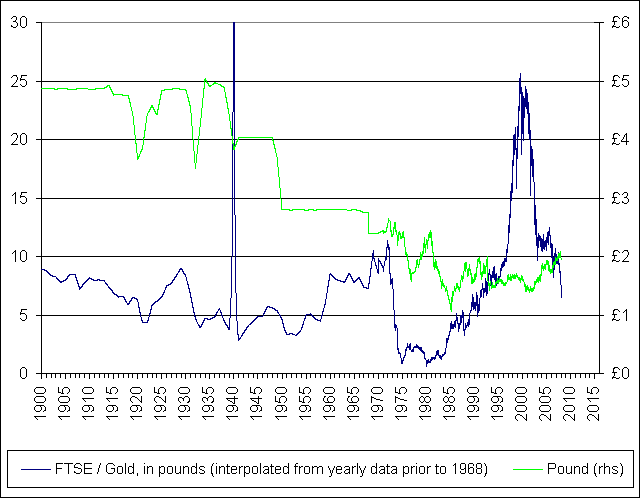
    There may be an arrangement with other holders to limit sales so as to avoid drastically devaluing the purchasing power of their respective holdings. These all tend to limit the rate of decline. That said, there is no limit to the extent of this process. It can go on for decades as it did to the pound sterling. (Thanks for the chart, bart.)


    Leave a comment:


  • jk
    replied
    Re: Door Number Two

    Originally posted by ej
    Quote:
    "...bonds at 6% don't have value. this is the case because of inflation."

    What Pomboy is missing in her analysis is that she is not accounting for the fact that markets set the yield on any bond by assessing a combination of default risk and inflation risk. Even if the true rate of inflation, versus the rate reported by the government that creates it, nets out the yield of a 30 year bond at 6% the default risk is zero. That gives it value.
    there are others who think it has value becaue they think there will be deflation. gary shilling, for example, who - irrespective of his analysis- has been consistent and correct about buying bonds for over 20years iirc.

    Originally posted by ej
    Quote:
    as i read it, pomboy is saying that the markets will suffer a deflation scare. the only mention of the fed is re: intervening to pull down long rates.

    The concept of a "deflation scare" in the context of the treasury bond market does not make sense. The bond markets are constantly assessing default and inflation risk. One thing about the bond market is that unlike the stock market is is rarely surprised, except when a sovereign default occurs such as the Russian bond default. But you have to be a government to pull off that kind of thing. The anomaly of low and falling interest rates in an inflationary environment can be explained on the short end as resulting from Fed liquidity injections and the long end by a flight to quality. It's the flip side of what is going on in the corp. bond market.
    i agree that much of the push on the long end is a flight to quality. but even though you [and i] think that deflation isn't going to happen, there are those who think otherwise, and buy long bonds on that basis.

    Originally posted by ej
    Even a casual examination of the data, which I'm sure Pomboy has access to, shows that the 10 yr stays pretty well pegged around 5% come hell or high water even in the event of actual deflation, never mind impending deflation.
    it may historically hang around 5%, but this morning it's at 3.59%

    Originally posted by ej
    But what if the decline of the dollar turns out to be a simple function of the rate of decline of US consumer demand for imports from oil producers and Asia.....
    i don't understand how declining us consumer demand for imports results in a decline in the dollar. it would appear that it should have the opposite effect: supporting the dollar. i.e. less demand for imports means less demand for non-dollar currencies on the part of dollar holders, means a stronger dollar.

    Originally posted by ej
    ...and the inflation and recession processes are self reinforcing with no natural limitation? That is the "scare" that we should be worried about, not "deflation." We ought to worry about "Poom." At this rate, we're not even going to get a disinflationary "Ka" period.
    [emphasis added]

    can you unpack this a bit? i take it to mean that inflation in the form of higher prices for imported goods puts more pressure on u.s. consumers in the absence of enough wage growth, which causes them to reduce consumption of non-essentials, which further pressures the economy, but then we need a link from recession back to higher imported goods prices. alll i can think of here is to look at capital/portfolio flows in addition to trade flows. if we posit that foreign investors, cb's in particular, are in this scenario less interested in supporting the dollar because their export market in the us has disappeared, then that provide the missing link to allow recession and reduced demand for imports to cause a weakening dollar. this then addresses my immediately prior question as well. is this what you have in mind, or is there some other mechanism?

    Leave a comment:


  • bill
    replied
    Re: Door Number Two

    Originally posted by EJ View Post
    That is the "scare" that we should be worried about, not "deflation." We ought to worry about "Poom." At this rate, we're not even going to get a disinflationary "Ka" period.
    The excess dollar holding scare will keep upward price pressures on energy and infrastructure commodities.
    I have waited for a commodity KA period for a year now and called it the coming “resource theater” thinking the KA would set up a buying opportunity. The Fed’s current dollar policy and global demand for select commodities may not produce KA for all commodities. The recent China run on Rio Tinto http://www.ft.com/cms/s/0/98de9ad8-d...0779fd2ac.html is a prime example of to many dollars, a dollar depreciation scare, and a need for resources to build their country.
    In my opinion select commodities to feed an infrastructure expansion will not experience much downward pricing pressure.
    Infrastructure is next.
    I have listen to every Infrastructure Committee hearing http://transportation.house.gov/ for the last year and come to the conclusion when people say it would take to long to get an infrastructure project up and running they are wrong. According to the committee we are 90 days before the shovel hits the ground on many proposed projects. That’s right boring ass meetings no one ever comments about are full of details.
    Until we ramp up infrastructure projects, the China ’s of the world will fill the demand gap for select resource’s not allowing deflationary pricing. What happens when we demand select resources to expand our infrastructure projects? One example is what Jack Lifton said in my post above, the government gets involved. The US will have to use its own select resources when feasible and available.
    You may ask what select resource I am talking about; here is an example.
    http://en.wikipedia.org/wiki/Climax%2C_Colorado
    On 2007-12-04, Phelps Dodge parent Freeport-McMoRan Copper & Gold Inc. reported that it planned to reopen the Climax mine and production should start in 2010. An initial $500-million project involves the restart of open-pit mining and construction of state-of-the-art milling facilities. [4] The company stated that the Climax mine has "... the largest, highest-grade and lowest-cost molybdenum ore body in the world."[5]. The remaining ore reserves are estimated to be 500 million pounds of molybdenum, contained in ore at an average grade of 0.165%. Production is expected to be 30 million pounds per year, starting in 2010.[6]
    http://www.rttnews.com/sp/breakingne...4/2007&item=97
    Last edited by bill; February 02, 2008, 05:52 PM.

    Leave a comment:


  • zmas28
    replied
    Re: Door Number Two

    EJ,

    You say:
    "Goes without saying that demand for goods and services falls off in a recession. Ka-Poom Theory says that in a US recession, demand for the currency in which they are priced falls off even faster."

    Does this imply that (keeping your prescient bear market call in mind) the commodity sector (energy, food, metals) will outperform cash?
    And if so, would this be expected to be after the market bottoms out (following your Japanese market proxy) perhaps in the second half of 2008?
    Thanks.

    Leave a comment:


  • WDCRob
    replied
    Re: Door Number Two

    Originally posted by EJ View Post
    But what if the decline of the dollar turns out to be a simple function of the rate of decline of US consumer demand for imports from oil producers and Asia, and the inflation and recession processes are self reinforcing with no natural limitation?
    "With no natural limitation" seems like a noteworthy phrase to me.

    Assuming that you're right and the Fed etc. are shooting for this result to reduce our debt in a politically expedient way, does the cycle end when it's decided that we've wiped enough debt out to take the body blow of a deep recession?

    If this truly becomes 'self-reinforcing' we'd have to bite the bullet - or the currency totally collapses. Yes? Or is there some other way to disrupt that cycle?

    Also, how does 'no natural limitations' dovetail with...

    1) foreign CBs providing some sort of a floor for the dollar?

    2) the hyper-inflation can't happen here list?
    Last edited by WDCRob; February 02, 2008, 11:13 AM.

    Leave a comment:


  • EJ
    replied
    Re: Door Number Two

    Originally posted by Lukester View Post
    Minor correction - Mr. Janszen seems to have inadvertently referred to Mr. Jim Puplava as a "deflationista"?:
    Jim Puplava has not ever been a "deflationista". He is 100% in sync with John Williams of Shadowstats, Marc Faber, Jim Rogers, Jack Crooks, and others espousing the inflationary imperative and the exact same dollar debasing opinions which iTulip espouses.

    http://www.financialsense.com/fsn/main.html Jan19th broadcast - 3rd hour - scan through to the last third of the hour to catch John Williams talking about the imperative for inflation with Puplava agreeing at every step. Anyone who has listened to even just one or two Puplava broadcasts knows Puplava is 110% "inflationista".

    It should be noted that Puplava's views (like those of quite a few sober-minded, erudite, and mis-quoted "Peak Oilers"? :rolleyes: ) are in fact extremely close in viewpoint to iTulip's own positions.
    You are correct. My mistake. Jim holds opinions very close to ours.

    Leave a comment:


  • EJ
    replied
    Re: Door Number Two

    Originally posted by jk View Post
    well, to me for one. you'll have to speak for yourself, fred.
    FRED was having a bad day. Let met take shot at it.

    "...bonds at 6% don't have value. this is the case because of inflation."
    What Pomboy is missing in her analysis is that she is not accounting for the fact that markets set the yield on any bond by assessing a combination of default risk and inflation risk. Even if the true rate of inflation, versus the rate reported by the government that creates it, nets out the yield of a 30 year bond at 6% the default risk is zero. That gives it value.
    as i read it, pomboy is saying that the markets will suffer a deflation scare. the only mention of the fed is re: intervening to pull down long rates.
    The concept of a "deflation scare" in the context of the treasury bond market does not make sense. The bond markets are constantly assessing default and inflation risk. One thing about the bond market is that unlike the stock market is is rarely surprised, except when a sovereign default occurs such as the Russian bond default. But you have to be a government to pull off that kind of thing. The anomaly of low and falling interest rates in an inflationary environment can be explained on the short end as resulting from Fed liquidity injections and the long end by a flight to quality. It's the flip side of what is going on in the corp. bond market.

    one problem is the difficulty is finding good ways to play these themes. another problem is that i expect industrial materials to sell off as the recession deepens, while gold can hold or even increase in price as investors see the tidal wave of dollars bearing down on us.
    Goes without saying that demand for goods and services falls off in a recession. Ka-Poom Theory says that in a US recession, demand for the currency in which they are priced falls off even faster. The last recession was short enough that the "Poom" process was abbreviated. You could say that the housing bubble stopped it short. What will stop it this time?

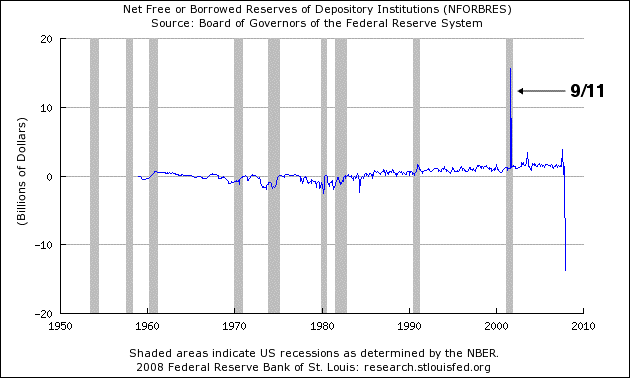
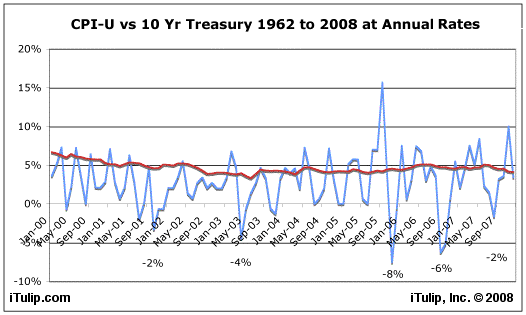
    It's not even clear to me at this point that a period of disinflation (falling rate of inflation), never mind outright deflation (negative inflation rate), will occur in this cycle. Last time around, there were two periods of reported negative inflation. The first occurred right after 9/11. The economy was just coming out of recession.

    2001 05 6.297
    2001 06 2.741
    2001 07 -2.007
    2001 08 0.000
    2001 09 4.839 <- (9/11)
    2001 10 -3.317 <- deflation
    2001 11 -0.674
    2001 12 -0.674
    2002 01 2.048
    2002 02 2.045

    The Fed responded with an emergency injection of reserves into the banking system.


    The second deflation scare, for the Fed not the bond markets, occurred 2003 - 2004.

    2003 02 6.785
    2003 03 4.680
    2003 04 -4.471
    2003 05 -0.653
    2003 06 1.318
    2003 07 2.649
    2003 08 4.667
    2003 09 3.301
    2003 10 -0.647
    2003 11 -1.290
    2003 12 3.297
    2004 01 4.631

    Did the treasury bond market in either instance suffer a "deflation scare"? A look at periods of actual deflation and yields on the 10 yr show the treasury bond market does not "scare" easily, if that is a meaningful term.


    Even a casual examination of the data, which I'm sure Pomboy has access to, shows that the 10 yr stays pretty well pegged around 5% come hell or high water even in the event of actual deflation, never mind impending deflation.

    But the more serious issue I have with this analysis is that it puts the risk of deflation ahead of the more obvious risk as the dollar sells off during this recession. Remember this chart?


    It shows how US consumers experience inflation as a mix of low cost imported goods from China and other low wage countries and high cost goods that cannot be gotten at a lower price via trade, including energy, insurance, medical care, and education. Our theory was that rising inflation among US trade partners, resulting from the US policy of exporting its inflation via dollar depreciation, would eventually feed back into imort prices.

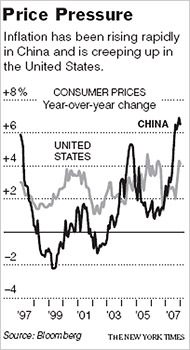
    Lo and behold, here comes the US inflation back at us. From today's NYTimes:

    China’s Inflation Hits American Price Tags
    China’s latest export is inflation. After falling for years, prices of Chinese goods sold in the United States have risen for the last eight months.

    Soaring energy and raw material costs, a falling dollar and new business rules here are forcing Chinese factories to increase the prices of their exports, according to analysts and Western companies doing business here.

    The rise was a modest 2.4 percent over the last year. But even that small amount, combined with higher energy and food costs that also reflect China’s growing demands on global resources, contributed to a rise in inflation in the United States. Inflation in the United States was 4.1 percent in 2007, up from 2.5 percent in 2006.

    Because of new cost pressures here, American consumers could see prices increase by as much as 10 percent this year on specific products — including toys, clothing, footwear and other consumer goods — just as the United States faces a possible recession.

    The current environment, recession and inflation, has been characterized in the press as "stagflation light." But what if the decline of the dollar turns out to be a simple function of the rate of decline of US consumer demand for imports from oil producers and Asia, and the inflation and recession processes are self reinforcing with no natural limitation? That is the "scare" that we should be worried about, not "deflation." We ought to worry about "Poom." At this rate, we're not even going to get a disinflationary "Ka" period.

    As a final note, and to inject a little humor into the discussion, here's our take on global "decoupling." In the fantasy of global decoupling of Soros the actual level of dependence on the US consumer to counter self-imposed demand deficits in China, Japan and other export countries is generally unappreciated, as is the dependence of the US on foreign borrowing to finance consumption and government spending. With 70% of US GDP produced by consumption, below is our representation of the relationship of the world to the US consumer. As the US consumers goes down, so goes the world economy.

    Last edited by FRED; February 02, 2008, 10:40 AM.

    Leave a comment:


  • Guest's Avatar
    Guest replied
    Re: Door Number Two

    Minor correction - Mr. Janszen seems to have inadvertently referred to Mr. Jim Puplava as a "deflationista"?:
    Originally posted by EJ View Post
    believe. Jim Puplava of Financial Sense is also a deflation spiral believer. ... We call the group Deflationistas. Deflationistas have repeatedly called for a deflation spiral and all-goods prices declines for the past several years, since at least 2005. ... Each oft repeated forecast of imminent price deflation has been contradicted by evidence of ever-increasing all-goods price inflation. You'd think repeated failures would send them back to the drawing board to try to figure out what went wrong but instead they keep doubling down. ...
    Jim Puplava has not ever been a "deflationista". He is 100% in sync with John Williams of Shadowstats, Marc Faber, Jim Rogers, Jack Crooks, and others espousing the inflationary imperative and the exact same dollar debasing opinions which iTulip espouses.


    http://www.financialsense.com/fsn/main.html Jan19th broadcast - 3rd hour - scan through to the last third of the hour to catch John Williams talking about the imperative for inflation with Puplava agreeing at every step. Anyone who has listened to even just one or two Puplava broadcasts knows Puplava is 110% "inflationista".

    It should be noted that Puplava's views (like those of quite a few sober-minded, erudite, and mis-quoted "Peak Oilers"? :rolleyes: ) are in fact extremely close in viewpoint to iTulip's own positions.
    Last edited by Contemptuous; February 02, 2008, 12:53 AM.

    Leave a comment:


  • World Traveler
    replied
    I Like the Reminders of iTulips Good Calls!

    Some of the posters here are true financial wizards and very knowlegeable in the ways of the financial world (I'm very impressed with them).

    But many of us are not! Sometimes we less sophisticated folks need that repetition just to remember the message, one Fred or EJ posting on a topic may not do the trick! Links in Fred or EJ posting to prior postings on the same topic are VERY helpful.

    I've reading iTulip since year 2000 and think it is the best, most foresighted in big picture analysis available. I also read several other financial websites daily and none come close to iTulip.

    I'm retired now and I'm just trying to hang onto what it took me a lifetime of work to earn and save.

    Keep up the good work, Fred and EJ!

    Leave a comment:


  • jk
    replied
    Re: Door Number Two

    Originally posted by FRED View Post
    It's a pretty weak analysis. Bonds at 6% don't have value? To whom?
    well, to me for one. you'll have to speak for yourself, fred.

    Originally posted by fred
    Captain Obvious says: Of course, the Fed is afraid of deflation.
    as i read it, pomboy is saying that the markets will suffer a deflation scare. the only mention of the fed is re: intervening to pull down long rates.

    Originally posted by fred
    Why are short rates are down? Because "markets" are forecasting recession or because of the Fed's liquidity flood? Why are long rates are down? Because "markets" are forecasting recession or because of the foreign central bank liquidity flood?
    are these either/or forced choices, fred? who says? and what do these questions have to do with the value of ms. pomboy's little piece?

    more generally, you can afford to be more gracious about the fact that there are others in the world who have thoughts, insights or perceptions worthy of consideration. i truly value what's offered here at itulip, witness the fact that i spend a significant amount of time here. it's special and valuable enough that you don't have to get caught up in jousting for "credit." res ipsa loquitur. relax.

    Originally posted by fred
    Here's a very thought provoking article by Jack Lifton today in Resource Investor, Why Gold can not be a hedge against inflation:
    Gold and silver are also not very good investments when compared with the basic, utilitarian metals, such as copper, lead, zinc, aluminium, tin, iron, yes, iron and nickel; the minor metals, such as cobalt, chromium, gallium, germanium, indium, selenium, tellurium, vanadium, rhenium, rhodium and ruthenium and the rare earth metals, all 16 of them; and the power metals, uranium and, coming very soon, thorium.

    Just look at what an investment in molybdenum in 1980 would have done for your net worth. As I recall molybdenum was selling for less than $3.00 per pound in 1980, in 1980 dollars. Today, conservatively, that price is 10 times that number. Therefore while inflation during that 28 years was 167% the price rise of molybdenum was 1,000%, so you would have multiplied your investment in real terms by around 7 times! Imagine if you were compounding!

    Interestingly enough the price of iron ore, the basis of our age of steel, in just the last five years has outpaced dollar inflation dramatically, so that if you had invested in iron ore just 5 years ago you might now be set for life.

    The coming recession is going to be led by the devaluation of the dollar. The recession will worsen as foreign producers of natural resources such as oil and metals decouple their prices from the U.S. dollar. This is going to literally destroy the ability of domestic producers to control the pricing of durable goods, such as cars and appliances, which are made from steel, and it will make specialty alloys made from imported metals such as cobalt, nickel and tungsten for tool steels and military armour and ammunition much more expensive.

    The end result will be a revival of nuclear power to reduce dependence of foreign oil and a slowdown of any rush to electric and hybrid cars as raw materials for batteries, other than lead-acid types, become wildly expensive in dollars.

    If you want to hedge your portfolio, therefore, in the near term, against the coming recession invest in American mining and oil companies with proven domestic reserves of accessible resources of energy, metals and minerals. The United States has sufficient domestic resources of oil, gas and coal; nickel and rare earths, iron ore, boron, lithium, copper, lead, zinc, germanium, selenium, tellurium, molybdenum, tungsten, chrome, vanadium, uranium and thorium to be independent of foreign sources of all of these to make all of the materials we need to sustain our way of life and preserve our economy. Also invest in recycling companies, which actually bring the metal values in scrap back to their original forms for re-use. The time for conserving energy and metals by simply not producing them is over. The time for shoring up the dollar is now.
    Forget gold and silver. Rhenium, ruthenium and rhodium, gallium, indium, germanium, selenium and tellurium taken all together are produced at a volume of 20%, by weight, globally of the amount of gold mined each year. Metals such as these are truly precious, and are irreplaceable in most of their industrial uses. Look for domestic American producers and recyclers of such metals and invest in them and ask your government to do the same.
    one problem is the difficulty is finding good ways to play these themes. another problem is that i expect industrial materials to sell off as the recession deepens, while gold can hold or even increase in price as investors see the tidal wave of dollars bearing down on us.

    Leave a comment:


  • FRED
    replied
    Re: Door Number Two

    Originally posted by jk View Post
    i'm not convinced that pomboy actually believes there will be deflation. that's why i posted her piece with the title "predicts deflation SCARE." to quote her: "Either way, the upshot will be to spur fears of deflation." [emphasis added to word "fears"]

    she runs an institutional advisory service and is focused on the financial markets more than the real economy. at least that is my impression.

    so she points out the breakdown in traditional pricing relationships. bonds going up as interest rates go down is traditionally associated with economic slowdown and declining inflation, while gold rising is normally associated with increasing inflation. but, as she points out, we have bonds and gold rising simultaneously. i would add that although we like to draw parallels to the stagflation of the '70s, bonds sold off over that period while gold was rising. in the '70s, bonds were eventually nicknamed "certificates of guaranteed confiscation" because the dollars they would return were "guaranteed" to be worth less than the dollars used to buy the bonds. so bonds rising while gold rises is something new.

    she predicts a long bond at 3%, but she is almost explicit in implying that this will NOT occur because of deflation. if we had real deflation, bonds would trade at low interest rates because the dollar was more valuable. in a deflation, bonds at 3% would have value. but she says that bonds at 6% don't have value. this is the case because of inflation. bonds will go to 3% because of fed intervention and/or a flight to safety in the context of a deflation SCARE, not a context of actual deflation.
    It's a pretty weak analysis. Bonds at 6% don't have value? To whom?

    Captain Obvious says: Of course, the Fed is afraid of deflation.

    Why are short rates are down? Because "markets" are forecasting recession or because of the Fed's liquidity flood? Why are long rates are down? Because "markets" are forecasting recession or because of the foreign central bank liquidity flood?

    Here's a very thought provoking article by Jack Lifton today in Resource Investor, Why Gold can not be a hedge against inflation:
    Gold and silver are also not very good investments when compared with the basic, utilitarian metals, such as copper, lead, zinc, aluminium, tin, iron, yes, iron and nickel; the minor metals, such as cobalt, chromium, gallium, germanium, indium, selenium, tellurium, vanadium, rhenium, rhodium and ruthenium and the rare earth metals, all 16 of them; and the power metals, uranium and, coming very soon, thorium.

    Just look at what an investment in molybdenum in 1980 would have done for your net worth. As I recall molybdenum was selling for less than $3.00 per pound in 1980, in 1980 dollars. Today, conservatively, that price is 10 times that number. Therefore while inflation during that 28 years was 167% the price rise of molybdenum was 1,000%, so you would have multiplied your investment in real terms by around 7 times! Imagine if you were compounding!

    Interestingly enough the price of iron ore, the basis of our age of steel, in just the last five years has outpaced dollar inflation dramatically, so that if you had invested in iron ore just 5 years ago you might now be set for life.

    The coming recession is going to be led by the devaluation of the dollar. The recession will worsen as foreign producers of natural resources such as oil and metals decouple their prices from the U.S. dollar. This is going to literally destroy the ability of domestic producers to control the pricing of durable goods, such as cars and appliances, which are made from steel, and it will make specialty alloys made from imported metals such as cobalt, nickel and tungsten for tool steels and military armour and ammunition much more expensive.

    The end result will be a revival of nuclear power to reduce dependence of foreign oil and a slowdown of any rush to electric and hybrid cars as raw materials for batteries, other than lead-acid types, become wildly expensive in dollars.

    If you want to hedge your portfolio, therefore, in the near term, against the coming recession invest in American mining and oil companies with proven domestic reserves of accessible resources of energy, metals and minerals. The United States has sufficient domestic resources of oil, gas and coal; nickel and rare earths, iron ore, boron, lithium, copper, lead, zinc, germanium, selenium, tellurium, molybdenum, tungsten, chrome, vanadium, uranium and thorium to be independent of foreign sources of all of these to make all of the materials we need to sustain our way of life and preserve our economy. Also invest in recycling companies, which actually bring the metal values in scrap back to their original forms for re-use. The time for conserving energy and metals by simply not producing them is over. The time for shoring up the dollar is now.
    Forget gold and silver. Rhenium, ruthenium and rhodium, gallium, indium, germanium, selenium and tellurium taken all together are produced at a volume of 20%, by weight, globally of the amount of gold mined each year. Metals such as these are truly precious, and are irreplaceable in most of their industrial uses. Look for domestic American producers and recyclers of such metals and invest in them and ask your government to do the same.

    Leave a comment:


  • jk
    replied
    Re: Door Number Two

    i'm not convinced that pomboy actually believes there will be deflation. that's why i posted her piece with the title "predicts deflation SCARE." to quote her: "Either way, the upshot will be to spur fears of deflation." [emphasis added to word "fears"]

    she runs an institutional advisory service and is focused on the financial markets more than the real economy. at least that is my impression.

    so she points out the breakdown in traditional pricing relationships. bonds going up as interest rates go down is traditionally associated with economic slowdown and declining inflation, while gold rising is normally associated with increasing inflation. but, as she points out, we have bonds and gold rising simultaneously. i would add that although we like to draw parallels to the stagflation of the '70s, bonds sold off over that period while gold was rising. in the '70s, bonds were eventually nicknamed "certificates of guaranteed confiscation" because the dollars they would return were "guaranteed" to be worth less than the dollars used to buy the bonds. so bonds rising while gold rises is something new.

    she predicts a long bond at 3%, but she is almost explicit in implying that this will NOT occur because of deflation. if we had real deflation, bonds would trade at low interest rates because the dollar was more valuable. in a deflation, bonds at 3% would have value. but she says that bonds at 6% don't have value. this is the case because of inflation. bonds will go to 3% because of fed intervention and/or a flight to safety in the context of a deflation SCARE, not a context of actual deflation.

    Originally posted by pomboy
    But talking about deflation in the abstract is very different from living it. From a macro trading standpoint the standard relationships will break down. Many already have. Like bonds and gold, the yield curve... and so on. I expect the euro will soon begin to trade inversely with rates (eg., the tighter the ECB the weaker the euro, because it virtually ensures they completely disintegrate). Meanwhile, in the US, the Fed, running out of room to cut short rates, will shift to the long end and US treasuries will move well below 3%. This isn't a statement about the value of Treasuries. Heck, there wasn't any value in Treasuries at 6%!! But that's not the point.

    Leave a comment:


  • bill
    replied
    Re: Door Number One or Door Number Two?

    With dollar purchase power sinking globally, driving US import resource cost up, an infrastructure expansion in the pipeline, domestic US

    http://www.resourceinvestor.com/pebble.asp?relid=40029
    31 Jan 2008 at 07:35 PM GMT-05:00 By Jack Lifton
    Now ask yourself, to paraphrase the words of the poet, “What rough beast slouches towards [Washington] waiting to be born?” For natural resources the answer is clearly price inflation from too much money, created in part by making the Fed Funds Rate too low, so that banks can ‘create money’ by borrowing it very cheaply and lending it out at higher rates, chasing the too few domestically produced natural resources, the shortages of which have resulted from, in great part, an anti-mining bias promoted by activist environmentalists who fix their sights on the past and refuse to accept the advances in health and safety that have occurred in the natural resources production sector in the last 30 years.
    Since our legislators, finance ‘experts’ and businessmen have systematically ignored the effects of the cornering of natural resources supplies by foreign nations and foreign businesses, which are not subject to the laws of the U.S. with regard to monopolization and price (fixing) controls, the U.S. consumer is about to discover that a rapid inflationary period is well under way, a great part of which is due to the necessity to import natural resources priced in inflating dollars, and that the only way to avoid massive natural resource driven price inflation is to slow down import demand while re-igniting the American natural resource machine.
    Yale economist Robert Schiller, who coined the term irrational exuberance, said last year that one way for ordinary people to eliminate the issue of oil price rises would be for them as individuals to buy barrels of oil and/or gasoline now and hold them to use as needed. The point he was making while impractical for an individual with limited investment capital, is in fact a prescription by which the U.S. Federal Government can reign in the costs of natural resources that can be produced domestically.
    The U.S. Federal Government could, for example, agree to buy the output of a domestic rare earth mine in U.S. dollars and hold the output in a strategic stockpile and then sell the material preferentially to domestic manufacturers for use in domestic production facilities only. The selling price in U.S. dollars from the government stockpile could reflect only the cost of acquisition and holding charges, in dollars. The American manufacturers using such materials would pay American workers in dollars and would be constrained to sell, as there contribution to using the government’s strategic stockpile, all or some part of their production in the U.S. at prices reflecting their domestic costs of raw materials. Exported products would of course sell for many more dollars due to the added value, on the world market, of the domestically produced, in dollars, natural resources. This is exactly what has been done in past emergencies due to war including every war and police action since 1917! In part this is still done by the U.S. Department of Defense, but the program needs to be expanded and upgraded with funding and expertise and given a civilian industrial strategic stockpile initiative.
    Last edited by bill; February 01, 2008, 04:28 PM.

    Leave a comment:

Working...
X