Announcement

Collapse
No announcement yet.

"We will heat our homes with your dollars!"

Collapse
X
 
  • Filter
  • Time
  • Show
Clear All
new posts

  • algerwetmore
    replied
    Re: "We will heat our homes with your dollars!"

    Originally posted by EJ View Post
    Indeed the Perot's and Paul's influence the debate from outside the two main parties or in the case of Paul from within. However, once elected, the performance of Presidents of either of the two parties has become increasingly indistinguishable over the past 20 years. They are all FIRE Economy presidents.

    To the point of the article, in the days of party politics, not coincidentally before the development of the FIRE Economy, one party or the other would seize upon the depreciation of the dollar to score points with voters. My point is that neither party is doing this today as a party issue. One reason is that voters don't understand or care. The other is that dollar depreciation has occurred more under both parties.
    It is interesting that when any President of the U.S. threatens to print money outside of the Federal Reserve or any central bank that TPTB
    do not take kindly to that message.
    I did not realize that JFK (a democrat) had threatened to authorize congress to print greenbacks outside of the Federal Reserve system, much like what Lincoln(a republican) had proposed a hundred years earlier.
    I suspect that though Ron Paul's message to abolish the IRS and other government institutions is seductively attractive, the media has long been coached to dismiss such common-sense rhetoric as naive and sophmoric.

    Leave a comment:


  • metalman
    replied
    Re: "We will heat our homes with your dollars!"

    Originally posted by FRED View Post
    Dollar slide pushes UAE to currency-peg crossroads
    November 13, 2007 (Masayuki Kitano - REUTERS)

    TOKYO – The United Arab Emirates is at a “crossroads” on the dirham's dollar peg, the central bank said on Tuesday in the clearest signal yet that the U.S. currency's slide is forcing Gulf oil producers to review exchange rates.

    The euro rose 15 ticks against the dollar after Central Bank Governor Sultan Nasser al-Suweidi's remarks raised expectations that the UAE, Saudi Arabia and three neighbours were looking to unshackle their currencies from the dollar as Kuwait did in May.

    Currencies also rallied across the world's biggest oil exporting region, although Suweidi said any policy shift would be decided by the rulers of the six Gulf states preparing for monetary union as early as 2010.

    Given the bleak outlook for the dollar and the U.S. economy, the six could consider tracking a currency basket rather than the greenback, he said, without making clear whether that could happen before or after monetary union.

    “The dirham's peg to the U.S. dollar has served the economy of the UAE very well in the past,” Suweidi said in a speech hosted by the Japan Bank for International Cooperation and the Japan Institute for Overseas Investment in Tokyo.

    “However, we have reached a crossroads now with a further deterioration in the U.S. dollar and expected further weakening of the U.S. economy,” he said.

    Dollar pegs force Gulf central banks to track U.S. monetary policy to maintain the relative value of their currencies, at a time when Federal Reserve is cutting rates and inflation in the Gulf is running at decade highs.
    dollar down and gold and oil up on the news. time to crank up the beegees

    Leave a comment:


  • FRED
    replied
    Re: "We will heat our homes with your dollars!"

    Dollar slide pushes UAE to currency-peg crossroads
    November 13, 2007 (Masayuki Kitano - REUTERS)

    TOKYO – The United Arab Emirates is at a “crossroads” on the dirham's dollar peg, the central bank said on Tuesday in the clearest signal yet that the U.S. currency's slide is forcing Gulf oil producers to review exchange rates.

    The euro rose 15 ticks against the dollar after Central Bank Governor Sultan Nasser al-Suweidi's remarks raised expectations that the UAE, Saudi Arabia and three neighbours were looking to unshackle their currencies from the dollar as Kuwait did in May.

    Currencies also rallied across the world's biggest oil exporting region, although Suweidi said any policy shift would be decided by the rulers of the six Gulf states preparing for monetary union as early as 2010.

    Given the bleak outlook for the dollar and the U.S. economy, the six could consider tracking a currency basket rather than the greenback, he said, without making clear whether that could happen before or after monetary union.

    “The dirham's peg to the U.S. dollar has served the economy of the UAE very well in the past,” Suweidi said in a speech hosted by the Japan Bank for International Cooperation and the Japan Institute for Overseas Investment in Tokyo.

    “However, we have reached a crossroads now with a further deterioration in the U.S. dollar and expected further weakening of the U.S. economy,” he said.

    Dollar pegs force Gulf central banks to track U.S. monetary policy to maintain the relative value of their currencies, at a time when Federal Reserve is cutting rates and inflation in the Gulf is running at decade highs.

    Leave a comment:


  • jimmygu3
    replied
    Re: "We will heat our homes with your bonars!"

    Originally posted by rj1 View Post
    Inflation question. Is it absolute or relative, or does absolute inflation matter?
    This reminds me of a physics question I once heard, asking what would appear different if everything in the universe increased in size tenfold. Though my immediate reaction was that the relative relationships between planets, objects, blood cells, etc. would be the same, a deeper look reveals that gravity would have a much greater influence than in the smaller universe, creating earthquakes and terrific calamity as the Earth is sent hurtling toward the sun.

    So, yes, absolute inflation matters. If all currencies inflate in tandem, exchange rates remain stable, but debts are repaid with devalued paper with less purchasing power. Interest rates must rise to include an inflation premium, putting strain on economic growth. Slowing economies and scarce jobs may keep wages down even as goods prices rise.

    I'm trying to figure out how the "Earth is sent hurtling toward the sun" part of the analogy works. I suppose it's an international fire sale of assets to those with cash. Ten years ago I would say the US was the sun. Perhaps China is the sun now?

    Jimmy

    Leave a comment:


  • jk
    replied
    Re: "We will heat our homes with your dollars!"

    Originally posted by Lukester View Post
    This is where I get an iTulip smackdown for being impertinent ... (gulp! )

    the dollars might be better quality for that purpose than what they're using now.

    Leave a comment:


  • Guest's Avatar
    Guest replied
    Re: "We will heat our homes with your dollars!"

    This is where I get an iTulip smackdown for being impertinent ... (gulp! )


    Sarkozydollars_REDUX.jpeg.jpg

    Leave a comment:


  • FRED
    replied
    Re: "We will heat our homes with your dollars!"

    Originally posted by metalman View Post
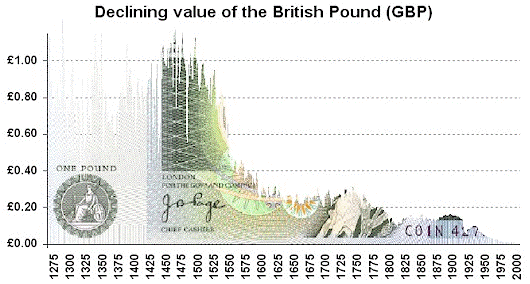
    good one. wonder what the brit bond yield curve looked like as the brit empire started to unravel.

    Leave a comment:


  • EJ
    replied
    Re: "We will heat our homes with your dollars!"

    Originally posted by MLM View Post
    The last time there was a serious "third party" was Perot, and I believe that Clinton sized up the major issues (the federal deficit in particular) Perot was running on and changed course to address them.

    I'd say you've got it right that the system is still in relatively good shape.

    “The fault, dear Lukester, lies not in our stars, but in ourselves.”
    Indeed the Perot's and Paul's influence the debate from outside the two main parties or in the case of Paul from within. However, once elected, the performance of Presidents of either of the two parties has become increasingly indistinguishable over the past 20 years. They are all FIRE Economy presidents.

    To the point of the article, in the days of party politics, not coincidentally before the development of the FIRE Economy, one party or the other would seize upon the depreciation of the dollar to score points with voters. My point is that neither party is doing this today as a party issue. One reason is that voters don't understand or care. The other is that dollar depreciation has occurred more under both parties.

    Leave a comment:


  • *T*
    replied
    Re: "We will heat our homes with your dollars!"

    Originally posted by NemoPublius View Post
    Is there any evidence of this so far? 30-year Treasuries yield 4.6%, for crying out loud.

    All other indicators of excessive money creation (i.e. inflation) are here, except for those stubborn bonds. I have yet to read a convincing explanation -- with some evidence to back it up -- for how this can be.
    Very puzzling.
    China, other FCBs pegging explains the anomalous demand at the back end of the yield curve. I like Brad Setser for analysis on this. FCBs won't be stopping anytime soon. Until then, let's party like it's 1929!

    Leave a comment:


  • Guest's Avatar
    Guest replied
    Re: "We will heat our homes with your dollars!"

    Hey Metalman - sorry to bend your ear!

    You know what, I'm not a bleeding heart patriot with my heart on my sleeve either! They can take the whole sorry mess and do whatever the F*** they want with it.

    I'm gonna bail out of here one of these days and go live in Malta, or Cyprus or someplace (maybe the Galapagos Islands?) and tell America and it's beautiful constitution, which we've trashed with apathy and unholy debt, to go get stuffed. So there!


    P.S. And yes I realise this is all hopelessly off-topic. I'll harder try to stay on topic in the future - really ...

    Leave a comment:


  • MLM
    replied
    Re: "We will heat our homes with your dollars!"

    The last time there was a serious "third party" was Perot, and I believe that Clinton sized up the major issues (the federal deficit in particular) Perot was running on and changed course to address them.

    I'd say you've got it right that the system is still in relatively good shape.

    “The fault, dear Lukester, lies not in our stars, but in ourselves.”

    Leave a comment:


  • GRG55
    replied
    Re: "We will heat our homes with your dollars!"

    Originally posted by c1ue View Post
    RJ,

    It depends on who you are.

    If you are in the country with higher inflation, then it is absolute inflation which matters.

    If you are outside of the country in question, then relative inflation matters - but not in the way you think.

    In this case, the change in prices of goods times volume, then compared to your own economy, is what matters.

    Think of it this way: When the US had a strong dollar and Mexico went through their peso crisis, Mexico's problems had very little effect on the US since the US/Mexico trade was small and furthermore it was Mexico with the inflation problem.

    However, if the US has an inflation problem, you can be pretty sure Mexico is affected as the same relative trade has a much larger impact on Mexico.

    Thus our present devaluation/inflation is affecting everyone else in the world since the US is the big boy in terms of trade.

    My mental analogy uses ice and fire as an example. Fire represents inflation; if your chunk of ice is on fire and sitting next to a big chunk of ice, the big chunk of ice doesn't get affected much. If you are the small piece of ice next to a large flaming glacier, well, you're going to get melted!
    It's hard to think of these tiny desert sheikhdoms in the Arabian Gulf as "little chunks of ice" (it's November and I'm still running the air conditioners in my home), but your point is amply illustrated by the imported inflation, amplified by the pegged currencies, being experienced here half way around the world from the USA.

    Leave a comment:


  • rj1
    replied
    Re: "We will heat our homes with your dollars!"

    Originally posted by FRED View Post
    EJ asked me to post:


    qwerty posted the following link last week. The story addresses your question.
    The Prime Minister, Harold Wilson, has defended his decision to devalue the pound saying it will tackle the "root cause" of Britain's economic problems.

    The government announced last night it was lowering the exchange rate so the pound is now worth $2.40, down from $2.80, a cut of just over 14%.

    The decision came after weeks of increasingly feverish speculation and a day in which the Bank of England spent £200m trying to shore up the pound from its gold and dollar reserves.

    In a radio and television broadcast this evening, the Prime Minister said devaluation would enable Britain to "break out from the straitjacket" of boom and bust economics.
    It does not mean that the pound here in Britain, in your pocket or purse or in your bank, has been devalued."

    - Prime Minister Harold Wilson
    The only alternative, he said, was to borrow heavily from governments abroad - but the only loans on offer were short-term ones.

    The government inherited an £800m deficit from the Conservatives when it was elected three years ago.

    Mr Wilson said Labour had managed to reduce the deficit, but the cost of hostilities in the Middle East, the closure of the Suez Canal and the disruption to exports through the dock strikes had contributed to the strain on sterling.

    He said: "Our decision to devalue attacks our problem at the root and that is why the international monetary community have rallied round.

    "From now the pound abroad is worth 14% or so less in terms of other currencies. It does not mean, of course, that the pound here in Britain, in your pocket or purse or in your bank, has been devalued.

    "What it does mean is that we shall now be able to sell more goods abroad on a competitive basis."

    The argument is nonsense and the opposition party jumped all over it.
    Conservative leader Edward Heath has also appeared on television to reply to Mr Wilson's broadcast.

    He accused the Labour Government of failing in one of its foremost duties - to safeguard the value of the country's money.

    He said: "Having denied 20 times in 37 months that they would ever devalue the pound, they have devalued against all their own arguments."
    Needless to say, the devaluation did NOT address the "root" problem. The "root" problem was that Britain had not yet dealt with the consequences of the reverse of capital flows from its former colonies that resulted after its empire ended in 1948 and continued to live beyond its means. Britain's economy finally hit bottom nine years later on September 29, 1976 when Britain under PM Callaghan applied to the IMF for a loan of $3.9 billion. To get an idea of how much money that was, in 1971 when the US defaulted on its gold obligations, it owed the world $50 billion. Today it owes $5 trillion. If the US were to need an emergency international loan under similar circumstances today, it would need to borrow on the order $4 trillion.

    National currency devaluations and are always moves of desperation. Under the floating exchange rate system, these are no longer acknowledged as there is no drain on gold from the nation's treasury to explain. Two important points. One, the vast majority of the US population is too unaware of the consequences of dollar devaluation for President Bush to need to explain the 33% devaluation of the dollar against the euro since 2002 in the way Prime Minister Harold Wilson needed to explain a 14% devaluation to the British people in 1967. In fact, Bush's Treasury Secretary Henry Paulson continues to lie about the fact, at least "20 times in 37 months." Second, under the US single party state there is no need to apologize for fear of attack by the opposition party. There is no opposition party, and either party will do the same.

    The question is, once the US is no longer able to sell long term bonds to Asia, Europe, and oil producing countries in amounts needed to support domestic spending and US leadership is forced by circumstances to stop lying about the fact, what will they do?

    That is the real question we have been discussing here all these years.
    But are Bernanke and Paulson devaluing the dollar just as an ill-fated attempt at propping up manufacturing? I have to think that cannot be just it, as manufacturing has suffered for a long time, and no one in power really cared, there has to be something more.

    Leave a comment:


  • Guest's Avatar
    Guest replied
    Re: "We will heat our homes with your dollars!"

    Metalman -

    That's no kind of proof at all. The fact you discern almost complete "cloned" homogeneity of views between one party and the other substantively does not remotely demonstrate that the institutional structures are any less than fully functioning to allow a multi-party functioning republic.

    I have yet to see the tough, factual arguments demonstrating exactly where the electoral process has set up impenetrable barriers to a popular backlash against the status quo. Where is it exactly that the institutional mechanisms now clearly block a grassroots party from introducing a change agenda?

    Monotonous or brainwashed similarity of views between the two major political groups has little or nothing to do with the legal and electoral structures of a democratic state. What afflicts the US today is a moral failure. The institutions still largely hold, and that's a huge difference.

    I read many descriptions on this website which openly suggest it's a one party state here. I think these opinions would undergo a drastic change and lose their "tenderness" towards our current constraints, if they were ever char-broiled by a genuinely one-party state environment.

    I'm completely open to being wrong - I just haven't seen the convincing argument for it yet. The malady is moral, it's within the electorate - not within the institutions. Curiously, that is almost the more fatal illness of the two. However, it does not by any means describe a 'one-party state'.

    Leave a comment:


  • jk
    replied
    Re: "We will heat our homes with your dollars!"

    Originally posted by NemoPublius View Post
    Is there any evidence of this so far? 30-year Treasuries yield 4.6%, for crying out loud.

    All other indicators of excessive money creation (i.e. inflation) are here, except for those stubborn bonds. I have yet to read a convincing explanation -- with some evidence to back it up -- for how this can be.
    Very puzzling.
    2 possible factors i can think of:

    1. pension funds, burned by the 2001-02 bear market, found religion in the form of matching their assets and their liabilities, so need long duration instruments and are relatively price insensitive in this pursuit.

    2. deflation believers. gary shilling, for example, still is recommending long bonds on the theory that we're headed into deflation. he's been recommending long bonds for a long time and, so far, he's been right. with the financial system under obvious stress, some investors will buy duration instead of just going with tbills.

    Leave a comment:

Working...
X