
Re: Bernanke: Talks the Dove, Acts the Hawk
Dialing down the discount rate will incentivize them to intermediate more as I read it.
I keep thinking:
Gozar the Gozarian hath spoken to the American Economy, "Choose the form of your Destructor!"
The choice made is this modified Discount Window-Primary Dealer OMO model. It's no Stay-Puffed Marshmallow Man.
The moral hazard is now concentrated in these Four Horsemen. If this works, it looks like they will be the prime beneficiaries of the "more orderly" disinflation of asset prices. BoA's $2B convertible preferred in CFC should give them a prime seat at CFC's bankruptcy table. Choice pickings? Maybe Sapiens and Tet are getting in my head but, this looks more like the "land grab" they were alluding to on another thread.
-
Re: Bernanke: Talks the Dove, Acts the Hawk
If what happened with CFC and BoA is an indicator of how this is going to play out, it will fail. The banks are just too greedy.Leave a comment:
-
Re: Bernanke: Talks the Dove, Acts the Hawk
the blog "sudden debt"
http://suddendebt.blogspot.com/
makes a good point about this program:
so, who wants to hold the garbage loans? or, more precisely, what will incentivize the citi's and boa's to intermediate?Originally posted by sudden debtLeave a comment:
-
Re: Bernanke: Talks the Dove, Acts the Hawk
Originally posted by EJ View PostDoesn't seem to be much of a market, at least so far.WASHINGTON (MarketWatch) -- Few U.S. banks have taken advantage of the Federal Reserve's offer last Friday to lend them unlimited amounts of money at 5.75%, Fed data released Thursday show.
As of Wednesday, outstanding loans from the Federal Reserve's discount window totaled $2 billion, exactly the amount four major banks said Wednesday that they had borrowed to show solidarity with the Fed's attempt to ease the crunch on short-term credit.
The Fed is probably disappointed, economists said.
"We suspect that the Fed would ultimately like to see $20 billion -- or even $50 billion -- of discount-window borrowing," wrote David Greenlaw, an economist for Morgan Stanley, ahead of the Fed status report. To get that much liquidity, it might take a much lower discount rate, perhaps 5.25%, Greenlaw said.Leave a comment:
-
Re: Bernanke: Talks the Dove, Acts the Hawk
Bernanke is said to have been one of the chief proponents of the idea that the Fed shouldn't target asset prices. See, for example, http://www.princeton.edu/~bernanke/asset.doc. Clearly an idea endorsed by Greenspan circa 1995-1999. Since, as I've argued extensively here at iTulip, asset prices lead those for consumer goods, that they're in effect the canary in the inflation mine, it would be a welcome development if Bernanke's views on the matter have changed.
"Welcome to the Open Market Operations Fed or OMOF. It's motto: Liquidity Without Asset Price Inflation." The Bernanke Fed at least seems to be trying. The new discount window strategy is an admirably clever and out of the box use of a tool that has been gathering dust in relative obscurity for so many years. If it can be used in such a limited way as to grease the sticky wheels in credit markets without encouraging further asset price inflation, it could turn out to have been a stroke of genius.
That said, it seems almost inevitable that the Fed will be under tremendous pressure to countenance higher inflation. Even in the 1970s, the US was a net creditor to the rest of the world. It is now a net debtor to the tune of trillions of dollars. Unless it outright defaults - not exactly an attractive option itself - the only way to mitigate that debt burden would be to pay it off in depreciated dollars. Inflation of course has problems of its own, not least further reinforcing debt as a way of life for the American consumer and therefore yet further aggravating the original problem, but the prospect of a US willing to consuming less than it produces in order to retire debt the old fashioned way seems unlikely any time soon.Leave a comment:
-
Re: Bernanke: Talks the Dove, Acts the Hawk
It's up to the market made by the credit-worthy banks what is and isn't valued. Read the doc, but my interpretation is that anything goes as long as the bank is willing to buy it from the hedge fund to use as collateral for a loan. Of course, the bank makes money doing this. Citibank, BoA, etc., ain't stupid.Originally posted by jk View Post
Not just waiting. At least one cut is priced in. My best guess is that when the markets finish processing this major change in Fed policy, the dollar rises. Unless the new FOMO Fed regime fails, in which case not only a rate cut but several will be needed. Then the dollar tanks.2. what are the implications for the dollar? everyone and his brother have been waiting for the fed to cut and assuming that the dollar would dive post haste. long term, it's hard to see the dollar holding value against THINGS, but it might certainly hold value and ?even appreciate against other pieces of paper. your thoughts?Leave a comment:
-
Re: Bernanke: Talks the Dove, Acts the Hawk
2 points:
1. the fed, lowering the discount rate said it would accept mbs, but my understanding is that that meant only mortgages with federal guarantees. not cdo's stuffed with subprime interest only, neg-am, option arms. so i'm not sure that your friendly neighborhood hedge fund is going to be able to borrow on holdings like that. does this fit with your understanding, ej?
2. what are the implications for the dollar? everyone and his brother have been waiting for the fed to cut and assuming that the dollar would dive post haste. long term, it's hard to see the dollar holding value against THINGS, but it might certainly hold value and ?even appreciate against other pieces of paper. your thoughts?Leave a comment:
-
Bernanke: Talks the Dove, Acts the Hawk
Bernanke: Talks the Dove, Acts the Hawk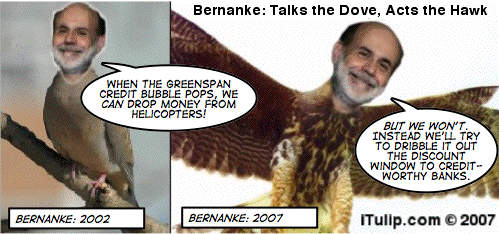
On the Goldman Sachs client call last week, we heard ex-Fed governor Larry Meyer intone that the Fed intended to stop the credit bubble collapse using the discount window in new and creative ways, providing liquidity selectively without lowering the Fed funds rate and flushing the whole system with money, Greenspan-style.
We have long wondered how the Bernanke Fed planned to fight an asset price deflation. As expressed in No Deflation. Disinflation followed by lots of inflation, we heard the Fed saying it planned to fight asset price deflation using every trick in the book, and then a few that aren't in the book.
Now we appear to have our answer, or at least a good part of it. What the Bernanke Fed has for the past few weeks been trying to do is prevent a runaway asset price deflation, keep the banking system whole, and at the same time not create a moral hazard by bailing out speculators who should be allowed to fail, all without producing excess liquidity that will lead to another set of asset bubbles.
Here's the Fed's program.
Federal Reserve Bank of New York Staff ReportsWhat is says is that there will be no Fed Funds rate cut in response to the credit bubble collapse. The easy money Greenspan Fed put is gone. Welcome to the Open Market Operations Fed or OMOF. It's motto: Liquidity Without Asset Price Inflation.
Rediscounting under Aggregate Risk with Moral Hazard - Staff Report no. 296 - August 2007
James T. E. Chapman and Antoine Martin
This paper presents preliminary findings and is being distributed to economists and other interested readers solely to stimulate discussion and elicit comments. The views expressed in the paper are those of the authors and are not necessarily reflective of views at the Federal Reserve Bank of New York or the Federal Reserve System. Any errors or omissions are the responsibility of the authors.
Mechanically, here's how it works. The Fed will only do business directly with banks that maintained good loan practices and are the most credit-worthy. Lenders of various flavors such as investment banks and hedge funds that took on a lot of bad loans can only deal with the banks that deal directly with the Fed. They do not have access to the new and improved discount window on their own. The credit-worthy banks can use the weak creditors' assets as collateral to borrow from the Fed.
For example, a distressed hedge fund can't access the Fed directly but can take the mortgage-backed securities they hold and bring them to a credit-worthy bank that does have access to the Fed. That bank uses the paper as collateral for a one month loan. That's why Bank of America, Wachovia, Citigroup, and JP Morgan all hit up the discount window at the same time, each for the same $500 million amount yesterday, to let hedge funds and others know where to go to put up their asset backed securities and CDOs and other paper as collateral for loans. The banks borrow from the Fed, and the hedge funds borrow from the banks. Hedge funds and others can still fail, but in an orderly way versus a simultaneous dumping of assets into a frozen market. The Fed can turn the discount window knob as need to control the rate of failure, averting the dreaded "break in the chain of payments."
While its too early to call an all-clear on the debt deflation at the top of the debt pyramid, evidence is that this new system is working–so far. Even the secondary market in CDOs is opening up, as we heard from a company that structures them that contacted us yesterday. While these events are not definitive, we will use the occasion to invite our respected friends Mish and Rick Ackerman, who were expecting at this point in the process an uncontrolled deflation, to come over the dark side, the one that acknowledges that central banks have a big bag of tricks to fight asset price deflation. C'mon down, boys!
Of course, there are still plenty of signs that the debt default danger is far from over, even at the top where cures can be targeted and the crisis is thus more readily managed. iTuliper Charles Mackay posted this note today from Justin Oliver at Canaccord Adams:The unprecedented spread between US TBill and LIBOR rates is suggesting a heretofore unseen attack on the global financial system. There is clearly something going on that the large banks are privy to, that we are not as they are clearly not willing to lend to each other without a massive risk premium. It is inconceivable that equities can continue to trade relatively unaffected by a complete backing up of the credit markets.For now the new OMOF approach appears to be succeeding, but it is far too early to say whether this approach, while very clever, will ultimately allow $13 trillion in fictitious value in the housing market dissipate without causing significant damage to either the credit markets or economy. There remain millions of homeowners underwater on their mortgages.
Today iTulip's recently appointed new ShadowFed Chairman Finster discusses Bill Gross's appeal today to the Bush administration to bail out homeowners for prevent a "destructive housing deflation."Pimco's Gross Urges Bush to Bail Out U.S. Homeowners... with taxpayer moneyIf Gross is asking, clearly at the street level a bailout is needed that the OMOF system will not address.
Today Bloomberg published the following report.Pimco's Gross Urges Bush to Bail Out U.S. HomeownersLet’s dig into this a little bit.
By Patricia Kuo
Aug. 23 (Bloomberg) -- Bill Gross, manager of the world's biggest bond fund at Pacific Investment Management Co., urged the Bush administration, rather than the Federal Reserve, to bail out U.S. homeowners to avoid ``destructive housing deflation.''
Pimco's Gross Urges Bush to Bail Out U.S. HomeownersNo, Bill. Bush doesn’t have that kind of money.
Gross advised President George W. Bush to set up a ``Reconstruction Mortgage Corporation'' and ``write some checks'' to bail out homeownersOh … I see. You want Bush to use MY money. How generous of you. more...
What are the implications of OMOF for the equity markets? Short term negative, and long term negative.
Short term, markets have priced in at least one rate cut. If it's needed, that's because the U.S. economy has fallen into recession; the drop in primary demand that is now pushing down oil prices has created self-reinforcing recessionary processes in the economy. Long term, markets have already priced in a Next Bubble, as if Greenspan were still in charge. Markets are still digesting this new evidence that the new Fed chair who rode in on a helicopter full of money turns out to be the first asset inflation fighter we've seen in over 20 years.
He talks dove and acts the hawk. What does this mean long term? We don't know yet. But it looks like our expectations of creative asset deflation management were well founded. And, as usual, you heard it here first.
iTulip Select: The Investment Thesis for the Next Cycle™
__________________________________________________
Special iTulip discounted subscription and pay services:
For a book that explains iTulip concepts in simple terms see americasbubbleeconomy
For macro-economic and geopolitical currency ETF advisory services see Crooks on Currencies
For macro-economic and geopolitical currency options advisory services see Crooks Currency Options
For the safest, lowest cost way to buy and trade gold, see The Bullionvault
To receive the iTulip Newsletter or iTulip Alerts, Join our FREE Email Mailing List
Copyright © iTulip, Inc. 1998 - 2007 All Rights Reserved
All information provided "as is" for informational purposes only, not intended for trading purposes or advice. Nothing appearing on this website should be considered a recommendation to buy or to sell any security or related financial instrument. iTulip, Inc. is not liable for any informational errors, incompleteness, or delays, or for any actions taken in reliance on information contained herein. Full DisclaimerLast edited by FRED; August 24, 2007, 12:39 PM.


Leave a comment: