Announcement

Collapse
No announcement yet.

Economic MAD approaching its logical conclusion?

Collapse
X
 
  • Filter
  • Time
  • Show
Clear All
new posts

  • Jay
    replied
    Re: Economic MAD approaching its logical conclusion?

    Originally posted by dbarberic View Post
    This ship is not going to turn around easy.

    Leave a comment:


  • chr5648
    replied
    Re: Economic MAD approaching its logical conclusion?

    Originally posted by dbarberic View Post
    This ship is not going to turn around easy.
    That is a big assumption, to think this monstrosity is going to turn.

    Leave a comment:


  • dbarberic
    replied
    Re: Economic MAD approaching its logical conclusion?

    Originally posted by jk View Post
    i thought you were saving the unrealistic optimistic scenarios for the general public. things are going to have to get pretty terrible here before these things become conceivable, let alone accomplished.

    I agree. RE is 1/3 of the FIRE animal and its interests are still entrenched throughout government, quasi-government agencies, and public mindset. This ship is not going to turn around easy.

    The system is so rotten to the core, that it must be destroyed before it can be rebuilt. Perhaps the elimination of RE subsidizes is part of the rebuild, but its not going down without a fight and a lot more pain ahead is necessary to be the impetus for real change.

    Leave a comment:


  • Jeff
    replied
    Re: Economic MAD approaching its logical conclusion?

    QUOTE
    Instead of beating up our trade partners to sacrifice more to improve our weak export position, we need to boost our private sector to be more competitive. We can do it by investing in transportation, energy, and communications infrastructure that drives private companies to compete for projects and to develop new technologies and lowers the energy tax on consumers and producers. We need to reduce taxes and remove obstacles that hamper entrepreneurs: zero payroll taxes, zero capital gains taxes, and zero health insurance costs for companies under 50 employees. Call it the zero, zero, zero plan. It will be paid for by eliminating government subsidies to the housing industry. From the looks of things, that's coming.
    UNQUOTE


    Eric, I'm with you on dropping payroll taxes and health insurance costs (I assume you somehow mean for entrepreneurs, rather than every hedge fund that shows up for a hand out) but how does the capital gains tax harm entrepreneurs? A mere 15% on holdings over a year old has been a fine thing, and hardly seems a burden.

    Leave a comment:


  • vinoveri
    replied
    Re: Economic MAD approaching its logical conclusion?

    Originally posted by EJ View Post
    [B]e. We can do it by investing in transportation, energy, and communications infrastructure that drives private companies to compete for projects and to develop new technologies and lowers the energy tax on consumers and producers. We need to lower taxes and other costs that hamper entrepreneurs: zero payroll taxes, zero capital gains taxes, and zero health insurance costs for companies under 50 employees. Call it the zero, zero, zero plan. It will be paid for by eliminating government subsidies to the housing industry. From the looks of things, that's coming.
    Right on. Great Idea.
    CSPAN should invite you for one of their early morning interviews regarding your book and these ideas. Appreciate the leadership.

    Leave a comment:


  • Jay
    replied
    Re: Economic MAD approaching its logical conclusion?

    Originally posted by EJ View Post
    Decades old housing subsidies will in the coming years be dumped onto the ash heap of politically motivated, destructive and destabilizing economic policies along with protectionist auto import tariffs in the 1970s that resulted over-priced, low quality cars for consumers, especially from Chrysler.
    This makes me happy from a philosophical standpoint and for selfish personal reasons as a renter, that being said, this is going to implode recapitalized bank balance sheets and wreck the commercial paper market. We will be looking at what, in my mind, will be a larger deleveraging than what we saw in 2008. YIKES!!

    Leave a comment:


  • jk
    replied
    Re: Economic MAD approaching its logical conclusion?

    the somewhat subtle currency war easily morphs into a more overt trade war. that sure solves the "deflation problem" the fed's worried about- everyday higher prices.

    Leave a comment:


  • we_are_toast
    replied
    Re: Economic MAD approaching its logical conclusion?

    So do we allow China to implement it's version of Smoot–Hawley, while we stand by and watch our businesses pay the price of unfair competition?

    Amid Tension, China Blocks Vital Exports to Japan

    ...

    Chinese customs officials are halting shipments to Japan of so-called rare earth elements, preventing them from being loading aboard ships at Chinese ports, industry officials said on Thursday.

    On Tuesday, Prime Minister Wen Jiabao personally called for Japan’s release of the captain, who was detained after his vessel collided with two Japanese coast guard vessels about 40 minutes apart as he tried to fish in waters controlled by Japan but long claimed by China. Mr. Wen threatened unspecified further actions if Japan did not comply.

    A Chinese Commerce Ministry spokesman declined on Thursday morning to discuss the country’s trade policy on rare earths, saying only that Mr. Wen’s comments remained the Chinese government’s position. News agencies later reported that Chen Rongkai, another ministry spokesman, had denied that any embargo had been imposed.

    ...

    The United States, the European Union and Mexico brought W.T.O. complaints against China last November after it issued regulations limiting the export of yellow phosphorus and eight other industrial materials. American trade officials have been considering for months whether to challenge China’s longstanding and increasingly tight quotas on rare earth exports as well.

    China mines 93 percent of the world’s rare earth minerals, and more than 99 percent of the world’s supply of some of the most prized rare earths, which sell for several hundred dollars a pound.

    Dudley Kingsnorth, the executive director of the Industrial Minerals Company of Australia, a rare earth consulting company, said that several executives in the rare earths industry had already expressed worries to him about the export ban. The executives have been told that the initial ban lasts through the end of the month, and that the Chinese government will reassess then whether to extend the ban if the fishing captain still has not been released, Mr. Kingsnorth said.

    “By stopping the shipments, they’re disrupting commercial contracts, which is regrettable and will only emphasize the need for geographic diversity of supply,” he said. He added that in addition to telling companies to halt exports, the Chinese government had also instructed customs officials to stop any exports of rare earth minerals to Japan.

    Leave a comment:


  • jk
    replied
    Re: Economic MAD approaching its logical conclusion?

    Originally posted by ej
    Decades old housing subsidies will in the coming years be dumped onto the ash heap of politically motivated, destructive and destabilizing economic policies along with protectionist auto import tariffs in the 1970s ..
    i thought you were saving the unrealistic optimistic scenarios for the general public. things are going to have to get pretty terrible here before these things become conceivable, let alone accomplished.

    Leave a comment:


  • EJ
    started a topic Economic MAD approaching its logical conclusion?

    Economic MAD approaching its logical conclusion?

    Two stories today indicate the beginning of the end of the long period of tense stability produced by Economic MAD.
    House panel approves China currency bill

    (Reuters) - A congressional panel, in a move likely to increase trade tensions with China, approved on Friday a bill that allows the United States to slap duties on goods from countries with fundamentally undervalued currencies.

    Big Yuan Rise Would Mean Bankruptcies: Chinese Premier

    An appreciation of 20 percent in China's currency would cause widespread bankruptcies in China's export sector, where firms operate on thin margins, Chinese Premier Wen Jiabao said on Wednesday.

    "The conditions for a major appreciation of the renminbi do not exist," Wen said in a speech to U.S. businessmen in New York. He said the appreciation of China's currency demanded by U.S. lawmakers would not bring jobs back to the United States because U.S. firms no longer make such labor-intensive products.
    AntiSpin: More bad craziness from our economic policy leadership. This is Smoot-Hawley version 2.0.

    The Smoot–Hawley Tariff Act of 1930 turned a major recession into The Great Depression by launching a trade war in the middle of a global downturn. World trade fell by 66% between 1929 and 1934.

    As Milton Friedman said, governments never learn.

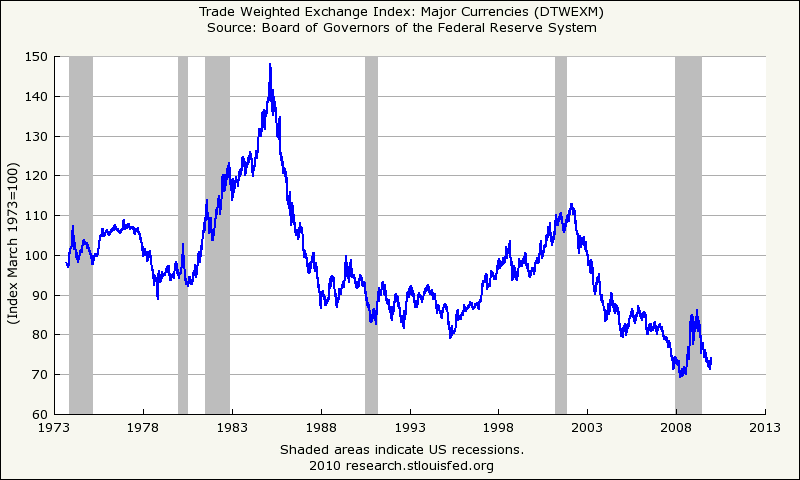
    The US dollar has fell 16 % against major currencies since 2009 and nearly 50% since 2001 yet US policy makers view China's currency policy as producing an unfair trade advantage.


    The real problem is that the global debt deflation leaves every nation in need of a weaker currency to maintain exports for economic growth. That is especially true of a tangible goods exporter like China. A financial goods exporter like the US needs happy tangible goods exporters like China to finance its trade deficit or its fiscal deficit. Therein lies the conflict.

    When Wen Jiabao says a stronger renminbi will cause mass defaults and economic crisis in China, he's not politicking like the folks on Capital Hill when they say China is manipulating its currency. China will have no choice but to respond with tariffs of its own.

    This bill will either launch a trade war, or create a crisis in the economy of our largest creditor. Neither outcome benefits us.

    The truth is we should never have allowed ourselves to get into this position in the first place, as I explained in Economic MAD back in 2006.

    Instead of beating up our trade partners to sacrifice more to improve our weak export position, we need to boost our private sector to be more competitive. We can do it by investing in transportation, energy, and communications infrastructure that drives private companies to compete for projects and to develop new technologies and lowers the energy tax on consumers and producers. We need to reduce taxes and remove obstacles that hamper entrepreneurs: zero payroll taxes, zero capital gains taxes, and zero health insurance costs for companies under 50 employees. Call it the zero, zero, zero plan. It will be paid for by eliminating government subsidies to the housing industry. From the looks of things, that's coming.

    Philly Fed researchers agree with Postcatastrophe Economy on housing

    With the caveat the "The views expressed are those of the authors and do not necessarily represent the views of the Federal Reserve Bank of Philadelphia or the Federal Reserve System, Fed researches Wenli Li and Fang Yang today issued a detailed report "Benefits and costs of Homeownership" (attached) that questions the wisdom of a government subsidized housing market, as The Post Catastrophe Economy does:
    "Our review of the economic benefits and costs of homeownership suggests that the economic case for subsidizing homeownership has, at the minimum, been oversold. And we have not addressed the offsetting costs. Indeed, economists have found that government subsidies incur a cost to the general economy. For example, in his article, Martin Gervais studied the welfare consequences of the preferential tax treatment of housing capital and found that the current tax structure crowds out business capital and leads to a loss in consumption of over 1 percent.

    "The net dollar value of owning one’s home remains a question for economists and policymakers to consider. One thing that is certain is that homeownership is not for everyone, and thus, based on the economic benefits, the case for trying to achieve a nation of homeowners needs to be rethought."
    Coming from the Fed, despite the disclaimer, this paper reveals a sea change in official philosophy on housing. It reminds me of the "research papers" the Fed issued in 2003 about deflation and how they planned to handle if should it happen here.

    Decades old housing subsidies will in the coming years be dumped onto the ash heap of politically motivated, destructive and destabilizing economic policies along with protectionist auto import tariffs in the 1970s that resulted over-priced, low quality cars for consumers, especially from Chrysler.


    iTulip Select: The Investment Thesis for the Next Cycle™
    __________________________________________________

    For a concise, readable summary of iTulip concepts read Eric Janszen's September 2010 book The Postcatastrophe Economy: Rebuilding America and Avoiding the Next Bubble.

    To receive the iTulip Newsletter/Alerts, Join our FREE Email Mailing List

    To join iTulip forum community FREE, click here for how to register.

    Copyright © iTulip, Inc. 1998 - 2010 All Rights Reserved

    All information provided "as is" for informational purposes only, not intended for trading purposes or advice. Nothing appearing on this website should be considered a recommendation to buy or to sell any security or related financial instrument. iTulip, Inc. is not liable for any informational errors, incompleteness, or delays, or for any actions taken in reliance on information contained herein. Full Disclaimer
    Attached Files
    Last edited by FRED; September 24, 2010, 08:24 PM.
Working...
X