Announcement

Collapse
No announcement yet.

Deflationistas, inflationistas, and hyperinflationistas - Eric Janszen

Collapse
X
 
  • Filter
  • Time
  • Show
Clear All
new posts

  • FRED
    replied
    Re: Deflationistas, inflationistas, and hyperinflationistas - Eric Janszen

    Originally posted by Kurt Horner View Post
    Right, and it does so by assuming that the contraction/re-inflation cycle will continue much as it has in the past. But there should be a breaking point. Since the re-inflation portion of these cycles prevents full liquidation of past malinvestment, there would be a cumulative build up of misallocated resources. Eventually, you'll hit a wall at which point the only alternatives are depression or hyperinflation.

    If we have hit that wall, and we might have, then it all comes down to which choice (depression or hyperinflation) benefits the dominant portion of the power elite. Loss of dollar hegemony does not benefit the elite and since the state will protect their assets ("too big to fail") the institutional pressure is decisively on the side of depression.

    (Caveat: if we see a lot of nationalization, then this institutional pressure might reverse. But as of right now, hyperinflation has no real constituency.)


    CPI has turned negative, and all of the things you cite are down from their peaks -- oil and platinum considerably so. Prices didn't immediately hurtle downward in the Great Depression either. Regardless, we agree that we're in what iTulip calls the "Ka" phase. The question is whether or not there will be much of a "Poom."

    I'm not really sure either way, but I'm increasingly leaning toward the idea that this cycle is the last one and the breaking point has been reached.
    Ka-Poom Theory is starting to be followed carefully on many sites around the world. For example, this analysis Deflation, Reflation and Our Oil Future:


    Figure 2 — Ka-Poom Theory from Eric Janszen (itulip.com@2006).
    Annotated to reflect the current recession (in gray). Note that the start of
    the current downturn (December, 2007) was predicted in 2006 following
    the reflation that began in 2003 after the collapse of the stock market
    (Tech) bubble


    Note that the period of the "Ka" disinflation begins toward the end of 2008. Mind you, this chart was created in March 2006. Note also that the period of disinflation lasts well into 2010.

    That's how long we think the political and economic wheels churn and grind before the current monetary regime gives out.

    Ka-Poom Theory says a brief period of actual deflation is possible, as occurred in 2001 and is occurring now.

    See, it's not enough to say what is going to happen, one also has to say why and, just as importantly when, and years ahead of time, else it's not an economic forecast, it's a statement of current or near current economic conditions, weather forecast by a weatherman looking out the window to tell you if it's raining.
    Last edited by FRED; January 29, 2009, 05:16 PM.

    Leave a comment:


  • Kurt Horner
    replied
    Re: Deflationistas, inflationistas, and hyperinflationistas - Eric Janszen

    Originally posted by Masher View Post
    But Ka-Poom Theory accounts for both disinflation and inflation.
    Right, and it does so by assuming that the contraction/re-inflation cycle will continue much as it has in the past. But there should be a breaking point. Since the re-inflation portion of these cycles prevents full liquidation of past malinvestment, there would be a cumulative build up of misallocated resources. Eventually, you'll hit a wall at which point the only alternatives are depression or hyperinflation.

    If we have hit that wall, and we might have, then it all comes down to which choice (depression or hyperinflation) benefits the dominant portion of the power elite. Loss of dollar hegemony does not benefit the elite and since the state will protect their assets ("too big to fail") the institutional pressure is decisively on the side of depression.

    (Caveat: if we see a lot of nationalization, then this institutional pressure might reverse. But as of right now, hyperinflation has no real constituency.)


    Originally posted by Masher View Post
    Credit contraction and asset price deflation are bigger and moving at a faster rate than government credit and money inflation now, resuting in the disinflation that iTulip has talked about. But i this was deflation as in the USA in the 1930s or even Japan in the 1990s, in dollar terms gold will not be at $880, silver at $11, platinum at $969, oil at $40, but at $300, $4, $400, and $15 or $20. To call this deflation is to misunderstand what's really going on. It's a critical error.
    CPI has turned negative, and all of the things you cite are down from their peaks -- oil and platinum considerably so. Prices didn't immediately hurtle downward in the Great Depression either. Regardless, we agree that we're in what iTulip calls the "Ka" phase. The question is whether or not there will be much of a "Poom."

    I'm not really sure either way, but I'm increasingly leaning toward the idea that this cycle is the last one and the breaking point has been reached.

    Leave a comment:


  • Chris Coles
    replied
    Re: Deflationistas, inflationistas, and hyperinflationistas - Eric Janszen

    If the system is predicting deflation and the reality becomes inflation then, as the change occurs and inflation starts they will be completely blindsided and will refuse to recognise the symptoms. Classic Mandarin mindset will overcome their perceptions. The more I have listened to the debate the more I have come to believe that regardless of what does happen, the system will be unable to respond. That it will lock up solid.

    We often see this in a science fiction movie where the computer is asked an impossible question and because it tries to answer but cannot, it blows up. I suspect we are about to see the same effect, but this time for real. Faced with the unacceptable impossibility that they were after all wrong, they will not be able to change direction.

    Leave a comment:


  • Spartacus
    replied
    Re: Deflationistas, inflationistas, and hyperinflationistas - Eric Janszen

    Originally posted by FRED View Post
    Sorry, raja. Still don't get your point. Are you saying that goods and commodity prices can't rise while demand is falling? Is that the deflationists' point that you say is "right"?
    FRED, I read Raja to mean "unemployed people are not going to borrow more"

    and maybe

    "fearful employed people are not going to borrow more"

    which may leave scant numbers to take on new credit

    My answer is that yes, even with mass unemployment, there still are lots of people with good credit.

    AND ... there seem to be no brakes on government.

    Raja, you're making the same appeal (but less hysterical, less histrionic) that some have been making for a long time - a purely emotional, hysterically stated

    "that just CANNOT BE"

    I can calmly get your point, but once you strip out the over the top rhetoric you can see that there is another side - on on that other side is the fact that this has never happened since fiat money took over:

    mild inflation --> sustained, self-reinforcing deflation --> hyperinflation

    what has happened repeatedly:

    steady state ---> inflation ---> high inflation --->(rarely if ever) sustained, self-reinforcing deflation
    Last edited by Spartacus; January 29, 2009, 04:53 PM.

    Leave a comment:


  • Masher
    replied
    Re: Deflationistas, inflationistas, and hyperinflationistas - Eric Janszen

    Originally posted by Kurt Horner View Post
    I don't think Mish predicted deflation repeatedly so much as he has consistently said that it is possible in our economy. Now it looks like such a thing is actually occurring.

    The market wants to purge all the excess credit (i.e. deflate) but monetary authorities have always acted to prevent that. It's not unreasonable to posit circumstances where monetary authorities can't act fast enough to offset deleveraging and deflation results.

    As it stands right now it is very difficult to gauge whether the flood of new money will ultimately offset the disappearing credit. But right now, disappearing credit is clearly winning the fight despite stimulus that is at least two orders of magnitude larger than in any previous downturn.
    But Ka-Poom Theory accounts for both disinflation and inflation. iTulip looks at the financial system, markets, and economy as interacting processes, undergoing constant change, and can't tell assets from commodities. Mish looks at the thing as a giant, undifferentiated mass, like a train rumbling toward a knocked out bridge over a ravine. In the train goes, down it goes, and he's right!

    Credit contraction and asset price deflation are bigger and moving at a faster rate than government credit and money inflation now, resuting in the disinflation that iTulip has talked about. But i this was deflation as in the USA in the 1930s or even Japan in the 1990s, in dollar terms gold will not be at $880, silver at $11, platinum at $969, oil at $40, but at $300, $4, $400, and $15 or $20. To call this deflation is to misunderstand what's really going on. It's a critical error.

    Leave a comment:


  • bart
    replied
    Re: Deflationistas, inflationistas, and hyperinflationistas - Eric Janszen

    Originally posted by Kurt Horner View Post
    I don't think Mish predicted deflation repeatedly so much as he has consistently said that it is possible in our economy. Now it looks like such a thing is actually occurring.
    If you read his older comments on his forum on Silicon Investor, which far predates his blog, I think you will likely be surprised.

    Leave a comment:


  • Kurt Horner
    replied
    Re: Deflationistas, inflationistas, and hyperinflationistas - Eric Janszen

    Mish's "Deflation All The Time Theory" sees deflation even when inflation is rampant
    I don't think Mish predicted deflation repeatedly so much as he has consistently said that it is possible in our economy. Now it looks like such a thing is actually occurring.

    The market wants to purge all the excess credit (i.e. deflate) but monetary authorities have always acted to prevent that. It's not unreasonable to posit circumstances where monetary authorities can't act fast enough to offset deleveraging and deflation results.

    As it stands right now it is very difficult to gauge whether the flood of new money will ultimately offset the disappearing credit. But right now, disappearing credit is clearly winning the fight despite stimulus that is at least two orders of magnitude larger than in any previous downturn.

    Leave a comment:


  • FRED
    replied
    Re: Deflationistas, inflationistas, and hyperinflationistas - Eric Janszen

    Originally posted by raja View Post
    You have completely missed my point :eek:


    Originally Posted by raja
    With a 10% or 20% unemployment rate in the works, and 30% or more of the retail stores on the way to being shuttered, I don't think the American consumer is going to be in the mood to spend, even if the gov't gave them the money, much less lent it to them putting them further in debt, even at no interest. Looks what's happening right now as an indicator of things to come?

    And the stimulus package? Do you think the government will be able to foster trust in "the system" by the time the stimulus "takes effect"? Things will be much worse by that time.

    I'm not saying this means deflation, but IMO it certainly deflates iTulip's contention that the deflationistas are wrong on this point.

    If people think that money will become worthless through inflation (when they learn what that means), they might spend it . . . but probably more for survival items than for cars, computers and TVs . . . and to pay down debt.
    Sorry, raja. Still don't get your point. Are you saying that goods and commodity prices can't rise while demand is falling? Is that the deflationists' point that you say is "right"?

    Leave a comment:


  • raja
    replied
    Re: Deflationistas, inflationistas, and hyperinflationistas - Eric Janszen

    Originally posted by FRED View Post
    Okay, let's try it this way. Here is Mish vs iTulip in charts.


    What if we did it the other way? What if we said, "Inflation, inflation, inflation, inflation, inflation, inflation..." through periods of both inflation and disinflation? Then we'd be "wrong" when the disinflation part of the cycle and "right" when inflation occurred.
    You have completely missed my point :eek:


    Originally Posted by raja
    With a 10% or 20% unemployment rate in the works, and 30% or more of the retail stores on the way to being shuttered, I don't think the American consumer is going to be in the mood to spend, even if the gov't gave them the money, much less lent it to them putting them further in debt, even at no interest. Looks what's happening right now as an indicator of things to come?

    And the stimulus package? Do you think the government will be able to foster trust in "the system" by the time the stimulus "takes effect"? Things will be much worse by that time.

    I'm not saying this means deflation, but IMO it certainly deflates iTulip's contention that the deflationistas are wrong on this point.

    If people think that money will become worthless through inflation (when they learn what that means), they might spend it . . . but probably more for survival items than for cars, computers and TVs . . . and to pay down debt.

    Leave a comment:


  • FRED
    replied
    Re: Deflationistas, inflationistas, and hyperinflationistas - Eric Janszen

    Originally posted by raja View Post
    With a 10% or 20% unemployment rate in the works, and 30% or more of the retail stores on the way to being shuttered, I don't think the American consumer is going to be in the mood to spend, even if the gov't gave them the money, much less lent it to them putting them further in debt, even at no interest. Looks what's happening right now as an indicator of things to come?

    And the stimulus package? Do you think the government will be able to foster trust in "the system" by the time the stimulus "takes effect"? Things will be much worse by that time.

    I'm not saying this means deflation, but IMO it certainly deflates iTulip's contention that the deflationistas are wrong on this point.

    If people think that money will become worthless through inflation (when they learn what that means), they might spend it . . . but probably more for survival items than for cars, computers and TVs . . . and to pay down debt.
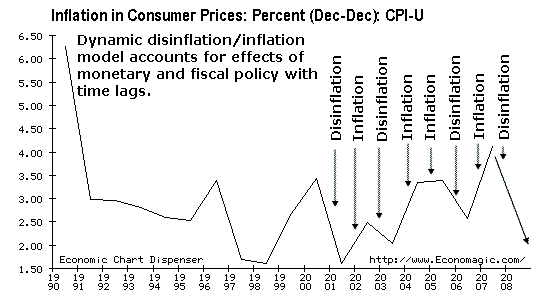
    Okay, let's try it this way. Here is Mish vs iTulip in charts.


    iTulip Ka-Poom Theory of cycles of asset price inflation, disinflation, and reflation.
    The last line with the arrow is the disinflation forecast.
    The rest of the chart is right out of economagic. How's that for a disinflation forecast?


    Mish's "Deflation All The Time Theory" sees deflation even when inflation is rampant

    What if we did it the other way? What if we said, "Inflation, inflation, inflation, inflation, inflation, inflation..." through periods of both inflation and disinflation? Then we'd be "wrong" when the disinflation part of the cycle and "right" when inflation occurred.

    Leave a comment:


  • raja
    replied
    Re: Deflationistas, inflationistas, and hyperinflationistas - Eric Janszen

    Originally posted by EJ View Post
    Once past this first part of the deflationista's argument, the next is the "you take a horse to water but can't make him drink" argument, that the Fed can create all the money in the world but it can't make households and businesses spend it.
    With a 10% or 20% unemployment rate in the works, and 30% or more of the retail stores on the way to being shuttered, I don't think the American consumer is going to be in the mood to spend, even if the gov't gave them the money, much less lent it to them putting them further in debt, even at no interest. Looks what's happening right now as an indicator of things to come?

    And the stimulus package? Do you think the government will be able to foster trust in "the system" by the time the stimulus "takes effect"? Things will be much worse by that time.

    I'm not saying this means deflation, but IMO it certainly deflates iTulip's contention that the deflationistas are wrong on this point.

    If people think that money will become worthless through inflation (when they learn what that means), they might spend it . . . but probably more for survival items than for cars, computers and TVs . . . and to pay down debt.

    Leave a comment:


  • sunskyfan
    replied
    Re: Deflationistas, inflationistas, and hyperinflationistas - Eric Janszen

    The only thing that I quibble about in the analysis is that the FED does have an infinite balance sheet but it cannot move infinitely fast let alone the need for this influence to be EVENLY inlfuentual across the economy. We are hitting a asymptotic even in the economy. Whether we approach infinite from the positive side (inflation) or the negative side (deflation) only makes a difference in the amount of time to get there. Things seem to be moving very fast to me. I have never thought much of "Armegeddon" thinking but then again I never thought I would loose money as a defrense researcher during a war.

    Leave a comment:


  • Slimprofits
    replied
    Re: Deflationistas, inflationistas, and hyperinflationistas - Eric Janszen

    Thanks Bill!

    This is a great line:
    We've got money left, but I love spending money. Cash makes me very unhappy.
    I think this is the par that Bill was referring to:

    SG: We all know that in the long run everything is going to work out, but as you analyze President Obama's economic plan, what do you think are the trade-offs? What are the consequences?

    WB: Well the trade-off... the trade-off basically is that you risk setting in motion forces that will be very hard to stop in terms of inflation down the road and you are creating an imbalance between revenues and expenses in the government that is a lot easier to create than it will be to correct later on, but those are problems worth taking on, but you don't get a free lunch.

    Leave a comment:


  • Chris Coles
    replied
    Re: Deflationistas, inflationistas, and hyperinflationistas - Eric Janszen

    Originally posted by bill View Post
    Bill, thank you for that, a wonderful interview, pity that the interviewers microphone was not well positioned. But a transcript is also available and I took the liberty of passing this small part on to everyone.

    http://www.pbs.org/nbr/site/onair/transcripts/090122t/

    WB: Well I've learned my lessons before that. I read a book what is it, almost 60 years ago roughly, called The Intelligent Investor and I really learned all I needed to know about investing from that book, in particular chapters 8 and 20 so I haven't changed anything since.

    SG: Graham and Dodd?

    WB: Well that was Ben Grahams' book The Intelligent Investor. Graham and Dodd goes back even before that which was important, very important. But you know you don't change your philosophy assuming you think have a sound one and I picked up I didn't figure it out myself, I learned it from Ben Graham, but I got a framework for investing that I put in place back in 1950 roughly and that framework is the framework I use now. I see different ways to apply it from time to time but that is the framework.

    SG: Can you describe what it is? I mean what is your most important investment lesson?

    WB: The most important investment lesson is to look at a stock as a piece of business not just some thing that jiggles up and down or that people recommend or people talk about earnings being up next quarter, something like that, but to look at it as a business and evaluate it as a business. If you don't know enough to evaluate it as a business you don't know enough to buy it. And if you do know enough to evaluate it as a business and its selling cheap, you buy it and don't worry about what its doing next week, next month or next year.

    Leave a comment:


  • powersown
    replied
    Re: Deflationistas, inflationistas, and hyperinflationistas - Eric Janszen

    Originally posted by flintlock View Post
    Sadly, I have to agree with the above.

    My guess is we'll see about a 50/50 split on this new bill between pork and real stimulus. So the pigs will continue to line up at the trough.
    For what it's worth, Rush Limbaugh quoted a source today stating that approximately 12% of the bill could be considered real stimulus.

    Leave a comment:

Working...
X