
Originally posted by phirang
View Post
-
Re: The Fed's Maginot Line
All except the < 4% inflation guess. It'll be there only if the BLS keeps fiddling with the measurement criteria. Not out of the question, of course, but increasingly difficult to do while maintaining that "confidence thing"...;) -
Re: The Fed's Maginot Line
I fall off the planet for 2 years, come back to discover that everything is "back to normal", credits is everywhere, global GDP growing, inflation is <4%, the DJI is 17k AND the U.S. fiscal budget deficit is $1.5 Trillion per year and the total U.S. debt is $20 Trillion.
Why is this not a somewhat probable if not likely scenario? Although the credit/debt game has to end at some point, but what's to prevent it from continuing for another 20 years. All it would seem to take is a major increase in the U.S' credit limit and continued cash advances from the ROW.
Although I tend to agree with from pure common sense and intuition the notion that real capital comes from real savings, it would seem to me that recent history has shown that this idea of "Confidence" is the key to the credit Ponzi scheme, and as long as one thinks the scheme is still in its early stages, greed will drive participation; i.e. paper and fictitious wealth are "real" as long as there is "confidence" in the system.Leave a comment:
-
Re: The Fed's Maginot Line
Maybe that's why they are reconsidering? Or want a better deal?Originally posted by phirang View Post
Mitsubishi and Morgan Stanley Renegotiating
By ANDREW ROSS SORKIN
Published: October 12, 2008
Morgan Stanley was racing to salvage a crucial investment from a big Japanese bank on Sunday in an effort to allay growing fears about its future — negotiations so critical to the financial markets that they have drawn in both the Treasury Department and the Japanese government...
Leave a comment:
-
Re: The Fed's Maginot Line
After having read full article on "Econbrowser", the argument as I can figure is as follows:Originally posted by baw View Post
1) There have been a number of lending facilities that have pumped money/treasuries into the financial system which are backed by various forms of (increasingly risky) collateral. The credit may available is based on the value of the collateral less some haircut, depending on the riskiness of the collateral.
2) To the extent that money has been used (instead of treasuries), the Fed has sold additional treasuries into the market (having obtained the additional treasuries from the Treasury on a temporary loan basis) to absorb money from the system by an offset close to equal to what was provided by through the lending programs. Therefore, there has been no significant influx of new money actually in the system.
3) By pumping the system with treasuries while keeping the currency within the system flat, this helps increase bank reserve ratios (since more credit is given to treasuries than the supporting collateral) but does not have an inflationary impact.
4) At the point in time when the market starts to stabilize, treasuries can be withdrawn. I believe that a key assumption here is that the prices on the underlying collateral have also stabilized (maybe even risen) and the market starts to function again so that the banks have a more reliable place that they can sell these assets into. Therefore, there would be no need to change the amount of money in the system since money would flow out of treasuries and back into the assets that the collateral is comprised of.
5) The excess treasuries that the Fed borrowed from the Treasury would be returned, the money level would remain at a stable level and all would be fine.
Ok, so that's my understanding of how this all works. The key assumptions are that (1) the banks that borrow money/treasuries under these various lending facilities return the money/treasuries (+ interest) back when they're due, and (2) there will be some stabilization of the prices on the underlying collateral.
To the extent that a participating bank defaults on one of these lending facilities, the Fed now has significant credit risk which was not considered within the original article. If the collateral ends up being worth less than the hair-cutted values that were considered when posted to the lending facility, the Fed will be on the hook for any deficiency. Unless the Fed plans to default on the treasuries, the only way that they can buy back the treasuries from the market would be for the Treasury to increase the money supply which is obviously inflationary.
As to my second point, it is vastly important for the prices of the underlying collateral to firm up such that companies can sell them into the market at the level at which they are carrying them on their balance sheet. If the value of the assets used as collateral continue to deteriorate, the capital of the companies holding this stuff will also deteriorate. The need for all of these credit lending facilities will be required as long as the financial health of the companies participating remains weak. If banks fail, this adds turmoil to the currently dysfunctional marketplace and increases the credit risk assumed by the Fed.
All of the central bank market actions work on the premise of supplying an ever increasing supply of high quality, liquid assets in the form of treasuries (or other gov't bonds) while trying to keep the aggregate money supply constant. However, if the fundamentals that underlie the collateral continue to deteriorate (ie. home prices continue to decline), the collateral value will continue to decline increasing the Fed's credit risk leading to substantial credit losses. At that point, the Fed will be reduced to only two options, default on gov't treasuries or increasing the amount of currency in circulation. Neither option is good and both are inflationary since defaulting on treasuries will lead to a mass exodus of capital from the US and a declining USD.
Therefore, it is vitally important that banks return to health and a liquid market supporting the risky forms of collateral forms once again. However, neither appear to be coming back anytime soon. But that's not going to stop the Fed and other central banks from providing support through TARP, equity injections, etc. to prime the pump until either stability is restored or everything goes to hell!Leave a comment:
-
Re: The Fed's Maginot Line
Yeah, they can't get something going because they can't get the farms going lol.
I imagine it was the farms which formed the backbone of Zim's real economy. Ignore the rule of law and property rights and everything else is window dressing.
Gold could get it going if they gold backed the currency at the same time as having the rule of law which allowed property laws to be upheld. Would take a while to build up as nobody would trust them for a couple of decades. (mmmm... the disappation of trust... sound familiar?) Without the latter, the people will just be as poor whether they have 1 zim dollar or 10 gazillion.
Instead, Zim's resources are elite owned and pilfered in a trickle down economy which only includes their military and anyone with connections to government (expenditure). Their Swiss bank accounts (which could now be insolvent because of the banking crisis lol!) get the rest (profit).
In a nutshell, it's just the elite giving the finger to the people.
Africa is the ultimate example of a 100% trickle down economy. It seems America is following this path at a tremendous rate. If it really wants to stop the crisis, it has to go from the bottom up (this all depends on how selfish, scared and individually detached America's elite really are).
If it does not, then America will become two countries, one where resources are pilfered to support the military (mmm... sounds familiar too) and one, which exists entirely on the black economy, which will be much more successful than Zimbabwe because of the rule of law.
If property rights and the rule of law can be maintained in the West, then the real threat to the Elite is the loss of power through their issuance of money and credit. The black market could spawn an era of a new beginning. The (new) elite will be the land owners and gold hoarders. Perhaps the old elite are positioning themselves to become the new elite as we speak.
Although, I would say, in such an event the new powerful will be more localised, rather than national, as everything breaks down to its immediate surroundings.
However, if martial law is announced, then Zimbabwe here we come.
Martial law, is the elite's way fo saying we will remain in power no matter what. Then, I'm afraid, the human experiment is over and darkness will reign, unless there is a revolution.
Let's just pray there are some people in powerful positions who care. The intention is enough, even if they get it wrong first, they will eventually get it right. If the intention isn't there, then we are screwed.Leave a comment:
-
Re: The Fed's Maginot Line
EJ --
What do you think the impact of the worldwide banking interventions will be on the market beyond one week? Also, I just heard that China is going to use its reserves to stabilize the currency market. How long will they continue to do this?Leave a comment:
-
Re: The Fed's Maginot Line
My margin account has been slashed!
I have been wondering if this would happen but to actually see it is shocking. My currency trading account has had its margin slashed from 100:1 to 20:1! Without any notification which is obviously illegal.
This takes my positions from an average leverage of 3% which is a very conservative play to 16% which is getting very dangerous.
People that had higher leverage than me and are not paranoid enough to check their accounts on the opening of the currency markets will get margined out of even winning positions if they have high leverage and their positions temporarily move against them.
I will be posting updates on www.slycapital.com
Your brokers are in survival mode - beware!Leave a comment:
-
Re: The Fed's Maginot Line
This article begins: "A popular misconception holds that central bank interventions in banking crises and financial markets panics in the form of liquidity injections are in and of themselves inflationary. Not so. These policies indicate a path decided, a choice in an economic policy fork in the road – a trap, if you will."Originally posted by baw View Post
The challenge in the debate is that there are three camps:
1) Commentators who know nothing about economics and use the wrong terms in the wrong way. They have formed an Internet based economics cargo cult that picks graphs off the Fed's site and deifies the images as representing their god Inflation or Deflation, depending on whether they own gold and silver or not. It's inflation if they do, deflation if they don't.
2) Commentators who know nothing about economics and use the right terms but in the wrong way. They pose as economists and need only know more than their readers do to get away with it. Their interpretations of Fed charts are motivated by the need to sell the fund or other product offered by the management that is writing the commentator's paycheck.
3) Commentators who know something about economics and use the right terms in the right way. That's us. We've played whack-a-mole with the other two camps for ten years. We expect they will keep coming back until they realize that inflation is a political-economic process, resulting from a complex mix of politically motivated economic orthodoxy, history, and accumulated error, not some kind of purely mechanical process. There are mechanical processes involved, but they are too complex to explain to lay readers without boring them to death.
Here is a paper, for example, that explains how an inflation can turn into a hyperinflation.Cointegration and Cagan's model of hyperinflation under rational expectationsThe mechanisms of inflation and hyperinflation are not intuitive and do not lend themselves to casual discussion among lay people. The models used by 99% of the commentators are simply too primitive to be useful. Rather than try to explain papers such as the above to readers, we have over the years attempted to explain inflations bottom up, by how they are experienced by the people living in them, as we do in Confusion reigns: A crisis-driven global rush to dollar liquidity is not deflation.
by Tom Engsted
WHEN MONEY AND PRICES ARE INTEGRATED of order two, I(2), and shocks to money demand or velocity are stationary, then the Cagan (1956) monetary model of hyperinflation has the implication that real money balances cointegrate, in the sense of Engle and Granger (1987), with the rate of inflation. As a result, one can estimate the interesting parameter in the model, the semielasticity of the demand for real balances w.r.t. expected inflation, super-consistently in a cointegrating regression without having to specify the exact expectations formation process. In addition, simultaneity or omitted variables bias vanishes asymptotically. In a recent paper in this journal, Taylor (1991) makes use of these insights in a reexamination of some of the classic interwar European hyperinflations, and although the results are mixed, he generally finds support for the Cagan model with stationary velocity shocks.
In the present paper I show, in the next section, that by making the stricter assumptions of rational expectations and no bubbles, an additional cointegrating relationship can be derived from the Cagan model, namely that real money balances cointegrate with money growth. I then show how, under these assumptions, the Cagan specification imposes testable restrictions...
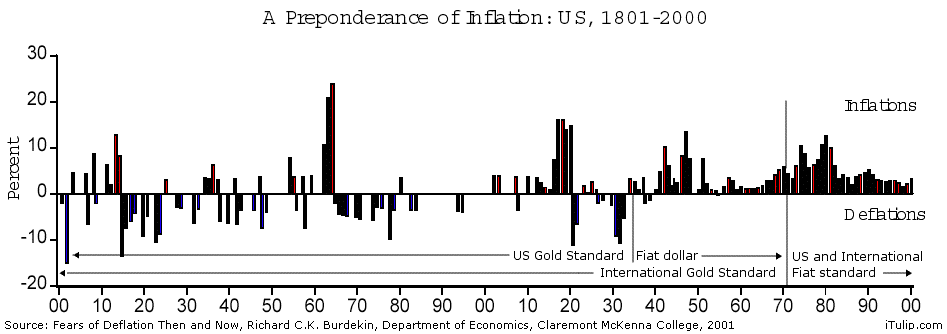
A nation operating on fiat currency can experience inflation spirals with virtually no functioning banks, no credit, no lending, no borrowing, 80% unemployment, and declining output. It has happened over and over. Deflation spirals, on the other hand, are exceedingly rare, even during the gold standard era before 1934, and non-existent since.
Our experience over the years is that deflationists are allergic to facts. Most in the inflation camp doesn't understand economics. It's a mess.
Last edited by FRED; October 12, 2008, 10:28 AM.Leave a comment:
-
Re: The Fed's Maginot Line
Thanks for your comment. I have been thinking along those same lines. However, what about counterfitting. I know it sounds like a conspiracy theory, but what would prevent that from happening overseas. That could really put alot of currency into circulation over many years. Maybe this is a stupid question, but I haven't seen any discussion whether it could happen or how we could prevent it.Leave a comment:
-
Re: The Fed's Maginot Line
There will always be a von Mannstein
Fall Gelb, the masterplan from the German General 'Erich Von Mannstein' was the basis for the attack of western Europe. A major attack through the Belgian Ardennes (which was thought to be impossible), outstepping the strong French 'Maginot Line' on the borders of Germany and France. It was by this maneuver that the German forces could conquer large parts of the open area in northern France easily and strike forward to the French coast with great speed.
It was because of this plan that Holland suddenly became strategic important. There was great danger for an attack from Holland into the back of the advancing German forces. Besides, Germany desperate needed the Dutch airfields to supply it's advancing forces. During the raid on Holland history was written. Never before so many paratroopers landed in such short time on enemy territory. All of Germany's Airlanding forces (2 divisions from who no one knew the existence) including the major part of Germany's air force, was put into action in The Netherlands. They were put in action to capture the Dutch Airfields and the Royal Family.
Holland was attacked by Armygroup B under the command of the legendary Field Marshall Fedor von Bock.
...
http://www.marketgarden.com/2010/UK/page1.html
And I don't know much aout the geopolitics of Africa, but Zimbabwe and Sudan(oil) are of interest to the major powers and especially for China.
They have gold and somehow are still not able to get something going
Zimbabwe's small-scale gold mines output falls drastically
(Xinhua)
Updated: 2007-03-18 19:58
The Zimbabwe Miners' Federation (ZMF) President George Kawonza was quoted as saying the decline in the production of the metal was also due to the police operation "Chikorokoza Chapera," which is presently being implemented to eliminate illegal gold panning activities.
"Production levels have been reduced. We used to produce four tons a month, but we are only producing 600 kg per month at the moment," he said.
Kawonza said the continued increase in the price of fuel on the parallel market and an unrealistic fixed gold price of 16,000 Zimbabwe dollars (64 U.S. dollars) had made operations of the small-scale miners difficult.
Kawonza said operation Chikorokoza Chapera, which had resulted in the closure of most small-scale mining operations, had also impacted on operations.
He said the exercise had discouraged investment from identified partners from Asian countries such as China, India and Pakistan because of the uncertainty it brought and called on the government to re-open small-scale mines.
Mining contributes up to 4.5 percent of gross domestic product (GDP), 5 percent of employment and 16 percent of total foreign currency earnings.
....
Gold is integral to Zimbabwe's economy as it accounts for more than 72 percent of foreign currency receipts.
...
http://www2.chinadaily.com.cn/world/...ent_830476.htmLeave a comment:
-
Re: The Fed's Maginot Line
I believe the iTulip position is that the dollars needed to bring on massive inflation already exist. Banks don't need to lend or convert their current reserves to cash.
All that needs to happen is for the dollar's decline to precipitate dollar repatriation from overseas.Leave a comment:
-
Re: The Fed's Maginot Line
The response to inflation is this chart used to show that the reserves are not being converted to cash and loaned out into the real world. Here chart via a quote>
Anyone who suggests that last week's ballooning reserve deposits represent inflationary pressure or the Fed monetizing the deficit simply doesn't know what they're talking about. Banks are sitting on the reserves, not withdrawing them as cash. When markets settle down, the Fed can and will absorb those reserves back in with sterilizing sales of Treasury securities, just as it did in 2001 or after the more modest spike in August 2007. Providing new reserves aggressively is absolutely and unquestionably the way the Fed needs to respond to this kind of development. Is the deflation/inflation debate similar to the heaven/hell debate?.
Leave a comment:


Leave a comment: