Announcement

Collapse
No announcement yet.

Headed for a Sudden Stop

Collapse
X
 
  • Filter
  • Time
  • Show
Clear All
new posts

  • jimmygu3
    replied
    Re: Headed for a Sudden Stop

    Originally posted by FRED View Post
    Asia Needs Deal to Prevent Panic Selling of U.S. Debt, Yu Says
    By Kevin Hamlin

    Sept. 25 (Bloomberg) -- Japan, China and other holders of U.S. government debt must quickly reach an agreement to prevent panic sales leading to a global financial collapse, said Yu Yongding, a former adviser to the Chinese central bank.

    ``We are in the same boat, we must cooperate,'' Yu said in an interview in Beijing on Sept. 23. ``If there's no selling in a panicked way, then China willingly can continue to provide our financial support by continuing to hold U.S. assets.''

    An agreement is needed so that no nation rushes to sell, ``causing a collapse,'' Yu said. Japan is the biggest owner of U.S. Treasury bills, holding $593 billion, and China is second with $519 billion. Asian countries together hold half of the $2.67 trillion total held by foreign nations.

    China, Japan, South Korea and others should meet soon to seal a deal, said Yu, a former academic member of the central bank's monetary policy committee. The talks should involve finance ministers, central bank governors and even national leaders, he said.

    ``Whether some kind of agreement between them to continue to hold Treasury bills is viable, I'm not sure,'' said James McCormack, head of sovereign ratings at Fitch Ratings Ltd in Hong Kong. ``It would be unusual. If it became apparent that sovereigns in Asia were selling Treasuries the market would take that quite badly, it's something to be avoided.'' more...
    Whoa. That's serious stuff. Sounds like the options are whether to get out fast or get out gradually. No mention of continued buying.

    Question: If they can't agree and instead race to get out before the other, that would obviously push yields up. Would that be a time for mortgaged middle class investors to shift into treasuries, taking guaranteed 10% (or whatever it's pushed to) nominal returns to provide current income and service lower fixed-rate debt, thereby crashing stocks?

    Is this one of the scenarios the Fed & Treasury are aware of and could implement pre-emptive currency controls to mitigate? If so, what type of controls would discourage China & Japan from dumping?

    Jimmy

    Leave a comment:


  • FRED
    replied
    Re: Headed for a Sudden Stop

    Asia Needs Deal to Prevent Panic Selling of U.S. Debt, Yu Says
    By Kevin Hamlin

    Sept. 25 (Bloomberg) -- Japan, China and other holders of U.S. government debt must quickly reach an agreement to prevent panic sales leading to a global financial collapse, said Yu Yongding, a former adviser to the Chinese central bank.

    ``We are in the same boat, we must cooperate,'' Yu said in an interview in Beijing on Sept. 23. ``If there's no selling in a panicked way, then China willingly can continue to provide our financial support by continuing to hold U.S. assets.''

    An agreement is needed so that no nation rushes to sell, ``causing a collapse,'' Yu said. Japan is the biggest owner of U.S. Treasury bills, holding $593 billion, and China is second with $519 billion. Asian countries together hold half of the $2.67 trillion total held by foreign nations.

    China, Japan, South Korea and others should meet soon to seal a deal, said Yu, a former academic member of the central bank's monetary policy committee. The talks should involve finance ministers, central bank governors and even national leaders, he said.

    ``Whether some kind of agreement between them to continue to hold Treasury bills is viable, I'm not sure,'' said James McCormack, head of sovereign ratings at Fitch Ratings Ltd in Hong Kong. ``It would be unusual. If it became apparent that sovereigns in Asia were selling Treasuries the market would take that quite badly, it's something to be avoided.'' more...

    Leave a comment:


  • jimmygu3
    replied
    Re: Headed for a Sudden Stop

    Originally posted by c1ue View Post
    On the one hand, I feel some vindication as the fears I have been acting on for 2 years are coming true.

    On the other hand, this sucks. I'd much rather have been wrong and looked paranoid/foolish.
    Yes, I think most of us around here feel the same way. Kind of like when my alcoholic relative says he can handle social drinking and I know he's going to fail. I always hope somehow I'm wrong and it will be different this time. I'd way rather say "I was dead wrong" than "I told you so."

    Leave a comment:


  • magicvent
    replied
    Re: Headed for a Sudden Stop

    Marc Faber agrees with you

    Next year, if the economy in the U.S. is as weak as I think it would be, the trade and the current account deficit will continue to contract,” Faber said. “When global liquidity contracts, it’s not a good time for financial assets.”
    Other sources of funding, such as foreign reserves of resources-rich countries, are also likely to dry up, Faber said. “I think sovereign wealth funds are going to be very busy supporting their own markets, they won’t have much money to buy assets around the world.”
    The next emergency measure will be that Americans are not allowed to buy foreign currency and transfer money overseas, and the next measure will be not permitting Americans to buy gold and so on and so forth… It creates even more uncertainty in the market place when you continually change the rules.

    Leave a comment:


  • idianov
    replied
    Re: Headed for a Sudden Stop

    Is China suddenly pulling the plug?

    From Marketwatch:

    China asks local lenders not to lend to U.S. banks

    By V. Phani Kumar
    Last update: 10:28 p.m. EDT Sept. 24, 2008
    Comments: 78
    HONG KONG (MarketWatch) -- Chinese regulators have asked domestic banks to stop lending to U.S. financial institutions in the interbank money markets to prevent possible losses during the financial crisis, the South China Morning Post reported Thursday. The China Banking Regulatory Commission's ban on interbank lending of all currencies applied to U.S. banks, but not to lenders from other countries, the report added, citing a source.
    More from SCMP.com:

    Another banking source said the CBRC issued the ban after obtaining data about the exposure of mainland banks to bonds issued by bankrupt Lehman Brothers Holdings.

    Top officials said they were keeping a close watch on the crisis and warned mainland financial institutions to be cautious in their daily business and overseas expansion.

    "The international transaction volume of Chinese banks is not big. Those concerning subprime loans are probably lower than US$10 billion," deputy central bank governor Ma Delun wrote this week in the China Business Post, a PBOC-affiliated newspaper.

    But the deteriorating situation in the US has shocked top officials.

    Mr Ma said that among the unexpected developments was the effect the crisis was having on normal assets, not just problematic assets; its impact on the whole credit market, not just single products; and its effect on Europe and other nations, not only the US.

    The exposure of seven listed mainland banks to bonds related to Lehman Brothers totaled US$721 million.
    Update:

    The news are being denied, but the TED has been spreading to 3% today...
    Last edited by idianov; September 25, 2008, 03:35 AM.

    Leave a comment:


  • c1ue
    replied
    Re: Headed for a Sudden Stop

    On the one hand, I feel some vindication as the fears I have been acting on for 2 years are coming true.

    On the other hand, this sucks. I'd much rather have been wrong and looked paranoid/foolish.

    Leave a comment:


  • EJ
    started a topic Headed for a Sudden Stop

    Headed for a Sudden Stop


    Headed for a Sudden Stop

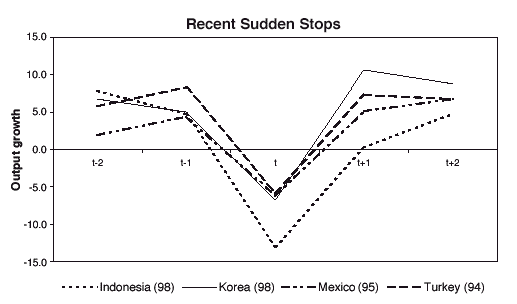
    iTulip has since 1999 warned that in a protracted financial crisis the US, a net debtor, is vulnerable to withdrawal of foreign capital and capital flight, producing inflation and a severe economic contraction known in the economics literature as a Sudden Stop.

    We called our theory Ka-Poom Theory. It defines two distinct crisis periods. One, a six to 12 month period of disinflation (Ka) that typically proceeds a sharp inflationary (Poom) period of repatriation of capital by foreign investors and capital flight by residents. Repatriation and flight both cause and result from currency depreciation in a rapid, self-reinforcing process.

    In light of recent events, a subscriber recently asked how a disinflationary “Ka” crisis period such as we are experiencing during this financial crisis can turn into an inflationary “Poom” as foreign investment dries up and capital flees. In response, I provided the explanation below based on research I am doing for a book. In light of today’s events, I thought I’d share it with readers generally.
    Treasuries Lose Allure for Asia, Europe Investors

    Sept. 24 (Bloomberg) -- Investors outside the U.S., who own more than half of all Treasuries outstanding, say the government's $700 billion plan to revive the banking system will diminish the appeal of the nation's bonds.

    Treasury Secretary Henry Paulson's proposal, which seeks funds to rescue banks by purchasing devalued securities, would drive the country's debt to more than 70 percent of gross domestic product. The last time taxpayers owed as much was in 1954, when the U.S. was paying down costs from World War II.

    ``The image of U.S. Treasuries as a safe haven has been tainted by the ongoing financial debacle,'' said Kwag Dae Hwan, head of global investment in Seoul with South Korea's $220 billion National Pension Fund, which holds about $14 billion of U.S. government debt. ``A big question mark hangs over whether the U.S. can deal with an unprecedented amount of debt. That is unnerving all the investors, including me.''
    Stuck in the Debt Deflation Box

    The US is in a tough spot. If the Fed does not take drastic measures to at least try to get the US credit markets working again the US economy will continue to crash. Foreign investors will pull out, and domestic investors will follow – or at least they'll try. On the other hand, if the Fed purchases all of the bad debt that is clogging up the credit markets, it dilutes the value of US treasury debt in the process, and as you can see from the Korean fund manager's comments above, that can potentially lead to a crisis of its own. In any case I am not confident that the bailout effort will succeed because the fundamental problem is not toxic debt but too much debt is owed against depreciating assets.

    These debt deflation crises all end up in some kind of conundrum like this. For a net creditor with a high savings rate like Japan the choice was between throwing the currency or the labor force under the bus. They went with deflation and a strong yen.

    Our latest analysis for subscribers US exchange rate and capital controls or bust ($ubscription) includes research that shows that the yield of the 10 year Treasury bond may increase by 100 basis points for each year that net foreign purchases do not increase. Of course if they were to sell, bond prices will fall more rapidly.

    Capital takes off

    I've studied a dozen instances of capital flight. The process varies case by case but can be generally outlined in this eight step process. Keep in mind that this was written before the nationalization of Fannie Mae and Freddie Mac, the Lehman Bros. bankruptcy, the extension of government depositor insurance to money market accounts, and other recent events.

    1) Build-up: The antecedents for crisis may be too much short-term foreign debt relative to GDP, unsustainable fiscal deficits, insufficient foreign exchange reserves, or some other imbalance or vulnerability, or multiple vulnerabilities. A crisis occurs – a crash, such as our housing and securitized debt market crash starting in 2007 – and the economy turns down rapidly. Defaults and bankruptcies begin, first as a few small companies and financial institutions but escalating in size and frequency over time.

    2) Erosion: Confidence in the economy and financial markets gradually erodes over a period of a year or more. There are bank and non-bank institution failures, some of which are handled badly by authorities, reducing faith in the ability of government institutions to manage the crisis. Inflation and defaults are equally worrisome for a net debtor because these test the confidence of foreign creditors. Wealth holders inside the country and out start to wonder whether the authorities have things under in control.


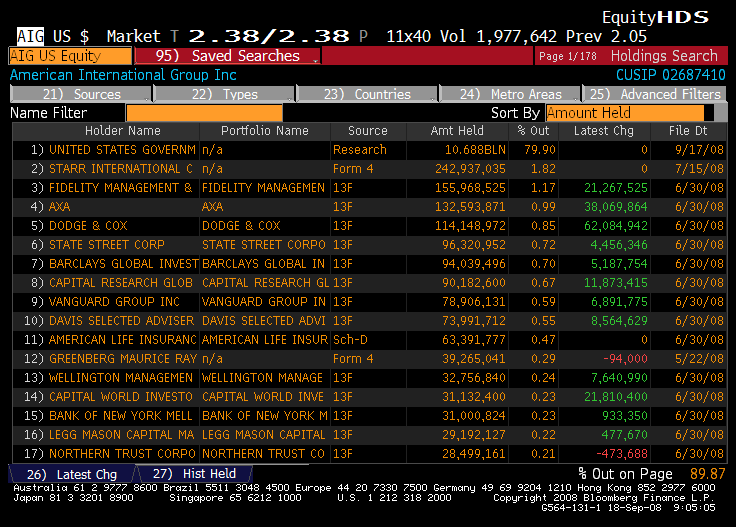
    Sept. 18, 2008 the Fed and Treasury bail out insurance giant AIG (Bloomberg screen capture)

    3) Pre-Flight: Crises become more frequent and severe, remedies increasingly drastic, with ever more heavy handed government intervention in what were formerly considered sacrosanct market institutions and processes. Banks and other institutions fail. There is talk of nationalization. The pre-flight phase may last for several months to a year.

    4) Preparation: Long before the event occurs that triggers capital flight, such as the Russian bond default, insiders prepare for a potential economic D-Day with strategies to preserve as much of their wealth as possible. They set up foreign accounts and make ready to transfer funds at a moment's notice. They gradually liquidate bond, stock and other funds to move into their foreign accounts with a phone call – generally not in writing. The preparation process can occur on and off for months or for as long as a year. They may purchase stocks, sovereign bonds, and other assets denominated in other currencies, and take possession of the physical certificates. I've had conversations with fund managers who have clients who have been discussing the topic since the Q1 of this year.

    5) Flight Crisis: An event occurs, such as the Russian bond default, that causes the currency to fall in a wave of sales of assets. Those not in-the-know panic and try to follow the prepared insiders out the door; a disorderly expatriation of capital and repatriation of foreign capital begins. In the case of past crises, the currency crashes as rubles or pesos or won are thrown onto the market as assets are converted to dollars or euros or yen en masse for deposit offshore. This typically happens in a matter of days or weeks.

    6) Emergency Mitigation: As the crisis goes critical one day the government slams the door shut with capital controls, trapping foreign and domestic investors alike. Malaysia did so in 1998 but Korea did not. We explore the history of capital controls by the US and other countries to assess that risk and recommend steps to hedge the risk for subscribers in US exchange rate and capital controls or bust ($ubscription).


    7) Sudden Stop:
    If the government does not exact capital controls and capital leaves en masse, credit contracts, interest rates rise, the currency falls, and economic output drops suddenly as businesses close and unemployment spikes. In the case of Korea during the 1997-1998 currency crisis, for example, college students had to go home to their families in Seoul that year because the won did not cover the tuition. City parks quickly filled with the unemployed when only months before unemployment was largely unknown. The crisis is well documented in social and economic impact of Sudden Stop economic crises in South Korea and Argentina.

    8) Recovery: What happens next depends on the structure and state of the nation's economy before the crisis. Koreans, part of a culturally homogeneous and egalitarian society, quickly scraped together more than a billion dollars of jewelry, coins and other personal gold items to give to the government voluntarily to be melted down to shore up the central bank's accounts, which combined with a massive loan from the IMF stabilized the currency and economy.

    Korea, like Russia, had a strong basis for recovery. Korea's powerful industrial base, deep pool of household savings, strong work ethic, high education level, and group spirit combined with strong demand from the US and Europe enabled it to quickly rebuild. When I was there only four years after the collapse it was as if nothing had happened, at least on the surface. Korean friends tell me that scars remain, especially mistrust of the IMF. Since then Korea and most Asian countries maintain at least a year's foreign exchange reserves to defend against a future attacks on their currencies. Paradoxically, the buildup of these reserves since 1998 contributed to the glut of foreign official capital inflows that the US has enjoyed.

    Russia, aided by western oil companies, began to pump the oil that the inefficient Soviet system could not get out of the ground. Ten years after its crisis Russia developed massive foreign reserves in excess of $600 billion.

    Where are we?

    Keep in mind that the stages of the process are non-linear, and apply differently to a major economy like the US, with its debts denominated in its own currency and most of it long not short term, compared to the Korean and other cases mentioned.

    Steps can revert from one back to another and forth again, for example between pre-flight and preparation phases. However, these processes tend to escalate in a positive feedback loop of crisis and response.

    At this point it is not clear to me how the US avoids either capital controls to avoid a Sudden Stop or takes the full capital flight trip and experiences a Sudden Stop.

    Most economists reading will be taken aback by the suggestion that the US might be the victim of capital flight and a Sudden Stop. The US has long been the recipient and beneficiary of flight capital as other nations experienced financial crisis. But a world ordered by poor nations financing the rich with their "excess savings" is an environment where long standing beliefs can be turned upside down, and fast. It remains to be seen what happens to the euro as the financial crisis spreads to Europe. The dollar, at least temporarily, may benefit.

    The US has averted a "Poom" event so far because foreign central banks stepped in to support our housing and treasury market in 2003. But the financial and economic crisis is intensifying; counting on foreign governments to support the US throughout is an invitation to disaster. One of these days one of our creditors, not all of whom get along with each other, may force the US to make an impossible decision between a political ally and high interest rates. If that were to happen against the current background of global financial crisis, longstanding imbalances between the US and the rest of the world may re-balance in a hurry.

    We explore the history of capital controls by the US and other countries to assess that risk and recommend steps to hedge the risk for subscribers in US exchange rate and capital controls or bust ($ubscription). The ideal hedge doesn't cost much to set up, so that if the crisis never develops to that stage you have not spent a lot of money for nothing. Needless to say, the cost of not being hedged is enormous. Just ask your average stock market investor who missed our Dec. 2007 notice that a Debt Deflation Bear Market awaited us in 2008.

    Subscribe to iTulip Select: The Investment Thesis for the Next Cycle™
    __________________________________________________

    To receive the iTulip Newsletter or iTulip Alerts, Join our FREE Email Mailing List

    Copyright © iTulip, Inc. 1998 - 2007 All Rights Reserved

    All information provided "as is" for informational purposes only, not intended for trading purposes or advice. Nothing appearing on this website should be considered a recommendation to buy or to sell any security or related financial instrument. iTulip, Inc. is not liable for any informational errors, incompleteness, or delays, or for any actions taken in reliance on information contained herein. Full Disclaimer
    Last edited by FRED; September 06, 2011, 08:55 AM. Reason: typos and spelling errors
Working...
X