Announcement

Collapse
No announcement yet.

The Face of Inflation: Does the U.S. Have a "Peso Problem" revisited

Collapse
X
 
  • Filter
  • Time
  • Show
Clear All
new posts

  • raja
    replied
    Re: The Face of Inflation: Does the U.S. Have a "Peso Problem" revisited

    zoog,

    Thanks for doing some research on this.
    I guess Fred was wrong . . . these bonds were callable.

    Some nice interest rates:

    November 15, 200730 years912810DB110.375%
    November 15, 200630 years912810CY214.000%
    May 15, 200630 years912810CV813.875%
    November 15, 200530 years912810CS512.750%
    May 15, 200530 years912810CP110.000%
    February 15, 200530 years912810CM811.750%
    November 15, 200430 years912810CK210.375%

    25 year maturity is not as good as 30 years, but it's not bad, either. Early maturity is not a dealbreaker by any means for my plan, but I'll have to add the threat of callability to my risk analysis. Who know what the government will do if they're paying out 25% interest . . . .

    Leave a comment:


  • zoog
    replied
    Re: The Face of Inflation: Does the U.S. Have a "Peso Problem" revisited

    Originally posted by raja View Post
    I checked the Fed website, and all bonds now are not callable. You are suggesting they will change that policy in the future.

    . . .

    Is there a history of this?
    Is there any way to get some idea about how long they will wait before calling in the bonds?

    Seems like it would piss off a lot of people if they called in high-paying bonds after only a few years . . . .
    Trying to piece this together from the treasury website....

    For certain bonds issued before 1985, the U.S. Treasury reserves the right to stop paying interest before the bonds mature. When the Treasury "calls" a bond, it stops paying interest on the date of the call, before the maturity date.
    View a list of bonds called from 2000 to the present.
    Searched for a couple of the bond ID numbers listed, and got this:

    January 14, 2000 The Treasury today announced the call for redemption at par on May 15, 2000, of the 8-1/4% Treasury Bonds of 2000-05, issued May 15, 1975, due May 15, 2005 (CUSIP No. 912810BU1). There are $4,224 million of these bonds outstanding, of which $2,047 million* are held by private investors. Securities not redeemed on May 15, 2000, will cease to earn interest.
    January 14, 2005
    The Treasury today announced the call for redemption at par on May 15, 2005, of the 10% Treasury Bonds of 2005-10, originally issued May 15, 1980, due May 15, 2010 (CUSIP No. 912810CP1). There are $2,987 million of these bonds outstanding, of which $1,811 million are held by private investors. Securities not redeemed on May 15, 2005 will stop earning interest.
    Only two examples is not enough to make a definitive case, but both of these were called after 25 years.

    Leave a comment:


  • raja
    replied
    Re: The Face of Inflation: Does the U.S. Have a "Peso Problem" revisited

    In the early 1980s you could buy a 30 yr treasury bond in the low teens. Get this: it wasn't callable! They won't make that mistake again.
    Dang it, Fred. You found a chink in my plan.:eek:

    For it to at least break even, my plan requires that I collect high interest rates for at least long enough to recoup my initial loses. And even calling the bond in some years later would still spoil my wonderful dream of clearing 15% for 25 years.

    I checked the Fed website, and all bonds now are not callable. You are suggesting they will change that policy in the future.

    How might that work?

    They would issue 30-year bonds at high rates, and then after interest rates fall back to lower levels, they would say here's your principal back, good bye?

    Is there a history of this?
    Is there any way to get some idea about how long they will wait before calling in the bonds?

    Seems like it would piss off a lot of people if they called in high-paying bonds after only a few years . . . .

    Leave a comment:


  • raja
    replied
    Re: The Face of Inflation: Does the U.S. Have a "Peso Problem" revisited

    if interest rates hit 20% - something which hasn'nt occured ever in the United States as far as I know, do you really think nothing will have happened to justify this?
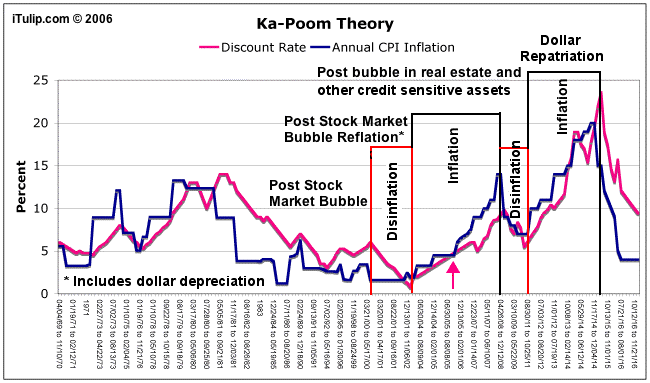
    Being a financial neophyte, I derive a large part of my thinking from a mix of sources. EJ predicts a discount rate above 20% for about a year period.
    So, to answer your question about what will happen . . . what he said.

    But I don't see what you're getting at with this question. Can you please say what you think will happen and why it will scuttle my plan?

    Certainly the USA is not Zimbabwe, but then again it is equally foolish to think that the USA is somehow immune to reaping the rewards of its actions.
    It is precisely the reaping that will enable me to make a profit. If there is no reaping, my plan won't work.
    In other words, high inflation, high interest rates, big spread, big profit.

    As for your reaping interest - you don't get to both renew and lock in a rate. You can do 1 year Tbills, or you can lock in a rate with a long bond, but you cannot do both at once.
    Perhaps I need to explain again . . . .
    I buy short term T-bills (either 3- or 6-month), which are then continuously reinvested. When interest rates reach a high level, I either sell the T-bills or let them mature. Then, I take the money and purchase a 30-year bond locking in a a high rate.
    At what point am I doing "both at once"?

    what I am suggesting is to look to existing financial instruments based on the actions you are proposing to understand what risk you are taking on.
    The two financial instruments involved in my proposal are the equity loan and Treasury securities, both of which I have examined and have some familiarity with. Since I found no great risk in what I am proposing, I was hoping someone with more experience would be able to point out something I had missed.

    Ultimately it is your money, do with it what you will
    That's a relief. I thought I had to do what EJ said

    Leave a comment:


  • FRED
    replied
    Re: The Face of Inflation: Does the U.S. Have a "Peso Problem" revisited

    In the early 1980s you could buy a 30 yr treasury bond in the low teens. Get this: it wasn't callable! They won't make that mistake again.

    Leave a comment:


  • c1ue
    replied
    Re: The Face of Inflation: Does the U.S. Have a "Peso Problem" revisited

    Raja,

    Let me put this another way: if interest rates hit 20% - something which hasn'nt occured ever in the United States as far as I know, do you really think nothing will have happened to justify this?

    Certainly the USA is not Zimbabwe, but then again it is equally foolish to think that the USA is somehow immune to reaping the rewards of its actions.

    As for your reaping interest - you don't get to both renew and lock in a rate. You can do 1 year Tbills, or you can lock in a rate with a long bond, but you cannot do both at once.

    As for the other points - what I am suggesting is to look to existing financial instruments based on the actions you are proposing to understand what risk you are taking on.

    Ultimately it is your money, do with it what you will

    As for what I recommend - I've talked about that already. The implementation is up to every individual and individual's temperament/skill set.

    Leave a comment:


  • raja
    replied
    Re: The Face of Inflation: Does the U.S. Have a "Peso Problem" revisited

    c1ue,

    Responding to your last post . . . .

    I'm not telling you what to do - just pointing out some items which I personally would be concerned about when considering such an investment strategy.
    I appreciate your feedback . . . but after carefully reading everything you said, I still don't get your objections . . . any of them.
    From my admittedly neophyte perspective, I don't think you have accomplished your goal of "wound(ing) some bad ideas floating around due to breathless financial media machinations." On the contrary, I think you are warding off people from a brilliant investment idea that could earn them a great profit . . . if they have a similar financial situation as I have.
    Then, again, I may be wrong . . . .

    The interest rate on the T-bill is not an actual amount of money paid to you. It is a result of the amount paid for the T-bill at a given time as a ratio to the amount of money that WILL be paid back at the time of maturity . . . Thus unless the interest rates change in between when you've sold a T-bill and you've bought another (higher yielding) one, your previous Tbill will have lost value.
    When you buy a $100,000 T-bill @ 4.5%, your are actually paying $96,500. Six months later you get $100,000 back, i.e., $96,500 plus 4.5% interest.
    If you have choosen auto reinvestment, your $100,000 is immediately reinvested. If the rate is 4.5%, you are investing $96,500 again, and $4,500 appears in your bank account the same day, which you can invest anywhere you choose.
    What's the problem with this?
    You say, "You wait for maturity: you're losing relative interest every day."
    I'm not sure what you mean by this, but if I'm losing anything, it isn't much. It still looks to me like I'm making 4.5% on my investment.

    But even if I am loosing something, aren't you looking at this from a microscopic perspective?
    If there are minor losses from reinvesting T-bills for a few years, they pale in comparison to the 14% or more spread I'm hopefully going to earn for 25 years.
    Therefore, in my opinion, this point you bring up, while possibly valid, in no way detracts from the overall soundness of my plan.

    Because you're getting into the interest rate swap now, and you are a seller not a buyer. By entering into an arrangement as you've specified, the counter party either effectively or literally enters into an interest rate swap which you've given him/her. Thus YOU are the one taking on the risk.
    Ahhhh, I see now that you were talking about MY risk.
    Since all investment is inherently risky, which everyone knows, I had assumed you must be talking about the atmosphere of risk present in the financial environment.
    So to reanswer your original point, of course I'm taking risk. But why do you feel the need to point that out as a downside? Perhaps you can recommend some profitable investments that do not have risk? ;-)

    You are assuming 20% for 25 years is good. There are numbers of examples where this is not true: in 1981 - had you bought T-bills at the highest interest rate point, while you made money you would have made more money investing in stocks from 1981 to 2001.
    I'm not saying that 20% for 25 year is the best investment in the world. But you're not really criticizing and investment that earns 20%, are you? If so, you are the one that should start a hedge fund . . . you are a quite a bit more ambitious than I . . . .

    default - USA hasn't done this in a long while, but there are many examples of countries who did. And the ones who did generally did it to their internal investors first.
    Yes, default by the US goverment is a possibility. I'd give it about the same chance as the Pope hooking up with Britney Spears.
    Seriously, though . . . I can see the government printing its way out of difficulty, or extending bond maturities, but never outright default.
    But if you know more about the potential of default, please share it.

    dollar commitment: Tbill by definition are dollar securities. In addition to picking the right interest rate peak, you would be fully subject to any dollar based devaluation.
    True. But you seem to forget that this is money that I otherwise wouldn't have to invest, so whatever I earn in the spread, it's all profit.

    Certainly 20% is a historical record - actually I think 30 year treasuries only hit a tad above 14% at the worst part of the previous cycle.
    What I said above . . . .

    My point was that you are taking on debt to invest - it is not the bank's money but your debt. Thus you are taking on added risk (marketing timing, currency, etc) compared to the bank (your solvency). Now if the bank GAVE you money...
    From an accounting perspective, I agree with you. But look at it this way . . . .
    I've got this house, which I'm living in. After the bank gives me the money, I'm still living in the house, but now I've got $100,000 to play with.
    I invest it in such a way that I earn a profit (assuming my bet is good) at almost zero risk to principal, from which I can bail out at any time with a small loss.
    At the end of thirty years, I've still got the house, but I'm considerably richer.
    You may call it debt, but I call it using the bank's money to make a profit.

    I wrote: "People have made millions on the carry trade . . . and as long as they get out in time, it seems like a good idea to me."
    True, but they were using OPM. You will be using your own. Losing OPM means a public black eye but cushioned by the lovely 2% fees. Losing your own money means many steps back in the walk of life.
    From what I have read, huge numbers of ordinary Japanese have been using their own money in the carry trade, so your statement is only partially true. My statement was 100% true.

    As for never losing principle - if the dollar is devaluing and you are in a fixed input investment, you are very much losing principal. You're just assuming the interest rate you lock in will be greater than the devaluation and/or inflation.
    No, you're missing the point. I'm paying the bank back with devalued money. Any profit I make on the spread will still be profit, whether it's devalued or not. It's profit that I wouldn't otherwise have, had I not been using the bank's money.

    Lastly if things go into the pot, not all financial assumptions are going to pan out. The holders of MBS' are finding this out the hard way.
    My only assumptions are that the government won't default, and that during the first few years I may have to bail out at a small loss if interest rates don't rise. The only thing that will be hard is if I miss this opportunity and regret it later.
    But, if you have some alternative ideas of where to invest that are as risk free as Treasury bonds and earn 20%, I'm all ears.

    If the rest of the world decides the US is no longer a good place to invest due to poor economic policies and a US govt. decision to inflate its way out of debt - can you guarantee that the T-bill market is still going to be liquid?
    Are you really saying that a time will come when it's not possible to sell a 6-month T-bill? That's hard to envision.
    Still, even if that were the case, I might miss the top by a bit, but I could just let my T-bill go to maturity, then buy the 30-year bond. A more negative scenario might be that I only catch it at the halfway point on the downside, so I only make 7% pure profit for 25 years using the bank's money. Worse case scenario is that it drops somewhere below the loan rate, in which case I would pay off the bank and lose a relatively small amount.
    But as I say, I don't foresee a time when a 6-month T-bill could not be sold. What scenario would you see that could create such an event?

    1. If you are still working - then your daily expenses are still being paid by a job. Jobs are (in general) dependent on the overall economy.
    2. Putting a significant chunk of your money into a 25 or 30 year investment means you REALLY won't need to use it for a LONG time.
    3. In this way a long term Treasury is the same as a house - you get nothing until you sell it. Although you don't have to pay much upkeep on a Treasury...
    1. I'm not still working. But this $100,000 would be paid by Treasury bond interest, not by a job.
    2. This is money the bank is providing me, so I wouldn't have it to use anyway if I didn't make the loan.
    3. Wrong. Unlike a house, I will be earning the spread in payments every six months -- about $13,000 a year if I caught a 20% bond. Not bad.

    c1ue, I have responded to all your points, and feel these responses have been resonable. However, I've been wrong before. So if you still feel I'm not understanding something, I welcome your further insights . . . .

    Leave a comment:


  • Spartacus
    replied
    Re: The Face of Inflation: Does the U.S. Have a "Peso Problem" revisited

    Originally posted by GRG55 View Post
    the same relative wealth position as we were before (e.g. If everyone's real estate doubles in value, or gets cut in half, is anyone really better or worse off)?
    there are specific losers.
    Those who paid taxes on the higher values - retirees who could not afford higher taxes and are forced out of their homes, ferinstance.

    Those who paid highly inflated brokerage fees (and on the opposite side are the "winners", the real estate pumpers^H^H^H^ agents)

    Those who live in countries that don't give a tax holiday on principal residence sales.

    Leave a comment:


  • c1ue
    replied
    Re: The Face of Inflation: Does the U.S. Have a "Peso Problem" revisited

    Originally posted by raja
    Am I not doing that when I said, "I take the $100,000 and invest in T-bills at whatever the going rate is now . . . let's say 4.5%. So at this rate I'm losing 2.2% on my money."
    Of course, I am wagering that this loss will soon change to a profit after a few years.
    Raja,

    First let me be clear - I'm not picking on you specifically!

    I am, however, hopefully using you as an excuse to hopefully wound some bad ideas floating around due to breathless financial media machinations.

    Having said that: Have you actually bought a full T-bill before? As opposed to a T-bill fund or some derivative?

    The interest rate on the T-bill is not an actual amount of money paid to you. It is a result of the amount paid for the T-bill at a given time as a ratio to the amount of money that WILL be paid back at the time of maturity.

    Thus for a given $value of T-bill and x% interest, you pay $value divided by (1+x)exp(time to maturity).

    Thus unless the interest rates change in between when you've sold a T-bill and you've bought another (higher yielding) one, your previous Tbill will have lost value. Again, if you are that good then you should get OPM and start a hedge fund.

    To review:
    Case 1: You wait for maturity: you're losing relative interest every day.
    Case 2: You sell before maturity: your Tbill value will be lower - possibly lower than when you bought it depending on time delta and interest rate change. Why buy a lower interest Tbill than a higher interest longer duration one? (your old one will have had some time run by)

    If you buy through funds - the result is the same except you also get management and transaction fees tacked on top.

    Originally posted by raja
    But when risk aversion sets in, won't inflation climb. It seems to me that more risk-aversion is exactly what will make my investment a winner, not less.
    Actually, no. Because you're getting into the interest rate swap now, and you are a seller not a buyer. By entering into an arrangement as you've specified, the counter party either effectively or literally enters into an interest rate swap which you've given him/her. Thus YOU are the one taking on the risk.

    If you had bought the swap - you'd be the counter-party. Note that the counter-party is not necessarily one person but is what the market will behave as.

    Originally posted by raja
    I studied the interest rate/inflation relationship in the process of coming up with this idea, and I agree with your assertion about the lag. But what difference does it make? I'll be losing money the first few years anyway, but I'll still be locking in 25 years at 20% ?
    You are assuming 20% for 25 years is good. There are numbers of examples where this is not true:

    1) in 1981 - had you bought T-bills at the highest interest rate point, while you made money you would have made more money investing in stocks from 1981 to 2001.

    2) default - USA hasn't done this in a long while, but there are many examples of countries who did. And the ones who did generally did it to their internal investors first.

    3) dollar commitment: Tbill by definition are dollar securities. In addition to picking the right interest rate peak, you would be fully subject to any dollar based devaluation.

    Certainly 20% is a historical record - actually I think 30 year treasuries only hit a tad above 14% at the worst part of the previous cycle.

    But then again even today we are seeing interest rates over 20% in several parts of the world.

    Originally posted by raja
    Judging from this chart, there seem to have been several months during the early-80s interest rate spike during which one could have locked in 14% rates, and I'm expecting rates to go higher and last longer this time around. But even if I only got 14%, that's still 7 1/2% yearly profit for 25 years using the bank's money.
    My point was that you are taking on debt to invest - it is not the bank's money but your debt. Thus you are taking on added risk (marketing timing, currency, etc) compared to the bank (your solvency). Now if the bank GAVE you money...

    Originally posted by raja
    People have made millions on the carry trade . . . and as long as they get out in time, it seems like a good idea to me. Now if you had said, "Sometimes it's not a good idea" . . . .
    True, but they were using OPM. You will be using your own. Losing OPM means a public black eye but cushioned by the lovely 2% fees. Losing your own money means many steps back in the walk of life.

    Its the secret to Donald Trump's success.

    Originally posted by raja
    There are many significant differences between buying a house vs. investing in Treasury bills. For one, T-bills are completely liquid, so one can bail out in a second if things trend badly. Second, you never lose your principle with T-bills, unlike a house which can lose value dramatically as we are now seeing. Third, if T-bill interest rates suddenly plunge over a 6-month period, I simple stop reinvesting them and pay off the bank with no penalty.
    Several of these same arguments have been used for numerous other securities in the past: Internet stocks being a prime example.

    As for never losing principle - if the dollar is devaluing and you are in a fixed input investment, you are very much losing principal. You're just assuming the interest rate you lock in will be greater than the devaluation and/or inflation.

    Lastly if things go into the pot, not all financial assumptions are going to pan out. The holders of MBS' are finding this out the hard way.

    If the rest of the world decides the US is no longer a good place to invest due to poor economic policies and a US govt. decision to inflate its way out of debt - can you guarantee that the T-bill market is still going to be liquid?

    Already there is a lot of talk about China, the Middle East, etc no longer buying Treasuries.

    Originally posted by raja
    I don't see what "personal" has to do with it. I'm counting on the government to supply the cash flow, and other than government default -- which is possible but doesn't seem likely, because they can print money -- this seems like a reliable source.
    Raja,

    If you are still working - then your daily expenses are still being paid by a job. Jobs are (in general) dependent on the overall economy.

    Putting a significant chunk of your money into a 25 or 30 year investment means you REALLY won't need to use it for a LONG time.

    In this way a long term Treasury is the same as a house - you get nothing until you sell it. Although you don't have to pay much upkeep on a Treasury...

    I'm not telling you what to do - just pointing out some items which I personally would be concerned about when considering such an investment strategy.

    Leave a comment:


  • GRG55
    replied
    Re: The Face of Inflation: Does the U.S. Have a "Peso Problem" revisited

    I use a rather broad definition for "alternate" energy, including gas-to-liquids, coal-to-liquids, nuclear, etc. Collectively all this stuff will make a difference over time. Some alt energy ideas will gain material market share, and some will prove to be technology or economic dead-ends. People seem to have forgotten that some of the most advanced early work on wind turbines was done in Mojave, California, not in Germany or Denmark as smug Eurocrats would have one believe. There's some interesting work going on in Mojave now using solar trough collectors for commercial scale power generation (in collaboration with an Israeli company).

    California is an amazing incubator of new technologies of all sorts. That's why I found it ironic that, speaking recently with some friends that live near LA, they told me SoCal was experiencing rotating black-outs. Seemed sort of...um...third-world. Reminded me of living in Lagos.

    The US seems to prefer energy policy that tries to preserve life as is (home grown SUV fuel for example) but this is bound to give way to energy technologies that prompt gradual change in patterns of living. Despite all the global criticism the US approach is attracting, I think it will ultimately prove vastly more effective at driving and commercializing innovative solutions than the restrictive, rule-based "we-know-what's-best-for-society" attitudes in Brussels, and promoted by the priesthood of the "new global order" that flock to Davos each year.

    Leave a comment:


  • Guest's Avatar
    Guest replied
    Re: The Face of Inflation: Does the U.S. Have a "Peso Problem" revisited

    Thank you Rajiv.

    Another quote: << Exxon Mobil and Royal Dutch Shell have each gone on record (statements were by both of their CEO's) this past summer that wind and solar power would supply only about 1 PER CENT of global energy demand by 2030 >>

    Even if these two CEO's estimate were off by 1000%, are the broad implications of this stat meaningful to anyone here? Alt-energy will not even remotely replace hydrocarbons - even looking out to mid-century.

    _______________________


    One more illustration of why "technology" and "innovation" are in fact mythical as an alternative to hydrocarbons.

    The innovation fallacy ------- by John Michael Greer

    http://www.itulip.com/forums/showthread.php?t=2050
    Last edited by Contemptuous; September 23, 2007, 11:11 PM.

    Leave a comment:


  • Rajiv
    replied
    Re: The Face of Inflation: Does the U.S. Have a "Peso Problem" revisited

    Nice post Lukester -- Peak Oil very nicely presented!

    Leave a comment:


  • Guest's Avatar
    Guest replied
    Re: The Face of Inflation: Does the U.S. Have a "Peso Problem" revisited

    GRG55 -

    I'm posting this to the end of this thread because nested sub-topics make a thread really hard to read sequentially. So with Rajiv's gracious permission I will post a "non-sequitur" to his last comment on this thread.

    ______________


    GRG55 -

    Thank you for putting a very substantive issue squarely before the readers of this website, as described by yourself, as an oilman living and working in the Gulf. I doubt many here will pay the most fleeting attention to the serious issue unfortunately. I remark with astonishment instead that there seems a willingness among some here to buy often and easily into theories of contemporary events which incorporate subterfuge and plots - and this is very popular and engaged in all to easily.

    Witness the box spread "Bin Laden Trade" which it was conjectured on this website was ostensibly betting on manufactured (i.e. terrorist) catastrophe causing a vast collapse in the markets - and yet a small footnote on the Seeking Alpha website quietly noted this weekend that this position had indeed expired worthless on Sept. 21st?

    Yet here, this insight into the nature of probabilities (when something looks implausible it probably is) goes completely unremarked. Instead glamorous theses such as the "Bin Laden Trade"and many other collusive plots by "powers that be" are breathlessly discussed.

    In the same breathless vein, theories are put forth without challenge as to collusive strategies by the Carlisle Group, the Bilderbergers, "Big Oil", and right on up to entire nation states who cunningly start wars to "manipulate the price of oil" merely to astutely and stealthily line their pockets with "oil profits" ( !!!?? ).

    This sort of stuff occasionally gets bandied about on this website with little challenge, and it's detrimental precisely because it's mixed in among a lot of otherwise really high quality discussion thereby throwing up a dense fog around what the really big story is that's brewing in the global energy markets.

    So I wish to note here that amid all the agonizing on what asset classes are "safe harbors" in the increasingly rocky markets, which is also a topic that gets endless reams of web page space as people try to indentify "promising investment classes" - the points you are making actually lead squarely to energy, as being an asset class that is so robustly underpinned by screamingly bullish secular fundamentals that it leaves one marveling at the stubborn skepticism of some readers here on iTulip.

    These same readers worry about "where the G8 is now in it's growth cycle" and even more, fretting "is the USA going into recession and should I therefore buy consumer staples?". This community has had extensive articles posted to it's attention in past months, authored by the likes of Henry Groppe, and Charley Maxwell, not to speak of Matt Simmons who as an investment banker to the oil industry for 30 years is curiously dismissed as a lightweight - Henry Groppe and Charley Maxwell, with literally 100 years of energy markets analysis between the two of them, and superb, unimpeachable reputations.

    These two are just two sample commentators among dozens describing the same large changes occurring in the petroleum sector. These are the kind of reputations, and individuals for whose advice international corporations pay lavishly, and these corporations will then proceed to take that industry insider intelligence straight to the bank as their preferred investment advice.

    These corporations do so, after intelligently understanding the seniority and sobriety of those sources, and the unimpeachability of those sources. They take that intelligence to the bank without question because the verdict among the smart industry insiders is in, and it's agreed - on the truly precarious fundamentals for reliable energy supply to meet the world's growing needs in the NEXT DECADE.

    Yet in this community, there persists among some a complacent skepticism, such that people find nothing unreasonable in the expectation that the price of oil is a "bubble" which will collapse to $40 a barrel as the global economy compliantly collapses along with the presumed imminent collapse of North American oil consumption.

    I would ask readers here again, to reexamine their stubborn skepticism of the reality of a whole new paradigm in the energy markets, and to take a square look at the secular chart below, and ask themselves "what part, of a discernible and hugely significant trend in "no new major oil discoveries in 25 years" do they not yet understand???

    Instead skeptics seem to trust their own astuteness in distinguishing substantive issues from flimsy ones, by speculating in avid discussion on the dark potential for a "Bin Laden trade" in the equities markets, or "geopolitical machinations" expressly intended to manipulate the price of petroleum. I would suggest instead, that their selective "suspension of disbelief" is being employed in the wrong places?

    There is a story afoot in the critical resource markets, so much bigger even than the real Bin Laden, that it will leave his actions as a mere footnote in history - and these readers are missing it entirely.

    _____________________


    GRG55 wrote -
    << - for the first time ever the marginal demand for crude oil is coming from the developing economies. In the past crude oil demand was dependent on the economic cycles in the OECD countries - when the OECD was recovering from its most recent recession, crude demand increased and prices eventually responded.

    That is NOT what is happening this time so, unlike Bubblevision, you may want to put less emphasis on US (& European) demand patterns. If greater Asia continues to grow at even a moderate pace, energy consumption is probably going to rise regardless of what happens in the USA. If you expect an economic set-back in Asia you probably want to avoid, or short, crude.

    - The cost of finding and developing oil has skyrocketed in recent years. Saudi Arabia expects to spend $30 Billion to add the next 1 million bbls/day of new incremental production. Wasn't this supposed to be the "cheap oil"? Saudi exports fell more than 3% full year 2006 compared to 2005.

    There are no places left to add cheap barrels of reserves or deliverability because the NOCs (National Oil Companies) are subject to the same escalating cost and manpower pressures as Exxon, BP. et. al.

    - OPEC no longer controls the market. I know there are many that will dispute that statement - and persist in believing the price is manipulated by OPEC, or Big Oil, or the Carlyle Group (or maybe even the Easter Bunny ). Some of those people reside in the fairyland known as the US Congress. I wouldn't recommend basing your investment decisions on that cohort's pronouncements.

    Note that oil blew through $80 on the day OPEC announced a production increase this month. I can see one scenario whereby OPEC regains control in the future, but for now they are price takers, not price setters. >>


    _____________________


    _____________________


    COMMENT ON THIS CHART:

    Only around 50 super-giant oilfields have ever been found, and the most recent, in 2000, was the first in 25 years: the problematically acidic 9-12 billion barrel Kashagan field in Kazakhstan.

    Let us reduce our scale of scrutiny from the super-giant to the merely giant. Half the world's oil lies in its 100 largest fields, and all of these hold 2 billion barrels or more, and almost all of them were discovered more than a quarter of a century ago.

    Consider the recent record of discoveries of giant oil- and gas-fields of over 500 million barrels of oil or oil equivalent. Half a billion barrels - the definition of a "giant" field - sounds a lot. But since the world is eating up more than 80 million barrels of oil a day at the moment, it is in fact less than a week's global supply.

    In 2000 there were 16 discoveries of 500 million barrels of oil equivalent or bigger. In 2001 there were nine. In 2002 there were just two. In 2003 there were none.
    Last edited by Contemptuous; September 23, 2007, 03:48 PM.

    Leave a comment:


  • raja
    replied
    Re: The Face of Inflation: Does the U.S. Have a "Peso Problem" revisited

    c1ue,

    Thank you for your response . . . but I am confused by several things you said:

    You said:
    I suggest you think in terms of what the equivalent interest rate swap would cost you - because that is what you are doing.
    Am I not doing that when I said, "I take the $100,000 and invest in T-bills at whatever the going rate is now . . . let's say 4.5%. So at this rate I'm losing 2.2% on my money."
    Of course, I am wagering that this loss will soon change to a profit after a few years.

    You said:
    This means the swap will cost more in the future should risk-aversion set in.
    But when risk aversion sets in, won't inflation climb. It seems to me that more risk-aversion is exactly what will make my investment a winner, not less.

    You said:
    You are assuming interest rates are higher than inflation. Historically the interest rates lag. As I've mentioned before - the problem then is your money gets inflated before it earns equivalent interest.
    I studied the interest rate/inflation relationship in the process of coming up with this idea, and I agree with your assertion about the lag. But what difference does it make? I'll be losing money the first few years anyway, but I'll still be locking in 25 years at 20% ?

    You said:
    Will you be able to time the market?

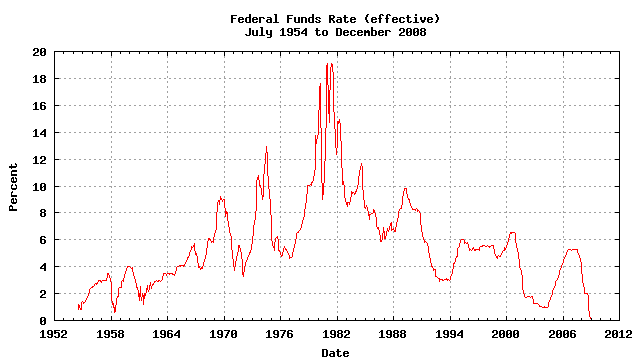
    Judging from this chart, there seem to have been several months during the early-80s interest rate spike during which one could have locked in 14% rates, and I'm expecting rates to go higher and last longer this time around. But even if I only got 14%, that's still 7 1/2% yearly profit for 25 years using the bank's money.

    You said:
    You're borrowing money to invest. Never a good idea.
    People have made millions on the carry trade . . . and as long as they get out in time, it seems like a good idea to me. Now if you had said, "Sometimes it's not a good idea" . . . .

    You said:
    This is very similar to buying a house you can't afford with an Alt-A loan - believing all will be made right by one thing: house price appreciation.
    There are many significant differences between buying a house vs. investing in Treasury bills. For one, T-bills are completely liquid, so one can bail out in a second if things trend badly. Second, you never lose your principle with T-bills, unlike a house which can lose value dramatically as we are now seeing. Third, if T-bill interest rates suddenly plunge over a 6-month period, I simple stop reinvesting them and pay off the bank with no penalty.

    You said:
    it is generally thought unwise to count on present cash flows continuing to grow or even keeping steady. This of course very much depends on the personal situation.
    I don't see what "personal" has to do with it. I'm counting on the government to supply the cash flow, and other than government default -- which is possible but doesn't seem likely, because they can print money -- this seems like a reliable source.
    The gamble here is that interest rates will not rise, and I have acknowledged that could happen. There is a risk, but a very minor one, with a huge pay-off if interest rates rise.

    c1ue, I've been reading your posts over several months, and I have been impressed by your worldly experience and wisdom in financial matters. However, everything you said in your post to me seems incorrect. So as an admitted financial neophyte, I must conclude that it is I who am incorrect, and I ask that you please help me understand what I am missing here . . . .

    Leave a comment:


  • Rajiv
    replied
    Re: The Face of Inflation: Does the U.S. Have a "Peso Problem" revisited

    I got the answer from John Williams at Shadowstat - it is 5.94 from 1980 - 2006 Now 1979/80 being a cusp year for high inflation I was off a bit -- But including 2007 it should end up about 6.53

    I will start a new thread on how income taxes have been shifting the tax burden from the rich to the poor over the last century by not indexing personal tax exemptions and tax brackets to the inflation rate -- very similar to not indexing the minimum wage to inflation.

    Leave a comment:

Working...
X