Announcement

Collapse
No announcement yet.

Illusion of Recovery – Part I: Print and pray has officially failed - Eric Janszen

Collapse
X
 
  • Filter
  • Time
  • Show
Clear All
new posts

  • lektrode
    replied
    Re: Illusion of Recovery – Part I: Print and pray has officially failed - Eric Janszen

    +100
    NOW we're talkin!
    couldnt've said it better myself....

    Originally posted by Rantly McTirade View Post
    As usual, an informative and enlightening article, Eric.
    However, we absolutely DID NOT need Bernanke's machinations
    since '08-and this observer is as 'serious' as any other.
    We have too much bad debt so, very simply, we need...
    'debt deflation/across the nation'. If this had been allowed-
    with proper help to all those who suffered collateral(sic)
    damage-we would have seen the Dow at 5000-or lower-
    headline unemployment at 20%+(real world higher), etc.
    We'd also be seeing a real, organic recovery at this point,
    with the FIRE sectors permanently shrunken in stature.
    We'd also see the vampires of the FIRE economy(Rubin,
    Fuld, Paulson(H),Mozilo, Lewis and hundreds more) in,
    to use the vernacular,'butt-slamming prison' and bank-
    rupted to the point that their families would be living
    under freeway overpasses, plus perhaps a few heart
    warming scenes of vigilante retribution. Instead, we
    have this massive debt overhang strangling the real
    economy(and we don't need any residential or
    retail/office commercial construction at all right now),
    while the FIRE crowd continues to run our political-
    and political economy-system. Bernanke, and of course
    his predecessor, needs to swing in the yard in Leavenworth.

    Leave a comment:


  • bart
    replied
    Re: Illusion of Recovery – Part I: Print, spend, and wait has officially failed - Eric Janszen

    Originally posted by Chris Coles View Post
    Quick question; does the chart include the decrease of the value of the $US over the time period?
    Nope, not adjusted for inflation either.

    Leave a comment:


  • Chris Coles
    replied
    Re: Illusion of Recovery – Part I: Print, spend, and wait has officially failed - Eric Janszen

    Originally posted by bart View Post
    I just updated the chart itself too.
    Quick question; does the chart include the decrease of the value of the $US over the time period?

    Leave a comment:


  • shiny!
    replied
    Re: Illusion of Recovery – Part I: Print, spend, and wait has officially failed - Eric Janszen

    Originally posted by bart View Post
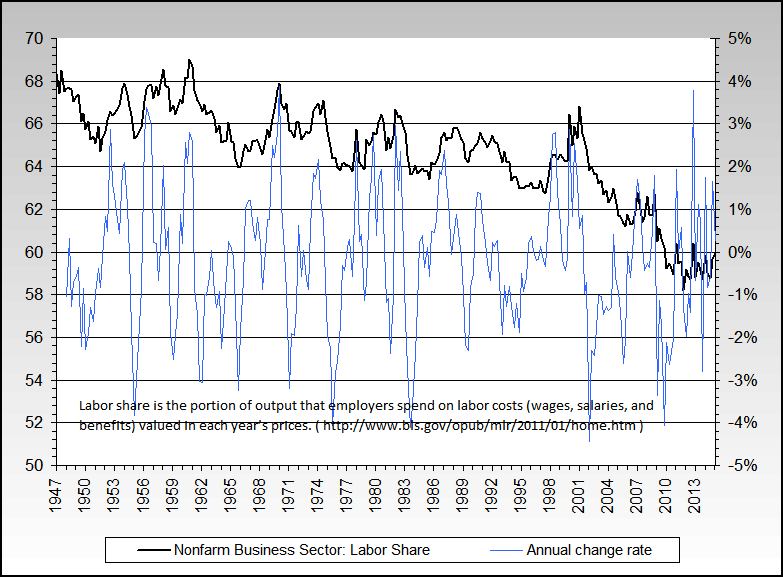
    Labor share is the portion of output that employers spend on labor costs (wages, salaries, benefits, etc.) in their prices. Nonlabor share—the remaining portion of output—includes returns to capital, such as profits, net interest, depreciation, and indirect taxes.

    When labor share is constant or rising, workers benefit from economic growth. When labor share falls, the compensation–productivity gap widens.


    I just updated the chart itself too.
    Thanks for this!

    Leave a comment:


  • bart
    replied
    Re: Illusion of Recovery – Part I: Print, spend, and wait has officially failed - Eric Janszen

    Originally posted by shiny! View Post
    Bart, could you please explain what this chart means?
    Labor share is the portion of output that employers spend on labor costs (wages, salaries, benefits, etc.) in their prices. Nonlabor share—the remaining portion of output—includes returns to capital, such as profits, net interest, depreciation, and indirect taxes.

    When labor share is constant or rising, workers benefit from economic growth. When labor share falls, the compensation–productivity gap widens.


    I just updated the chart itself too.

    Leave a comment:


  • gwynedd1
    replied
    Re: Illusion of Recovery – Part I: Print, spend, and wait has officially failed - Eric Janszen

    The solution was a tax holiday and deficits to keep money circulating to replace the private credit that is in a perpetual stall. Instead they kept with the banker tax cut with low interest rates. They should raise interest rates to keep the dollar strong while the goods and service economy is compensated with low taxes. This however would leave the FIRE economy out of it, and we can't have that..... FIRE is wringing us out by the drop, and it does not matter to them we are missing it by the buckets everywhere else. Other than that, good ROI public spending is also a great idea.

    Leave a comment:


  • Slimprofits
    replied
    Re: Illusion of Recovery – Part I: Print, spend, and wait has officially failed - Eric Janszen

    The dwindling jobs growth situation - non farm payrolls

    http://www.bls.gov/schedule/archives/empsit_nr.htm#2011

    March 2011 revised to +194K
    April 2011 revised to +217k
    May 2011 revised to +53k
    June 2011 revised to +20k
    July 2011 revised to +85k
    July to August change = 0

    Leave a comment:


  • shiny!
    replied
    Re: Illusion of Recovery – Part I: Print, spend, and wait has officially failed - Eric Janszen

    Originally posted by bart View Post
    Yep.

    Bart, could you please explain what this chart means?

    Leave a comment:


  • bart
    replied
    Re: Illusion of Recovery – Part I: Print, spend, and wait has officially failed - Eric Janszen

    Originally posted by ASH View Post
    My understanding is that a wage-price spiral is helpful for discharging debt because the nominal wages of individual workers rise, providing them with the cash to pay down their debt, and generating nominal tax income for the government. In contrast, cost-push inflation from commodities and imports is unlikely to help much by itself, because that mostly translates into income for producers of commodities and imports. From what I understand, labor had a lot more pricing power in the 70's and 80's, so it was able to secure nominal wage increases to help offset inflation. That isn't going to be the case this time around, so possibly high cost-push inflation won't help as much with the debt.

    Yep.

    Last edited by bart; September 06, 2011, 02:15 PM.

    Leave a comment:


  • dcarrigg
    replied
    Re: Illusion of Recovery – Part I: Print and pray has officially failed - Eric Janszen

    Originally posted by flintlock View Post
    Great post. Why is it so hard for some to just step back and look at the situation logically like you do? When it comes to economics, logic just seems to fly out the window. White becomes black and up becomes down if people think it will fufill their preconcieved political notions. Some start out with a philosophy, then spend the rest of their lives trying to prove it. Instead they should let the facts lead them to the truth.
    I think the root of the problem is that causation is hard to prove and the results of changes to a complex system are hard to predict.

    See, you say the facts lead you to truth.

    But I cannot see the obvious logic in arguing that if the .gov ran 1/10 the budget over the last 50 years then the economy would be better (since I believe that this was the argument SalandRichard was making).

    There is no objective way to prove that conjecture. The world would be different in myriad and unpredictable ways. This is why playing "what-ifs" on this scale is somewhat an exercise in futility (although it may make for a good Harry Turtledove book).

    I agree that one must always be open to being proven wrong empirically. One should also always remain skeptical of ones own beliefs.

    A quick paragraph in a forum is not enough to shake the foundations of anyone's beliefs, however, particularly when it is accompanied by no figures or sources.

    Leave a comment:


  • Rantly McTirade
    replied
    Re: Illusion of Recovery – Part I: Print and pray has officially failed - Eric Janszen

    As usual, an informative and enlightening article, Eric.
    However, we absolutely DID NOT need Bernanke's machinations
    since '08-and this observer is as 'serious' as any other.
    We have too much bad debt so, very simply, we need...
    'debt deflation/across the nation'. If this had been allowed-
    with proper help to all those who suffered collateral(sic)
    damage-we would have seen the Dow at 5000-or lower-
    headline unemployment at 20%+(real world higher), etc.
    We'd also be seeing a real, organic recovery at this point,
    with the FIRE sectors permanently shrunken in stature.
    We'd also see the vampires of the FIRE economy(Rubin,
    Fuld, Paulson(H),Mozilo, Lewis and hundreds more) in,
    to use the vernacular,'butt-slamming prison' and bank-
    rupted to the point that their families would be living
    under freeway overpasses, plus perhaps a few heart
    warming scenes of vigilante retribution. Instead, we
    have this massive debt overhang strangling the real
    economy(and we don't need any residential or
    retail/office commercial construction at all right now),
    while the FIRE crowd continues to run our political-
    and political economy-system. Bernanke, and of course
    his predecessor, needs to swing in the yard in Leavenworth.

    Leave a comment:


  • aaron
    replied
    Re: Illusion of Recovery – Part I: Print and pray has officially failed - Eric Janszen

    The transfer payments to the poor, many of them armed veterans, is the "bread" part of the circuses. Seriously, do you want 50 million angry, hungry people rising up against the evil __________ who have held them down all these years? The alternative to transfer payments is civil war.

    The fact is, if you really want to take a step back and look at the big picture... we can produce all our country needs now (using oil) with a very small portion of the population actually working. What do you want to do with all the "surplus labor"?

    With the organization a functioning government provides, we can at least take the extra labor and build stuff that the rest of us can use and enjoy. Skilled labor may never be this cheap again in the U.S. Interest rates will also never be this low again. If there was ever a time to borrow 10 trillion and make the country a better place to live, now is the time. We even still have oil to burn for the job.

    Of course, that is only a short term step. Long term, I think we should focus on decreasing population size in the United States and most problems will work themselves out. I think this can be accomplished by increasing inflation (check) and strict immigration policies. The job problem will work itself out as well with less people and more work (less oil) in the future.

    But make no mistake, transfer payments to the poor make the United States a tolerable, dare I say "nice" place to live.

    Leave a comment:


  • flintlock
    replied
    Re: Illusion of Recovery – Part I: Print and pray has officially failed - Eric Janszen

    Originally posted by SalAndRichard View Post
    Any proof increased govn't spending on infrastructure and energy wouldn't just be more boondoggles like that in California where $535M was "invested" in a green company that recently closed its doors? Or merely given to political cronies and unions and other supporters, as long as it sounds beneficial?

    Why is this method deemed superior to the other side of the coin? ("spending" via tax cuts for businesses, incentives to expand, lowered regulation, etc?)

    Make no mistake, business is corrupt and imperfect. But government seems worse.

    Wouldn't energy tax increases provide the incentive to make alternative energy financially viable while also raising revenue? I doubt any "serious" person thinks govn't can centrally plan that better than private enterprise.

    What about local incentives for businesses to locate outside of major metro areas where traffic jams consume massive amounts of energy in wasted time spent idling in traffic? In the internet age there's minimal reason to commute an hour from the suburbs to a centrally located office.

    Under the theory that cutting deficit spending would be a bad thing, (no doubt it would be painful), where does it end? If it's possible to borrow and spend one's self into prosperity, why aren't we better off with a $14T debt vs the $4T or whatever it was when Ross Perot had his own charts/graphs out 20 years ago?

    What exactly did we get for our $10T "investment"?

    How did the US see such growth 1870-1920 without massive federal deficit spending?

    I still can't see how globalism benefited any American who didn't a) have money to invest, b) have an immigrant-proof job, and c) had a job in the FIRE economy , and Yes, you can "consume" more items for less. But when your real income is fallling doesn' that offset the benefits and then some? Isn't the over emphasis on consumption in our economy a result of this? Cheap consumer items plus easy credit, or deficit spending on massive programs plus the ability to borrow cheap by the government. Sounds like the same things. Huge distortions that we have to now pay the piper for.

    If we were running $1.5T surpluses due to small government does anyone really think we'd be facing potential disaster? How is more debt the solution to too much debt? Isn't the a big culprit massive transfer payments to unproductive individuals, (and wars) with the resulting distortions that causes in the economy?
    Great post. Why is it so hard for some to just step back and look at the situation logically like you do? When it comes to economics, logic just seems to fly out the window. White becomes black and up becomes down if people think it will fufill their preconcieved political notions. Some start out with a philosophy, then spend the rest of their lives trying to prove it. Instead they should let the facts lead them to the truth.

    Leave a comment:


  • c1ue
    replied
    Re: Illusion of Recovery – Part I: Print, spend, and wait has officially failed - Eric Janszen

    Originally posted by SalandRichard
    I have to wonder how much additional energy useage was caused by trends in lifestyle and politics during the past 30 years or so.
    - much bigger homes require more energy (thanks to govnt inspired credit bubble)
    It wasn't the government that desired the credit bubble. It was the banks and banksters.

    Originally posted by SalandRichard
    - road building as a method of economic "infrastructure" led to more driving rather than public transit and short commutes to numerous smaller citeis that pop up w/o high speed road access.
    It should not be forgotten that the national highway system was created for the purpose of national defense. That this program dovetailed nicely with real estate developers, possible but I personally don't know.

    Originally posted by SalandRichard
    -cheap gas inhibited need for fuel efficiency.
    -lack of emphasis on oil self-sufficiency for strategic reasons led to preference of buying cheap foreign oil rather than adjusting to limits of our own supply of energy sources.
    -reliance on middle eastern oil and other aspects of globalism led to hidden costs (a large standing army) and involvment in foreign entanglements.
    Cheap gasoline has been a cornerstone of American government policy for generations. The oil companies want their tax breaks, the car companies want cheap gasoline, the real estate developers want cheap transportation thus permitting suburban real estate, the list goes on and on.

    Notice what's missing: credible governance and a clear strategic plan.

    Originally posted by SalandRichard
    -mass immigration and lack of enforcement led to population increase and resulting higher demands on domestic energy sources.
    Mass immigration was due to the demand for cheap labor. Again this finger can be pointed at corporations.

    Originally posted by SalandRichard
    -consumption culture led to more energy consumption.
    And who promotes the consumption culture?

    Originally posted by SalandRichard
    We exported oil during WWII and fought a far-flung war on a massive scale with our own oil. With massive increases in efficiency since then (a 300hp car can get 30mpg highway) there should have been the ability to remain self-sufficient. Money for energy would stay here in our economy.
    We didn't have suburbs in WW II. We didn't have more cars than people in WW II. We didn't have Wal-Marts everywhere in WW II. We didn't have widespread air conditioning and refrigerator/freezer combos prior to WW II. The US population in 1945 was less than half the size of the US population today.

    In fact if the US population today were cut to 140 million (US population in 1945), per capita energy use even at today's levels would still see massive reductions in oil imports.

    As FRED notes: we aren't where we are by some law of physics. This situation is the culmination of years and decades of poor choices - and many of those poor choices were lobbied for by FIRE.

    Leave a comment:


  • FRED
    replied
    Re: Illusion of Recovery – Part I: Print, spend, and wait has officially failed - Eric Janszen

    Originally posted by SalAndRichard View Post
    I have to wonder how much additional energy useage was caused by trends in lifestyle and politics during the past 30 years or so.
    - much bigger homes require more energy (thanks to govnt inspired credit bubble)
    - road building as a method of economic "infrastructure" led to more driving rather than public transit and short commutes to numerous smaller citeis that pop up w/o high speed road access.
    -cheap gas inhibited need for fuel efficiency.
    -lack of emphasis on oil self-sufficiency for strategic reasons led to preference of buying cheap foreign oil rather than adjusting to limits of our own supply of energy sources.
    -reliance on middle eastern oil and other aspects of globalism led to hidden costs (a large standing army) and involvment in foreign entanglements.
    -mass immigration and lack of enforcement led to population increase and resulting higher demands on domestic energy sources.
    -consumption culture led to more energy consumption.
    -A complete ignorance of the fact that "cheap" foreign oil and goods and "cheap" domestic services are subsidized by the government through higher defense and transfer payments as domestic workers earn less, require more aid, and immigrants also take a bite. That $20 barrel of 80's oil came courtesy of a $2B carrier and $5B of escorts and such standing guard over the straights the tankers came through.

    We exported oil during WWII and fought a far-flung war on a massive scale with our own oil. With massive increases in efficiency since then (a 300hp car can get 30mpg highway) there should have been the ability to remain self-sufficient. Money for energy would stay here in our economy.
    All of your points agree with the Postcatastrophe Economy thesis: the simultaneous development of the Dollar Cartel and FIRE Economy since 1980 increased US dependence on foreign oil, reduced the incentive to conserve, and increased incentives to project military to protect US oil interests.

    Leave a comment:

Working...
X