
Re: Asylum Markets of the post FIRE Economy – Part I: Locked Up - Eric Janszen
And this brings the discussion right back to the question: Which nation, over the next, say, five years, is going to be the best location for a product design, manufacturing and distribution business where one will own and control all aspects ?
-
Re: Asylum Markets of the post FIRE Economy – Part I: Locked Up - Eric Janszen
That same article was my entrance to the site...Originally posted by FRED View Post
http://www.itulip.com/forums/showthread.php?t=105Leave a comment:
-
Re: Asylum Markets of the post FIRE Economy – Part I: Locked Up - Eric Janszen
Hi Chris,Originally posted by Chris Coles View Post
You live around 5,500 miles away from me in a different country with a different currency. I can't judge for myself what is happening in your market and wont attempt to.
The points you raise seem to be more part of a longer term trend towards selling inferior food products. This has been going on for my entire life however and is not a response to Fed money printing in the US, which is iTulip's argument.Leave a comment:
-
Re: Asylum Markets of the post FIRE Economy – Part I: Locked Up - Eric Janszen
There is an entire thread documenting instances of this type of inflation here: Inflation snapshots: December 2009[/QUOTE]
This thread is at the extreme end of unconvincing. There are only three documented examples of reduction in quantity supplied and prices kept the same - which is clearly a price rise. Comically there is also an example of the opposite where the poster proves a drop in prices unintentionally.
My local supermarket (all of iTulip's examples for some reason are food related) has yellow stickers for items on sale. It is a challenge to find an item not discounted. The entire supermarket is a sea of yellow stickers.
You and your readers seem to be confusing a small number of producers or service providers desperate attempts to remain in business as evidence of inflation. If my personal costs in every area are declining then the inputs for US businesses are declining too. The Chinese restaurant cutting corners is buying cheaper groceries just like I am.
It is typical for a failing business to do things like this. Failure breeds desperation.Leave a comment:
-
Re: Asylum Markets of the post FIRE Economy – Part I: Locked Up - Eric Janszen
With all due respect, that is a quite incorrect conclusion. Indeed, that has been my viewpoint for some decades, backed up by repeated presentations of papers to the contrary. The underlying problem of insufficient employment, ergo, insufficient job creation; is a direct result of the failure to establish a free marketplace for the capital required to create the jobs. Instead, what we have today is a system, (venture capital, merger and acquisition and private equity), all linked to the major investment banks; that flatly refuses to permit competition with existing investment. It is this refusal to permit new job creation, unless they are in complete control, that has, IMHO, caused the collapse of the financial system that we see all around us today.Originally posted by flintlock View Post
Indeed, is why I put together all my previous papers, including some placed here on iTulip, into my free download book The Road Ahead from a Grass Roots Perspective www.chriscoles.com/page3.html and is why I have, as of last night, put up an entry for the YouTube/Davos Debate competition. http://www.youtube.com/watch?v=wVWhgdL6Tt8
Please look out for me if I get past the first stage and put forward for a public vote. http://www.weforum.org/en/index.htm
The Davos Debate starts here: http://www.youtube.com/davos
Perhaps someone else from the iTulip community will also "have a go"???Leave a comment:
-
Re: Asylum Markets of the post FIRE Economy – Part I: Locked Up - Eric Janszen
What immediately came to mind was the thought; "what if" China closed its trade doors in the same manner that Germany did before WW2? The US would be stuffed. Period. Worth bearing in mind??I had reason to buy some steel warehouse shelving two weeks ago. As I backed my truck up to the dock to pick it up at the warehouse, they had my shelves on their forklift at the loading dock ready to load on my truck.
I asked them how they knew who I was, as they had never seen me before and I had not identified myself or shown my paperwork yet.
They said "easy -- you're our only customer pickup today." They then allowed as they were going out of business and I got half price, cash only, on an extra shelf.Leave a comment:
-
Re: Asylum Markets of the post FIRE Economy – Part I: Locked Up - Eric Janszen
I had reason to buy some steel warehouse shelving two weeks ago. As I backed my truck up to the dock to pick it up at the warehouse, they had my shelves on their forklift at the loading dock ready to load on my truck.Originally posted by jtabeb View Post
I asked them how they knew who I was, as they had never seen me before and I had not identified myself or shown my paperwork yet.
They said "easy -- you're our only customer pickup today." They then allowed as they were going out of business and I got half price, cash only, on an extra shelf.Leave a comment:
-
Re: Asylum Markets of the post FIRE Economy – Part I: Locked Up - Eric Janszen
Originally posted by Spartacus View Post
My bet is that 2010 USA = Argentina 2001. Plan accordingly.
All the classic signs are there. Supply is going going... Prices are at liquidation levels ... and no new supply coming on line to back-fill inventories.
This IS WHEN YOU GO SHOPPING for durable goods, as EJ pointed out. You will EITHER not find what you need or NOT be able to afford it next year.
Ka In progress, Poom immediately following. And I mean tick-tock, get your shopping done, now!
I look at tools, computer parts, hardware, all the kinds of long term items you need to sustain yourself. Know what, it ain't there.
Inventories are very low making it hard to find items. Prices are all over the place. If a store is going out of business, Quality items are priced DIRT CHEAP. If they are not liquidating, prices are very high. Price depends on which store you buy from (liquidation sale vs not). The only price reductions (read good deals on quality items) from firms closing out inventory for bankruptcy. Inventories of remaining items are running thin with no replacements to refill exhausted supplies.
When this residual supply runs out, POOM HITS, and the supply is almost gone. Sudden stop is only a heartbeat away.
Don't believe me, go shopping for durable quality stuff, you'll see exactly what I mean.
Monetary Policy hasn't hit supply shock YET. It soon will. That's what I figure will trigger our POOM, and from everything I can see, that supply is damn near gone.
(Note: I am not talking about crap Walmart stuff, I'm talking about SNAP-ON Tools and the like. From my vantage point I am seeing EXACTLY the phonomenon EJ described in his Argentina article, PRECOLLAPSE).
Get ready, sooner rather than later, we hit our supply shock and get run over by our monetary policy.Last edited by jtabeb; December 29, 2009, 03:06 AM.Leave a comment:
-
Re: Asylum Markets of the post FIRE Economy – Part I: Locked Up - Eric Janszen
Tom Friedman is a moron.
His first example: completely misleading and useless.
When I get more batteries for the digital camera (rechargeable Energizers only lasted 3 or 4 charges :mad , I'll post my 'Skin Magazine Index' for the past 3 years.
Page count for October through December 2007: about 500 total
Page count for October through December 2008: about 400 total
Page count for October through December 2009: about 240 total
Given a few pages are devoted to articles, advertiser indices, 'about us', etc etc it is clear that the economy has slammed this magazine.
Advertising is down at least 50% from 2007 peak and likely more; advertising prices themselves also are likely lower.
Skin Magazine is a free publication for skin care professionals: salons and what not. This is a very high margin business oriented toward the high end consumer. Clearly this isn't insulating either the salon segment nor its service industry/manufacturer sources.
Tom Fried-brain's second example: outsourcing to Mexico. A token upstate New York facility but otherwise sending even more jobs outside of the US.Leave a comment:
-
Re: Asylum Markets of the post FIRE Economy – Part I: Locked Up - Eric Janszen
New-home sales crater as subsidy wanesWASHINGTON (MarketWatch) -- Sales of new homes fell 11.3% in November to a seasonally adjusted annual rate of 355,000 as a popular tax break for first-time homeowners was set to expire, the Commerce Department estimated Wednesday.Today the government will pay you $8,000 to buy one, the way they paid you $4,500 to buy a new car in October. Look how well that worked out for the auto industry.
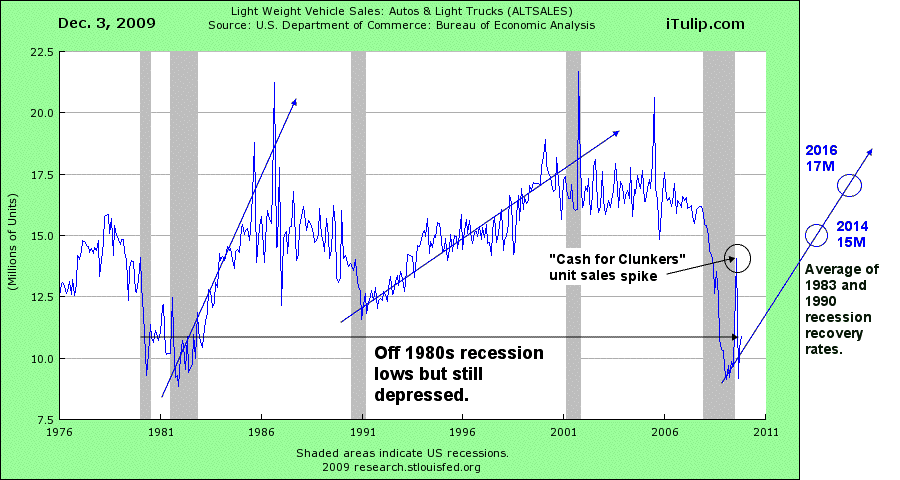
"Cash for Clunkers" produced brief unit sales spike to 1986 unit sales volume before falling back to 1983 levels, back when the U.S. economy was 2/3 its currency size. Current course and speed, the market will not recover to pre-crash levels until 2016.
It was the lowest sales pace since April and followed months of steadier sales boosted by the tax break that was set to expire on Nov. 30.Leave a comment:
-
Re: Asylum Markets of the post FIRE Economy – Part I: Locked Up - Eric Janszen
Hey BS,Originally posted by BiscayneSunrise View Post
I enjoyed reading your post, do you recall where you got it? I didn't see a link.
OK I found it here: http://www.nytimes.com/2009/12/13/op...3friedman.htmlLeave a comment:
-
Re: Asylum Markets of the post FIRE Economy – Part I: Locked Up - Eric Janszen
Right. That's why I was asking what iTulip saw that I wasn't.
Here is a recent Tom Friedman piece. No wage inflation there either:
The Do-It-Yourself Economy
By THOMAS L. FRIEDMAN
Published: December 12, 2009
In case you haven’t noticed, the U.S. economy today is actually being hit by two tsunamis at once: The Great Recession and the Great Inflection.
The Great Inflection is the mass diffusion of low-cost, high-powered innovation technologies — from hand-held computers to Web sites that offer any imaginable service — plus cheap connectivity. They are transforming how business is done. The Great Recession you know.
The “good news” is that the Great Recession is forcing companies to take advantage of the Great Inflection faster than ever, making them more innovative. The bad news is that credit markets and bank lending are still constricted, so many companies can’t fully exploit their productivity gains and spin off the new jobs we desperately need.
Two examples, one small, one large: The first is my childhood friend, Ken Greer, who owns a marketing agency in Minneapolis, Greer & Associates. The Great Recession has forced him to radically downsize, but the Great Inflection has made him radically more productive. He illustrated this by telling me about a film he recently made for a nonprofit.
“The budget was about 20 percent of what we normally would charge,” said Greer. “After one meeting with the client, almost all our communication was by e-mail. The script was developed and approved using a collaborative tool provided by www.box.net. Internally, we all could look at the script no matter where we were, make suggestions and get to a final draft with complete transparency — easy, convenient and free. We did not have a budget to shoot new footage, yet we had no budget either for stock photography the old way — paying royalties of $100 to $2,000 per image. We found a source, istockphoto.com, which offered great photos for as little as a few dollars.
“We could easily preview all the images, place them in our program to make sure they worked, purchase them online and download the high-resolution versions — all in seconds,” Greer added. “We had a script that called for 4 to 5 voices. Rather than hiring local voice talent — for $250 to $500 per hour — we searched the Internet for high-quality voices that we could afford. We found several sites offering various forms of narration or voice-overs. We selected www.voices.com. In less than one minute, we created an account, posted our requirements and solicited bids. Within five minutes, we had 10 to 15 ‘applicants’ ” — charging 10 percent of what Greer would have paid live talent.
“Best part,” he said, “within minutes we had sample reads, which could be placed into our film to see if the voices fit. We selected our finalists, wrote them with more specific instructions and within hours had the final read delivered to us via MP3 files over the Web. We could get any accent or ethnicity we wanted. For music, we used a site called www.audiojungle.net,” where he could sample thousands of cuts of music and sound effects with the click of a mouse, and then buy them for pennies.
By being able to access all these cheap tools, Greer got to focus on his value-add: imagination. The customer got a better product for less money. But he didn’t create many new jobs. For that, he needs the economy to pick up. “If we could only borrow a buck and invest,” said Greer, “we’d all be rolling again.”
Farooq Kathwari, the longtime C.E.O. of Ethan Allen Interiors, had to accelerate reinvention of his company for the same reasons. In the last year, he reduced his work force by 25 percent, consolidated several U.S. manufacturing plants, including transferring all upholstery manufacturing into a large state-of-the-art facility in North Carolina, enabling Ethan Allen to substantially decrease its production time. The most labor-intensive upholstery work is done in the company’s new plant in Mexico, and the components are shipped to the North Carolina facility for completion.
“Five years ago,” said Kathwari, “it would take about 20 hours of labor time to make a high-quality custom sofa. Now, due to our investments in technology and a smaller work force that is more highly skilled, the labor time to make this sofa is about three hours.”
Everywhere he can, Kathwari says he is leveraging technology to cut costs and improve quality to retain his competitive position in world markets. This enabled Ethan Allen to maintain sufficient cash to survive. “We now produce all our advertising programs in-house, including national television commercials, at a fraction of the cost we spent a few years back — just as your friend is doing,” said Kathwari. “Our associates recognize that reinvention is vital to our survival.”
Given its new state of hyperefficiency, any uptick in business would really help Ethan Allen’s bottom line and stimulate hiring, but that requires credit markets to loosen for its customers and store owners. Said Kathwari, “Credit is still a vital issue, and it is not happening at the grass-roots level — or when it is, it is very expensive.”
Strange times: The Great Recession and Great Inflection are making our companies ultralean, innovative and productive. But with credit still constricted, we’re like a superfit track star with a weak heart. We’ve got to get credit pumping to our industrial muscles again.Leave a comment:


Leave a comment: