
Re: Mission Accomplished – Part I: Wrecking the Economy - Eric Janszen
i do not believe that it is in the interest of ANY country for the dollar to be devalued in a "disorderly" way. that's the word they use in all the communiques, and i think that's the word they mean. every government likes to be in control. a disorderly devaluation may be defined as the loss of control by any and all parties.
-
Re: Mission Accomplished – Part I: Wrecking the Economy - Eric Janszen
Writing is an art form of communicating well with your intended audience. My concern is the overall quality and readability of EJ’s writing.Originally posted by FRED View Post
One consequence, for example, sometimes leads to ambiguous interpretations: easily confirmed by reading some of the posters who think EJ said one thing and other’s claiming EJ said something different. Others have expressed their own concerns to which I concur. Shouldn't we all inspire to higher standards of professionalism?
EJ is brilliant in understanding the underlying fundamentals of our financial malaise; however, writing is not his strong suit - leading to better comprehension for his reader. Having said this, let me offer a possible solution.
EJ lives in an area that boasts some of the best learning institutions in the world. Find a journalism student, possibly one who also minors in Economics to proof, before publishing. There is no need for me to list the benefits, which I hope, should be obvious.
Leave a comment:
-
Re: Mission Accomplished – Part I: Wrecking the Economy - Eric Janszen
That a nation act in its own interest is not surprising. What I've laid out repeatedly is that the creditors to the US had more to lose in the past thus were willing to be 'taken advantage of' in the 70s (BW exit) and 90s (Star Wars debt restructure).Originally posted by Jay
What you still have yet to answer is why these other nations would give the US another 'advantage' when there is negative net benefit in doing so.
You are simply reiterating the belief that EJ noted in the article: that the US as the biggest consumer can still get away by screwing its creditors/suppliers.
EJ in the article also noted that the US isn't going to be the biggest consumer anymore. US consumption is dropping and will continue to fall as long as the massive Internet/Real Estate/Obamafed debts continue.
And if you think other nations will just cough up their labor and materials under threat from the US military, well, you'd first have to show how the US gets out of Iraq and Afghanistan gracefully - i.e. not as an obvious loser.
This argument might be sensible for China, but China itself cannot fund the entirety of the US debt - not even half of it.Originally posted by thousandmilemargin
China's trade surplus with the US is probably only going to be around $200B this year - compared with $250B in 2008.
That's worth about 10 weeks of Treasury sales at the 'official' pace, and about 5 weeks worth at the $2T/year pace. And we have at least 15 months more to go at this pace.
Who is going to buy the remaining 42 or 47 weeks? The Fed's $300T facility is good for another three months.
Furthermore China has been overall maintaining or even dropping its overall US debt: China's corporate and agency bond holdings are in free fall.
Clearly China is not doing all it can to support the vast Obama spending.
While I've said in other posts that clearly China is going to 'play nice' by recycling its trade surplus with the US into bonds, it just ain't enough.
Even despite all this the reality is that China can both be a 'good' and a 'bad' creditor: it can both minimally fulfill its obligations as a US creditor AND benefit from other nations being the creditor whip hand - getting the cake and eating it too so to speak.
It depends on what your definition of technology transfer is.Originally posted by tmm
If you mean factories to assemble iPods, then yes.
If you mean state of the art defense, electronics, biotechnology, etc etc - there are some examples but overall it is safe to say that the leading edge stuff is still very well controlled by the US technology transfer regulations. But then again, China doesn't need leading edge stuff to be a powerhouse exporter.
As for global power and influence - the dollar was indeed a means to China growing. I don't see how this makes any difference in the future though.
What has the US done for China lately?
If this is true, then there is even LESS reason for China to help the US ease its devaluation transition.Originally posted by tmm
But in point of fact China's government would face a lot of very difficult questions if it allows devaluation of its savings without a fight. Unlike the dumb people in the US, the people in China are well aware of larger geopolitical finance issues.
I don't see what you're getting at. Is anyone outside of the stupid American public unaware that China is growing in financial and military power? That China is a threat to challenge for superpower status in the next 50 years?Originally posted by tmm
The Yellow Peril was all the rage in the 1890s, for crying out loud.
And again, your fatuous assertion that monetization is inevitable doesn't answer the question of how it will occur: will it be in a manner beneficial to the US, or in a manner beneficial to the US' creditors?
I've never said that the US debt will not be deflated away in some manner. The sheer magnitude of the problem dictates some type of default will occur.
What I've said is that the US - being still dependent on foreign goods, foreign credit, and foreign goodwill on the interest being paid on existing debt - is no longer in control of how this default occurs.
The situation now is that the US is very much acting like North Korea.
North Korea: give us your money/oil/food or we'll shoot ourselves in the head via famine amongst the DPRK population and building nuclear bombs
US: give us your money/oil/food/manufactured goods or we'll shoot ourselves in the head via dollar devaluation and building a debt bomb
Last I looked North Korea's strategy has been...sub optimal. For the PRNK as a nation, for the DPRK's people, pretty much for anything/everything in the DPRK except the ruling class.
You're also ignoring the fact that China's trade with Europe is now larger than its trade with the US. Sure, losing some of its monopoly trade surplus with the US would hurt, but then again it is no longer the only game in town.
So I again await with bated breath for some facts to go with the talk.Leave a comment:
-
Re: Mission Accomplished – Part I: Wrecking the Economy - Eric Janszen
I learned from a professional proof reader to read the copy backwards, sentence by sentence, from the end to the beginning. Thanks for the print and read trick!Originally posted by mooncliff View Post
Thanks for this tip, too!Also, if you are using MS Word, even if you have grammar and spell check on automatic, you still may have to manually force the checks at the end by selecting from the menu. Word will then suddenly notice problems it did not flag previously.Leave a comment:
-
Re: Mission Accomplished – Part I: Wrecking the Economy - Eric Janszen
We're not heading into an era of unreason, we're already there. Most of the MSM covers unreason in order to provide balance to reason. Some networks actually promote unreason! Unreason has reached deep into too many outlets of communication, even here at iTulip.Originally posted by EJ View Post
An uninformed or misinformed public, that elects it's leaders based on unreason is playing Russion Roulette with it's future. Seperation of media and oligarchy needs to be as important as seperation of church and state. Sources that promote misinformation need to be exposed and publicly discredited if a democracy hopes to continue.
I like the format of this piece, and as always, there's plenty of data supported content to think about and discuss.Leave a comment:
-
Re: Mission Accomplished – Part I: Wrecking the Economy - Eric Janszen
Originally posted by metalman View Post
Personally, I find the little typos kinda charming... the ideas are so clear and compelling, they are like the little nicks that the Chinese deliberately put on the bottom of fine porcelain... because perfect things are not of this Earth.
I do a lot of professional editing, and the only way I have found to minimize typos is to read and edit the final draft printed on paper. Trying to find typos on a computer screen does not work. I think there is some interaction with eye-flick blindness and flickering of the screen. Some of the things I have missed are just amazing.
Also, if you are using MS Word, even if you have grammar and spell check on automatic, you still may have to manually force the checks at the end by selecting from the menu. Word will then suddenly notice problems it did not flag previously.Leave a comment:
-
Re: Mission Accomplished – Part I: Wrecking the Economy - Eric Janszen
Real estate continues to drop in Japan... as it has for nearly two decades...
Thursday, September 17, 2009
Land Prices Fall At Fastest Pace In 5 Years
TOKYO (Kyodo)--Average commercial and residential land prices in Japan fell at the fastest pace in five years in the year to July 1 as the global recession forced businesses to shut down offices and stores and curbed demand for private housing, the government said Thursday.
The average nationwide commercial land price dropped 5.9 percent, declining for a second straight year, while the average residential land price fell 4.0 percent, down for the 18th consecutive year, the Ministry of Land, Infrastructure, Transport and Tourism said in an annual survey.
Only three of the around 23,000 locations in the annual land price survey recorded rises, the smallest number since the ministry started the survey in 1975.
Land price declines were conspicuous in metropolitan regions and large provincial cities.
''While businesses downsized or closed their offices and stores throughout Japan due to the global recession, housing demand also slackened,'' a ministry official said.
Average commercial land prices declined in the three metropolitan regions of Tokyo, Osaka and Nagoya for the first time in four years, falling 8.9 percent in the Tokyo region, 7.1 percent in the Osaka region and 7.3 percent in the Nagoya region.
The average commercial land price in other regions fell 4.9 percent, declining for the 18th straight year.
Average residential land prices declined in the Tokyo and Osaka regions for the first time in four years, falling 6.5 percent and 4.5 percent, respectively, while the Nagoya region saw a 4.2 percent drop, the first decline in three years.
In other regions, the average residential land price fell 3.4 percent, down for the 17th consecutive year.
Commercial and residential land prices declined in all of Japan's 47 prefectures.
Tokyo recorded the largest commercial land price drop of 10.8 percent, followed by 8.6 percent in Osaka Prefecture and 8.1 percent in Miyagi Prefecture.
As for residential land prices, Tokyo also registered the largest fall of 8.7 percent, followed by 6.2 percent in Ishikawa Prefecture and 5.4 percent in Saitama, Kanagawa, Toyama and Fukui prefectures.
Among major cities, Fukuoka saw the largest commercial land price decline of 15.9 percent, followed by central Tokyo with a fall of 14.0 percent, Nagoya with an 11.9 percent drop and Osaka with an 11.2 percent decline.
The highest commercial land price of 25 million yen per square meter was recorded in a location in Tokyo's Ginza district in Chuo Ward. A location in Tokyo's Chiyoda Ward had the highest residential land price of 3.02 million yen per square meter.Leave a comment:
-
Re: Mission Accomplished – Part I: Wrecking the Economy - Eric Janszen
Elsewhere you have suggested that if the old way of creating consumer demand by having the banks lend them money no longer worked so well, then we could keep things rolling a new way, by having the banks lend new money to the government (banks buy Treasuries) and the government use that money for whatever spending programs it can invent. Lordie knows governments can be quite creative when they are stressed to invent more ways to spend money.Originally posted by thousandmilemargin View Post
One thing I don't get though. The Chinese export production capacity is focused on manufactured goods, especially consumer goods such as afluent Westerners might purchase. By the old way, there were many afluent Westerners (well, at least there were many spending as if they were afluent.)
But by the new way, most Westerners will feel poorer and spend less. Only a few (suspected to be corrupt) wealthy will still be spending on consumer goods in robust quantities. I don't see how money spent this new way flows through the majority of Western consumers to the Chinese factory worker as fluidly as it flowed the old way.
Won't this put a crimp in the export powered engine of China's economic miracle?Leave a comment:
-
Re: Mission Accomplished – Part I: Wrecking the Economy - Eric Janszen
Your posts worth bottling, bloke.Originally posted by thousandmilemargin View Post
(I hope I didn't just insult your wife or anything; I adapted that reply from an online Aussie phrase book. I don't really speak Aussie .)
.)
Anyhow, the quality of your posts on this thread prompted me to go back and read your earlier iTulip posts. Good stuff. I look forward to more of your comments.Leave a comment:
-
Re: Mission Accomplished – Part I: Wrecking the Economy - Eric Janszen
I was just talking about "technology transfers" in the Select forum recently. I find your comments here most interesting - as I've personally been involved in selling and implementing several technology transfers into China over the last several years.Originally posted by thousandmilemargin View Post
This messed-up global fiat currency system is going to prove to have many unintended consequences. Globally.Leave a comment:
-
Re: Mission Accomplished – Part I: Wrecking the Economy - Eric Janszen
By reducing the debt to GDP ratio and allowing the US to limp along for longer, so the transfer of technology to China can continue. It also assists in the long term decline of US global power, which has strategic value for China.Originally posted by c1ue View Post
What were the fruits of the last decade? Technology transfer, the construction of a manufacturing base, increased global power and influence. The dollar hoard was just a means to an end. Like I said, they (China and Japan) PRINTED yuan and bought dollars. The exporters who actually earned the money swapped their dollars for Yuan and Yen long ago. The governments who now hold the dollars bought them with fiat currency (cost: zero). This wasn't an investment - it was an OPERATION, in the military/intelligence sense.Originally posted by c1ue View Post
You should think of this as a mafia loan shark operation, not as being analogous to a stockholder/bondholder situation.
If the value in gold of the dollar hoard halves, that doesn't halve its political and strategic value.
Monetarization. It's started, it is inevitable. The Chinese will make outraged noises about it, but since it is a slow form of national suicide they may also gloat in private. By acting outraged they can demand compensation in return for the loss of their investments - such as the right to invest in strategic US companies.Originally posted by c1ue View Post
It's all about leverage - of the political kind.
Think of one of those political thrillers where nothing is what it seems, and you realise by the end of the movie that the main actors were playing a game entirely different than what their apparent actions would suggest.
"The Great Game", in this case.
You can see that the Chinese are long the US dollar by a trillion or so - but maybe behind the scenes they are actually short by several trillion more. What price do you put on superpower status?Leave a comment:
-
Re: Mission Accomplished – Part I: Wrecking the Economy - Eric Janszen
Seconded! Great material clearly presented.Originally posted by metalman View PostLeave a comment:
-
Re: Mission Accomplished – Part I: Wrecking the Economy - Eric Janszen
i like it. do it again.If readers like the format, we’ll do it again.
take california...Take California, the world’s seventh largest nation by GDP.
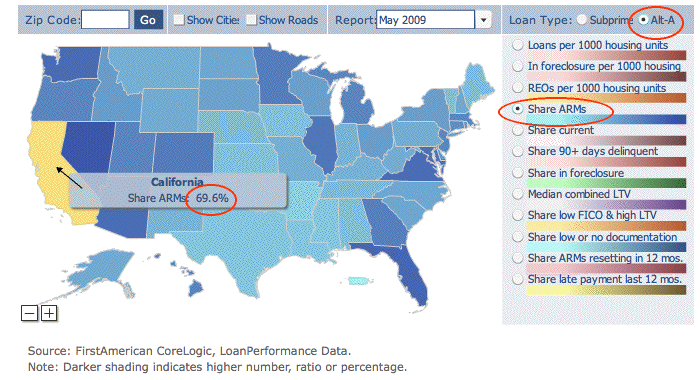
Just under 70% of ARMS in California are Alt-A, so-called prime not sub-prime morgages.
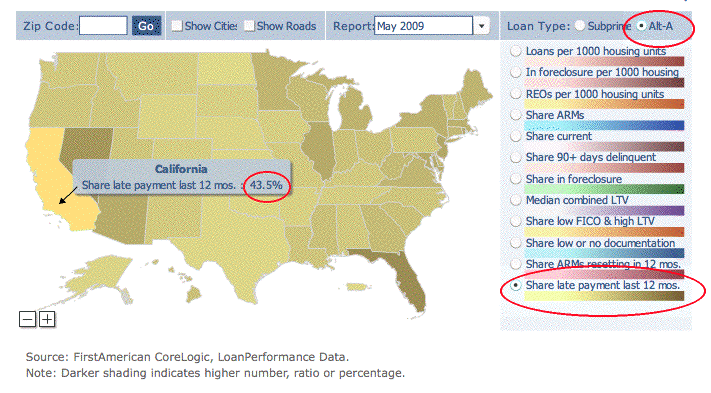
As of May, 44% of those mortgages were technically in default, of 70% of all ARMS; about 30% of all ARMS are in default.
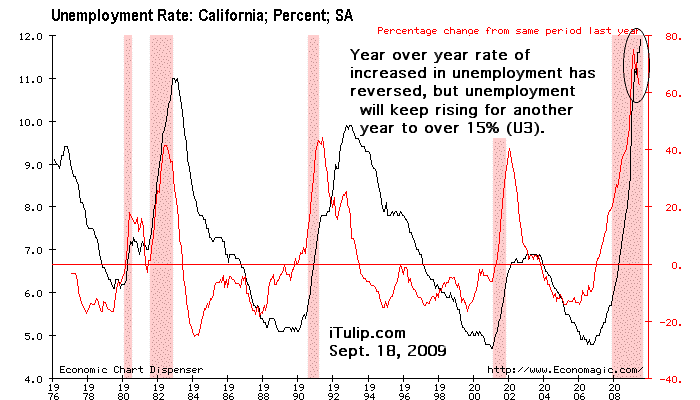
Meanwhile, unemployment continues to rise.

Leave a comment:
-
Re: Mission Accomplished – Part I: Wrecking the Economy - Eric Janszen
The mechanics of the peg requires buying treasuries to stop the yuan rising against the dollar, acting as a brake on the dollar devaluation, and keeping US rates low.Originally posted by thousandmilemargin View Post
Given that China are using other tools to control the resulting internal inflation, like deposit requirements, what you say is plausible...Leave a comment:


Leave a comment: