Announcement

Collapse
No announcement yet.

Peak Cheap Oil Ends Globalization

Collapse
X
 
  • Filter
  • Time
  • Show
Clear All
new posts

  • metalman
    replied
    Re: Peak Cheap Oil Ends Globalization

    Originally posted by Lukester View Post
    Idianov - answer me this. How does this massive impairment of global trade by the "price of fuel" fit into a theory of oil's price as a pure expression of inflation? If this is all one more symptom of the generally inflating price level, why doesn't the global price structure of international commerce accomodate the new cost of transport within the same ratios to profitability as it was ten years ago? Can anyone clarify this? It seems to me, the portion of global trade occupied by the "price of fuel" today, is a completely different percentage than it was ten years ago. That seems like a "d'uh" observation, but if it's true, how can this all be pure inflation?

    Leave a comment:


  • Guest's Avatar
    Guest replied
    Re: Peak Cheap Oil Ends Globalization

    Originally posted by idianov View Post
    This supplement to Jeff Rubin interview contains lots of specific info on shipping costs and inflation:
    CIBC World Markets: Will Soaring Transport Costs Reverse Globalization? (PDF)

    Globalization is reversible. Higher energy prices are impacting transport costs at an unprecedented rate. So much so, that the cost of moving goods, not the cost of tariffs, is the largest barrier to global trade today. In fact, in tariff-equivalent terms, the explosion in global transport costs has effectively offset all the trade liberalization efforts of the last three decades. Not only does this suggest a major slowdown in the growth of world trade, but also a fundamental realignment in trade patterns. . .

    With oil prices now accounting for almost half of total freight costs, it should come as no surprise that soaring oil prices have translated directly into soaring transport costs (Chart 1). Over the last three years, every one dollar rise in world oil prices has fed directly into a 1% rise in transport costs.
    Idianov - answer me this. How does this massive impairment of global trade by the "price of fuel" fit into a theory of oil's price as a pure expression of inflation? If this is all one more symptom of the generally inflating price level, why doesn't the global price structure of international commerce accomodate the new cost of transport within the same ratios to profitability as it was ten years ago? Can anyone clarify this? It seems to me, the portion of global trade occupied by the "price of fuel" today, is a completely different percentage than it was ten years ago. That seems like a "d'uh" observation, but if it's true, how can this all be pure inflation?

    Leave a comment:


  • idianov
    replied
    Re: Peak Cheap Oil Ends Globalization

    This supplement to Jeff Rubin interview contains lots of specific info on shipping costs and inflation:
    CIBC World Markets: Will Soaring Transport Costs Reverse Globalization? (PDF)

    Globalization is reversible. Higher energy prices are impacting transport costs at an unprecedented rate. So much so, that the cost of moving goods, not the cost of tariffs, is the largest barrier to global trade today. In fact, in tariff-equivalent terms, the explosion in global transport costs has effectively offset all the trade liberalization efforts of the last three decades. Not only does this suggest a major slowdown in the growth of world trade, but also a fundamental realignment in trade patterns. . .

    With oil prices now accounting for almost half of total freight costs, it should come as no surprise that soaring oil prices have translated directly into soaring transport costs (Chart 1). Over the last three years, every one dollar rise in world oil prices has fed directly into a 1% rise in transport costs.

    Leave a comment:


  • Nicolasd
    replied
    Re: Peak Cheap Oil Ends Globalization

    Originally posted by metalman View Post
    one gigantic protest... against what?

    fred. ej. someone... please!

    just say...

    'oh, luke you are soooo right! you are right. you are the man. you are the one. you are luke skywalker! saving us from itulip's slow ponderous analysis'!

    pls! someone! tell him he's right or we'll find him curled up in the corner babbling and spitting and snapping at dogs, eyes rolled back in his head, in a puddle, slapping his own face, tearing his greasy hair, licking the walls.

    Metalman , Is this what you have in mind ?

    http://imagecache2.allposters.com/im...ol-Posters.jpg

    (No offense to Lukester , a great debater and someone with the courage to defend his convictions against all odds.Just trying to add a little humour here )

    Leave a comment:


  • Guest's Avatar
    Guest replied
    Re: Peak Cheap Oil Ends Globalization

    Originally posted by zmas28 View Post
    This is my take ... Too much money chasing too few goods has created inflation in the classical monetary sense of aggregate price levels. ... excess liquidity finds its way into different asset classes ... depending on the demand for that asset class, and causes price inflation of that asset class. ... commodity price increases do not generate price inflation ... but are a very efficient way of transmitting/distributing costs across the global economy.
    Appreciate your input Zmas28. Here's the novel approach I was trying to introduce. Net out all factors to do with money supply - i.e. assume money supply s static, and filter out "latent inflation" accumulated from previously, just for the sake of examination. You have money as "inert" component. Now either reduce the supply of a commodity, or leave it static, and increase the supply of bids upon it. You get, as you note, an increment of comparative price on that commodity, and a concomitant reduction in available funds for other expenditures. But the "holistic insight" is that not all commodities command the same degree of financial response. The critical, "oxygen like" commodities command an instant monetary response, because they instantly disperse that price signal across a very large segment of other goods and services, draining funds from the organism. Oil does this more than any commodity. There is then "no such thing" as a static money supply in response to this predicament, when the commodity is oil, because it is the most powerful transmitter of price signals into virtually every other goods or service segment.

    So you've got one new factor now introduced and fully accepted. When the primary cost transmitting commodity (oil) goes into stress in the supply demand relationship, this is an instant transmitter of sharp price increments across the entire board. You have a global economic "organism" whose "blood supply" is getting diminished (oil) therefore "plasma" (money) must be injected to replace it or the organism dies. What fraction of discretionality exists in this scenario for the "plasma" to be withheld? None. Meanwhile, oil is directly causing the price of perhaps 50%++ of that entire global economy to surge. This is why it is academic to observe that "oil price rises cannot be inflationary per se". A lot of economists outside of this small community have long agreed oil can be directly inflationary. In this community, even as recently as six months ago, this idea was not accepted easily - it's all logged in the archives - the idea being dismissed by a large number of posters six months ago, and zero comments or clarifications by editors in the past 18 months on commodities ever being capable of "causing" inflationary signals. Today it is a "great find".

    All I am noting is that viewpoints have changed, but there is no admission that six months or a year ago this viewpoint was not readily or explicitly endorsed. That simple acknowledgement (hey folks, we just have endorsed something about which we were previously skeptical) seems to have some difficulty emerging, and the mere fact anyone is pointing out something this "awkward" engenders howls of indignation. :rolleyes:

    http://www.itulip.com/forums/showthr...6943#post36943

    Leave a comment:


  • GRG55
    replied
    Re: Peak Cheap Oil Ends Globalization

    Originally posted by GRG55 View Post
    ...While analysts continue to focus on differential labour costs, here's the longer term shift that I think the developed countries should be more concerned about

    The global labour arbitrage (as Steve Roach labelled it some years ago) started by exporting the production of low value, "low technology" products with relatively high labour content, once labour costs made it uneconomic to continue to produce those items in the developed world.

    Transport costs are a small part of the total cost of high value goods, but often a significant portion of the final cost of low value goods. If the cost of moving stuff around the globe continues to escalate, as Jeff Rubin expects, the shift to be concerned about may have little to do with labour differentials and more to do with Asian exporting countries competing with the developed economies in the production of higher value, more advanced goods than ever before.

    The US and European auto makers ignored this threat from Japan in the late 1960's (a time when anything "Made in Japan" was treated as cheap junk). In part because of the energy cost increases in the 1970's (cost to ship raw materials, direct energy input and cost to ship finished cars across the Pacific) the Japanese moved up market. Going to be interesting to see how it plays out this time.
    As usual, this is a trend that iTulip is already tracking, before others have figured it out (apparently those others include the US Trade Representative) :cool::

    Originally posted by FRED View Post
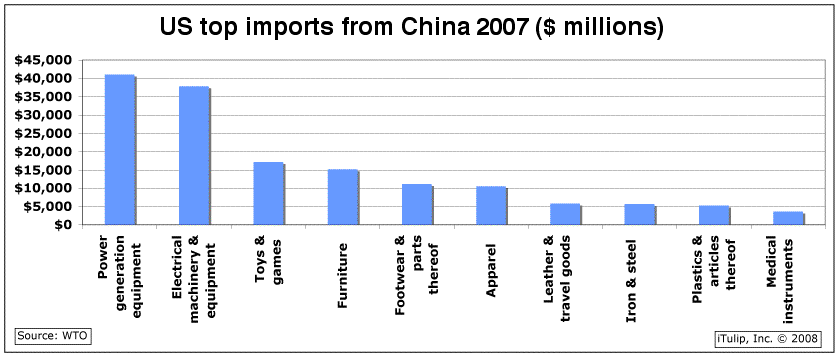
    Was watching US Trade Representative Susan C. Schwab on Charlie Rose lost night. She said the US imports a lot of low high gear, like apparel and toys, while the US compared to China exports an increasing amount of high tech gear. She said a week dollar is allowing the US to build on its strength as an exporter of high value products and services.

    So we went to check the data and here's what we found from WTO reports.


    Maybe we import tons of toys and clothes by unit volume but not dollar volume.

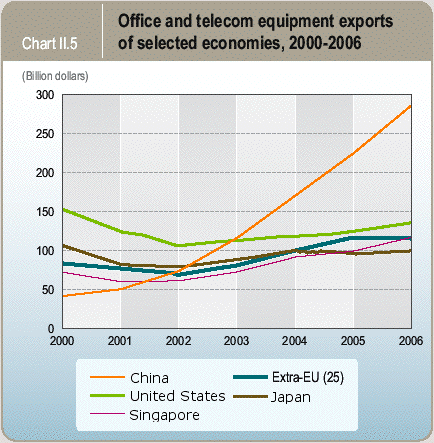
    How about China's high tech exports versus the US?


    Office and telco equipment exports for the US (hard to read, it's the green line on the chart) were in 2006 up to 19% to $135B from $110B since we started to debase the bonar in earnest in 2002 but are still down from the $150B level from 2000. In inflation adjusted terms, dollar volume is way down. Meanwhile, China's office and telco equipment exports are up from $75B in 2002 to $275B in 2006, a 270% gain.

    Dollar depreciation sure is working wonders on the US economy to "build on our strengths."

    Leave a comment:


  • GRG55
    replied
    Re: Peak Cheap Oil Ends Globalization

    Originally posted by zmas28 View Post
    True, but the question was whether increased transportation costs put a brake on the labor arbitrage, i.e. precisely on those sectors where it is practical to outsource and outsourcing in fact is taking place. Are the increased transportation costs sufficiently large to overcome the large wage discrepancy in these outsourceable sectors? Because one of the arguments hitherto has been that it is this wage arbitrage that keeps a lid on inflation that otherwise would become more widespread (we have already seen wage increases, at least in some areas that are not subject to this arbitrage).
    I wrote about where the wage inflation is going to originate. Just like the sub-prime fiasco, I doubt it will be contained to those sectors.

    While analysts continue to focus on differential labour costs, here's the longer term shift that I think the developed countries should be more concerned about.

    The global labour arbitrage (as Steve Roach labelled it some years ago) started by exporting the production of low value, "low technology" products with relatively high labour content, once labour costs made it uneconomic to continue to produce those items in the developed world.

    Transport costs are a small part of the total cost of high value goods, but often a significant portion of the final cost of low value goods. If the cost of moving stuff around the globe continues to escalate, as Jeff Rubin expects, the shift to be concerned about may have little to do with labour differentials and more to do with Asian exporting countries competing with the developed economies in the production of higher value, more advanced goods than ever before.

    The US and European auto makers ignored this threat from Japan in the late 1960's (a time when anything "Made in Japan" was treated as cheap junk). In part because of the energy cost increases in the 1970's (cost to ship raw materials, direct energy input and cost to ship finished cars across the Pacific) the Japanese moved up market. Going to be interesting to see how it plays out this time.

    Leave a comment:


  • zmas28
    replied
    Re: Peak Cheap Oil Ends Globalization

    This is my take on the inflation discussion. Too much money chasing too few goods has created inflation in the classical monetary sense of aggregate price levels. Much of this money has been created by central banks from the US to Japan and has resulted in a sea of liquidity. This excess liquidity finds its way into different asset classes (dot.com stocks, bonds, commodities) depending on the demand for that asset class, and causes price inflation of that asset class. Without the excess liquidity, the price inflation of one asset class would be accompanied by price deflation of other asset classes.
    From this perspective, commodity price increases do not generate price inflation in the aggregate (in the world-wide closed system), but are a very efficient way of transmitting/distributing costs across the global economy; in contrast to say gold, the price inflation of which would tend to stay localized to gold.
    Last edited by zmas28; May 29, 2008, 07:33 AM. Reason: spelling

    Leave a comment:


  • zmas28
    replied
    Re: Peak Cheap Oil Ends Globalization

    Originally posted by GRG55 View Post
    Wage inflation doesn't necessarily have to be broad based. As always in these situations there will be winners and losers. The wage inflation is going to originate in those sectors which derive increased domestic pricing power due to rising import costs, and in those service sectors where it is impractical (including politically impractical) to outsource the labour component - primarily the delivery of government/public services through monopoly providers (like unionized public sector employees).

    A city cannot outsource its firefighting to China no matter how cheap the wages there, and can only cut the number of firefighters to a point before the voters start to feel "unsafe". Expect the cost of firefighters in your town to go up, as their cost of living goes up.
    True, but the question was whether increased transportation costs put a brake on the labor arbitrage, i.e. precisely on those sectors where it is practical to outsource and outsourcing in fact is taking place. Are the increased transportation costs sufficiently large to overcome the large wage discrepancy in these outsourceable sectors? Because one of the arguments hitherto has been that it is this wage arbitrage that keeps a lid on inflation that otherwise would become more widespread (we have already seen wage increases, at least in some areas that are not subject to this arbitrage).

    Leave a comment:


  • Guest's Avatar
    Guest replied
    Re: Peak Cheap Oil Ends Globalization

    Originally posted by GRG55 View Post
    ... Some of the longest threads on this site are about the issue of inflation and it's origins, causes and consequences. Anytime a thread gets very long it's because there is an intense debate going on. That is hardly indicative of unanimity. ... This is far from the unthinking, easily influenced, monochromatic community that you repeatedly try to paint. ... that there is not "... dry, classically derived, academic unanimity - that inflationary impulses ONLY ever emanate from central banks..."
    OK, due to this more engaged and serious response, I stand duly corrected - you are right, this community (of course) engages in spirited and very broadly varied viewpoints. I made the mistake of not phrasing the observation very narrowly and specifically to one thread, and beyond that thread, to this one very narrow and specific theme. Do commodities inject their own, autonomous inflationary price signals into the macro-economy? The community has long said "don't know", or "don't much care", or "no comment". The "dry, classically derived, academic unanimity" is most specific to that one thread topic. Right in around December 07, January 08, in continuing pursuit of a clarification of this one very narrow point, I posted a thread asking, "why can't inflation spring from commodities, as well as from money"? I remember the response was almost commiserating, viewed as I were putting on a slightly embarassing display of "economic illiteracy".

    In that thread, I was surprised and took due note, of the unanimity of responses that this was a "misconception", because inflation "belongs to the banks to create" and commodities are an inert recipient of that monetary valuation. We hashed it out very directly, in these terms. It seemed an extremely rigid, stalely academic understanding - it envisons commodities scarcity as something which curiously remains in perpetual "price limbo" - permanently dependent upon the issuance of money from central banks. I thought it sounded absurd. And yet I remember being struck by the fact that A) so many posters were explaining why anything other than that would be "economically impossible", and B) iTulip had absolutely nothing to volunteer in clarification. That's as may be. It is only worth a remark now, because suddenly the notion that commodities can exercise an entirely independent input into the pure and narrow concept of inflation, has "shifted" imperceptibly to become a central tenet of the ongoing inflation.

    I challenge anyone to locate a comment from the editors (and I sure had a hard time finding any comment on this from contributors too!) on these pages, in the last 18 months, which specifically mentions rising commodity prices as exercising a direct input into "inflation". OK, I think it's mentioned in passing within the context of the "Peak Cheap Oil" articles linked from the home page - but that makes the lack of it's mention anywhere else even more striking. That's the sole point of what I call to attention here. Now it's applauded as a "great find", but a scant six months ago when we had an entire thread dedicated to that one topic, iTulip chose not to clarify they actually agree with this idea (or they do now, anyway!), despite the fact a dozen iTulipers were posting that it was nonsense? You can't sweep these incongruities away so easily. Hello?

    _________________

    http://www.itulip.com/forums/showthr...24290#poststop

    Quote:
    Originally Posted by FRED
    ... The question is how the increased demand for money by a shortage of cheaply extracted, high quality oil creates commodity price inflation.

    In truth, the primary question I was trying to introduce, was merely to whether a shortage of cheaply extracted oil ever even could create commodity price inflation. This seems to have been regarded as a preposterous idea here by many ther contributors only a few weeks ago? I understand you are acknowledging that it does do so in part? If you'll recall - in a previous thread only a few weeks ago, devoted to "what is inflation in commodities?" a large number of iTulipers soundly rejected the thesis that commodities scarcity could in any way cause the central bank expansion of money? That is, that "sustained commodities price rises can cause inflation also"? Perhaps this should now be clarified in an editorial, as a lot of people here seem to be under the mis-apprehension that inflation only can be "caused" by the banks in a single direction?

    Quote:
    Originally Posted by FRED
    The phrase "inflation is first and foremost a monetary phenomenon" is meant as an antidote to the commonly repeated misstatement in the business press that "rising prices are creating inflation."

    This is clear and evident to all readers here, and does not need to be further clarified, let alone established.
    Last edited by Contemptuous; May 29, 2008, 02:17 AM.

    Leave a comment:


  • GRG55
    replied
    Re: Peak Cheap Oil Ends Globalization

    Originally posted by zmas28 View Post
    What struck me about the video is the notion that higher transportation costs have removed the greatest brake on inflation, the labor arbitrage. I can understand the example of steel shipments where labor is apparently a relatively smaller fraction of the overall price. However, in light of the still substantial difference in wage rates between say the US and China for example, I question whether this will have a significant impact, i.e., sufficient to generate US wage inflation?
    Wage inflation doesn't necessarily have to be broad based. As always in these situations there will be winners and losers. The wage inflation is going to originate in those sectors which derive increased domestic pricing power due to rising import costs, and in those service sectors where it is impractical (including politically impractical) to outsource the labour component - primarily the delivery of government/public services through monopoly providers (like unionized public sector employees).

    A city cannot outsource its firefighting to China no matter how cheap the wages there, and can only cut the number of firefighters to a point before the voters start to feel "unsafe". Expect the cost of firefighters in your town to go up, as their cost of living goes up.

    Leave a comment:


  • zmas28
    replied
    Re: Peak Cheap Oil Ends Globalization

    What struck me about the video is the notion that higher transportation costs have removed the greatest brake on inflation, the labor arbitrage. I can understand the example of steel shipments where labor is apparently a relatively smaller fraction of the overall price. However, in light of the still substantial difference in wage rates between say the US and China for example, I question whether this will have a significant impact, i.e., sufficient to generate US wage inflation?
    Last edited by zmas28; May 28, 2008, 11:36 PM. Reason: grammar

    Leave a comment:


  • Guest's Avatar
    Guest replied
    Re: Peak Cheap Oil Ends Globalization

    Originally posted by Sapiens View Post
    I hate to burst your bubble, but the present price of oil is not wholly attributable to resource depletion. I will not be surprised to see an “Oil Glut” once the credit contraction is in full swing. We will have this exchange then, that is, if you still have internet access.
    "Sapiens" -

    One cannot mention the term "patronizing" around these pages without due and full acknowledgement of you, as you are a past master at this form of address (sometimes I conclude it is your only form). It seems that those bereft of sound arguments fall back consistently upon the aid of straw men, as you are here. Let us take a conscientious (means "fact-oriented") note of the following: I have nowhere [ read my lips: N O T _____ A N Y W H E R E: which means "you cannot attribute this claim to me" ] claimed that the present price of oil is "wholly attributable to resource depletion". Please trot your mis-representations out in debate with someone else.

    Really Sapiens. I will be glad to offer you my full respect. But you must abide by one or two small guidelines to earn it. One of those entirely sensible guidlelines is not to artlessly attempt to insert foolish assertions into my mouth. Your breathlessly anticipated "oil glut" will arrive, quite soon in fact. It will be delivered to your rhetorical claims in the form of a badly overdue and nasty correction in the oil markets. And please, "I hate to burst your bubble" is gimcrack "blog" vernacular. Does not lend anything to "gravitas".

    Leave a comment:


  • Sapiens
    replied
    Re: Peak Cheap Oil Ends Globalization

    Originally posted by Lukester View Post
    Yeah, right. A fine and forthright acknowledgment of the points being made. This is called "position creep", where "acknowledgments" are emitted only sporadically. If we were borrowing ideas from authors without attribution, that would be an entirely different story, right? From iTulip contributors' they are discreet slips of paper that go into the anonymous suggestions box? :rolleyes:
    I hate to burst your bubble, but the present price of oil is not wholly attributable to resource depletion. I will not be surprised to see an “Oil Glut” once the credit contraction is in full swing.

    We will have this exchange then, that is, if you still have internet access.

    Leave a comment:


  • GRG55
    replied
    Re: Peak Cheap Oil Ends Globalization

    Originally posted by Lukester View Post
    ...We had another thread on these pages which discussed how inflation might really spring partially out of the real world cost inputs of "making stuff", but everyone got really dug down into their positions, "classically academic" about it. There was complete unanimity - dry, classically derived, academic unanimity - that inflationary impulses ONLY ever emanate from central banks. ... Seemed there were a lot of people very invested in this "exclusive cause" thesis ...
    Lukester: You must be on a different iTulip site than the one I have bookmarked. Go back over the threads on the really meaty topics, including several that started with a post by yourself, and I doubt you'll find "complete unanimity" on anything in the iTulip community.

    Some of the longest threads on this site are about the issue of inflation and it's origins, causes and consequences. Anytime a thread gets very long it's because there is an intense debate going on. That is hardly indicative of unanimity.

    Frankly, nobody here will be surprised by anything in the interview with Jeff Rubin. I didn't find anything in this interview that hadn't already been covered quite thoroughly in various forums by various iTulip members on this site, since I started lurking around here a year ago. This is far from the unthinking, easily influenced, monochromatic community that you repeatedly try to paint. Just speaking for myself, here's a post of mine from February which is just one example [there's many by others] that there is not "...dry, classically derived, academic unanimity - that inflationary impulses ONLY ever emanate from central banks..."

    Originally posted by GRG55 View Post
    As others have pointed out before, if wages paid were the only factor that determines competitiveness then Haiti would be the manufacturing powerhouse of the world.

    A 50% currency move will improve competitiveness in the USA for a time, provided the inputs are exclusively or predominantly USA sourced. For example, producers using US made steel from US mined iron ore will gain an advantage [for a while] over the guy across the street who buys his steel from Brazil and is seeing costs rise as the Brazilian real rises. Since the Gulf currrencies are US$ proxies, I have been dealing with this exact issue on my firms international petroleum projects. Projects in jurisdictions where operating costs are not in the "dollar zone" are at increasing competitive disadvantage as the US$ has fallen, and our allocations of new project capital have been modified accordingly over recent years. A comparison of the current situation at Airbus and Boeing, is another example; as is European carmakers continued appetite to install capacity in the USA.

    People seem to forget that the US is still a huge producer of energy and raw materials like coal and copper (just two examples) and food. But in the end, EJ is correct in that US located producers of these sorts of inputs, while benefiting from the lower costs to produce, are not motivated to sell at a discount to their foreign competitors (imports ultimately set the price) - and that's ultimately inflationary.

    Eventually the depreciating currency advantage is eroded away by spiralling wages and salaries - and we are finally seeing that happening in the Gulf now. Eventually Boeing et al will see this too.

    Leave a comment:

Working...
X