Announcement

Collapse
No announcement yet.

A Stroll With Mish - "Through da-flation looking glass"

Collapse
X
 
  • Filter
  • Time
  • Show
Clear All
new posts

  • c1ue
    replied
    Re: A Stroll With Mish - "Through da-flation looking glass"

    Originally posted by jtabeb
    We all have to hold SOME assets in dollars for daily transactions. At what time will every thing else be secondary to getting everything out of the dollar. When that time comes, I expect the stock market action will confirm the inflation by making steep rises in response to the loss of purchasing power of the monetary unit.
    Actually you don't even have to do that.

    One thing I never see happening: any country preventing money from coming IN.

    For example: A bank account in New Zealand paying 10% interest. An ATM card.

    Each time you run out of dollars in your wallet, you go to an ATM and extract $200 out - instantly converted from NZ plus a bit of ATM fee.

    This is a microcosm of what rentiers have historically been able to do.

    Ain't modern technology grand?

    Leave a comment:


  • Finster
    replied
    Re: A Finster Rant

    Originally posted by FRED View Post
    Blaming "speculators" for bad government policy is a tried and true tradition...
    A timely headline from Bloomberg underscores that perfectly:
    Wall Street Grain Hoarding Brings Farmers, Consumers Near Ruin

    By Jeff Wilson

    April 28 (Bloomberg) -- As farmers confront mounting costs and riots erupt from Haiti to Egypt over food, Garry Niemeyer is paying the price for Wall Street's speculation in grain markets...

    http://www.bloomberg.com/apps/news?p...d=aDZej7GJjpjM

    Leave a comment:


  • bart
    replied
    Re: A Finster Rant

    Originally posted by Lukester View Post
    Bart - Finster is too old for a kewpie doll. It would not look good for the Shadowfed Chairman to be seen accepting a kewpie doll award.

    ssshhhh... "Kewpie doll" is triple secret iTulip Shadowfed code for things that mere mortals may not know until they are worthy... :eek: :cool: ;)

    And besides, I'm way older than Finster... I was here way before dirt was even thought of...

    Leave a comment:


  • Guest's Avatar
    Guest replied
    Re: A Finster Rant

    Originally posted by bart View Post
    A winnah!... give that EJ d0000d a kewpie doll, and take one for yourself too.
    Bart - Finster is too old for a kewpie doll. It would not look good for the Shadowfed Chairman to be seen accepting a kewpie doll award.

    Leave a comment:


  • bart
    replied
    Re: A Finster Rant

    Originally posted by Finster View Post

    Contrast this with EJ’s references to "debt deflation". Rather than just say "deflation" and risk getting lost in fuzzyisms and ambiguity, he is careful to be clear that he is talking about a contraction of credit.
    A winnah!... give that EJ d0000d a kewpie doll, and take one for yourself too.


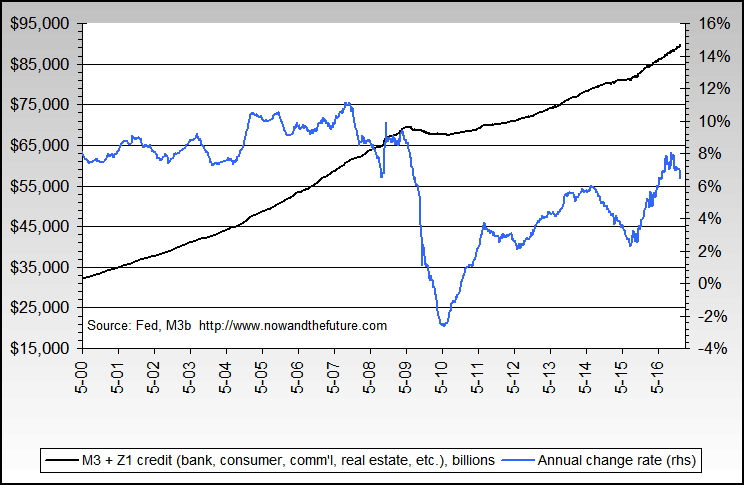
    Herewith one of my few speculative charts to try and illustrate what's actually going on with "money". There are a number of relatively wild assumptions behind it and its full of holes and is even a bit extreme... but it also provides one view of "debt deflation".

    All I did is add up M3 and all forms of credit that I track, and also added in quarterly US derivatives data notional totals from the Treasury report. Then I adjusted the derivatives total downward since June 2007 by the percentage drop in the BKX (the Philadelphia Bank Index), the BKX being used as a proxy for actual losses in derivatives values. The actual dollar totals are on the left hand scale, and the annual rate of change is on the right hand scale.

    Quite a picture...


    Here's the same chart, but since 2000 and without any derivatives, for comparison.

    Last edited by bart; April 27, 2008, 12:32 PM.

    Leave a comment:


  • bart
    replied
    Re: A Finster Rant

    Originally posted by Finster View Post
    Speculators were invented by Bush and Cheney in 2001 not long after they blew up the WTC, sent anthrax all over the place, and started a plot to heat the planet up ...
    I see you're working on your next merit badge for your tinfoil hat too... ;)


    And on a more serious note, that Youtube Nixon video just posted by Fred is priceless. All hail the internet... and I wonder how long it will be until someone does a MasterCard (aka MasterBlaster ) "priceless" take off ad on inflation & wage and price controls, etc. :cool:

    Leave a comment:


  • Finster
    replied
    Re: A Finster Rant

    Originally posted by Lukester View Post
    Finster, I fully take your point that Mish is a very capable analyst. He covers a lot of ground, and as you note the greater part of his observations is spot on.
    You hint that before one "takes Mish on" on needs to get one's ducks in a row? Well of course I could never hold a patch to Mish's capability, and indeed I am not even anyone's excuse for an economic analyst. Even the notion would be an embarassment to me. But what may "exhonerate my impertinence" here is that those few holes in his theses that do exist are so broad and logically exasperated that anyone who has read even a few scraps of iTulip could spot them from a hundred yards away. Does this guy ever even read people like Doug Noland, or John Williams for instance?

    You really don't have to read very far in the cited article - for example statements "explaining" why gold is going up but the dollar is going down - which according to some more rationally ironed out version of "Mishology" should both be going up or down together, because they are "both money".

    As they evidently are not moving in concert with each other, "Mishology" has to develop a construct as to why they have in fact traced almost perfect, inversly related trajectories for years, and his construct on that particular rationailizaton is so strained that it is almost painful to read. For rationalisations this fanciful, one does not need a particularly exalted proficiency in economics, right? So it's due to spectacular departures (into the realm of the irrational!) regarding observable price action such as this example that I posted a spoof of "Mishology". It may appear to be "unseemly" at first glance that an absolute analytic nobody like me is posting impertinent comments about this guy, but the fact is that spotting these "logical lacunae" in fact requires no particularly special knowledge whatsoever.

    I'm not sure if the Netiquette Squads will have me summarily clapped in irons for this audacious foray into condemnation, but the conclusions he draws seem at times strained to the point of appearing comical (aka "Just Plain Nuts"!).
    I haven’t spent much time reading Mish (can’t think of a reason to…;)), so risk unfairly distorting his views. But with that caveat, it looks to me like the object of your criticisms is rooted in his confusing himself with imprecise terminology. Word like "inflation" and "deflation" have multiple meanings, but many analysts use them as if they were unambiguous elements of symbolic logic.

    For example, the word "deflation" has one meaning that refers to a contraction of credit. It has another meaning that refers to a general decrease in the price level. Mish correctly asserts that we are having "deflation" in the first sense. Then he transmogrifies that into the second sense, concluding that we therefore ought to be experiencing falling prices. This comes about from using the term "deflation" as if it described a single, well-defined, phenomenon. Ambiguous terms, sloppy reasoning. As a result, because we have rising prices instead of the falling prices that he erroneously assumes "ought" to be there, he has to invent an external explanation for that. This leads him down a chain of strained reasoning and traps him in an unnecessarily complex set of rationalizations.

    Contrast this with EJ’s references to "debt deflation". Rather than just say "deflation" and risk getting lost in fuzzyisms and ambiguity, he is careful to be clear that he is talking about a contraction of credit.

    We can put a still finer point on credit contraction. Real or nominal? That is, exactly what contracted, the real outstanding value of credit, or the nominal outstanding value of credit? Well, if the value of the currency unit were constant, they would be identical. But there’s no reason why that has to be the case. Right now we’re on the far side of a credit bubble, and real credit is contracting. The government and the banking system, however, are attempting to paper it over by keeping the nominal outstanding value of credit from contracting as well. And if nominal credit is to remain static to expanding while real credit contracts, that means the value of the currency unit must decline. Ergo, rising prices.

    So what Mish paints as an anomaly doomed to transience is nothing particularly unusual at all. Sure, you can get deflation in the outstanding real value of credit and inflation in prices.

    The only thing standing in the way of that would be something that prevented currency inflation (e.g. a gold standard), and that last time that was the case was in the early thirties. Since then, debt deflation has normally been accompanied by price inflation.

    Leave a comment:


  • FRED
    replied
    Re: A Finster Rant

    Originally posted by Finster View Post
    I appreciate your patience with my penchant for getting into dust-ups with very smart people, Lukester ... some of the most illuminating discussions seem to come out of them.

    :cool:

    The answer to your question depends on the context. Keep in mind that my comments were painting in broad strokes. Of course acute systemic shortages and any number of other transient issues can and do affect the prices of commodities in general and oil in particular. Hence caveats such as "over time".

    But my argument isn't based on an assumption of static money, viz. "If over time (e.g. over the course of a full credit cycle) the supply of money grew no faster than the supply of physical commodities, the net price action would be identically zero. Whatever degree of scarcity or abundance may occur in the physical commodities, the same would be reflected in money." In other words, between the end points of this "cycle" there could be significant fluctuations in both the supply of money and that of commodities, provided the net changes were similar. If the supply of physical commodities grew by 50%, for example, and the supply of money grew by 50%, all else being equal we'd expect the price to go nowhere. Oil prices in gold have been stable over time not because the supply of gold is never-changing, but because of broadly similar changes in abundance.

    What actually has happened to dollar prices, however, is not even close. Without delving into the detailed data, the price of a barrel of oil has gone from something like $3.35 in 1970 to $119.35 in 2008. Oil supply has actually increased quite a bit, but money supply by orders of magnitude more. Hence the remarkable "price increase". Notice that we casually toss out those figures as the "price of oil", but crucially, they relate two variables, oil and dollars. As in "dollars per barrel".

    The point is to counter the endless stream of media propaganda about how oil prices went up because of hurricanes, strikes in Nigeria, greedy speculators, economic growth overseas, etceteras, as if our own government had nothing to do with it. Hurricanes were not invented yesterday, nor was labor unrest, nor global economic growth. I guess speculators - one of the latest whipping boys - didn't exist in the 1990s when oil prices were falling! And as pointed out elsewhere, oil is not the only commodity whose price has risen - not even an exceptional example - it just gets the most press.

    Crucially, whether the price has risen at all is simply a function of what you price it in. We cited gold as a monetary unit above, but others work, too. For example, if you happened to be a Brazilian doing your accounting in reals the price of oil hasn’t done much of anything over the past year or two.

    How can we conclude that "price of oil" even exists as an independent element of objective reality? It doesn’t! It only exists in relation to some monetary unit. And if different monetary units can tell such wildly diverging stories, we are forced to conclude that we learn from the "price of oil" much more about the monetary unit we’re using to express it in than we do about the oil.

    There is another part to this story that we haven’t gotten into yet, though. If the "price of oil" doesn’t exist apart from a monetary unit, then what about the value of oil? How can we measure that? If it rose, how would we know? How could we isolate what’s happening to the value of oil? Apart from the vagaries of seemingly ephemeral, changing, monetary units? Is there some standard of market value that we could use?

    I think there is an answer, or at least some credible candidates for one, but want to pose the question as food for thought. Careful consideration of that question alone may enlighten more than any number of words spilled in this post.

    Then maybe we can take on Mish ... ;)
    Blaming "speculators" for bad government policy is a tried and true tradition.


    As for Mish, we've covered that exhaustively already here.

    Anyone who will not admit that inflation is occurring is at best confused and at worst is not being truthful. Further, any analyst says one thing, that delfation is "in the cards," but recommends an asset that only makes sense own under inflationary conditions – gold – is at best misguided but is more likely playing games with his audience.

    The reason for these inconsistencies is that these analyses are based on ideology versus intellectually independent theory. Mish openly admits that his analysis is based on the Austrian school, which assertion itself is an appeal to an audience of gold-bugs. We recommended gold in 2001 and will recommend when it is likely that those reasons for buying it then are no longer true. Mish will, we presume, continue to insist that "gold is money" much as similarly ideology-based analysis insisted from 1980 forward that "gold is money" even as gold plunged into a 20 year bear market.

    This is antithetical to our approach. We are more aligned with Jim Sinclaire's thinking on that subject. Our philosophy is that there are times to bet with government and times to bet against it. Our analysis is informed by the Austrian school, but also Keynesianism, Hayek, Minskey, Galbraith, and many others. We hope are taking the best of the best to inform our analysis, and we are always broadening our base.

    We have little use for analysis that is confused and avoids facts because it is narrowly based on a single ideology. If we wanted that we can read Ben Stein or listen to FOX news. It brings in to question all of the other "analysis" and makes it singularly unreliable for making investment decisions.

    Leave a comment:


  • Finster
    replied
    Re: A Finster Rant

    Originally posted by bart View Post
    That's one of my favorites these days - asking the folk bitching about speculators if they thanked a speculator when oil went down to about $10 in the last '90s... or dropped about 50% from 2000 to 2002. :eek: ;)
    Speculators were invented by Bush and Cheney in 2001 not long after they blew up the WTC, sent anthrax all over the place, and started a plot to heat the planet up ...

    Leave a comment:


  • Guest's Avatar
    Guest replied
    Re: A Finster Rant

    Originally posted by Finster View Post
    ... want to pose the question as food for thought. Then maybe we can take on Mish ... ;)
    Finster, I fully take your point that Mish is a very capable analyst. He covers a lot of ground, and as you note the greater part of his observations is spot on.
    You hint that before one "takes Mish on" on needs to get one's ducks in a row? Well of course I could never hold a patch to Mish's capability, and indeed I am not even anyone's excuse for an economic analyst. Even the notion would be an embarassment to me. But what may "exhonerate my impertinence" here is that those few holes in his theses that do exist are so broad and logically exasperated that anyone who has read even a few scraps of iTulip could spot them from a hundred yards away. Does this guy ever even read people like Doug Noland, or John Williams for instance?

    You really don't have to read very far in the cited article - for example statements "explaining" why gold is going up but the dollar is going down - which according to some more rationally ironed out version of "Mishology" should both be going up or down together, because they are "both money".

    As they evidently are not moving in concert with each other, "Mishology" has to develop a construct as to why they have in fact traced almost perfect, inversly related trajectories for years, and his construct on that particular rationailizaton is so strained that it is almost painful to read. For rationalisations this fanciful, one does not need a particularly exalted proficiency in economics, right? So it's due to spectacular departures (into the realm of the irrational!) regarding observable price action such as this example that I posted a spoof of "Mishology". It may appear to be "unseemly" at first glance that an absolute analytic nobody like me is posting impertinent comments about this guy, but the fact is that spotting these "logical lacunae" in fact requires no particularly special knowledge whatsoever.

    I'm not sure if the Netiquette Squads will have me summarily clapped in irons for this audacious foray into condemnation, but the conclusions he draws seem at times strained to the point of appearing comical (aka "Just Plain Nuts"!).

    Leave a comment:


  • bart
    replied
    Re: A Finster Rant

    Originally posted by Finster View Post
    I guess speculators - one of the latest whipping boys - didn't exist in the 1990s when oil prices were falling!
    That's one of my favorites these days - asking the folk bitching about speculators if they thanked a speculator when oil went down to about $10 in the last '90s... or dropped about 50% from 2000 to 2002. :eek: ;)

    Leave a comment:


  • Finster
    replied
    Re: A Finster Rant

    Originally posted by Lukester View Post
    Finster - First of all please be assured I fully take your point, and acknowledge it is "true". However there is a problem. What you describe, a static quantity of currency, not only does not exist in the fiat currency era, but it in fact likely never existed in any "pure state" in the past several hundred years. Even in gold backed monetary regimes in the 17th, 18th and 19th centuries, the supply of paper monetary certificates remained always somewhat elastic, relative to the gold in the government's possession. In the 20th century of course we can clearly see that that formerly "elastic" link between the paper in circulation and the bullion backing it became first "fractional" and finally an ethereal bungee cord of truly cosmic length. Not only in Western nations, but the world over. Clearly "static money" is a concept without a home in the world where money circulates.

    My point is this - your thesis is "true" but it has never existed in the real world where money is issued and used. It is always responding dynamically in quantity and credit stringency or looseness to economic conditions. Therefore if a critical commodity goes into scarcity, for whatever reason, this "shock" to the system requires a response from the currency issuer. To state that in the absence of government accomodation the oil price could go nowhere is "true" but it's a purist theory with no place to park in the real world, where money is frequently almost literally "commanded" to come forth in response to economic events, particularly acute systemic shortages in industrial society's most critical commodity - oil.

    I say this with the utmost trepidation as you naturally do run circles around me at light speed on these analyses, but is this not a valid objection? I appreciate your input Finster.
    I appreciate your patience with my penchant for getting into dust-ups with very smart people, Lukester ... some of the most illuminating discussions seem to come out of them.

    :cool:

    The answer to your question depends on the context. Keep in mind that my comments were painting in broad strokes. Of course acute systemic shortages and any number of other transient issues can and do affect the prices of commodities in general and oil in particular. Hence caveats such as "over time".

    But my argument isn't based on an assumption of static money, viz. "If over time (e.g. over the course of a full credit cycle) the supply of money grew no faster than the supply of physical commodities, the net price action would be identically zero. Whatever degree of scarcity or abundance may occur in the physical commodities, the same would be reflected in money." In other words, between the end points of this "cycle" there could be significant fluctuations in both the supply of money and that of commodities, provided the net changes were similar. If the supply of physical commodities grew by 50%, for example, and the supply of money grew by 50%, all else being equal we'd expect the price to go nowhere. Oil prices in gold have been stable over time not because the supply of gold is never-changing, but because of broadly similar changes in abundance.

    What actually has happened to dollar prices, however, is not even close. Without delving into the detailed data, the price of a barrel of oil has gone from something like $3.35 in 1970 to $119.35 in 2008. Oil supply has actually increased quite a bit, but money supply by orders of magnitude more. Hence the remarkable "price increase". Notice that we casually toss out those figures as the "price of oil", but crucially, they relate two variables, oil and dollars. As in "dollars per barrel".

    The point is to counter the endless stream of media propaganda about how oil prices went up because of hurricanes, strikes in Nigeria, greedy speculators, economic growth overseas, etceteras, as if our own government had nothing to do with it. Hurricanes were not invented yesterday, nor was labor unrest, nor global economic growth. I guess speculators - one of the latest whipping boys - didn't exist in the 1990s when oil prices were falling! And as pointed out elsewhere, oil is not the only commodity whose price has risen - not even an exceptional example - it just gets the most press.

    Crucially, whether the price has risen at all is simply a function of what you price it in. We cited gold as a monetary unit above, but others work, too. For example, if you happened to be a Brazilian doing your accounting in reals the price of oil hasn’t done much of anything over the past year or two.

    How can we conclude that "price of oil" even exists as an independent element of objective reality? It doesn’t! It only exists in relation to some monetary unit. And if different monetary units can tell such wildly diverging stories, we are forced to conclude that we learn from the "price of oil" much more about the monetary unit we’re using to express it in than we do about the oil.

    There is another part to this story that we haven’t gotten into yet, though. If the "price of oil" doesn’t exist apart from a monetary unit, then what about the value of oil? How can we measure that? If it rose, how would we know? How could we isolate what’s happening to the value of oil? Apart from the vagaries of seemingly ephemeral, changing, monetary units? Is there some standard of market value that we could use?

    I think there is an answer, or at least some credible candidates for one, but want to pose the question as food for thought. Careful consideration of that question alone may enlighten more than any number of words spilled in this post.

    Then maybe we can take on Mish ... ;)

    Leave a comment:


  • FRED
    replied
    Re: A Stroll With Mish - "Through da-flation looking glass"

    Originally posted by Finster View Post
    I don't what Hudson has claimed, but it sounds like fun. Far as Friedman goes, I definitely agree with his "always and everywhere a monetary phenomenon" point. The central point as far as commodity prices go is that a price - any price - is simply the ratio of the market value of the commodity whose price you are quoting to that of another commodity, the monetary unit in which you are quoting it.

    We need to keep in mind that we never quote the value of a barrel of oil. We only quote its price ... that ratio. We do so however as if we were talking about the value of the oil itself, hence the confusion and the need to make a conscious effort to remind ourselves that we are not, but rather expressing the relative value of two commodities, the oil and the monetary unit.
    EJ writes in:

    Very well put. We remind readers to review:
    Energy and Money Part I: Too Little Oil or Too Much Money?

    Inflation is not only determined by the supply of goods available relative to the supply of money to buy them, but also the demand for the currency in which goods are priced relative to the supply of that currency. It can be hard to tell which factor is primarily driving prices.
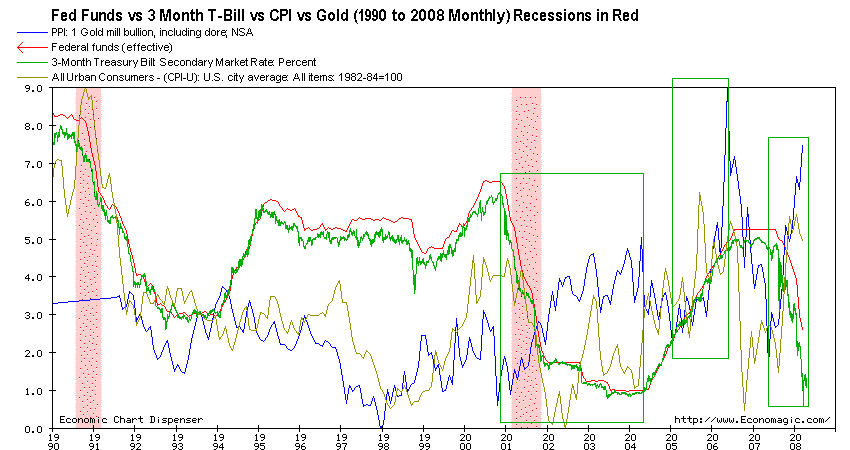
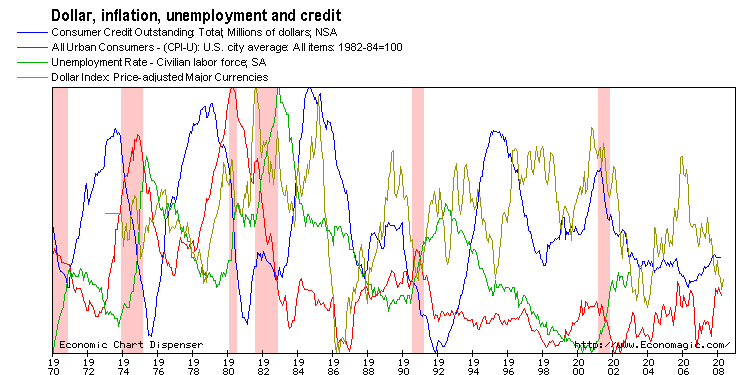
    While it's our view that charts tell us little about what will happen in the near term future, they are very helpful in showing relationships among factors influencing prices especially over long periods of time. These relationships can give indications of long future direction, or at least help us ask the right questions. To wit:


    Key:

    Gold, percent change from previous year
    Fed Funds, effective rate
    3 month Treasury bill, rate
    CPI-U, rate

    What is extraordinary about our current environment is: 1) the spread between the Fed Funds rate and the 3 month tbill, and 2) rising CPI while the Fed is cutting. Usually the Fed starts cutting just before recession starts and is fighting disflation during the rate cutting period. Not this time. CPI increased before, during, and after the cuts.

    What is different this time? The dollar had declined versus strengthened.


    Is the US economy slowing because of the inflation caused by a prolonged weak dollar or is the dollar weakening because of the slowing US economy? They feed into each other. Cutting rates is a gamble that this will revive the economy and that in response the dollar will appreciate. That has since the early 1980s been the cycle. What if it doesn't work this time? What if the FIRE Economy is down for the count?

    Leave a comment:


  • Guest's Avatar
    Guest replied
    Re: A Finster Rant

    Originally posted by Finster View Post
    This is the core contention, Lukester. It is indeed all of the price action. Not some, not most … but all of it.

    This was the point of the "thought experiment" I posed earlier in the thread containing the linked post, and in my subsequent statement that we could have $5 oil if we wanted it. If over time (e.g. over the course of a full credit cycle) the supply of money grew no faster than the supply of physical commodities, the net price action would be identically zero. Whatever degree of scarcity or abundance may occur in the physical commodities, the same would be reflected in money. Consequently, the prices of commodities are fully dependent on the value of money and fully within the control of monetary authorities. ...
    Finster - What you describe, a static quantity of currency causing commodities to regress back to their 'equilibrium value', seems to be difficult to find in any fiat currency world.

    If a critical commodity is reacting to fiat money, particularly if you add in any scarcity factor (oil as strategic commodity with tightening availability) this can represent a "shock" to the equation which requires a response from the currency issuer. And that 'requiring' is also occurring in a world where governments are constantly re-jiggering money supply anyway.

    No one has ever seen a world with a static money supply. You still have a statement of principle which is true - money supply is the only factor which can permit the oil price to rise, but that principle can get obscured in application by a constant flux of money supply in all economies. If this were only a single instance (just one economy with currency volumes in flux), it would remain an immediately applicable principle, but money supply in constant flux exists in all economies.

    Also there is the fact that new issuance of currency can be almost an imperative for governments, (governments have to balloon the money supply during wars, which have occurred throughout history, for just one example) merely due to the shocks or urgencies occurring in economic events? Maybe it's worth noting with regard to oil, that it is a strategic commodity, so it's the first in line (with water, or food) to create 'imperatives' for government issuance of fresh currency.

    Given all that, couldn't you also argue that 'commodities prices are exclusively a factor of money in circulation' is an idea which encounters difficulty translating in direct fashion into the real world of commodity prices? The argument here is that critical or strategic commodities at least, are a 'two-way street' - between for example, petroleum's stranglehold on the economy, vs. Government's 'option' to deny it any extra liquidity? Government cannot deny it that liquidity, as it would 'blow out the tires' of the economy they have to keep running.

    Not trying to be argumentative here Finster. I'm seriously suggesting that in this case 'pure monetary principles' may indeed be at risk of stumbling on their way to applicability - particularly in a world approaching peak cheap oil. And you can extend these qualifiers out to the 'imperative' which countries like China and India have to industrialize, as their populations need to move forward into a higher standard of living or risk economic implosion?

    That is arguably one very large 'imperative' for commodities prices to push upwards, and in direct consequence to that, for governments to 'give way' to that imperative by issuing more liquidity.

    I'm not an iTulip premium member. What is the gist of EJ's post - "Why I don't believe in Peak Oil, in one chart"? If the thesis behind that thread is in any way interlinked with your argument that all commodities must be determined primarily by the monetary aggregates, the above observations may be a valid set of qualifiers?

    I reiterate despite disagreeing with you on this 'crucial monetary question' which you are patiently trying to feed into my wooden head ( ) that I've broadened my views considerably reading your posts. I also generally see eye to eye with your world view around here. Consider me one of your more 'pain in the ass' students perhaps, but one who regards you with considerable loyalty.

    [ POSTSCRIPT - Finster, I modified my post on this to better express what I intended. Maybe this modification can express the objection more clearly. ]
    Last edited by Contemptuous; April 26, 2008, 05:32 PM.

    Leave a comment:


  • Finster
    replied
    Re: A Stroll With Mish - "Through da-flation looking glass"

    Originally posted by jtabeb View Post
    Here are the most vexing thoughts I've had on this:

    1. Finster directly contradicts Dr. Hudson (Hudson says Milton Friedman was wrong, Finster says MF was correct)...

    I want to see a wrestling match (debate/interview) with Finster VS Hudson!
    I don't know what all Hudson has claimed, but it sounds like fun. Far as Friedman goes, I definitely agree with his "... always and everywhere a monetary phenomenon" statement. The central point as far as commodity prices go is that a price - any price - is simply the ratio of the market value of the commodity whose price you are quoting to that of another commodity, the monetary unit in which you are quoting it.

    We need to keep in mind that we never quote the value of a barrel of oil. We only quote its price ... that ratio. We do so however as if we were talking about the value of the oil itself, hence the confusion and the need to make a conscious effort to remind ourselves that we are not, but rather expressing the relative value of two commodities, the oil and the monetary unit.
    Last edited by Finster; April 26, 2008, 01:15 PM.

    Leave a comment:

Working...
X