Announcement

Collapse
No announcement yet.

Fed Raises and Now Tariffs? Have we been in ka--- for ten years?

Collapse
X
 
  • Filter
  • Time
  • Show
Clear All
new posts

  • touchring
    replied
    Re: Fed Raises and Now Tariffs? Have we been in ka--- for ten years?

    A lot of talk about OBOR, but no one (including the Chinese themselves) are talking about the greatest demographic time bomb in the history of mankind. Many times worst than Japan. Japan didn't have a 1 child policy, most couples had 2 kids. The Japanese didn't leave their kid at home with their grandparents and return home only once a year.

    I have an acquintance who married a woman from Shanghai, and as most people in their 20s and 30s, she is single child with 2 aging parents who maybe retired or are retiring.

    Firstly, unlike Europe, and even Russia, there's no working pension scheme in China. The meagre pension can only pay 10-20% of the bills. There's also no free healthcare and quality private healthcare is even more expensive than in many more developed countries. There had been reports of Chinese tourists going to Taiwan for medical operations and health checks because it is cheaper over there in Taiwan.

    The millennials in China are about to face an impossible task soon - to pay for the mortgage of a 20-30 times annual income 800 sq ft apartment and to pay for the living expense and medical bills of 2 aging parents.

    Now, we haven't come to the cost of raising a kid.

    My acquintance has to pay for the bills of six:

    1. Part of his own parents living expenses (he is not from China - he has siblings)
    2. All of his wife's parents living and medical expenses.
    3. His own family living expense - his wife is a stay at home mum.

    As you can see there's not much discretionary income left.


    Originally posted by GRG55 View Post
    Quite some years ago I made the observation that China's behavior was one of a "dragon" at home (inside its borders) and of a "panda" (cautious, tentative, careful) when it came to the world outside its borders and its approach to international relations.
    Last edited by touchring; April 12, 2018, 12:57 AM.

    Leave a comment:


  • jk
    replied
    Re: Fed Raises and Now Tariffs? Have we been in ka--- for ten years?

    Originally posted by dcarrigg View Post
    Lots of changes, for sure. And worth watching. But also important to keep an eye on the scale of things.


    what is this a graph OF? currency in circulation? size of bond markets? % of global trade?

    Leave a comment:


  • dcarrigg
    replied
    Re: Fed Raises and Now Tariffs? Have we been in ka--- for ten years?

    Originally posted by jk View Post
    a parallel monetary universe, a cny/gold/local currency universe, is emerging: russia, iran, venezuela, obor client states, turkey [dealing with iran], india [dealing with iran] and of course china. this of course interacts in places with the usd-centric universe, especially in chinese trade and some russian energy exports, but the status of the usd is changing from being THE reserve currency to being A reserve currency.
    Lots of changes, for sure. And worth watching. But also important to keep an eye on the scale of things.


    Leave a comment:


  • jk
    replied
    Re: Fed Raises and Now Tariffs? Have we been in ka--- for ten years?

    a parallel monetary universe, a cny/gold/local currency universe, is emerging: russia, iran, venezuela, obor client states, turkey [dealing with iran], india [dealing with iran] and of course china. this of course interacts in places with the usd-centric universe, especially in chinese trade and some russian energy exports, but the status of the usd is changing from being THE reserve currency to being A reserve currency.

    Leave a comment:


  • touchring
    replied
    Re: Fed Raises and Now Tariffs? Have we been in ka--- for ten years?

    Originally posted by Milton Kuo View Post
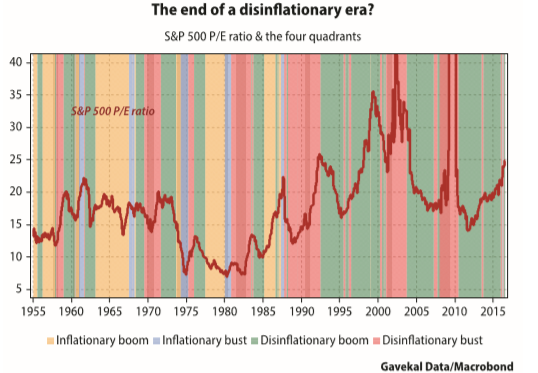
    The problem I have with the Gavekal model is that they claim that the period after the dot-com bust and before the housing/credit bubble bust was a disinflationary boom with tiny periods of inflationary boom. What?! I don't know what data they are using to generate that chart but I would characterize the period after the dot-com bust as an inflationary boom. We saw the USD lose a tremendous amount of purchasing power, gold prices soared, crude oil soared, grains soared, the Federal Reserve was slowly increasing the funds rate by 25 bps every meeting and thus lagging inflation.
    It's not the USD but every currency especially the RMB has lost a lot of value in the past 10 years. Just look at the 20-30x annual salary for real estate in shanghai and beijing.

    Sometimes, I think economists think differently from us. Maybe disinflation to economist just means "dishyperinflation". As long as prices rise only 10% a year, it is not inflation!

    Leave a comment:


  • GRG55
    replied
    Re: Fed Raises and Now Tariffs? Have we been in ka--- for ten years?

    Originally posted by jk View Post
    demographics say that chinese working population must be feeling the consequences of the 1 child policy.

    a quick google gets this:
    The number of working age people in China is set to fall to 700 million by 2050 – a decline of nearly a quarter, according to a government spokesman. The working-age population has been in decline since 2012, with the number of people aged 16-59 predicted to be 830 million in 2030.Jul 25, 2016

    thus closing some factorieswon't create a labor problem.
    Quite some years ago I made the observation that China's behavior was one of a "dragon" at home (inside its borders) and of a "panda" (cautious, tentative, careful) when it came to the world outside its borders and its approach to international relations.

    This is changing rapidly. And as the USA continues to swing towards isolationism (driven in no small part by the remarkable reduction in its dependence on imported oil and what that will in due course do to its trade and current account balances) I suspect China will attempt to fill the partial void in global political and economic influence the gradual withdrawal of the USA leaves. Unlike Puff, the mighty (Chinese) dragon will not "sadly slip into his cave".

    If the Chinese are successful with OBOR, examining the Chinese economy by looking only within its borders may be a mistake. It would be similar to studying the UK economy of the 1800s by examining only inside its borders, while overlooking the outsized role of Empire and of the East India Company in particular.

    By embracing (instead of lecturing) and financially and politically rewarding every cooperative odious regime, every theocratic kleptocracy, every President for Life, every modern day "Maharaja" in greater Asia and Africa, the Chinese seem well on their way to owning or controlling a vast economic network. I saw this first hand in the south of Nigeria, in Kazakhstan and in Kyrgyzstan. If anyone doubts this have a look at the development of the massive gas fields of Turkmenistan. Its a great case study in who benefits (and who does not) when the Chinese arrive. I disagree with GaveKal. Although the author professes not to be a Chinese permabull, the presentation reads like it was written by one.

    The Chinese have absolutely no incentive or benefit to reduce capacity in aggregate that I can fathom. The OBOR region could be a source of global disinflation/deflation for some time yet.

    I am in Dr. Lacy Hunt's camp. We may not have seen the end of this secular disinflationary cycle yet, and before this is over the USA may join Japan and the EU and experience negative interest rates.
    Last edited by GRG55; April 10, 2018, 10:37 PM.

    Leave a comment:


  • Milton Kuo
    replied
    Re: Fed Raises and Now Tariffs? Have we been in ka--- for ten years?

    Originally posted by thriftyandboringinohio View Post
    We have been living and investing in a mostly disinflationary climate. They claim we are about to make the shift back to inflationary conditions again, which requires entirely different investing strategies to make money. They advise we adopt 1965 style approaches to our portfolios to book profits in the years ahead.
    The problem I have with the Gavekal model is that they claim that the period after the dot-com bust and before the housing/credit bubble bust was a disinflationary boom with tiny periods of inflationary boom. What?! I don't know what data they are using to generate that chart but I would characterize the period after the dot-com bust as an inflationary boom. We saw the USD lose a tremendous amount of purchasing power, gold prices soared, crude oil soared, grains soared, the Federal Reserve was slowly increasing the funds rate by 25 bps every meeting and thus lagging inflation.

    With regard to the four quadrants of investment, a similar idea was discussed here years ago in some table that bart (I think) posted. If we knew with any degree of certainty what quadrant the economy will be in with good timing and duration, I think asset allocation would be much easier and torturous than it currently is. In light of Gavekal's peculiar belief that the post dot-com bust was a period of disinflationary boom, I question whether they will get correct what the next quadrant of investment style should be.

    Leave a comment:


  • thriftyandboringinohio
    replied
    Re: Fed Raises and Now Tariffs? Have we been in ka--- for ten years?

    Originally posted by dcarrigg View Post

    ...But I just really doubt the third leap of logic--that s&p 500 p/e ratios are in some way correlated with commodities and/or bonds prices. Like I said, I've seen them move in the same direction for a while and in the opposite direction for a while. And sometimes--as with commodity prices in the red zones, I think the opposite of the authors' advice holds far more often over the last 50 years than the author's advice...
    The correlations are probably not direct and probably not enduring. To an investor equities, commodities, bonds, and real-estate are in a sense competing goods, each taking market share from the other. When certain conditions prevail, one of them gives the best returns and so investors dump the dogs and buy the rising stars. There are at least as many investing climates as there are investment choices. So we can look back at historical returns and see times when equities and bonds moved together in the same direction and times when they moved in opposite directions and still other times when both languish unchanged.

    That’s why I'm more interested in the analysis and discussion of fundamental economic conditions rather than chart patterns or quantitative modeling of correlations. I still believe that some understanding of economic fundamentals gives one insight into how to invest. I have never had the ability to create big quantitative computer models like Finster or bart and have never had faith in, or understanding of, chartist techniques. That's what I find intriguing about the article here much like EJ's past articles. They give me some hope of underestanding which sort of correlations might hold sway for the next few years and why, and what to look for that might upset the climate to end those particular correlations.

    Leave a comment:


  • dcarrigg
    replied
    Re: Fed Raises and Now Tariffs? Have we been in ka--- for ten years?

    Originally posted by jk View Post
    i don't recall most commodity price history except for some notable moments- the gold peak in ~'80, the gold low and the oil low around '00. perhaps you're right- but then where did that chart come from? do you think it was just created out of whole cloth?
    No, I think the chart probably does what it says and tracks s&p500 p/e ratios. I am just skeptical that s&p500 p/e ratios correlate with commodity prices in any meaningful way. If I had more time, I'd run the numbers and let you know whether any reasonable confidence interval crosses zero. But my instinct tells me it probably does. Too many times in history stick out in my mind when they go hand-in-hand or in total opposite directions to be decent correlates.

    The core of the thesis--that there broadly exists four types of inflationary environments, and we're about to enter a new one not seen in many years--may turn out to be 100% correct. I don't know. I don't think so, but I explain why I don't see where big inflation's going to come from in earlier posts in this thread.

    The next inferential step--that these four types of inflationary environments each relate to s&p500 p/e ratios--may be true, but I find less likely, and I'd be more convinced if I saw more statistical proof, since this seems to me to be pretty trivial to test.

    But I just really doubt the third leap of logic--that s&p 500 p/e ratios are in some way correlated with commodities and/or bonds prices. Like I said, I've seen them move in the same direction for a while and in the opposite direction for a while. And sometimes--as with commodity prices in the red zones, I think the opposite of the authors' advice holds far more often over the last 50 years than the author's advice, which I find worrisome for the rest of the thesis that I can't recall so easily from gas pump and supermarket prices or the strength of the looney in a given year on our vacation.

    Leave a comment:


  • vt
    replied
    Re: Fed Raises and Now Tariffs? Have we been in ka--- for ten years?

    If we go back and reread EJ we may gain better understanding of how inflation may unfold in the future.

    Leave a comment:


  • thriftyandboringinohio
    replied
    Re: Fed Raises and Now Tariffs? Have we been in ka--- for ten years?

    I understood the chart in a different way.
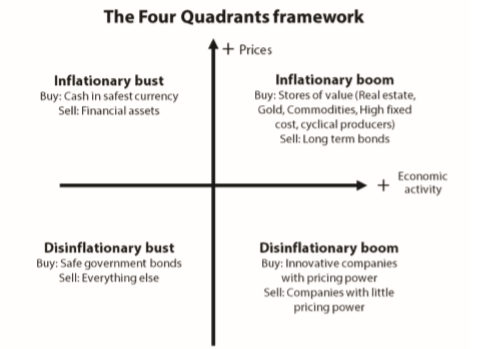
    The preceding chart and text makes the point that the economy shifts between boom-and-bust frequently, but these boom-and-bust cycles can be of two types; inflationary or disinflationary. The authors claim the shift between types of boom/bust cycles is less frequent and more important. The first chart shows quadrants with the normal boom/bust shift as a left-to right shift, and the unusual transition from inflationary cycles to disinflationary cycles as a top-to-bottom shift on the chart. Here it is:


    They claim we are now making the unusual shift into a new pair of boom/bust cycles. To illustrate that point, they show the figure we are discussing above. Its purpose is to show that our frequent boom/bust cycles were of the inflationary types for 30 years from 1955 until about 1985. About then we had the unusual shift from inflationary cycles to disinflationary cycles. In the 40 years since then, from 1985 until now, we have seen frequent boom/busts of the disinflationary type.

    We have been living and investing in a mostly disinflationary climate. They claim we are about to make the shift back to inflationary conditions again, which requires entirely different investing strategies to make money. They advise we adopt 1965 style approaches to our portfolios to book profits in the years ahead.

    Leave a comment:


  • bpr
    replied
    Re: Fed Raises and Now Tariffs? Have we been in ka--- for ten years?

    Really hard to see/estimate where the specific cutoffs are on a 70-year chart so small, but there's this larger slice of 1980-2015:

    Not sure how to read the interactive chart, or if proprietary SW is required:
    http://web.gavekal.com/article/four-...rowth-question

    Leave a comment:


  • jk
    replied
    Re: Fed Raises and Now Tariffs? Have we been in ka--- for ten years?

    i don't recall most commodity price history except for some notable moments- the gold peak in ~'80, the gold low and the oil low around '00. perhaps you're right- but then where did that chart come from? do you think it was just created out of whole cloth?

    Leave a comment:


  • dcarrigg
    replied
    Re: Fed Raises and Now Tariffs? Have we been in ka--- for ten years?

    Originally posted by jk View Post
    here's gavekal's china argument complete with charts

    https://blog.evergreengavekal.com/a-...eration-shift/
    Not sure what's up with this part of the thesis:


    • The red periods represent “disinflationary busts”, or phases of falling growth and falling inflation. These were bad times for equity investors and horrible for commodity investors.


    Seems to me if you bought commodities in 2007 and sod them in 2011, you'd have made a pretty penny...not so horrible in the last big red band. Ditto with 2002 to 2004. 1988 to 1991 didn't fare too badly either. In fact, the red times seem to not be horrible for commodity investors at all.

    • The yellow bands represent “inflationary boom” periods, or times of rising growth and inflation. At such times, the best place to be was usually value stocks, commodities and emerging markets.


    You would have not done well being in commodities and emerging markets from 62 to 68. You would have made a killing from 68 to 74. The band colors are interesting, but the yellow advice is working better in the red again, and pretty terrible for the yellow, I think.

    • The blue bands represent “inflationary bust” periods, or phases of rising inflation and falling growth. At such times, investors should have taken refuge in gold, or in the cash of countries running large current account surpluses and/or large fiscal surpluses


    The big run-up in gold was '78 to '80. If you bought in '80 and sold in '82 along with the blue stripe here, you'd be taking a bath...

    Not trying to be a jerk, and I this isn't really a researched post meant to poke holes in the thesis, so maybe I'm wrong somewhere, but the advice here just doesn't correspond with my sense of price history...

    Leave a comment:


  • jk
    replied
    Re: Fed Raises and Now Tariffs? Have we been in ka--- for ten years?

    here's gavekal's china argument complete with charts

    https://blog.evergreengavekal.com/a-...eration-shift/

    Leave a comment:

Working...
X