
Originally posted by DSpencer
View Post
-
Re: anyone else read ej's twits?
I think its a complex cause situation. Home buyers were in on it as well but failed to realize that savings based upon accumulating obligations is not saving macro economically. Housing more or less depends on someone else's buying power. Its not a root cellar full of goods which is real saving. Its not industrial capital. So I dispute the usual psychological claim that it was "a spending binge" which I think is important. There is much less consumer binge mentality than is claimed. If the dollar is traumatized it will only get worse. Its just a matter of what will be the savings vehicle. The more credit oriented it is the worse and that is to say saving debts is not a virtuous cycle. I don't think its a public vs private issue. Its a total failure of our combined economic culture. The entire economic paradigm is faulty everywhere you look. -
Re: anyone else read ej's twits?
What has been overproduced? Housing? I think it's pretty clear that the housing bubble was in large part caused by government/central bank intervention through the manipulation of interest rates and other means. Sounds like a classic misallocation of capital.Originally posted by Southernguy View PostLeave a comment:
-
Re: anyone else read ej's twits?
Marx was right in his descriptions. The fundamental problem with the West is the boogie man they have created in what appears to be the common mistake of mixing economic explanations with Marx's more questionable economic apothecary. Marx was the first critic of capitalism. How could anyone deny that working 12 year old children 16 hours a day until an early death just couldn't go on? Darwin was wrong in many ways too. However he was the first critic of magical thinking in biology that was completely wrong.Originally posted by Southernguy View Post
Keynes of course declared Say's law to be entirely defunct as well. How could it not be in a world of debtors and creditors? Prices are not so easily liquidated. Its also worth pointing out Friedman's floating currency concept looks much different when a third world country is a debtor country. It does not result in an equilibrium when this is violated:
Deuteronomy 24
6 “No man shall take the lower or the upper millstone in pledge, for he takes one’s living in pledge.
So instead of demanding less currency they demand more hard currency in the form of more loans since the mill stones now back the hard currency.
Can't just let prices float downward to be rescued by St Say and his angelic army of buyers in a world of debtors and creditors. I believe the word is overhead.Last edited by gwynedd1; October 30, 2012, 03:23 PM.Leave a comment:
-
Re: anyone else read ej's twits?
What you are saying is very much alike Marxist theory of economic crises.Originally posted by gwynedd1 View Post
Contradiction between social production versus individual apropiation. Net result=overproduction=economic crises. As the wealthy do not consume all they earn, a lack of demand is created.
That is exactly against Say´s law: every production creates it´s own demand.
History is again proving Marx right.Leave a comment:
-
Re: anyone else read ej's twits?
Problem is that, as in the depression, beggar thy neighbor export strategy is creating a global savings glut. This is why currencies have complete immunity. People are reading the wrong Malthus with this idea of population causing scarcity. Its the opposite. Try his glut theory. Since we went global we vastly increased productive capacity while creating so much wage competition that there is no buying power to buy the output. Even the stock market bubble and subsequent housing bubble is mis-characterized as US spending binge. That was merely the result Americans completely dissociated with investment. However psychology behind both were as savings vehicles. That means the US is not a consumer monster waiting to get out especially with the wealth gap growing because as that grows the wealthy will cause us to net save. Even with our stock of spenders they are losing buying power while savers are increasing it.
That is the now. Unfortunately this could drag on for a very long time. The only real possibility is China consumption but that regime is not going to be very comfortable with a well financed middle class. Energy is the only potential scarcity I see.
That is what the chart is saying to me. We have a global savings glut.Last edited by gwynedd1; October 30, 2012, 11:07 AM.Leave a comment:
-
Re: anyone else read ej's twits?
Investopedia does a great job explaining bonds. This section deals with bond pricing. Recommend all of the articles in the series.Originally posted by globaleconomicollaps View Post
As far as plotting bond prices, you can calculate the price of a bond and plot how the price changes with changes in interest rates.
But the plot that I have done is typically done to invert an index to see the inverse of the index. Inverting yields does not produce a price curve but it does reveal the extreme price level of the bond market overall.Leave a comment:
-
Re: anyone else read ej's twits?
Is it possible to plot the bond price and is this info on line somewhere?Originally posted by EJ View PostLeave a comment:
-
Re: anyone else read ej's twits?
eventually international demand for the Dollar dries up due to bilateral trade agreements that bypass the Dollar, especially if there are internal issues in some of those countries related to war or energy resource scarcity. (I think on Financial Sense EJ mentioned that the US could have issues with China or Japan if drawn into some sort of engagement between them).Originally posted by vinoveri View Post
eventually the negative returns destroy pension funds & insurance companies. that in turn destroys some people's lives & the general trust in the financial system + economy. greater friction then acts as a drag on GDP growth, making funding ongoing obligations that much harder.
once inflation rises above some point the gap becomes large enough that people find ways to opt out, as eventually they lose credibility.Leave a comment:
-
Re: anyone else read ej's twits?
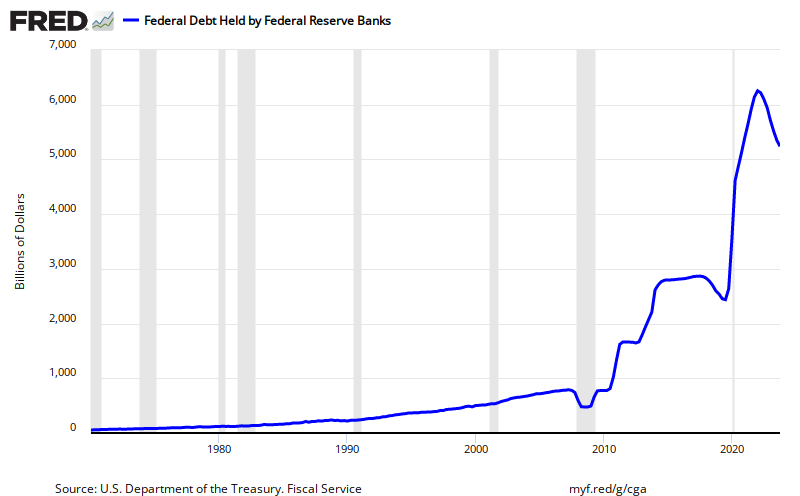
The Fed doesn't have to buy all of the UST issuance for the UST market to be 100% government controlled. It can use its "infinite" balance sheet to intimidate bond buyers into accepting interest rates that fail to reflect market-based pricing of default and inflation risk. No one dares to try bid up interest rates or bid down prices. Everyone who has tried over the past three years has gotten killed.Originally posted by vinoveri View Post
Leave a comment:
-
Re: anyone else read ej's twits?
"1. UST bonds have never been cheaper since the 1850s."
If I understand correctly, should read "UST bonds have never been more expensive since the 1850s."
Could this be translated also as: "cash has never been so cheap since...."?Leave a comment:
-
Re: anyone else read ej's twits?
This tweet was premature. As part of the new iTulip.com we use Twitter to announce the availability of new articles on iTulip. The article is scheduled to appear before the election.Originally posted by Dave Stratman View Post
On the chart, you cannot derive a price of a bond from the yield but by dividing 1 by the yield you can see relative changes in bond prices over time.
The chart shows the relative price of long-term U.S. Treasury bonds from January 1856 to September 2012. The chart tells us two things:
1. UST bonds have never been more expensive since the 1850s.
2. UST bond prices have never before risen so quickly.
The chart brings into sharper focus the danger that the UST market faces.Leave a comment:


Leave a comment: