
Originally posted by zoog
View Post
-
Re: Mortgage Swamp
The biggest errors iTulip has made in the past is not in predicting recessions but underestimating the willingness and capacity of the Fed and Congress to fight them once they get underway. Problem is, no two cycles are the same, and we are starting out from an extraordinarily bizarre place. -
Re: Mortgage Swamp
bill, Fred, c1ue, all good info, thanks. So a recession starting late this year, that gets progressively worse as defaults grow and hedge funds stumble and everything keeps building upon itself.
There's still talk out there that the stock market tends to do well in election years. Could that still be a possibility in the midst of such a recession?
My personal take on this has been to expect a relatively mild recession late this year, followed by a weak recovery next year, then followed by a serious crash say 2009 or so. But I'm just an armchair economist, so I trust iTulip analysis and forecasts more than my own.Leave a comment:
-
Re: Mortgage Swamp
Interesting additional info from:
http://www.fpafunds.com/news_070703_absense_of_fear.asp
We (Robert L Rodriguez & Co.) were on the March 22 call with Fitch regarding the sub-prime securitization market’s difficulties. In their talk, they were highly confident regarding their models and their ratings. My associate asked several questions. “What are the key drivers of your rating model?” They responded, FICO scores and home price appreciation (HPA) of low single digit (LSD) or mid single digit (MSD), as HPA has been for the past 50 years. My associate then asked, “What if HPA was flat for an extended period of time?" They responded that their model would start to break down. He then asked, “What if HPA were to decline 1% to 2% for an extended period of time?” They responded that their models would break down completely. He then asked, “With 2% depreciation, how far up the rating’s scale would it harm?” They responded that it might go as high as the AA or AAA tranches.Leave a comment:
-
Re: Mortgage Swamp
Oddly, the front page has the same first line as the forum post, but the "here" at the end of the front page is not hyperlinked.
As usual, great summary of the Credit Suisse report.Leave a comment:
-
Re: Mortgage Swamp
If the US economy were not already skirting recession, I'd agree with you. But given weak Q1 performance and drastically low retail numbers in June, when demand is traditionally strong, you are arguing the 50% probability iTulip Economic Face Plant case: we get a drastic self-reinforcing recession such as we have not seen in decades.
Housing recession -> cap-ex recession -> layoffs -> demand implosionLast edited by FRED; July 13, 2007, 10:48 AM. Reason: Wrote "inflation" meant "recession," but, yeh, inflation, too.Leave a comment:
-
Re: Mortgage Swamp
EJ 1-10 cycle:http://www.itulip.com/forums/showthr...11082#poststopOriginally posted by zoog View Post
The process goes like this.
1. As the housing market tanks, the US economy slows even while other countries' economies keep growing.
2. As the US economy slows relative to other nations which also attract foreign investment, the relative expected future return on investment in the US falls.
3. Among other financial assets, demand for US treasuries bonds falls.
4. As demand for US treasury bonds falls, prices fall and yields rise.
5. Demand for bonars also declines because fewer are needed when converting foreign currencies to bonars to purchase bonar denominated financial assets.
6. Import prices rise.
7. In the US, where so much of the low inflation story is based on cheap imports, the impact on net inflation is significant.
8. Bond yields rise in response to increased inflation risk.
9. Mortgage rates rise.
10. Housing market tanks some more. Go to step 1.
I think in 08 in addition to the housing debacle the PE bubble will start to have a impact. Jim Finkel said http://www.itulip.com/forums/showthread.php?t=757 in a interview:
Private equity bubble is even bigger than mortgage bubble, and serious macro-economic fallout is more likelyLast edited by bill; July 13, 2007, 09:15 AM.Leave a comment:
-
Re: Mortgage Swamp
That's interesting...Originally posted by Fred View Post
I'm sticking with believing you're right.As trillions of dollars in mortgage loans reset to higher monthly payments before the end of the year, the already historically high rate of foreclosure, and falling sales and prices accelerated by more frequent abandonment of homes by borrowers with negative equity, along with negative wealth effects, reductions in consumer confidence, will drive the US economy into recession. We are sticking with our October 2006 prediction of a housing led recession in Q4 2007.
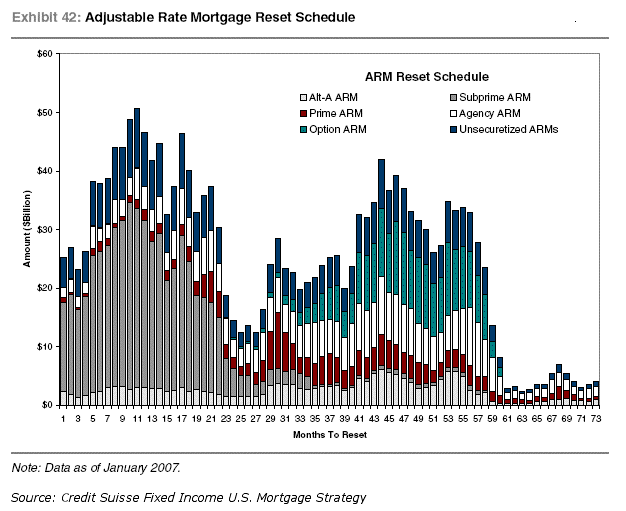
However, looking at the reset schedule chart, it appears that the peak in resets will happen ~ October/November this year, with most of that subprime. One of the other graphics in the report was this one, showing the typical foreclosure cycle is four to six months from default to showing up on the market.

With that delay in additional supply being dumped on the market, causing prices to drop, causing potential buyers to hesitate, etc... would this postpone the recession until early/mid 2008? Or do you think there is already so much in the pipeline in terms of defaults & foreclosures and the CDO shakedown that the recession will hit even before the reset peak?Leave a comment:
-
Re: Mortgage Swamp
Superb analysis, send this to CNBC and Bloomberg they can use it in a special presentation and put the public on alert as to what’s about to happen. CC a copy to Moody’s and S&P for their risk ratings report.
Leave a comment:
-
Mortgage Swamp
Everything you ever wanted to know about how bad the mortgage mess is but forgot to ask
Today Credit Suisse issued a new report titled Mortgage Liquidity du Jour: Underestimated No More. (Thanks Sapiens for locating it.) Below is a brief rundown of some of the most pertinent charts. We analyzed Credit Suisse' previous report on ARM resets here.
Often we hear that, sure, a lot of crummy subprime loans are going bad with more to come, and, yes, the ratings agencies have downgraded the bonds that backed these mortgages, but that's because the borrowers are high credit risk due to poor credit records and income histories, and the problems will be confined to subprime mortgages and to borrowers who are in the high credit risk category. This new report suggests that this view is false.
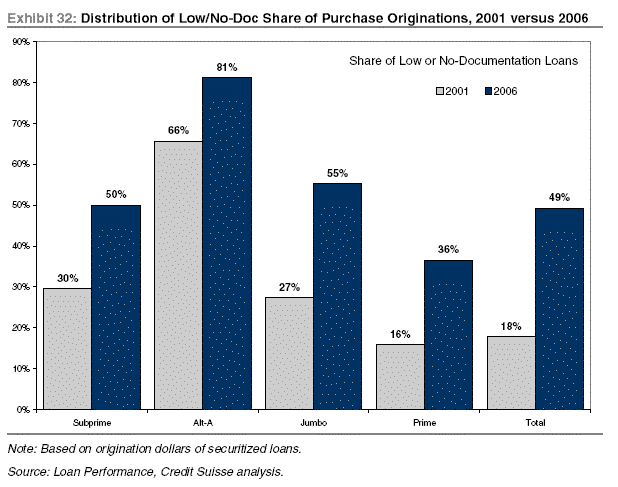
You probably know that Low/No-Doc loans are also called "stated income" or "liar" loans. That's because the borrower was allowed, and in some cases encouraged, to overstate their income in order to qualify for the loan. Obviously, these borrowers are at a higher risk of default than borrowers who are living within their means, who borrowed only what, by traditional measures, their income will permit. A low credit risk has in effect be turned into a high credit risk by the act of lending more money than income will reasonably allow these borrowers to repay. If in addition to subprime borrowers, a significant number of Alt-A, Jumbo, and Prime borrowers were also granted Low/No-Doc loans, then risks in the mortgage market cannot be confined to subprime loans.
How many Low/No-Doc loans were originated for each class of securitized loan? As it turns out, more than 80% of Alt-A, more than half of Jumbo, and 36% of Prime securitized loans (approximately 75% of all mortgages are securitized).
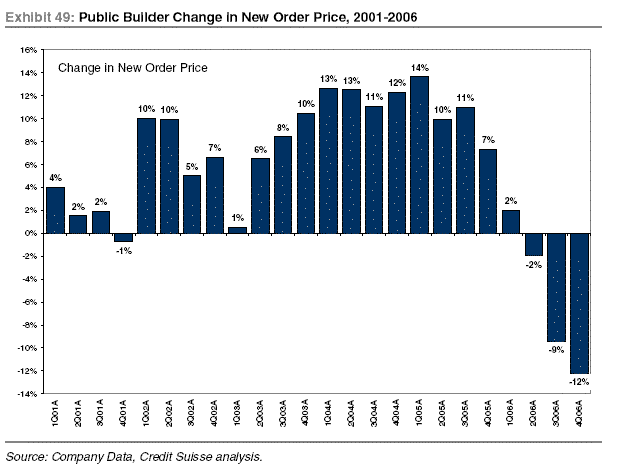
One hope is that price declines are reaching the end of the cycle. However, prices for new homes on order fell 12% in Q4 2006. This shows a market still in steep decline, not bottoming out.
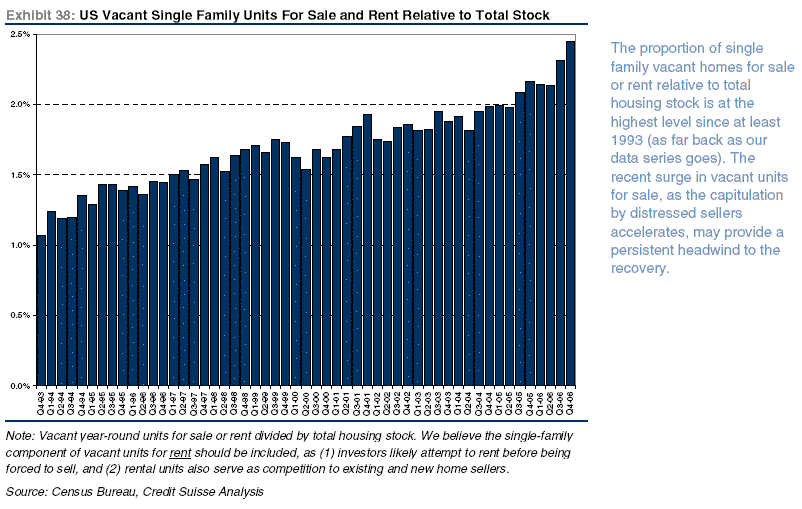
The rise in vacant homes indicates that some regions of the US are entering Step E, as defined by iTulip's January 2005 Housing Correction prediction, while others are only at Step B and may not decline further.
"Five years into the downturn, rising unemployment will begin to more seriously affect the market, as indicated in Chart 1. As unemployment rises, homeowners will leave housing bust regions to move to areas where there are more jobs. Many houses will be sold at a loss, or even abandoned, as the market price falls below the loan value. Given the choice between paying cash out of pocket to sell their home or leaving the keys with the bank, many home owners will make the latter choice."
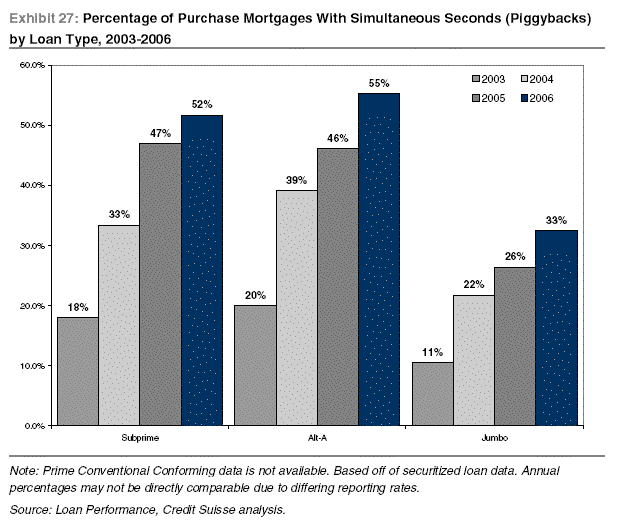
Piggyback loans are another risky mortgage. Piggyback loans get their name from a second mortgage that is "piggybacked" onto a first mortgage to compensate buyers who are unable to come up with a larger down payment or any at all. Piggyback borrowers are another group that is vulnerable to default. More than 50% of subprime and Alt-A mortgage holders fall into this category.
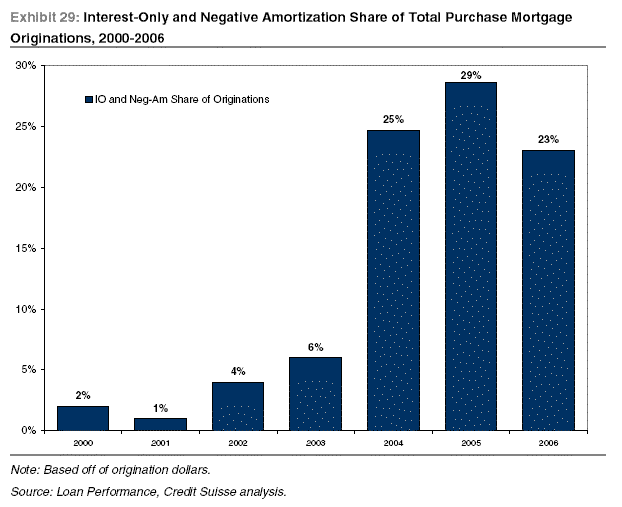
This picture is to us the most disturbing of all. It shows that an average of one quarter of all mortgage loans made since 2003 were to "homeowners" who are doing nothing more than renting a house from the bank. There is no equity built in a home during the period when the borrower is paying only the interest on the loan. This borrower has no incentive to fight to stay in their home if the price falls and the mortgage goes underwater, especially if they lose a source of income. They have no equity to lose.
This chart is from our previous analysis. It shows arm resets by mortgage type over time. It shows a large group of borrowers who have adjustable rate mortgages which will, of mortgage rates continue to climb, experience major increases in their monthly payments. According to CNN, they "may see their monthly mortgage payments climb by 35 percent or more." Many will try to refinance into a fixed rate mortgage, but this may be impeded by a continued tightening of lending standards.
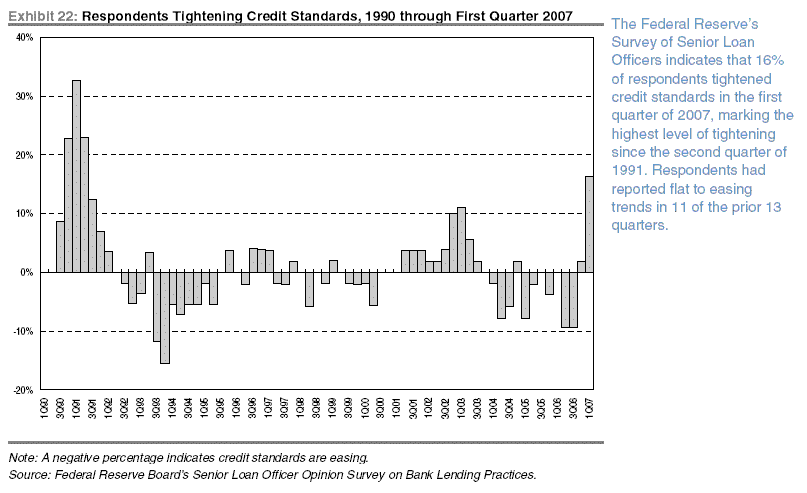
No surprise that after this lending free-for-all defaults are starting to rise and lenders, in response, are tightening lending standards.
Where did the money come from to back these loans? From the asset-backed securities (ASB) firms that you've been reading about. Note that Fannie Mae and Freddie Mac reduce their holdings of household mortgage debt, ASB firms make up the difference, and then some.
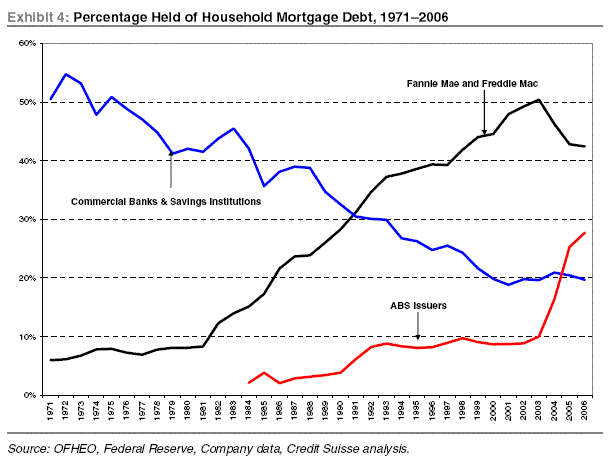
The last is the bag-holder chart. It shows Freddie Mac and Fannie Mae holding about 50% of all mortgages. Guess who bails these guys out when the time comes?
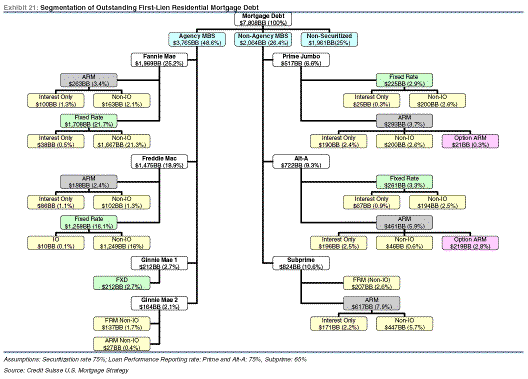
What you see in the charts and graphics above is a picture of millions of borrowers who, as No-Doc and Piggyback mortgage holders, have taken on more debt that they can afford even when the monthly payment on their ARM is low. As trillions of dollars in mortgage loans reset to higher monthly payments before the end of the year, the already historically high rate of foreclosure, and falling sales and prices accelerated by more frequent abandonment of homes by borrowers with negative equity, along with negative wealth effects, reductions in consumer confidence, will drive the US economy into recession. We are sticking with our October 2006 prediction of a housing led recession in Q4 2007.
Other Housing Related:
The New Road to Serfdom (Feb 2007)
Are We Idiots? (Apr 2007)
Fueling the FIRE Economy: Part I (Apr 2007)
Sub-prime Loans and the Failure of Credit Welfare (Mar 2007)
Top in Housing Bubble - Dancing, Booze and Overpriced Houses (Jun 2005)
Housing Bubbles Unlike Stock Bubbles (Jan 2004)
Housing Bubble Correction Prediction – Timing (Jan 2005)
Housing Bubble Correction Prediction – Geographic (Mar 2006)
The Six D's of Foreclosure (Jul 2006)
Global Housing Bubble? Report from Thailand (Aug 2006)
High Commuting Costs Push Rural Property Owners Past the Tipping Point (Mar 2006)
Housing is correcting in northern California. How far will it go? (Apr 2006)
iTulip Select: The Investment Thesis for the Next Cycle™
__________________________________________________
Special iTulip discounted subscription and pay services:
For a book that explains iTulip concepts in simple terms see americasbubbleeconomy
For macro-economic and geopolitical currency ETF advisory services see Crooks on Currencies
For macro-economic and geopolitical currency options advisory services see Crooks Currency Options
To receive the iTulip Newsletter or iTulip Alerts, Join our FREE Email Mailing List
Copyright © iTulip, Inc. 1998 - 2007 All Rights Reserved
All information provided "as is" for informational purposes only, not intended for trading purposes or advice. Nothing appearing on this website should be considered a recommendation to buy or to sell any security or related financial instrument. iTulip, Inc. is not liable for any informational errors, incompleteness, or delays, or for any actions taken in reliance on information contained herein. Full DisclaimerLast edited by FRED; July 30, 2007, 04:49 PM.

Leave a comment: