Re: Re-inflation Rally Part I: Falsehoods, fantasies, fabrications, and fake-outs - Eric Janszen
Well, we are several trillion dollars into the money spinning, and still waiting to see any of the above. What insures that they will ever distribute any of that money into the hands of normal American families? So far it has gone ONLY to the favored few, who then offer to lend it back to us. Meantime, the G20 are beginning to talk about removing our money spinning powers and turning them over to the NWO.
-
Re: Re-inflation Rally Part I: Falsehoods, fantasies, fabrications, and fake-outs - Eric Janszen
Originally posted by Willette View Post
Tax rebates.
Public works projects
Government buys houses.
Government buys stocks.
Government buys bonds.
Government buys ag products
etc. etc. etc.Leave a comment:
-
Re: Re-inflation Rally Part I: Falsehoods, fantasies, fabrications, and fake-outs - Eric Janszen
I have long been a convinced inflationist, so much so that I was surprised by the big KA deflation. But now that its happened, I'm reconsidering inflation. The biggest flaw that I see is that in the USA, how are we going to get incomes to inflate along with prices of goods and services??? No sign or that, for sure.
No doubt that the feds can create money without limit - the issue is, how does it get into circulation? So far, they are mainly turning it over to the "too big to fail" operators. How does that create an inflationary feedback loop?
Suppose these TBTF characters have already acquired loads of real wealth during the prior inflationary boom. Their problem now is the money they borrowed to do so, and the worthless inventory of derivatives they got stuck with when the music stopped. If most of the Fed's new money is given to them, and they simply use it to reduce their leverage, pay down debts, and unload their worthless gambling chits, how does this ever produce inflation? Meanwhile the DEflation cycle of lost jobs, falling incomes, decreasing purchases, declining asset prices and diminishing tax revenues continues unabated.Leave a comment:
-
Re: Re-inflation Rally Part I: Falsehoods, fantasies, fabrications, and fake-outs - Eric Janszen
Don't vote: it just encourages them. Voting sustains the illusion that Americans choose policy by their votes, when in reality it is a rigged game and all we choose are personalities, or may be only faces.Leave a comment:
-
Re: Re-inflation Rally Part I: Falsehoods, fantasies, fabrications, and fake-outs - Eric Janszen
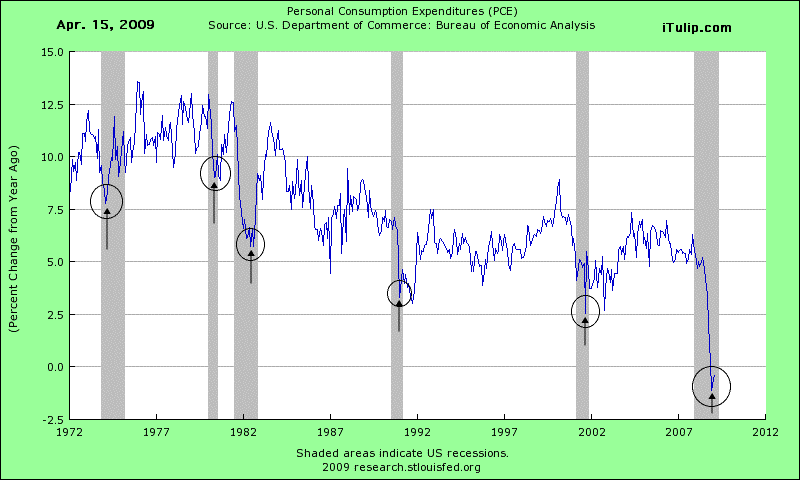
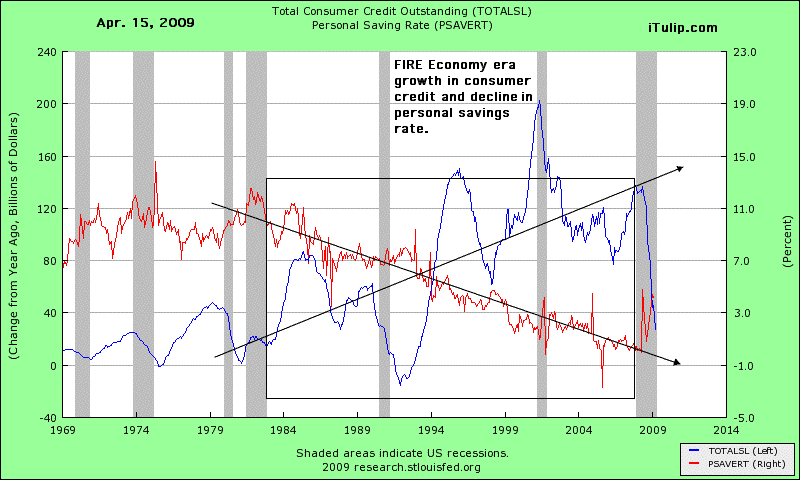
So spot on EJ, thank you (both for I and II)-- especially your comments about PCE (and sales), and PCE's (and it's influence on GDP) increasing relevance as a predictor as savings erodes. And, as you infer later on, the key observation behind PCE and consumption is: what's the source of PCE and sales? Is it income, debt, or savings?Originally posted by EJ View Post
Your comments on savings are extremely important. I keep an eye out for it too because it is helpful to try to understand the choices individuals will make (or be forced to make) in the future -- and what the implications are for the economy. FWIW, some of the charts I look at are:
LT erosion in savings, LT debt loading:

Savings can be telling in terms of what people are doing and think about the economy. Check out how little savings have increased during this recession -- in spite of the magnitude.

Or is it that because of rising unemployment, lowered PIs, and (in spite of interest rate changes) they can't pay debt service:

I'm really looking forward to PCE/PI etc releases at the end of April. Oh yeah, and CMDEBT.Leave a comment:
-
Re: Re-inflation Rally Part I: Falsehoods, fantasies, fabrications, and fake-outs - Eric Janszen
Me too. At the time, despite the fact that I voted against all of the incumbents who voted for the bailout, for some reason I couldn't force myself to not vote for the President. Arguments against a "wasted" vote I guess, but I'd retract my vote in protest now.Leave a comment:
-
Re: Re-inflation Rally Part I: Falsehoods, fantasies, fabrications, and fake-outs - Eric Janszen
i'm not sorry i voted for him, given the choice, but on his economics- omg:eek:.Originally posted by metalman View Post
i suppose if he'd lost, at least there'd be some laughs.
on his economics, sometimes i wonder what i'd do if i were president, my goal was inflation but i wasn't allowed to say so.Leave a comment:
-
Re: Re-inflation Rally Part I: Falsehoods, fantasies, fabrications, and fake-outs - Eric Janszen
hey, ej... you man obama is pushing stocks...
...and two days later was on TV pushing refis.
still loving obama? not me. sorry i voted for him.Leave a comment:
-
 Guest repliedRe: Re-inflation Rally Part I: Falsehoods, fantasies, fabrications, and fake-outs - Eric Janszen
Ditto.Originally posted by Chomsky View Post
I remember them trowing a 10 trillion number out not so long ago for a target of their balance sheet.The Fed is only getting warmed up.
So not less then that is my uninformed reading.Leave a comment:
-
Re: Re-inflation Rally Part I: Falsehoods, fantasies, fabrications, and fake-outs - Eric Janszen
These are great arguments. The only credence I give to the deflation camp is MY belief in the inflation arguement.Leave a comment:
-
Re: Re-inflation Rally Part I: Falsehoods, fantasies, fabrications, and fake-outs - Eric Janszen
Some more from Rosenberg, via Zero Hedge from 4/17/09 http://zerohedge.blogspot.com/2009/0...ervations.htmlOriginally posted by stockman View Post
The piece on Zero Hedge is short and might be worth some readers' time.Originally posted by I do believe this is Durden quoting RosenbergLeave a comment:
-
Re: Re-inflation Rally Part I: Falsehoods, fantasies, fabrications, and fake-outs - Eric Janszen
Originally posted by ej View Post
the treasury injects money into gm, likely to be converted to equity. the fed buys tbonds. so maybe the fed only buys equity indirectly. maybe it already has.
Originally posted by ej
if anyone can afford to take a loss, it's an entity that can print money.
every period of growth is accompanied by rising rates. the issue is one of speed and timing. gradually rising rates has never choked off anything.Originally posted by ej
Originally posted by ejit seems to me that the length of time until we get a true recovery is an important variable. the longer that interval, the more banks can coin money by borrowing at zero and buying positive yielding tbonds provided the yield curve has any slope at all. also the longer the time til recovery, the more time for inflation to work its magic on fixed rate liabilities. perhaps the dead can walk again, if only they molder long enough.Originally posted by ej
Leave a comment:
-
Re: Re-inflation Rally Part I: Falsehoods, fantasies, fabrications, and fake-outs - Eric Janszen
EJ writes in:Originally posted by Jim Nickerson View PostRe-read the Fed's "Debt Deflation Playbook."
The deflationists laughed in 2006 when we told them the Fed will print money and buy mortgage securities "That's not legal under their charter," they said.
The deflationists laughed again in 2007 when we told them the Fed will print money and buy 10 Year Treasury bonds. "That's never been done since WWII," they said.
Both have happened.
"When deflation hits, oil will fall to $10 and gold to $200," the deflationists warned. They were wrong. Gold is holding above $800 and oil above $40. Why?
When will the deflationists stop being wrong and when will we stop to be right?
The question preoccupies us; it is the worry that keeps us vigilant.
The Fed will:Print money and buy not only MBS but mortgages directly, and gold will rise.The Fed is only getting warmed up in its execution of desperate anti-deflation measures.
Print money and buy corporate bonds directly, and gold will rise.
Print money and buy stocks directly, and gold will rise.
We have read everything the Fed has ever written about deflation starting in 2002. One thing we can say for certain is that the misguided concepts in their heads as they express them in their reports have been 100% confounded by unfolding events.
There are not a lot of elegant ways for a central bank to fight deflation, as debt deflation causes the collapse of the FIRE Economy to spill over into the Production economy, without producing a raft of unintended consequences that are much worse than deflation itself. The Fed has so far followed all of the promised "solutions" to deflation proposed in the "Deflation Playbook" that we brought to iTulip readers' attention back in 2003. What is the chance that they will abandon the desperate inflation path and not execute on the other measures outlined in 2003, plus many more that were not, such as TARP?
The Fed will print money to buy corporate bonds, stocks, mortgages, and so on, all as promised. From the 2003 Playbook:
On unintended consequences of buying the long end of the yield curve"First of all: No one, we believe, has a good quantitative sense of the mechanics of this strategy–that is, what size operations are needed to secure a given stimulus? While the Fed has managed longer-term yields at various times in the 1940s, ‘50 and ‘60s, the last time such a strategy was implemented was nearly 40 years ago."On wrecking the Fed's balance sheet
"Second, if the short riskless rate is zero, but other rates are positive, those rates must be positive for reasons–to compensate the holders of those assets for some form of illiquidity or risk. Under this strategy, the Fed takes those risks onto its balance sheet."On two bad outcomes
"This leads us to a third point: the Fed is almost guaranteed to take a capital loss on its portfolio. If the strategy works, the economy picks up, interest rates go up, bond prices go down, and the value of the Fed’s holdings of longer-term Treasuries falls."That means we are locked into a world where the economy cannot recover without also causing long rates to rise, killing the recovery of the FIRE Economy. That's the trap, not liquidity.
"Finally, narrowing the yield spread between assets of long and short maturity can stress institutions, such as banks, that profit from that spread. On the other hand, it must be noted, a wave of deflation-induced loan defaults would no doubt also be stressful for banks."A true, self-sustained recovery, when it happens, will kill the zombie banks, too.
-Eric
Last edited by FRED; April 19, 2009, 10:02 AM.Leave a comment:




Leave a comment: