Announcement

Collapse
No announcement yet.

Still no deflation: Disinflation then lots of inflation

Collapse
X
 
  • Filter
  • Time
  • Show
Clear All
new posts

  • GRG55
    replied
    Re: Still no deflation: Disinflation then lots of inflation

    Originally posted by tombat1913 View Post
    Will somebody tell me what I'm missing here? :confused:
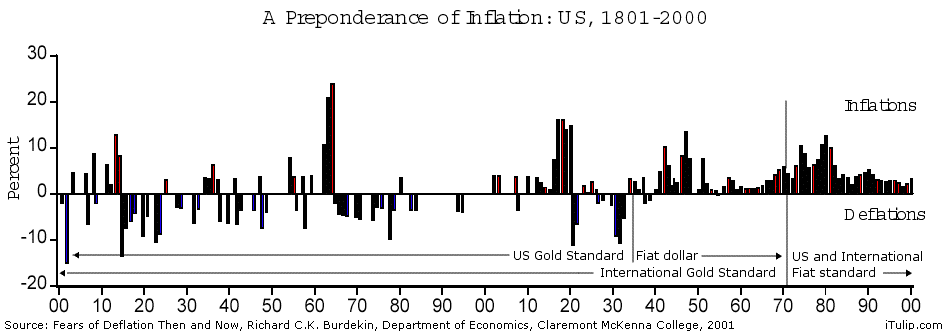
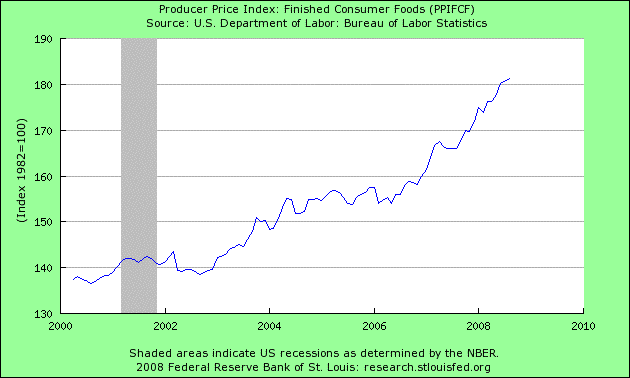
    You appear to be missing the fact that one chart shows 200 years of broad trend history, and the other chart shows "a brief history of time", namely the period from 2000 where the current FIRE economy [version 2.0] has entered its death throes and month-to-month CPI [as measured by the notoriously reliable and honest BLS remember] swings back and forth as the Fed and the Administration desperately try to keep the game going.

    You think Greenspan timed his retirement so he could spend more time with his family? Or write his book? :rolleyes:

    Leave a comment:


  • friendly_jacek
    replied
    Re: Still no deflation: Disinflation then lots of inflation

    This is one of the idiosyncrasies of Itulip. Some posters are browbeat for using the term deflation, yet EJ or Fred show plenty of evidence of deflation, especially in the context of Ka-Poom.

    Leave a comment:


  • tombat1913
    replied
    Re: Still no deflation: Disinflation then lots of inflation

    Will somebody tell me what I'm missing here? :confused:

    Originally posted by EJ View Post

    I leave you with the following history of inflations and deflations since 1900. Note that since every central bank abandoned the gold standard globally there have been two slight periods of deflation. These occurred before 1930. Since the international gold standard was abrogated by the US in 1971, ushering in the second era of floating exchange rates in 100 years – the last one ended badly as well – no deflation has occurred. Japan's on and off "deflation" does not even show up because in no year has deflation in Japan exceeded 2%.

    We continue to expect that the actions of central banks to halt deflation will, as usual, in the long run work too well.

    Originally posted by FRED
    BLS data confirm deflation in Aug. 2008.


    A month of negative inflation at annual rates occurred in Aug.

    There have been 15 months of deflation since 2000.

    2000 01 3.613
    2000 02 5.076
    2000 03 7.292
    2000 04 -0.700
    2000 05 2.127
    2000 06 7.239
    2000 07 3.541
    2000 08 0.000
    2000 09 6.436
    2000 10 2.094
    2000 11 2.090
    2000 12 2.791
    2001 01 7.094
    2001 02 2.768
    2001 03 0.684
    2001 04 2.064
    2001 05 6.297
    2001 06 2.741
    2001 07 -2.007
    2001 08 0.000
    2001 09 4.839
    2001 10 -3.317
    2001 11 -0.674
    2001 12 -0.674
    2002 01 2.048
    2002 02 2.045
    2002 03 3.423
    2002 04 5.513
    2002 05 1.347
    2002 06 0.671
    2002 07 2.706
    2002 08 3.385
    2002 09 2.013
    2002 10 2.687
    2002 11 2.005
    2002 12 2.002
    2003 01 5.410
    2003 02 6.773
    2003 03 1.979
    2003 04 -4.473
    2003 05 -1.947
    2003 06 1.320
    2003 07 4.004
    2003 08 5.353
    2003 09 3.973
    2003 10 -1.289
    2003 11 0.651
    2003 12 3.292
    2004 01 4.623
    2004 02 3.270
    2004 03 2.601
    2004 04 1.941
    2004 05 5.245
    2004 06 4.556
    2004 07 1.278
    2004 08 1.920
    2004 09 2.564
    2004 10 6.509
    2004 11 5.149
    2004 12 0.628
    2005 01 0.000
    2005 02 3.821
    2005 03 3.809
    2005 04 5.745
    2005 05 -1.842
    2005 06 0.622
    2005 07 8.362
    2005 08 8.304
    2005 09 17.114
    2005 10 2.441
    2005 11 -5.289
    2005 12 -0.603
    2006 01 7.512
    2006 02 -0.600
    2006 03 1.821
    2006 04 6.180
    2006 05 4.269
    2006 06 3.636
    2006 07 6.108
    2006 08 5.455
    2006 09 -5.172
    2006 10 -5.757
    2006 11 1.195
    2006 12 7.363
    2007 01 1.486
    2007 02 3.656
    2007 03 5.667
    2007 04 3.870
    2007 05 5.684
    2007 06 3.240
    2007 07 2.696
    2007 08 0.231
    2007 09 4.479
    2007 10 3.212
    2007 11 11.278
    2007 12 4.351
    2008 01 4.867
    2008 02 0.283
    2008 03 4.200
    2008 04 2.504
    2008 05 8.089
    2008 06 13.423
    2008 07 10.280

    2008 08 -1.630

    Before 2000 you have to go all the way back to 1986 to find a month of deflation. In fact, three in a row.

    1986 02 -2.162
    1986 03 -6.369

    1986 04 -4.312

    Leave a comment:


  • metalman
    replied
    Re: Still no deflation: Disinflation then lots of inflation

    Originally posted by GRG55 View Post
    Supply destruction, raja. Supply destruction...:eek:

    Input costs are influencing everyone, everywhere. It's more acute in the US$ zone, but it's hitting China and others too.
    you and fred talk about this, no one else i've come across.

    what's with the blind spot on the supply side of the price level equation? i don't get it. have the deflationists all received a supplobotomy?

    Leave a comment:


  • GRG55
    replied
    Re: Still no deflation: Disinflation then lots of inflation

    Originally posted by raja View Post
    Why would input costs stay high?
    If the grocer is having to tighten his belt by lower prices, why wouldn't those selling what he's re-selling have to do the same? Wouldn't demand destruction affect everyone down the line?
    Supply destruction, raja. Supply destruction...:eek:

    Input costs are influencing everyone, everywhere. It's more acute in the US$ zone, but it's hitting China and others too.

    Leave a comment:


  • FRED
    replied
    Re: Still no deflation: Disinflation then lots of inflation

    Originally posted by Chief Tomahawk View Post
    Sadly, this bout of "disinflation" has whacked my precious metal mining stocks in a manner I'm sure Tony Soprano would be proud of. Ugh.:mad:
    We have been 100% consistently against PM stocks forever. Why?

    1. No one ever guesses which companies do not have stupid management.
    2. Dollar weakness from falling dollar demand will drive up input costs faster than declining dollar value will drive up finished goods prices.
    3. Now as PM demand falls, finished goods demand will fall faster than input costs; producers will cut production faster than recession will cut demand.

    The paper gold market will obscure this, although rising spreads between spot and physical are indicative.

    Hat tip to metalman: watch this site for gold prices. The secondary market will be more reliable indicator of demand for a while.

    Leave a comment:


  • Chief Tomahawk
    replied
    Re: Still no deflation: Disinflation then lots of inflation

    Sadly, this bout of "disinflation" has whacked my precious metal mining stocks in a manner I'm sure Tony Soprano would be proud of. Ugh.:mad:

    Leave a comment:


  • Guest's Avatar
    Guest replied
    Re: Still no deflation: Disinflation then lots of inflation

    Originally posted by FRED View Post
    Cutting prices to burn off inventory is certainly deflationary. Across the entire retail sector you will see it happen as the recession deepens. The question is, what is the new equilibrium price that your grocer pays for goods and can charge for it? Clearly he cannot stay in business for long if the input costs for his goods stay higher than what he can charge his customers. Input costs must fall as well to match the new discounted sale prices that are meeting demand or he will not be able to restock the next cycle of inventory and sell it at a profit.


    Uh, oh. Not looking so good. Hope he's got a lot of cash on hand to float expenses. Better not be counting on the credit line.

    What happens if half of the grocers in your area wind up going out of business? Then the ones that survive get to charge what they need to in order to stay in business. That may be more than they charge today. As a result your grocer's customers' buying behavior will change. They will buy less and they will substitute lower quality products.

    That's how it is in countries where the standard of living has declined because the nation had lost purchasing power.
    ....better make friends with someone in the LDS church now while you can still get some food :eek:

    Leave a comment:


  • don
    replied
    Re: Still no deflation: Disinflation then lots of inflation

    Originally posted by FRED View Post
    Cutting prices to burn off inventory is certainly deflationary. Across the entire retail sector you will see it happen as the recession deepens. The question is, what is the new equilibrium price that your grocer pays for goods and can charge for it? Clearly he cannot stay in business for long if the input costs for his goods stay higher than what he can charge his customers. Input costs must fall as well to match the new discounted sale prices that are meeting demand or he will not be able to restock the next cycle of inventory and sell it at a profit.


    Uh, oh. Not looking so good. Hope he's got a lot of cash on hand to float expenses. Better not be counting on the credit line.

    What happens if half of the grocers in your area wind up going out of business? Then the ones that survive get to charge what they need to in order to stay in business. That may be more than they charge today. As a result your grocer's customers' buying behavior will change. They will buy less and they will substitute lower quality products.

    That's how it is in countries where the standard of living has declined because the nation had lost purchasing power.
    I'll tell my wife! Good stuff, Fred.

    Leave a comment:


  • raja
    replied
    Re: Still no deflation: Disinflation then lots of inflation

    Originally posted by FRED View Post
    Clearly he cannot stay in business for long if the input costs for his goods stay higher than what he can charge his customers. Input costs must fall as well to match the new discounted sale prices that are meeting demand or he will not be able to restock the next cycle of inventory and sell it at a profit.
    Why would input costs stay high?
    If the grocer is having to tighten his belt by lower prices, why wouldn't those selling what he's re-selling have to do the same? Wouldn't demand destruction affect everyone down the line?

    Leave a comment:


  • phirang
    replied
    Re: Still no deflation: Disinflation then lots of inflation

    China has been tackling inflation by shutting down inefficient steel mills and retrenching other unproductive yet resource-intensive activities and focusing on using methods and technology with higher yields.

    Leave a comment:


  • JoeSixpack
    replied
    Re: Still no deflation: Connecting the dots

    Lukester put up this lenghty piece The Fed is Dead. Long Live The US Treasury. today.

    The key take-away for me was that it argues the Fed had only started to "print money" on Sep 17., when it implemented the "Supplementary Financing Program", where the Treasury issues into the Fed, and all the TAFs and whatnot had not increased the monetary base so far.

    This is the most intruiging chart on the Monetary base from the article. http://research.stlouisfed.org/publications/usfd/page3.pdf

    If you look up your gold charts from Sep 17., you will find that was the day when Gold futures went from a low of 777 to the high of 869, the largest one-day increas ever if i recall correctly.

    Leave a comment:


  • FRED
    replied
    Re: Still no deflation: Disinflation then lots of inflation

    Originally posted by don View Post
    Disinflation Anecdote (Snail's Eye View) :

    My wife and I did our weekly shopping yesterday at a local, comfortable middle class supermarket we frequent. Practically everything was on sale. Not a few cents off but a significant, practically across the board discount. Our ticket showed a 14% savings on a $145 buy.

    By the amount of bags filled (sorry for the loose analysis here) this didn't appear to be a large price increase/temporary sale gambit, a commonplace here and I assume everywhere in grocery retail.

    Motive? Critical cash flow for the chain? They have around 12 stores in the surrounding burgs. Time will tell.
    Cutting prices to burn off inventory is certainly deflationary. Across the entire retail sector you will see it happen as the recession deepens. The question is, what is the new equilibrium price that your grocer pays for goods and can charge for it? Clearly he cannot stay in business for long if the input costs for his goods stay higher than what he can charge his customers. Input costs must fall as well to match the new discounted sale prices that are meeting demand or he will not be able to restock the next cycle of inventory and sell it at a profit.


    Uh, oh. Not looking so good. Hope he's got a lot of cash on hand to float expenses. Better not be counting on the credit line.

    What happens if half of the grocers in your area wind up going out of business? Then the ones that survive get to charge what they need to in order to stay in business. That may be more than they charge today. As a result your grocer's customers' buying behavior will change. They will buy less and they will substitute lower quality products.

    That's how it is in countries where the standard of living has declined because the nation had lost purchasing power.

    Leave a comment:


  • don
    replied
    Re: Still no deflation: Disinflation then lots of inflation

    Disinflation Anecdote (Snail's Eye View) :

    My wife and I did our weekly shopping yesterday at a local, comfortable middle class supermarket we frequent. Practically everything was on sale. Not a few cents off but a significant, practically across the board discount. Our ticket showed a 14% savings on a $145 buy.

    By the amount of bags filled (sorry for the loose analysis here) this didn't appear to be a large price increase/temporary sale gambit, a commonplace here and I assume everywhere in grocery retail.

    Motive? Critical cash flow for the chain? They have around 12 stores in the surrounding burgs. Time will tell.

    Leave a comment:


  • doharra
    replied
    Re: Still no deflation: Disinflation then lots of inflation

    To clarify: Are we, then, entering the moment of KA?

    If so, it seems to put us right on the schedule outlined in the Original Ka-Poom theory.

    And C1ue, also, just took a stab at describing possible POOMs here. Yes?

    Am I connecting the dots?

    Leave a comment:

Working...
X