Announcement

Collapse
No announcement yet.

Still no deflation: Disinflation then lots of inflation

Collapse
X
 
  • Filter
  • Time
  • Show
Clear All
new posts

  • metalman
    replied
    Re: Still no deflation: Disinflation then lots of inflation

    Originally posted by Starving Steve View Post
    Only if the dollar is sharply de-valued, do we get out of this deflation-spiral. But that would mean hyper-inflation and a complete collapse, not just in the U.S. but everywhere in the world. Everyone would flee from the dollar and probably from all world paper money, all paper assets, and nearly everything.
    nah. the dollar dies a slow death ala the pound sterling, in steps. the usa grows poorer and poorer over decades. imports become more and more expensive. the two car family becomes the one car family. eating out is a treat. we become like the brits before they found oil in the north sea, except without the imf to bail it out after it hits bottom... we pine for the old days, glorify our 'culture' and so on. get ready of a decade of sappy, sentimental movies about the america's past glory. a legacy of literacy led the brits to invent punk rock. americans invented hip hop.

    except there is no usa 'north sea oil... on and on it goes. the us economy shrinks and shrinks and shrinks. chinese water torture... so to speak. a degenerating empire like the brit's but without the class.

    Leave a comment:


  • Starving Steve
    replied
    Re: Still no deflation: Disinflation then lots of inflation

    The fact that baby boomers now desperately need to save for retirement means one thing: less consumption. The "go-go" economy of the boom years is over.

    The idiots running the central banks will have fits and print like crazy, but the banks won't lend. Banks will hoard money.... And why should banks lend when the risks of lending in a recession are great and the rewards for lending are near zero?

    Would you lend $100,000 overnight to any business for $3 or $4 interest? Even if you could collect fees for the loan, would you lend? And if you take collateral for lending, as banks do, what is illiquid collateral worth now when everything is so uncertain?

    This all means that the deflation feeds upon itself, no matter what the central banks do. Only if the dollar is sharply de-valued, do we get out of this deflation-spiral. But that would mean hyper-inflation and a complete collapse, not just in the U.S. but everywhere in the world. Everyone would flee from the dollar and probably from all world paper money, all paper assets, and nearly everything.
    Last edited by Starving Steve; October 11, 2008, 06:29 PM.

    Leave a comment:


  • phirang
    replied
    Re: Still no deflation: Disinflation then lots of inflation

    Originally posted by Lukester View Post
    Phirang - if you bothered to unpack that for the regular readership without the racy condensed reference, it would appear less flashy. Win converts ... that sort of thing. That's what EJ does. He takes the intricacies and technicals, and without any fanfare he "unpacks" them for the general readership for maximum accessibility. This elicits instant respect. The inverse of that is the minor specialist, who deposits the fruit of his narrow focus of studies in gaudy packets. You are informative, but you are flashy. Sorry, it's a "style thing". You leave a trail of unanswered questions to your assertions elsewhere.
    feel free to PM me... i'm a flighty fellow eh.

    Leave a comment:


  • bill
    replied
    Re: Still no deflation: Disinflation then lots of inflation

    Originally posted by GRG55 View Post
    Nor will supply increase quickly when the global economy inevitably recovers and begins to grow again. The unprecedented nationalizations now underway imply that, for the first time since FDR's New Deal, governments will have an enormous hand in capital allocation decisions in the next global economic recovery.


    Government Infrastructure Bank (or regional state by state gov. owned banks) injecting capital for selected projects?
    …and as the dollar continues down creating inflation and limited inventory we may have to use domestic resources.
    http://www.itulip.com/forums/showthr...26306#poststop
    http://itulip.com/forums/showthread....6408#post26408

    Leave a comment:


  • Guest's Avatar
    Guest replied
    Re: Still no deflation: Disinflation then lots of inflation

    Phirang - if you bothered to unpack that for the regular readership without the racy condensed reference, it would appear less flashy. Win converts ... that sort of thing. That's what EJ does. He takes the intricacies and technicals, and without any fanfare he "unpacks" them for the general readership for maximum accessibility. This elicits instant respect. The inverse of that is the minor specialist, who deposits the fruit of his narrow focus of studies in gaudy packets. You are informative, but you are flashy. Sorry, it's a "style thing". You leave a trail of unanswered questions to your assertions elsewhere.

    Originally posted by phirang View Post
    Herein lies the art of commodity trading... why is CODELCO bothering with Minmetals to do M&A in Africa and Asia if their reserves are fine?
    Last edited by Contemptuous; October 10, 2008, 12:49 AM.

    Leave a comment:


  • phirang
    replied
    Re: Still no deflation: Disinflation then lots of inflation

    Originally posted by GRG55 View Post
    raja: What you describe is part of the "normal" situation. And another normal part is that over times of plenty basic commodity producers around the globe increase production and increase production and increase production, until the glut exceeds consumption by such a margin it takes years to work off the overcapacity [by a combination of bankrupcy and closure of the highest cost sources and the gradual expansion of economies and population to take up the slack over time].


    However the difference this time is primarily threefold [this is a simplfied summary, but forgive me as it is late]:
    • Supply response in this so-called commodity bubble has been anemic, compared to historical patterns, in many critical commodity sectors. This price cycle didn't last long enough to overcome the scepticism, through much of this cycle, of commodity companies and capital markets that the higher prices were sustainable - a deeply ingrained scepticism after a quarter century of brutal declines in those businesses. Further, most of the available cashflow and capital went to fund unprecedented early cycle M&A between the majors and intermediates. The cycle time to bring on substantive new, green-field production of most commodities is longer, much longer, than this price cycle allowed.
    • Capital markets are exerting discipline over the high cost producers much, much faster than usual...the money [credit] is simply not available to keep low/zero/negative margin commodity sources in production. This is a break with past experience.
    • Finally, resource extraction and commodity production is a very capital intensive activity. And when capital is not available it does not matter what the input costs and product prices are doing. Supply simply will not expand without capital. Lots of capital. To use your example, if you grow cotton, it matters not a whit that your input costs in US$ are declining. If you cannot secure sufficient credit at planting time to buy those inputs [seed, fertilizers, fuel and so forth] then you will grow less, or perhaps not at all. And we are in a capital markets/credit situation that will not self-correct, nor will it quickly respond to the increasingly desperate government interventions to correct it.
    These are the reasons that this so-called commodity bubble collapse will not involve many years of working off huge quantities of uneconomic commodity production overcapacity.

    Nor will supply increase quickly when the global economy inevitably recovers and begins to grow again. The unprecedented nationalizations now underway imply that, for the first time since FDR's New Deal, governments will have an enormous hand in capital allocation decisions in the next global economic recovery. And you can guess where they will want to direct most of the money. Your cotton growing farmer friend should do fine, since governments everywhere view agriculture subsidies as a national birthright.

    Provided he can get the diesel to run his John Deere...
    Herein lies the art of commodity trading... there are going to be severe dislocations(on the upside) in many commodity markets, especially when nations resort to Keynsian policies and wars to get GDP up.

    The DRC and the Tenke project are great examples of the problems facing mining going forward... why is CODELCO bothering with Minmetals to do M&A in Africa and Asia if their reserves are fine?

    I'd also note that the massive infrastructure commitments will hit the two (formerly;)) tightest markets: steel and copper.

    Leave a comment:


  • GRG55
    replied
    Re: Still no deflation: Disinflation then lots of inflation

    Originally posted by raja View Post
    I have very little experience in economics, so could you elaborate on this for me?

    Say you are growing cotton, for example.
    The clothes manufacturer is ordering less cotton because consumers are buying fewer clothes. You cut back on your production of cotton, but you're also cutting back on your input costs, because you need less labor, fuel, fertilizer to produce a smaller amount of cotton. Plus, basic material inputs, such as fuel and fertilizer are dropping in cost, so you can actually sell your cotton for less than before, which is a perfect match for consumers who have less money.

    I agree, supply would be destroyed, because there is less demand . . . but wouldn't the reduced supply be matched to the now reduced demand level. So I don't understand how supply destruction would increase prices?
    raja: What you describe is part of the "normal" situation. And another normal part is that over times of plenty basic commodity producers around the globe increase production and increase production and increase production, until the glut exceeds consumption by such a margin it takes years to work off the overcapacity [by a combination of bankrupcy and closure of the highest cost sources and the gradual expansion of economies and population to take up the slack over time].


    However the difference this time is primarily threefold [this is a simplfied summary, but forgive me as it is late]:
    • Supply response in this so-called commodity bubble has been anemic, compared to historical patterns, in many critical commodity sectors. This price cycle didn't last long enough to overcome the scepticism, through much of this cycle, of commodity companies and capital markets that the higher prices were sustainable - a deeply ingrained scepticism after a quarter century of brutal declines in those businesses. Further, most of the available cashflow and capital went to fund unprecedented early cycle M&A between the majors and intermediates. The cycle time to bring on substantive new, green-field production of most commodities is longer, much longer, than this price cycle allowed.
    • Capital markets are exerting discipline over the high cost producers much, much faster than usual...the money [credit] is simply not available to keep low/zero/negative margin commodity sources in production. This is a break with past experience.
    • Finally, resource extraction and commodity production is a very capital intensive activity. And when capital is not available it does not matter what the input costs and product prices are doing. Supply simply will not expand without capital. Lots of capital. To use your example, if you grow cotton, it matters not a whit that your input costs in US$ are declining. If you cannot secure sufficient credit at planting time to buy those inputs [seed, fertilizers, fuel and so forth] then you will grow less, or perhaps not at all. And we are in a capital markets/credit situation that will not self-correct, nor will it quickly respond to the increasingly desperate government interventions to correct it.
    These are the reasons that this so-called commodity bubble collapse will not involve many years of working off huge quantities of uneconomic commodity production overcapacity.

    Nor will supply increase quickly when the global economy inevitably recovers and begins to grow again. The unprecedented nationalizations now underway imply that, for the first time since FDR's New Deal, governments will have an enormous hand in capital allocation decisions in the next global economic recovery. And you can guess where they will want to direct most of the money. Your cotton growing farmer friend should do fine, since governments everywhere view agriculture subsidies as a national birthright.

    Provided he can get the diesel to run his John Deere...
    Last edited by GRG55; October 09, 2008, 11:35 PM.

    Leave a comment:


  • phirang
    replied
    Re: Still no deflation: Disinflation then lots of inflation

    Originally posted by Louie.G View Post
    OK forgive my ignorance here and my possible lack of correct terminology, but I have become a little confused. There seems to be some issue in posts as regards using the terms Deflation and Disinflation. While I feel I have an understanding of Ka Poom and I believe it is an accurate predictive indicator can you please clarify this for me....

    Upon reading Ka Poom http://www.itulip.com/kapoomtheory.htm I note that in the first (top) graph you mention DEFLATION. On the last (bottom) Graph you mention DISINFLATION. Both are followed by POOM, which to me is logical.

    Thus I would summise that it is the exogenous events and their timing that are more important. Of course if a bubble crashes, it should cause a reduction in the rate of inflation (disinflation) which could lead to deflation depending on how serious the event is and how much the fed intervenes to try and stop deflation occuring.

    The other problem I see is the Global side of things. A lower exchange rate is basically importing inflation a higher FX rate is importing Deflation, to a certain limitied extent.

    However in the global economies, if the USD is the primarily reserve currency, the inverse to the US situation would be the case. So USD strong = imported inflation (to a certain extent) everywhere else in the world. So in their case it would be Poom - Ka so to speak. However the exogenous event of FIRE Melt down would obviously switch it back to Ka Poom for them as well

    So to summarise, I presume I am right to say that Poom will follow a period of EITHER DISINFLATION and/or DEFLATION provided the exogenous event(s) that need to happen do happen. Ka Poom primarily is based on the US economy and thus will be more relative there.

    My last query is how will the actions of other Central Banks and economies around the world, have an effect on Ka Poom. I would think that FX rates would be one aspect. In my humble opinion, the USD has taken the place of Gold, as far as Foreign FX exchange rates are concerned. By that I mean that USD is the only thing that their currency can be measured against with any form of relativeness. So that in itself would put this current "Credit" crisis into new and uncharted waters, as against 1929 or 1871. Now we are probably more than ever at the whim and call of emotional, greedy and fear based decisions being made by various countries all trying to look after their own best interests.

    Having been hammered yesterday in AUD, NZD and GBP because everyone wants/needs to buy USD I now have a dilemma, which I will resolve by simply freezing the other currencies and using only our USD reserves, then hopefully releasing the others when the USD begins to fall. If you know when that will happen please let me know.

    So the USD goes up because people need them to settle contracts, pay debt denominated in USD, which in turn could limit the ability of the built in "Anti-Deflation" Mechanism to kick in. So if foreign Economies realise that they have huge exposure to debts, right-offs etc denominated in USD, they will need to keep buying USD which could possibly lead the USD into full blown deflation by default, (Because their purchase of USD would tend to hold up it's value) thus extending the time frame of Ka and worsening the US situation and so on goes the worldwide spiral downwards.

    So I could suggest that maybe one critical factor that possibly might have an effect is the total value of USD denominated Debt, equity, investments etc that may need to be settled in USD currency in the future.

    Thanks in advance. Ohh By the way. The sun came up again this morning, rising from the east, so all is well

    Cheers
    The USD you speak of sit in vaults in BRIC's and OPEC. They will repatriated duly.

    Teehee... they thought they'd our gems when in fact they get our gizzards!

    Leave a comment:


  • Louie.G
    replied
    Re: Still no deflation: Disinflation then lots of inflation

    Originally posted by FRED View Post
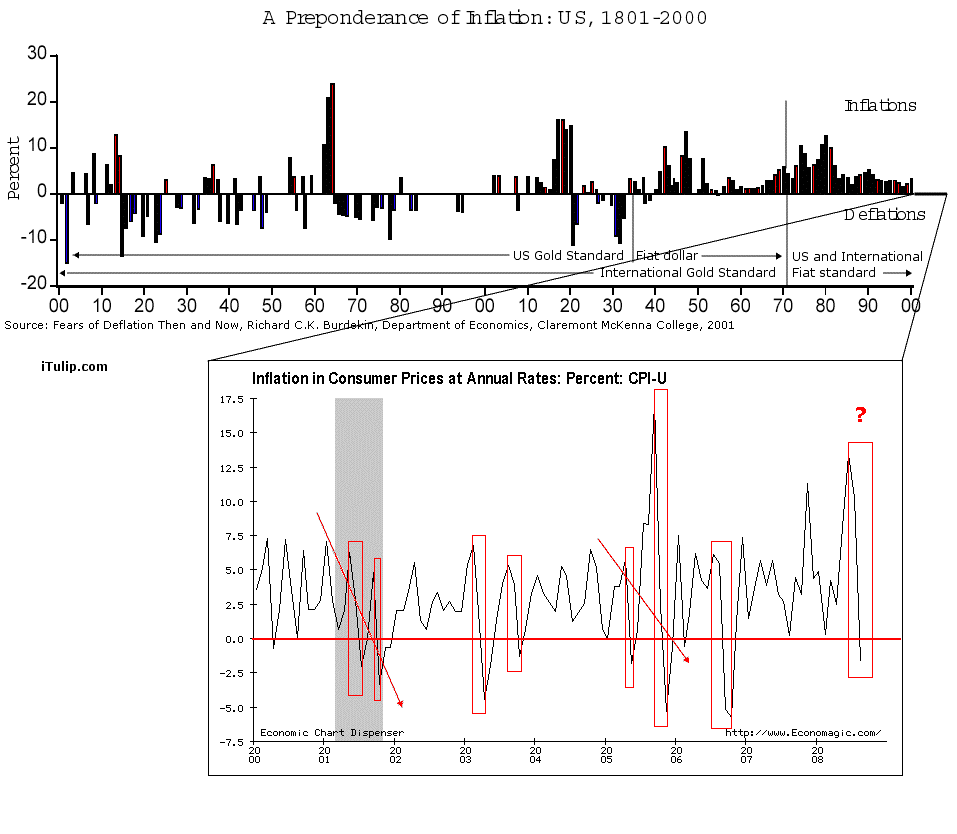
    If we zoom in on various periods show on the chart you will see what appears to be entry into a deflationary period, for example in 2001. AS the article points out, dollar depreciation is the "foolproof way" out of deflation, and as the zero bound tends to cause a reversal of capital inflows to the US, the US economy has a built-in anti-deflation mechanism: foreign debt.

    OK forgive my ignorance here and my possible lack of correct terminology, but I have become a little confused. There seems to be some issue in posts as regards using the terms Deflation and Disinflation. While I feel I have an understanding of Ka Poom and I believe it is an accurate predictive indicator can you please clarify this for me....

    Upon reading Ka Poom http://www.itulip.com/kapoomtheory.htm I note that in the first (top) graph you mention DEFLATION. On the last (bottom) Graph you mention DISINFLATION. Both are followed by POOM, which to me is logical.

    Thus I would summise that it is the exogenous events and their timing that are more important. Of course if a bubble crashes, it should cause a reduction in the rate of inflation (disinflation) which could lead to deflation depending on how serious the event is and how much the fed intervenes to try and stop deflation occuring.

    The other problem I see is the Global side of things. A lower exchange rate is basically importing inflation a higher FX rate is importing Deflation, to a certain limitied extent.

    However in the global economies, if the USD is the primarily reserve currency, the inverse to the US situation would be the case. So USD strong = imported inflation (to a certain extent) everywhere else in the world. So in their case it would be Poom - Ka so to speak. However the exogenous event of FIRE Melt down would obviously switch it back to Ka Poom for them as well

    So to summarise, I presume I am right to say that Poom will follow a period of EITHER DISINFLATION and/or DEFLATION provided the exogenous event(s) that need to happen do happen. Ka Poom primarily is based on the US economy and thus will be more relative there.

    My last query is how will the actions of other Central Banks and economies around the world, have an effect on Ka Poom. I would think that FX rates would be one aspect. In my humble opinion, the USD has taken the place of Gold, as far as Foreign FX exchange rates are concerned. By that I mean that USD is the only thing that their currency can be measured against with any form of relativeness. So that in itself would put this current "Credit" crisis into new and uncharted waters, as against 1929 or 1871. Now we are probably more than ever at the whim and call of emotional, greedy and fear based decisions being made by various countries all trying to look after their own best interests.

    Having been hammered yesterday in AUD, NZD and GBP because everyone wants/needs to buy USD I now have a dilemma, which I will resolve by simply freezing the other currencies and using only our USD reserves, then hopefully releasing the others when the USD begins to fall. If you know when that will happen please let me know.

    So the USD goes up because people need them to settle contracts, pay debt denominated in USD, which in turn could limit the ability of the built in "Anti-Deflation" Mechanism to kick in. So if foreign Economies realise that they have huge exposure to debts, right-offs etc denominated in USD, they will need to keep buying USD which could possibly lead the USD into full blown deflation by default, (Because their purchase of USD would tend to hold up it's value) thus extending the time frame of Ka and worsening the US situation and so on goes the worldwide spiral downwards.

    So I could suggest that maybe one critical factor that possibly might have an effect is the total value of USD denominated Debt, equity, investments etc that may need to be settled in USD currency in the future.

    Thanks in advance. Ohh By the way. The sun came up again this morning, rising from the east, so all is well

    Cheers

    Leave a comment:


  • FRED
    replied
    Re: Still no deflation: Disinflation then lots of inflation

    Originally posted by babbittd View Post
    The freshest Research headline on Barclays Capital website:

    Fed considers further unprecedented measures to provide liquidity, lower Libor

    07 Oct 2008 Julia Coronado - Economics:Global:Analyst Desktop...

    Client login required. I am not a client.

    any guesses?
    Only this:
    Fed pumps billions more into banks

    Central bank doubles to $300 billion the amount it will loan banks. Loans could reach $900 billion by end of year.

    Last Updated: October 6, 2008: 11:55 AM ET

    NEW YORK (CNNMoney.com) -- The Federal Reserve announced Monday that it will increase by hundreds of billions of dollars the money it makes available to the nation's banks.

    The central bank said that its so-called term auction facility, which accepts financial instruments such as mortgage-backed securities as collateral, will be doubled immediately to $300 billion. The total amount available to banks will rise to $600 billion under the moves announced Monday.

    In addition, the Fed signaled it could increase the amount available through those loans to $900 billion by the end of the year, increasing the amount the Fed will loan through the program by $750 billion above its previous limit.

    The moves come in the wake of the passage on Friday of a $700 billion bailout bill that will allow Treasury to buy damaged assets directly from banks and Wall Street firms.

    Experts said the moves by the Fed were an acknowledgement that many of the nation's leading financial institutions may not be able to wait until Treasury sets up its program. It may take weeks or perhaps even months before the Treasury can pump billions into the system itself by buying the damaged assets held on their balance sheets.

    "The crisis in credit markets has become very acute, not just here but in Europe as well," said Lyle Gramley, a former Fed governor who is now an economist with the Stanford Group. "In a situation like this, you have to provide all the liquidity that is needed so that illiquid institutions don't become insolvent institutions." more...

    We do have the latest Barclays (ex-Lehman) reports but can only post them to the Select area. Will do so tomorrow.

    Leave a comment:


  • Slimprofits
    replied
    Re: Still no deflation: Disinflation then lots of inflation

    The freshest Research headline on Barclays Capital website:

    Fed considers further unprecedented measures to provide liquidity, lower Libor

    07 Oct 2008 Julia Coronado - Economics:Global:Analyst Desktop...

    Client login required. I am not a client.

    any guesses?

    Leave a comment:


  • Miamicondoforum
    replied
    Re: Still no deflation: Disinflation then lots of inflation

    Well, even if supply/demand remains in perfect balance(adjusting to lower supply/demand) you have the govt increasing money supply. The most effective means of doing that is with stimulus packages. These act as FORCED loans. So even if the banks won't lend, the government will. Unlike Japan with its 30% savings rate, Americans have 0% or negative savings, so they will not save this stimulus. They will spend it. They will buy food, gas, NASCAR memorabilia, beer, speculate on housing or the market (bubble psychology still intact in my opinion). The govt will likely lend 50-100 billion to the public with the next stimulus package. Well FoMoCo or ConAgra or ADM won't increase hiring or production. Even if they did, it is unlikely they would create so much supply as to keep up with the new money (demand) in the system. So you get more money chasing the previously in balance supply of goods. So demand (money-wise) is up, but supply stays low. You get inflation. Rinse and repeat. By about stimulus package 3 we'll see things like govt guarantees of small business loans so the banks will start lending on top of the stimulus packages. You'll then get insane inflation.

    Leave a comment:


  • Supercilious
    replied
    Re: Still no deflation: Disinflation then lots of inflation

    Originally posted by LargoWinch View Post
    PS: Sorry to $#!, but I could not ask him about El Erian comments regarding "dark matter". I guess I can ask Alan Greenspan when he will be visiting us on Nov. 7... (although I don't care much for Alan).
    No problem LargoWinch, I believe I found out (from one of my sources) what the "dark matter" is. It would have been nice to to get a confirmation from Jim Rogers, but not essential. Still, I appreciate you did not forget about me. Don't bother asking this question when you meet Mr. Greasepan. I doubt he will be able to give a straight answer.

    Leave a comment:


  • Old Mathew
    replied
    Re: Still no deflation: Disinflation then lots of inflation

    Phirang,

    Could you explain how you are in yen? Is it FXY? And can you explain why the yen will appreciate vs the dollar?

    I'm in Gold and cash, short some equities, and have been watching the FXY and FXE etc. But I confess not to understand why the yen will improve, though I understand why the euro might decline in value. Aren't all fiat monies more or less in the same inflationary boat?

    Leave a comment:


  • phirang
    replied
    Re: Still no deflation: Disinflation then lots of inflation

    Originally posted by LargoWinch View Post
    I had a chance to speak with Jim Rogers at a convention in Toronto last Thursday (and obtain my signed copy of a "Bull in China"). Pretty nice guy. No bodyguard nothing, which is quite surprising given the size of the event (500+ attendees).

    Anyway, when asked about the discrepancy between the price of gold on COMEX vs physical bullion, he said "physical dealers have it, but don't want to sell it at a loss", hence creating a shortage of the physical stuff. I find this puzzling; but hey, he "is" the man and I am just Largo.

    He further told me that crude oil is a much better investment than gold due to the supply/demand squeeze and the fact that the Saudis have been lying for the past 30 years about their reserves. In fact, he believes that crude oil is the asset of the future, hands down.

    Jim is also very bullish on China, a lot less on India due to severe infrastructure problems among other things. Jim also loves anything agricultural-related. He told the audience that he bought some agriculture recently (and that the market wanted to sell him a lot more...).

    So the question is: sell gold and overweight crude now that we are under $90/barrel? I am quite affraid of the downside of crude in a slowing economy (I got wacked pretty hard buying natural gas with 2x leverage earlier this summer).

    Oh, I also told him jokingly to go easy on the poor female Bloomberg anchors (this was as per my wife's request).

    PS: Sorry to $#!, but I could not ask him about El Erian comments regarding "dark matter". I guess I can ask Alan Greenspan when he will be visiting us on Nov. 7... (although I don't care much for Alan).

    PPS: EJ: when are you visiting Toronto for a conference?
    There are tankers in the GCC full of oil, sitting there, with no buyers.

    No rush...

    I'm staying in gold/yen/usd until it clears, and then move into a short 1mth/long 10yr.

    edit: I am curious if rogers would have ever gotten anywhere without soros... he has been SO wrong about so much, especially this, "printing money" stuff from the Fed. The fed has been very careful in its operations, and the impact of inflation has been... oh, right!
    Last edited by phirang; October 06, 2008, 03:02 PM.

    Leave a comment:

Working...
X