Announcement

Collapse
No announcement yet.

Deflation vs Inflation debate: Part XXXVI - Final

Collapse
X
 
  • Filter
  • Time
  • Show
Clear All
new posts

  • Guest's Avatar
    Guest replied
    Re: Deflation vs Inflation debate: Part XXXVI - Final

    Originally posted by Jim Nickerson View Post
    I think anything Welling puts out is worth at least perusing
    Their comments on baseline inflation display an astonishing degree of complacency - along with a range of other fruit salad views as to what the actionable trends are. After taking the time to read the article, to come across such comments as "baseline inflation is extremely subdued" tells me I've been patiently reading the opinions of a flake. I don't need flakey opinions on how to protect myself these days. Flakey opinions in dangerous times are hazardous to one's financial health.

    DA-FLATION-BAND.jpg
    Last edited by Contemptuous; June 26, 2008, 03:26 AM.

    Leave a comment:


  • Jim Nickerson
    replied
    Re: Deflation vs Inflation debate: Part XXXVI - Final
    Originally posted by Lukester View Post
    And Jim Nickerson of all people, nodding with agreement that this article provides sage insights? Jim's been one of the most assiduous readers of everything on this website for three years? These two analysts are watching an imploding asset market and concluding the actionable advice to draw from that is to gear one's assets for deflation, and you guys are nodding your heads concluding these are searing and horrifying market insights?
    Luke, when I am just again barely able to find reading your posts tolerable, you fuck up and ascribe to me something you do not have an icecube's chance in hell of knowing one way or the other.

    You often have been guilty of ascribing any number of things to the so-called iTulip community, which I have always thought was dumb for a guy like you that has occasionally quite lucid things to put forth. There is no polled iTulip opinion about anything of which I am aware.

    I think anything Welling puts out is worth at least perusing whether one agrees or not with whatever thesis is advanced. The guy made a nice find, and that was all I said.
    Last edited by Jim Nickerson; June 25, 2008, 12:18 PM.

    Leave a comment:


  • Guest's Avatar
    Guest replied
    Re: Deflation vs Inflation debate: Part XXXVI - Final

    Originally posted by Brooks Gracie View Post
    This is MUCH scarier than the inflation scenario, and I cannot see any logical flaws in the reasoning.. http://bigpicture.typepad.com/commen...er_REPRINT.pdf
    I read the whole piece. If you cannot spot the multiple fallacies as to why their deflationary outcome is the actionable conclusion, I don't know what ypu have gleaned from reading iTulip. Janszen has reviewed ALL of their assumptions regarding the net effect upon inflation / deflation and trashed them. What exactly is it we purport to be reading as a main thesis here anyway?

    "Cannot see any logical flaws"? Eh. :rolleyes: And Jim Nickerson of all people, nodding with agreement that this article provides sage insights? Jim's been one of the most assiduous readers of everything on this website for three years? These two analysts are watching an imploding asset market and concluding the actionable advice to draw from that is to gear one's assets for deflation, and you guys are nodding your heads concluding these are valuable market insights?

    Originally posted by Jim Nickerson View Post
    Nice find, thanks for putting it up.
    QUOTE:

    << I know you’ve been talking about an approaching “Ice Age” for around a decade, but what’s that signify to you now? Albert: James articulates it in a slightly different way, just focusing on cyclically adjusted market valuations being at such extreme levels. But the key thing I’ve been saying is that I still think it’s a world of low inflation. People will be surprised, especially as commodities come back. Core inflation is incredibly low, incredibly well-controlled, considering we just had this phenomenal supposed commodities boom. Core inflation is below 2% in the U.K. and in the eurozone. It’s around 2% in the U.S. >>

    What a load of horse poop.

    Maybe this is why Jim runs "bullish" and "bearish" threads concurrently and updates them almost daily. After three years of constant reading he can't make up his mind whether to gear for inflation or deflation. Read more iTulip, and dispel the fog. You can have ugly, black prospects as far as the eye can see and in our present fiat dollar world the "big trade" is to gear for inflation. Confused? Read yet more iTulip.

    Picture Welling and Weeden predicting global deflation taking hold from the broad hints provided by this chart. Too much time spent watching all the declining asset markets on their Bloomberg terminals perhaps. Oil consumption is a marker for global GDP growth or decline. What's this chart tell us? Where are Welling and Weeden when it comes to flight checking their theories against such data? I wonder if these guys are recommending gold as an essential part of their porfolios, along with the zero coupon bonds.

    HARBINGER OF GLOBAL DEFLATION NOT.gif
    Last edited by Contemptuous; June 25, 2008, 12:17 PM.

    Leave a comment:


  • EJ
    replied
    Re: Deflation vs Inflation debate: Part IVXXX - Final

    Originally posted by phirang View Post
    It is this that bernanke is banking on... the commodity productivity "shocks" will slow down consumption to the point where inflation converges to an upper-bound.

    Inflation is a global problem: the real question is, will wages continue to rise to meet the new price demand?
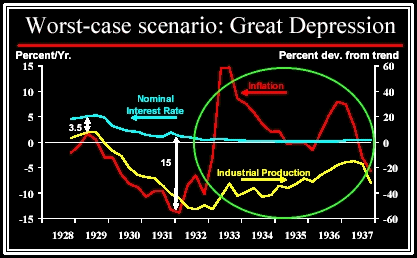
    This is essentially correct. The debt deflation risks of collapsing property bubbles were well known to the Fed years ago. The Fed has since 2002 issued several papers on the topic. In 2006 we borrowed a few charts from one of them, such as the chart below.

    As the credit bubble unwinds, the primary mission of the Bernanke Fed is to do whatever is necessary to prevent a zero bound event as occurred in Japan in the 1990s and in the US in the 1930s.


    Readers may wonder how the spike of inflation in 1933 was accomplished if money is lent into existence and the banking system was barely functioning after thousands of bank failures and bank runs. Where did the spike in the money supply come from to produce this immense inflation? I've asked various folks in the deflationist camp for an explanation but have never gotten one.

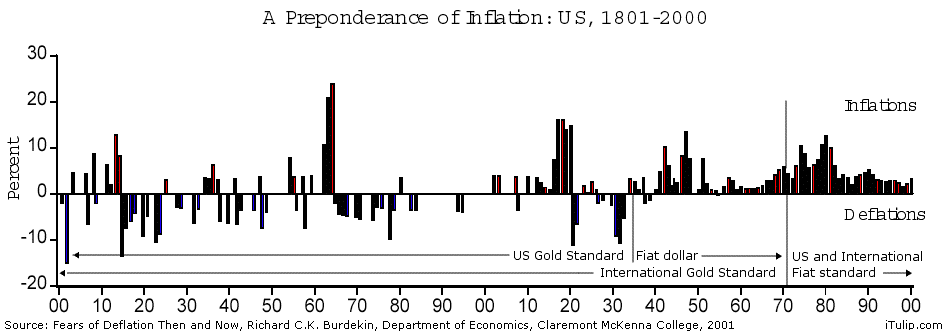
    Anyone worried about deflation needs to ask, How is the value of fiat dollars maintained?


    Periods of deflation in the US were common between 1801 and 1933 when the US was on a gold standard, two minor periods of deflation occurred after 1933 after the US went off the gold standard, and deflation has never occurred since the US unilaterally ended the international gold standard in 1971. In a world of fiat currencies, what exactly are currencies going to inflate against to create deflation?

    By fixating on the US and on the Fed, those who expect deflation are missing the key development in the larger picture today, the growth of global inflation since 2004. The global economy was still US-centric in the 1970s. One way to see the importance of the global inflation picture is to compare the current period to the 1970s.


    Inflation, Fed policy, oil, and the dollar: Five Periods, A through D

    A: Spike in oil imports and oil prices, loose monetary policy, inflation surge, dollar low, economic growth
    B: Final top in oil imports, extremely tight monetary policy, inflation peak, recession, followed by dollar recovery
    C: Bottom in oil imports, leveling off of inflation as Fed ends loose policy following recession and begins to tighten, dollar continues to strengthen
    D: OPEC oil imports back to 1970s levels with non-OPEC volumes to match (not shown), rising oil prices, loose monetary policy, inflation surge, dollar low, economic growth

    Our current Period D is in many ways similar to the late 1970s Period A. It appears to be clear what the Fed needs to do: halt the source of the inflation surge by raising interest rates. However, the world is constantly changing. No two periods are alike.

    The antecedents for this crisis are the collapsing housing bubble and Peak Cheap Oil that is fueling, if you'll excuse the pun, global inflation. The Fed's actions to manage the US debt deflation are exacerbating that problem. Further, in our less US-centric more multilateral economic world, the Fed cannot end the US dollar and inflation crisis by acting unilaterally by raising short term rates drastically as it did in the late 1970s. Not only is the US at the beginning of a long debt deflation cycle and in danger of turning the credit crunch into a full blown banking and credit crisis, but the negative impact of drastic rate hikes on US trade partners' economies, which were politically acceptable in the US-centric world as existed in the late 1970s, are a non-starter today.

    For example, the devastating impact the late 1970s Fed rate hikes had on the Soviet economy was consistent with foreign policy objectives that were accepted by most US allies. The negative impact on Russia of drastic monetary policy actions by the Fed today may be viewed by Russian leadership as hostile, potentially creating a grave political or even military crisis between the US and Russia. The Fed must move carefully. This can be noted in the step function character of the Fed Funds data depicted on the graph: no massive one point rate cuts but rather small increments surrounded by carefully crafted wording.

    Another other error deflationists make, besides denying the existence of inflation today, is to presume that just because long term interest rates are low, inflation must be low, too. The historical data do not bear this out.

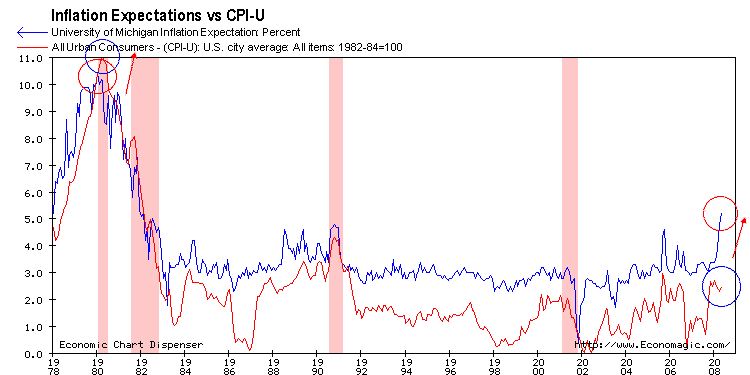
    Where is inflation going? Inflation expectations are a reasonably good leading indicator of future inflation. The data continue to point up. No doubt this has the Fed worried.


    A final point, deflation in Japan is often thought of as continuous since the 1990s. The chart below shows a more complicated picture. Our periods of inflation and disinflation – falling rate of inflation vs negative rate of inflation or deflation – will be equally variable albeit with an inflationary bias.


    Last edited by FRED; June 26, 2008, 01:05 PM.

    Leave a comment:


  • Spartacus
    replied
    Re: Deflation vs Inflation debate: Part IVXXX - Final

    during the last great deflation (the US great depression) the only reason the price of gold rose was because the government forced it to rise by fiat (or IOW, unilaterally revalued he US$ relative to Gold).

    Although Gold might do better than other investments, short dated bonds do much, much, much better than Gold

    Prechter, who based much of his book on US depression research, (and IIRC he claimed in the book he researched several deflations) is consistent in this regard, Mish is not.

    It's funny - Mish suggests "gold will do well in a deflation, and we will have deflation, thus you should buy gold" - is wrong on 2 counts (about inflation/deflation, and about Gold being a good investment in a deflation), but his recommendation has done well.

    Prechter is wrong on 1 count and his recommendations have done much less well (but not poorly - his recommendations of safe bonds have done OK)

    Originally posted by JKD View Post
    On the contrary, I have never understood EJ's problem when it comes to Mish's affinity for gold while also calling for broad money supply contraction. Did gold not just go down for 20 years during a period of constant broad money supply expansion? I don't think I would agree with Mish overall at all (although maybe I do, I am just not that familiar with him and his blog is all over the place), but I've read his explanation of why he recommends gold and I don't see the "internal inconsistency" that seems to get folks hot under the collar around here.
    Last edited by Spartacus; June 25, 2008, 02:24 PM.

    Leave a comment:


  • phirang
    replied
    Re: Deflation vs Inflation debate: Part XXXVI - Final

    Originally posted by Jim Nickerson View Post
    Nice find, thanks for putting it up.
    It accords perfectly with my reasoning and is consistent with both Fed actions and words.

    Leave a comment:


  • Guest's Avatar
    Guest replied
    Re: Deflation vs Inflation debate: Part IVXXX - Final

    Originally posted by JKD View Post
    On the contrary, I have never understood EJ's problem when it comes to Mish's affinity for gold while also calling for broad money supply contraction. Is this just a semantic argument due to EJ graduating from the Austrian School and Mish still carrying his bookbag around campus?? John
    JKD - The notion that monetary degradation and gold are unrelated is ahistorical. All you are getting flummoxed about is that the relationship, although virtually assured by hundreds of examples through thousands of years of history, is subject to potentially long "accumulative effect" lags. But the reason that Mish's notions regarding gold are considered whimsical here is because he abandons the principle established by 5000 years of history - that gold has acted always as the primary policeman of monetary degradation, NOT ever fiat money's ally in times of either a strengthening or weakening fiat currency.

    The disagreement with Mish has to do with his whimsical notion that in an environment of money no longer on a gold standard, a structural strengthening of the dollar can be in our future at this juncture. He waffles. He wants it "both ways". He suggests the value of most assets will fall (is falling?) vs. the dollar (which is manifest nonsense today anywhere beyond credit inflated asset classes) AND that gold will rise vs. most assets WITH the US dollar. If you find this notion plausible I am surprised. Finster has written at length on the lag effects preceding a bull market in inflation hedge assets (gold). It's starts and stops can be misunderstood and attributed via short term limited observation to mean that "gold has no real bearing on inflation", because "all through the inflationary past two decades it did not go up" - which is not just unduly agnostic about gold's millennial function in times of currency distress - it's also in my view ahistorical. History tells the story, and gold is not ever any substantive companion of fiat money particularly after cycles of credit excess. Mish's conclusions on this point are whimsical.

    Leave a comment:


  • Jim Nickerson
    replied
    Re: Deflation vs Inflation debate: Part XXXVI - Final

    Originally posted by Brooks Gracie View Post
    This is MUCH scarier than the inflation scenario, and I cannot see any logical flaws in the
    reasoning..
    http://bigpicture.typepad.com/commen...er_REPRINT.pdf

    Nice find, thanks for putting it up.

    Leave a comment:


  • Brooks Gracie
    replied
    Re: Deflation vs Inflation debate: Part XXXVI - Final

    This is MUCH scarier than the inflation scenario, and I cannot see any logical flaws in the
    reasoning..
    http://bigpicture.typepad.com/commen...er_REPRINT.pdf

    Leave a comment:


  • JKD
    replied
    Re: Deflation vs Inflation debate: Part IVXXX - Final

    Originally posted by zenith191 View Post
    Absolutely hilarious! Particularly like this reference to Mish's affinity for gold.

    LL

    On the contrary, I have never understood EJ's problem when it comes to Mish's affinity for gold while also calling for broad money supply contraction. Did gold not just go down for 20 years during a period of constant broad money supply expansion? I don't think I would agree with Mish overall at all (although maybe I do, I am just not that familiar with him and his blog is all over the place), but I've read his explanation of why he recommends gold and I don't see the "internal inconsistency" that seems to get folks hot under the collar around here.

    Prices of different things go up and down for very different reasons, especially over relatively short periods of time, that have nothing to do with broad money supply. There are a multitude of possible explanations as to why gold went down despite broad money supply expanion between 1980 and 2000. Central Bank policy to divest, psychological perception of gold as money waned, the reference starting rate was too high (use 1970 as the starting date and see how the analysis changes), etc.

    But to say "hey, credit contraction is going to bring money supply down over the coming years but gold will likely continue higher due to... -insert any number of possibilities here-..." seems perfectly logical to me, so long as the 'possibilities' are plausible, which I think they are. Maybe...

    - massive Central Bank accumulation
    - psychological perception to hold gold increases amongst the public
    - mining of new supplies severely constricted by higher energy costs (themselves the result of significant drop in easily accessible oil supply)

    I am not claiming to agree with this argument, I just had to throw in my 2¢ in after seeing repeated instances of this 'internal inconsistency' snark. Is this just a semantic argument due to EJ graduating from the Austrian School and Mish still carrying his bookbag around campus??

    John

    Leave a comment:


  • phirang
    replied
    Re: Deflation vs Inflation debate: Part IVXXX - Final

    Originally posted by rdgmail View Post
    Eric:

    Many thanks for the comic relief and thought-provoking analysis. Comment and questions for you (and all Itulipers):

    First, I'm not Roman, but is it IVXXX or XXXIV?

    Second, I'm also not an economist, but is it possible, despite negative real interest rates set by the Federal Reserve, that massive nationwide house deflation (nominal prices), which causes massive write downs of RMBS, which causes forced sales of such securities, which causes further write-downs and sales, which causes more than one major US bank failure, which causes a 1991 Nikkei style decline of the S&P 500, all of which cause a sufficient shock to the US economy and extreme recession that the asset, credit and debt deflation spread to the commodities, food markets and other currently inflationary markets and thereby create a general decline in prices, i.e., price deflation? (sorry for the run-on sentence.)

    In short, one difference between the inflation and deflation argument seems to be that deflationists believe the Fed and our federal government, despite keeping real interest rates negative, will not succeed in adding credit and liquidity to the monetary base and reflate the economy because the crashing housing market and related asset crashes and bank failures (or balance sheet decline and associated inability to supply credit) will totally overwhelm any attempt to keep general prices positive.

    If anyone can comment, a non-Roman, non-economist would like to know your thoughts. Thanks.
    It is this that bernanke is banking on... the commodity productivity "shocks" will slow down consumption to the point where inflation converges to an upper-bound.

    Inflation is a global problem: the real question is, will wages continue to rise to meet the new price demand?

    Leave a comment:


  • Guest's Avatar
    Guest replied
    Re: Deflation vs Inflation debate: Part IVXXX - Final

    Originally posted by metalman View Post
    ... turns turtle ... inflation over 5 - 7 years forecast ... 13% 2011 < mish and rick finally give up ... .
    In your dreams they finally give up. Ever heard of the Energizer Bunny? [ pink rabbit wearing sunglasses, banging the deflation drum? ... ]
    Last edited by Contemptuous; June 24, 2008, 11:15 PM.

    Leave a comment:


  • zenith191
    replied
    Re: Deflation vs Inflation debate: Part IVXXX - Final

    Originally posted by EJ View Post
    Mish: Floods are a rain phenomena.
    Eric: Hey, Mike. Surprised to see you out here. You're wearing waders. Good thinking. You've been recommending waders to your readers for years, even though you've been calling for a drought.
    Absolutely hilarious! Particularly like this reference to Mish's affinity for gold.

    LL
    Last edited by zenith191; June 24, 2008, 10:51 PM.

    Leave a comment:


  • rdgmail
    replied
    Re: Deflation vs Inflation debate: Part IVXXX - Final

    Eric:

    Many thanks for the comic relief and thought-provoking analysis. Comment and questions for you (and all Itulipers):

    First, I'm not Roman, but is it IVXXX or XXXIV?

    Second, I'm also not an economist, but is it possible, despite negative real interest rates set by the Federal Reserve, that massive nationwide house deflation (nominal prices), which causes massive write downs of RMBS, which causes forced sales of such securities, which causes further write-downs and sales, which causes more than one major US bank failure, which causes a 1991 Nikkei style decline of the S&P 500, all of which cause a sufficient shock to the US economy and extreme recession that the asset, credit and debt deflation spread to the commodities, food markets and other currently inflationary markets and thereby create a general decline in prices, i.e., price deflation? (sorry for the run-on sentence.)

    In short, one difference between the inflation and deflation argument seems to be that deflationists believe the Fed and our federal government, despite keeping real interest rates negative, will not succeed in adding credit and liquidity to the monetary base and reflate the economy because the crashing housing market and related asset crashes and bank failures (or balance sheet decline and associated inability to supply credit) will totally overwhelm any attempt to keep general prices positive.

    If anyone can comment, a non-Roman, non-economist would like to know your thoughts. Thanks.

    Leave a comment:


  • metalman
    replied
    Re: Deflation vs Inflation debate: Part IVXXX - Final

    Originally posted by akrowne View Post
    And as per my debates with Mish, predictably, vendors who are refusing to raise prices are cutting into their margins deeply, going out of business, or are about to. Exxon and Venezuela getting out of the gas station business were big ones that elicited almost no reaction.

    Those who won't raise prices to cover increased inputs will get slaughtered. Any consumer price "deflation", spotty at best, will be transient.
    the argentina graph shows inflation spiking the same year gdp turns turtle. for the usa that means gold spikes while gdp turns negative. it's a matter of degree. not sure about the 100% inflation over 5 - 7 years forecast. what about more of the same?

    2% 2003
    3% 2004
    4% 2005
    5% 2006
    6% 2007
    7% 2008
    9% 2009
    11% 2010
    13% 2011 < mish and rick finally give up
    15% 2012
    17% 2013

    etc. etc. frog heated slowly in a pot of water.

    don't forget the moral of that tale... the frog dies.

    Leave a comment:

Working...
X