Announcement

Collapse
No announcement yet.

Deflation vs Inflation debate: Part XXXVI - Final

Collapse
X
 
  • Filter
  • Time
  • Show
Clear All
new posts

  • FRED
    replied
    Re: Deflation vs Inflation debate: Part XXXVI - Final

    Originally posted by jacobdcoates View Post
    Forgive for me for being a bit confused about weather we are going to have a deflation or inflation.


    But i think this is where mish is coming from

    money=debt
    debt=deflating
    _______________________
    money=deflating

    more formally

    A=B
    B=C
    ___
    A=C


    if inflation is to happen then one of the premises must be incorrect. Either money does not equal debt or a debt deflation must not actually be happening. if a debt deflation is not happening then where is all the new debt being created at a rate to exceed the destruction of current debts?


    P.S. sorry if it is confusing but I've had a bit of wine tonight.
    Two reasons we've given up arguing with Mish. One, when we point him to any standard definition of any term used in economics, he rejects it and insists on inventing and using his own. The result is like playing a game with Calvin of Calvin and Hobbs where the rules change constantly during the game. Two, he sees only two variables that determine inflation, money supply and demand, and ignores the other two variables, goods supply and demand.

    For background, we recommend two articles on the subject by Mike Moffatt at About.com.

    Cost-Push Inflation vs. Demand-Pull Inflation
    What is deflation and how can it be prevented?

    There are four variables at work that determine inflation rates:

    1. The supply of money
    2. The supply of other goods
    3. Demand for money
    4. Demand for goods

    Below we offer the simple case of an economy growing in balance with 100 units each of goods supply/demand and money supply/demand resulting in an inflation rate of 3.3%.

    Our model is designed to show the relationship between changes in the four factors of inflation, not the actual extent of changes in inflation relative to the factors within the US economy during economic contraction. In other words, a 10% increase in the broad money supply in the model may cause inflation to rise more or less than 0.4%. The actual extent of inflation responses to inflation factors depends on many factors of the US economy and monetary system that are too complex for our super simple model.

    We break our scenarios up into two series: Growth Cases and Contraction Steps.

    Four Growth Cases, we demonstrate the relationship between the four variables by increasing one while holding the others constant.

    Growth Case 1: Raising goods supply causes inflation to fall

    Growth Case 2: Raising goods demand causes inflation to rise

    Growth Case 3: Raising money supply causes inflation to rise

    Growth Case 4: Raising money demand causes inflation to fall
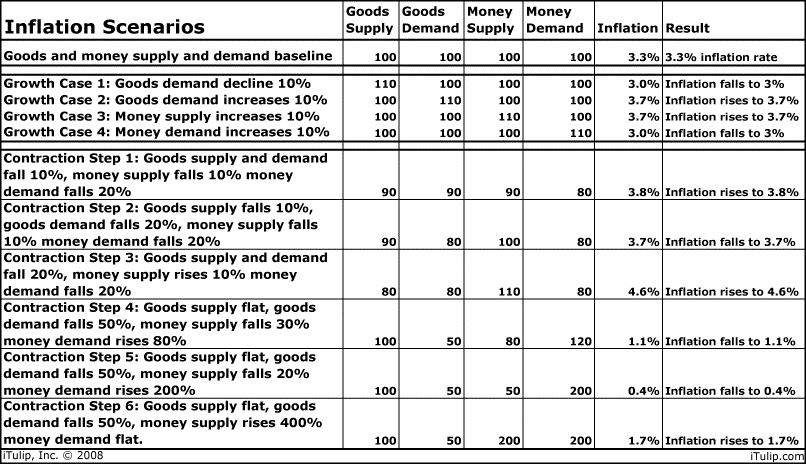


    Walking through the Contraction Steps, we start with both goods supply and demand, and money supply falling equally as money demand falls even more. The result is a moderate increase in inflation.

    Step 5 is the circumstance of very high goods supply (over-capacity) combined with a severe 50% decline in demand, a severe 50% decline in the money supply, and a doubling in demand for money. The result is that inflation falls to 1.1%. In real life, of course, such drastic reductions in goods demand and the money supply will likely have a much more severe impact on inflation. Again, the idea is to show the relationships.

    For a real life example, when we last interviewed Jim Rogers a few months ago when oil was at $100, we asked him why falling demand was not going to push down prices. He replied, "You are assuming that producers are going to maintain supply. They will cut supply to maintain prices, and that will continue to drive inflation for the US or any country tied to the dollar. They are not going to exchange precious oil for weak dollars."
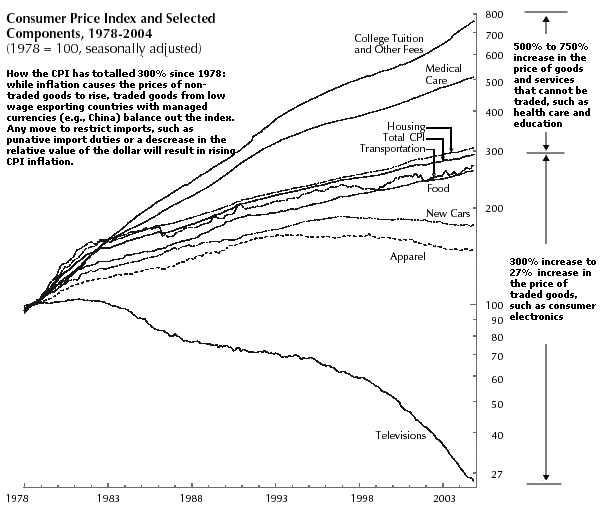

    Relationship among prices of imported and non-imported goods and services.

    What happens as the dollar weakens and the dollar price of US imports rises? Think back to when TVs and apparel were more expensive. What did we do? We bought fewer of them, that's what. Life goes on.

    On the weak dollar, just because we are willing to pay each other $230,000 for a house that was thrown together in a few days doesn't mean a European is willing to pay as much. In fact, they are paying about $120,000. When it comes to oil, we don't get to decide how much the oil costs in dollars, the suppliers do.

    Leave a comment:


  • jacobdcoates
    replied
    Re: Deflation vs Inflation debate: Part XXXVI - Final

    Forgive for me for being a bit confused about weather we are going to have a deflation or inflation.


    But i think this is where mish is coming from

    money=debt
    debt=deflating
    _______________________
    money=deflating

    more formally

    A=B
    B=C
    ___
    A=C


    if inflation is to happen then one of the premises must be incorrect. Either money does not equal debt or a debt deflation must not actually be happening. if a debt deflation is not happening then where is all the new debt being created at a rate to exceed the destruction of current debts?


    P.S. sorry if it is confusing but I've had a bit of wine tonight.

    Leave a comment:


  • Slimprofits
    replied
    Re: Deflation vs Inflation debate: Part IVXXX - Final

    Originally posted by EJ View Post
    4) Commodity price inflation is a leading indicator of future wage inflation. A few months ago we posted the Fed's research that demonstrates this. If this inflation goes on long enough, rising wage inflation is an eventuality. As this is a global inflation, we will see global wage inflation.
    JPMorgan - Daily Economic Briefing - June 24, 2008:

    Today’s EM activity reports also brought more scattered signs of a wage/price acceleration. In Thailand, manufacturing wages shot up 17%oya in 1Q08, far above the rate of inflation and productivity growth. In Russia, May wages rose 31.8%oya, more than double the rate of inflation.

    Leave a comment:


  • Slimprofits
    replied
    Re: Deflation vs Inflation debate: Part XXXVI - Final

    Ok, so the price of milk and vegetables have doubled (or whatever).
    This Mish is an arrogant SOB.

    Leave a comment:


  • Guest's Avatar
    Guest replied
    Re: Deflation vs Inflation debate: Part XXXVI - Final

    OK, I'm just posting this to drive EJ a little batty. ... Just when he thought it was over, it wasn't over. ... Lots (and lots) of analysis about the housing debacle - little analysis buttressing the origins and definitions of inflation.

    QUOTE:

    << Ok, so the price of milk and vegetables have doubled (or whatever). That is irrelevant in comparison to the mammoth destruction of "perceived wealth" in houses. Home prices in many areas have fallen by a third or even a half. Some condos have no bid at all. >>

    << Historically, there are times gold does well: Hyperinflationary times and Deflationary times. Gold does poorly under more normal conditions, and gets hammered in disinflationary conditions, a falling but positive rate of inflation. If gold is signaling anything right now, it is the further destruction of fiat credit (deflation) as we move from disinflationary conditions to deflationary ones. >>

    << Gold was up big today. Some look at gold as a sign of inflation, some as an inflation hedge. The reality is that it is neither >> [ :eek: ]

    << The big hit is coming when those "A" tranches get downgraded. Expect more credit writedowns. Lots more. What's happening is not inflationary in any way, shape, or form. >>

    << Inflation in China is indeed rampant. Just so that it is clear, I am talking about monetary inflation. Monetary inflation is really the only kind, but confusion keeps cropping up so I spell it out. China is printing Renminbi to buy US dollars. >> [ :eek: ]

    And from a linked article:

    << Right now, China, India, Brazil and other countries are on a different credit cycle than the US. Growth in China is providing huge strength in the commodities sector. In addition, horrid economic policies in the US are weakening the dollar. Those two factors are causing those who don't know what inflation is to scream inflation or stagflation. The real wackos are screaming hyperinflation. They are all mistaken. We are in deflation now. Most do not see it because they do not know what it is. >>

    [ Doubtless a voice of sanity in the wilderness. :rolleyes: ]


    _______________


    Is the Inflation Scare Over Yet? - Mike Shedlock

    Treasuries have been on a bit of a rally recently as the Lehman iShares 20+ year duration treasury fund (TLT) chart shows.

    The recent downtrend line has been broken. Is the inflation scare over? That is hard to say. It’s much easier to say that it should be.

    Destruction of credit via massive writedowns in banks and financials, accompanied by sharply rising unemployment rates, falling wages, and curtailment in credit lines everywhere is simply not an inflationary environment.

    Of course, this all starts with a proper definition of inflation. In Austrian economic terms, inflation is an expansion of money and credit. Money is not expanding and neither is credit. There is an illusion that they are as discussed in Bank Credit Is Contracting.

    We have reached Peak Credit, a once in a lifetime event.

    Those focused on the CPI, M3, and other such measures are completely missing the boat. Yes, the CPI is understated (at least on the surface). However, those using CPI data to short treasuries over the past few years have had their heads handed to them. OK there was a selloff from March to June, but seasonally this is an expected event. April and May are typically the worst months (tax season).

    A warning shot was fired at the treasury bears today as circled above. Will they heed the warning?

    Credit Deflation

    Some choose to call what is happening "credit deflation." In this regard "credit" is an unnecessary label. Deflation is about the contraction in money supply and credit. The conditions now are very similar to what happened in 1929. The primary difference is that prices of many goods and services (notably energy and food) have been rising.

    There are several reasons for this.
    • China and India are on a different credit cycle than the US.
    • Inflation in China is indeed rampant. Just so that it is clear, I am talking about monetary inflation. Monetary inflation is really the only kind, but confusion keeps cropping up so I spell it out. China is printing Renminbi to buy US dollars.
    • The US dollar is falling because of budget monstrosities by this administration and both parties in Congress.
    Fiscal conservatives are rare. In fact, other than Ron Paul, I cannot name one. So a weak dollar policy by this Administration coupled with inflation elsewhere is masking the actual deflation in the US (for those incorrectly fixated on prices).

    Ok, so the price of milk and vegetables have doubled (or whatever). That is irrelevant in comparison to the mammoth destruction of "perceived wealth" in houses. Home prices in many areas have fallen by a third or even a half. Some condos have no bid at all.

    Rapidly rising housing prices were massively understated in the CPI on the way up and are massively overstating CPI inflation now.

    Those focused on the CPI failed to see any chance of the Fed Fund's Rate at 2.00 again. On the other hand, those focused on the destruction of credit from an Austrian economic perspective got this correct. That is just one reason why it makes more sense to watch the credit markets than the CPI. The second is the CPI is so distorted it is useless.

    In my opinion, it is very likely new all time lows in the 10-year treasury yield and 30-year long bond are coming up.

    More Credit Writeoff Coming

    The worst in credit writeoffs lies ahead. I was laughing that the pundits on Bloomberg yesterday talking about the breakup value of some of the banks. Value? There is no value in most of them. There is heaps of debt that will be defaulted on.

    Banks like Washington Mutual (WM) and Wachovia (WB) are enormously overloaded with Pay Option Arms (i.e. the liar loans). Most of these loans were rated "Alt-A," a step above subprime (at least in theory). Massive problems are surfacing big time in those liar loans.

    The Housing Wire is reporting Alt-A Performance Gets Much Worse in May.
    A new report released by Clayton Fixed Income Services, Inc. on Wednesday afternoon found that 60+ day delinquency percentages and roll rates increased in every vintage during May among Alt-A loans, while cure rates have declined only for 2003 and 2007 vintages.

    The picture being painted for Alt-A is increasingly beginning to look a whole lot like subprime, as a result, even if peaking resets in the loan class aren’t expected until the middle of next year. In particular, loss severity continues to ratchet upward — a trend that portends some likely further reassessment of rating models at each of the major credit rating agencies, as they catch up with the data.

    Those numbers make Standard & Poor’s Ratings Services latest assumption of 35 percent loss severity on Alt-A loans, only one month old, already start to look a little too conservative.

    Bring On The Alt-A Downgrades

    I have been following one Alt-A pool, WMALT 2007-0C1, since January. Every month the defaults rise. Chris Puplava has helped out by providing some of the charts. Thanks Chris! The most recent discussion of WMALT 2007-0C1 was Bring On The Alt-A Downgrades.

    I have some new charts today that highlight how far behind the curve Moody's is. The new charts are from "CZ" at a global fixed income management firm.

    Admittedly this is just one pool, but it seems to be indicative of what Housing Wire is saying.

    First let's start with the most recent snapshot of the pool.

    Facts and Figures
    • The original pool size adding up the tranches below is $519.159M
    • 92.6% of this cesspool was rated AAA.
    • 22.89% of the whole pool is in foreclosure or REO status after 1 year.
    • 31.17% of the pool is 60 days delinquent or worse
    I now have a tranche list and a breakdown, by tranche of the current ratings.


    Tranche List

    [ picture missing ]

    The tranche breakdown shows total deal size. Total size is 519.159M, "A" Tranches are 476.069M total, "M" Tranches are 30.112M total, "B" tranches 7.788M total and "C" tranche is 5.19M total

    Let's look at the rating of tranche A1.

    Tranche A1

    [ picture missing ]

    In the upper right you see the current S&P rating is AAA and Moody's is Aaa. Those are the top ratings. However, every one of the 5 "A" tranches (A1, A2, A3, A4, A5) is still rated AAA and Aaa by the rating agencies. (screens not shown)

    The M1 tranche and below (10 tranches in all) have all been downgraded to BBB or below.

    Cesspool Math

    The top 5 tranches constitute $476.069M out of an original pool size of 519.159M. In other words, 91.7% of this entire mess is still rated AAA.

    Look at the first chart again. 31.17% of this cesspool is 60+ days delinquent, 15.12% is in foreclosure, and 7.77% of this pool is in REO status.

    The Big Hit Is Coming

    Here is the key stat: 15.17% foreclosed and 91.7% is still rated AAA or Aaa by Moody’s and the S&P. If this is indicative of what is happening in other pools, and I suspect it is, the number of tranches downgraded by Moody's is a very misleading indicator. Have Moody's and the S&P have been downgrading the lower rated tranches, (higher in number but way lower in volume), while ignoring the big problem? It sure looks like it.

    The big hit is coming when those "A" tranches get downgraded. Expect more credit writedowns. Lots more. What's happening is not inflationary in any way, shape, or form.

    Gold Up

    Gold was up big today. Some look at gold as a sign of inflation, some as an inflation hedge. The reality is that it is neither, except perhaps in the extreme long term. There was positive inflation from 1980 to 2000, yet gold fell from 800 to 250. As an inflation hedge, it would have been hard to pick a worse one! And if gold is rising because of inflation now, why was it falling for 20 years when there clearly was inflation all the way? Let's look closer.

    Historically, there are times gold does well: Hyperinflationary times and Deflationary times. Gold does poorly under more normal conditions, and gets hammered in disinflationary conditions, a falling but positive rate of inflation.

    If gold is signaling anything right now, it is the further destruction of fiat credit (deflation) as we move from disinflationary conditions to deflationary ones.

    Gold rose in the great depression, and it is poised to do so again. Recent action (the last several years) in gold is very consistent with deflationary theory about the destruction of credit. Gold, unlike fiat, is no one else's liability. Money with that attribute (and gold is money), should rise under these conditions.

    Trendline Break On The Dow

    [ picture missing ]

    The long term trendline headed all the way back to 1982 is busted. This is not an event to dismiss lightly. Not only did the Dow break it's long term trendline, it broke its yearly low, and shorter term trendlines as well.

    [ picture missing ]

    The close today in the markets can only be described as ugly. This is not a crash call, but please remember: Crashes occur in oversold conditions not overbought ones.
    Last edited by Contemptuous; June 27, 2008, 01:19 AM.

    Leave a comment:


  • c1ue
    replied
    Re: Deflation vs Inflation debate: Part XXXVI - Final

    Originally posted by rros
    I think this timeline isn't precise...

    Hyperinflation in Argentina happened during 1989 while Alfonsin was still in the government (lived through this). Just like 74/75's high inflation it could be argued that it was the result of a political crisis -as opposed to a strict monetary event-. The peg was instituted in 1991 by the government of Carlos Menem (Cavallo and his "Plan de Convertibilidad") and lasted 11 years. It actually created an artificial appreciation of the peso and removing it in 2002 restored the balance (devaluation). The first effect was deflation because of the severe recession and huge growth in unemployment, all the while there was massive transfer of resources to agribusiness. It is now that we have again the threat of very high inflation due to excessive printing by the BCRA. On my February trip, I could still stretch my dollars. On my most recent trip (now) this isn't happening anymore
    RR,

    You are correct. It could be argued that the seeds of the 2000 hyperinflation were sowed in 1945.

    There were definitely a series of hyperinflationary cycles in Argentina, but the last one was different - which is what I am pointing out.

    The previous cycles were temporary austerity measures followed by money printing due to poor government spending policies; the last one was largely an externally caused event (dollar peg forcing local currency to uncompetitive levels).

    Leave a comment:


  • Guest's Avatar
    Guest replied
    Re: Deflation vs Inflation debate: Part XXXVI - Final

    Jim - must have taken some effort to compose all of this stuff. Appreciate all the thought that went into it. Where the "personal family matters" factor into all of this is beyond me. Sounds like just a shuffling attempt at muckraking instead, along with which you manage to be shrill and vulgar. But I've got a thick skin so have at it. I'm still at work. It's late, and I'm tired. All I have ambition for is a cold beer and a peek at the international news headlines when I get home. I just don't have anything to say to all of your meanderings here.

    When petroleum goes to $300 a barrel, which it will with a good degree of probability, (and well within a decade, not two decades) we are probably looking at some inflation that will feel hotter than 2.00 pm in August standing in the middle of the Saudi empty quarter. Putting two and two together here is a matter of choice - not any longer a matter of being astute.

    The inflationary gale of $300 oil has a good chance of blowing you, your computer monitor, your notepad with all your carefully logged trades in progress, and your entire trailer home from Fort Worth half way to the Dakotas, and you'll probably still be strapped into your computer chair, glued to your monitor, tabulating your fractional returns from 50 positions in a stock market that just got vaporized.

    Leave a comment:


  • Jim Nickerson
    replied
    Re: Deflation vs Inflation debate: Part XXXVI - Final

    Originally posted by Lukester View Post
    I read the whole piece. If you cannot spot the multiple fallacies as to why their deflationary outcome is the actionable conclusion, I don't know what ypu have gleaned from reading iTulip. Janszen has reviewed ALL of their assumptions regarding the net effect upon inflation / deflation and trashed them. What exactly is it we purport to be reading as a main thesis here anyway?

    "Cannot see any logical flaws"? Eh. :rolleyes: And Jim Nickerson of all people, nodding with agreement that this article provides sage insights? Jim's been one of the most assiduous readers of everything on this website for three years? These two analysts are watching an imploding asset market and concluding the actionable advice to draw from that is to gear one's assets for deflation, and you guys are nodding your heads concluding these are valuable market insights?

    QUOTE:

    << I know you’ve been talking about an approaching “Ice Age” for around a decade, but what’s that signify to you now? Albert: James articulates it in a slightly different way, just focusing on cyclically adjusted market valuations being at such extreme levels. But the key thing I’ve been saying is that I still think it’s a world of low inflation. People will be surprised, especially as commodities come back. Core inflation is incredibly low, incredibly well-controlled, considering we just had this phenomenal supposed commodities boom. Core inflation is below 2% in the U.K. and in the eurozone. It’s around 2% in the U.S. >>

    What a load of horse poop.

    Maybe this is why Jim runs "bullish" and "bearish" threads concurrently and updates them almost daily. After three years of constant reading he can't make up his mind whether to gear for inflation or deflation. Read more iTulip, and dispel the fog. You can have ugly, black prospects as far as the eye can see and in our present fiat dollar world the "big trade" is to gear for inflation. Confused? Read yet more iTulip.

    Picture Welling and Weeden predicting global deflation taking hold from the broad hints provided by this chart. Too much time spent watching all the declining asset markets on their Bloomberg terminals perhaps. Oil consumption is a marker for global GDP growth or decline. What's this chart tell us? Where are Welling and Weeden when it comes to flight checking their theories against such data? I wonder if these guys are recommending gold as an essential part of their porfolios, along with the zero coupon bonds.

    [ATTACH]417[/ATTACH]
    Luke,

    I thought this post of yours and the following one with the four iterations of the deflationizer bunny were a bit of an over-reaction to the reference of Kate Welling's interview with Edwards and Montier in which the word deflation was mentioned only twice in the 14-page document.

    The first mention was put forth with three "if's." Albert Montier: "If we get a deep recession and the oil price buckles it way back to $60, even with food inflation still where it is, I calculate that produces zero headline inflation in the U.K. And it would work out about the same in the U.S. Now, what no one else really is saying is, “Hang on, if all this is a bubble and the bubble has burst, we could get a real flip over back to deflation worries if headline inflation collapses. Again, we’ve got a minority view on that, but markets do flip flop." [JN emphasis]

    In the other reference James Edwards puts forth a scenario advanced by a former colleage at Dresdner Kleinwort, Peter Tasker; "..suggested that if push comes to shove, the flexible nature of the U.S. economy could produce an economic death spiral where consumption goes through the floor, profits go through the floor, and it’s very difficult to turn it around. That’s why the deflation argument in the U.S., which seems incomprehensible at this point, could become a very real reality in 6-12 months’ time. So being “flexible” doesn’t always produce a desirable outcome." Notice in the underlined sentence, "could" was used to reference the possibility of deflation.

    None of this deflation talk in that article got me the least bit worked up, whereas these guys who appear to have at least 40 years experience between them "in the rarified top echelons of the investment banking world, for many years with Dresdner Kleinwort and more recently at Societe Generale (where they are co-heads of global cross asset strategy)" put forth other opinions that importantly seem to support what may lay ahead for the US and the global markets.

    They opined that decoupling between US and emerging markets seems unlikely: (Albert Edwards) "..not only have the emerging markets not decoupled, but they’ll get this double-whammy. Export growth will slow dramatically and they’ll suffer liquidity effects on top of that. So people will be astounded how much the emerging markets slow down over the next 12 months."

    They also join Das and Hussman (both of whom from my low economic level of understanding are highly credible) in declaring: (James Montier) "
    The bottom line is I don’t buy the whole “the worst is behind us” thing. Economic reality, which is definitely more Albert’s bailiwick than mine, says that the recession has barely begun, and yet everybody’s pretending it’s over. What we’ve seen is just the first wave of the market crisis hit; we’ve very probably got an economic recession that will undermine people’s confidence yet again still to come."

    Edwards also puts forth his opinion about a deep recession: "In the U.S., it has been so long [since a deep recession] that people just are not even thinking. I am not saying they have to make a deep recession their central case, but they should at least concede there’s a 20%-30% chance of one. Granted, it is my central case, but it amuses me that people just aren’t even considering the possibility."

    Edwards again: "And if you go back to the ’50s and ’60s, the whole market used to yield a lot more than bonds, not just a few stocks. I think that’s what we’re going back to. But mine is very much a minority view. So what we’re saying to clients is to just hang on. Don’t expect a bear market in a recession to be just 20% or 30% because of multiple expansion. You could get, in a deep downturn, market declines on the order of 50% to 75%, because you get the fall in profits and you get P/Es coming down. That’s how, mathematically, you can get to a seismic fall in the markets in the event of a decent recession. Nothing I’ve seen yet disproves that theory. Sure, the bulls also could still be right; maybe P/Es will expand to 18 times if bond yields come down to 2.5%. But that’s just their postulation. They argue multiples won’t contract again like they did in 2000-2003, because equities were ridiculously expensive then and the decoupling between bonds and equities was a one-off event. We’re just saying that maybe it wasn’t. And if so, watch out."

    It was a decent interview with, I presume, credible guys. Now if a home-schooled, self-educated-in-economics software geek thinks these guy's opinions are bullshit, that's fine with me, but I would caution readers to be careful if they tend to think all the deep knowledge of the investment world rest with contributors here on iTulip.

    I wondered for a while this afternoon, "Why did Luke get so perplexed over this Welling interview and so focused on the bit about deflation."

    Then from my poor recollection I recalled one of ole Luke's apparent moments of sharing:
    Originally posted by Lukester View Post
    I did a lot of careful homework, especially about what was breaking on the energy front, which comes about as close to an assured two decade trend as anything we've seen in investment themes for the past 100 years. I put two and two together and understood you can't have soaring real energy prices without sharply ramping inflation. And that this trend was permanent going forward. So I took all that money and put it into gold, silver and energy stocks (lots of uranium stocks but also stocks like Petrobras, Statoil, Petrochina and Schlumberger). Then I sold every last stock I owned last summer, and doubled down on metals. With these simple moves, I've doubled that windfall. I figure in the course of the next four to five years, it'll at least double again. It may not be a fancy retirement, and maybe it's only a double - in what will be a highly inflationary world by then - but I'm glad for whatever I can accomplish.
    If you were telling the truth, and if I understand English, Fool, you have all your eggs in one basket. You must have missed some of the lessons within these fora about allocation. You sole bet is on one thing: inflation. You better be right. No one who is wise that I know has all his eggs in a single basket. If ranting against a mere mention of deflation makes you feel better with your PM allocation then have at it.

    It really isn't so civil of me to reference you as a "fool," but perhaps that is appropriate in view of what you wrote
    Originally posted by Lukster,38721
    My mother and father passed away and left me precisely zip, although they left a three quarter million dollar home in San Francisco to my sister. Don't ask me why, as I don't know, and I stopped caring.
    If you have all your eggs in one investment basket, and the people who probably knew you best, your parents, chose to disinherit you, then I surmise they must have long known your bent for being foolish and chose not to subsidize you with willing even half of a three quarter million home to you. That you couldn't figure that out doesn't at all surprise me. It takes something special for people to recognize and speak of their own short-comings.

    Luke, I think you must have a cockleburr on the butt-cord of your Victoria Secrets thongs-for-real-men to get off of your little tirade about the bullish and bearish threads I started especially when they have nothing to do with the discussion at hand. Those threads were begun as a chronicle of what various people have thought along the way as we go through the continuing evolution of the markets' meanderings. I find it interesting to be able to look back and see what some "pundits" were opining at various points in the past about what might be ahead. There is a story too of much of this in all of iTulip's threads, but they are so jumbled that no one I know would ever attempt to sort them out chronologically.

    Those threads I started suffer because it has been mainly my input that has added to them, and I am sure the inputs are influenced by my biases in some manner and constrained by the time I have to put opinions into them. If you find them of no value, no one's holding a gun to your head to have to read them. On the other hand if you see any value to looking back on what was thought, you should put up some good articles in either or both of them.

    My investment dicisions are not guided entirely by those things I have put into those threads, but sometimes I am influenced by what I read as put forth by people to whom I attribute greater knowledge than my own.
    Last edited by Jim Nickerson; June 26, 2008, 01:12 AM.

    Leave a comment:


  • rros
    replied
    Re: Deflation vs Inflation debate: Part XXXVI - Final

    Originally posted by c1ue View Post
    The final inflation occurred when Argentina finally gave up the ghost and removed the currency peg.

    So there was hyperinflation, but not for the same reasons as in Weimar.

    It could be argued that the lack of printing early on is what caused the hyperinflation - rather than a deliberate goal of printing to avoid paying debt.
    I think this timeline isn't precise...

    Hyperinflation in Argentina happened during 1989 while Alfonsin was still in the government (lived through this). Just like 74/75's high inflation it could be argued that it was the result of a political crisis -as opposed to a strict monetary event-. The peg was instituted in 1991 by the government of Carlos Menem (Cavallo and his "Plan de Convertibilidad") and lasted 11 years. It actually created an artificial appreciation of the peso and removing it in 2002 restored the balance (devaluation). The first effect was deflation because of the severe recession and huge growth in unemployment, all the while there was massive transfer of resources to agribusiness. It is now that we have again the threat of very high inflation due to excessive printing by the BCRA. On my February trip, I could still stretch my dollars. On my most recent trip (now) this isn't happening anymore

    Leave a comment:


  • EJ
    replied
    Re: Deflation vs Inflation debate: Part XXXVI - Final

    Originally posted by c1ue View Post
    From the link posted by Brooks Gracie. That's what I've been focused on for more than 3 years.

    As for

    Jimmy, Argentina did not print money or at least that was not their goal.

    Their problem was that they borrowed lots of US dollars and thought an Argentine peso peg to the dollar made it all the same.

    But what happened then was a classic squeeze: the rise in the US dollar killed Argentinean exports, and unlike the US Argentina is not able to print AR pesos to make up the difference.

    The result was a trap where deficits kept increasing and in turn making exports even less attractive, as well as scaring away investment.

    The final inflation occurred when Argentina finally gave up the ghost and removed the currency peg.

    So there was hyperinflation, but not for the same reasons as in Weimar.

    It could be argued that the lack of printing early on is what caused the hyperinflation - rather than a deliberate goal of printing to avoid paying debt.
    I too worried about the possibility of a liquidity trap in the US in the late 1990s when the expected post stock market bubble bust was due to end in deflation, until I learned that the Fed is constantly out in public declaring exactly what it intends to do under these circumstances, and then it does it.

    This is what the Fed will do:

    Monetary Policy in a Zero Interest Rate Economy, Federal Reserve Bank of Dallas, May 2003 (PDF)
    The Fed's Deflation Playbook summary: print money, buy assets

    Escaping from a Liquidity Trap and Deflation: The Foolproof Way and Others, January 2003 (PDF)
    Existing proposals to escape from a liquidity trap and deflation, including my “Foolproof Way,” are discussed in the light of the optimal way to escape. The optimal way involves three elements: (1) an explicit central-bank commitment to a higher future price level; (2) a concrete action that demonstrates the central bank’s commitment, induces expectations of a higher future price level and jump-starts the economy; and (3) an exit strategy that specifies when and how to get back to normal. A currency depreciation is a direct consequence of expectations of a higher future price level and hence an excellent indicator of those expectations. Furthermore, an intentional currency depreciation and a crawling peg, as in the Foolproof Way, can implement the optimal way and, in particular, induce the desired expectations of a higher future price level. I conclude that the Foolproof Way is likely to work well for Japan, which is in a liquidity trap now, as well as for the euro area and the United States, in case either would fall into a liquidity trap in the future.
    Monetary Policy Rules and the Japanese Deflation, 2002 (pdf)
    On the basis of the arguments above, plus those presented in previous papers, my suggestion is that the Bank of Japan should temporarily increase the growth rate of base money to 10-15 percent per year, with most of the newly created base used to purchase foreign exchange (the remainder being used to purchase long-term government bonds).

    After a growth rate of nominal GDP of 4-5 percent is achieved, policy should revert to Real cyclical conditions should provide only a secondary objective for monetary policy because monetary effects on these conditions are temporary and poorly understood, whereas monetary effects on prices (and thus on inflation rates) are long-lasting and well understood.

    Moreover, decisions to share a common currency should be made on grounds of microeconomic efficiency, not in an attempt to solve macroeconomic stabilization difficulties. Indeed, it may well have been U.S. pressure that led the BOJ to be somewhat too loose (even on traditional standards that ignore asset price movements—see Figure 1, lower panel) during 1986-88, a stance that permitted the asset price boom of the late 1980s and set the stage for a clampdown that began the past decade’s slump.

    This is what the Fed should do but will not do:

    Deflation and Japan Revisited, 2003 (pdf)
    What consequences might one expect from the official measures taken, based on the official interpretation? Well, if deflation really would be benign for the economy at large (except for confiscatory deflation), then we might expect that any measures taken to prevent prices from falling might be not so benign. And most of the official measures taken have indeed been aiming at keeping the growth in money supply, in aggregate demand and the level of price inflation up.

    The result? It appears the official measures have been quite successful in their mistaken attempt to improve the economic situation – indeed, more money has been spent and things have generally become more expensive. But if there were one thing most economists would agree on it would probably be that Japan’s economic malaise is not over. This seems to be an important lesson for the future – preventing a free market adjustment to changing circumstances, including deflation, could prevent or prolong a recovery. Similar policy measures are most likely to fail in the future as well, despite the advice of some famous mainstream economists (16).

    As von Mises showed so long ago, government intervention in the economy tend to cause unintended problems, problems that later are used as excuses for further interventions. However caring and intelligent the individuals within the official bureaucracy, the ideas they base their decisions on appears not to measure up to any reasonable standards. Unfortunately, until a change of ideas occurs, the economic malaise of Japan is likely to continue.

    (16) According to Reuters on April 14, 2003, Nobel laureate and former World Bank chief economist Joseph Stiglitz the same day said “the Japanese government could stimulate domestic demand by printing money, in a form similar to U.S. treasury paper.” That is, above the money printing conducted by BoJ. According to popular economist and NY Times columnist Paul Krugman (1998a, 2001 and 2003), the problem is too little spending regardless of what kind, so that the spending in connection to the destruction of skyscrapers or even war is good for the economy.

    We have over the years talked to enough policy makers and read enough policy papers to get a clear picture that the least likely long term outcome is deflation. It is critical to understand that:
    1. The Fed's initial 1930's errors were monetary-political, not monetary-operational and only later became monetary-operational below the zero bound and after the banking system was wrecked.
    2. The Fed can and will do whatever is necessary to avoid the zero bound and the wrecking of the US banking system, even that means nationalizing banks in all but name and printing money to buy every kind of asset under the sun.
    3. While periods of disinflation will continue to occur along the way, if a deflation spiral does occur we may all die of old age waiting for it.

    Bottom line: none of these measures is dollar positive. See note above on the relationship between weak currency expectations on inflation.

    In today's news:
    Warren Buffett Tells CNBC U.S. Inflation is "Exploding"

    Warren Buffett says inflation in the U.S. is "exploding" and he urged the Federal Reserve not to signal in any way that controlling prices is a secondary goal to encouraging economic growth.| "Inflation is really picking up.| Whether it's steel or oil, we see it everyplace," Buffett said of rising prices.


    Buffett made his comments in a live interview with Becky Quick on CNBC's Power Lunch.| He spoke ahead of a charity lunch he is hosting in New York City.


    While Buffett stressed that the Fed needs to control inflation, he also said the central bank should also be concerned about slowing economic growth, and said he's glad he doesn't have Chairman Ben Bernanke's job. Pressed by Becky about what he would do if he were Fed chairman, Buffett joked that he'd "resign."
    As I said in Ask iTulip: The Bernanke Goat Rodeo and the Next Boom, so would I.

    Leave a comment:


  • JKD
    replied
    Re: Deflation vs Inflation debate: Part IVXXX - Final

    Originally posted by EJ View Post

    3) The dollar and inflation. In the minds of those forecasting commodity price and wage deflation, they have not made the connection between over-indebtedness and currency values. They can see collateral values vaporizing, the volume of loans issued contracting, and credit contracting, the conditions of a debt deflation. But because their analysis is ideological they cannot see the essential contribution of Keynes to our way of thinking about this problem, because he observed correctly is that what happens under these circumstances is that the demand for money greatly intensifies. If that demand is not met, commodity price and wage deflation results. Under the gold standard in the early 1930s, that demand could not be met. When FDR took the US off the gold standard the demand for money was quickly met and inflation resulted.

    Japanese policy makers were constrained in the 1990s by the fear that the yen would hyperinflate if they used currency depreciation as a tool to meet demand for money. The Fed today can meet the demand for money with neither the gold standard to constrain it nor serious fear, at least at this point, of the dollar hyperinflating. As long as the US can depreciate the dollar, commodity prices will not deflate.

    Thanks EJ. I look forward to re-reading the Hudson piece on the train. If you are looking for another topic to write up I would love to see deeper analysis of the 1990's Japan situation (apols if I have missed an earlier piece on the topic). I am not sure the US has as much room as they need on the dollar depreciation front (without a spike in interest rates that would make 'inflating away debt' impossible at any rate of wage/income growth). Japanese policy makers worked quite hard to push down the JPY in the middle of the '90s, after intervening on the buy side earlier in the decade. Over the course of the 1990's they saw periods of both rapid appreciation and depreciation of the currency, with neither having much of an affect on re-accelerating their economy. Would it have been different if they were a bigger reserve currency or had a total national debt of 7+ times GDP? Certainly, but probably not in a good way.

    Appreciate the analysis.

    John

    Leave a comment:


  • c1ue
    replied
    Re: Deflation vs Inflation debate: Part XXXVI - Final


    James:
    From my perspective the whole idea of
    the credit crunch could be seen in the Fed’s
    senior loan officer survey. There’s not only a
    supply of credit constraint, banks not willing to
    lend, there is a
    demand constraint. Nobody
    wants to borrow. So you have a market that is
    dead on both sides. That is a hallmark of a classic
    precursor to a liquidity trap whereupon the
    Fed’s actions have no power at all. You can raise
    rates, you can lower rates, and it really doesn’t
    make a damn bit of difference, because nobody
    is trying to borrow anyway. This is the problem.
    What you had was a multi-year Ponzi scheme

    that created an
    enormous debt burden.
    From the link posted by Brooks Gracie. That's what I've been focused on for more than 3 years.

    As for
    Originally posted by jimmygu3
    In Argentina's and all other fiat money crises, they printed like crazy, nominal prices skyrocketed, but prices went down or at least stayed the same in gold.
    Jimmy, Argentina did not print money or at least that was not their goal.

    Their problem was that they borrowed lots of US dollars and thought an Argentine peso peg to the dollar made it all the same.

    But what happened then was a classic squeeze: the rise in the US dollar killed Argentinean exports, and unlike the US Argentina is not able to print AR pesos to make up the difference.

    The result was a trap where deficits kept increasing and in turn making exports even less attractive, as well as scaring away investment.

    The final inflation occurred when Argentina finally gave up the ghost and removed the currency peg.

    So there was hyperinflation, but not for the same reasons as in Weimar.

    It could be argued that the lack of printing early on is what caused the hyperinflation - rather than a deliberate goal of printing to avoid paying debt.

    Leave a comment:


  • JKD
    replied
    Re: Deflation vs Inflation debate: Part IVXXX - Final

    Originally posted by Lukester View Post
    JKD - The notion that monetary degradation and gold are unrelated is ahistorical. All you are getting flummoxed about is that the relationship, although virtually assured by hundreds of examples through thousands of years of history, is subject to potentially long "accumulative effect" lags. But the reason that Mish's notions regarding gold are considered whimsical here is because he abandons the principle established by 5000 years of history - that gold has acted always as the primary policeman of monetary degradation, NOT ever fiat money's ally in times of either a strengthening or weakening fiat currency.

    The disagreement with Mish has to do with his whimsical notion that in an environment of money no longer on a gold standard, a structural strengthening of the dollar can be in our future at this juncture. He waffles. He wants it "both ways". He suggests the value of most assets will fall (is falling?) vs. the dollar (which is manifest nonsense today anywhere beyond credit inflated asset classes) AND that gold will rise vs. most assets WITH the US dollar. If you find this notion plausible I am surprised. Finster has written at length on the lag effects preceding a bull market in inflation hedge assets (gold). It's starts and stops can be misunderstood and attributed via short term limited observation to mean that "gold has no real bearing on inflation", because "all through the inflationary past two decades it did not go up" - which is not just unduly agnostic about gold's millennial function in times of currency distress - it's also in my view ahistorical. History tells the story, and gold is not ever any substantive companion of fiat money particularly after cycles of credit excess. Mish's conclusions on this point are whimsical.
    Thanks Lukester. Yes, what I find plausible, from an economic standpoint, surprises most people that know me. Especially my FIRE economy colleagues.

    "It's starts and stops can be misunderstood and attributed via short term limited observation"

    "Short term", like 20 years, exactly my point. What do you think Mish's timeframe is? Maybe he is waxing poetic about the next hundred years somewhere but it is not in the articles linked from here. All I see is a short term call, and if he is right about broad money supply contraction he will make less on the gold position than if he is wrong, obviously. But can gold gold go up if he is right (about money supply contraction), yes I think it can (I for one see massive central bank accumulation over the next 10 years regardless of the success of US reflation efforts). Will it, perhaps not. Repeatedly mocking the guy about it? Just seems bizarre to me, thought I must be missing something but I guess not.

    "All you are getting flummoxed about is that the relationship, although virtually assured by hundreds of examples through thousands of years of history, is subject to potentially long "accumulative effect" lags."

    I am not flummoxed at all, it just seems like a guy is making a specific call over a cycle of credit contraction (5 years, maybe 10?) and he is getting a hard time because the same call doesn't make sense if it were made over a very long investment horizon.

    He shouldn't make such a call because, over the very long term, the USD gold price shouldn't behave in such a way alongside broad money supply contraction, and if he makes money it will be because he was wrong about broad money supply and that's just not fair. Hey wait, that's it isn't it?? It irks you guys that this guy can be intellectually wrong but still make money! Now I get the snark. Funny how writing it all down clarifies things...

    John

    Leave a comment:


  • EJ
    replied
    Re: Deflation vs Inflation debate: Part IVXXX - Final

    Originally posted by JKD View Post
    On the contrary, I have never understood EJ's problem when it comes to Mish's affinity for gold while also calling for broad money supply contraction. Did gold not just go down for 20 years during a period of constant broad money supply expansion? I don't think I would agree with Mish overall at all (although maybe I do, I am just not that familiar with him and his blog is all over the place), but I've read his explanation of why he recommends gold and I don't see the "internal inconsistency" that seems to get folks hot under the collar around here.

    Prices of different things go up and down for very different reasons, especially over relatively short periods of time, that have nothing to do with broad money supply. There are a multitude of possible explanations as to why gold went down despite broad money supply expanion between 1980 and 2000. Central Bank policy to divest, psychological perception of gold as money waned, the reference starting rate was too high (use 1970 as the starting date and see how the analysis changes), etc.

    But to say "hey, credit contraction is going to bring money supply down over the coming years but gold will likely continue higher due to... -insert any number of possibilities here-..." seems perfectly logical to me, so long as the 'possibilities' are plausible, which I think they are. Maybe...

    - massive Central Bank accumulation
    - psychological perception to hold gold increases amongst the public
    - mining of new supplies severely constricted by higher energy costs (themselves the result of significant drop in easily accessible oil supply)

    I am not claiming to agree with this argument, I just had to throw in my 2¢ in after seeing repeated instances of this 'internal inconsistency' snark. Is this just a semantic argument due to EJ graduating from the Austrian School and Mish still carrying his bookbag around campus??

    John
    Their analysis suffers from five major flaws:

    1) Modern economics is 90% finance and 10% about production, consumption, employment, wages, and inflation. Anyone who doubts this is invited to look over Table Z of the Fed Flow of Funds report and see for themselves.

    Most economists lack the background in finance needed to understand how modern economics works. For a primer, read Saving, Asset-Price Inflation, and Debt-Induced Deflation. If readers are interested I'd be glad to write a piece to break these concepts down in to simpler terms.

    This what both socialist and the Austrian economists continuously miss in their thinking about inflation vs deflation. Their model of the economy is stuck in the 19th century and in their heads it looks like this. But this is how our economy actually functions. The relevance of this in the context of the inflation vs deflation debate is discussed in Inflation versus deflation debate for Red Pill consumers.

    2) In a global money and interest rate system managed by governments, market-like pricing behavior is often mistaken for market behavior. Think of gold in the market as like a plant. Add water, nutrients, and sun – the right mixture of light and humidity and nutrients – and it grows, don't and it dies. Market participants argue about which combination of increases and decreases in these factors are making the plant grow when it's growing and die when it is dying. Unconsciously they are thinking that the plant is growing in the wild, as in a forest, where changes in weather and other natural factors rule.

    But in fact the plant is in a terrarium, in the global money and interest rate system, where the levels of light, temperature, nutrients are managed by governments – effectively when there is order and agreement, not so effectively when there is not.

    Interest rates have not been set by markets since the end of WWII. The lesson to governments from the financial chaos leading up to WWII was that markets could not be allowed to set interest rates. The new monetary regime was developed out of the chaos of the 1970s. Gold fell for 20 years after 1980 as interest rates declined in a period when real rates were mostly positive.


    Source: Market Oracle

    As I explain to my hedge fund pals, long gold = short government. Gold goes down when the international government agreements fail to support an effective system of managed interest rates and currency values, and gold goes up when the system is working poorly. As I have explained to readers for years, the old US-centric system is out of date but no national government wants to fall on its sword to fix it, least of all the US. So governments try to muddle through. Now they are dealing with the shocks of collapsing property bubbles and Peak Cheap Oil. The result is global inflation as the dollar reflects its fundamental mismatch with the new global economic order.

    Paul Volcker worked for 10 years to lay the political foundation for the changes that he implemented in the late 1970s and early 1980s after the Nixon administration had worked over the dollar and the US economy with bad monetary, trade, social spending, and energy policy. Who is doing that today to clean up the Reagan/Bush/Clinton/Bush mess of FIRE Economy excesses and lack of a rational energy policy?

    3) The dollar and inflation. In the minds of those forecasting commodity price and wage deflation, they have not made the connection between over-indebtedness and currency values. They can see collateral values vaporizing, the volume of loans issued contracting, and credit contracting, the conditions of a debt deflation. But because their analysis is ideological they cannot see the essential contribution of Keynes to our way of thinking about this problem, because he observed correctly is that what happens under these circumstances is that the demand for money greatly intensifies. If that demand is not met, commodity price and wage deflation results. Under the gold standard in the early 1930s, that demand could not be met. When FDR took the US off the gold standard the demand for money was quickly met and inflation resulted.

    Japanese policy makers were constrained in the 1990s by the fear that the yen would hyperinflate if they used currency depreciation as a tool to meet demand for money. The Fed today can meet the demand for money with neither the gold standard to constrain it nor serious fear, at least at this point, of the dollar hyperinflating. As long as the US can depreciate the dollar, commodity prices will not deflate.

    4) Commodity price inflation is a leading indicator of future wage inflation. A few months ago we posted the Fed's research that demonstrates this. If this inflation goes on long enough, rising wage inflation is an eventuality. As this is a global inflation, we will see global wage inflation.

    5) Rates of change, and thinking in two dimensions at once. Falling demand is not in and of itself deflationary. If it were then we'd see commodity price deflation in Zimbabwe. Combinations of rates of change in demand for goods and demand for money compared to the rates of change in the supply of goods and money are inflationary or deflationary. There are four variables not two as the deflationists conceive.
    Last edited by FRED; June 26, 2008, 12:30 PM.

    Leave a comment:


  • jimmygu3
    replied
    Re: Deflation vs Inflation debate: Part IVXXX - Final

    Originally posted by Spartacus View Post
    during the last great deflation (the US great depression) the only reason the price of gold rose was because the government forced it to rise by fiat.

    Although Gold might do better than other investments, short dated bonds do much, much, much better than Gold

    Prechter, who based much of his book on US depression research, (and IIRC he claimed in the book he researched several deflations) is consistent in this regard, Mish is not.

    It's funny - Mish suggests "gold will do well in a deflation, and we will have deflation, thus you should buy gold" - is wrong on 2 counts (about inflation/deflation, and about Gold being a good investment in a deflation), but his recommendation has done well.

    Prechter is wrong on 1 count and his recommendations have done much less well (but not poorly - his recommendations of safe bonds have done OK)
    My read on the whole thing is that over the next few years we will be able to buy less stuff with a dollar, but the same amount or more stuff with gold. Mish for some reason calls this deflation and I don't portend to understand why.

    We only saw dollar price deflation in the '30s because of the gold standard. The dollar was not truly fiat, and the repegging of the gold price was the tool used to expand the money supply. End result: prices went down in gold terms.

    In the '70s we had a much different "dollar" that now floated. Prices went up in these new fiat dollars, but just like the '30s, they went down in gold.

    In Argentina's and all other fiat money crises, they printed like crazy, nominal prices skyrocketed, but prices went down or at least stayed the same in gold.

    Japan in the '90s chose to protect its currency, driving prices down in yen, but also down in gold.

    Our current crisis involves the dollar being sacrificed in the name of avoiding recession. Prices going up in dollars, down in gold.

    The fact that gold maintains purchasing power, or even strengthens, during economic crisis is why I hold it and why I suspect Mish recommends it, despite his deflationista double-talk.

    Jimmy

    Leave a comment:

Working...
X