
Originally posted by Verrocchio
View Post
-
Re: Unidentified Financial Objects
“There is the dangerous cliché in the financial world [that] everything depends on confidence. One could better argue the importance of unremitting suspicion.” - J.K Galbraith -
Re: Unidentified Financial Objects
Originally Posted by FRED
Asset price deflation (numerator) will help reduce rent and house payments where the denominator (the global purchasing power of dollars) does not matter; at least until the credit markets begin to price in inflation risk and mortgage rates rise along with long bond rates.
What will cause this to happen; seems to me it should already have happened?
Maybe I'm missing something, but the 10yr treasury is yielding < 4% while headline (by the U.S. gov's own metrics) CPI > 4%. The bond buyers are either in it for another reason, or they think inflation will recede dramatically.
The other reason: the result of foreign nations with account surpluses recycling their net savings into the U.S.?
Does anyone have any stats on who the buyers are of US bonds (e.g. % foreign vs % domestic)?Leave a comment:
-
Re: Unidentified Financial Objects
I had posted this on the London Times yesterday. The final indignity being the UK the government nationalising Vapour-ware production. http://business.timesonline.co.uk/to...cle3386895.eceOriginally posted by FRED View Post
"High streets are full of shops selling mortgages. Not one provides access to equity capital with a firm commitment to see an inventor safely capitalised for the long term development of his or her business vision. £100 billion invested in new entrepreneurs and inventors would have transformed our industrial base. In concentrating upon a failed bank, the government shows that it has no interest in the difficulties the British inventor faces with no access to capital from reliable LONG TERM national sources. Venture capital takes control of inventions so they can be rolled forward as fast as possible into a Merger or Acquisition, M&A. The VC refuses to invest for the long term so that the VC’s exit strategy can work fast and profitably as also the M&A. It has been precisely this that has driven the creation of the unstable financial condition of the “Northern Rocks” who create vapour-ware funds to keep the whole thing going. Nationalising vapour-ware production is the final stupidity." Last edited by Chris Coles; February 19, 2008, 03:45 AM.
Leave a comment:
-
Re: Unidentified Financial Objects
Asset price deflation (numerator) will help reduce rent and house payments where the denominator (the global purchasing power of dollars) does not matter; at least until the credit markets begin to price in inflation risk and mortgage rates rise along with long bond rates.Originally posted by ssvasulu View Post
Governments can reduce rents relative to income via the debt markets.
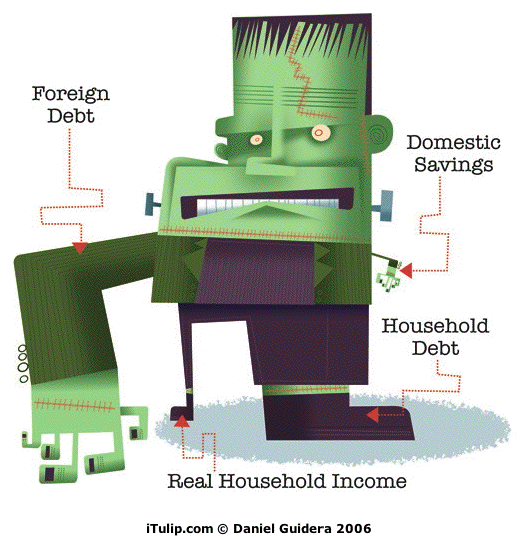
Now readers are starting to see how we arrived at the Frankenstein Economy: one non-market, politically motivated, government band-aide heaped on top of the last, with entrepreneurs asked to bail out these errors each time.
Leave a comment:
-
Re: Unidentified Financial Objects
The iTulip position on "decoupling" is that with respect to trade that Asia and Europe are more independent than during previous recessions but not 100% decoupled. If they were 20% decoupled before they are, say, 50% now. With respect to currencies, we (global central banks) hang together or hang separately, as they say.Originally posted by dbarberic View PostLeave a comment:
-
Re: Unidentified Financial Objects
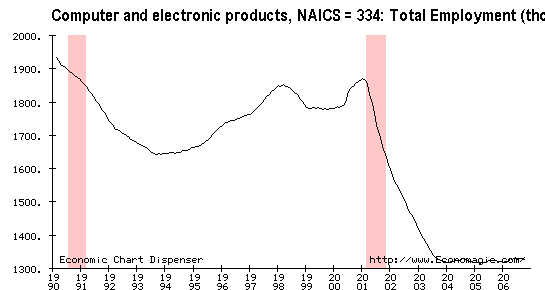
MDU is a function of falling net job creation. Before businesses lay people off they freeze hiring. Early in a recession workers lose jobs at the same rate as during expansion but fewer new jobs are created so it takes the average worker longer to find a new job. The MDU spike is caused later in the cycle when the rate of job losses is rising and at the same time the rate of new job creation is falling. Offshoring that's driven during a recession by the need for companies to reduce payroll expenses without a corresponding reduction in output results in a structural change in the affected industry, to wit: the offshoring of computer hardware jobs after the 2001 recession sent jobs overseas that never came back.Originally posted by zmas28 View Post
 Last edited by FRED; February 16, 2008, 08:34 PM.
Leave a comment:
-
Re: Unidentified Financial Objects
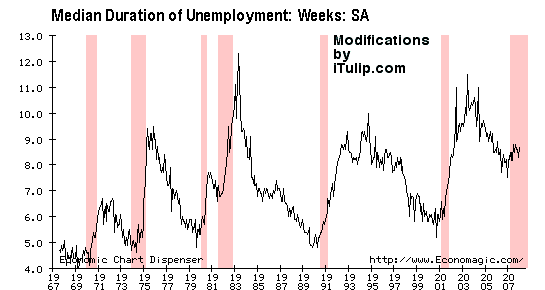
Another hypothesis: the MDU spike is delayed during in the case of inflationary recessions. Note that during the three recessions that occurred during high inflation periods in the 1970s MDU did not rise until the end of the recession. Based on the by-state and by-county analysis we're doing now, it looks like the surge in MDU will start midway through the recession. Assuming a nine to 12 month recession we expect MDU to start to spike in Q2 08 or Q3 08 at the latest.Originally posted by dauphiné View PostLeave a comment:
-
Re: Unidentified Financial Objects
Why don't we see unemployment surge ? May be because of more and more babyboomers retire at the same time... first recession in the mist of a massive wave of retirement... that's my guess. Same phenomena occuring in Europe as far as I can tell.Originally posted by quigleydoor View PostLeave a comment:
-
Re: Unidentified Financial Objects
EJ writes in:Originally posted by Chris Coles View Post
Chris,
Thanks for the kind words. Below is an additional piece of evidence of what is happening that will be included in next week's commentary. It's an animation of the year over year change in the unemployment rate in CA as the recession deepens there. The official measure of unemployment, U-3, is at 6%. Note that over the past year unemployment is rising in every county and has increased by 1.1% to 40% in all but eight. CA is with respect to job creation "going dark."
Eric

Lights Out in CaliforniaLast edited by FRED; February 16, 2008, 01:00 PM.Leave a comment:
-
Re: Unidentified Financial Objects
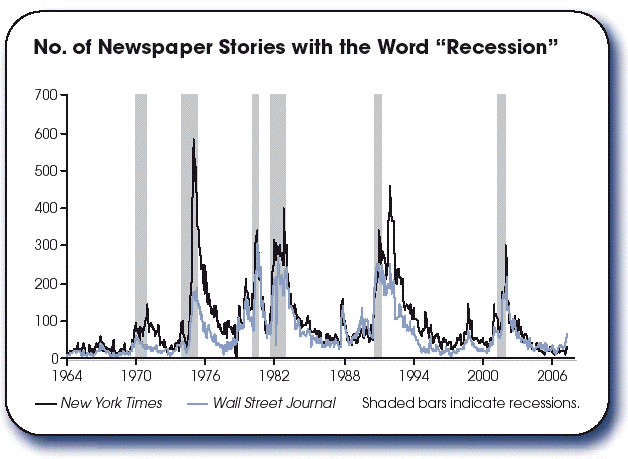
Originally posted by EJ View PostA .86 correlation is strong, but it shouldn't surprise anyone that newspapers publish stories about recessions during recessions. The time dimension of Theissen's graph isn't fine enough to allow me to identify his "noticeable jump" in the number of 'recession stories' in the Wall Street Journal in March 2007." Presuming it's at the extreme right, it isn't as noticeable as mini-spikes in 1988, 1995, and 1998. These are increases in "newspaper chatter," but they don't correspond to the shaded "recession" bars.
It may be worth pointing out that the top line in the Google Trends graph indicates the number of Google searches on "recession," while the bottom line indicates the number of news references (an extension of Theissen's analysis). The two lines are nearly parallel.
To see how "chatter" about recession compares to other economy-related concerns, iTulip readers can enter multiple terms, separated by commas. For example, try entering recession, gold, oil, global warming. I used recession, fashion, climate. Search volume shows far greater interest in fashion than climate and somewhat greater interest in global warming over recession. The news reference volume shows that volumes for fashion and global warming have been higher since January 2004; however, there was a sharp spike in early 2008 in references to recession, with recession far surpassing the other two topics.
Another problem with the howstuffworks explanation is that it supposes that the consumer is the pivotal factor in the economy and that all other factors are static, ignoring the dynamic role of governments, currency rates, trade relations, wars, natural disasters, and so forth.Originally posted by EJ View Post
Yet another problem in this explanation is the centrality of confidence. The current consumer may not lack confidence at all, but the combination of falling home equity and tightening lending standards, inflating prices, and stagnant incomes may well have left the consumer without the means to continue consuming at high levels.Leave a comment:
-
Re: Unidentified Financial Objects
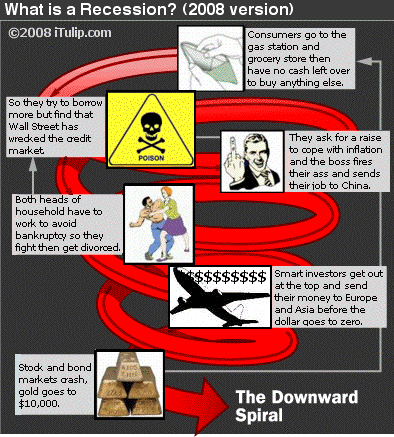
ROFLMAO; I like the images in the downward spiral, iTulip 2008 version. My favorite image is the boss flipping off the worker who wants a raise, right before he sends his job to China.Leave a comment:
-
Re: Unidentified Financial Objects
Whatever you do, don't ask the rightwing nutcases that run the Media Research Center.All this talk about recession got me thinking: does it ever happen that the business media talks a lot about recession when there's no recession?
Consumer Confidence: Only News When It's Low(er)
The Media’s Top 10 Economic Myths of 2007
Their assorted websites are good for a laugh.Media myth: The U.S. economy is nearly in, or is in, a recession.
Truth: The U.S. economy is NOT in a recession and has experienced strong growth.
Contrary to media assertions and CNN’s Ali Velshi suggesting that “the bottom line is to most Americans, a recession is what it feels like to you,” there is an actual, objective definition of a recession. It’s two quarters of negative economic (gross domestic product) growth, which the U.S. has not seen in the last four years.
Instead, the economy has had 51 consecutive months of job growth. The third quarter of 2007 was revised upward to 4.9 percent GDP growth – very strong indeed. Yet the media have remained negative throughout four straight years of job growth.
And the economy has weathered oil prices. On the June 12, 2004, “CBS Evening News,” Tony Guida reported a dire prediction. “Some oil analysts see economic disaster if oil hangs around $40 a barrel,” Guida said. Oil as of early December 2007 was in the high $80s after rising above $90 per barrel, and still no recession.
Add to all that an increase in workers’ earnings, documented by Rea Hederman and James Sherk of The Heritage Foundation.
“The economy created 94,000 jobs in November, and the unemployment rate remained unchanged from October at 4.7 percent,” Hederman and Sherk wrote. “Wages grew at their sharpest rate since the middle of the summer, which will fatten the wallets of workers during the Christmas shopping season. The economy faces real challenges, but the evidence so far refutes the notion that it is sliding into a recession.”
Those economists aren’t alone in their analysis. “By most economists’ terms, a recession is defined as two or more consecutive quarters of GDP decline – something we haven’t seen since 1991,” wrote Fortune’s Peter Eavis on October 2. “By that narrow definition we're not even close. Of 50-plus economists surveyed by research firm Blue Chip Economic Indicators, not one is predicting a recession. They still expect GDP to grow 2.6% next year.”Leave a comment:
-
Re: Unidentified Financial Objects
Its interesting and a little disconcerting that the MDU appears to be significantly higher (8 weeks) at the start of this recession than at the start of previous recessions (between 5 and 6 weeks). A higher "background" level of unemployment and is this related to offshoring or outsourcong of jobs?Leave a comment:
-
Re: Unidentified Financial Objects
Personally, I have been intrigued for some time now about the fact that there is a lot of evidence to show that the FIRE economy has drained away the spending power of the middle classes; yet few of these people have been able to say, for certain, that all their spending power has drained into the banking system. I belong to a gliding club, perhaps the most successful ever, Lasham www.lasham.org.uk Now, along with every other spare time activity imaginable, Lasham has seen a steady decline in both membership and particularly, demographics. Today, very few middle income families have any spare income to spend on these outside activities and yet, no one has been able to say why they do not have the funds any more. I believe this is because the whole process has been insidious. Very long term declines seem to act like the story of the frog placed into cold water that is brought to the boil. The frog is dead before he realises the fact is that the water is too hot.
I believe, because of the greater exposure, by the likes of EJ, people are at last waking up to the reality and that is why we are passing into perhaps the most serious depression imaginable. The decline has been so prolonged, so drawn out; the effect is the same as the frog. It is now too late to get out and so everyone is dead, financially, and it is too late to do anything about it.
Ordinary people take a sharp downturn in their stride. The breadwinners families survival always depends upon their ability to rise above the normal difficulties life throws at us all. But here, the changes have been so incremental, so tiny and also, right across the board; everyone got caught into the trap of believing they had their position covered. Instead of changes coming in weeks, these changes have come spread over several decades. Slowly but surely, everyone's spending power has declined.
Disaster theory shows a forty year upward incline that then gets steeper until try as one might, no matter what you do, you cannot make any further progress and everything reaches a plateau. The plateau suddenly declines right back to the beginning.
I believe we have now stepped, with the panicked 125 basis point interest decline by the FED, right off the edge of that plateau and this time we will have to ride the Downwave all the way to the bottom.
But there is a mighty big silver lining to the black cloud that has enveloped us. If the existing FIRE economy does collapse, then the greatest result will be that so many middle income families will be freed from that huge burden of all those FIRE economy payments that have so declined the natural, real economy. Moreover, with the decline in employment driving the need for completely new job creation, then there will be a strong drive towards a new industrial future for our respective nations. The "FIRE" will be extinguished and, if I have anything to do with it, there will be a new fresh breath of innovative investment into a completely new model of free enterprise with as before, at least a forty year upward incline until a new generation of complete idiots arrive to bring the whole thing down again all over again.
EJ, yes, you go enjoy your weekend, you have well and truly earned it. I am sure a great many people will be sleeping more easily today simply because they now, at last, understand what has been happening to them and, with that knowledge, comes the answers to their survival.Leave a comment:





Leave a comment: