Announcement

Collapse
No announcement yet.

Recession without Romance

Collapse
X
 
  • Filter
  • Time
  • Show
Clear All
new posts

  • GRG55
    replied
    Re: Recession without Romance

    Originally posted by EJ View Post
    ...The whole idea of the Fed developing long term economic targets is absurd. It furthers the fiction that the Fed has "control" of the economy. The Fed nfluences the economy, sometimes that influence is strong and at other times weak, sometimes for good and other times ill. I believe we are entering a period where the Fed will be overwhelmed by events largely out of its control, and the one tool that it has–printing money–will either not help to address the problem or will make the symptoms of the problem worse. By setting an expectation of Fed control versus weak influence, the Fed is setting itself up for an even greater credibility hit in the future.
    Agree. The Fed puts great stock in referencing growth against the economy's "potential", as though there is some knowable and reliable number for what GDP "should be". Factors such as capacity utilization and so forth probably go into the Fed model that spits out "potential"?

    The original question was prompted as I was thinking about how the Fed might use/manipulate the longer range forecasts to shape, or justify, current policy. For example, if they cannot avoid criticism for cutting interest rates now, in the face of skyrocketing energy, food and gold, perhaps a forecasted structural downward shift in US GDP gives them the cover they want? Just a thought...

    Originally posted by EJ View Post
    ...The Fed's greatest challenge is that it's role is simple. It has one and only one tool: printing money. The challenge is to make this appear more complex and mysterious than it is. The Fed can issue all manner of reports and attempt to be more "transparent" about its planned actions in various time frames but all the astute observer cares about is the see the relevant questions answered: Is the Fed going to print more or less? When? How much? Is the Fed printing now? How much? Everything else is cover, which the Fed needs to create in order for its money printing to have the intended result, which is why the idea of greater transparency by the Fed is at best an academic pursuit...

    Some things are timeless...
    …“The regulation of economic activity is without doubt the most inelegant and unrewarding of public endeavours. Almost everyone is opposed to it in principle; its justification always relies on the unprepossessing case for the lesser evil. Regulation originates in raucous debate in Congress in which the naked interests of pressure groups may at times involve an exposure bordering on the obscene.”…
    …“The great exception to this dreary story is the regulatory activity of the central bank – with us, the Federal Reserve System. Here is regulation of a seemly and becoming sort. No one apologizes for it; men of impeccable conservatism would rise to espouse such regulation were they called upon to do so, which they almost never are. This regulation…emerges in the measured and orderly discussion of men of quiet and dignified mien…around a handsome table in a richly panelled and draperied room. These men do not issue orders; at most they suggest. Chiefly they move interest rates, buy or sell securities and, in doing so, nudge the economy here and restrain it there. Because the meaning of their actions are not understood by the great majority of the people, they can reasonably be assumed to have superior wisdom. Their actions will on occasion be criticized. More often they will be scrutinized for hidden meaning."
    -- From "The Great Crash 1929", J. K. Galbraith --

    Leave a comment:


  • bart
    replied
    Re: Recession without Romance

    Originally posted by EJ View Post
    ...
    After watching this process for over ten years, my advice is that as we go into a period of flux, the economic data are going to become increasingly volatile, unreliable, and irrelevant. As happened in the early 1930s, as the fundamental structure of the economy and financial markets had changed, the Fed will be looking at and reacting to the wrong data. This is why we have repeating the following since 1999, because it will apply to the future period of change which is now, eight years later, upon us:
    ...


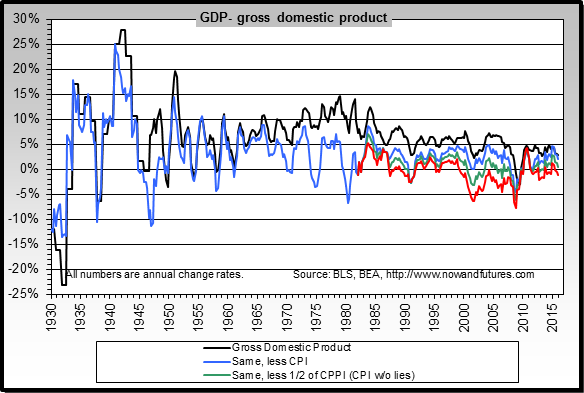
    Here's a real and recent (2005) example of how big BLS data revisions can be. The green line is pre-revision, the blue line is after for GDP:


    Leave a comment:


  • EJ
    replied
    Re: Recession without Romance

    Originally posted by GRG55 View Post
    Thanks. The referenced paper was instructive as you said.

    As for taking the Fed's forecasts with a grain of salt, here's someone of advanced years that apparently agrees with you...

    Mrs. Moskowitz Has Some Input for Mr. Bernanke:

    By Caroline Baum
    Nov. 23 (Bloomberg) -- Dear Chairman Bernanke:
    I read with interest your speech of Nov. 14 in which you outlined the Federal Reserve's steps toward greater openness. I was particularly interested in reason No. 4 on the ways in which transparency increases the effectiveness of monetary policy. ``Open discussion of the central bank's analyses and forecasts invites valuable input and feedback from the public,'' you said.
    Bloomberg generally, and Caroline especially, have done the best job of any mainstream business media organization at covering the housing market debacle, bank risk pollution, the Fed's contribution to the crisis, and related events. It's a quality outfit. I've communicated with Caroline on occasion and we set up an account for her here at her request, although I don't know if she has posted comments.

    The whole idea of the Fed developing long term economic targets is absurd. It furthers the fiction that the Fed has "control" of the economy. The Fed nfluences the economy, sometimes that influence is strong and at other times weak, sometimes for good and other times ill. I believe we are entering a period where the Fed will be overwhelmed by events largely out of its control, and the one tool that it has–printing money–will either not help to address the problem or will make the symptoms of the problem worse. By setting an expectation of Fed control versus weak influence, the Fed is setting itself up for an even greater credibility hit in the future.

    The Fed's greatest challenge is that it's role is simple. It has one and only one tool: printing money. The challenge is to make this appear more complex and mysterious than it is. The Fed can issue all manner of reports and attempt to be more "transparent" about its planned actions in various time frames but all the astute observer cares about is the see the relevant questions answered: Is the Fed going to print more or less? When? How much? Is the Fed printing now? How much? Everything else is cover, which the Fed needs to create in order for its money printing to have the intended result, which is why the idea of greater transparency by the Fed is at best an academic pursuit.

    I will say about Bernanke that he is getting better at conducting himself at hearings. He used to explain himself in the face of attacks by members of Congress. That's weak. When recently grilled by Ron Paul his response was right out of Greenspan's unofficial rules of Fed public conduct: he sat expressionless in silence. He's learning.

    Leave a comment:


  • jk
    replied
    Re: Recession without Romance

    - The price of crude has remained largely flat in Euros and Sterling for over a year.


    if this is so, why does this chart look the way it does?

    http://stockcharts.com/charts/performance/perf.html?FXE,$wtic

    Leave a comment:


  • GRG55
    replied
    Re: Recession without Romance

    Originally posted by Chris Coles View Post
    GRG,

    You have missed my point. The matter of the difference between the price of refined petroleum may be worrying my friend, but his concern about the price was not of interest to me. I looked over the top of his report to see something I believe to be much more significant.

    Which is that, the difference between the Euro and Dollar price contains a signal that on the one hand the Euro price is stable and on the other the Dollar price is constantly moving. I say that that constant movement marks the slide away from using the dollar as THE currency with which to do business internationally.
    Almost every currency in the world is rising compared to the US Dollar, not just the Euro. Is that really an indication of those currencies being preferred as a medium of exchange for international business? Or is it because they are preferred as a store of value over the US $?

    I think the upward moves in the Euro and other currencies are much more a function of preference for store of value (that's what I have done by converting US $ to Yen, Swissie, Loonies...)

    For global trade the Dollar is just a medium of exchange, as long as there are enough of them, and there appears no imminent shortage - I'm sure we agree on that.

    As long as US Dollars remain freely exchangable for goods, services and other major currencies I can't see the world rushing to abandon it, or even reducing its usage as a medium of exchange. It will take a long, long time before the Euro is as widely accepted for commerce across the world as the US Dollar. Try taking a Euro note anywhere in Asia, India, Middle East, Africa or North America (other than perhaps Manhattan's luxury stores) and exchanging it for anything, other than for the local currency at the desk at your hotel or a bank.


    Originally posted by Chris Coles View Post
    If that continues, then everyone that had once wanted to trade in other than a dollar can now start to do so. And, once that happens, then for every barrel of oil, or whatever else the US wishes to purchase, the US will have to, in turn, purchase Euro's and cannot print more dollars to dig themselves out of the mess they are in.

    If the dollar becomes unusable to trade, who will purchase it?

    So then, the question becomes, what can the US sell to purchase Euro's if the dollar will not be accepted?

    So another signal will be if you suddenly see the UK government deciding they want to become a part of the Euro. The UK pound might be stable now, but if the flight from the dollar continues, there will come a time when the old dream of the UK pound returning to its former glory, pre Breton Woods, and becoming the replacement currency will evaporate and the flight from the UK Pound will also start. Personally, I suspect that is already a point of discussion here.

    I believe that we are watching the greatest seismic event in economics ever, all in nice slow motion. The dollar mountain is collapsing; and who knows where this will end?
    Perhaps you are correct Chris. There's no doubt the US $ is becoming less valuable, but looking at Finster's charts it's been getting less valuable for decades and decades. All that's happening now is the pace has, temporarily, become a bit faster. Maybe there is a crisis that I am still not quite able to recognize for what it truly is. We'll see in due course I suppose...

    Finster's charts (check these out if you haven't seen them before - superb!!):
    FinsterFinancialForecast

    P.S. I just remembered that a couple days ago I posted something about the Indian Tourist Authority no longer accepting US $ for admission to the Taj Mahal. Maybe you're on to something Chris!!! :eek:
    Last edited by GRG55; November 23, 2007, 09:45 AM.

    Leave a comment:


  • GRG55
    replied
    Re: Recession without Romance

    Originally posted by EJ View Post
    I'd take all of these projections with a grain of salt, especially now. The following is instructive.

    Federal Reserve Bank of Minneapolis Quarterly Review (pdf)
    Vol. ol. 22, No. 4, Fall 1998, pp. 3–12
    Revisionist History: How Data Revisions Distort Economic Policy Research
    David E. Runkle, Research Officer, Research Department
    Federal Reserve Bank of Minneapolis

    The paper has the usual disclaimer:

    However, our most successful forecasts of future Fed behavior is based on these papers. In spite of the disclaimers, you can assume that these research papers mostly reflect official policy.

    Apparently worried that the BEA staff might be offended by his conclusions, the author offers the following note:

    His conclusion:

    After watching this process for over ten years, my advice is that as we go into a period of flux, the economic data are going to become increasingly volatile, unreliable, and irrelevant. As happened in the early 1930s, as the fundamental structure of the economy and financial markets had changed, the Fed will be looking at and reacting to the wrong data. This is why we have repeating the following since 1999, because it will apply to the future period of change which is now, eight years later, upon us:

    For the foreseeable future, no data are going to be as reliable as what the community collectively pulls together by looking out the window and reporting what we see.
    Thanks. The referenced paper was instructive as you said.

    As for taking the Fed's forecasts with a grain of salt, here's someone of advanced years that apparently agrees with you...

    Mrs. Moskowitz Has Some Input for Mr. Bernanke:

    By Caroline Baum
    Nov. 23 (Bloomberg) -- Dear Chairman Bernanke:
    I read with interest your speech of Nov. 14 in which you outlined the Federal Reserve's steps toward greater openness. I was particularly interested in reason No. 4 on the ways in which transparency increases the effectiveness of monetary policy. ``Open discussion of the central bank's analyses and forecasts invites valuable input and feedback from the public,'' you said.

    Chairman Bernanke, you don't know how good it makes me feel to know that you find my input valuable! Your predecessor, Alan Greenspan, wasn't interested in hearing from me. He wasn't much interested in hearing from his policy committee either, based on what I've read.
    I wanted to wait until you and your colleagues released the new three-year economic forecasts before I wrote you with my ideas and questions. Now that I've digested the information, the numbers and the distribution of participants' projections (OK, I had some trouble with the last one), I'm ready to rock.

    Let me start by saying I'm all for better communication. You can't imagine how frustrating it is straining to hear Mrs. Olson at our Friday bridge game here at the assisted-living center. If she talked more clearly -- she says it's my hearing -- we might actually end up in the right contract.

    No Green Bananas
    What I don't understand is why forecasting the economy's growth, inflation and unemployment rates in 2010 is going to help me, as you said in the minutes, or help me help you, as you said in your speech. As a senior citizen, I don't buy green bananas. I don't buy in bulk. I don't even buy next year's date book until I've got one foot in the new year.

    I'm not going to change my behavior one iota based on the 2010 outlook.
    At the same time -- and I mean no disrespect -- how can anyone know what's going to happen between now and 2010? Even the smartest, most highly trained economists can't predict the future with any degree of certainty, as you yourself have said. Sometimes they can't see what's coming one month out.

    Back in August, you thought you might have to raise short- term interest rates to fight inflation. Ten days later, you started to lower them. In late 2000, the outlook underwent the same sort of sudden turnaround. I have to wonder if things change that quickly or you Fed folks are slow to notice.

    If you don't know where your target interest rate is going to be one month from today, how can you possibly know how fast the economy will grow and what inflation will be in two to three years?

    What's `Appropriate?'
    I understand that these forecasts are goals, at least in the long run. What we don't know, and what you aren't telling us, is what it takes to get from point A to point B. You said projections are based on committee members' assessment of ``appropriate monetary policy.''

    Could you be more specific?
    To say that appropriate is the ``future policy'' most likely to achieve the Fed's dual mandates of maximum growth and price stability doesn't mean much to me. If you can't put an exact number on it, how about giving us the direction? ``Higher'' or ``lower'' would help.

    I like the fact that you are making these changes with an eye toward those of us on Main Street, not just on Wall Street. Still, some of the discussion from the meeting goes over my head.

    For example, why was the decision to cut rates on Oct. 31 a ``close call'' if monetary policy was ``somewhat restrictive'' and the economy is facing ``substantial downside risks?'' When I go to see Dr. Rosen and my blood pressure is up and he tells me I'm at substantial risk of a stroke, trust me, it's no ``close call.'' He puts me on meds right away.
    Return Mail

    I realize you're a busy man, what with real estate in the soup and folks losing their homes. But it would sure mean a lot if you could get back to me on a few of the points I brought up. The folks here didn't believe me when I told them you were interested in my feedback. I bet a personal letter on official Federal Reserve stationery would convince them otherwise.

    I look forward to corresponding with you in the future.

    Very truly yours,
    Minnie Moskowitz Delray Beach, Florida

    (Caroline Baum, author of ``Just What I Said,'' is a Bloomberg News columnist. The opinions expressed are her own.)

    Link:
    http://www.bloomberg.com/apps/news?p...d=aT4Q1mcUK9x4

    Leave a comment:


  • Chris Coles
    replied
    Re: HM Gov. short of cash

    Originally posted by qwerty View Post
    Chris, are you saying that if depositors started taking money out of National Savings accounts, they might find it more difficult in future, because they might be strapped for cash?

    If one transfers 1000 pounds from a National Savings account to a Barclays Bank account is it just like a regular bank transfer? The NS money comes from a Bank of England account though, right? So don't they just print some more gilts and give them to the BoE. (Thus if the BoE/NS/UK Govt is bust, pound notes are worth a fortune until such time as they print some more?)

    I am keenly interested in this idea that sterling lender of last resort not being able to pay up.
    Querty,

    Again, I am not concerned with the man or woman in the street and their national savings. I am concerned that the UK government is constrained from trading "intergovernmental purchases of securities". That they are as "locked in" as all the banks, that they are in the same boat and unable to trade their liabilities. That the intergovernmental trading of securities has also come to a complete halt.

    Also, going back to my previous point. If you want to sell gilts, what do you take in return? More dodgy CDO's? That is not possible simply because it is to cover the dodgy CDO's the loans to the banks are being, or have been made in the first place. Most seem to have forgotten that even a government can run out of money and will need to turn to the markets for a top up. But the markets are fatally damaged and locked up. That is my point.

    Further, as this dollar collapse continues, instead of the disadvantages of a strong currency leading to depressing trade, during the collapse, the strongest currency is King. We have a good example here in the UK with Northern Rock. It turns out that the banks with the strongest balance sheets are now raking in deposits from the customers of ANY bank under even the slightest suspicion.

    Cash is King in a Downwave and the strongest King is the strongest currency. We have seen nothing yet..... the best is yet to come.

    Leave a comment:


  • Chris Coles
    replied
    Re: Recession without Romance

    GRG,

    You have missed my point. The matter of the difference between the price of refined petroleum may be worrying my friend, but his concern about the price was not of interest to me. I looked over the top of his report to see something I believe to be much more significant.

    Which is that, the difference between the Euro and Dollar price contains a signal that on the one hand the Euro price is stable and on the other the Dollar price is constantly moving. I say that that constant movement marks the slide away from using the dollar as THE currency with which to do business internationally.

    If that continues, then everyone that had once wanted to trade in other than a dollar can now start to do so. And, once that happens, then for every barrel of oil, or whatever else the US wishes to purchase, the US will have to, in turn, purchase Euro's and cannot print more dollars to dig themselves out of the mess they are in.

    If the dollar becomes unusable to trade, who will purchase it?

    So then, the question becomes, what can the US sell to purchase Euro's if the dollar will not be accepted?

    So another signal will be if you suddenly see the UK government deciding they want to become a part of the Euro. The UK pound might be stable now, but if the flight from the dollar continues, there will come a time when the old dream of the UK pound returning to its former glory, pre Breton Woods, and becoming the replacement currency will evaporate and the flight from the UK Pound will also start. Personally, I suspect that is already a point of discussion here.

    I believe that we are watching the greatest seismic event in economics ever, all in nice slow motion. The dollar mountain is collapsing; and who knows where this will end?

    Leave a comment:


  • GRG55
    replied
    Re: Recession without Romance

    Originally posted by Chris Coles View Post

    - There appears to be an anti-competitive oligopoly of downstream petrol retailers that the EC should have taken on under anti-trust laws we already have. There is certainly no aggressive competition to gain share by sacrificing some of this massive artificial margin.
    Chris: The primary reason there is limited competition in petroleum refining and retailing in the developed economies is because for decades it has been an abysmal business - extremely high capital investment, regulated by multiple layers and departments of government, slow market growth, and persistently poor margins (some similar characteristics to the volatile air transport business where the companies swing between thin profits and large losses, on the way to the next restructuring). Despite what the public wants to think, in a typical decade the downstream petroleum business usually has one obscenely profitable year (which gets all the attention), two years that are decent, and the biblical 7 bad years to round it out.

    The national oil companies (NOC's) like Saudi Aramco, UAE, Kuwait, etc have more crude oil production than refining capacity. The non-NOC refining companies (like Shell and Exxon) do not produce anywhere near enough oil to supply their own refining capacity, and therefore have to purchase large amounts of crude on the open market. Given this situation, it is no longer a necessity to have proprietary upstream crude production in order to enter and be able to compete in the refining business with the Shells or BP's - anyone can build a refinery and anyone can buy the oil to supply it. In the USA this has occurred. If you think its a good business have a look at a 10 year chart for Valero (VLO:NYSE) and superimpose it on the Nasdaq circa 1990-2000. What do you think is going to happen next?

    If it really was a highly profitable business there would have been lots of new entrants - during the recent "free money" years the investment banks and hedgies were funding anything and everything that might make a buck (or Pound in your case). Notice they didn't have any appetite to enter the refining and gasoline retailing business. If "massive artificial margins" are so easy to come by, as your friend apparently believes, then how is it that this business never attracted the attention of the Private Equity masters-of-the-universe? At the very least they should have come in and overpaid to buy out a few refining companies and then jacked up prices enough to really give us something to complain about. Didn't happen, did it?

    When somebody figures out how to create a low-cost "Easyjet" business model equivalent for refining & marketing, then perhaps there will be some competition. Don't hold your breath.
    Last edited by GRG55; November 23, 2007, 04:41 AM.

    Leave a comment:


  • qwerty
    replied
    HM Gov. short of cash

    Chris, are you saying that if depositors started taking money out of National Savings accounts, they might find it more difficult in future, because they might be strapped for cash?

    If one transfers 1000 pounds from a National Savings account to a Barclays Bank account is it just like a regular bank transfer? The NS money comes from a Bank of England account though, right? So don't they just print some more gilts and give them to the BoE. (Thus if the BoE/NS/UK Govt is bust, pound notes are worth a fortune until such time as they print some more?)

    I am keenly interested in this idea that sterling lender of last resort not being able to pay up.

    Leave a comment:


  • Chris Coles
    replied
    Re: Recession without Romance

    Originally posted by jk View Post
    the shock!


    no, if the world announces a "study" of the role of the u.s dollar in the international system, the dollar drops like a rock. the role of the dollar can only diminish - when you're number one the only direction is down. a "study" can only pontificate on the status quo or recommend a change, and any change has to be an even quicker diminution of the role of the dollar.
    There are a number of points that I want to make. The first comes from a brief conversation I had in London in the 1980's when I had asked a banker out of Nomura about his interest in investment in the likes of new high technology start ups, (such as I was trying to get going at the time). His answer stuck in my mind ever since:

    "No! We only deal in intergovernmental purchases of securities".

    This came to mind the day before yesterday when here in the UK we heard that a science related long term research project was suddenly not being funded. There had been no consultation on the decision, the withdrawal of funding simply dropped out of the blue. It took a while and then it hit me. What if the government itself is in exactly the same situation as everybody else?

    So the first question is. With banking in crisis caused by defective money markets it is surely relevant to ask; what is the governments exposure to the same? Now, my first thought was to ask this about the UK, but then it surely also applies to the US as well?

    Is the US government as deeply up to its neck in dodgy CDO's as every other major borrower on the planet?

    Here in the UK we have seen the Bank of England lay on the line a very large sum of money to support Northern Rock. In dollar terms, it is beginning to look like as much as $80 billion. Now, I ask: Has the decision to support Northern Rock inadvertently done immense damage to their bottom line? Is the UK Government now in exactly the same situation as Northern Rock? Loan commitments made long, (to Northern Rock and others), that cffice:smarttags" />annot be covered on the external money markets simply because those money markets are locked out, even to them?

    And, if the entire world money market system is in crisis; what is the potential for the same conclusion to apply to the USA? If banks are not lending to each other; why should we believe it is any different for the "intergovernmental purchases of securities"?

    Turning to the ongoing development of the dollar crisis, by pure chance, (what a wonderful thing pure chance is sometimes?), this arrived in my in-box. It comes from a friend and fellow glider pilot, Brian Catt. As he asked us to pass it on I do so here in full but less his contact details.

    Hi
    This is for Europeans only. As I currently don't have enough fun and have a bit more time I am now making a nuisance of myself.
    I just made a rather startling discovery, freely available to any serious commentator but "unpromoted".
    - The price of crude has remained largely flat in Euros and Sterling for over a year.
    - Iranian oil is actually cheaper in Euros than a year ago. (Reports from the current OPEC meeting/ FT commodities index confirms).
    - Petrol is refined in Europe at a Euro cost, which cannot have changed much as the plant is built, labour costs and wage inflation small as a % and distribution ditto, albeit they use their own overpriced fuel.
    - In summary wholesale pre tax cost of petrol f.o.b. the depot should be much the same as a year ago.
    - The price of petrol has risen by over 30% in a year- in line with and justified by the irrelevant hike in the price of crude in devaluing dollars.
    - We are being massively ripped off by the oil companies on a spurious but unchallenged justification.
    - There appears to be an anti-competitive oligopoly of downstream petrol retailers that the EC should have taken on under anti-trust laws we already have. There is certainly no aggressive competition to gain share by sacrificing some of this massive artificial margin.
    - Yet every time the price goes up no one asks the simple question WHY - then questions the answer? There is no substantive cost justification.
    - Who benefits? The oil companies and the government through higher tax take
    - hardly a way to manage inflation or an economy.
    For the first time in my life I ask you to forward this to your list as its clear there is a massive and cynical rip off going on, politicians are complicit and the mainstream media compliant with it or incompetent to recognise and/or challenge it - so we will get no help unless the problem is aired outside the corridors of power - who would no doubt prefer we didn't have a forum to discuss this.
    Of course if you find fault with my facts or analysis then I'll happily withdraw or correct it.
    If you agree I think it should be given "the oxygen of publicity".
    Best,
    Brian Catt

    As you see, there is much going on in the background that gives me the thought that we have seen nothing yet, the worst is very much yet to come for if this is correct, then the collapse of the dollar may well be under way and truly unstoppable.

    Leave a comment:


  • EJ
    replied
    Re: Recession without Romance

    Originally posted by GRG55 View Post
    The problem with living over here is I wake up and get to start my day with these little sunshine posts of EJ's .

    EJ, Finster... A question: I was reading through the Fed minutes released yesterday (We are truly desperate for entertainment here in the desert. If any of you are unfortunate enough to be in a similar situation you can access the minutes here: http://www.federalreserve.gov/moneta...es20071031.pdf )

    I noticed on page 9 the following: "Participants read last summer's benchmark revisions to the national income and product accounts as suggesting a somewhat slower rate of trend growth than previously thought."

    Reading a bit further, the distribution of GDP projections shown on page 14 clearly indicate a material downward revision for 2008 from June expections (no real surprise), but much more interesting, projections now converge around 2.4%-2.5% annual GDP growth for 2009 and 2010. This would suggest that the Fed itself is now anticipating a structural (NOT cyclical) shift downward in US potential GDP. Chart 1 at the top of page 11 seems to indicate the same.

    Is my conclusion reasonable? Or am I mis-understanding what the Fed is telling us?

    If I am interpreting this correctly, would it also be correct to assume that the Fed has, or will, also also adjust it's expectation of the "neutral" Fed funds rate downward in years to come (and therefore the potential for chronic historically low administered rates for very extended periods of time, especially if already lowered GDP projections prove optimistic)?
    I'd take all of these projections with a grain of salt, especially now. The following is instructive.

    Federal Reserve Bank of Minneapolis Quarterly Review (pdf)
    Vol. ol. 22, No. 4, Fall 1998, pp. 3–12
    Revisionist History: How Data Revisions Distort Economic Policy Research
    David E. Runkle, Research Officer, Research Department
    Federal Reserve Bank of Minneapolis

    The paper has the usual disclaimer:

    The views expressed herein are those of the author and not necessarily those of the Federal Reserve Bank of Minneapolis or the Federal Reserve System.
    However, our most successful forecasts of future Fed behavior is based on these papers. In spite of the disclaimers, you can assume that these research papers mostly reflect official policy.

    Apparently worried that the BEA staff might be offended by his conclusions, the author offers the following note:

    I do not mean to be critical of the data collection and processing efforts of the BEA or of the policy making efforts of the FOMC. Both institutions do the best they can, given the available information. Naturally, more information about the economy becomes available over time.
    His conclusion:

    ...data revisions can have a large effect on the perceived history of real growth and inflation in the United States. Data revisions can be large, and initial estimates of real growth and inflation are not rational forecasts of final estimates.
    After watching this process for over ten years, my advice is that as we go into a period of flux, the economic data are going to become increasingly volatile, unreliable, and irrelevant. As happened in the early 1930s, as the fundamental structure of the economy and financial markets had changed, the Fed will be looking at and reacting to the wrong data. This is why we have repeating the following since 1999, because it will apply to the future period of change which is now, eight years later, upon us:

    It is of the utmost importance to realize this: given the actual facts which it was then possible for either businessman or economists to observe, those diagnoses -- or even the prognosis that, with the existing structure of debt, those facts plus a drastic fall in price level would cause major trouble but that nothing else would -- were not simply wrong. What nobody saw, though some people may have felt it, was that those fundamental data from which diagnoses and prognoses were made, were themselves in a state of flux and that they would be swamped by the torrents of a process of readjustment corresponding in magnitude to the extent of the industrial revolution of the preceding 30 years. People, for the most part, stood their ground firmly. But that ground itself was about to give way.

    - Joseph A. Schumpeter -- Business Cycles, 1939
    For the foreseeable future, no data are going to be as reliable as what the community collectively pulls together by looking out the window and reporting what we see.

    Leave a comment:


  • jk
    replied
    Re: Recession without Romance

    Originally posted by medved View Post
    One of the things they can do is pretend to solve the currency problem. Here is the scenario:

    1. G7 gets together and "reveals" to the world, the $US is not a good reserve currency anymore.
    the shock!

    2. International community happily engages in US-bashing and comes up with fancy do-gooder solutions for international harmony. G8 solemnly promises to solve the currency problems and appoints multiple commitees to study the issue. $US stabilizes, gold drops a bit (it is reasonable to assume, its price is around the old $850 peak). I am selling.
    no, if the world announces a "study" of the role of the u.s dollar in the international system, the dollar drops like a rock. the role of the dollar can only diminish - when you're number one the only direction is down. a "study" can only pontificate on the status quo or recommend a change, and any change has to be an even quicker diminution of the role of the dollar.

    Leave a comment:


  • medved
    replied
    Re: Recession without Romance

    Originally posted by dbarberic View Post
    Come on EJ.... what are you thinking the banks may do that will dis-inflationary to gold? Inquiring minds want to know. I'm thinking the receint drop below $800 is a good opportunity to stock up on more ounces.
    One of the things they can do is pretend to solve the currency problem. Here is the scenario:

    1. G7 gets together and "reveals" to the world, the $US is not a good reserve currency anymore.

    2. International community happily engages in US-bashing and comes up with fancy do-gooder solutions for international harmony. G8 solemnly promises to solve the currency problems and appoints multiple commitees to study the issue. $US stabilizes, gold drops a bit (it is reasonable to assume, its price is around the old $850 peak). I am selling.

    3. The experts release their recommendations. That includes internationally-managed currency basket with the wide participation of the countries like Russia and China. US agrees to sell, at least, *some* *real* assets to its creditors. US-bashing continues, $US stable, gold drops some more, I am still selling.

    4. G8.5 gets together in some historical setting (Bretton-Woods resort?) and establishes the new agreement. International community goes wild, celebrations around the world remind (and exceed) those induced by the fall of Berlin wall. US-bashing is at its peak, wallpaper made out of $US notes is a hot item in the Middle East, China and Venezuela.

    5.Central banks sign new Washington agreement and promise to sell much more gold. Gold drops like a stone, I am buying.

    6. This bashful rejoicing continues some more, until everybody begins to realize, they solved nothing. International banks and politicians are just as dumb and crooked as their US counterparts. They hate the free market just as much, and their currencies are just as fake. The currency problems and trade wars return with the vengeance. $US goes up, gold takes off and breaks $1000 barrier.

    m.

    Leave a comment:


  • zoog
    replied
    Re: Recession without Romance

    Originally posted by EJ View Post
    ...Point is, recessions bring on less fiscal restraint, not more. U.S. economic policy makers should have been raising taxes along with interest rates during the 2003 to 2006 recovery to balance the budget. They didn't for impractical, politically motivated ideological reasons so now we head into this next recession with huge deficits, a hangover from the last reflation. Soon we will have plummeting tax revenues. This will not encourage balanced budgeting. Substitute Paulson for Mellon and you see how little things change. ...
    Hmm, cut corporate taxes but make all of us pay national sales tax to make up for it? With retail sales falling, I'm not sure that additional taxes on consumers would balance lost taxes on corporations.

    A U.S. Treasury report on ways to cut corporate taxes will include discussion of a national sales tax, a senior Treasury official told CNBC.

    The U.S. currently has no national sales tax, also known as a value added tax, or VAT, though many states do. The tax would be one option to help offset revenue lost from lowering corporate taxes. The report is due in the coming weeks.

    The top corporate tax rate is now 35 percent, and the official said that if exemptions are eliminated, a 27 percent rate would be revenue-neutral. Besides a national sales tax, the Treasury report will also discuss accelerating depreciation and expensing, to as much 35 percent of the value of new investments in the first year.

    The Treasury official said the document would make no choice as to the best option, but would note that the "best bang for the buck" for growing the economy will come from accelerated expensing.

    The Treasury document is partly an attempt to counter a proposal by Charles Rangel, the Democratic chairman of the House Ways and Means Committee, to cut the corporate rate to 30.5 percent from 35 percent. Rangel’s bill contains proposals to offset his tax cuts with the elimination of special tax breaks for corporations.

    But the Treasury document will also discuss cutting corporate taxes and not offsetting them because, the official said, of the urgency to bring U.S. rates in line with competing nations. Both developed and developing nations are cutting corporate taxes to the point where the U.S. rate is no longer competitive, the official said.

    Leave a comment:

Working...
X